



About this worksheet
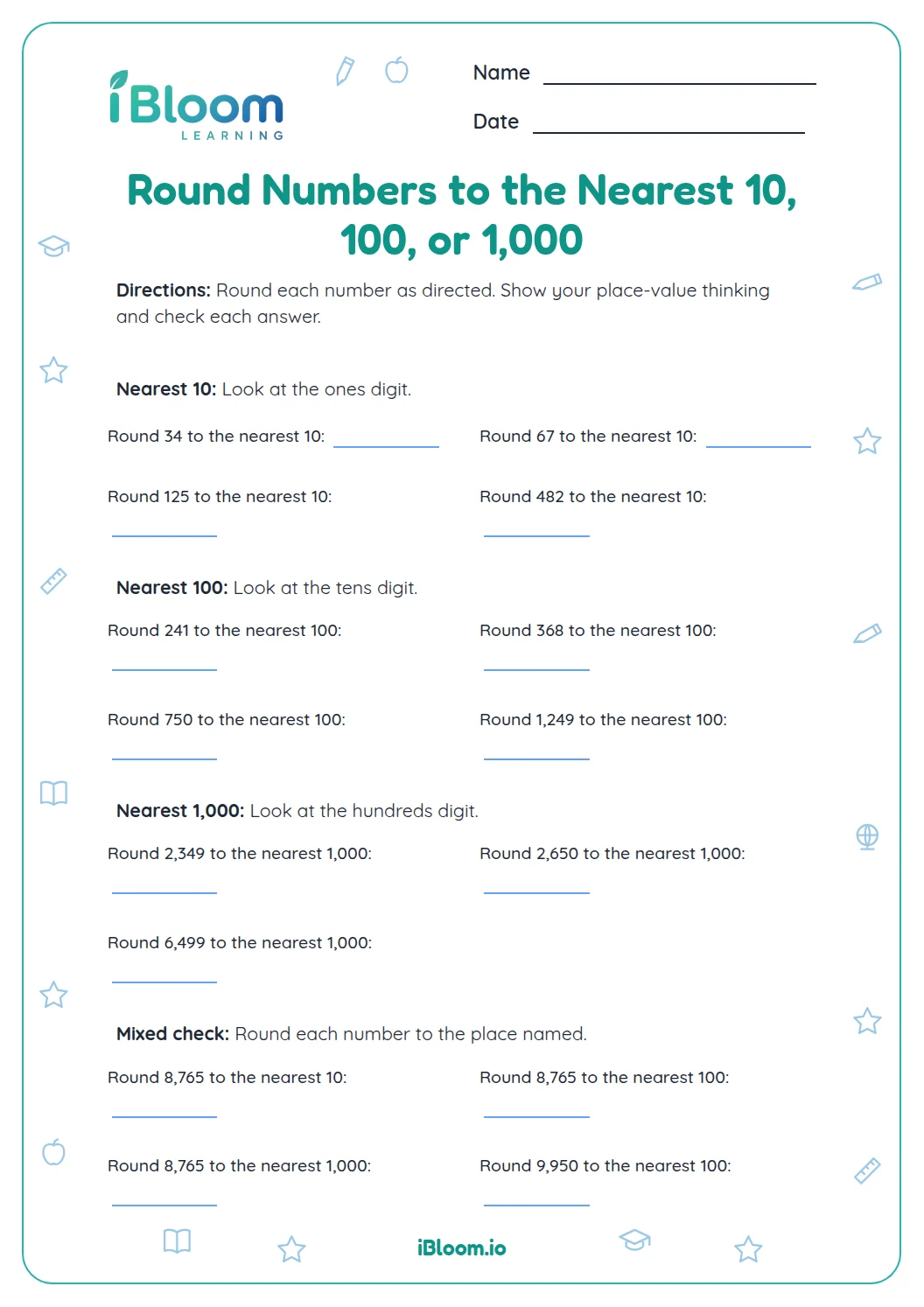
This worksheet practices rounding to the nearest 10, 100, and 1,000. The first ten questions use three-digit numbers; later questions include four-digit values, including nearest-thousand rounding named in the title. A separate key gives all 20 rounded values.
Aligned to 3.NBT.A.1 and 4.NBT.A.3
Which digit tells you how to round?
To round to tens, check the ones digit. To round to hundreds, check the tens digit. A digit of 5, 6, 7, 8, or 9 sends the named place up one; 0 through 4 keeps it where it is.
For question 1, 146 rounds to 150 because the ones digit is 6. For question 6, 342 rounds to 300 because the tens digit is 4.
- 1146
- 2Ones digit is 6, so increase the tens digit.
- 3146 rounds to 150.
What happens at a halfway point?
When the digit just right of the target place is 5, round up. So 650 rounds to 700, while 604 rounds to 600. The number does not need to end in 5; only the deciding digit matters.
How is the practice organized?
The first part rounds three-digit numbers to tens, and the second rounds to hundreds. The later parts keep the same skill but vary the size and place value of the numbers. Read the target place in every prompt before calculating.
How to use this worksheet
- 1Read the target place before looking at digits.
- 2Circle the digit immediately to its right.
- 3Decide whether that digit is 0–4 or 5–9.
- 4Change the target digit if needed and replace digits to its right with zeros.
- 5Use the answer key to review any missed boundary examples.
Common mistakes and quick fixes
The mistake
Rounding from the wrong digit: 342 to the nearest hundred uses the 2.
The fix
Look one place right of the hundreds digit: the tens digit 4 decides.
The mistake
Changing digits to the left of the target place.
The fix
Keep all digits left of the named place unchanged.
The mistake
Leaving nonzero digits after rounding to hundreds.
The fix
Replace all digits right of the hundreds place with zeros.
Common Core alignment
Questions 1–10 practice Grade 3 rounding to tens and hundreds; the title-named nearest-thousand work extends into Grade 4.
Round whole numbers to the nearest 10 or 100 using place value.
On this sheet: Questions 1–10 round three-digit numbers to the nearest 10 or 100.
Show the official wordingHide the official wording
Use place value understanding to round whole numbers to the nearest 10 or 100.
Use place value to round multi-digit whole numbers to a named place.
On this sheet: Questions 11–20 include four-digit values and rounding to the nearest 1,000, as named in the title.
Show the official wordingHide the official wording
Use place value understanding to round multi-digit whole numbers to any place.
What to practice next
Make more practice
Further reading
Questions parents and teachers ask
What digit decides how to round?
Look one place right of the place named in the prompt. A digit from 0 through 4 keeps that place; 5 through 9 rounds it up. Then replace the digits to the right with zeros. For example, rounding 342 to the nearest hundred gives 300, and rounding 146 to the nearest ten gives 150.
What happens at a halfway point?
If the deciding digit is 5, use the standard rule and round up. For instance, 650 rounds to 700 to the nearest hundred, and 1,500 rounds to 2,000 to the nearest thousand. This is a convention for values exactly halfway between multiples, and it gives one consistent rounded result.
How many questions are included?
There are 20 questions in four sections: nearest 10, nearest 100, four-digit numbers rounded to the nearest 100, and nearest 1,000. Each prompt names the target place, and the separate key lists the expected rounded value. The final section focuses only on thousands.
Is there a separate answer key?
Yes. The key lists the rounded value for every question. It follows the worksheet sections in order, so students or adults can match each answer to the same numbered prompt and review the rounding decision or place-value digit that determined the result. Each of the 20 items has a response.