



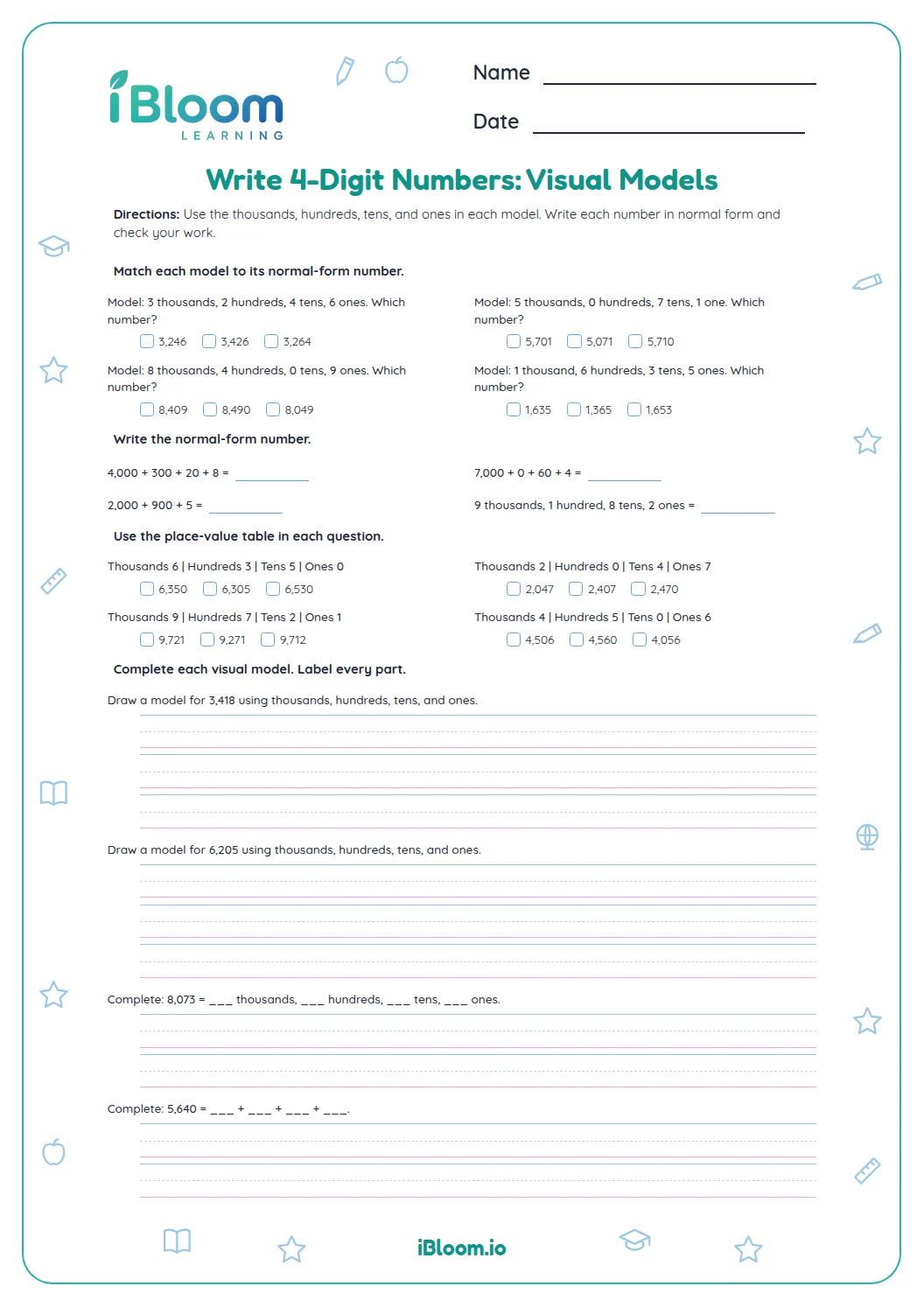
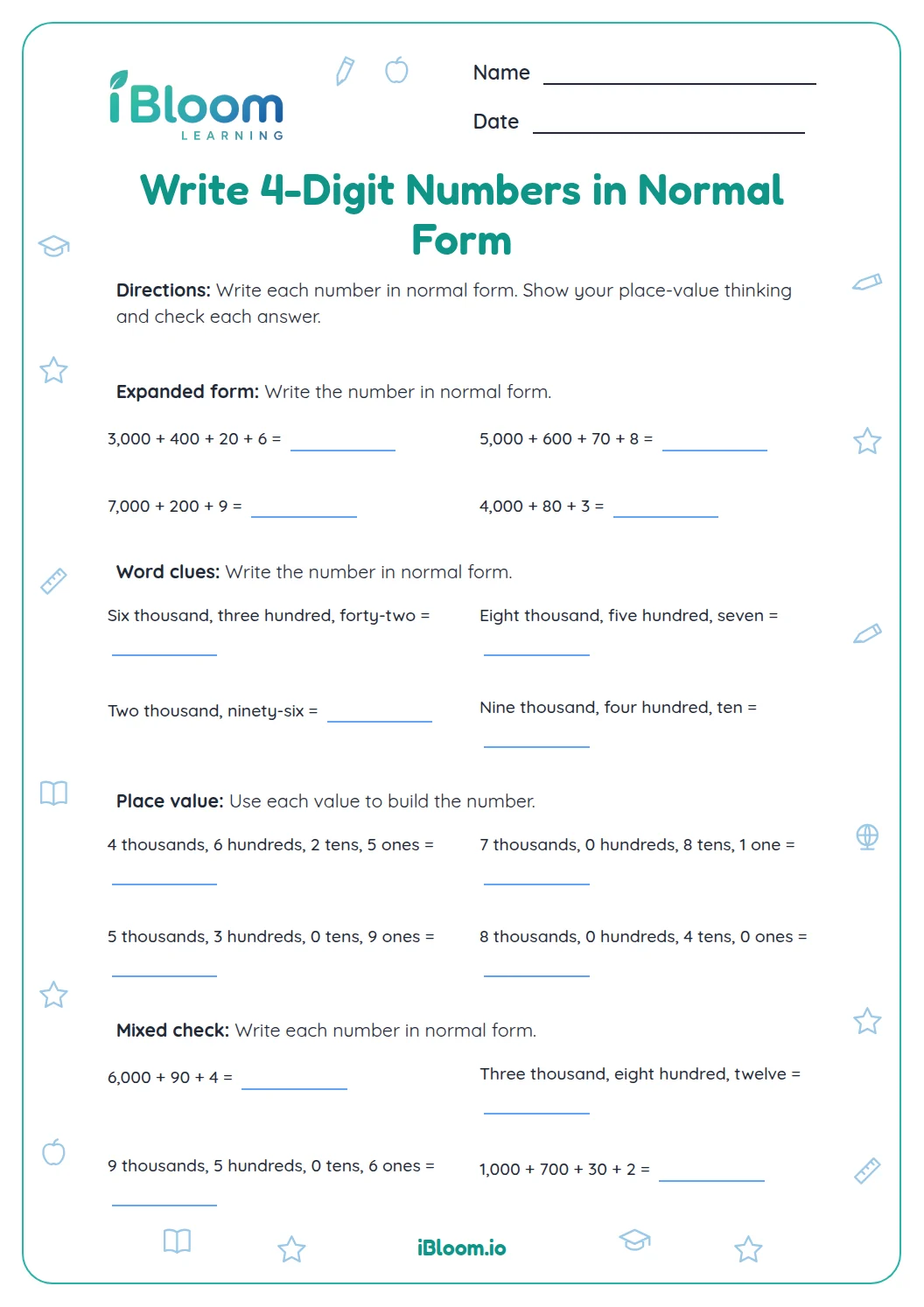
About this worksheet
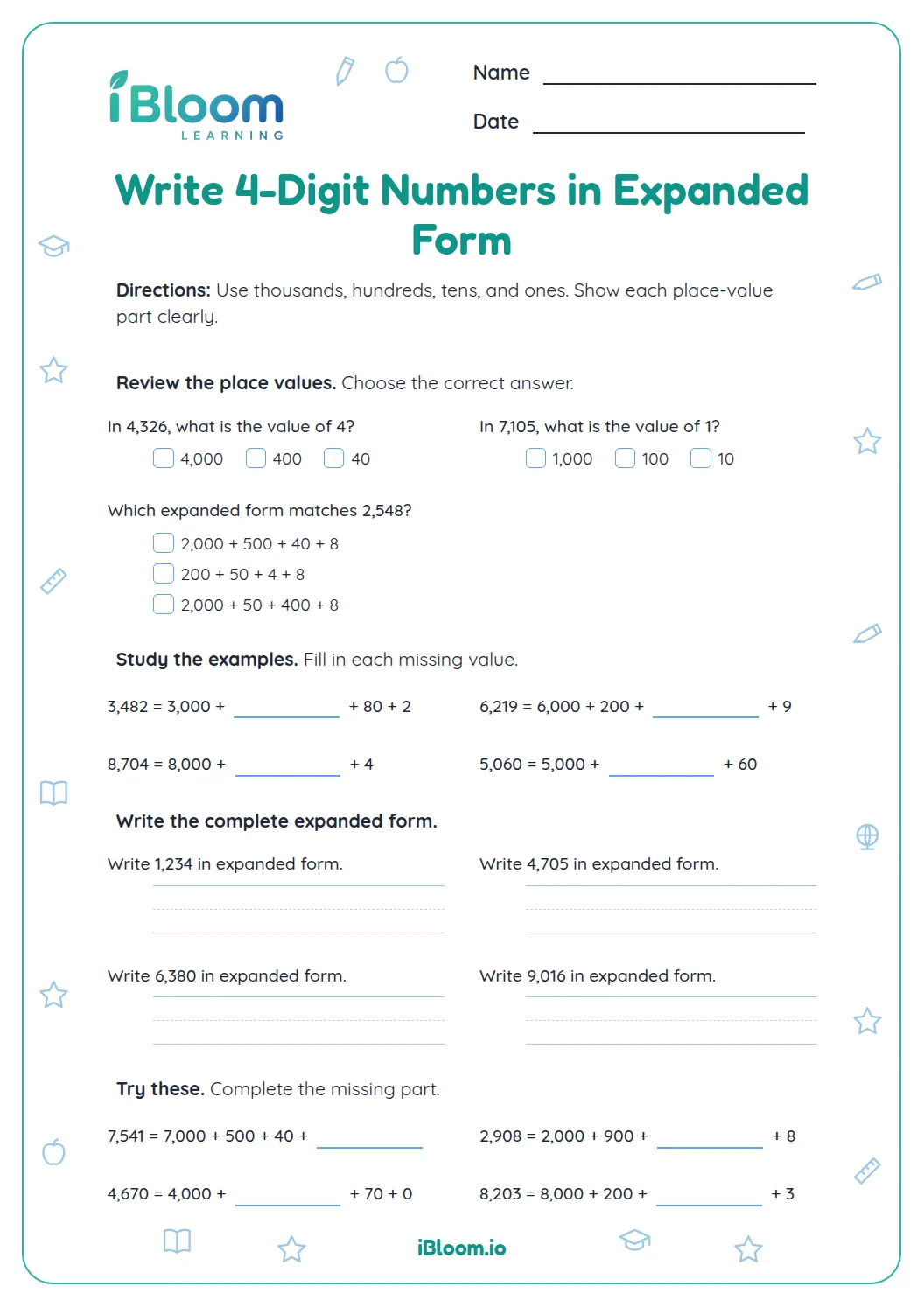
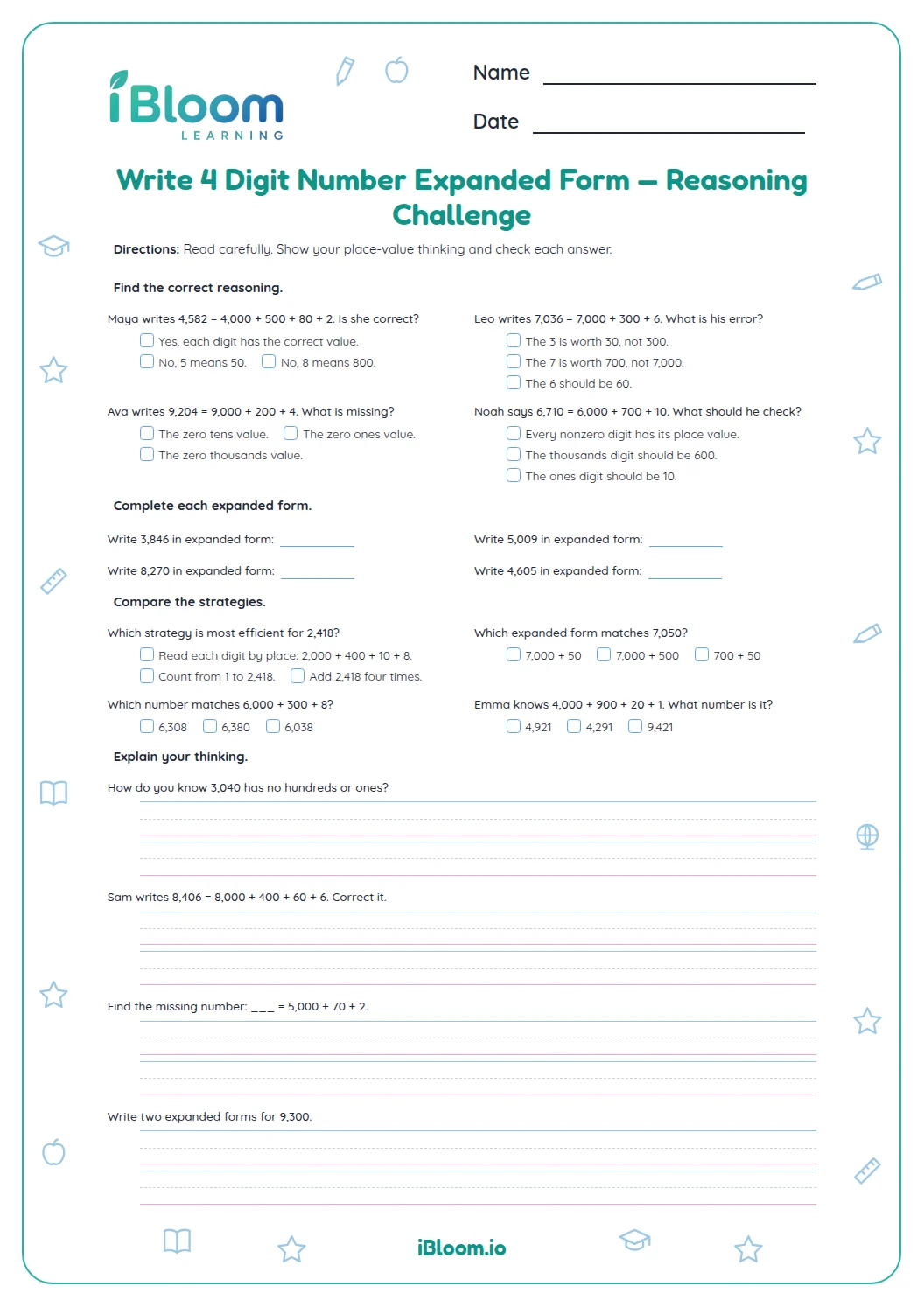
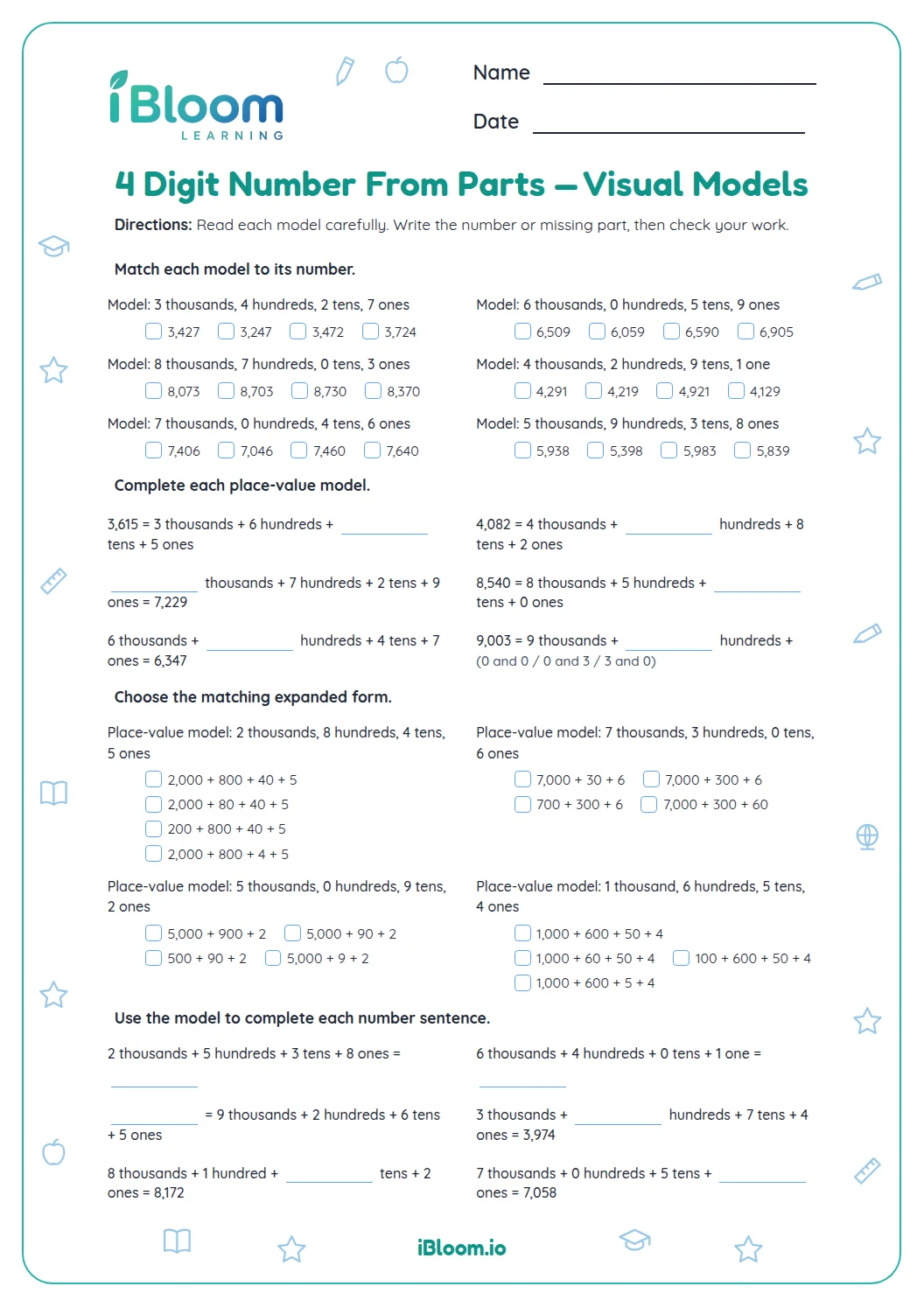
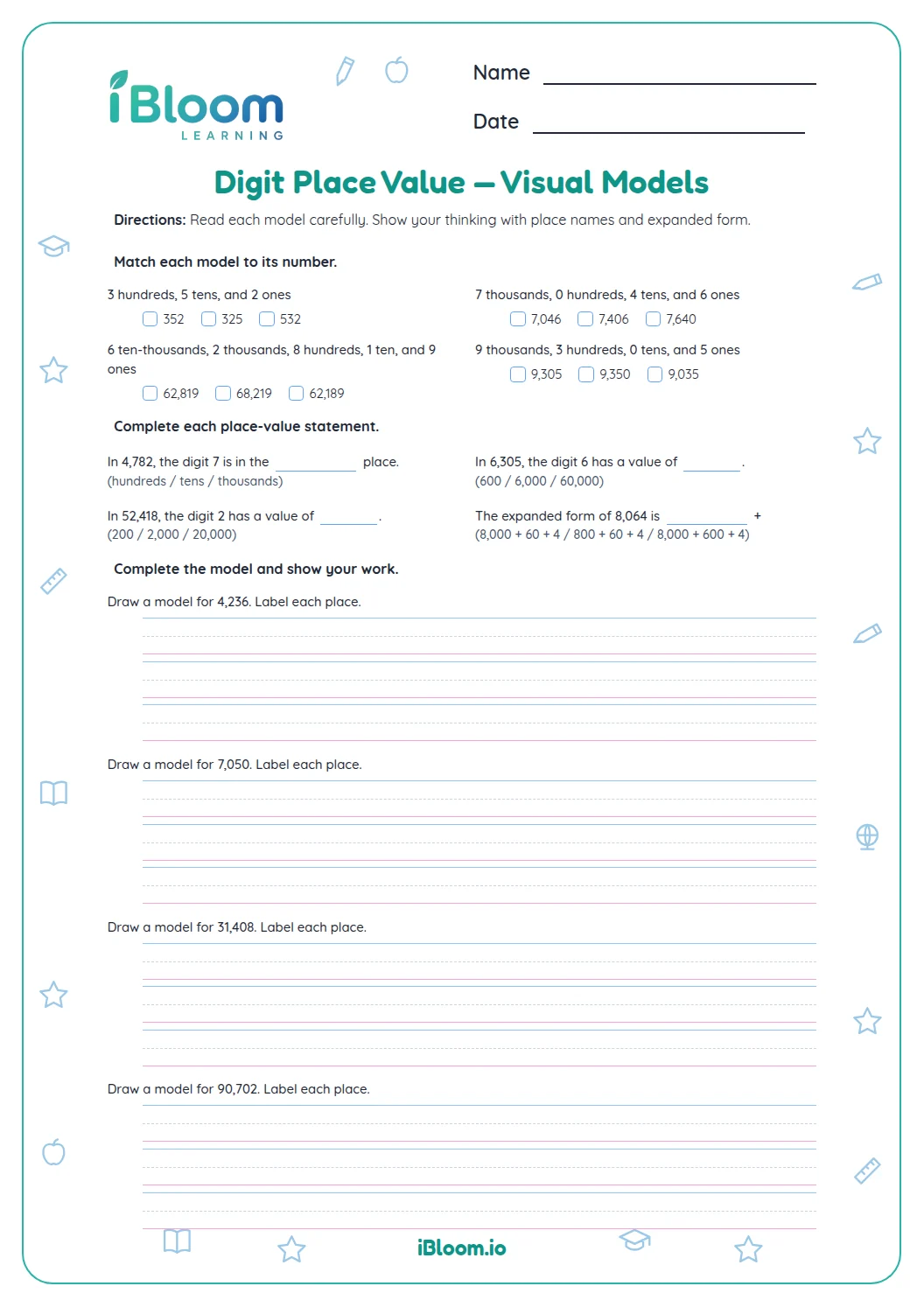
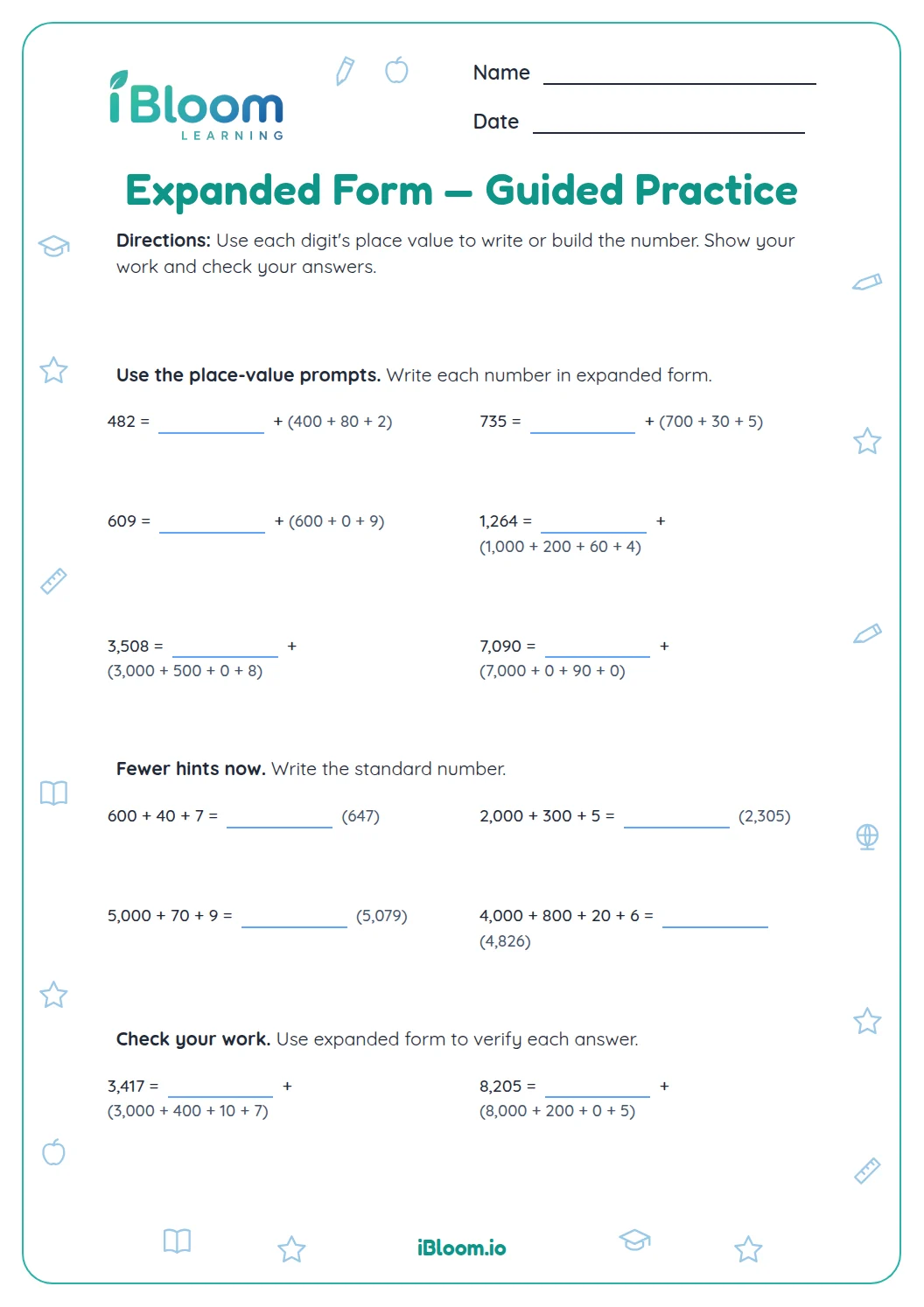
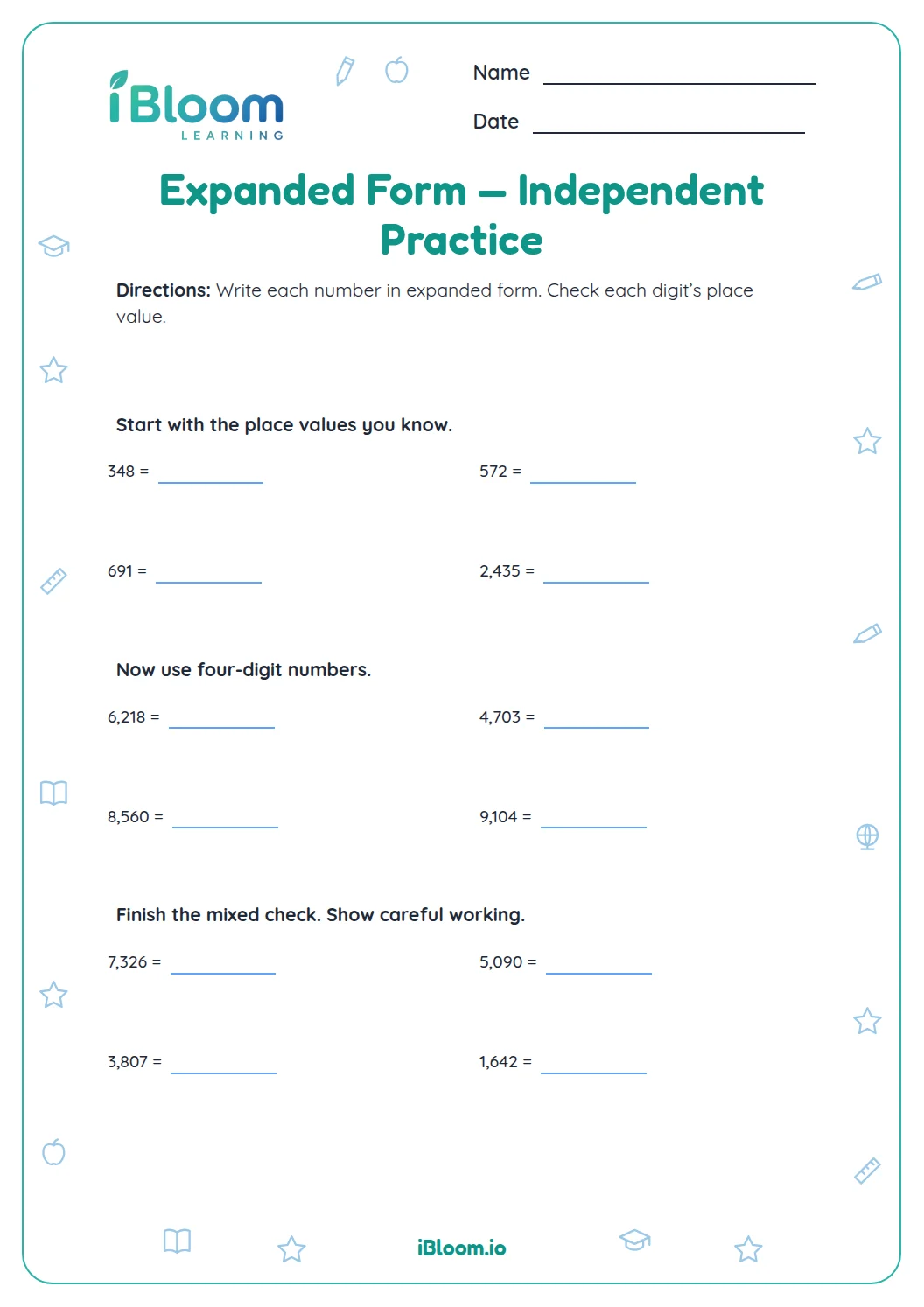
This Grade 3 printable gives 16 questions on writing four-digit numbers in expanded form. Learners break numbers into thousands, hundreds, tens, and ones; rebuild numbers from place-value clues; and choose or explain equivalent forms. A separate answer key supports checking each response.
What does each part practice?
Questions 1–4 decompose four-digit numerals into addends. Questions 5–6 build four-digit numbers from place-value clues, and questions 7–8 rebuild numbers from expanded sums. Questions 9–16 check equivalent forms, digit values, zero places, comparisons, and a learner-created example.
- 16 questions on four-digit numbers
- The separate answer key includes a model explanation for the zero in 5,046
How do you decompose a number with a zero digit?
Give each digit its value according to its place. A zero contributes no addend, so it is left out of the sum while the other place values remain.
- 1Write 6,105 in expanded form.
- 26 thousands, 1 hundred, 0 tens, and 5 ones
- 3Answer: 6,000 + 100 + 5
How can you check an expanded form?
Add the place-value addends. Their sum should equal the original number. When rebuilding a number, line up each stated value with its thousands, hundreds, tens, or ones place.
How to use this worksheet
- 1Read the number from left to right and name each place.
- 2Change each nonzero digit into its full place value.
- 3Leave out zero-value places in the sum.
- 4For a number built from clues, place each digit in the named position.
- 5Add the terms to check that they recover the original number.
Common mistakes and quick fixes
The mistake
Writing a digit instead of its place value.
The fix
Write 4 in the thousands place as 4,000.
The mistake
Dropping a place after a zero.
The fix
Keep each remaining digit in its original place; 5,046 is not 5,46.
The mistake
Treating the zero as a needed addend.
The fix
A zero place contributes no value, so it does not appear as a term.
What to practice next
Make more practice
Further reading
Questions parents and teachers ask
What is expanded form?
Expanded form writes a number as the sum of its place values. For example, 3,482 is 3,000 + 400 + 80 + 2. The page uses four-digit examples throughout, including numbers with a zero in the tens or hundreds place.
How many questions are included?
There are 16 questions. Learners decompose numerals, build numbers from place-value clues and expanded sums, identify equivalent forms, explain a zero place, compare numbers, and create an expanded form. Examples include zero in different places, so learners must preserve the values of the remaining digits.
How should a zero digit appear in expanded form?
A zero digit has a value of zero in its place, so that place is omitted from the sum. For example, 5,046 is 5,000 + 40 + 6. A useful check is to add the expanded terms and confirm that the total matches the original numeral.
Does the answer key show acceptable forms?
Yes. It gives the expected expanded forms and number values. For the explanation about zero, it provides a sample response; learners may use different words while expressing the same place-value idea. In open responses, accept equivalent explanations that correctly describe why a zero-value place adds no term.
How can learners check their expanded forms?
Add the terms and compare the total with the original number. If the total differs, check that each digit was assigned to the correct place, especially when one or more places contain zero. The prompts focus on place value and expanded form, so the page copy avoids a grade-level standards claim.