



About this worksheet
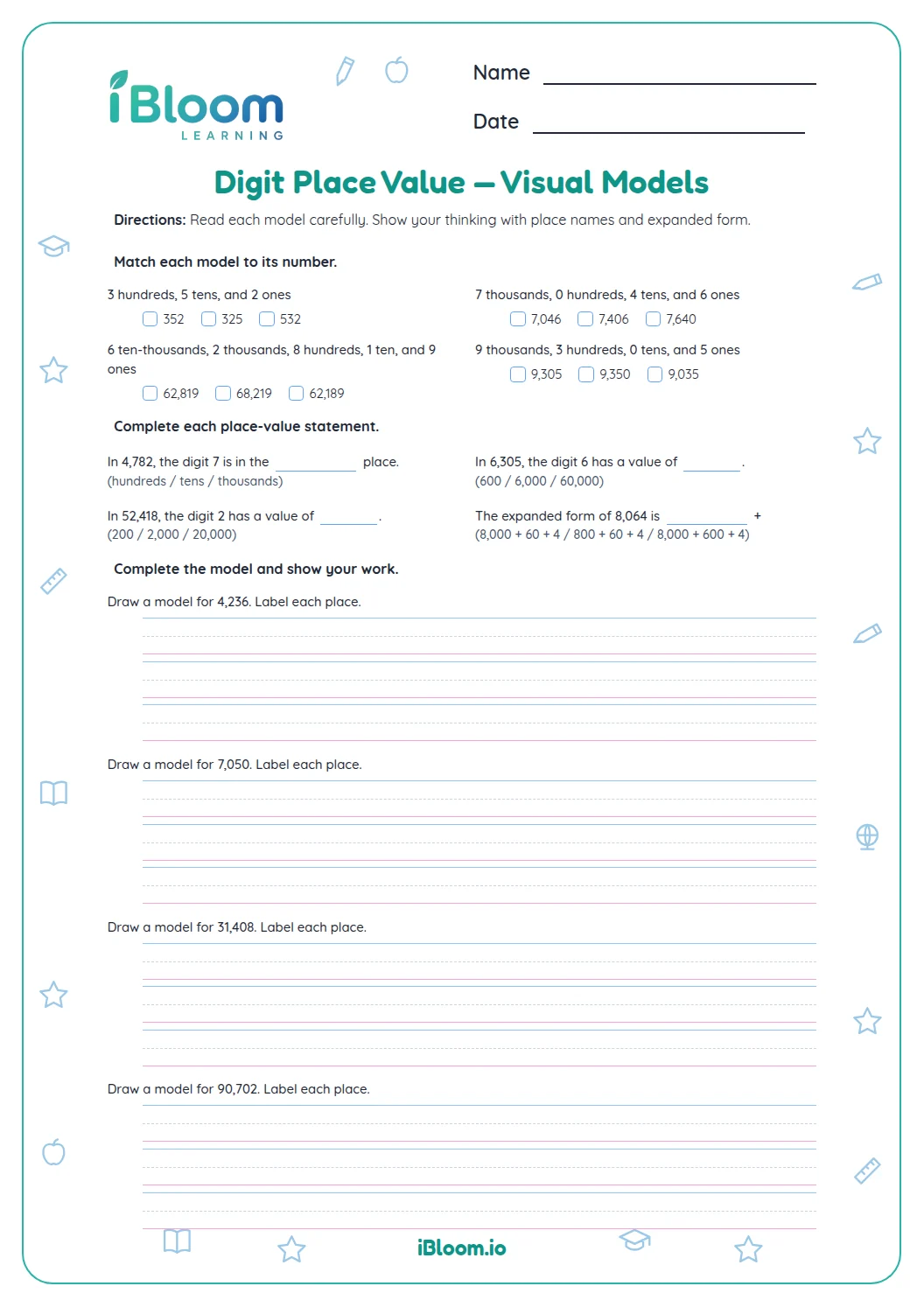
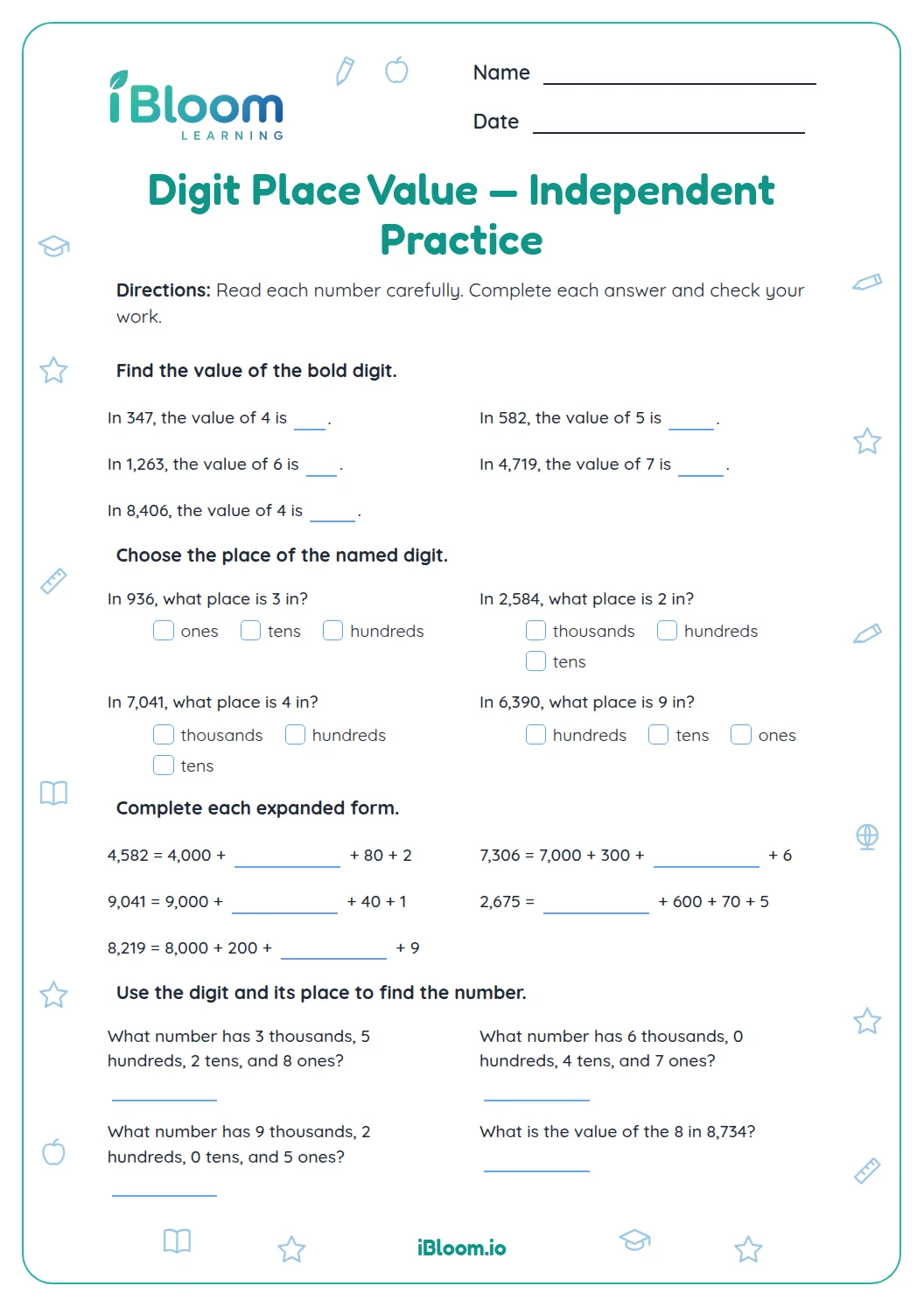
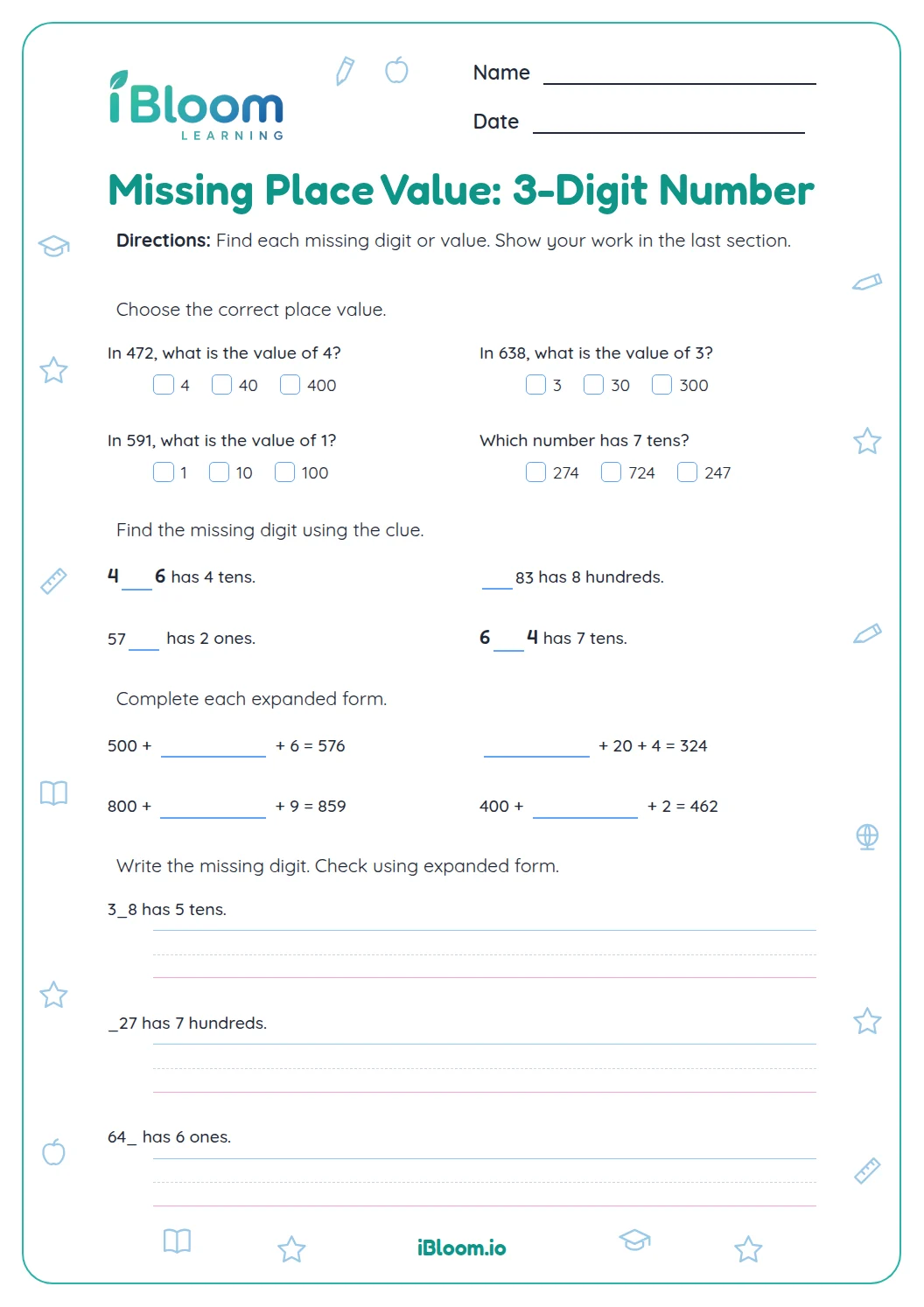
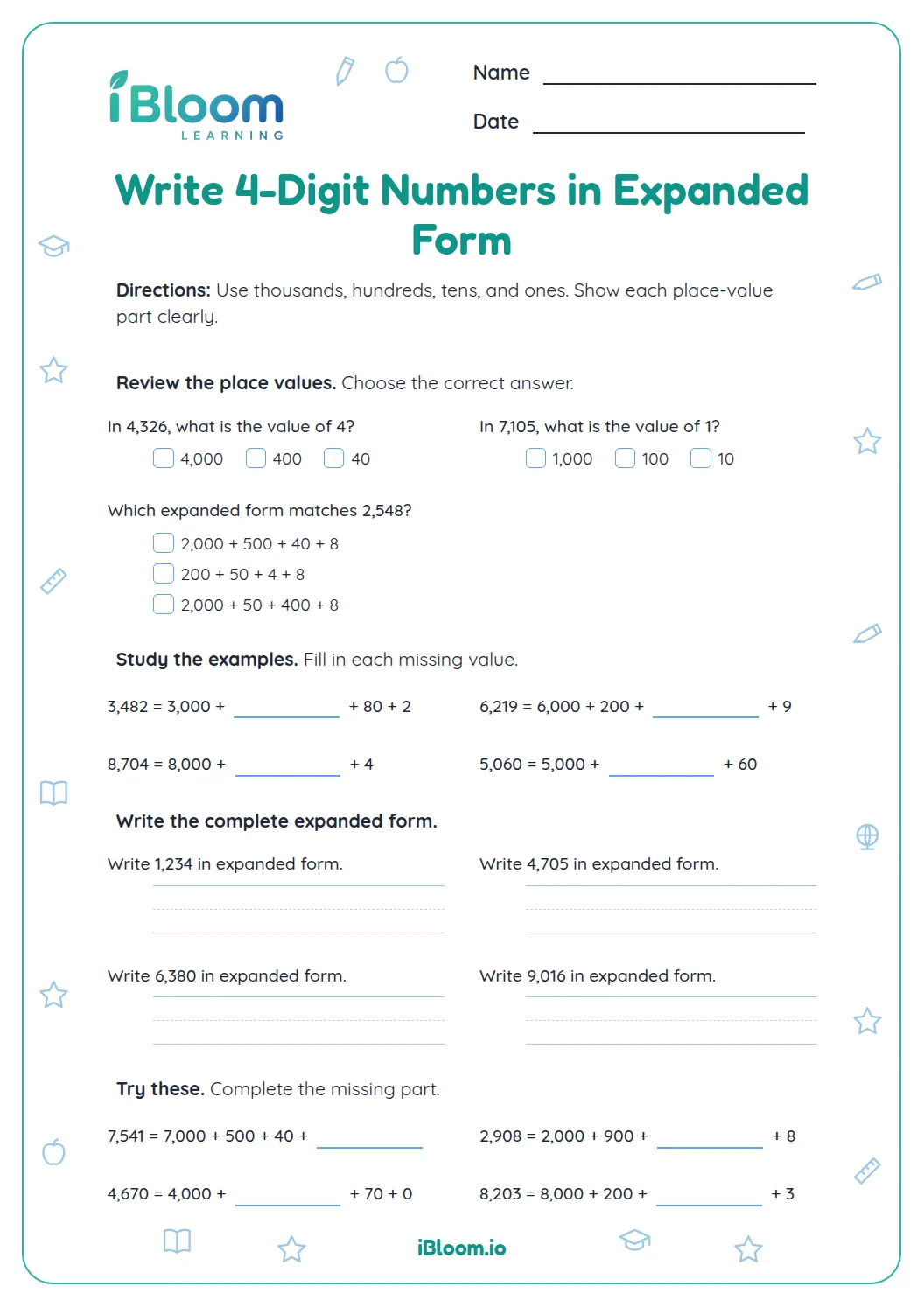
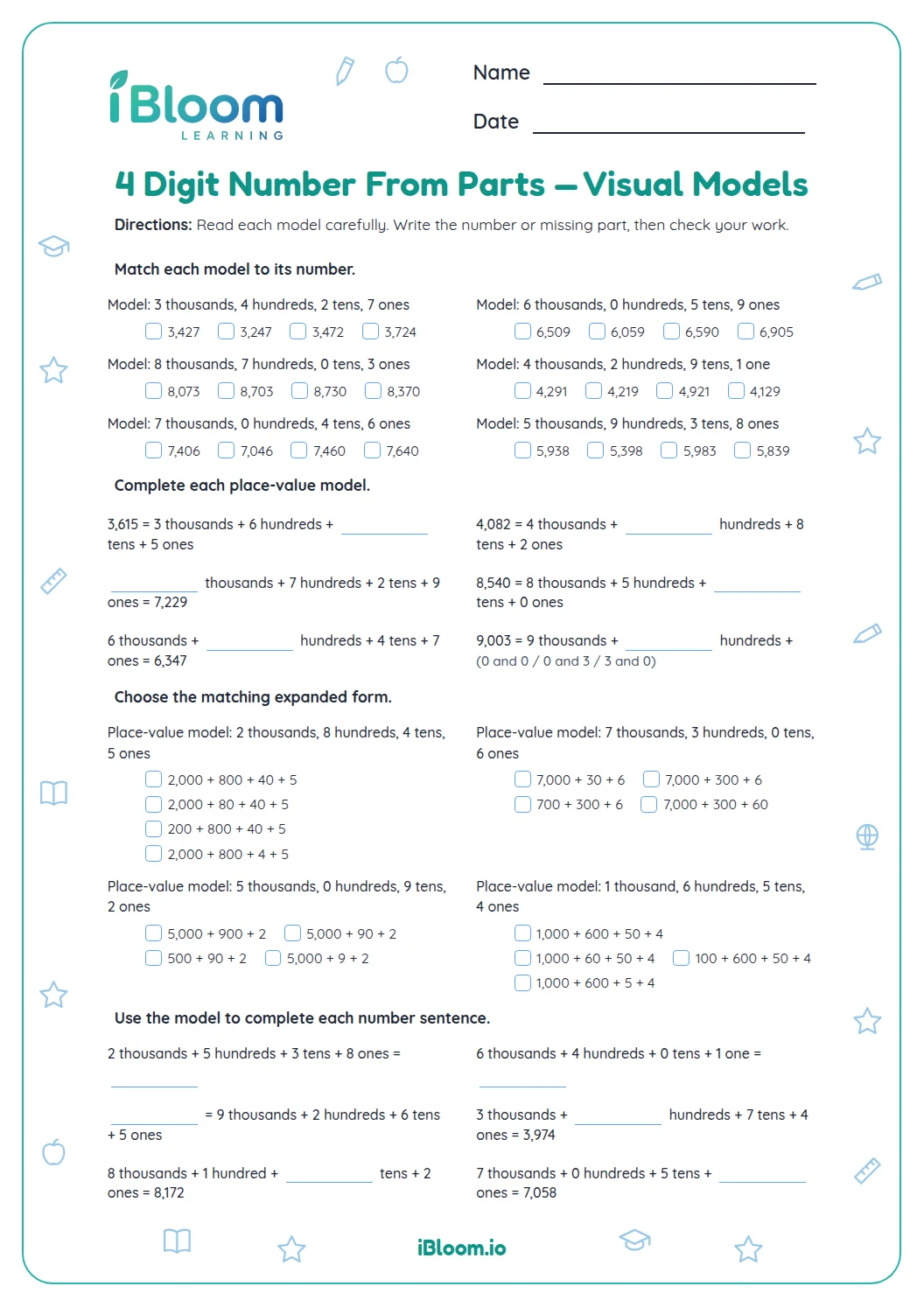
This free printable Grade 3 worksheet guides children through missing digits and place values in four-digit numbers. Part A names the four places and asks for a digit. Part B gives a value clue for a missing digit inside a number. Part C has four expanded-form equations with missing values, including zero. Part D has four multiple-choice checks. Printed models help children distinguish a digit from its value. The 16 questions practice reading and writing multi-digit numbers and expanded form in Common Core 4.NBT.A.2. A separate answer key covers all four parts.
Aligned to 4.NBT.A.2
How do the named places guide the first four questions?
Each Part A question gives a four-digit number followed by the same number described in thousands, hundreds, tens, and ones. Children use the named place after the blank to decide which single digit belongs there.
In question 1, 4,682 is 4 thousands, 6 hundreds, 8 tens, and 2 ones. The blank comes before hundreds, so the missing digit is 6. Reading the place word after a blank prevents an answer of 600 in that spot.
How do value clues reveal a missing digit?
In Part B, the blank sits inside a four-digit number. A clue states what the missing digit is worth. Use the named place to turn that value into a digit: 700 means 7 hundreds, so question 6 needs 7.
Part C reverses the task: the whole number is visible, and the blank needs a full addend. In question 11, 2,905 = 2,000 + ___ + 5, so the missing value is 900. Add the parts to check.
- 1The missing hundreds digit is worth 700. Complete 6,___31.
- 2700 = 7 hundreds, so the missing digit is 7.
- 3The completed number is 6,731.
- 4Check: 6,000 + 700 + 30 + 1 = 6,731.
Why are zeros part of this guided practice?
Zero keeps a place even when that place contributes no amount. In 9,052 there are 9 thousands, 0 hundreds, 5 tens, and 2 ones. Children keep all four named places in order in Part A, then complete an equation with a missing zero in Part C.
Part D checks whether the child can choose a value, a digit, or a number matching a decomposition without the same sentence frame each time. Have the child point to the relevant place before choosing an answer.
Guide the first answers, then release support
- 1Name the four places from left to right: thousands, hundreds, tens, ones.
- 2Read the printed model and do question 1 together.
- 3In Part B, turn each value clue into a digit: 700 means 7 hundreds.
- 4In Part C, write the full missing value and add the parts to check.
- 5In Part D, decide whether the question asks for a digit, value, whole number, or place.
Mistakes to catch and correct
The mistake
Writing 600 instead of 6 before the word hundreds.
The fix
The word hundreds already supplies the unit; write the number of hundreds.
The mistake
Writing 700 inside the number in question 6.
The fix
The blank holds one digit. Since 700 is 7 hundreds, put 7 in the hundreds place.
The mistake
Treating the 5 in 9,052 as 5 hundreds.
The fix
Count positions from the right: 2 ones, 5 tens, 0 hundreds, 9 thousands.
Common Core alignment
Connect four-digit numbers to the value of each digit and to expanded form.
On this sheet: Students complete four-digit decompositions and distinguish a missing digit from its place value.
Show the official wordingHide the official wording
Read and write multi-digit whole numbers using base-ten numerals, number names, and expanded form. Compare two multi-digit numbers based on meanings of the digits in each place, using >, =, and < symbols to record the results of comparisons.
What to practice next
Make more practice
Further reading
Questions parents and teachers ask
What kind of number belongs in each blank?
Parts A and B need single digits. In Part A, the place name follows the blank; in Part B, the blank sits inside a number. Part C needs a full value in expanded form. Read the prompt carefully: a hundreds digit of 7 represents a value of 700.
Why does the worksheet include a zero addend?
A zero addend makes an empty place visible while children are learning the four positions. Question 12 writes 9,052 as 9,000 plus a missing value plus 50 plus 2. The missing value is 0 because the hundreds place contributes nothing, even though its position remains in the number.
Should children subtract to find every missing value?
Matching places is the main method practiced here. In question 6, the clue says the missing hundreds digit is worth 700, so write 7. In Part C, find the missing addend by reading its place value, then add all the parts to check the completed equation.
How much help should I give in guided practice?
Read the printed models and work through question 1 together. Let the child finish Part A, then use the value clue in question 5 to find the missing digit. Offer the same support for the first expanded-form equation, and let the final four choices check independent understanding.
What does the answer key show?
The answer key supplies the missing digit or amount for each of the twelve blanks and marks the correct choices for the final four questions. Use it to check the type of answer as well as its size, especially when a child confuses the digit with its full value.