



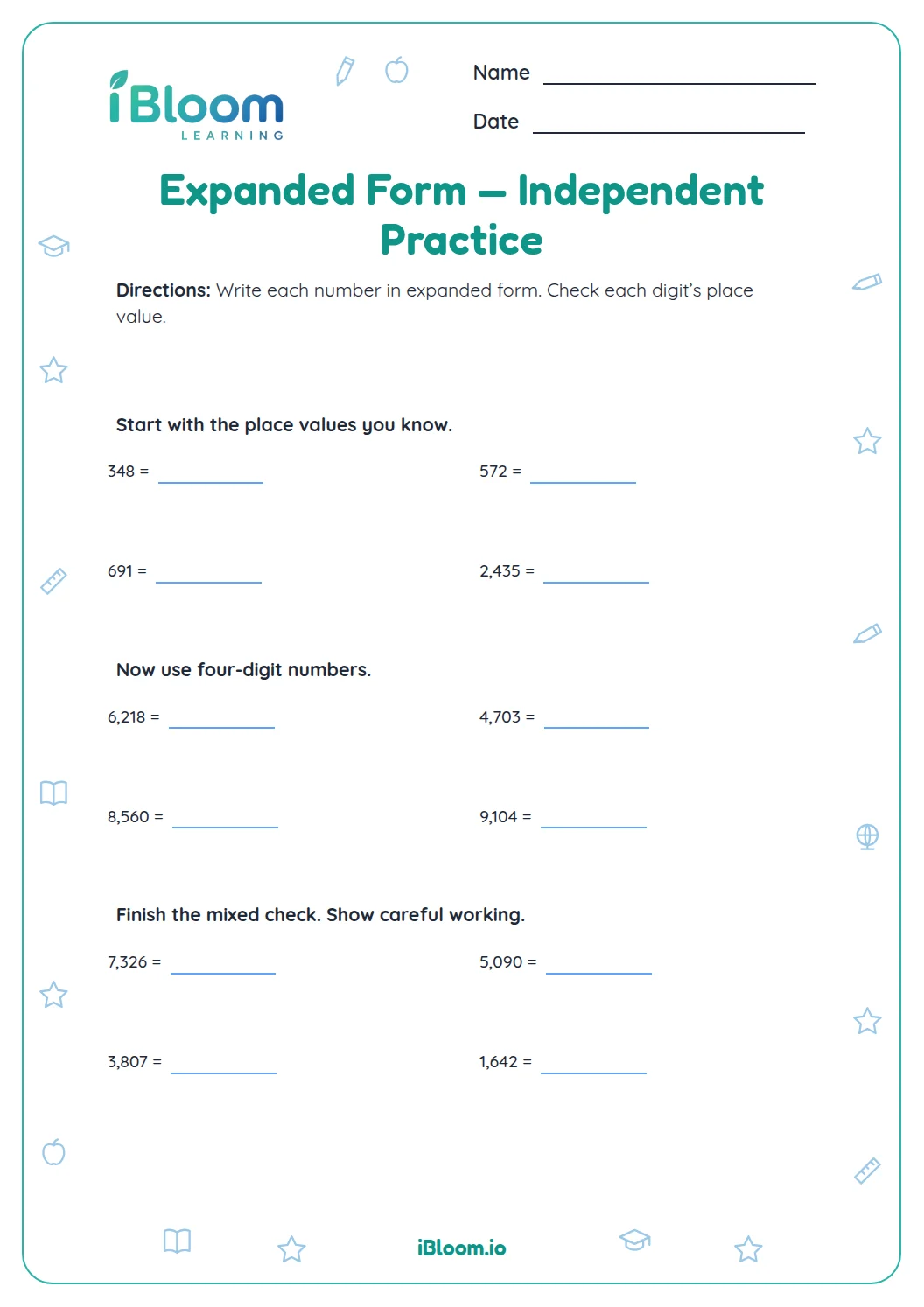
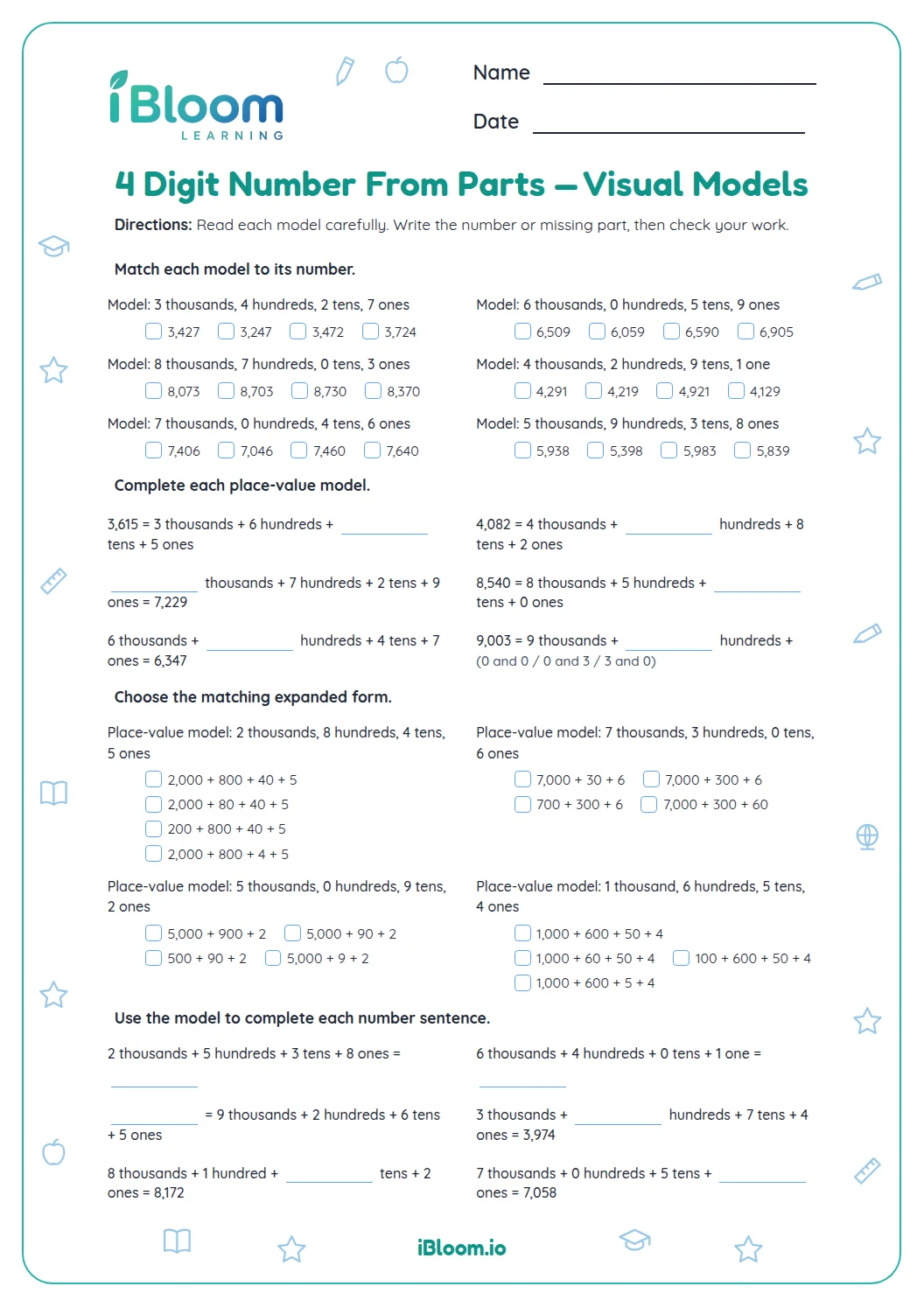
About this worksheet
This Grade 3 printable gives learners 15 short problems with four-digit numbers. Fourteen contexts ask students to use place value to find a missing digit; four more ask them to round to the nearest ten, hundred, or thousand. Students compare digits by place and use the rounding digit to decide whether to keep or increase the target digit. A separate answer key lists each answer. The page practices multi-digit place value and rounding.
Aligned to 4.NBT.A.2 and 4.NBT.A.3
How do place names help find a digit?
A four-digit number has thousands, hundreds, tens, and ones. Name the blank’s place, then compare the incomplete numeral with the given total.
- 1Books: 4,_28; total 4,628.
- 2Compare each place in the two numbers.
- 3The missing hundreds digit is 6.
How do you round a four-digit number?
Find the place named in the question and look one place to its right. If that digit is 5 or more, increase the rounding digit by one; otherwise, leave it as it is. Change digits to its right to zero.
How can a learner check each answer?
For a missing digit, replace the blank and compare all digits with the total. For rounding, check that digits to the right of the target place are zero and that the result is the closest rounded number.
How to use this worksheet
- 1For a missing digit, name the blank’s place.
- 2Compare the incomplete number with its total, one place at a time.
- 3For rounding, find the place named in the prompt.
- 4Look at the digit immediately to its right.
- 5Write the completed or rounded number and check it.
Common mistakes and quick fixes
The mistake
Confusing a digit with its value
The fix
Name the place first; a 6 in the hundreds place means 600.
The mistake
Reading from the ones place in the wrong direction
The fix
Line up digits from right to left: ones, tens, hundreds, thousands.
The mistake
Filling the blank from a nearby digit
The fix
Compare the full number with the total one place at a time.
Common Core alignment
The questions use multi-digit place value to find digits and round whole numbers.
Read and compare multi-digit whole numbers by the value of their digits.
On this sheet: Learners compare four-digit numerals place by place to identify missing digits.
Show the official wordingHide the official wording
Read and write multi-digit whole numbers using base-ten numerals, number names, and expanded form. Compare two multi-digit numbers based on meanings of the digits in each place, using >, =, and < symbols to record the results of comparisons.
Use place value to round multi-digit whole numbers to a named place.
On this sheet: Learners round four-digit whole numbers to the nearest ten, hundred, or thousand.
Show the official wordingHide the official wording
Use place value understanding to round multi-digit whole numbers to any place.
What to practice next
Make more practice
Further reading
Questions parents and teachers ask
What is a missing place-value digit?
A missing place-value digit is a blank in a number. Use the other digits and the total in the short context to determine which digit belongs there. This worksheet also includes rounding practice. Ask the learner to name the place and explain how the total confirms the digit.
Which places do these problems use?
The 14 missing-digit problems use thousands, hundreds, tens, or ones. One additional question asks learners to round four-digit numbers to the nearest ten, hundred, or thousand. Both skills rely on noticing the value and position of each digit.
Is there an answer key?
Yes. The separate two-page key lists answers for all 15 questions: 14 missing digits and one rounded number. Ask the learner to name a digit’s place or explain which digit decided a rounding answer. Then use the key to check each result.
Why use real-world contexts?
Short contexts give a reason to read each number carefully. The totals describe tickets, books, visitors, programs, seedlings, and other counts students may encounter in daily life. These examples use everyday counts so students can practice reading four-digit numbers in context.
How can I check a completed number?
For a missing digit, replace the blank and compare every place with the total in the prompt. For rounding, check that the digits to the right of the named place are zero and that the original number is closer to the rounded result than to the next one.