




About this worksheet
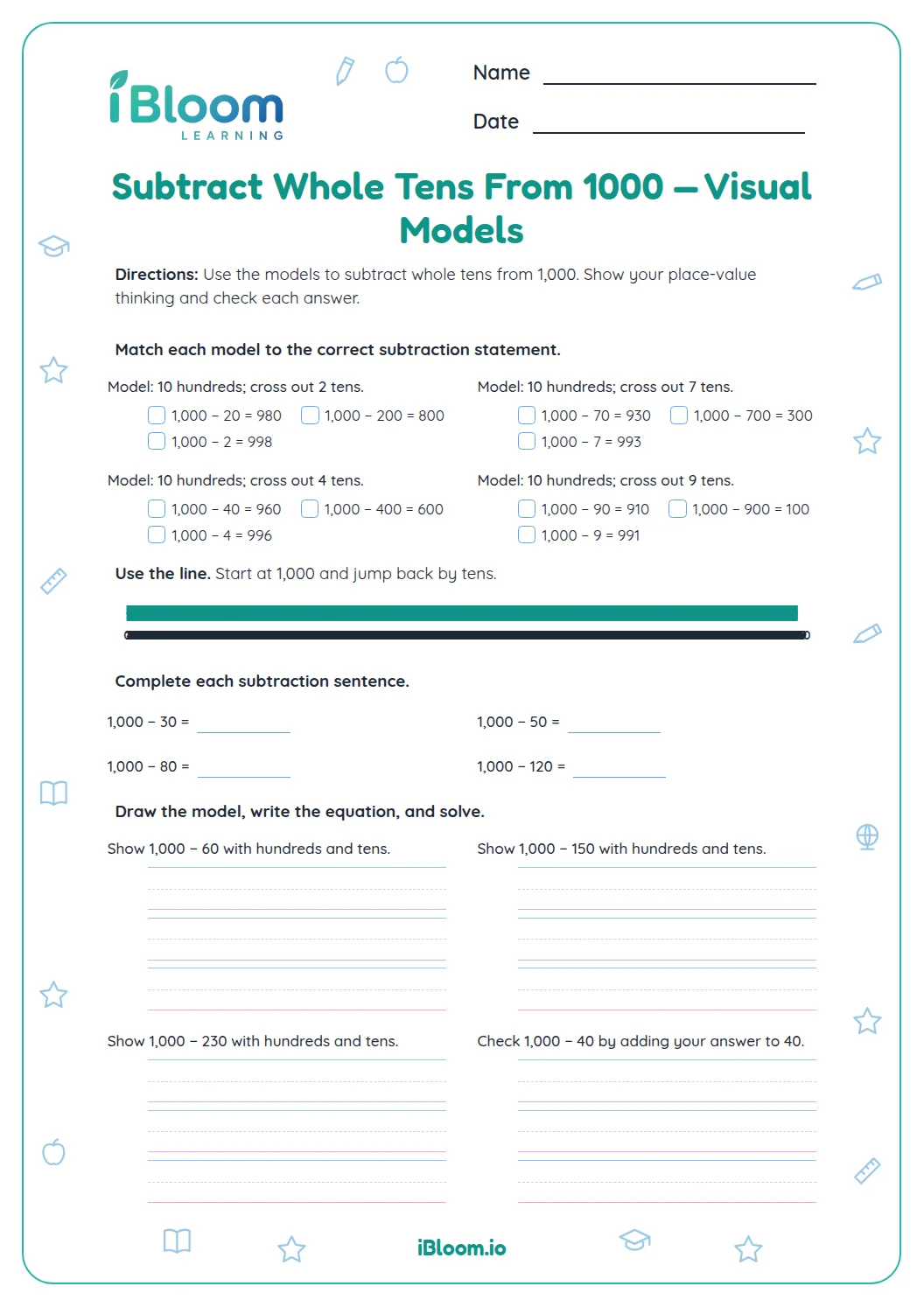
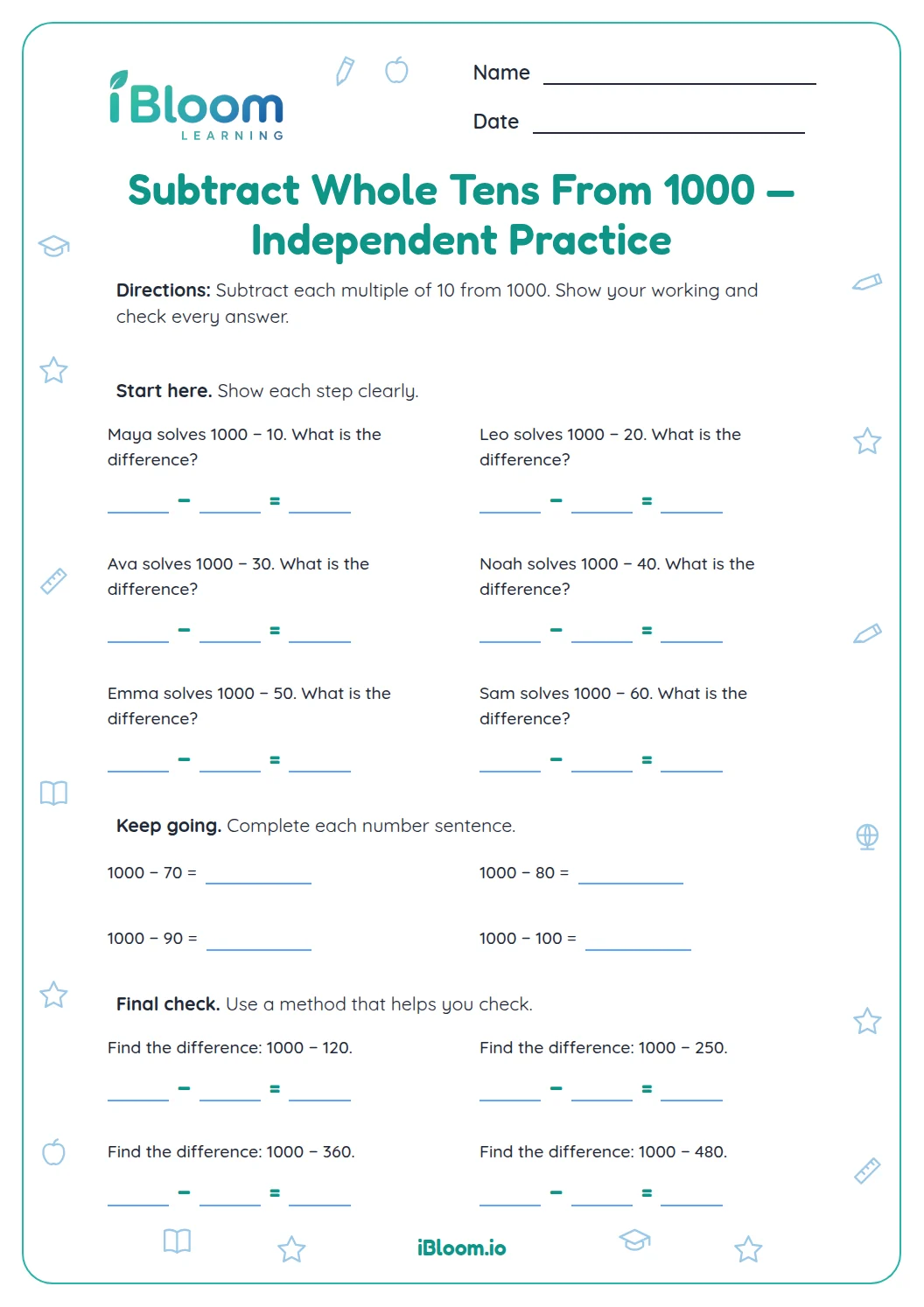
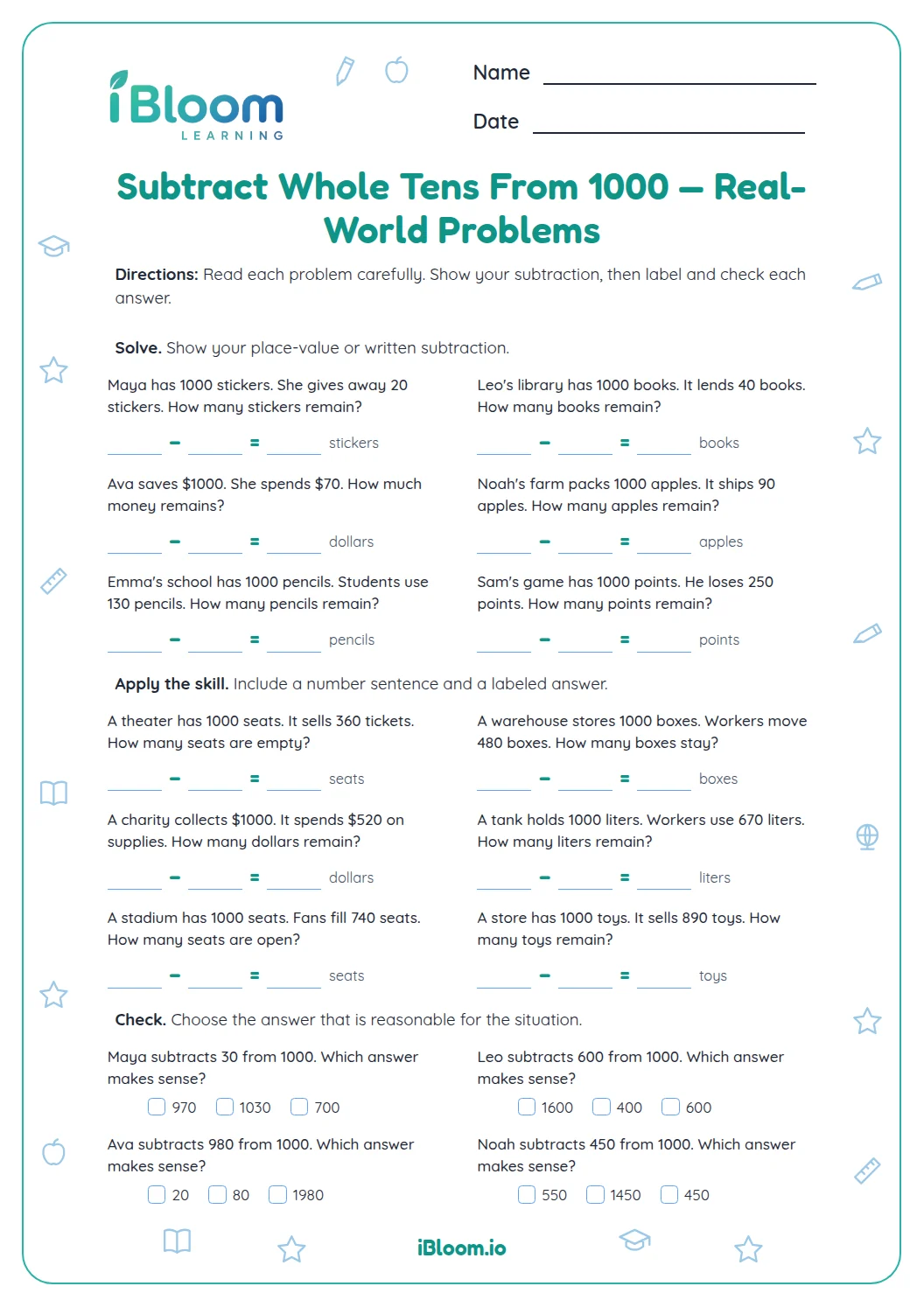
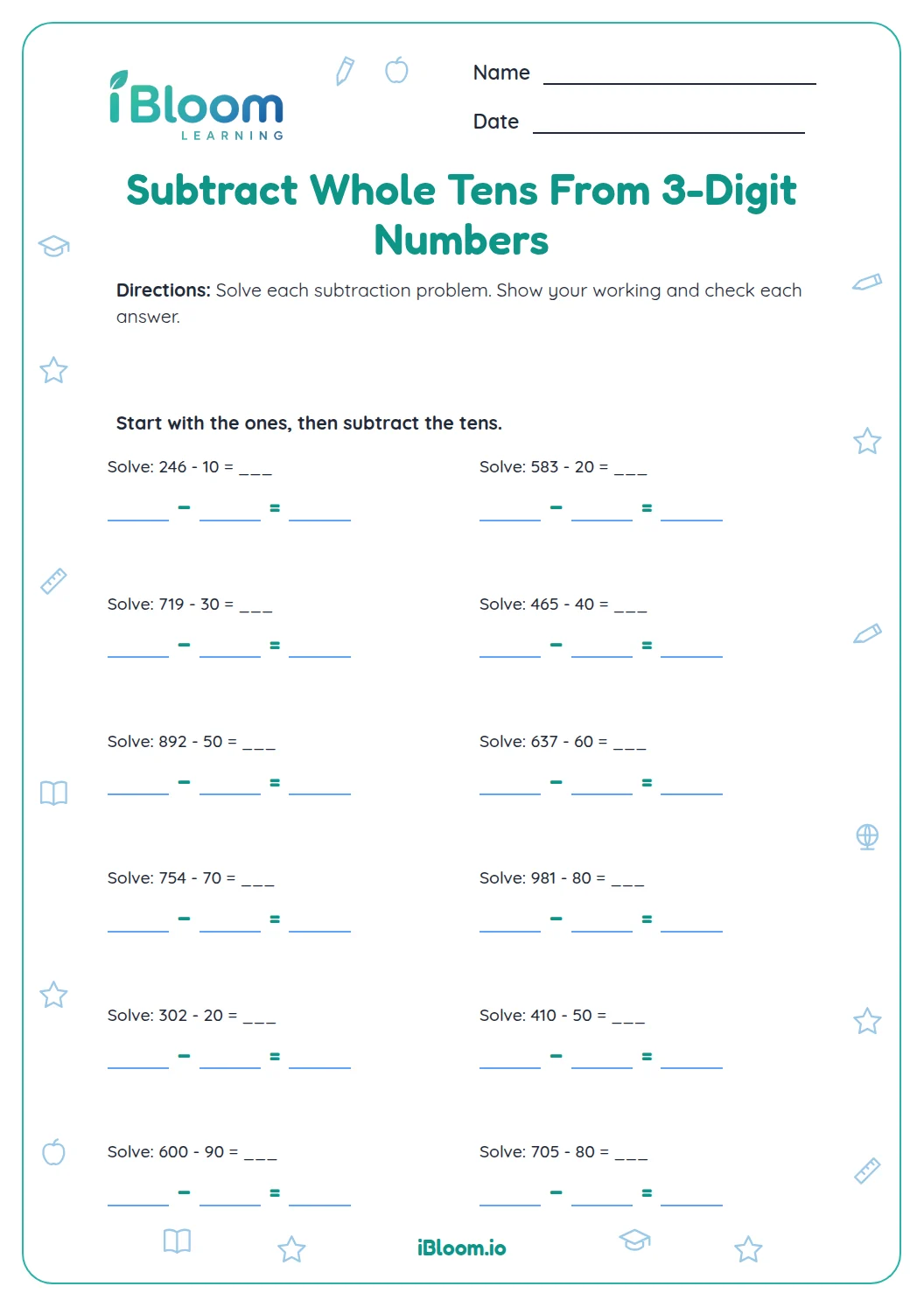
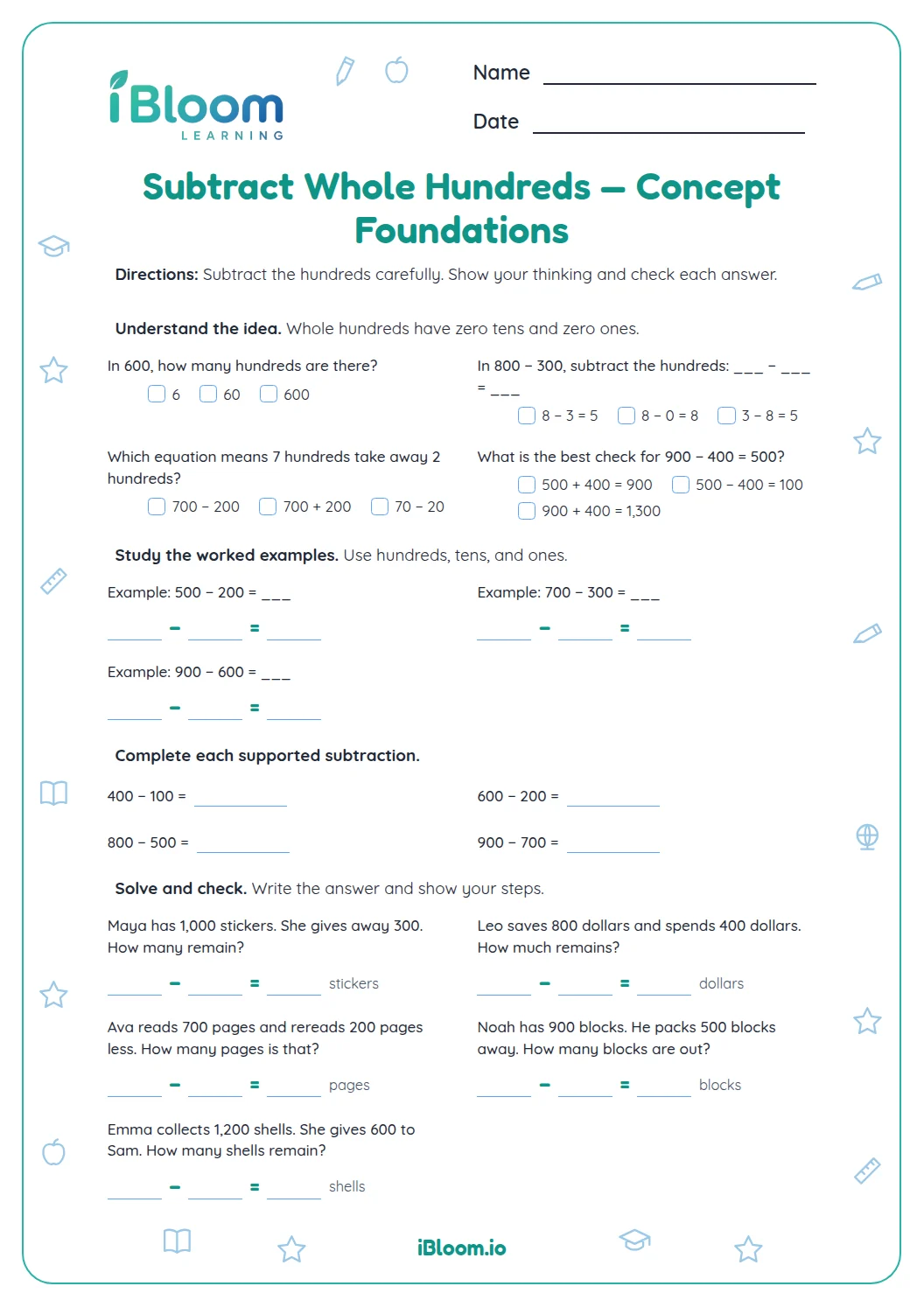
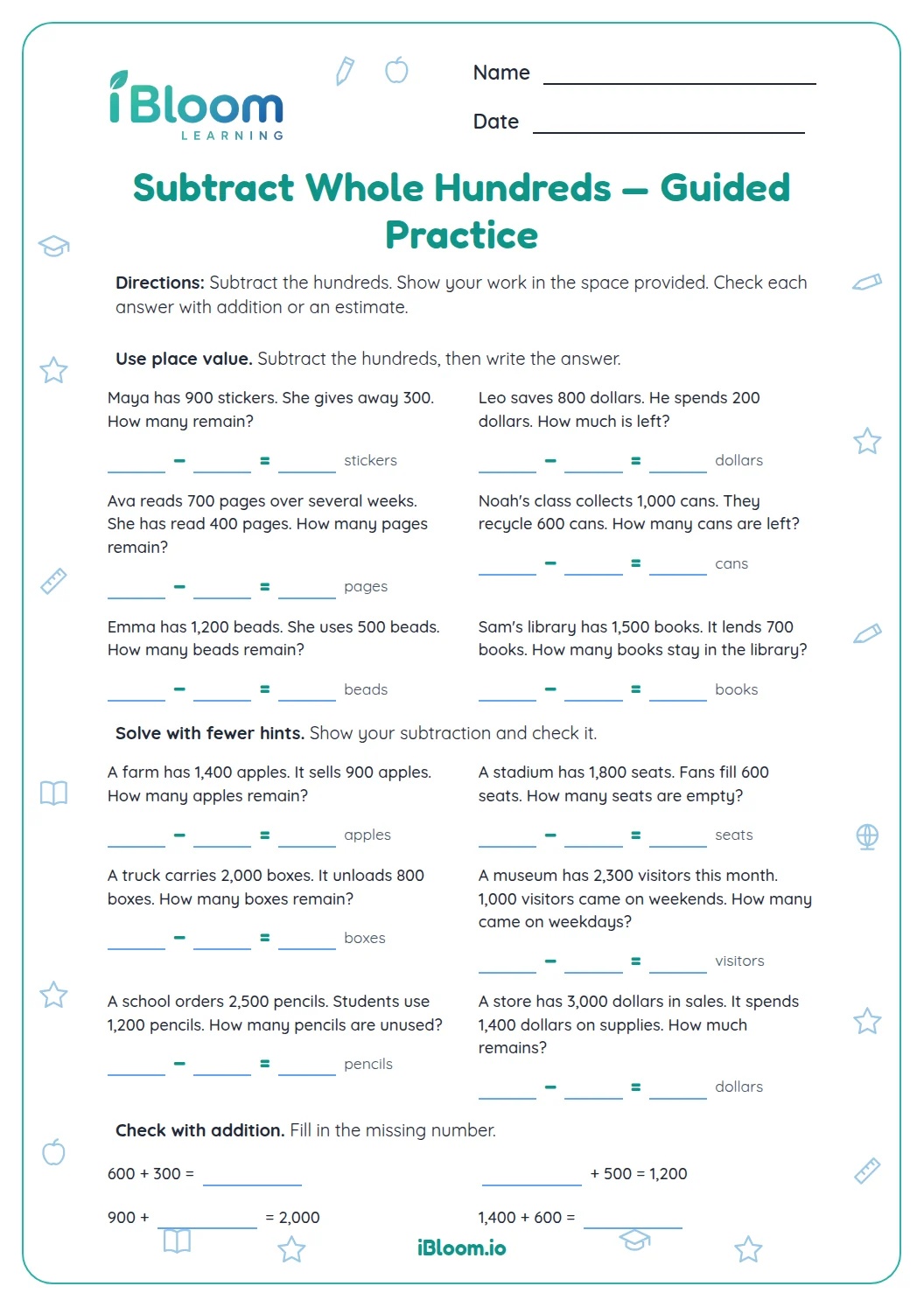
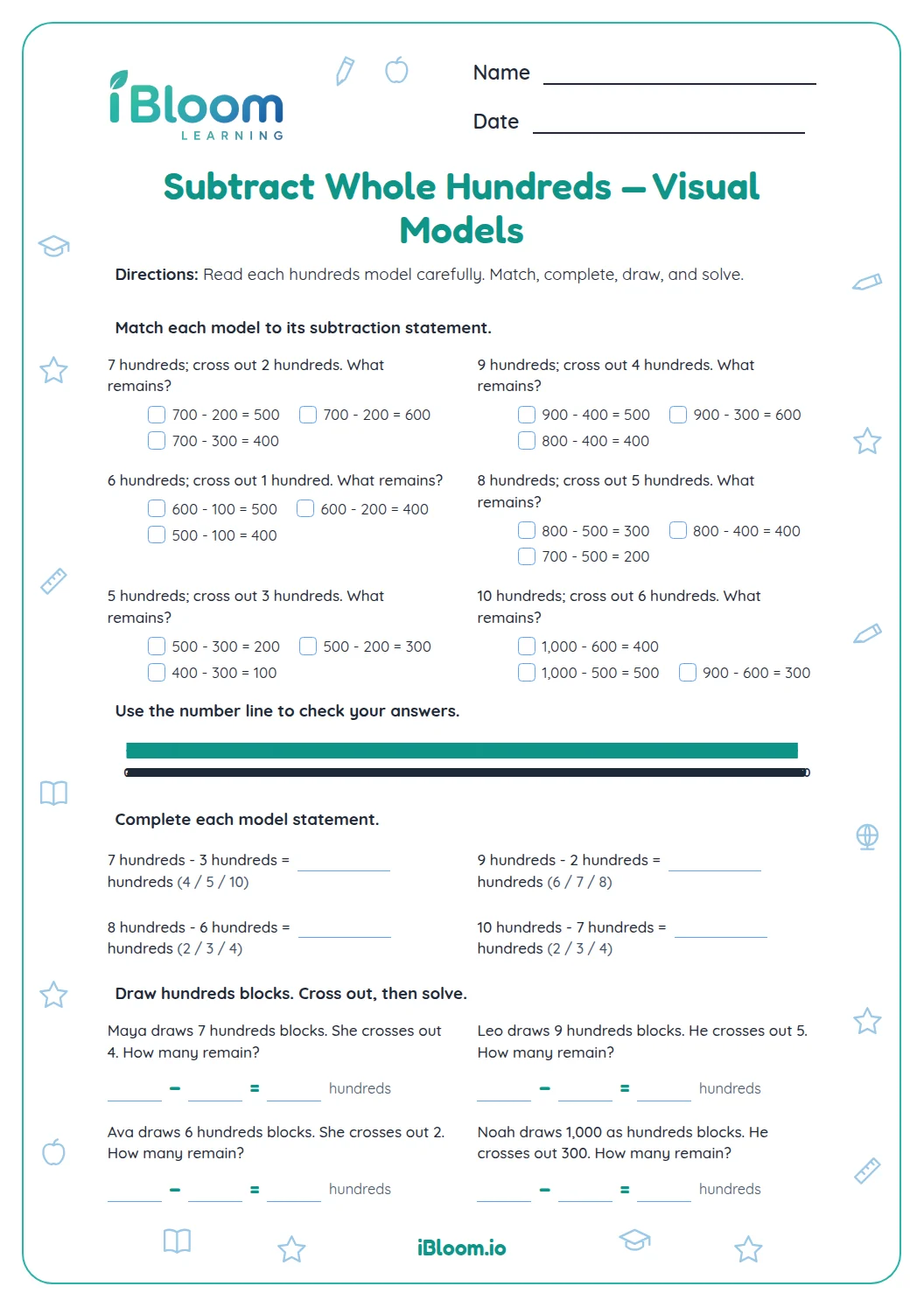
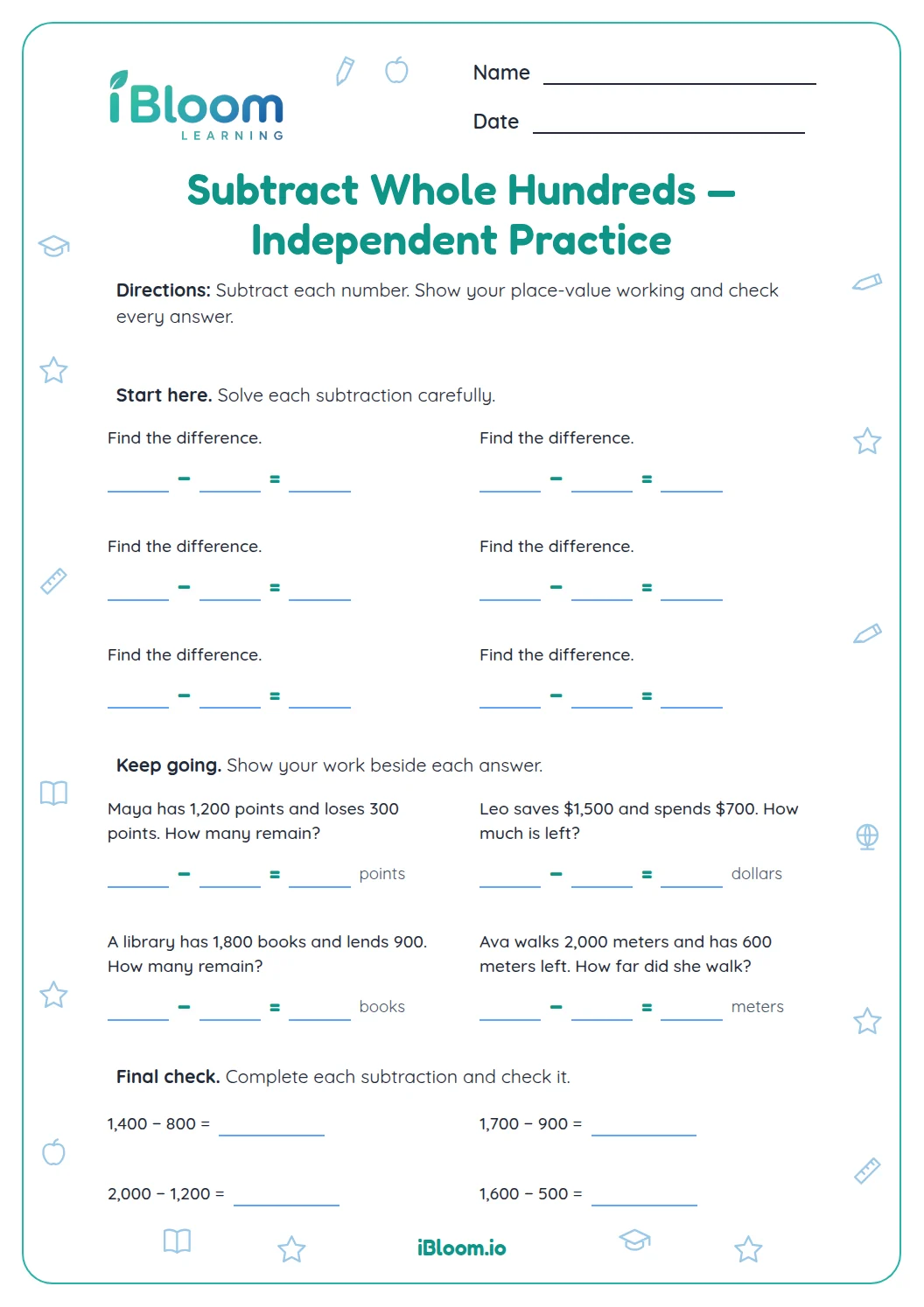
This Grade 3 subtraction worksheet focuses on subtracting whole tens from 1,000. Students solve 16 equations, from subtracting tens that leave hundreds and tens to cases that require regrouping across the zeros. The answer key gives every difference. This practice supports Common Core 3.NBT.A.2 and its use of place-value strategies and algorithms for subtraction within 1,000.
Aligned to 3.NBT.A.2
How do you subtract tens from 1,000?
Regroup 1,000 as 10 hundreds, then trade a hundred for 10 tens when the tens place needs more. Subtract the tens and keep track of the hundreds left.
- 11,000 − 20 = 980
- 2After regrouping, 10 hundreds become 9 hundreds and 10 tens; remove 2 tens.
What changes when the subtracted number has hundreds too?
Numbers such as 250 and 890 contain both hundreds and tens. Regroup across the zeros, subtract the hundreds and tens, and check that the digits reflect each trade. The later problems give repeated practice with larger amounts.
How can addition check the difference?
Add the difference to the number subtracted. The total should return to 1,000. For example, 750 + 250 = 1,000, so 1,000 − 250 = 750.
How to use this worksheet
- 1Write the number being subtracted under 1,000 by place value.
- 2Regroup from the hundreds to make enough tens.
- 3Subtract the tens and keep track of the remaining hundreds.
- 4Check by adding the difference and the tens back to 1,000.
Common mistakes and quick fixes
The mistake
Subtracting tens from the zero in the tens place
The fix
Regroup from the hundreds to create tens first.
The mistake
Forgetting that regrouping changes the hundreds
The fix
After trading a hundred, subtract from the updated hundreds.
The mistake
Leaving a zero in the answer without checking
The fix
Use addition to check that the difference plus the subtracted tens is 1,000.
Common Core alignment
This page gives students practice with the stated skill and the standard below.
Fluently add and subtract within 1,000 using place-value strategies.
On this sheet: Students subtract whole tens from 1,000 and use place value to handle zeros and regrouping.
Show the official wordingHide the official wording
Fluently add and subtract within 1000 using strategies and algorithms based on place value, properties of operations, and/or the relationship between addition and subtraction.
What to practice next
Make more practice
Further reading
Questions parents and teachers ask
What does “whole tens” mean here?
A whole ten is a number such as 20, 130, or 890 that ends in zero. Every problem subtracts a whole ten from 1,000, so students can focus on regrouping and place value. Regroup one thousand into hundreds first. If the subtracted tens are greater than the tens available, trade one hundred for ten tens and continue.
Why does subtracting from 1,000 require regrouping?
The tens and ones places in 1,000 are zero, so a student must regroup from a larger place value to create tens. Some problems also require changing the hundreds as the subtraction continues. A subtraction answer should be smaller than 1,000 but still close to it when only a few tens are removed. Estimating helps catch an unexpected digit.
How many problems are included?
There are 16 equations on the worksheet. Selected items include base-ten blocks showing 1,000 as one thousand, while the rest let students practice the same regrouping strategy independently. Base-ten blocks in selected items make the starting amount visible. Students still need to record the exchanges that create enough tens for subtraction.
How can students check a subtraction answer?
Add the difference to the number subtracted. The sum should be 1,000. For example, if 1,000 − 250 = 750, then 750 + 250 returns to 1,000. The answer key lists each difference. Students can verify any answer by adding the subtracted tens back and checking that the result is exactly 1,000.
What skill is a useful next step?
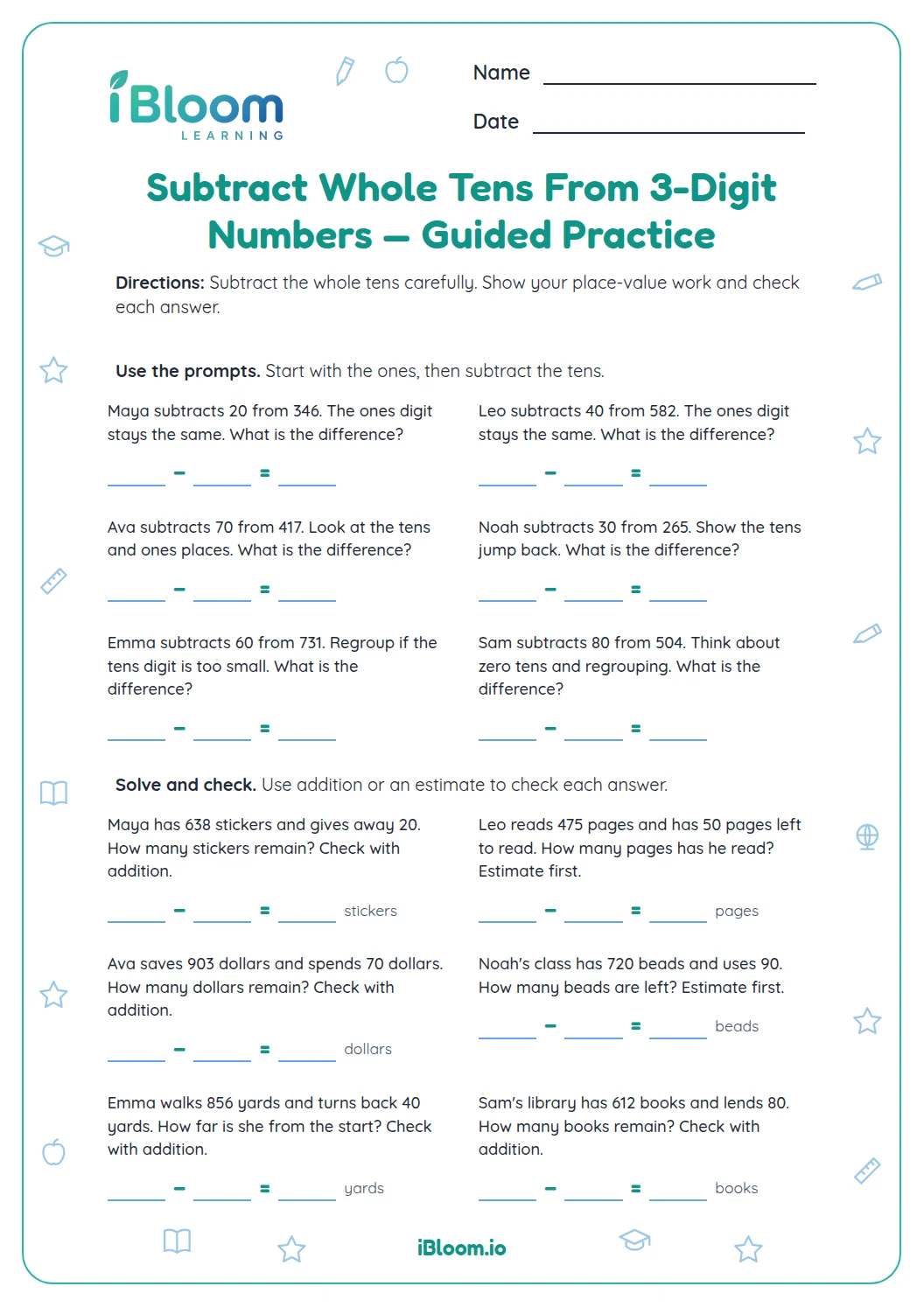
Students can next subtract whole tens from other three-digit numbers, then practice three-digit subtraction with regrouping. Those steps extend the same place-value reasoning. The harder examples subtract many tens, which makes regrouping especially important. Keep the hundreds and tens aligned while recording each exchange.