



About this worksheet
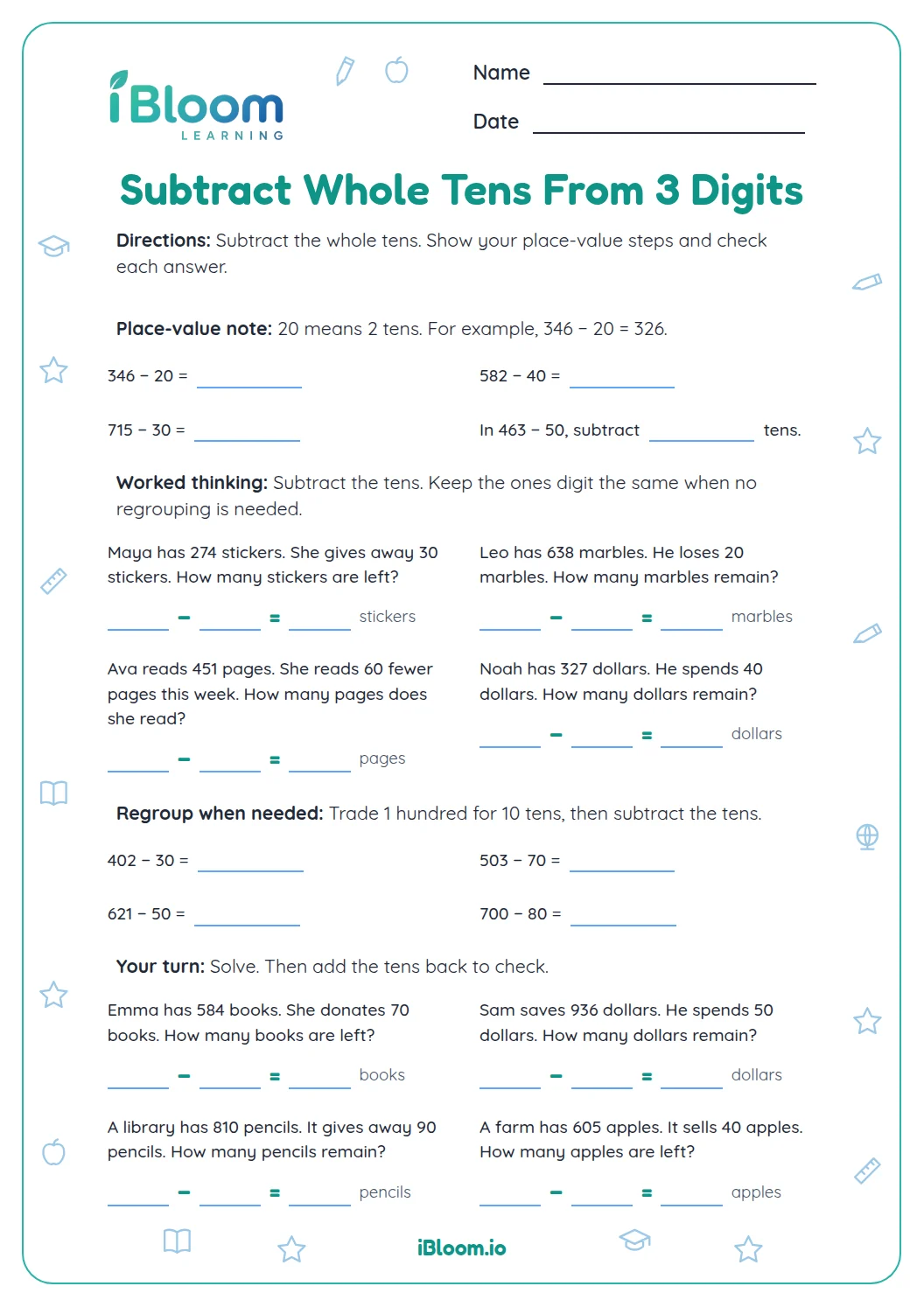
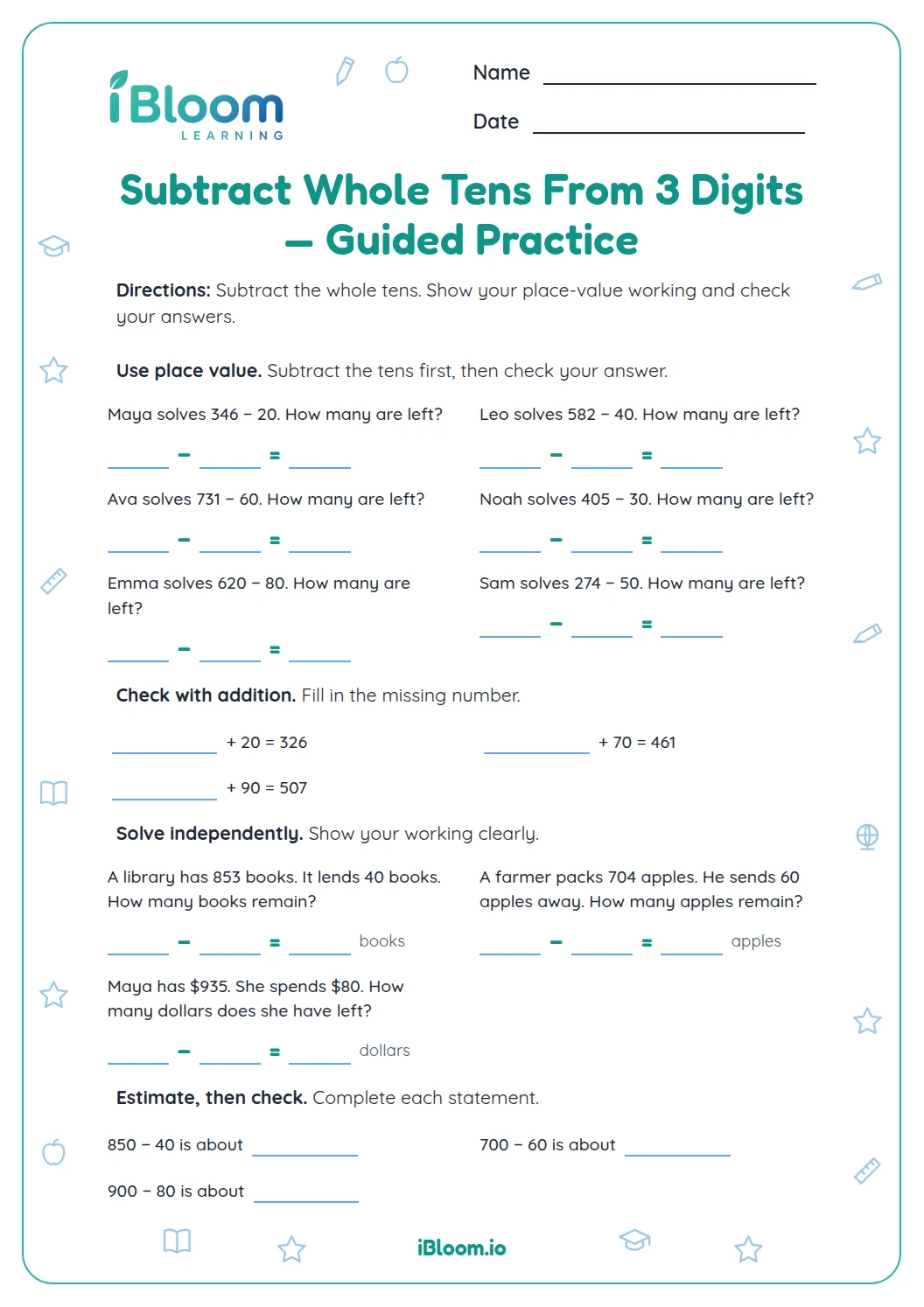
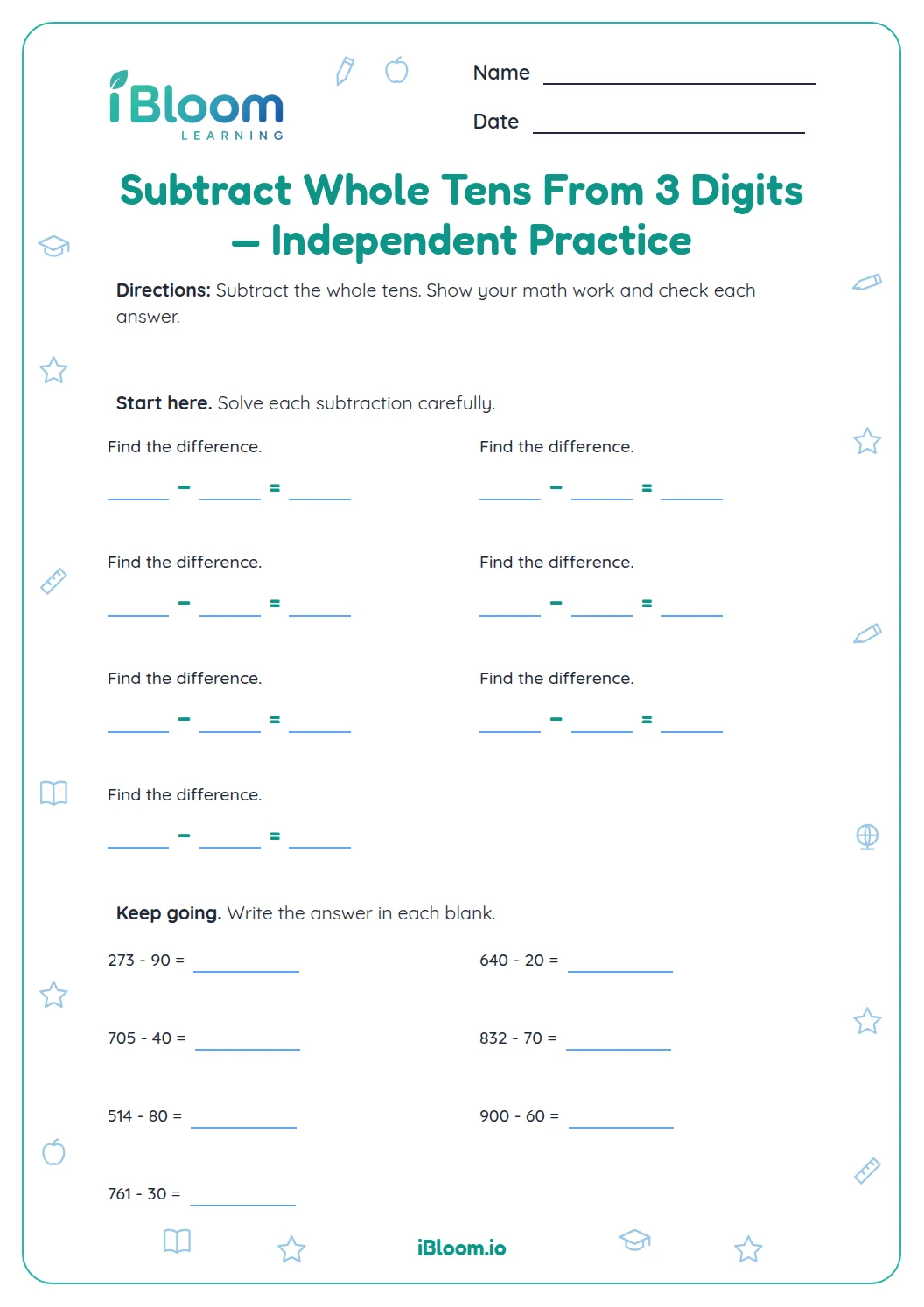
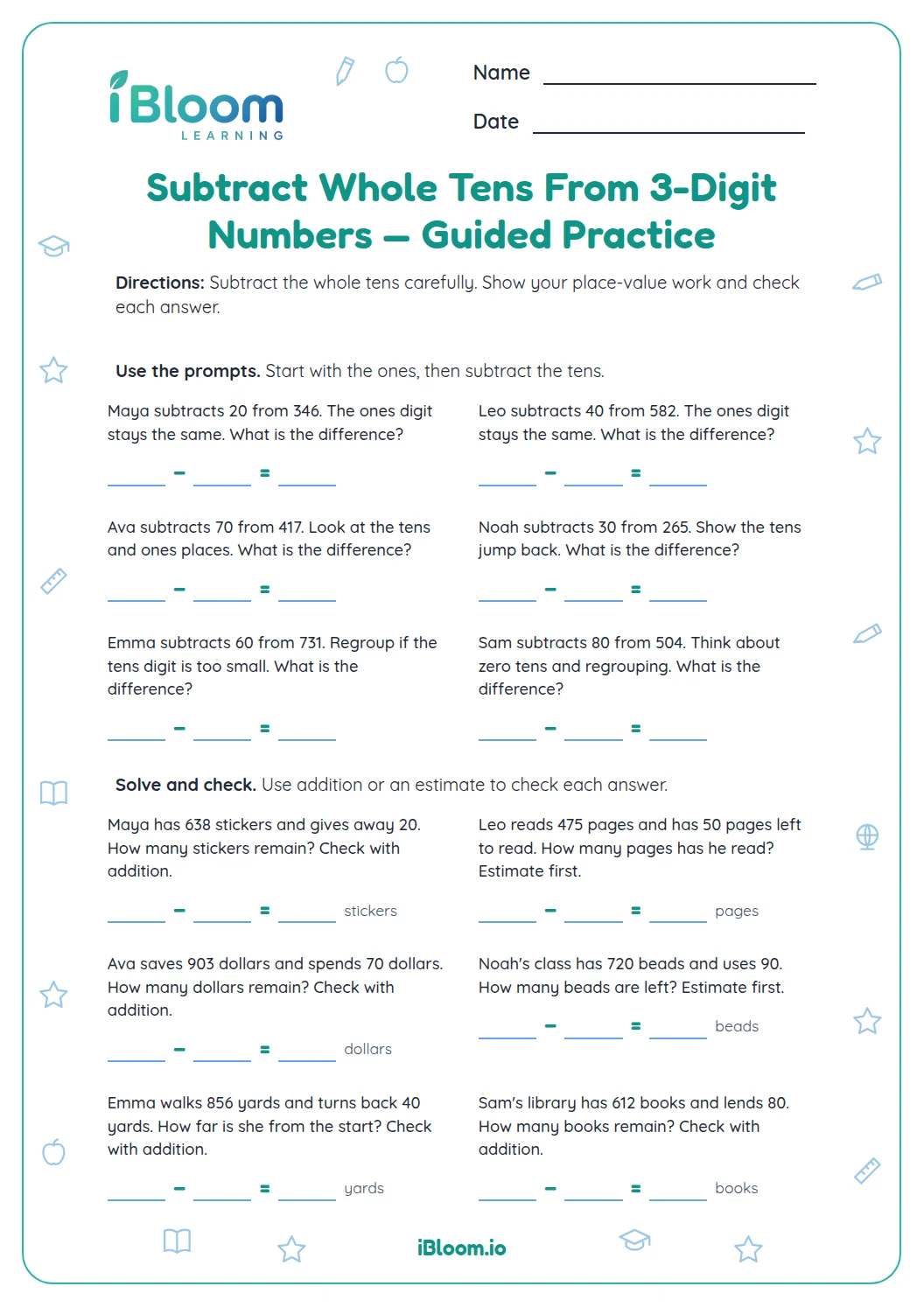
This Grade 3 printable turns subtraction of whole tens from three-digit numbers into short stories. Students complete an equation, solve it, and label the result in context across 13 one-step situations and one final two-step story. The separate answer key lets families and teachers check each result. These computations practice CCSS 3.NBT.A.2 strategies for subtraction within 1,000.
Aligned to 3.NBT.A.2
How do students solve the one-step stories?
Part A turns each story into a subtraction equation with the context built in. Students calculate the difference and include what remains.
684 − 230 = 454 bookmarks. The subtraction removes 2 hundreds and 3 tens, leaving 454.
- 1684 − 230 = 454 bookmarks
- 2The library has 454 bookmarks left.
How can students check a subtraction result?
The equation shows the starting amount and the amount taken away. Add the difference to the amount removed to check the starting total.
What changes in the last story?
The shelter receives cans before donating some. First add 160 to 521, then subtract 230. Keep the order of the events straight so the equation matches the story.
How to work each story
- 1Circle the starting amount and underline what changes.
- 2Decide whether the story adds or subtracts at each step.
- 3Read the equation that matches the story numbers.
- 4Solve and label the answer with its unit or object.
- 5Check a subtraction answer by adding the amount taken away.
Subtraction story checks
The mistake
Subtracting the starting amount from the amount taken away.
The fix
The remaining amount is the starting amount minus the amount removed.
The mistake
Writing a bare number without saying what it counts.
The fix
Add the context label, such as bookmarks, meters, or points.
The mistake
Subtracting the donation before adding the shelter’s new cans.
The fix
Follow the story order: add the received cans, then subtract the donated cans.
Common Core alignment
This worksheet practices the following Common Core standard.
Fluently add and subtract within 1,000.
On this sheet: Fluently add and subtract within 1,000.
Show the official wordingHide the official wording
Fluently add and subtract within 1000 using strategies and algorithms based on place value, properties of operations, and/or the relationship between addition and subtraction.
What to practice next
Make more practice
Further reading
Questions parents and teachers ask
What does the worksheet ask students to do?
Students read a short story, complete the printed subtraction equation and solve it, and label the answer. The 14 contexts include books, tickets, supplies, distances, and other quantities, so the unit in the answer should match the story. Students should include the item being counted in each response.
Does every problem use one subtraction step?
Thirteen stories ask for one subtraction. The final problem is about a shelter that receives cans and later donates some, so students first add the new cans and then subtract the donated amount. The received cans change the starting amount before subtraction.
How can students check their answers?
For a one-step subtraction, add the amount removed to the result. In the library example, 454 bookmarks left plus 230 given away equals the original 684 bookmarks. This check works because subtraction and addition undo each other. Check the original amount as well.
What should the answer include?
Write the number and what it measures, such as 454 bookmarks or 440 meters. The label helps show that the answer matches the story and that the student has answered the actual question. The labels are already suggested by each story context.
Is an answer key included?
Yes. The separate answer key lists the results for all 14 stories. For the last problem, it shows the final number after the received cans are added and the donation is subtracted. The key also makes it easy to review the two-step story separately.