
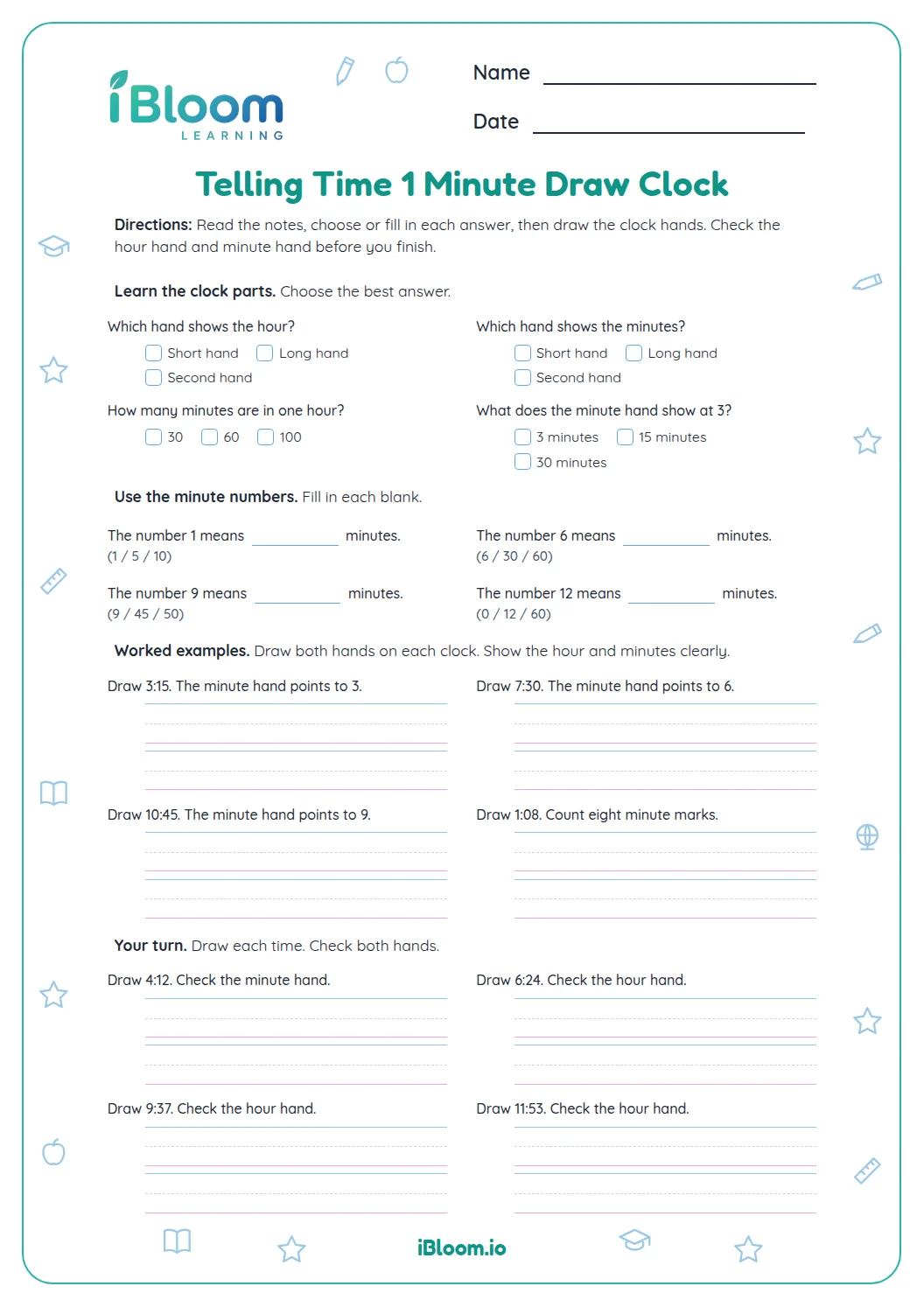
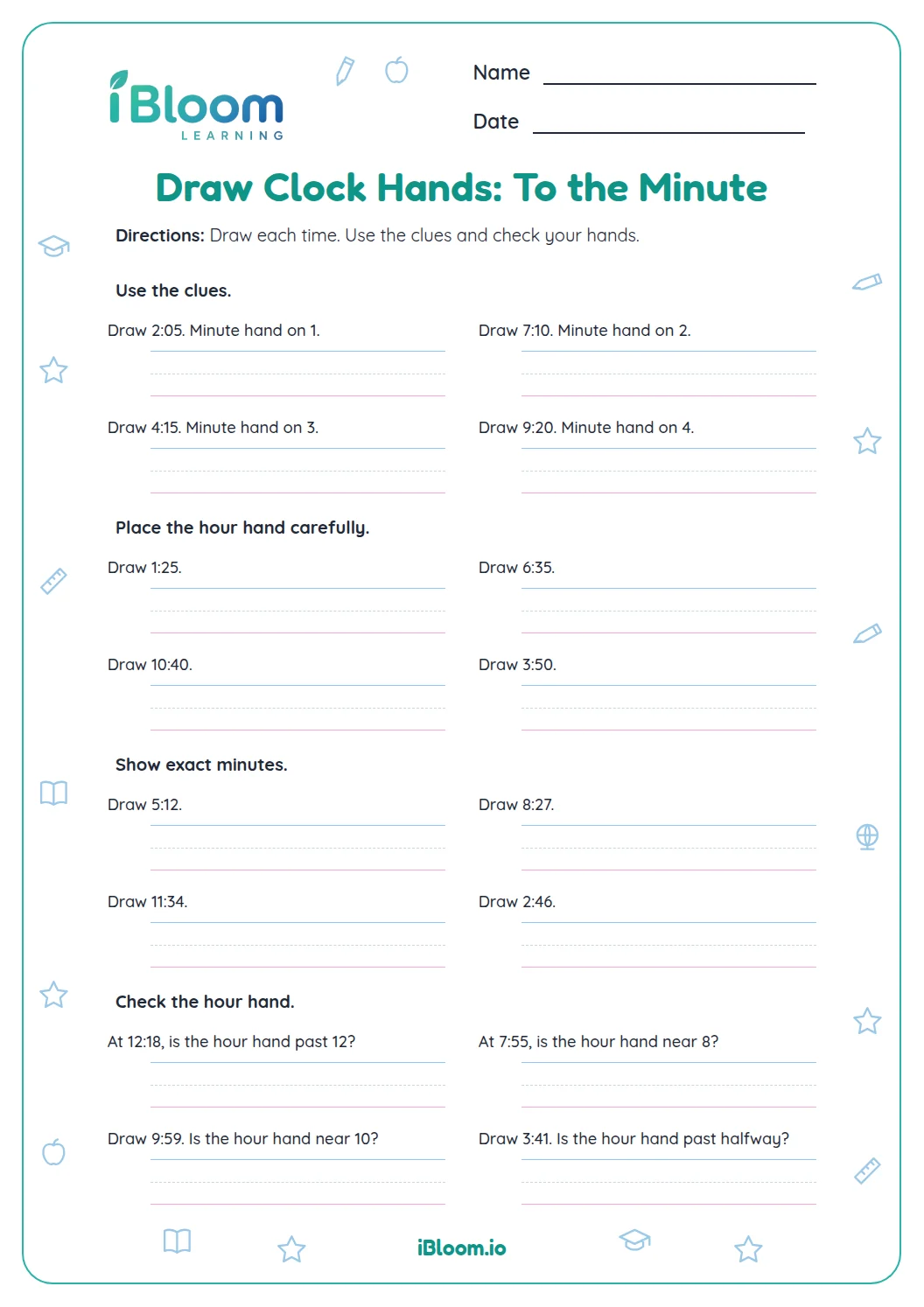
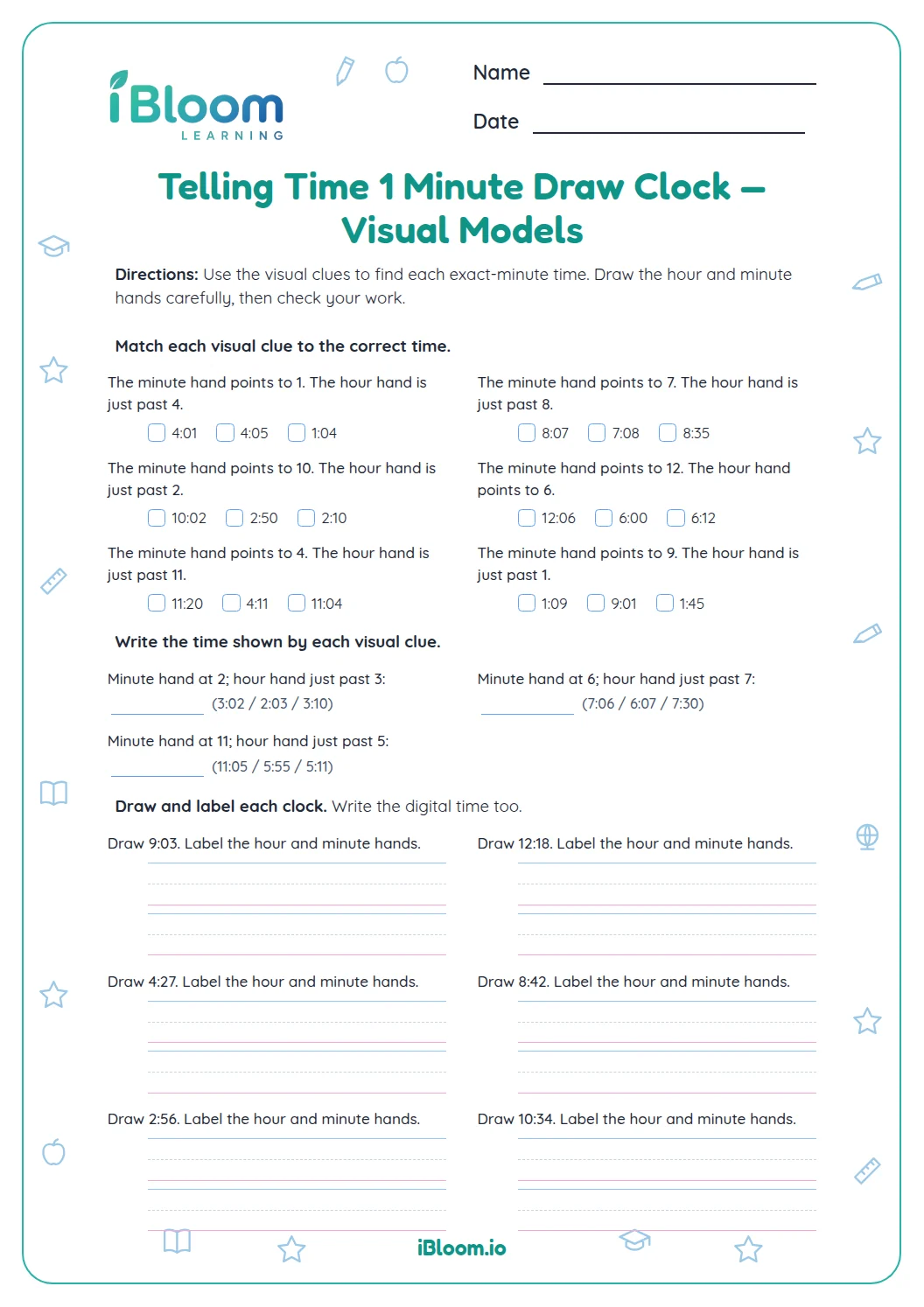

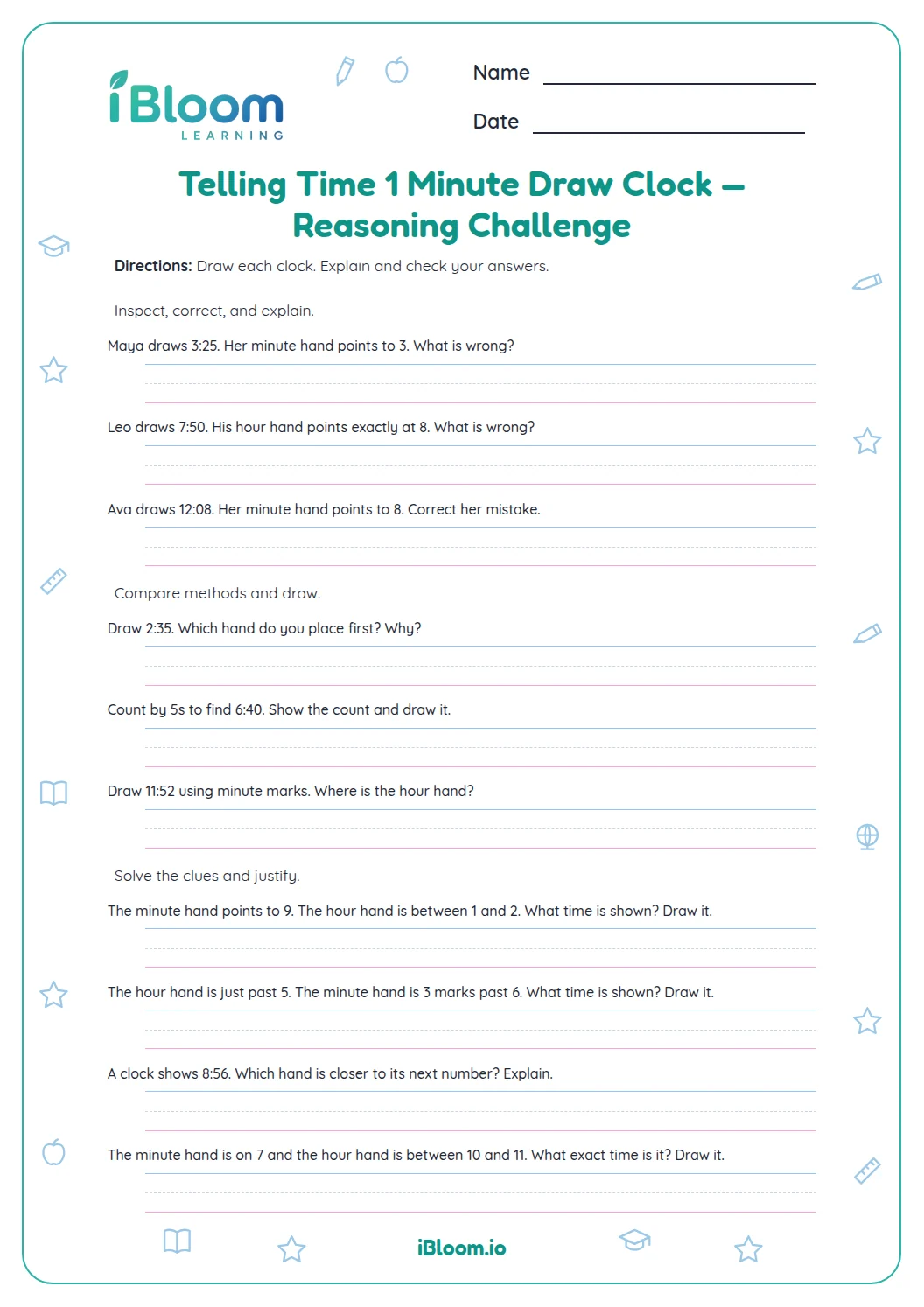



About this worksheet
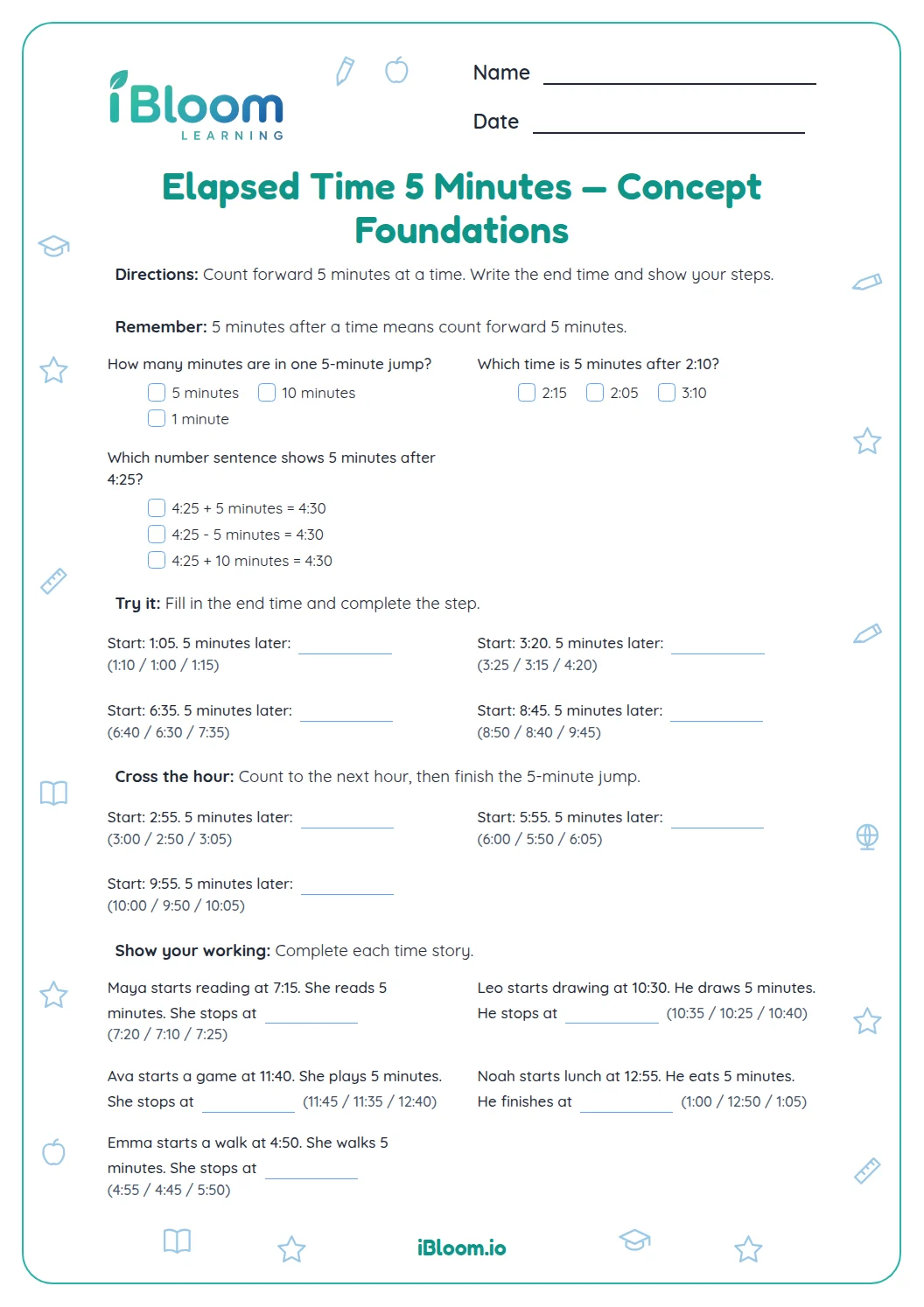
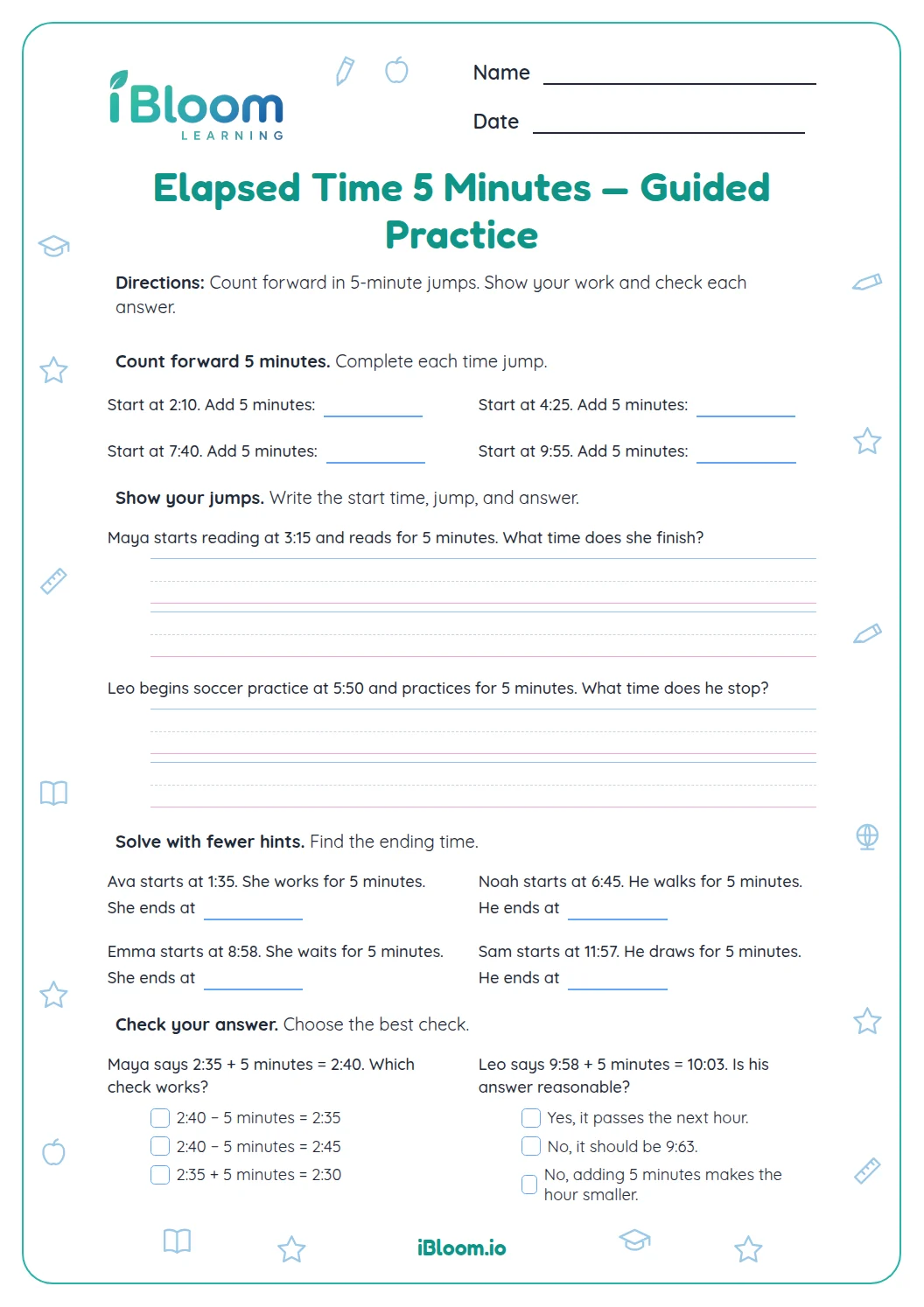
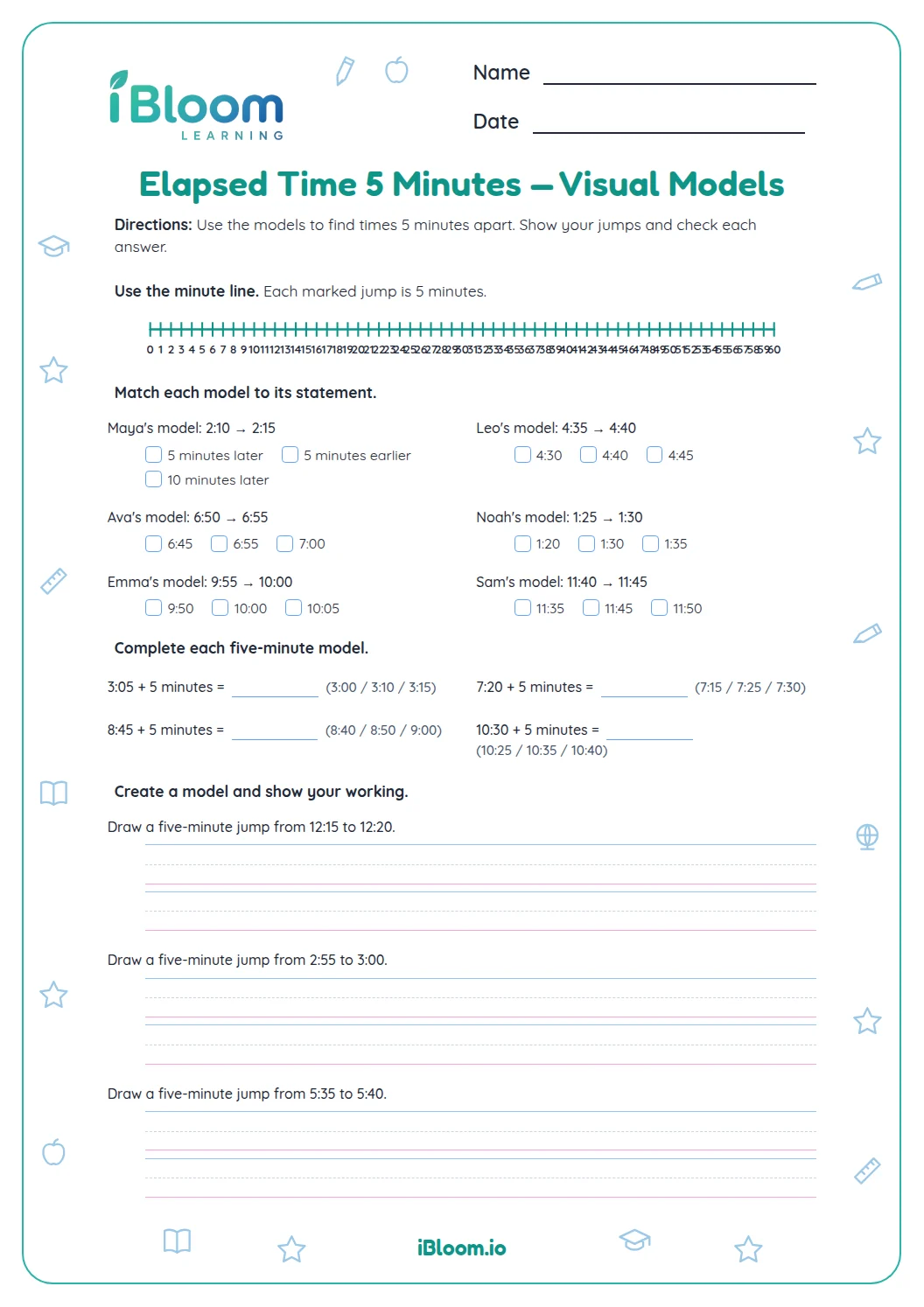
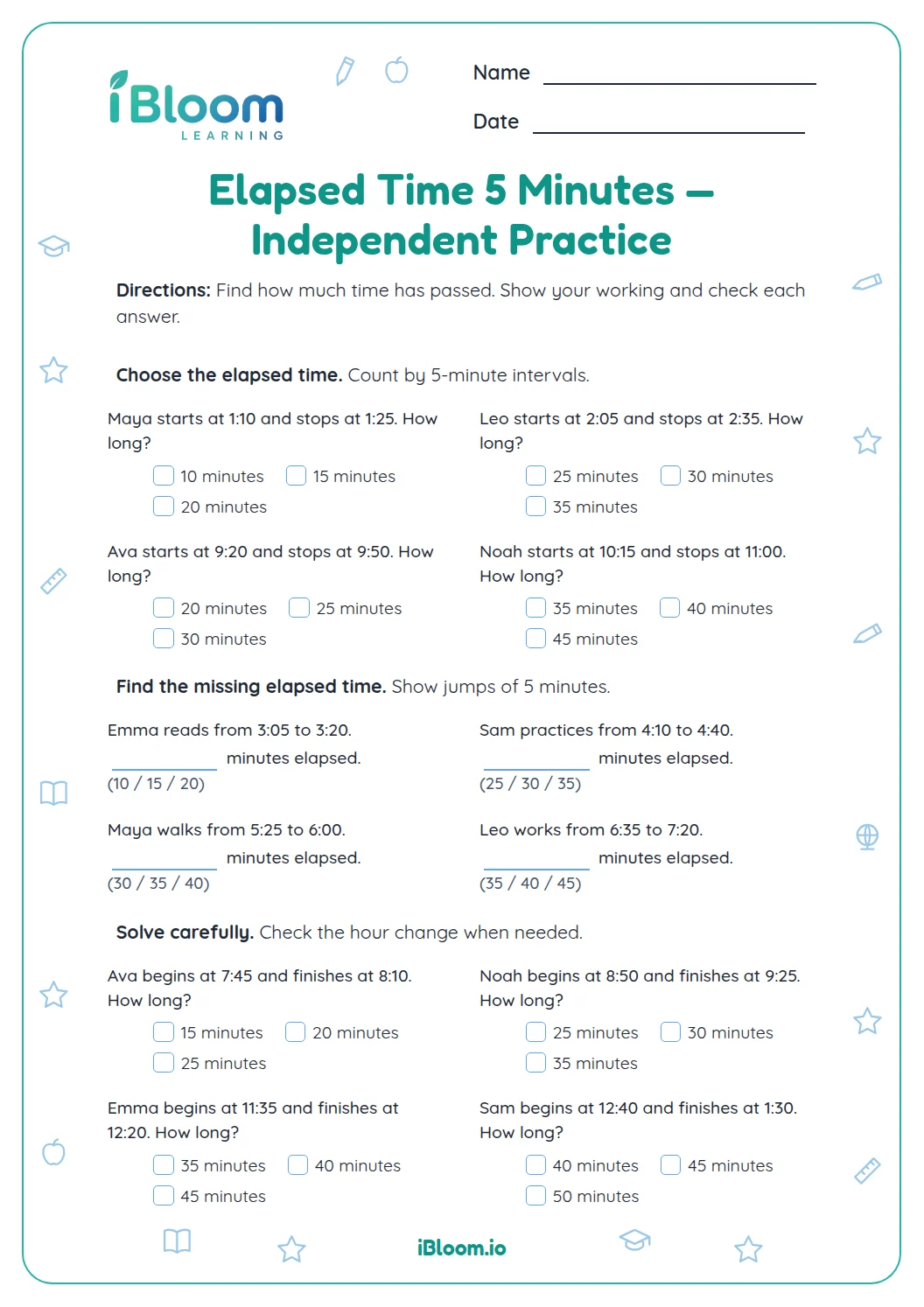
This Grade 3 printable worksheet practices telling time to the nearest minute and using minutes in everyday schedules. Part A has eight analog clock models to read. Part B has eight short stories about activities, travel, and schedules; learners add or subtract minutes to find a start or end time. It aligns with Common Core 3.MD.A.1, and includes a separate answer key. The page uses readable analog clock models to practice the minute-reading skill named in the title, with elapsed-time stories for transfer.
Aligned to 3.MD.A.1
How do you read an analog clock to the minute?
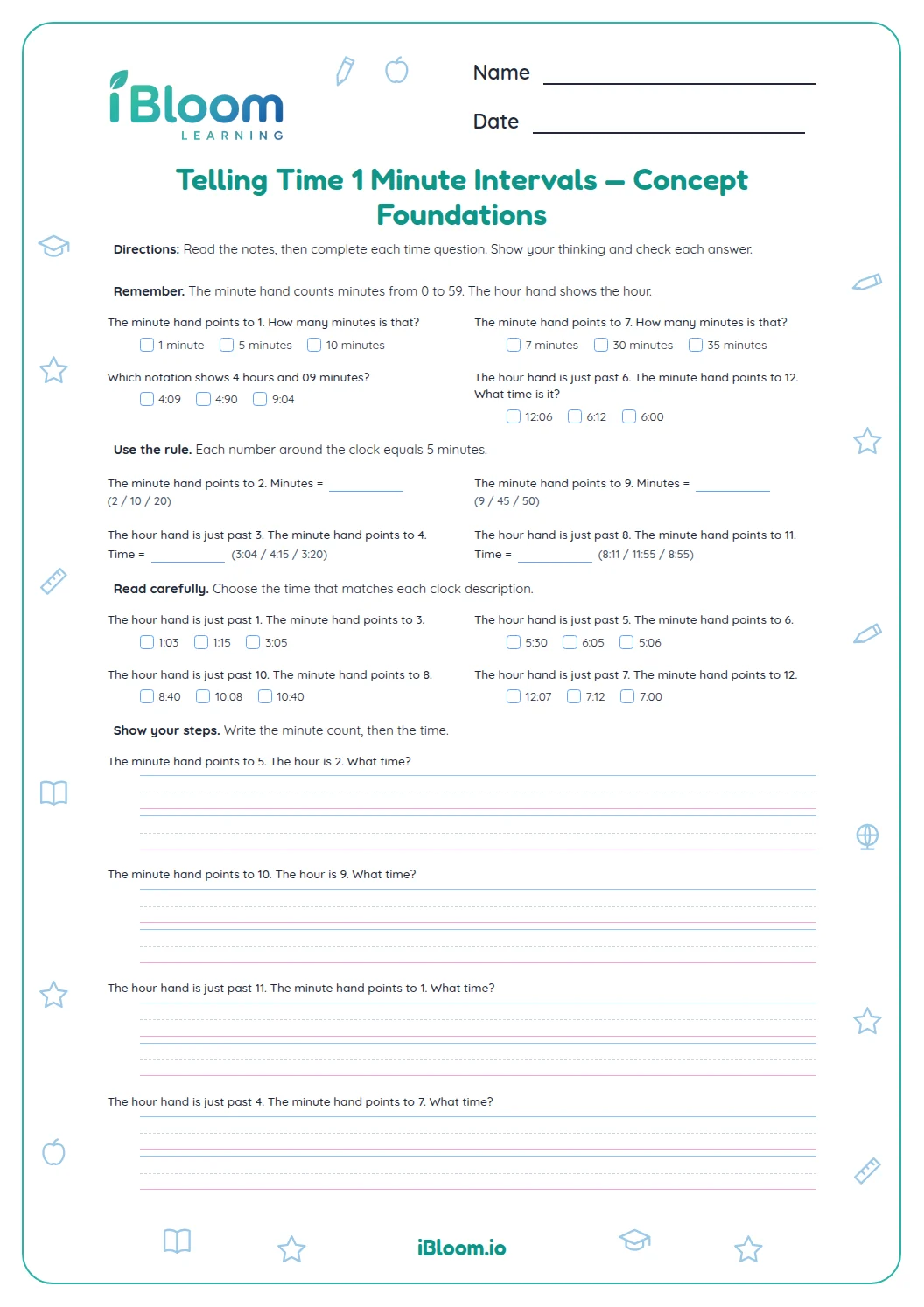
Read the short hand first to identify the hour that has begun. Then count the minute marks from 12, using five-minute jumps between numbers and single-minute counts for the smaller marks.
- 1The clock shows 2:17.
- 2The short hand is past 2.
- 3The minute hand is two marks past 15.
- 4Answer: 2:17
How do you solve a time story?
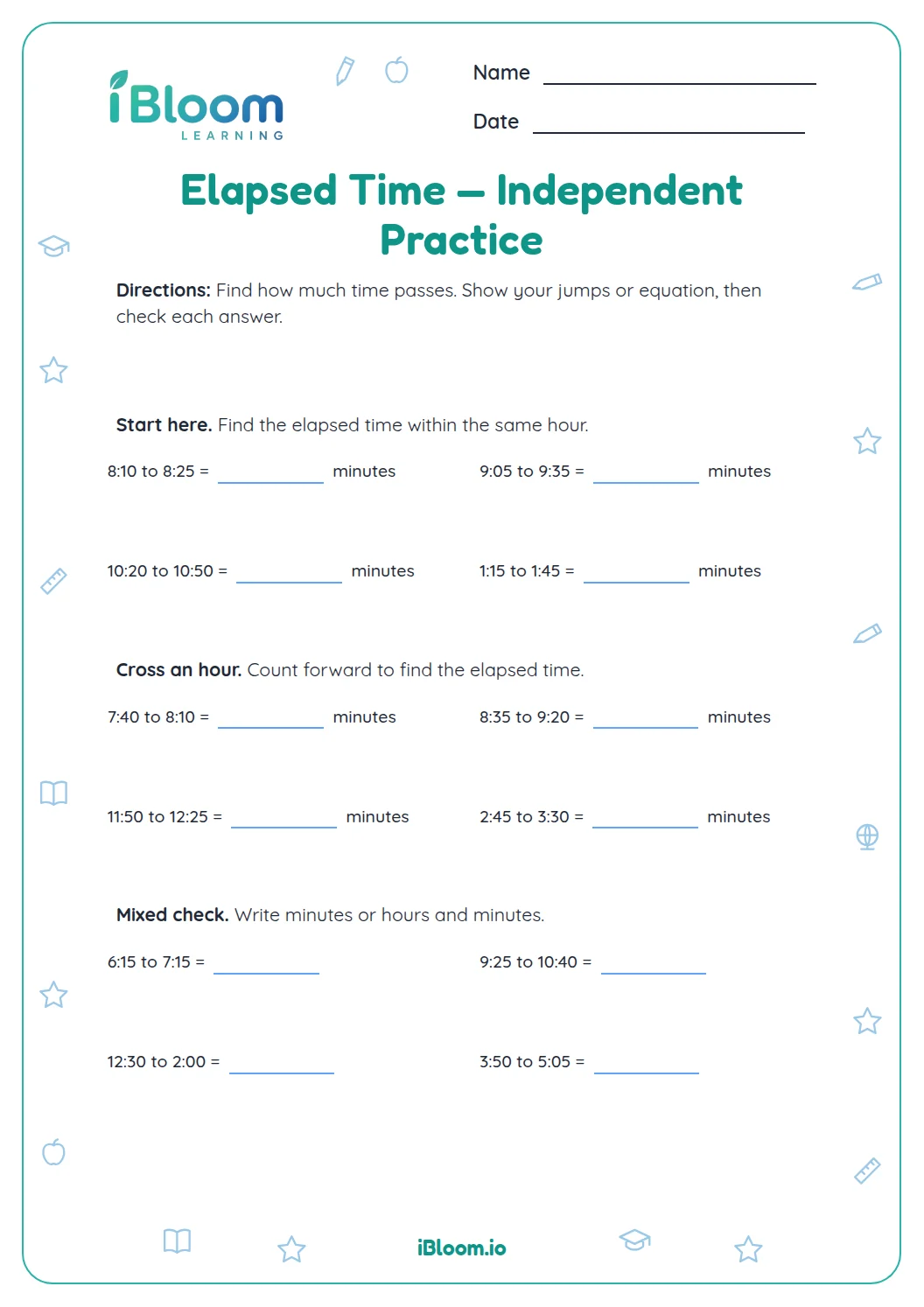
Keep the hour and minute together. Add minutes for an ending time; subtract minutes for a starting time when the ending time and duration are given. When the minutes cross 60 or go below 0, regroup one hour as 60 minutes.
What does the worksheet include?
Part A asks for the time shown on eight different clock faces. Part B has eight real-world problems, including both finding an ending time and working backward to a starting time. The answer key follows the same question order.
How to use this worksheet
- 1Read the short hand to name the hour.
- 2Count the long hand from 12 by fives, then ones.
- 3Choose the exact time for each clock.
- 4For a story, mark whether it asks for a start or end time.
- 5Add or subtract the given minutes and regroup at 60.
- 6Check each result with the answer key.
Common mistakes and quick fixes
The mistake
Counting every small mark by fives.
The fix
Use five-minute jumps only from one numbered mark to the next; count the little marks one at a time.
The mistake
Forgetting the hour changes at 60 minutes.
The fix
When minutes reach 60, write 00 and add one to the hour.
The mistake
Adding when the story asks for the start.
The fix
If the end and duration are given, subtract the duration to find the start.
Common Core alignment
This practice connects the worksheet activities to the following standard.
Read clocks to the minute and solve time-interval stories.
On this sheet: Clock reading and elapsed-time questions practice minute-level time and intervals.
Show the official wordingHide the official wording
Tell and write time to the nearest minute and measure time intervals in minutes. Solve word problems involving addition and subtraction of time intervals in minutes, e.g., by representing the problem on a number line diagram.
What to practice next
Make more practice
Further reading
Questions parents and teachers ask
How do children read the minute hand?
Each small mark stands for one minute. Start at 12 and count by fives to the numbered mark, then count any extra small marks; read the short hand for the hour. The eight clock questions ask children to use both hands to name the exact minute.
Does this page include elapsed-time practice?
Yes. Eight story problems ask children to find an ending time or a starting time by adding or subtracting minutes. Situations include a club, bus ride, reading time, a game, lunch, a walk, a movie, and a lesson.
Why does the title say draw clock if the page shows clocks?
The old activity asked learners to draw clock hands, but the available worksheet drawing is a clock with hands already set, not a blank clock face. This replacement keeps the exact-minute skill with readable analog clock models and adds real-world time stories.
What are the answers to the time stories?
The answers, in order, are 3:40, 9:03, 7:00, 2:02, 12:00, 4:53, 6:46, and 9:38. For the first six, add the duration to the start time; for the last two, subtract the duration from the ending time. Check whether the hour changed.
How long should the worksheet take?
Plan for about 20 minutes. A learner can complete the clock questions first, then solve the eight time stories, writing each time with a colon and both hour and minute digits when needed. Allow extra time to show work.
Is an answer key included?
Yes. A separate answer key gives the eight exact clock times and the eight results for the time stories. Use it after the learner has finished, or check one part at a time and review any tricky regrouping across an hour.