
About this worksheet
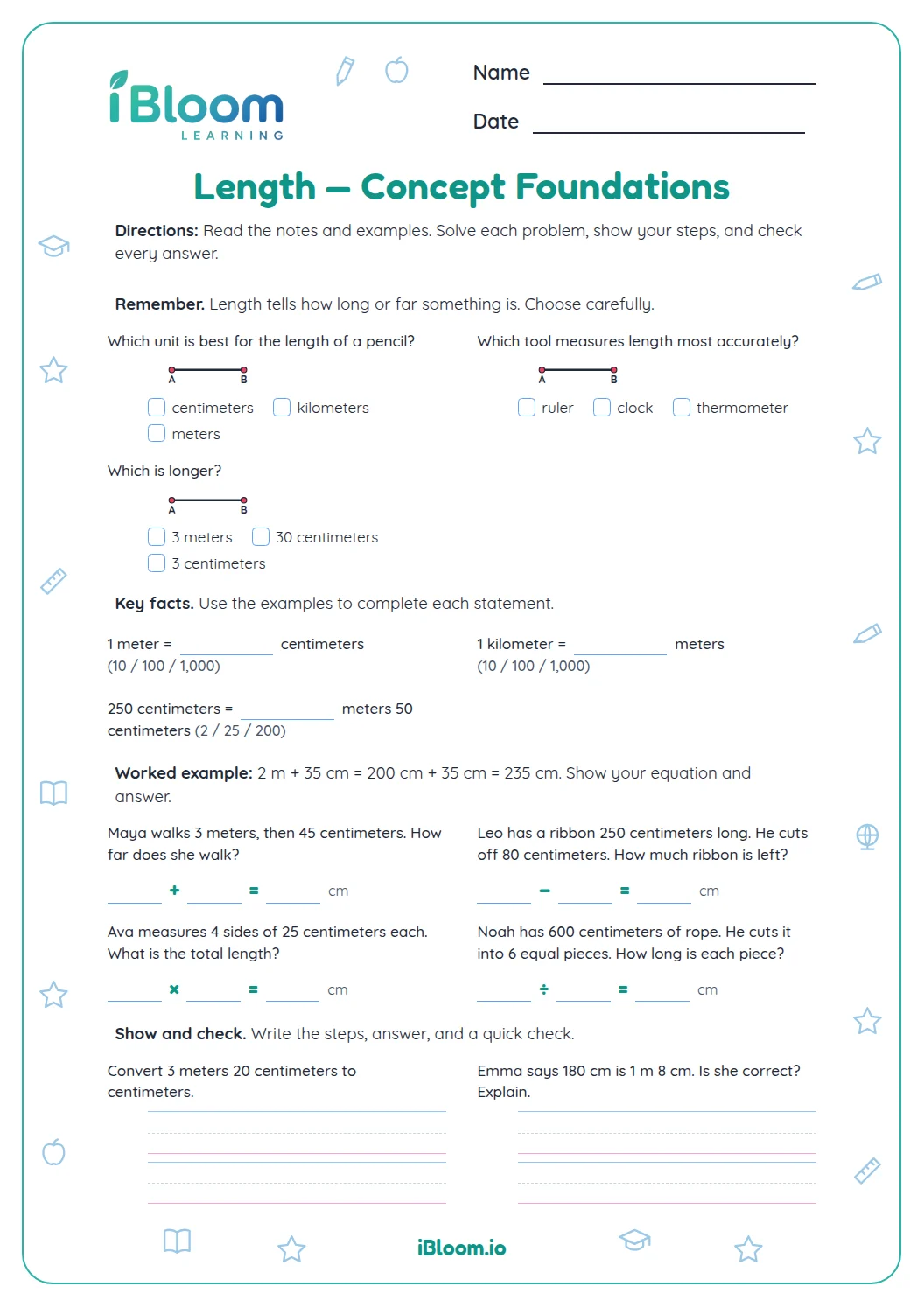
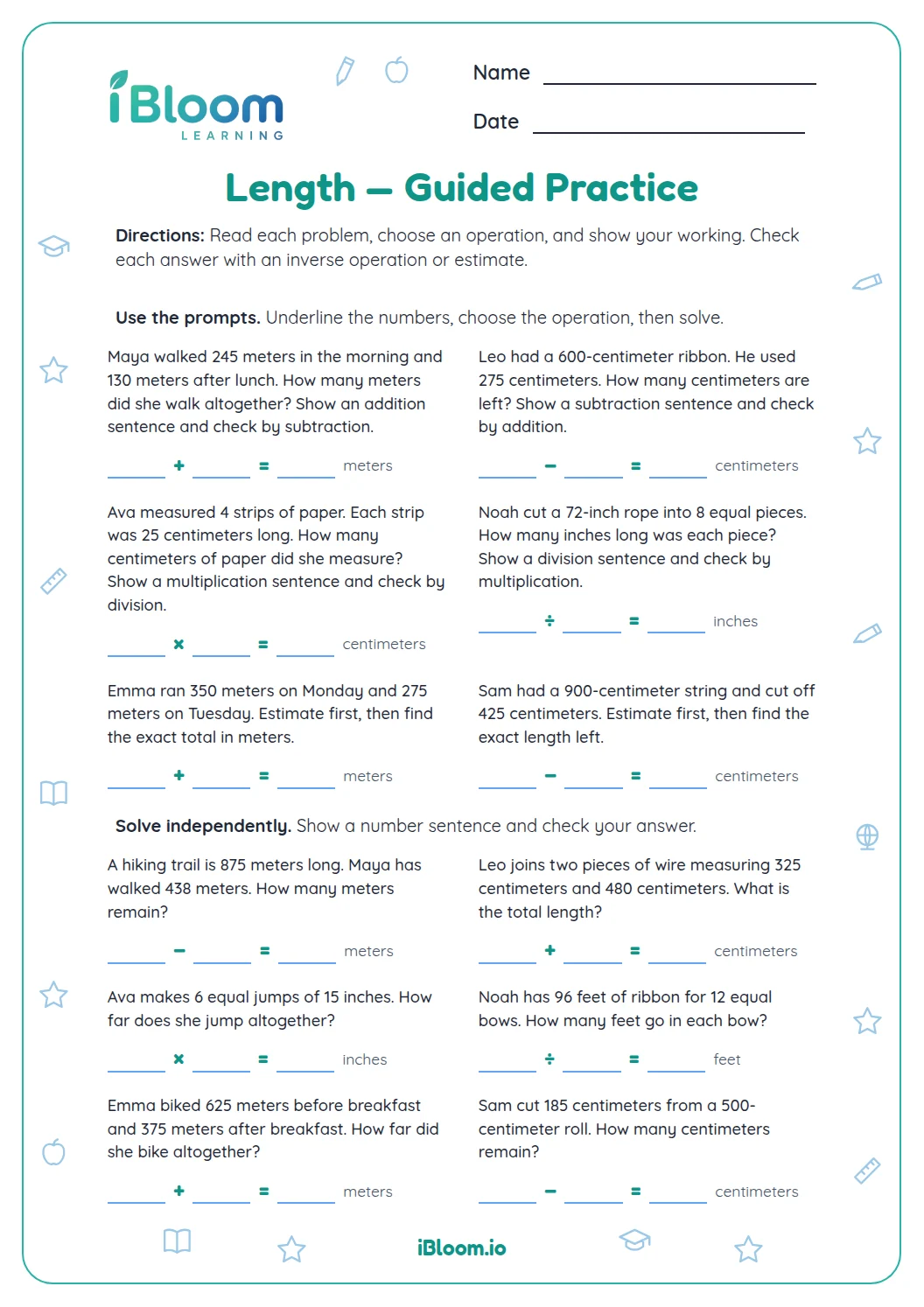
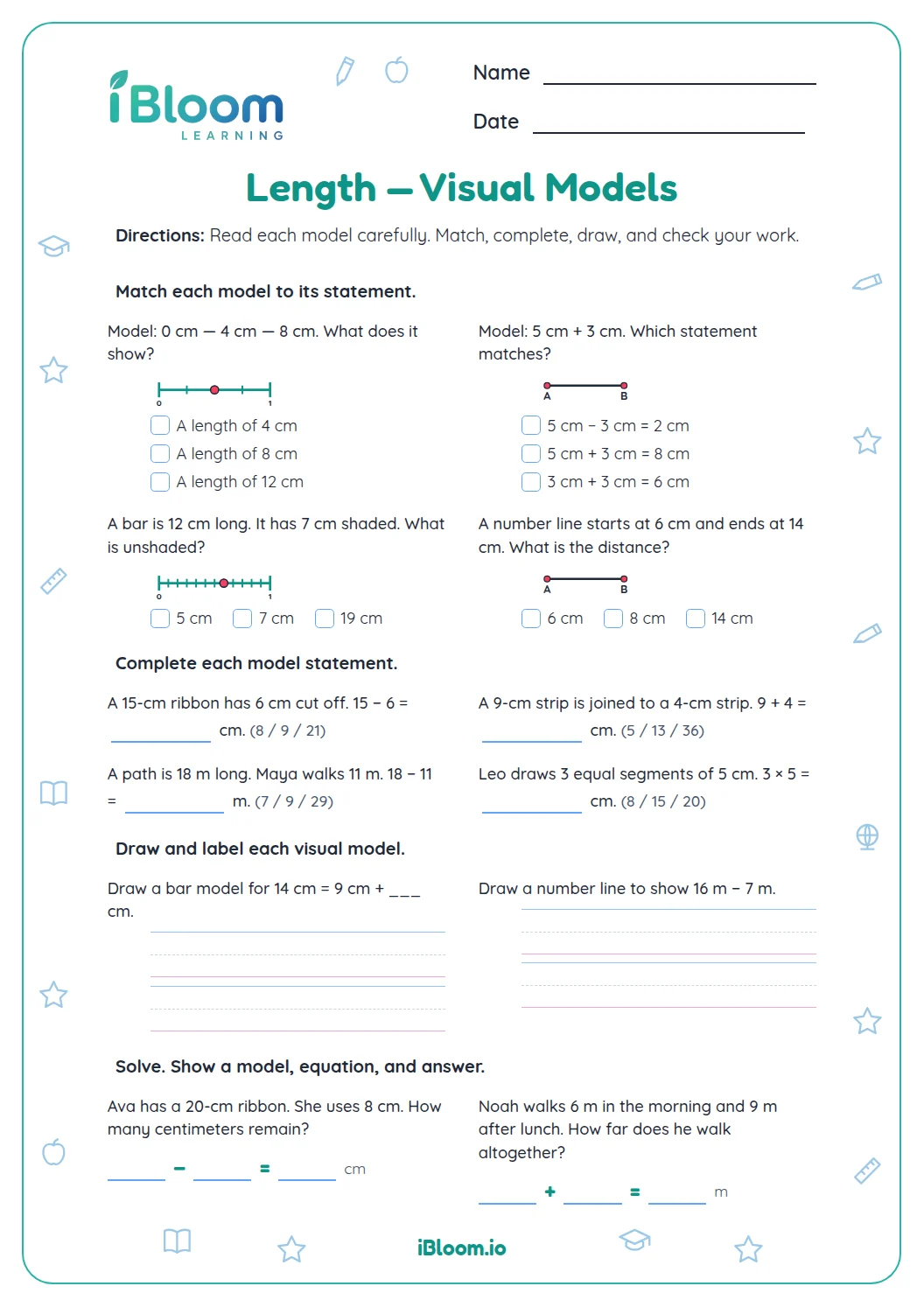
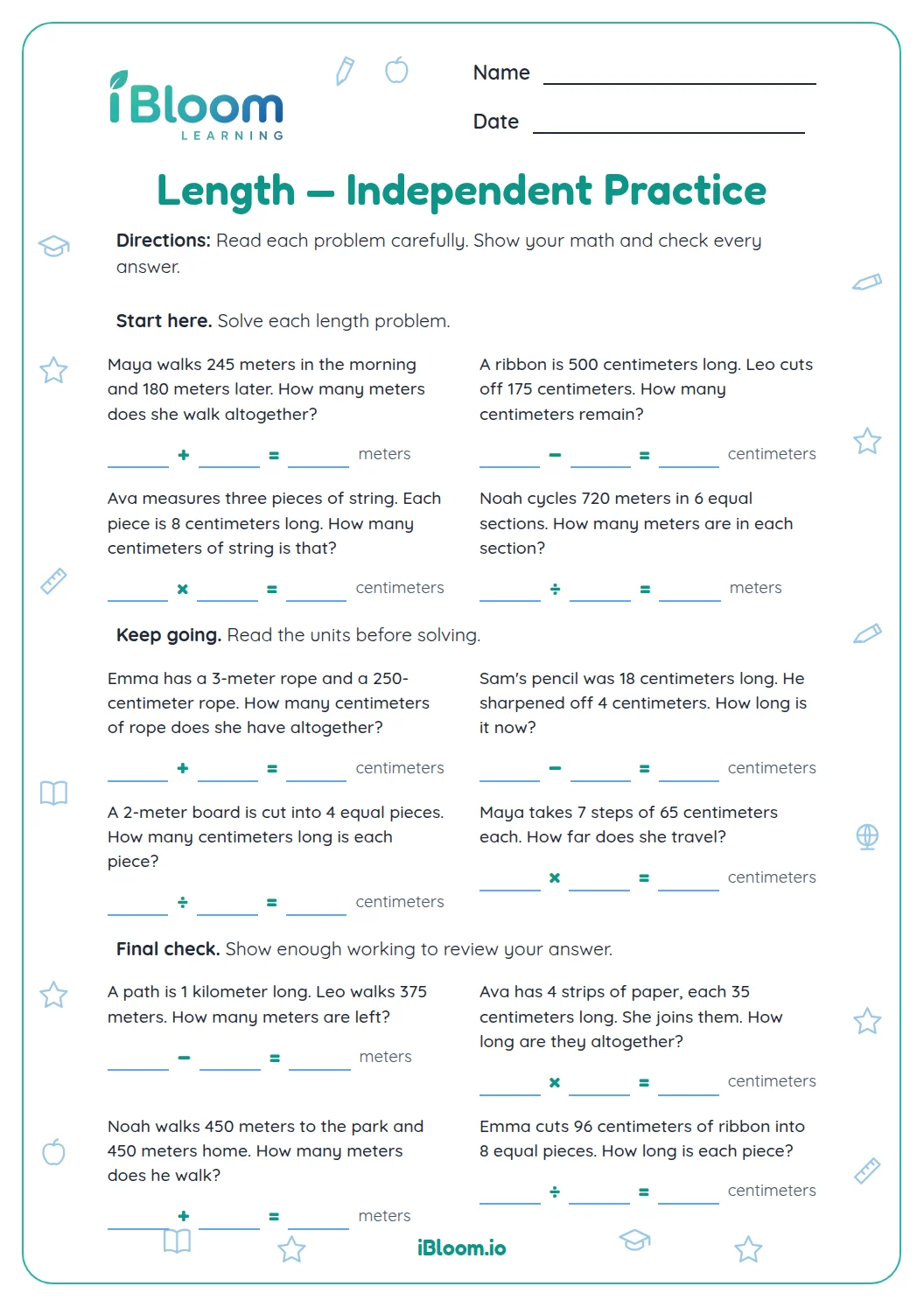
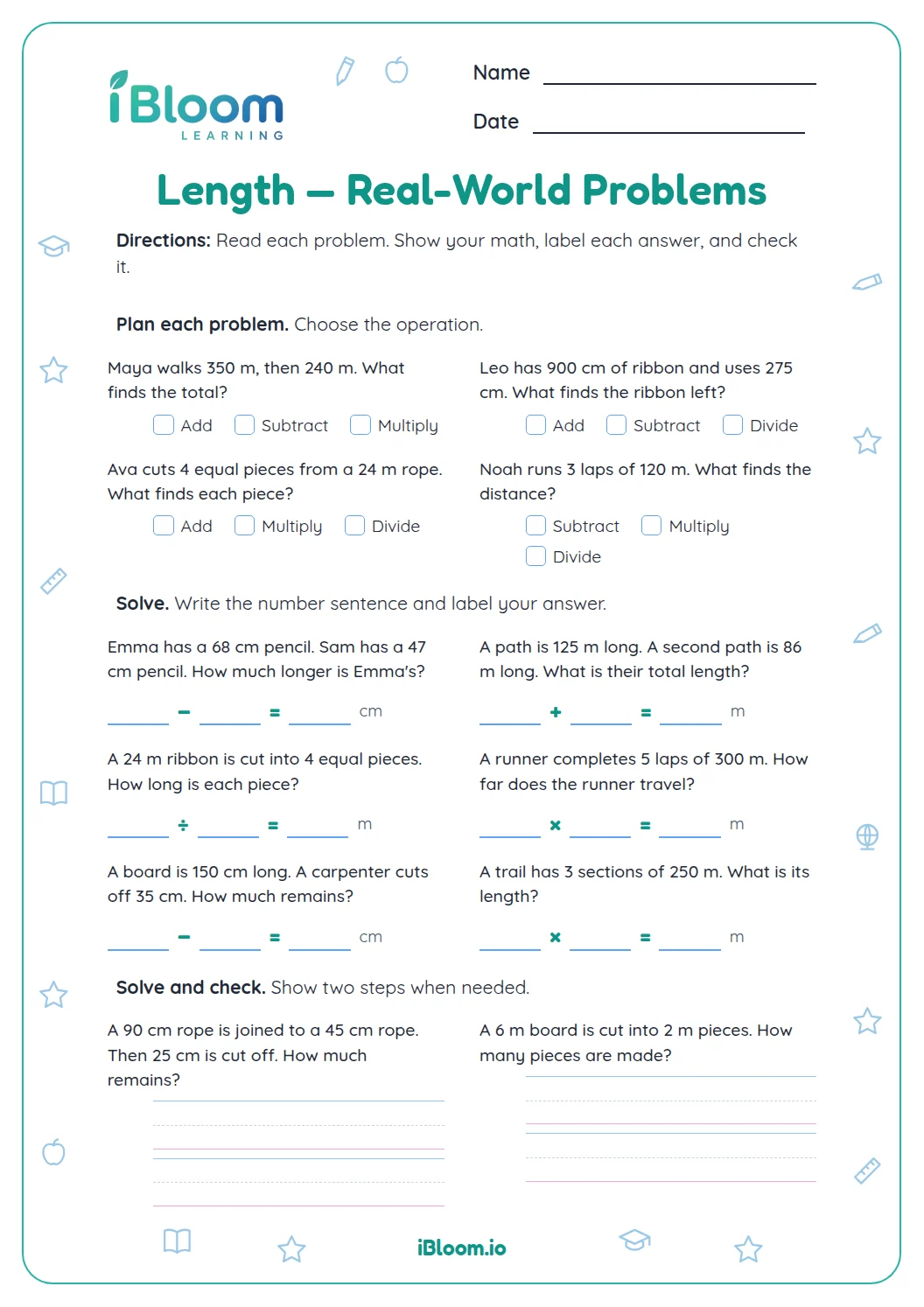
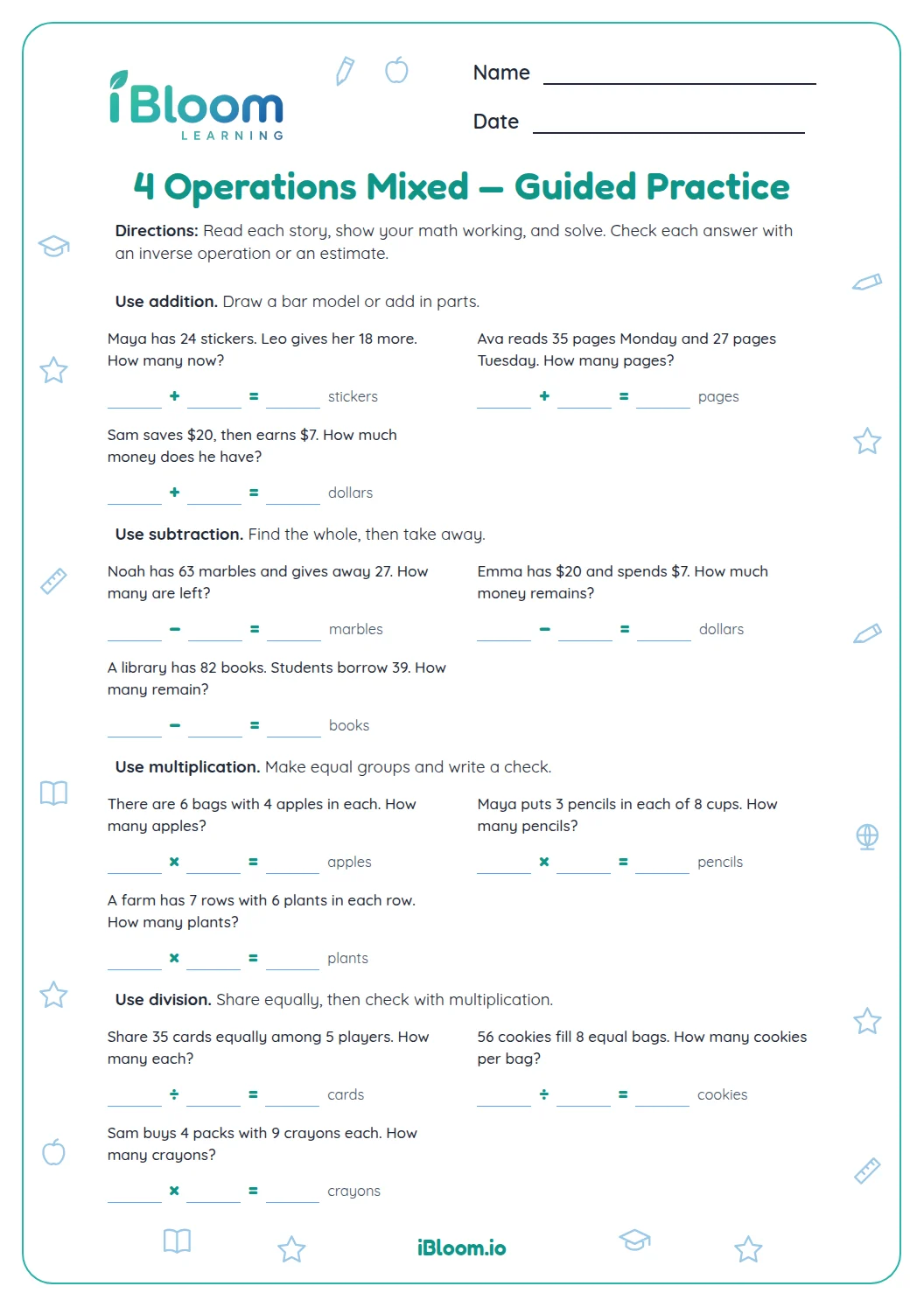
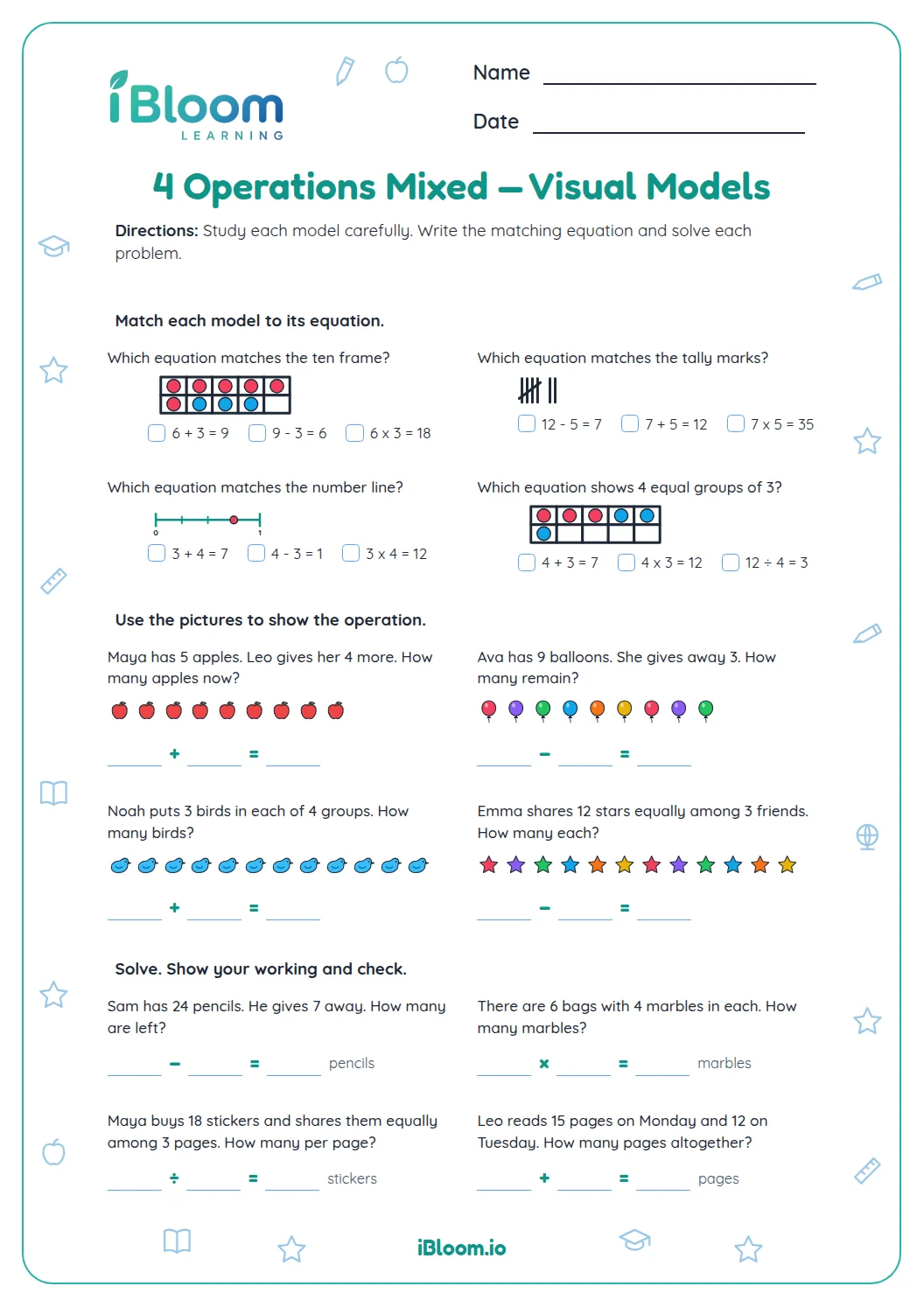
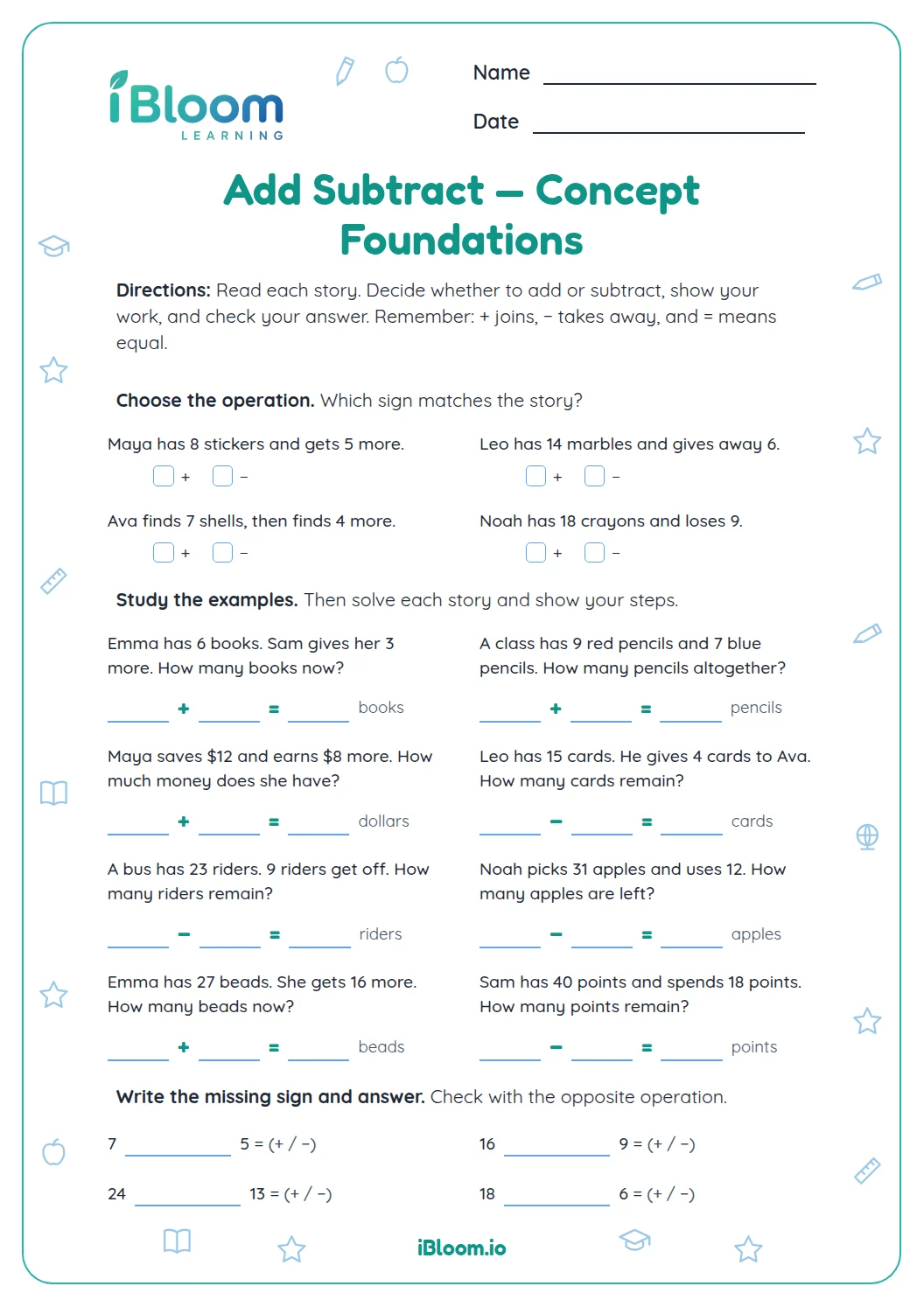
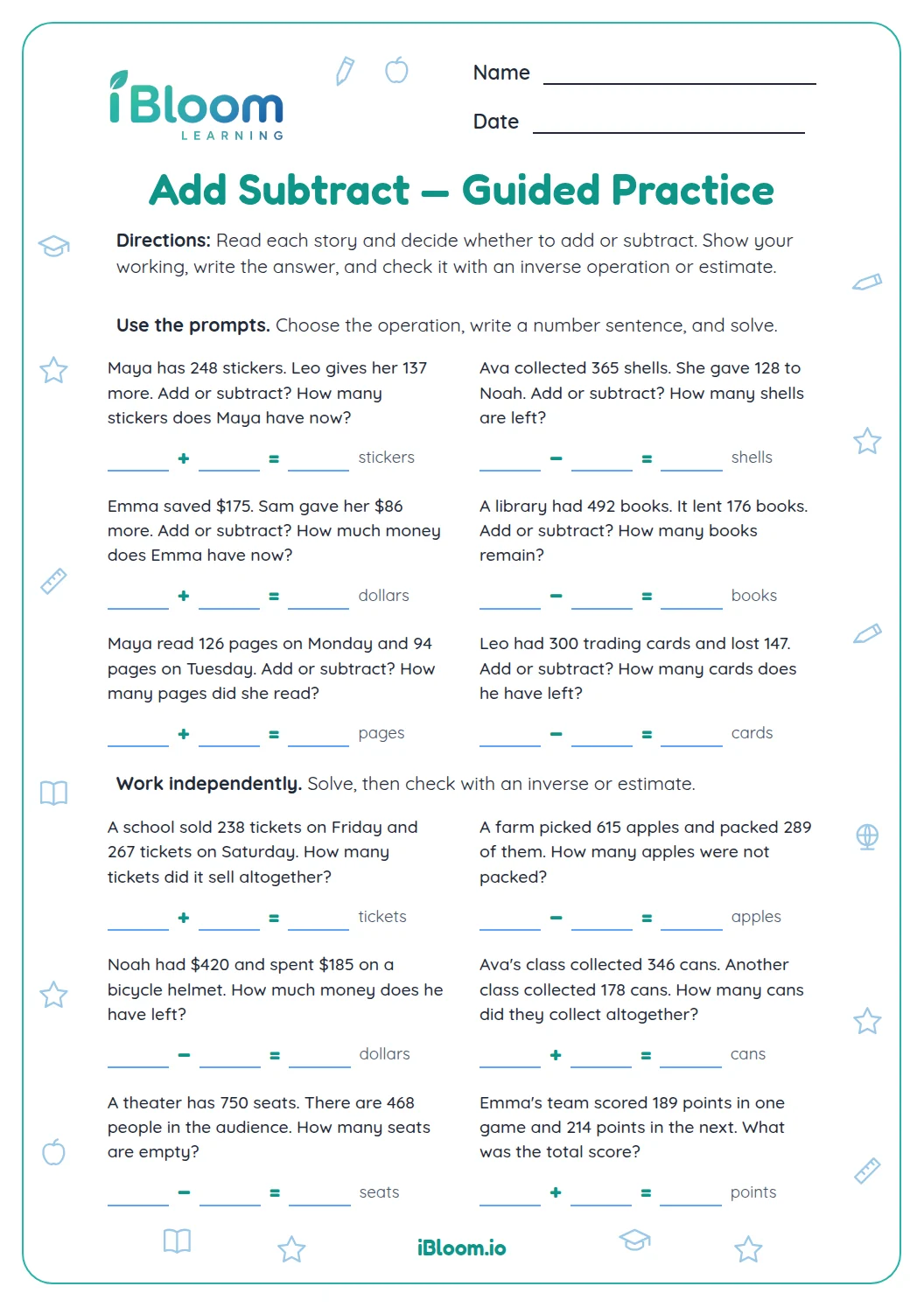
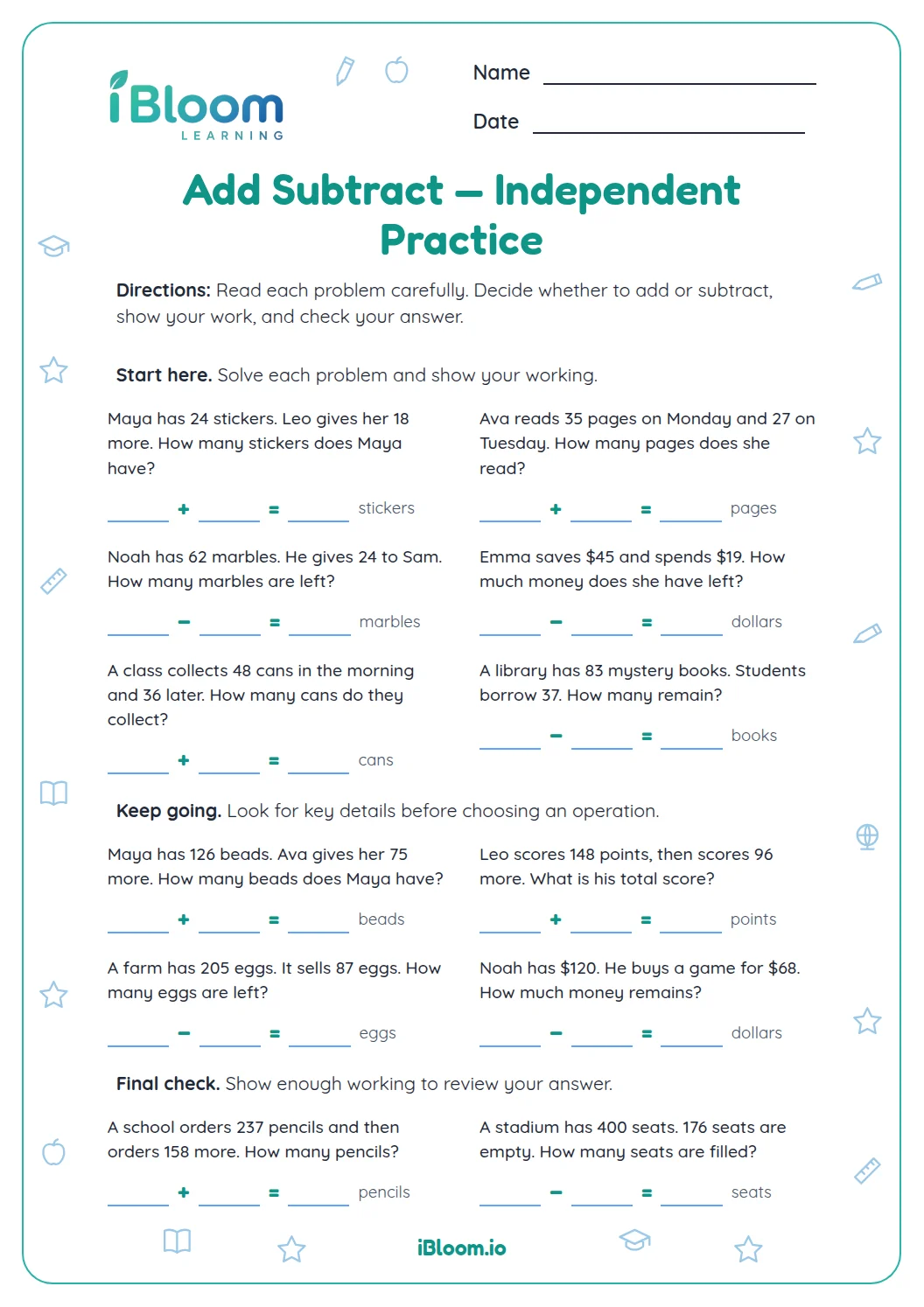
This printable gives Grade 3 students 14 length stories that ask them to compare, combine, split, or find a remaining distance. Students write an equation and result with the matching unit. The problems practice Common Core 3.NBT.A.2 and 3.OA.A.3. A separate answer key shows each calculation.
Aligned to 3.NBT.A.2 and 3.OA.A.3
What is each problem asking you to find?
Length stories may ask for a total, a difference, or the size of equal groups. Underline the lengths and the question, then decide what relationship connects them. Keep the unit in the final answer.
How can an equation organize the steps?
An equation makes the operation visible before the arithmetic begins. In a comparison story, subtract the shorter length from the longer one. In an equal-groups story, multiply or divide depending on what is unknown.
- 1Trail: 48 meters; loop: 19 meters
- 2Find how much longer: 48 − 19
- 348 − 19 = 29
- 4Answer: 29 meters
How do you check a length answer?
Estimate whether the answer is a sensible size, then reread the question. A difference should be less than the larger length; a total should be greater than either part. Include the unit from the story.
How to use this worksheet
- 1Read the final question before calculating.
- 2Underline the lengths and circle the unit.
- 3Choose addition, subtraction, multiplication, or division.
- 4Write an equation, then calculate carefully.
- 5Check the answer against the story and include the unit.
Common mistakes and fixes
The mistake
Adding when the question asks how much longer.
The fix
Compare by subtracting the shorter length from the longer one.
The mistake
Using a unit that was not in the story.
The fix
Copy the given unit into the final answer.
The mistake
Stopping after the first operation in a two-step story.
The fix
Reread the question to see whether another step is needed.
Common Core alignment
Add and subtract within 1,000 to find totals, differences, and remaining lengths.
On this sheet: Several length stories require adding or subtracting measurements within 1,000.
Show the official wordingHide the official wording
Fluently add and subtract within 1000 using strategies and algorithms based on place value, properties of operations, and/or the relationship between addition and subtraction.
Use multiplication and division to solve equal-group and measurement word problems.
On this sheet: Equal-group length problems use multiplication or division with an unknown measurement.
Show the official wordingHide the official wording
Use multiplication and division within 100 to solve word problems in situations involving equal groups, arrays, and measurement quantities, e.g., by using drawings and equations with a symbol for the unknown number to represent the problem.
What to practice next
Make more practice
Further reading
Questions parents and teachers ask
What kinds of length problems are included?
The 14 problems use addition, subtraction, equal groups, and sharing to find lengths. Each question names one unit and the answer keeps that same unit, so children can focus on choosing an operation and solving. The stories use meters or centimeters, and each answer keeps the unit named in its question.
Does the worksheet include unit conversions?
Each problem uses a single familiar unit throughout. Children add, subtract, multiply, or divide lengths that are stated in that unit. Children can underline the lengths and circle the question before choosing an operation. Each story gives all measurements in a single unit for straightforward arithmetic.
Should children write an equation?
Yes. Children may write an equation before giving the short answer. For example, a trail of 48 meters and a loop of 19 meters can be compared with 48 − 19 = 29. For equal groups, multiplication finds a total and division finds one group size.
How can I help a child choose an operation?
Ask what the problem is asking for. “Altogether” may suggest combining lengths, “how much remains” suggests subtraction, and equal pieces may call for multiplication or division. The child should still check the full story before choosing. The worksheet includes totals, comparisons, equal groups, and lengths left over.
Are the numbers appropriate for Grade 3?
The problems use whole-number lengths and multiplication or division within familiar facts, alongside addition and subtraction. Answers use meters or centimeters, with the same unit kept from the story. Each problem keeps one unit throughout, so the number operation is the main decision.
Is there an answer key?
Yes. The answer key is on its own page and gives the answer with the unit for each problem. Children can use it to check both the calculation and whether they answered the question being asked. The key includes the equation, calculation, and unit for each problem.