

About this worksheet
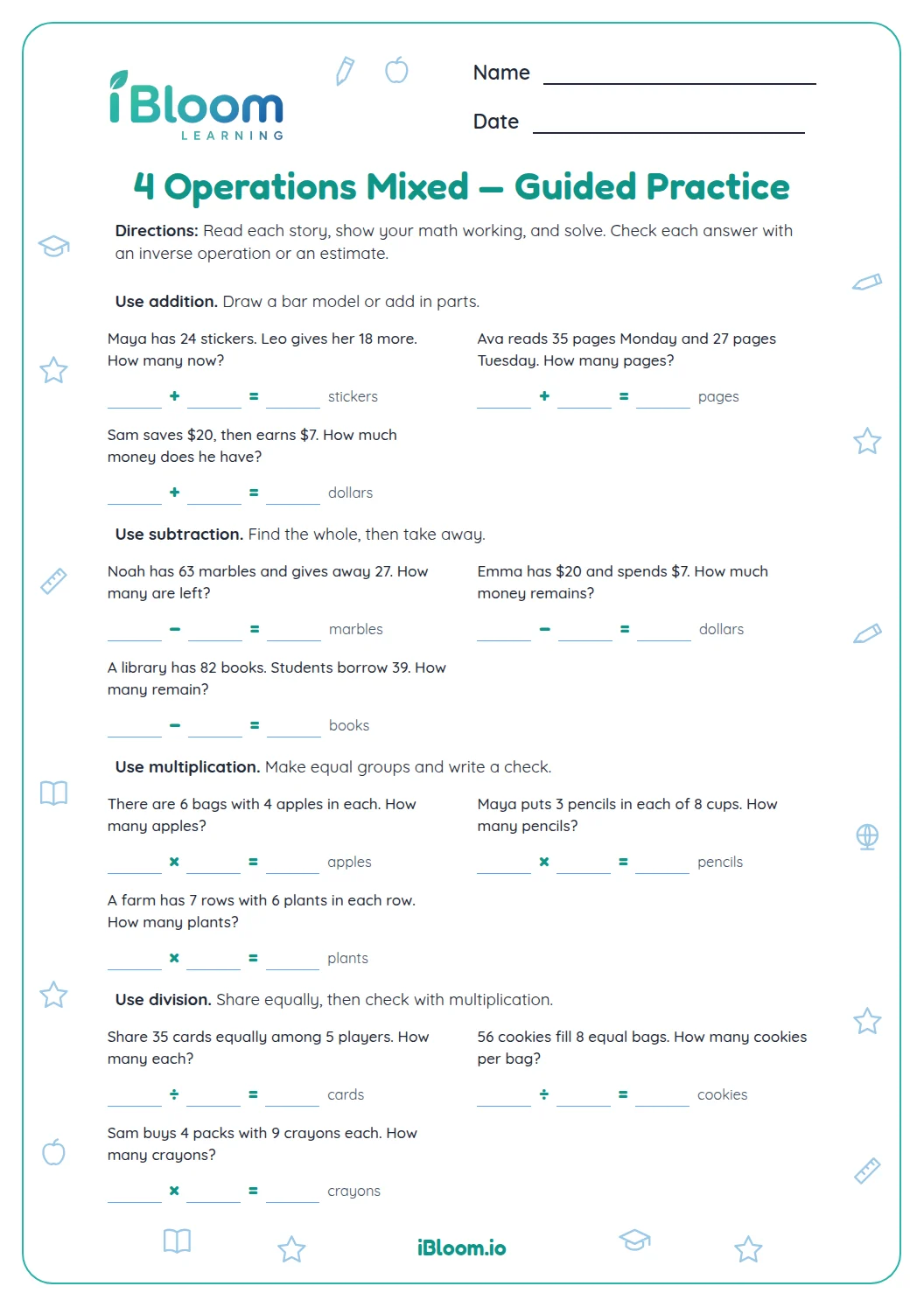
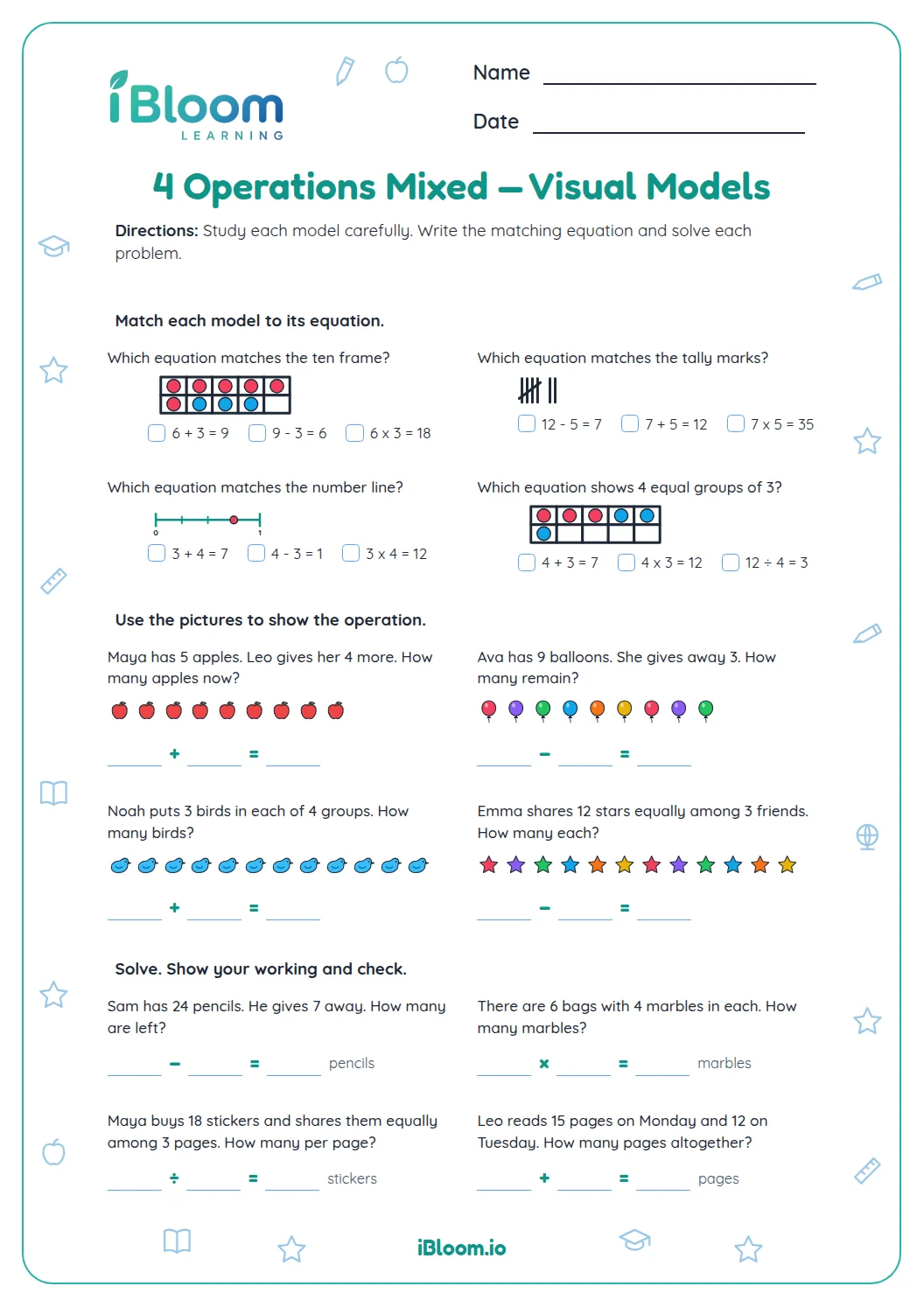
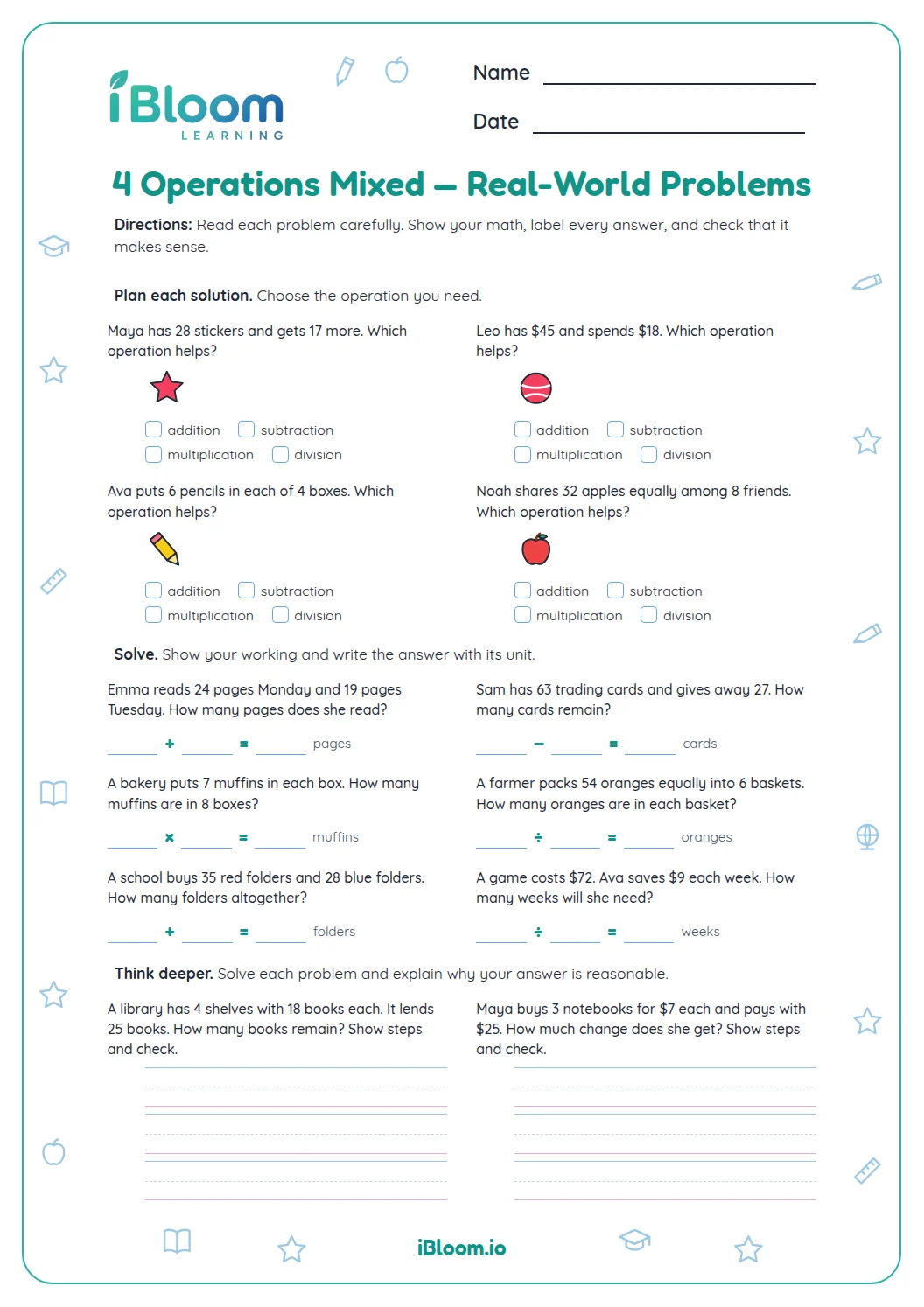
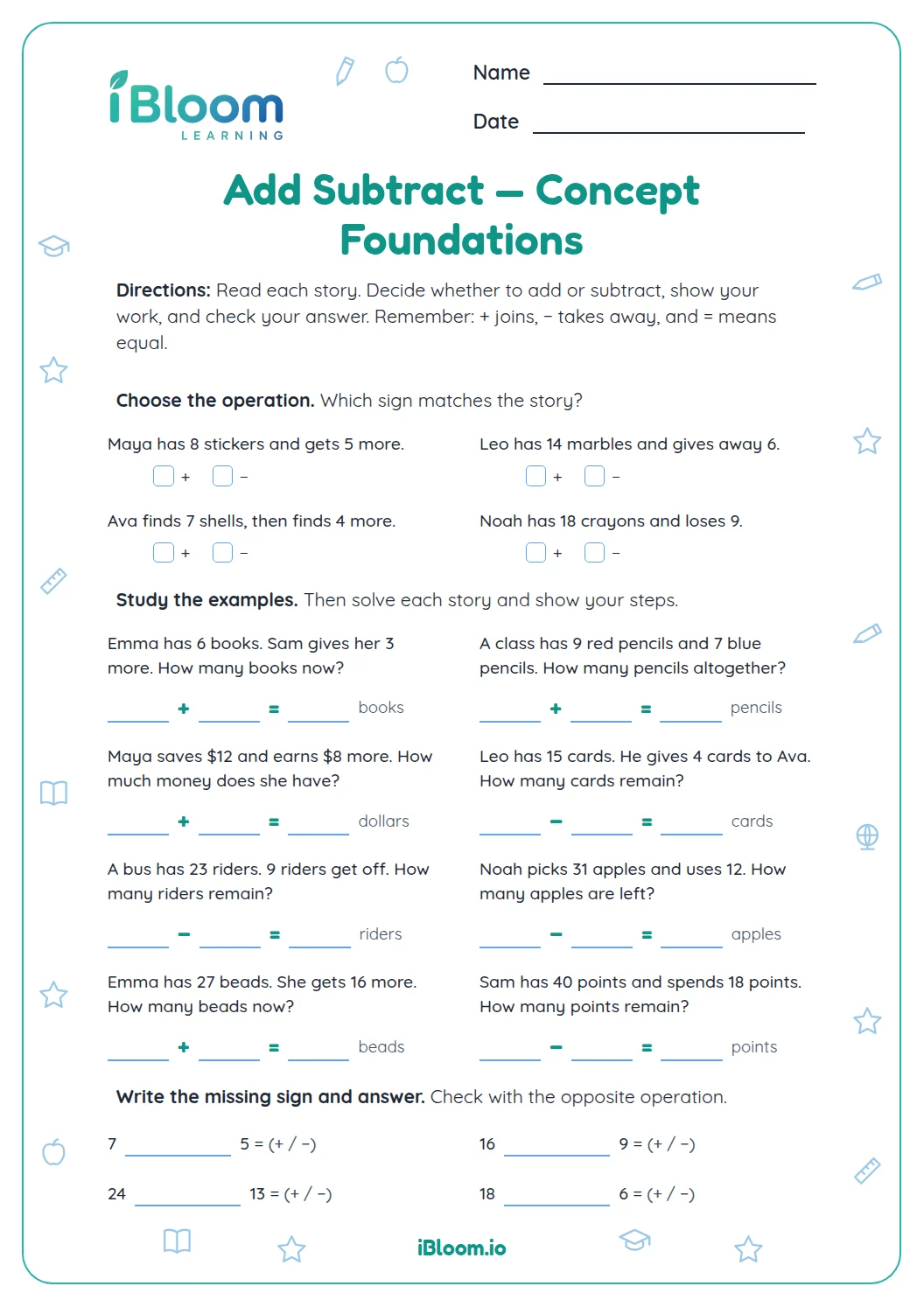
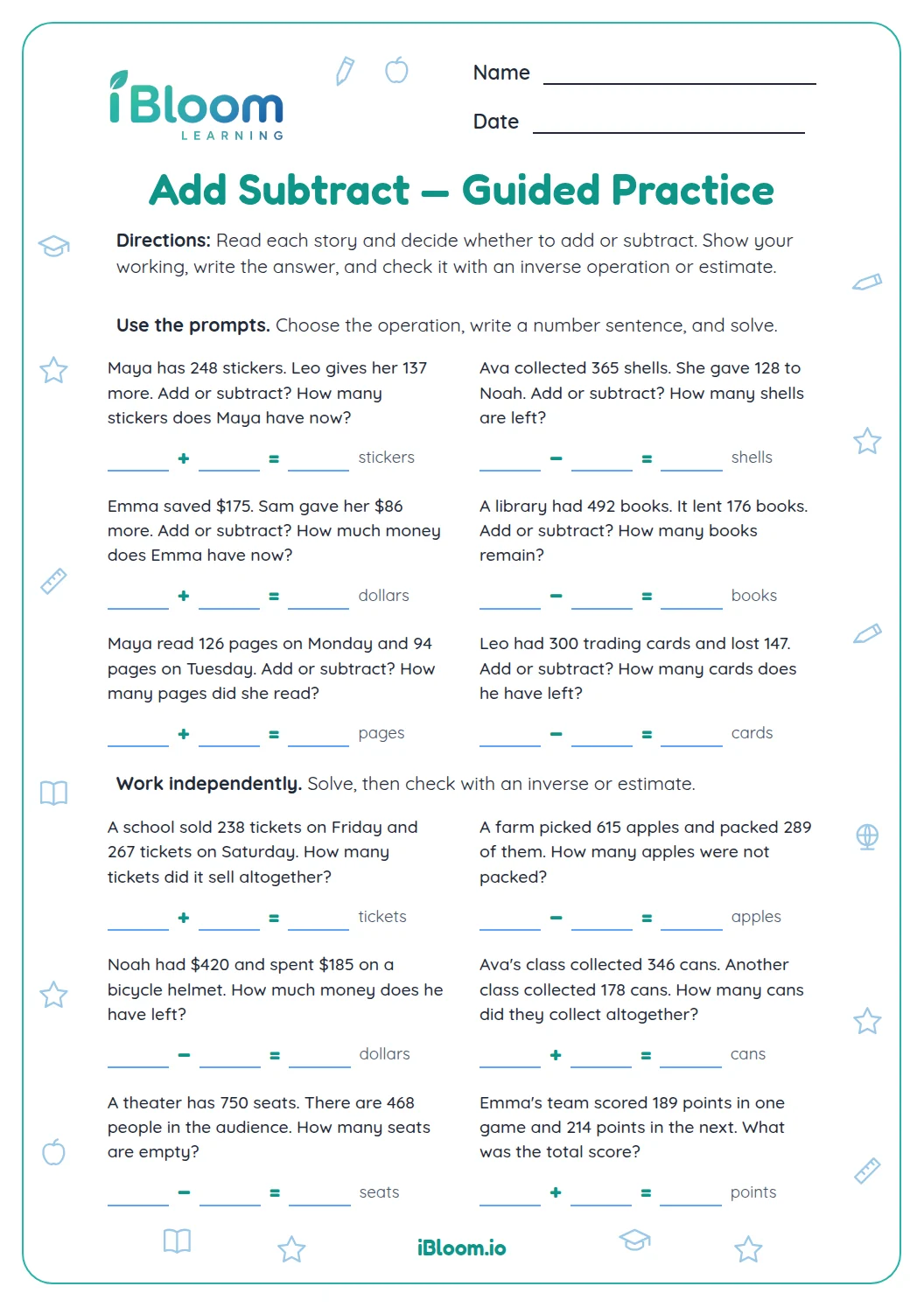
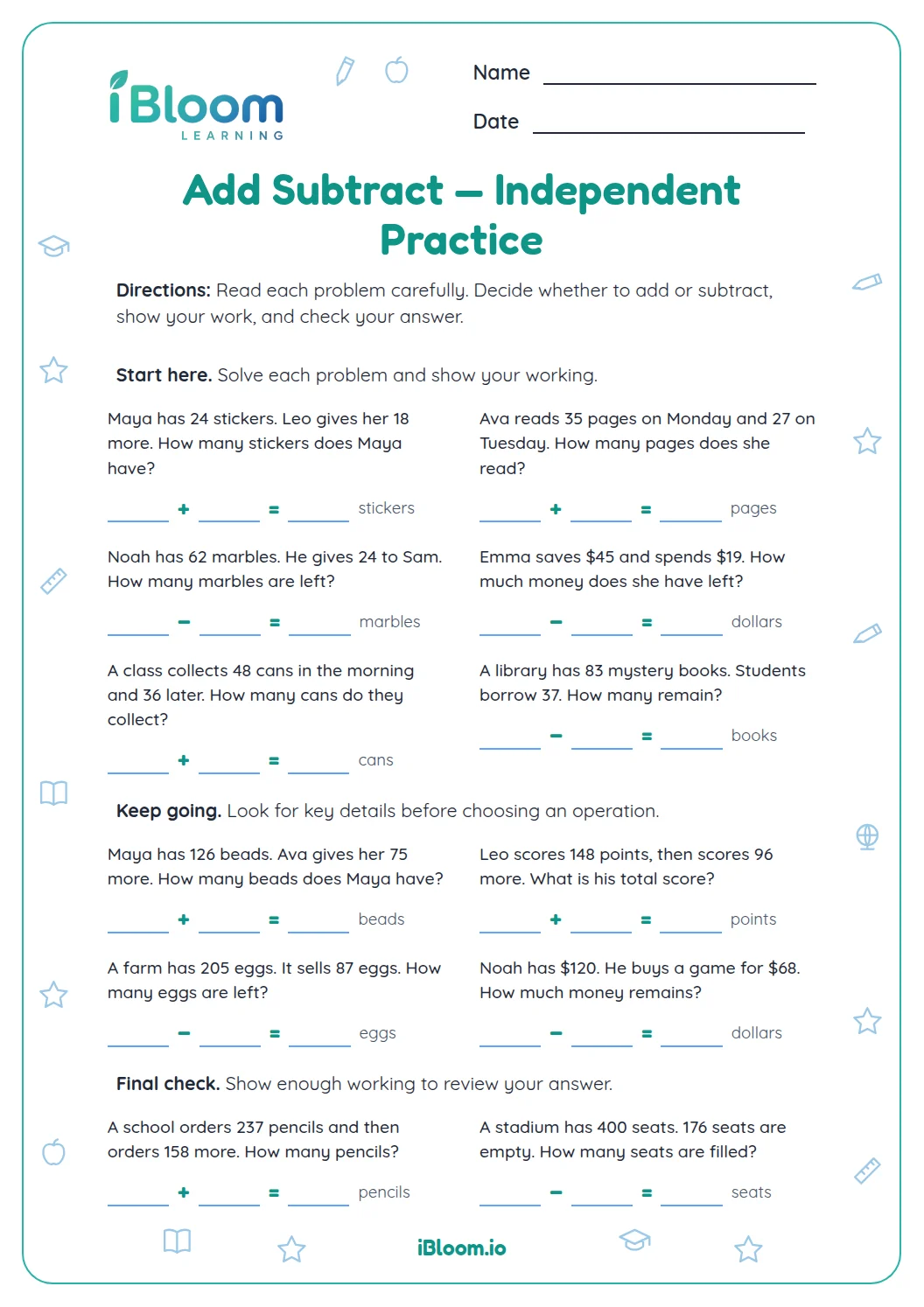
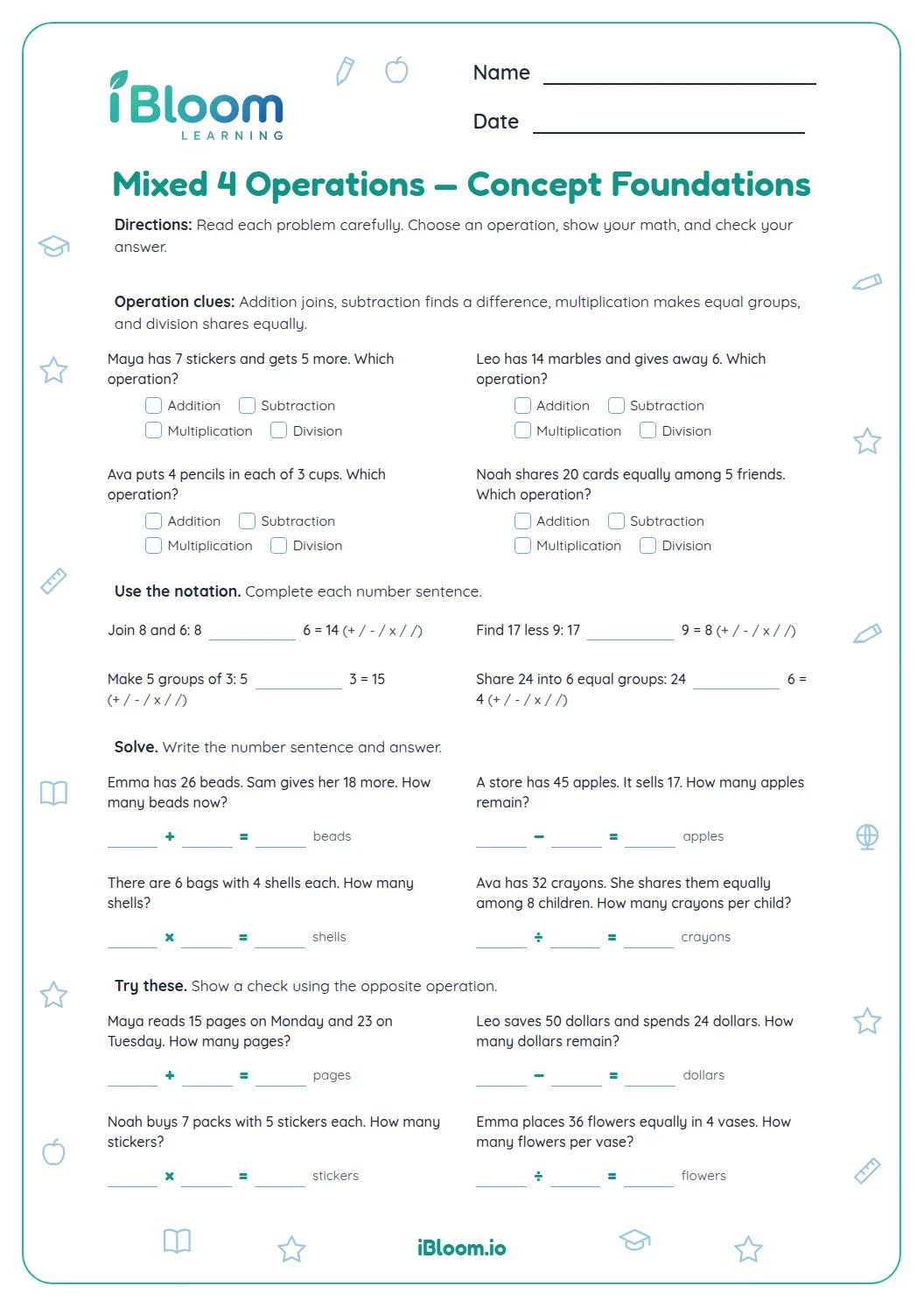
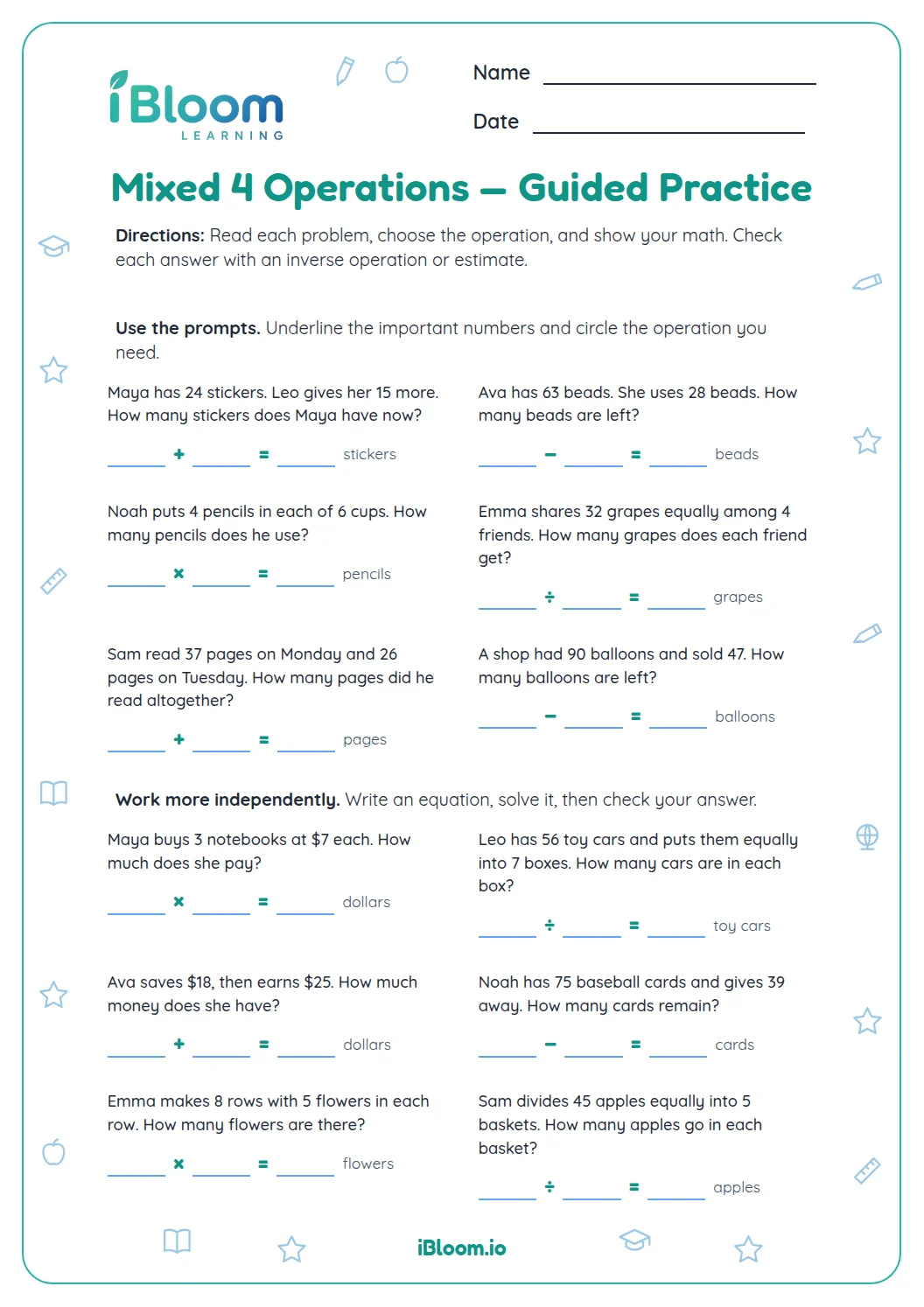
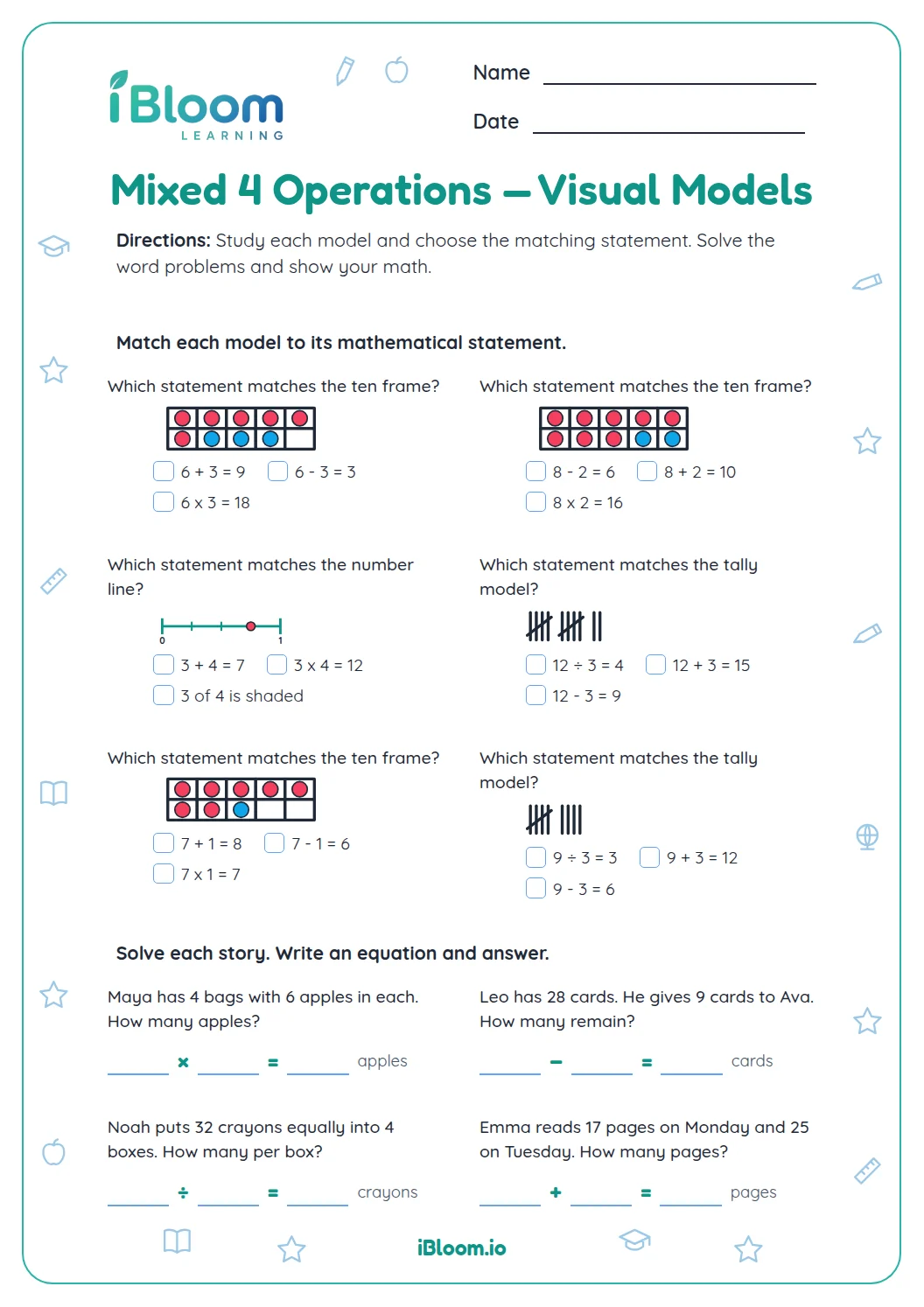
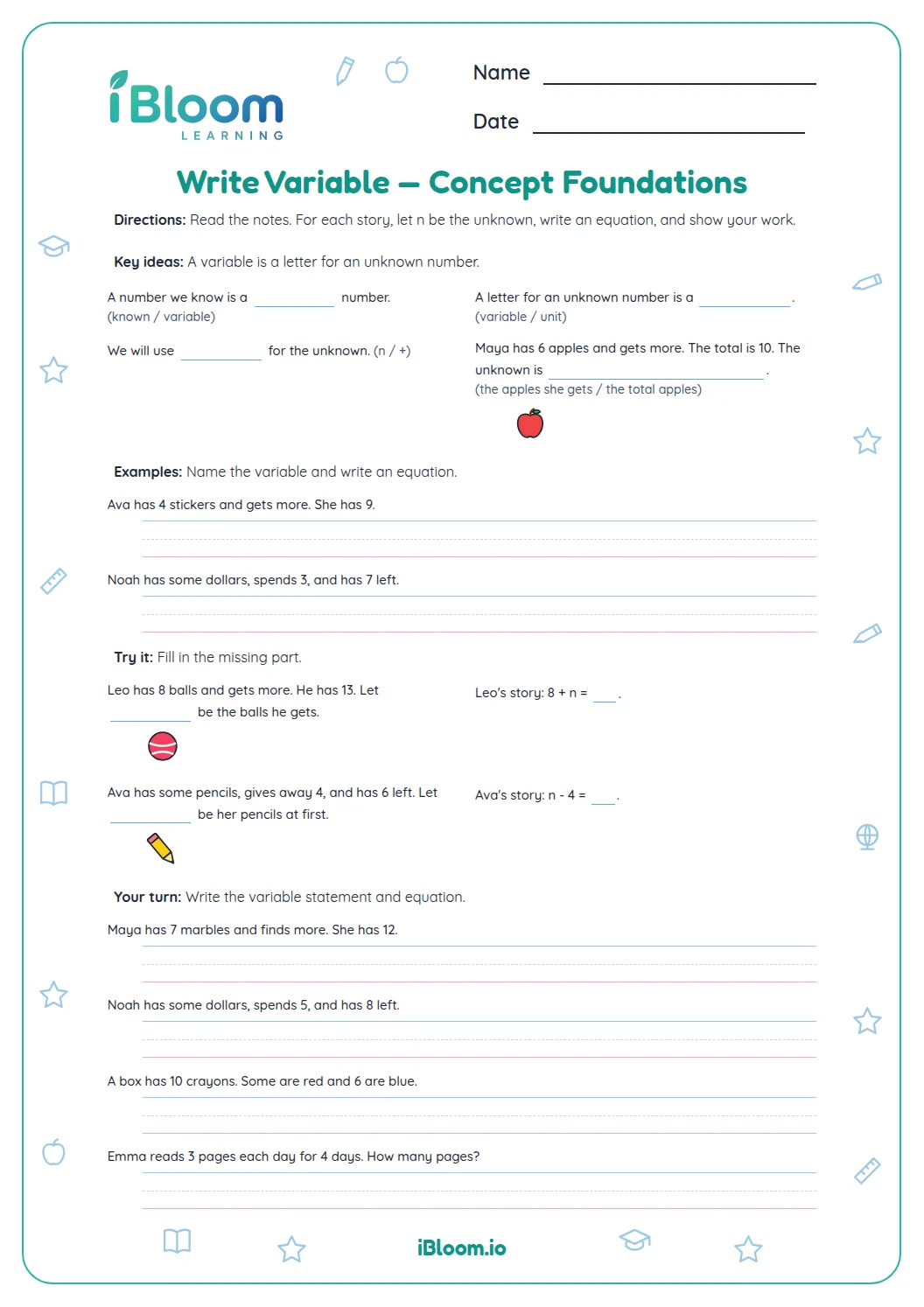
This free Grade 3 worksheet teaches children to match a story to addition, subtraction, multiplication or division. Fourteen questions move from expression choices to one-step and two-step stories. Children decide what each quantity means, solve, and check whether an answer fits the situation. The final stories combine operations and represent an unknown with n.
Aligned to 3.OA.A.3 and 3.OA.D.8
What should children notice before choosing a sign?
A story tells how quantities are related. Joining 18 cards and 7 new cards calls for addition. In the seats problem, 32 is the total and 9 is the unused part, so subtract to find the part in use.
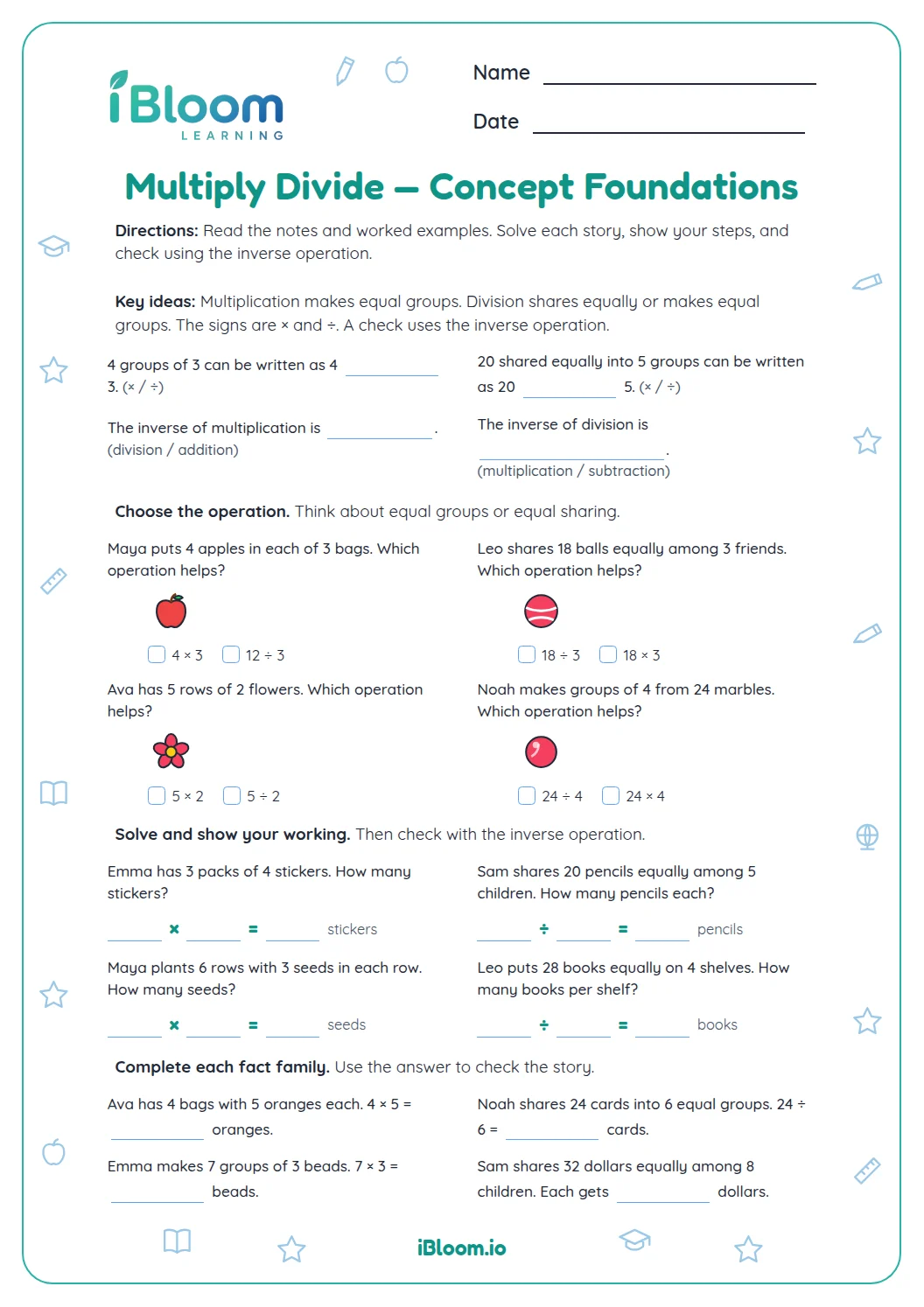
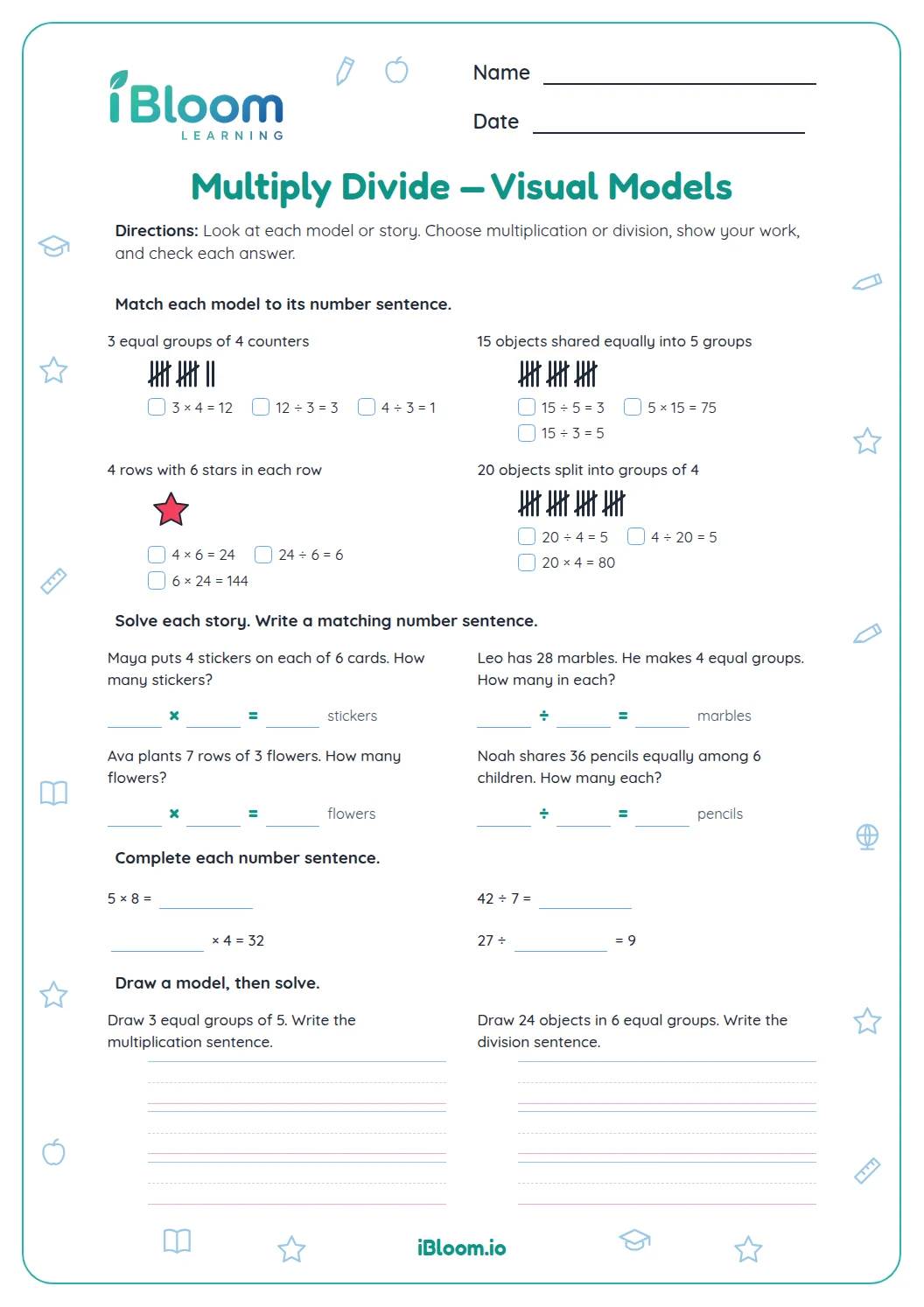
For equal groups, distinguish the total from a group size. Four bags with 6 apples each give 4 × 6. Sharing 28 beads among 7 children uses 28 ÷ 7 to find one share.
Does the word “more” always mean add?
For equal groups, multiply the number of groups by the amount in each group. For equal sharing, divide the total by the number of groups. Keep the unit in your answer so “8 boxes” and “8 muffins” do not get confused.
- 1Zoe: 54 shells; Eli: 38 shells
- 254 − 38 = 16
- 3Check: 38 + 16 = 54
- 4Zoe has 16 more shells.
How do the final stories use two steps?
For q12, write 18 + 14 = 4 × n; n = 8 flags. Check by multiplying 4 × 8 to recover 32. For q13, round the groups and blocked seats to estimate before checking the exact result of 60 seats.
How to use this worksheet
- 1Read the first story and ask which amount is unknown.
- 2Have your child explain one equation choice in Part A before marking it.
- 3For Part B, label the total, group size or difference in the story.
- 4Write a number sentence and include the object name in each answer.
- 5Use n in Part C, then check by counting back, multiplying shares or estimating.
Mistakes to notice and fix
The mistake
Adding 54 and 38 because the shells question says “more.”
The fix
Compare the two collections: 38 + 16 = 54, so the difference is 16.
The mistake
Subtracting 7 once when sharing 28 beads among 7 children.
The fix
Seven children need equal shares. Ask what number times 7 makes 28.
The mistake
Subtracting 5 from 8 before finding all the rolls in question 11.
The fix
Find the total in the three bags first: 24. Then take away the five rolls sold.
Common Core alignment
Use equal groups to choose multiplication or division in short stories.
On this sheet: Children solve equal-group and sharing problems with products and dividends within 100.
Show the official wordingHide the official wording
Use multiplication and division within 100 to solve word problems in situations involving equal groups, arrays, and measurement quantities, e.g., by using drawings and equations with a symbol for the unknown number to represent the problem.
Solve two-step stories, write an equation with n, and check the result.
On this sheet: Part C combines operations and asks for an equation with n and a mental check.
Show the official wordingHide the official wording
Solve two-step word problems using the four operations. Represent these problems using equations with a letter standing for the unknown quantity. Assess the reasonableness of answers using mental computation and estimation strategies including rounding.
What to practice next
Make more practice
Further reading
Questions parents and teachers ask
Which operations are included?
All four operations appear in the worksheet. Part A gives one equation-choice question for addition, subtraction, multiplication and division. Part B mixes joining, taking away, comparing, grouping and sharing. Part C combines multiplication with subtraction, then addition with division, so children must attend to the whole situation.
Should children solve the first four questions?
Children only need to mark the matching expression in Part A. Ask them to explain what each number represents before calculating anything. For example, in the apples question, 4 counts the bags and 6 counts the apples in each bag. Calculating the total afterward is a useful oral check.
How should my child write the two-step equations?
Use n for the unknown answer in Part C. For the rolls, write 3 × 8 − 5 = n; for the flags, write (18 + 14) ÷ 4 = n. Children can do the calculations in two smaller steps before combining them into one equation.
How can we check the division answers?
Multiply the answer by the number of groups or the size of each group. Seven stickers for each of six children gives 42 stickers, matching question 8. In question 10, seven boxes with five books each gives 35 books. The check should recreate the original total.
What does the answer key include?
The key marks the four expression choices and gives the ten story answers with units. Review the child’s working as well as the final number. For the two-step questions, ask the child to point to the story details that show which operation comes first.