

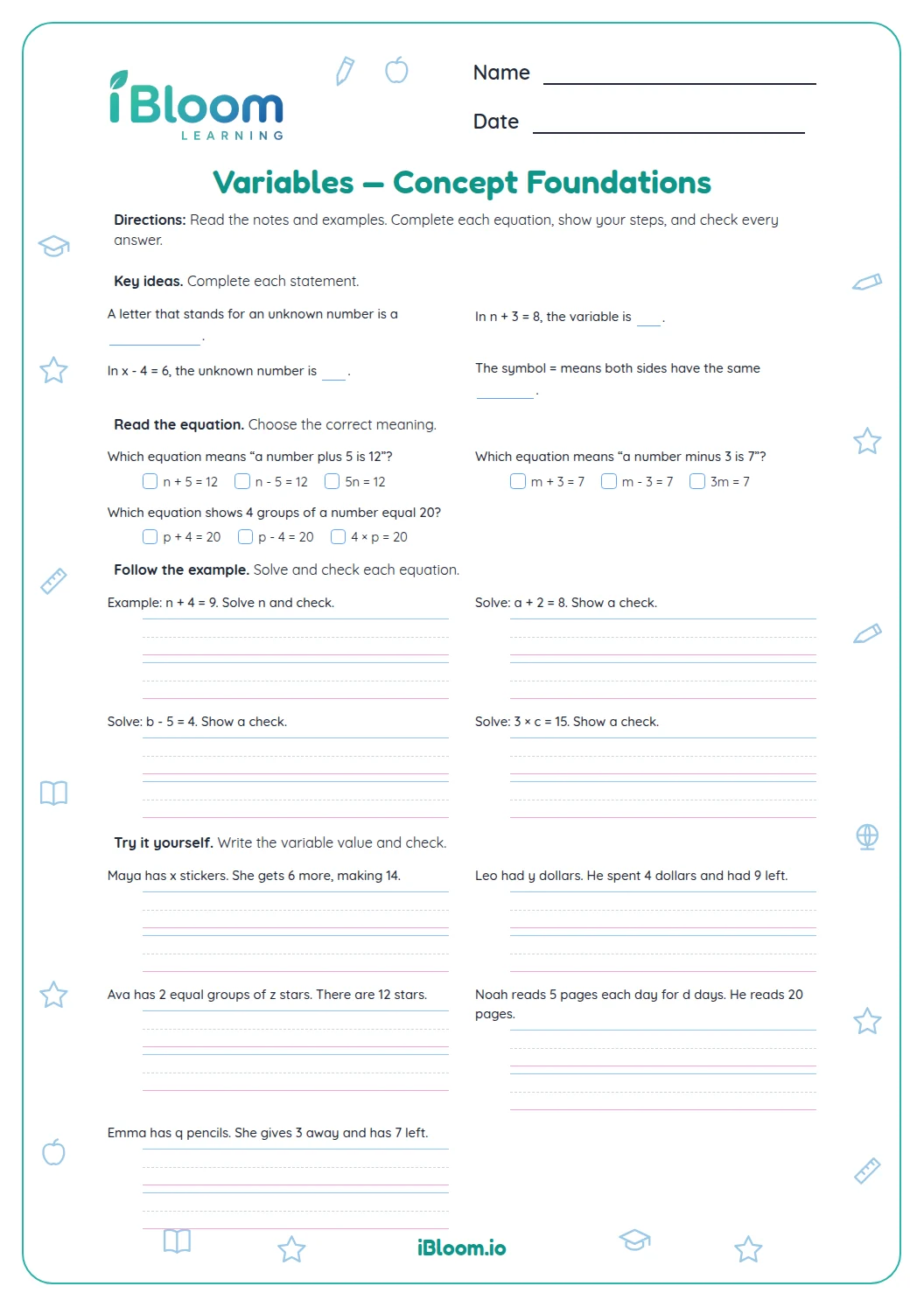
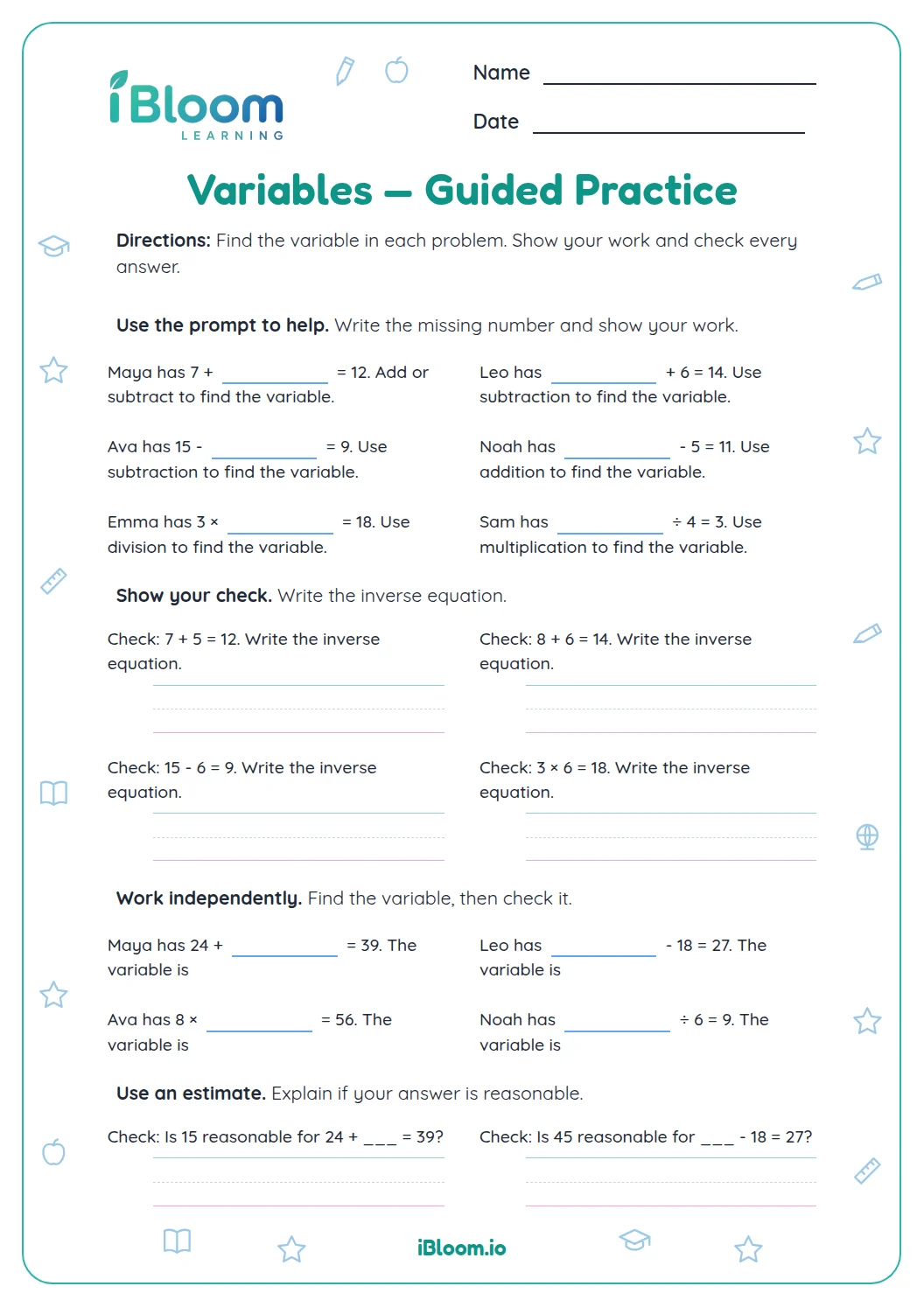
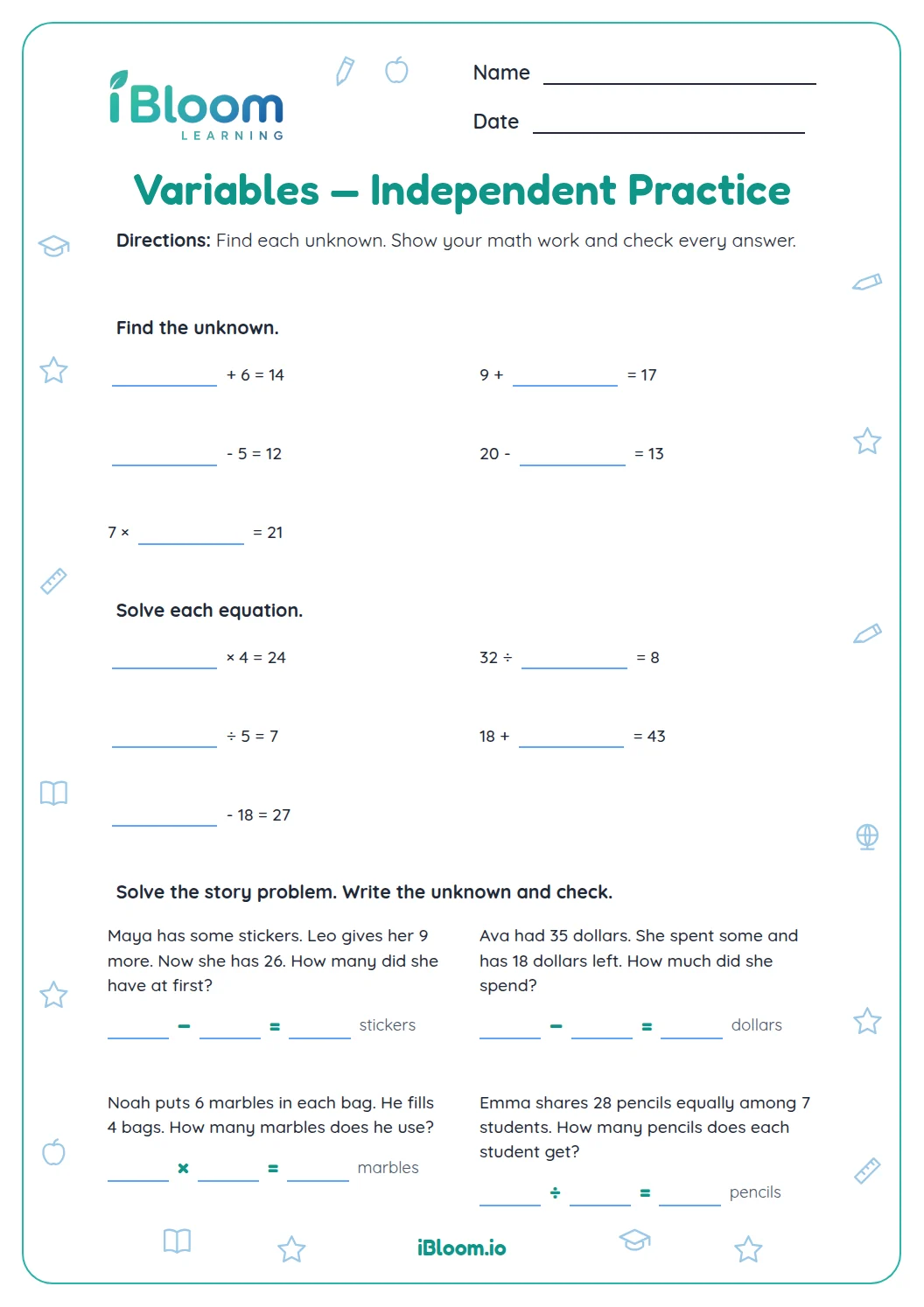
About this worksheet
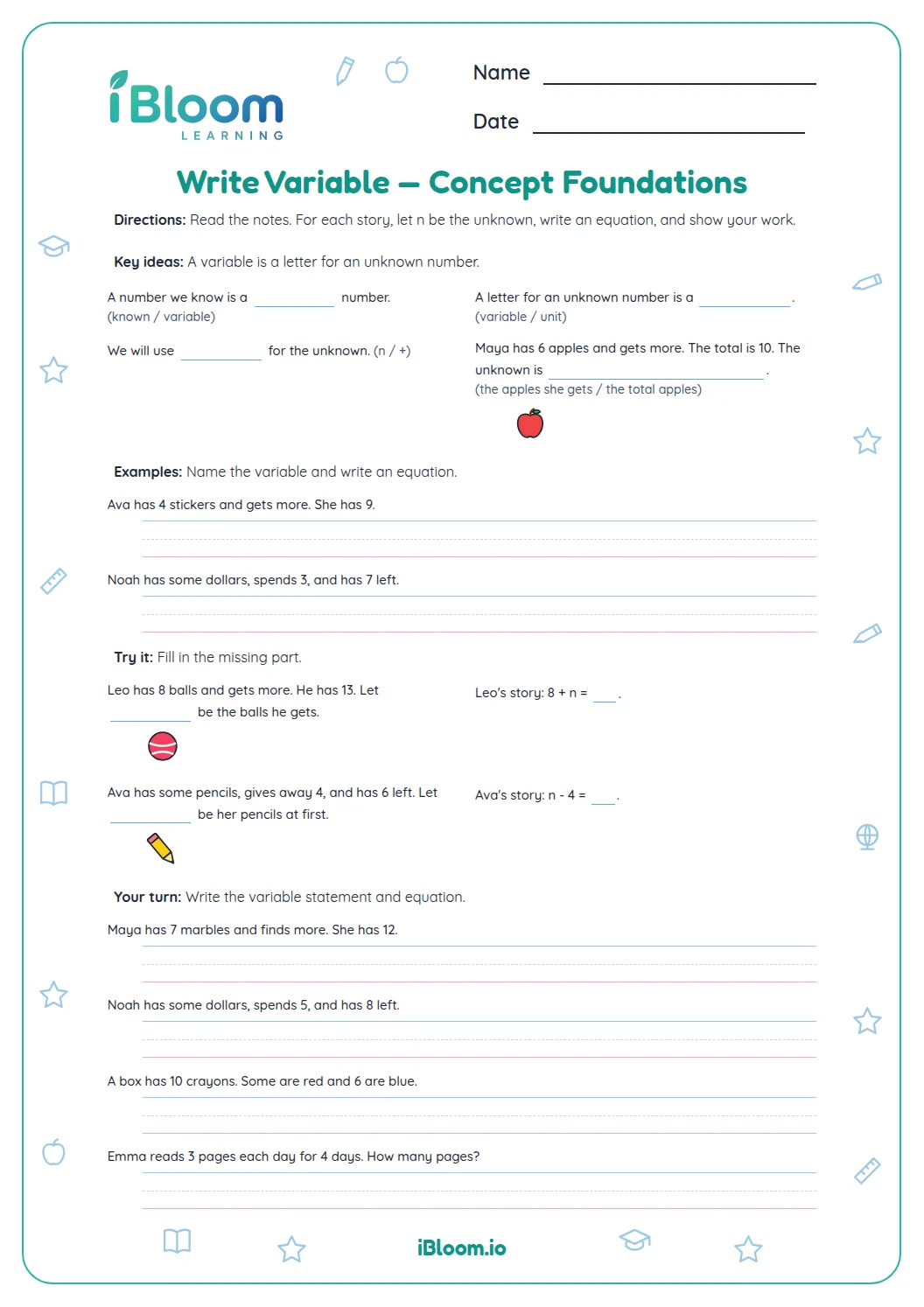
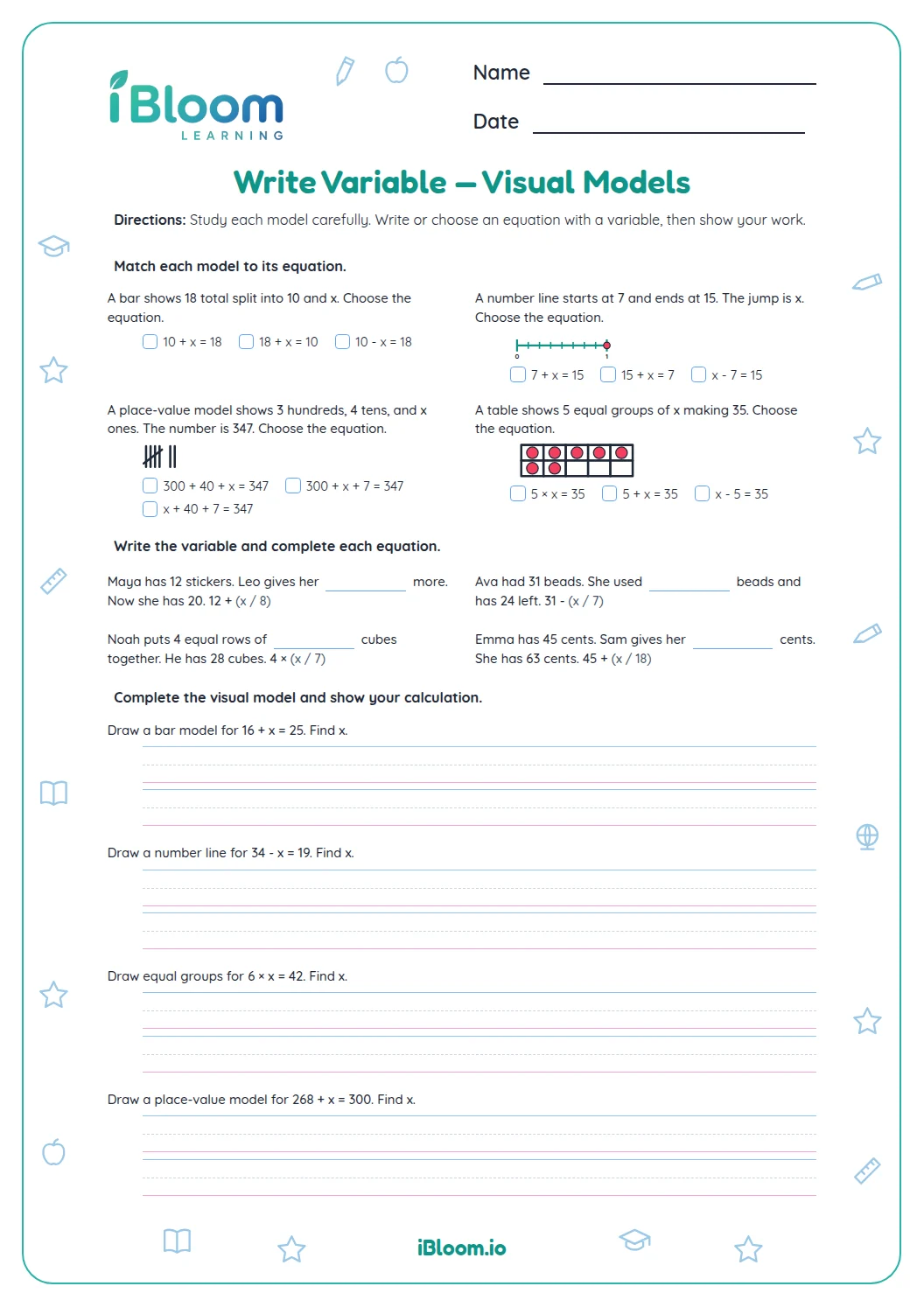
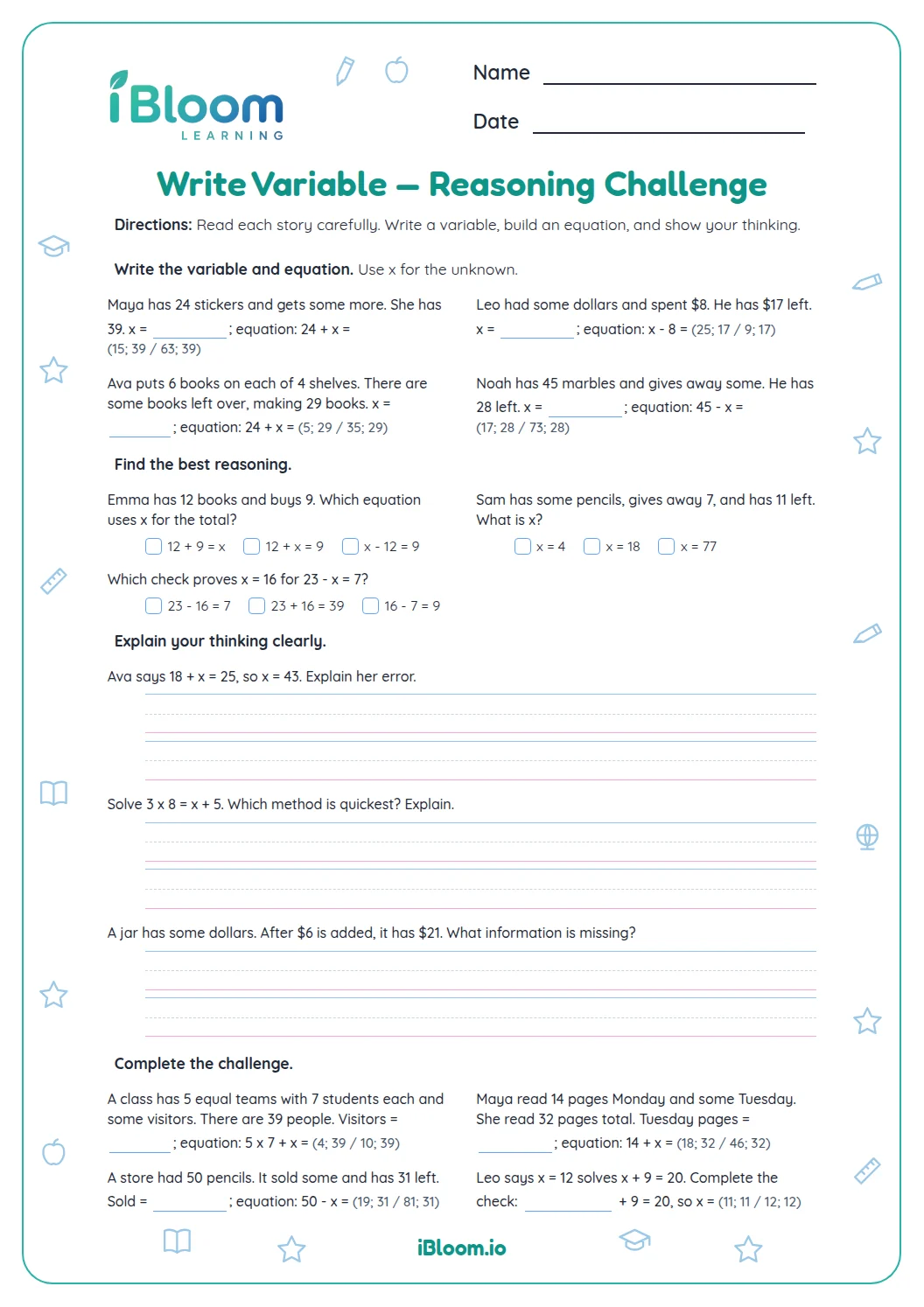
This Grade 3 guided practice uses 16 short stories to connect unknown quantities with equations. Children translate each story to a one-step equation with a single missing value, then solve; concise number sentences leave room to reason without large working grids. The answer key provides every missing value.
Aligned to 6.EE.B.7
How does a letter stand for an unknown?
This Grade 3 guided practice uses 16 short stories to connect unknown quantities with equations. Children translate each story to a one-step equation with a single missing value, then solve; concise number sentences leave room to reason without large working grids. The answer key provides every missing value.
- 1Let s = shells added
- 29 + s = 17
- 3s = 8; check: 9 + 8 = 17
How can the story suggest an operation?
Part A finds an added amount and Part B finds an amount taken away. Keep the story’s total and starting amount in their correct places when writing the equation.
How do you check the equation?
Parts C and D use equal groups and equal sharing. Decide whether the unknown is the number in each group or how many groups there are, then use multiplication or division to solve.
How can you use this worksheet?
- 1Read the final question and name what is unknown.
- 2Choose a letter and label what it represents.
- 3Write an equation that uses the known quantities.
- 4Solve for the letter.
- 5Substitute the answer to check, then include the unit.
Common mistakes and quick fixes
The mistake
Choosing the wrong quantity for the letter.
The fix
Write “Let x = …” before making the equation.
The mistake
Changing the order of quantities in a subtraction story.
The fix
Use the starting amount first, then subtract what changed.
The mistake
Giving a number without its unit.
The fix
Reread the story and name the matching objects or groups.
Common Core alignment
This practice connects the worksheet tasks to the stated Common Core skill.
Write and solve one-step equations for an unknown amount or group factor.
On this sheet: Students write and solve one-step addition and equal-group equations for the unknown.
Show the official wordingHide the official wording
Solve real-world and mathematical problems by writing and solving equations of the form x + p = q and px = q for cases in which p, q and x are all nonnegative rational numbers.
What to practice next
Make more practice
Further reading
Questions parents and teachers ask
What does “write a variable” mean in these stories?
A variable is a letter that represents an unknown number. In the first story, s stands for the extra shells: 9 + s = 17, so s equals 8 shells. Students write the equation before solving and check that the value makes the story true.
Do students need to use the same letter as the answer key?
The page has 16 short word problems in four parts. Students find an added amount, an amount taken away, a group size, or the number of equal groups. Each part has its own direction and the answer key lists a value with its unit.
What kinds of unknowns appear on the worksheet?
First identify what the story asks you to find. Use a letter for that quantity, write an equation that matches the known numbers and relationship, and solve it. Then substitute the value into the equation to check that both sides match.
How can a student check a variable equation?
The first two parts use addition and subtraction, while the last two use equal groups and equal sharing. The values stay within familiar whole-number facts, and each answer includes the unit named in its story, such as players or baskets.
How many questions and pages are included?
The worksheet has one page, with a separate one-page answer key. Its 16 items are grouped into addition, missing-addend, equal-group, and equal-sharing problems. The key gives the unknown’s value and matching unit for each story so the result can be checked.