

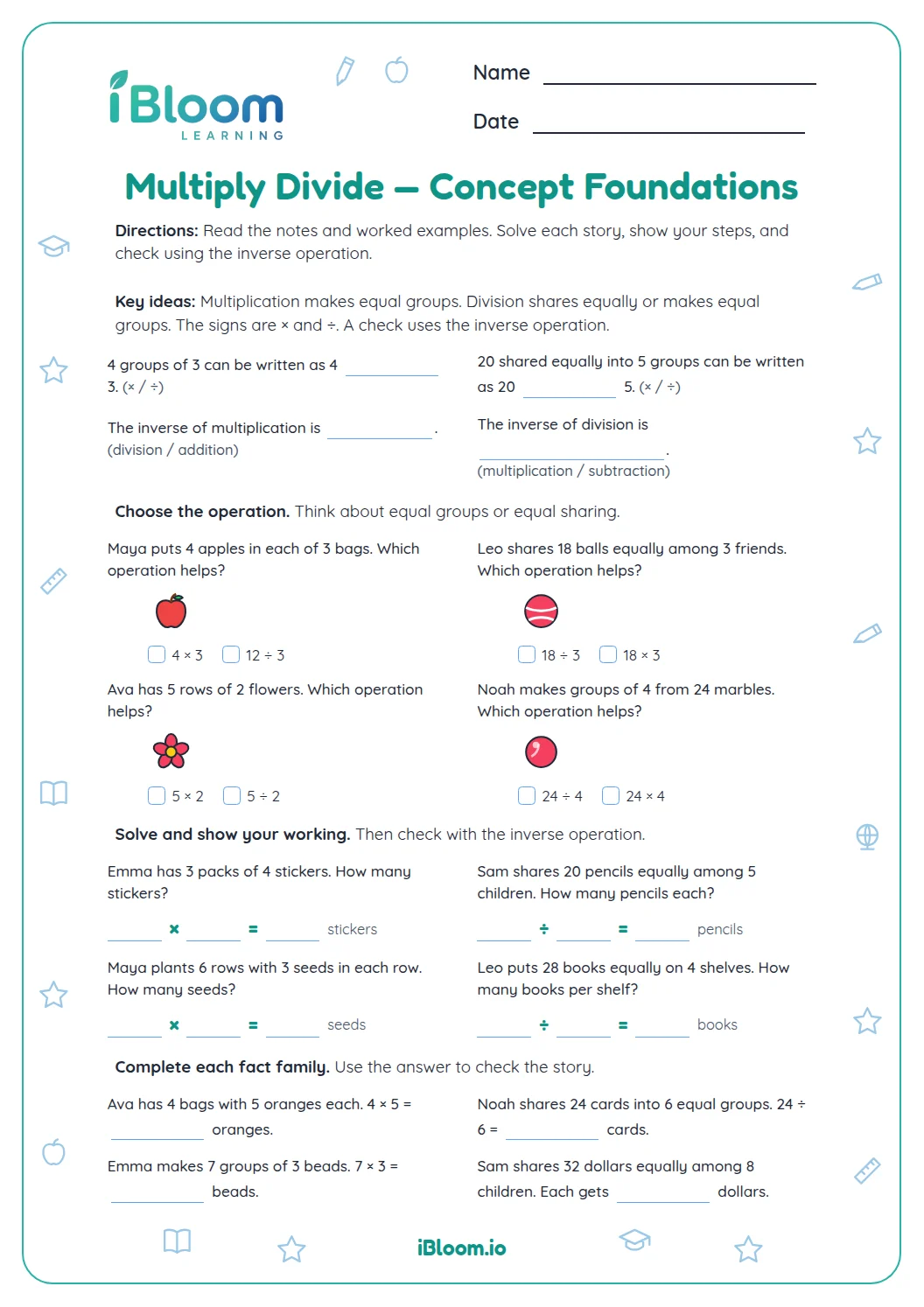
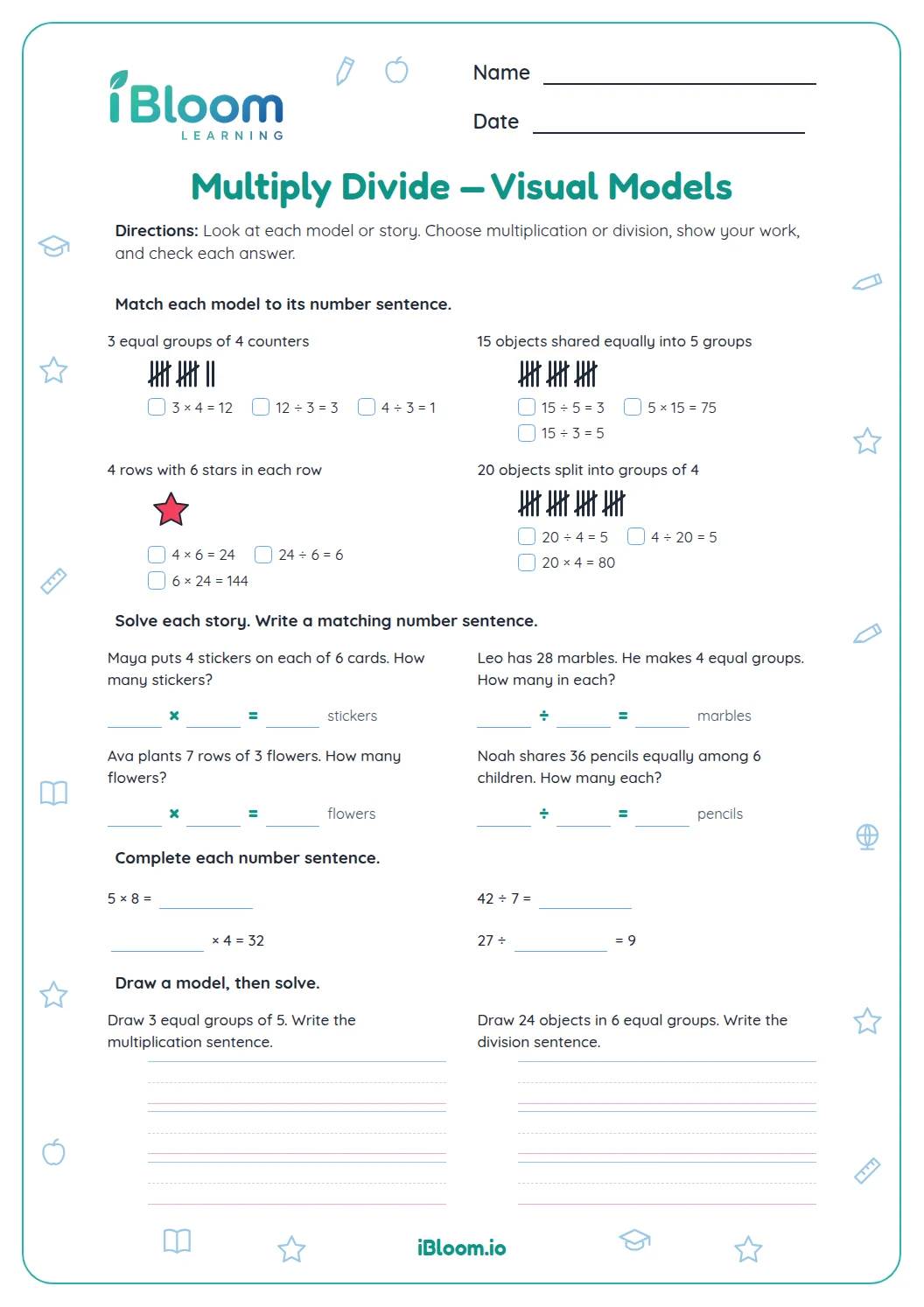
About this worksheet
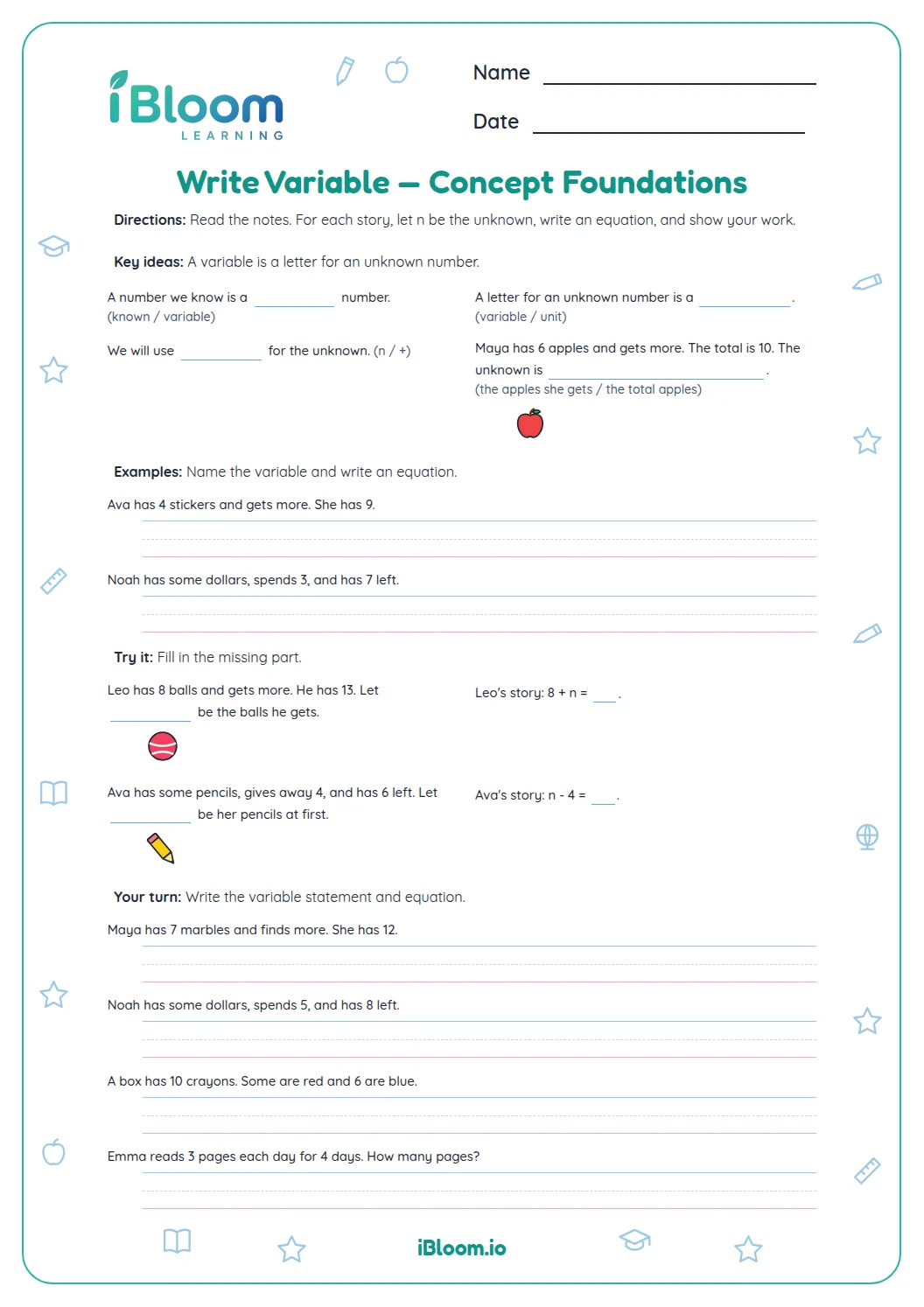
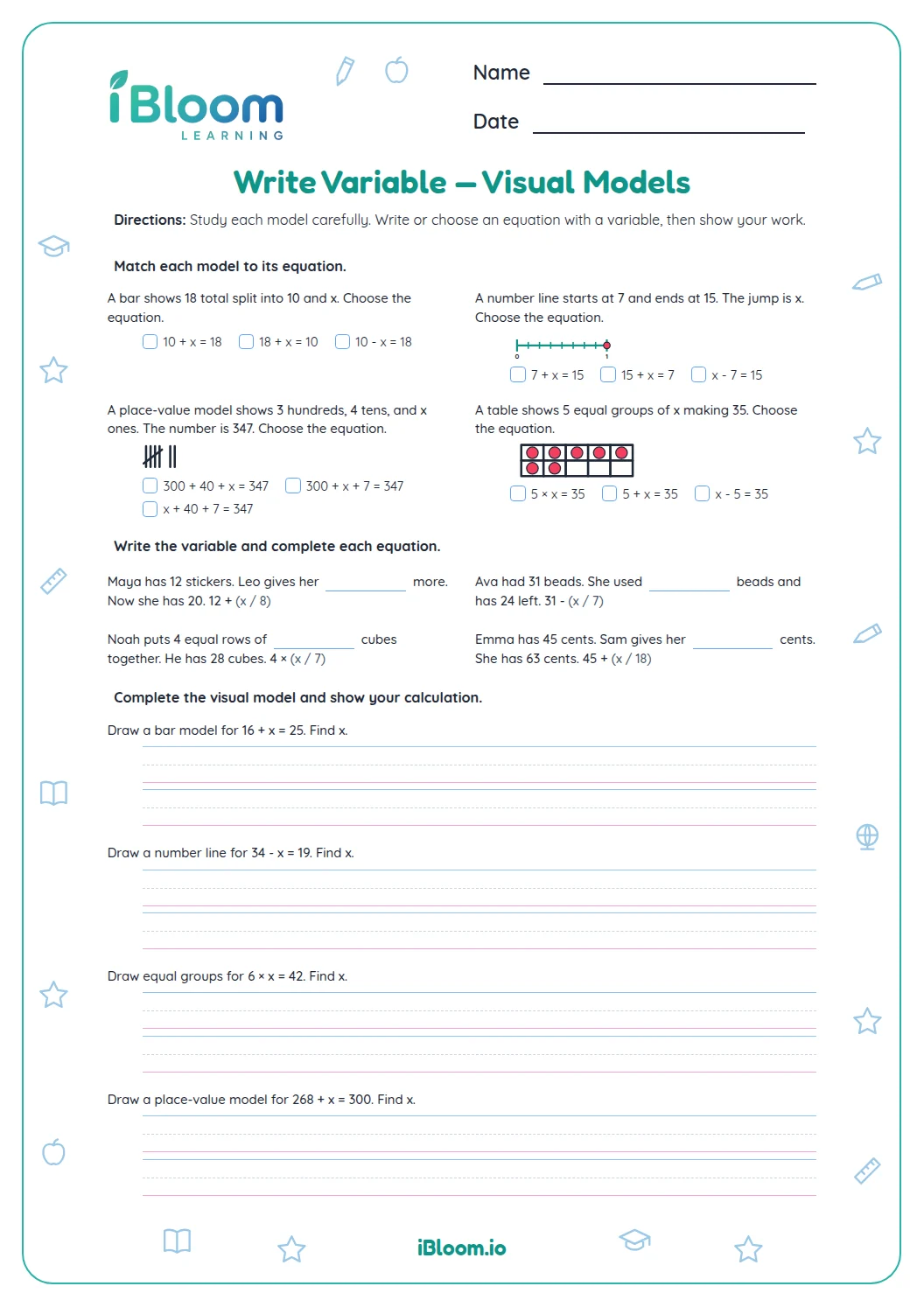
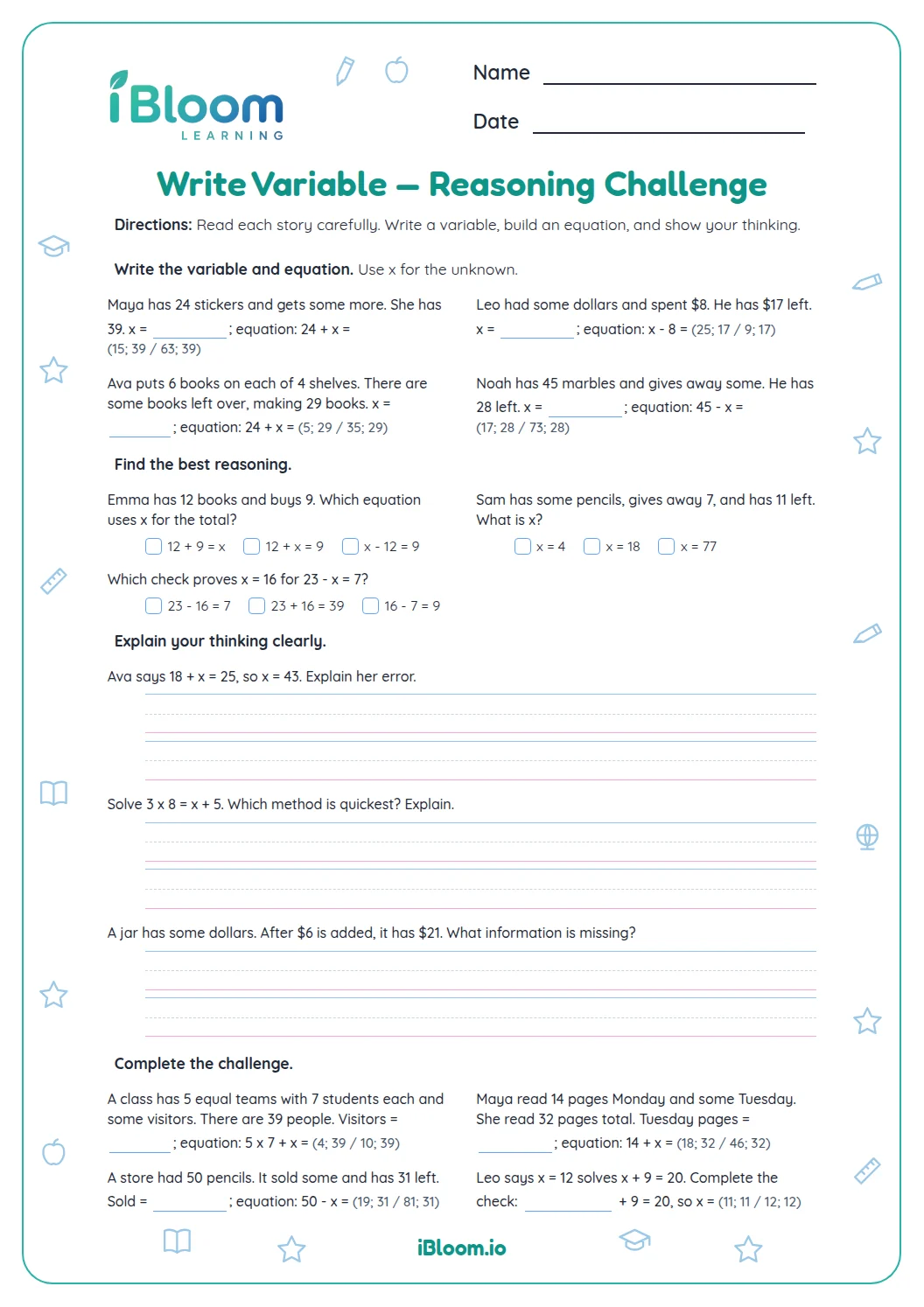
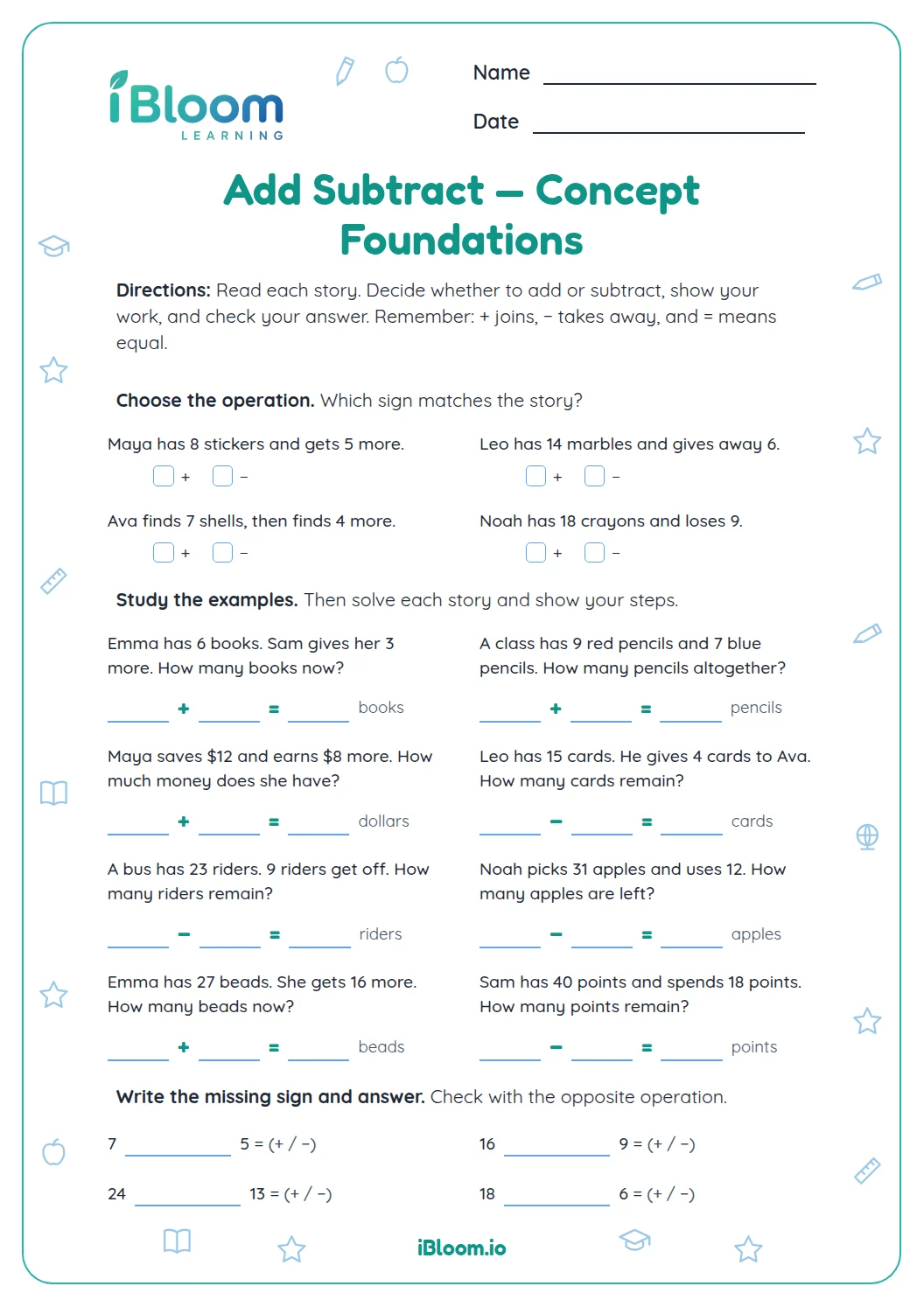
This Grade 3 math worksheet practices representing two-step word problems with variables. The 16 stories use addition, subtraction, multiplication, and equal groups or sharing, with whole-number answers. For each item, students write an equation using a letter for the unknown and solve it. The practice aligns with CCSS 3.OA.D.8, which asks students to represent two-step problems with equations using a letter for the unknown. A separate answer key lists each result.
Aligned to 3.OA.D.8
How does a variable stand for an unknown?
A variable is a letter used in place of a number we do not know. For the sticker story, begin with 24, add 15, then subtract 4. The equation 24 + 15 − 4 = n represents both steps, and n = 35 solves it.
- 124 + 15 − 4 = n
- 2n = 35 stickers
How do you choose an operation from the story?
Look at how the known quantities relate. “Gets some more” suggests addition; “some were checked out” suggests subtraction. Equal groups use multiplication, while sharing equally or asking how many groups use division. The unknown can appear in any position in the equation.
How can you check the answer?
Put the answer back into the story. If 15 new stickers are added to 24, the total is 39. Include the unit so the answer says what the number counts.
How to use this worksheet
- 1Read the whole story and name the unknown.
- 2Choose a variable letter for that unknown.
- 3Write an equation that represents both steps and includes the variable.
- 4Solve the equation using Grade 3 operations.
- 5Check the result in the story and include a unit.
Common mistakes and quick fixes
The mistake
Using the largest numbers to guess the operation.
The fix
Notice whether the story adds, removes, groups, or shares quantities.
The mistake
Writing a number sentence without a variable.
The fix
Put a letter where the unknown amount belongs.
The mistake
Solving correctly but reporting a mismatched quantity.
The fix
Reread the question and state the answer with its unit.
Standards alignment
Solve two-step problems and represent them with an equation using a letter for the unknown.
On this sheet: Solve two-step problems and represent them with an equation using a letter for the unknown.
Show the official wordingHide the official wording
Solve two-step word problems using the four operations. Represent these problems using equations with a letter standing for the unknown quantity. Assess the reasonableness of answers using mental computation and estimation strategies including rounding.
What to practice next
Make more practice
Further reading
Questions parents and teachers ask
What does it mean to write a variable in a word problem?
A variable is a letter that stands for the unknown number. In “24 stickers plus 15, then 4 are given away,” a student can write 24 + 15 − 4 = n and solve n = 35. The variable represents the final amount after both steps.
How many problems are on this page?
There are 16 two-step word problems across the practice pages, with an answer key. The situations include addition, subtraction, multiplication, and equal sharing or grouping, using whole-number answers within Grade 3 operations. Each story has two steps for the student to represent and solve.
Can children choose any letter for the variable?
Yes. A variable may be any letter, such as n, b, or x, as long as the child uses it to represent the unknown amount consistently in the equation. Invite the child to explain the choice in their own words, then compare it with the skill practiced on this page.
What is a good first step for solving each problem?
Identify the quantity that is unknown and what the story says about it. Then choose an operation, write an equation with a letter for the unknown, and solve it. Check whether the answer makes sense in the story. Invite the child to explain the choice in their own words, then compare it with the skill practiced on this page.
Why are units included in the answer key?
Units name what the number counts, such as stickers, books, or dollars. Writing the unit helps children connect their calculation to the situation and avoid giving a bare number without context. Invite the child to explain the choice in their own words, then compare it with the skill practiced on this page.