

About this worksheet
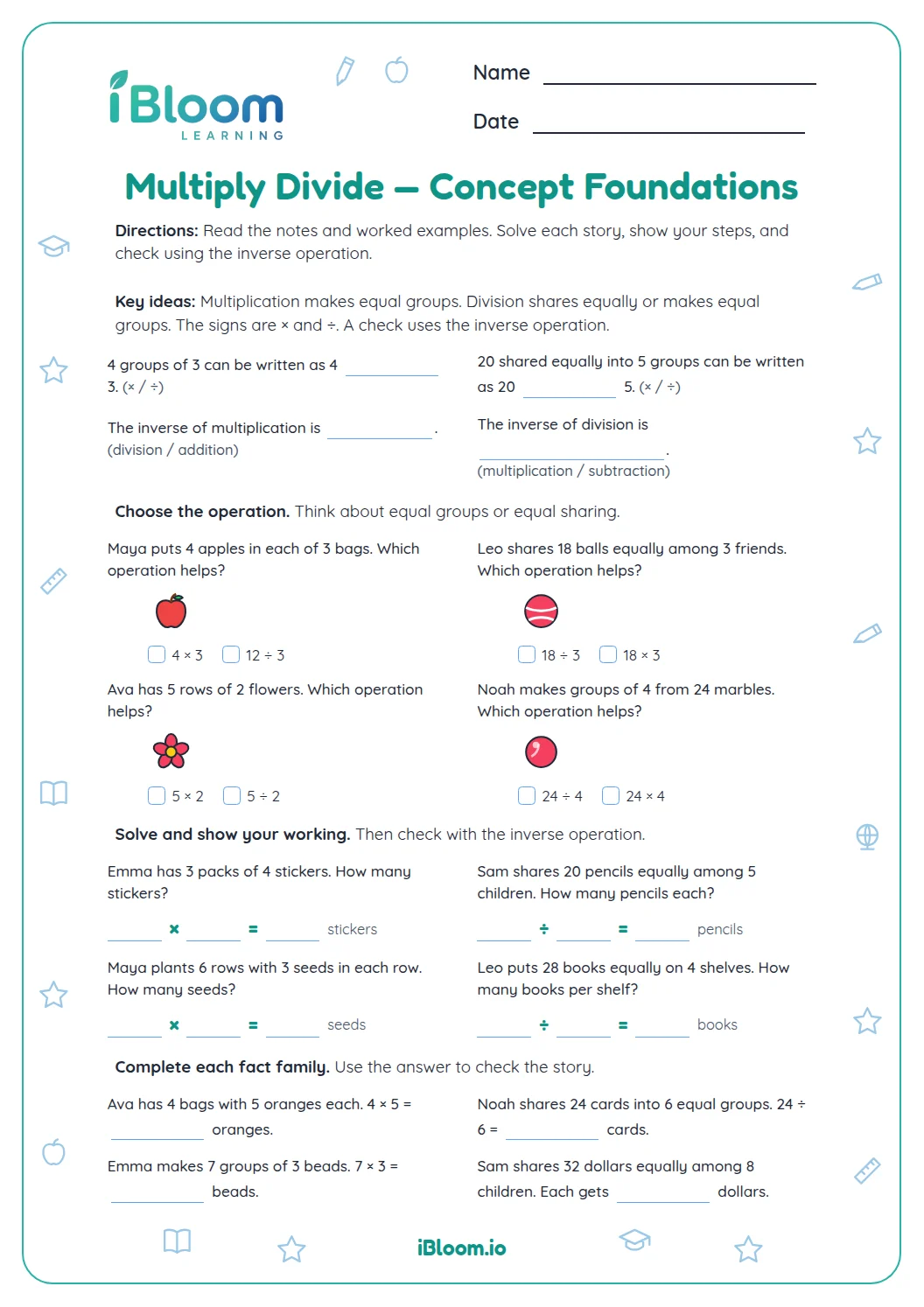
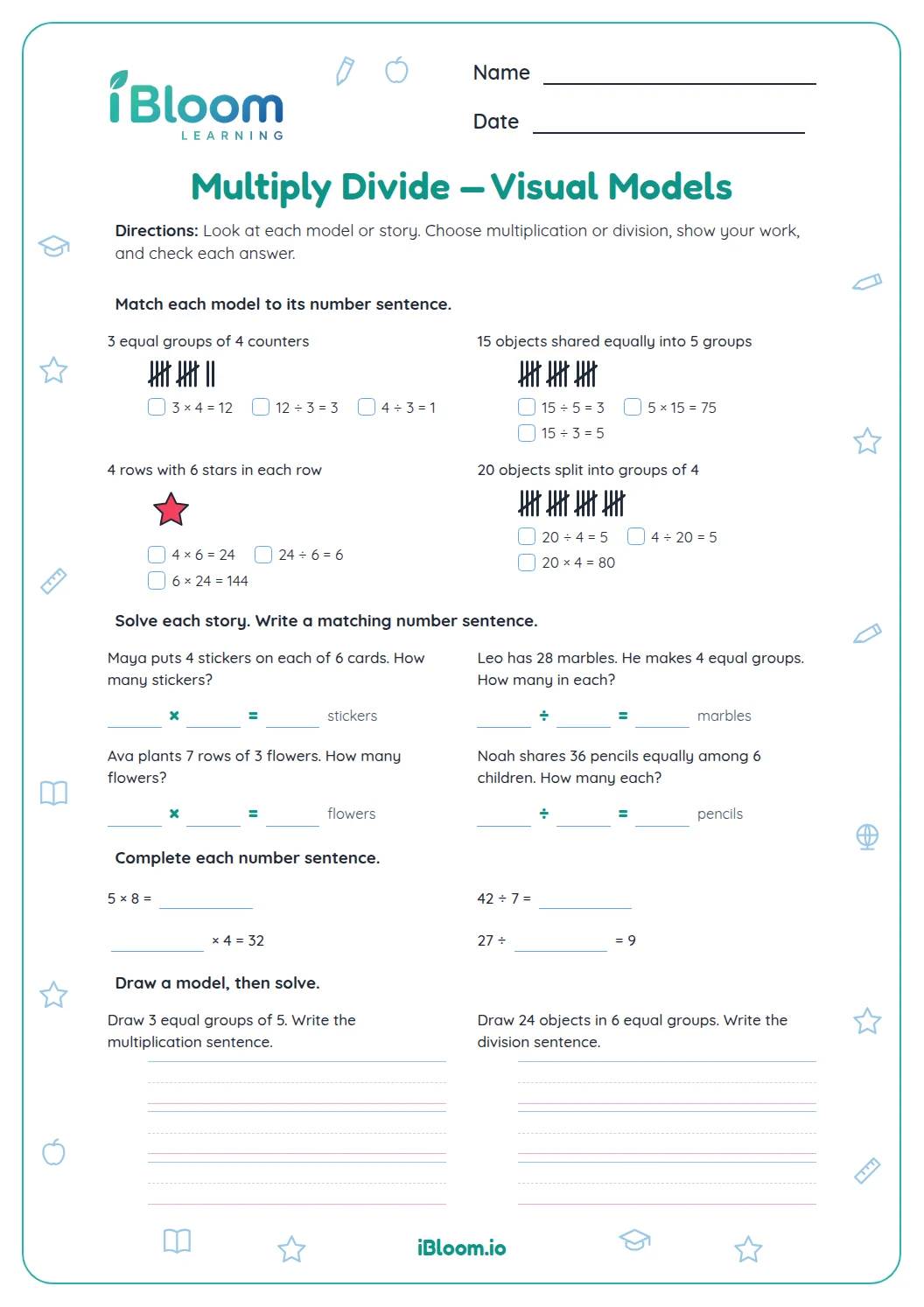
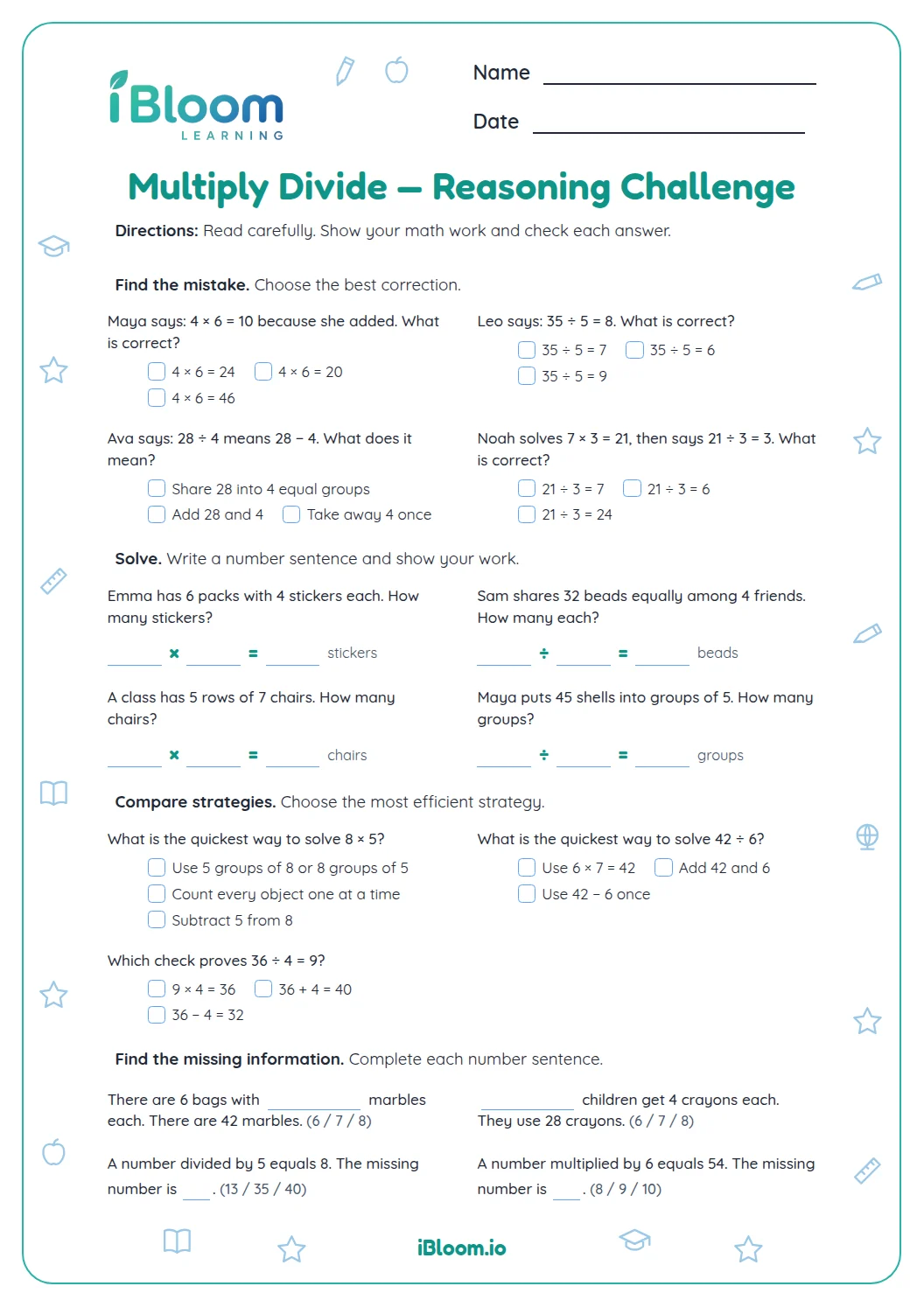
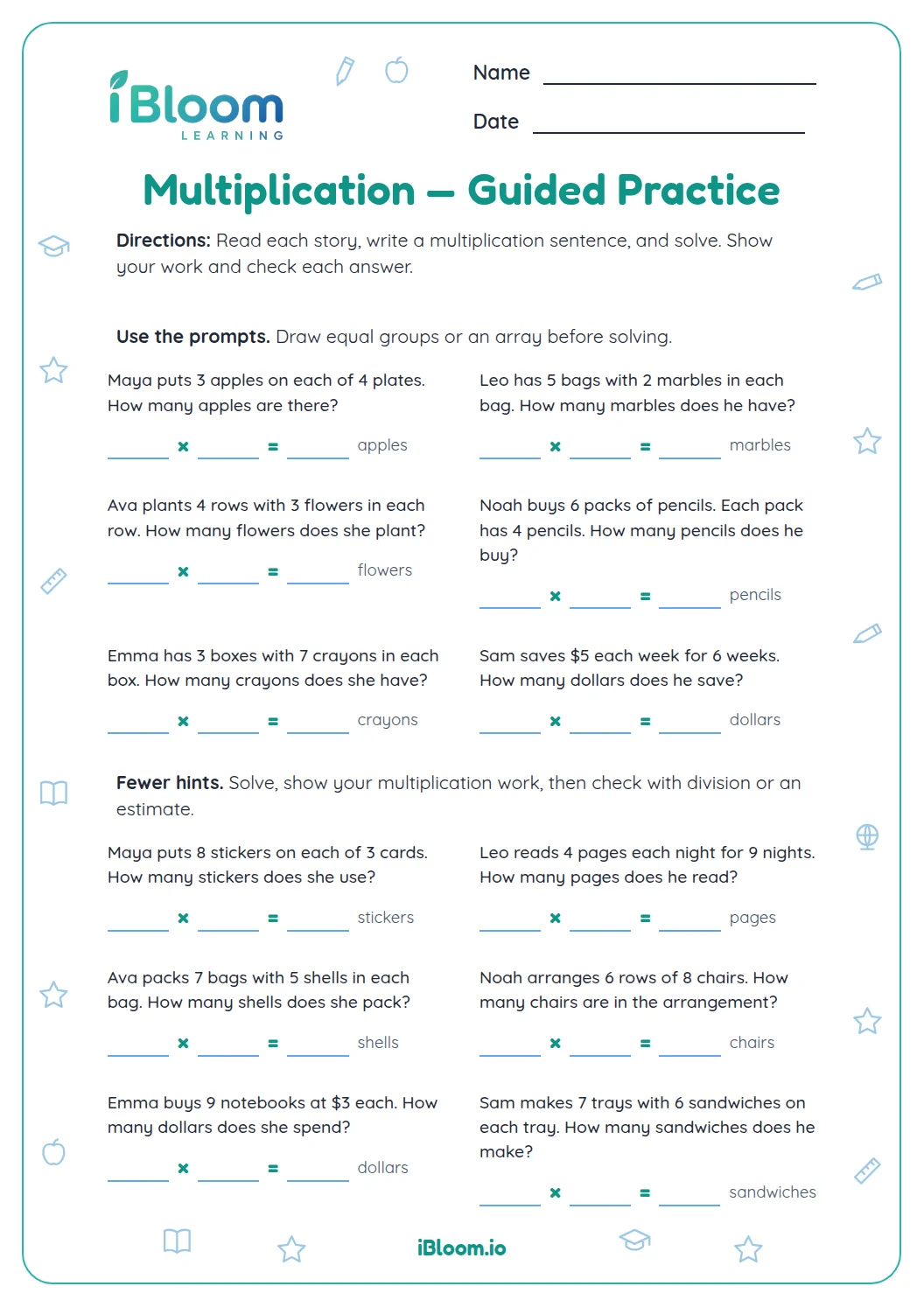
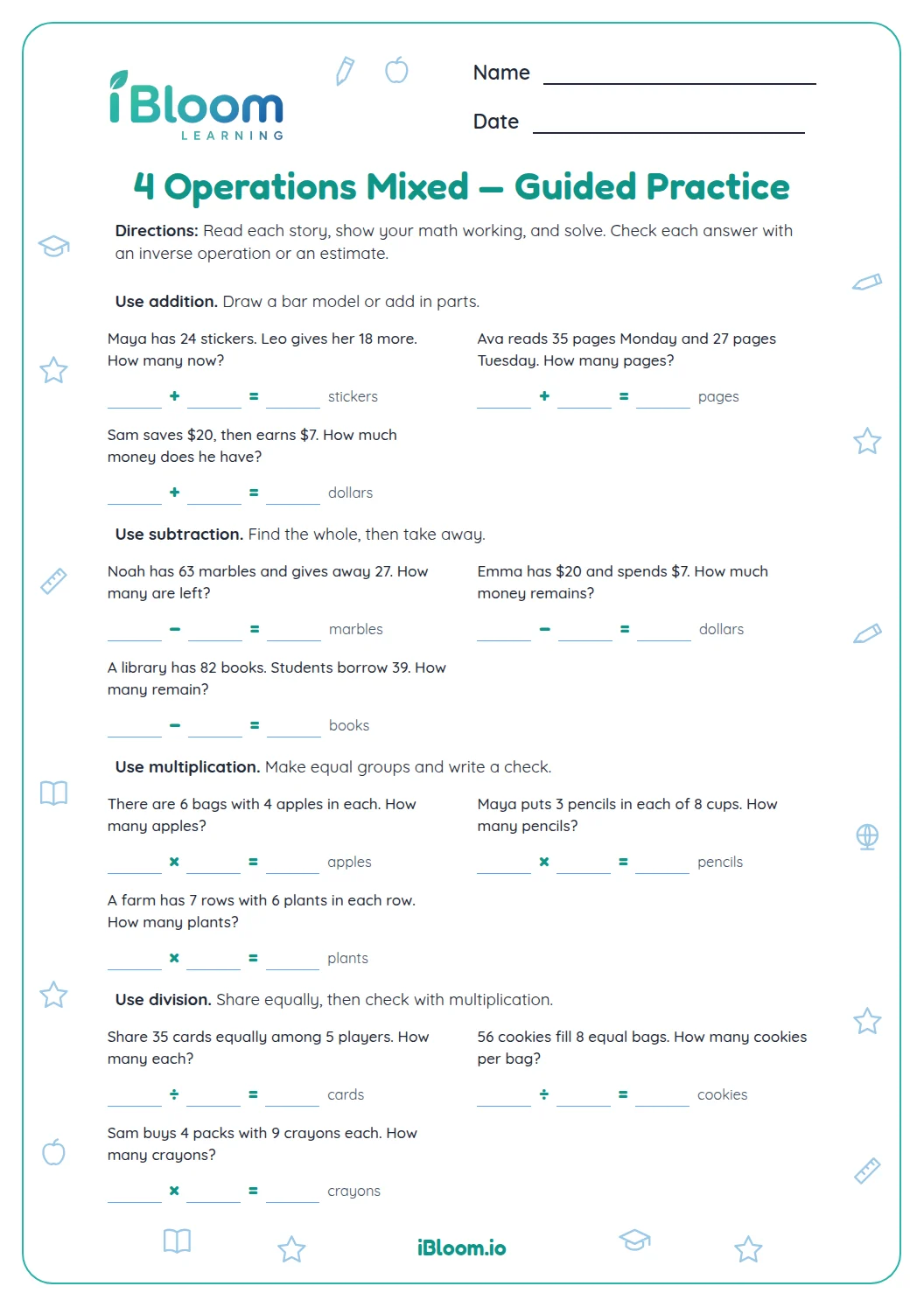
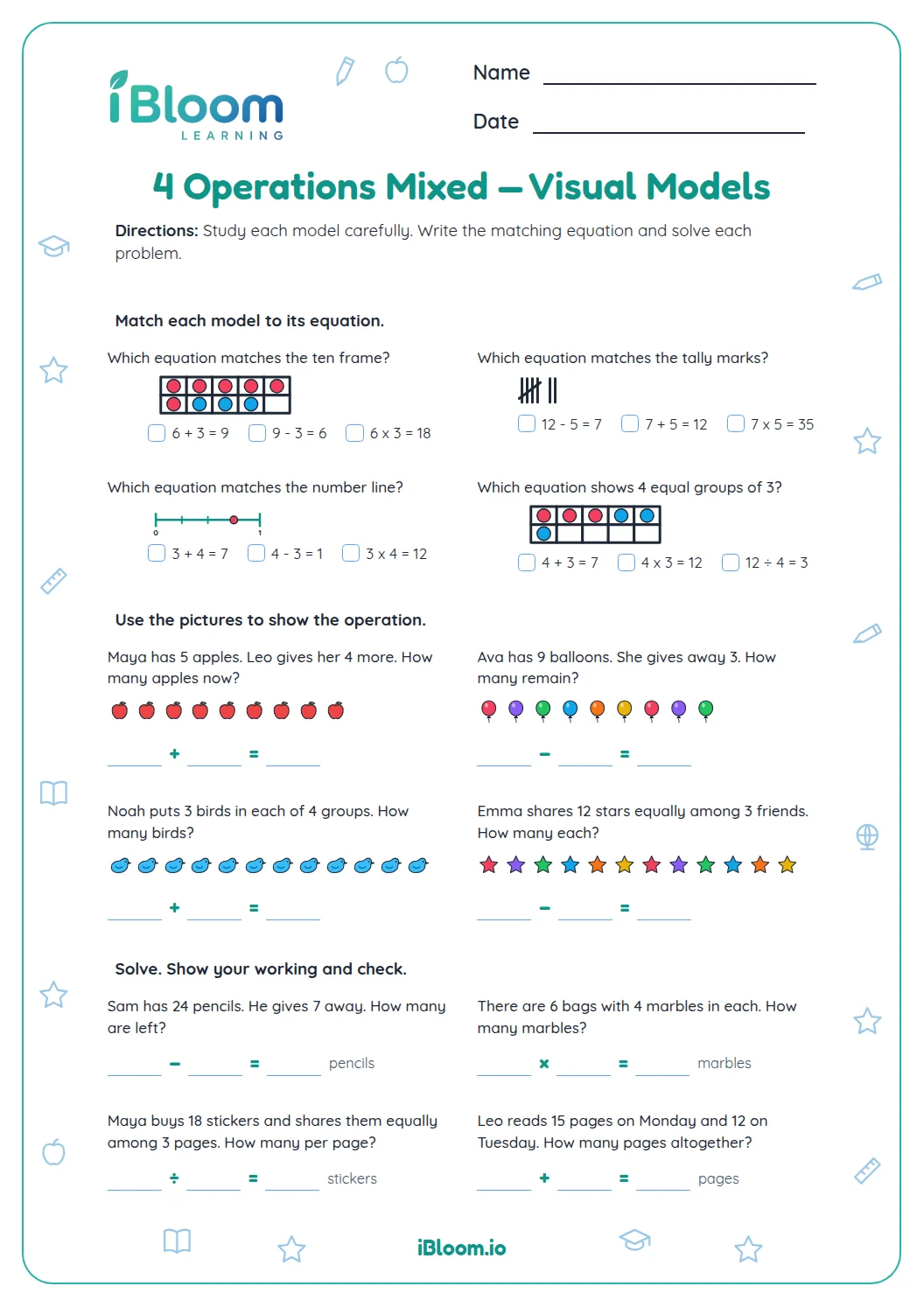
This Grade 3 printable replaces a repeated, highly similar set of multiplication and division prompts with 14 distinct stories. Children solve equal-group and equal-sharing situations with facts within 100, choose the needed operation, and write an equation with a solution. Each prompt gives working space and uses familiar settings such as teams, shelves, gardens, and classroom supplies. The page practices CCSS 3.OA.A.3 and includes a separate answer key.
Aligned to 3.OA.A.3
When does a story call for multiplication?
If the story gives the number of equal groups and the amount in each group, multiply to find the total. In question 1, 6 bags hold 4 balls each, so 6 × 4 = 24 balls.
- 16 bags × 4 balls per bag
- 26 × 4 = 24
- 3There are 24 balls.
When does a story call for division?
If the total is shared equally, divide by the number of groups to find the amount in each. In question 2, 32 stickers ÷ 4 friends = 8 stickers per friend.
How can division count groups?
Sometimes a problem gives a total and the size of each group. Division tells how many groups can be made. Question 4 groups 45 rolls in sets of 5, so 45 ÷ 5 = 9 bags.
How can learners check the answer?
Use the inverse operation. Multiply a quotient by the group size to recover the total, or divide a product by one factor to find the other. Check that the answer names the requested unit.
How can I use this page?
- 1Underline the total, group size, and unknown in each story.
- 2Decide whether the unknown is the total, group size, or number of groups.
- 3Write a multiplication or division equation before calculating.
- 4Use a related fact to check the answer.
- 5Include the requested unit in your answer.
What should learners check?
The mistake
Multiplying whenever the story mentions groups.
The fix
Check what is unknown: the total, the size of each group, or the number of groups.
The mistake
Dividing by the group size when the story asks for each share.
The fix
For equal shares, divide the total by the number of people or groups.
The mistake
Writing only a number without its context.
The fix
Add the noun the question asks for, such as books or bags.
Common Core alignment
This worksheet practices the following Common Core skill.
Solve multiplication and division word problems within 100.
On this sheet: The story problems represent equal groups and equal sharing with multiplication or division facts within 100.
Show the official wordingHide the official wording
Use multiplication and division within 100 to solve word problems in situations involving equal groups, arrays, and measurement quantities, e.g., by using drawings and equations with a symbol for the unknown number to represent the problem.
What to practice next
Make more practice
Further reading
Questions parents and teachers ask
What kinds of stories are on the worksheet?
The 14 prompts cover equal groups, equal sharing, and counting how many groups fit into a total. Children work with objects such as balls, stickers, books, and flags. Each problem uses multiplication or division facts within 100 and has room to show an equation.
How can learners tell whether to multiply?
Multiply when the story gives the number of equal groups and the amount in each group, then asks for the total. Question 1 gives 6 bags with 4 balls per bag, so 6 × 4 finds the number of balls altogether.
How does equal sharing connect to division?
When a total is split fairly among a known number of groups, divide the total by the number of groups. For example, sharing 32 stickers among 4 friends means 32 ÷ 4, or 8 stickers for each friend.
What if a problem asks how many groups can be made?
Divide the total by the size of each group. Question 4 puts 45 rolls into bags holding 5 rolls each, so 45 ÷ 5 = 9 bags. The quotient counts the bags, rather than the rolls in each bag.
How should children check a division answer?
Multiply the quotient by the divisor and see whether the product is the original total. If 32 stickers are divided among 4 friends, 8 each gives 8 × 4 = 32. Then reread the question to confirm the unit.
Is an answer key included?
Yes. A separate key lists each answer with its unit. Learners may write the factors in either order for multiplication, as long as the equation matches the story and the product is correct. The key also names what each answer counts.