

About this worksheet
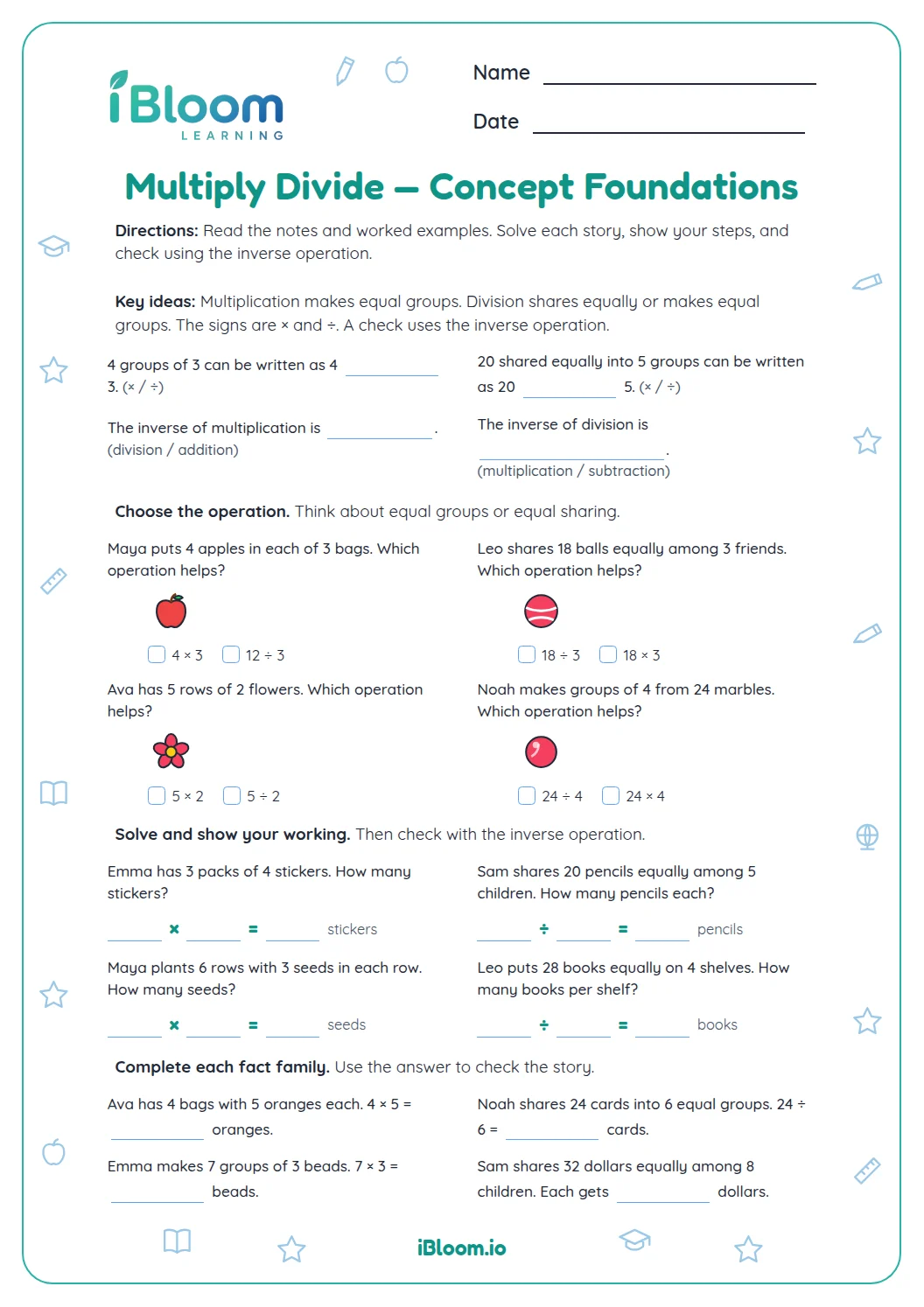
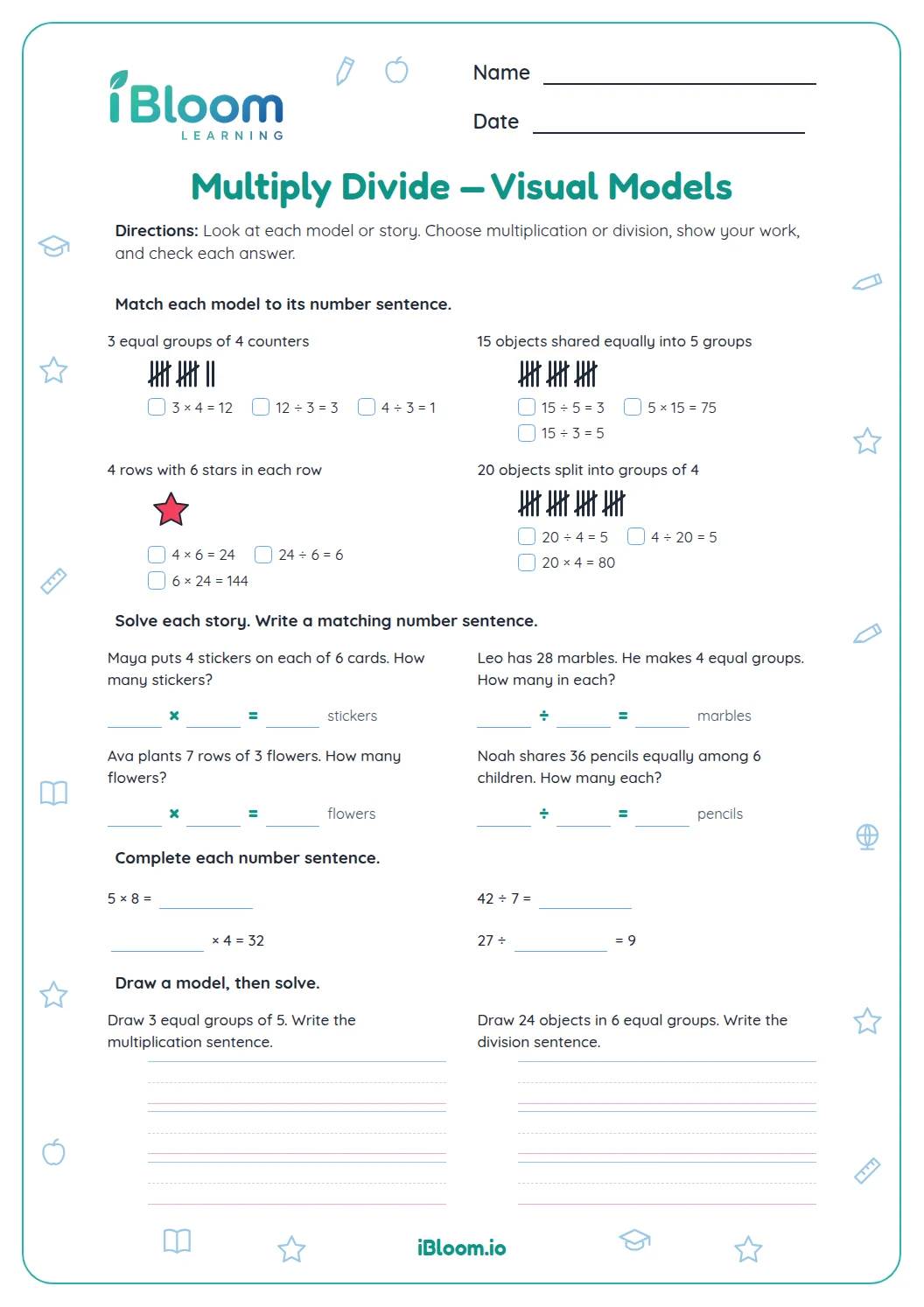
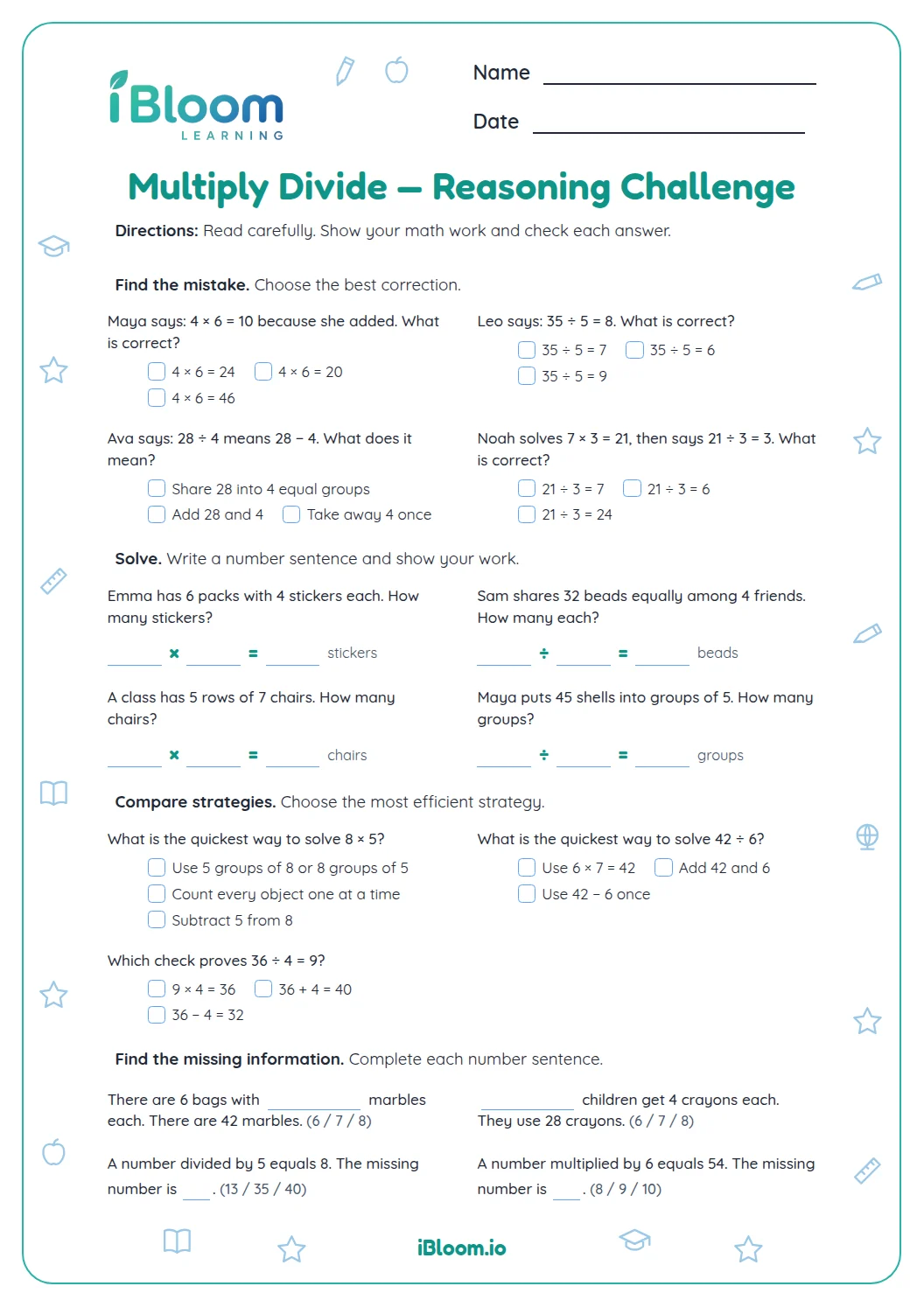
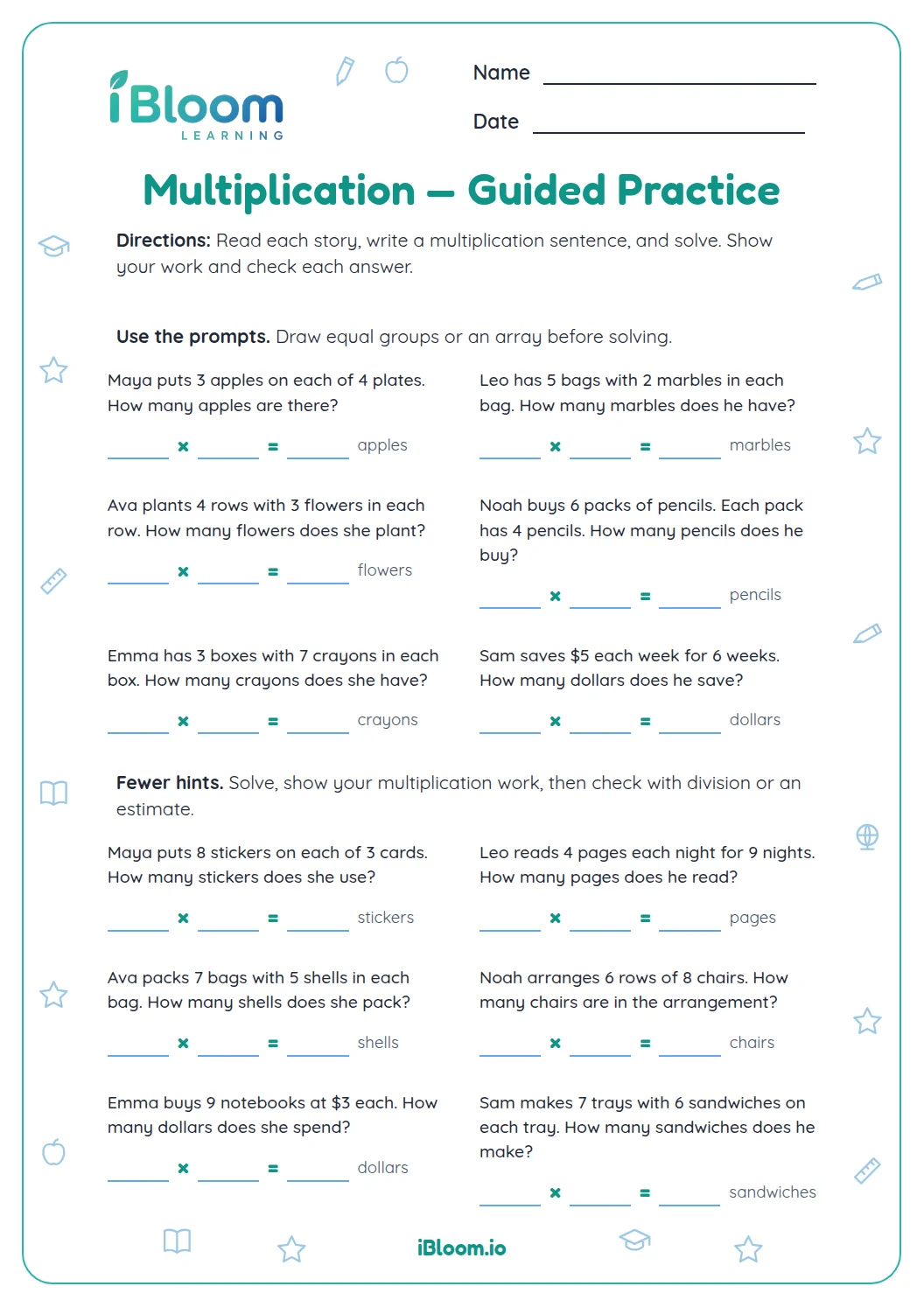
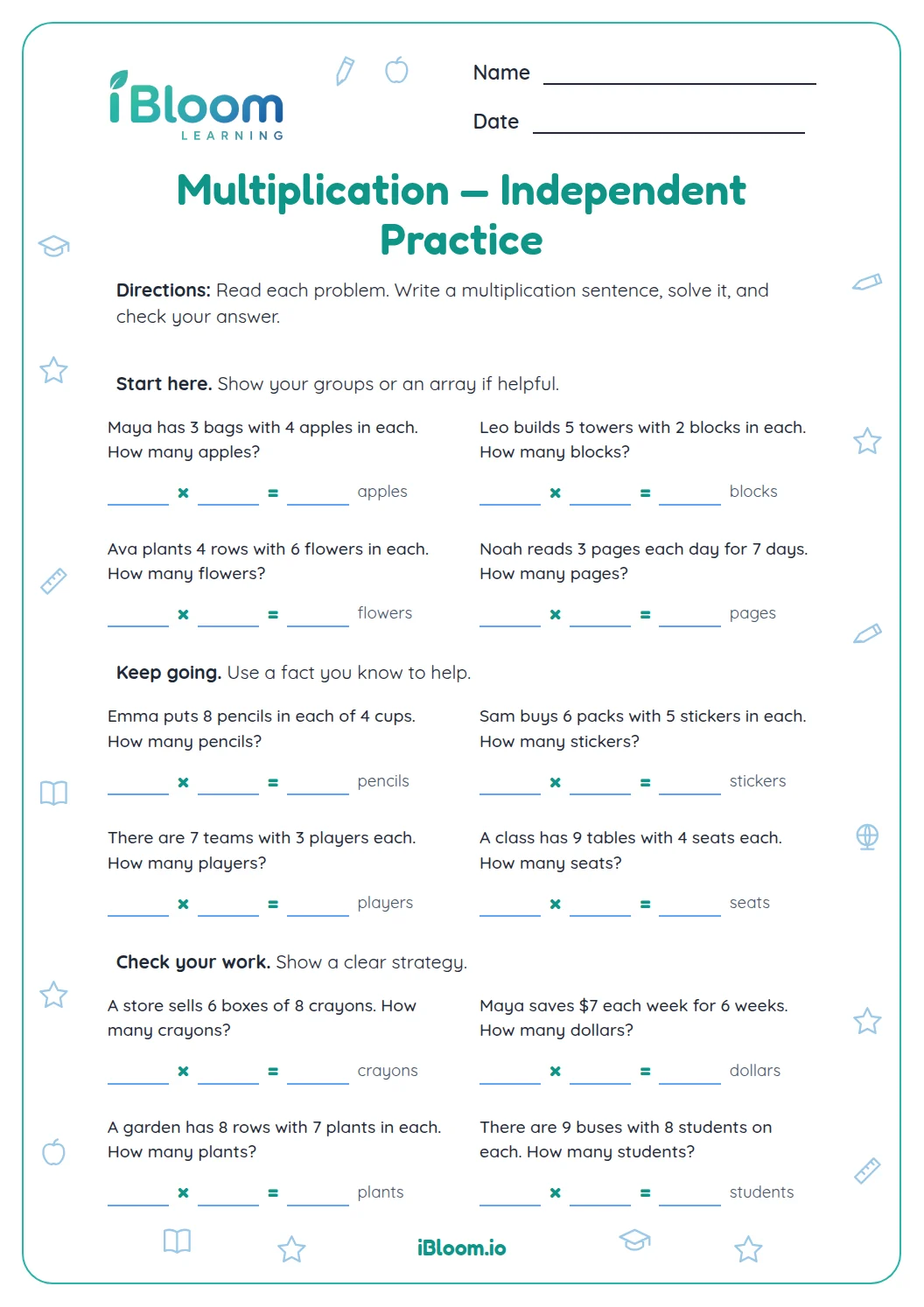
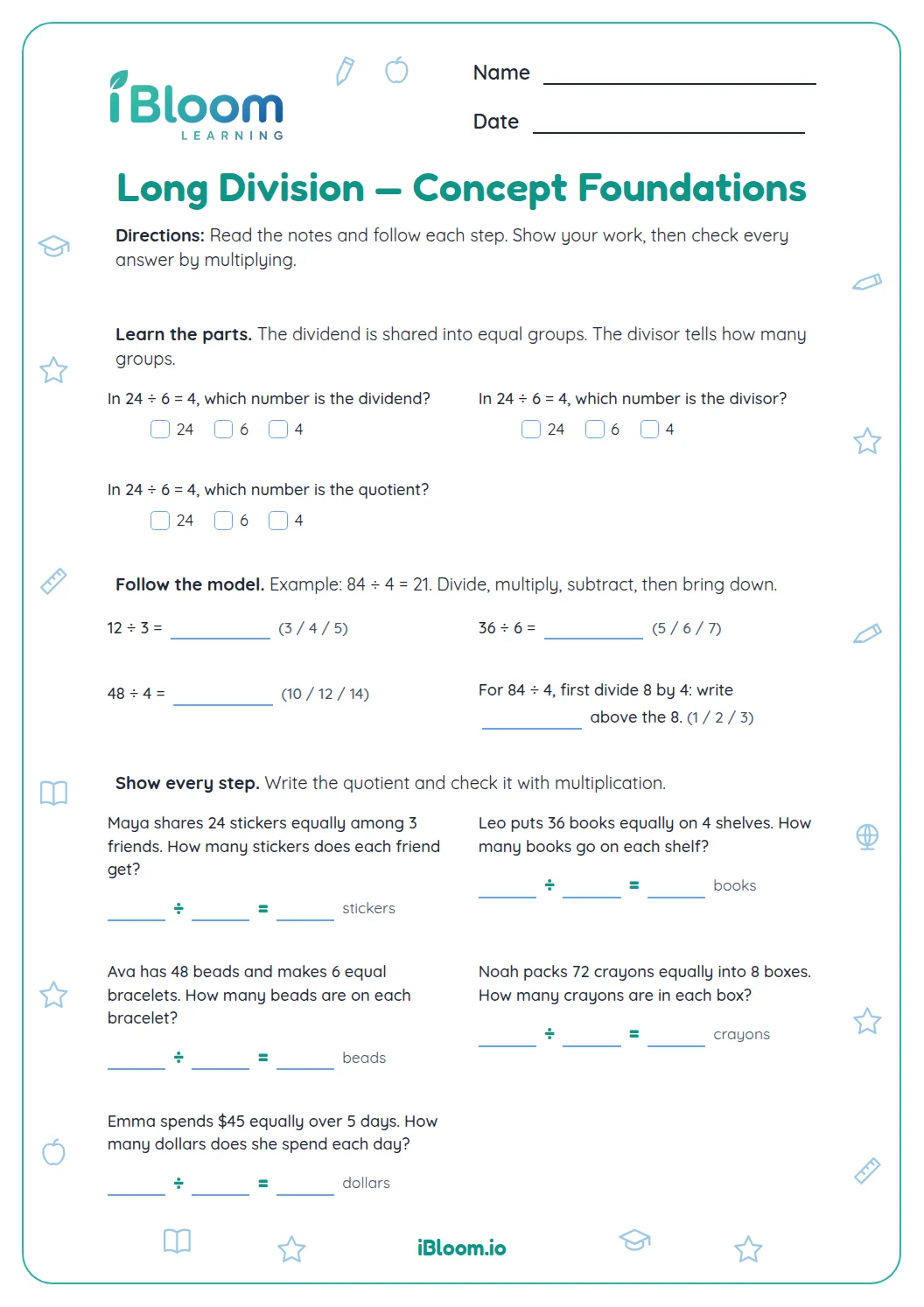
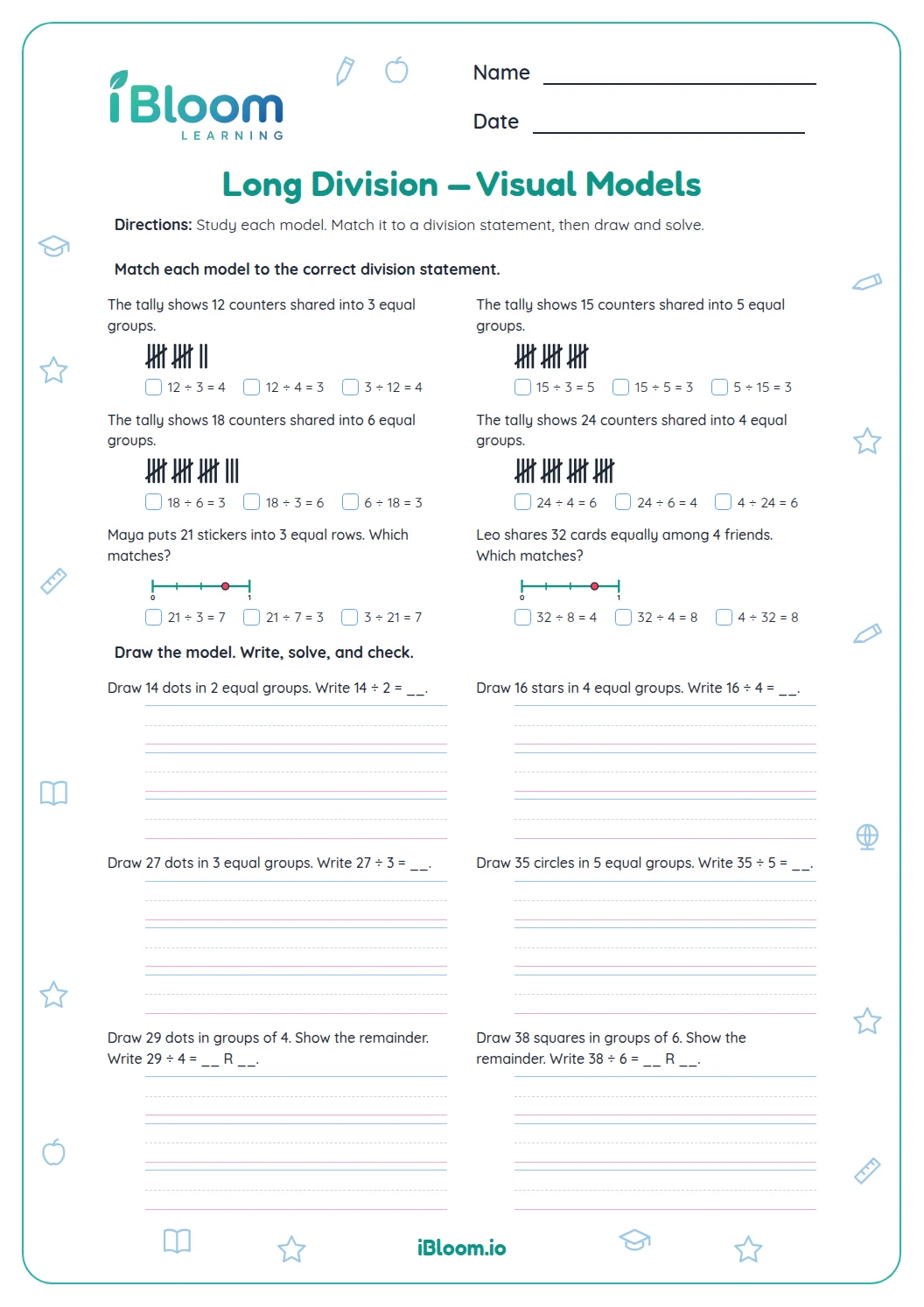
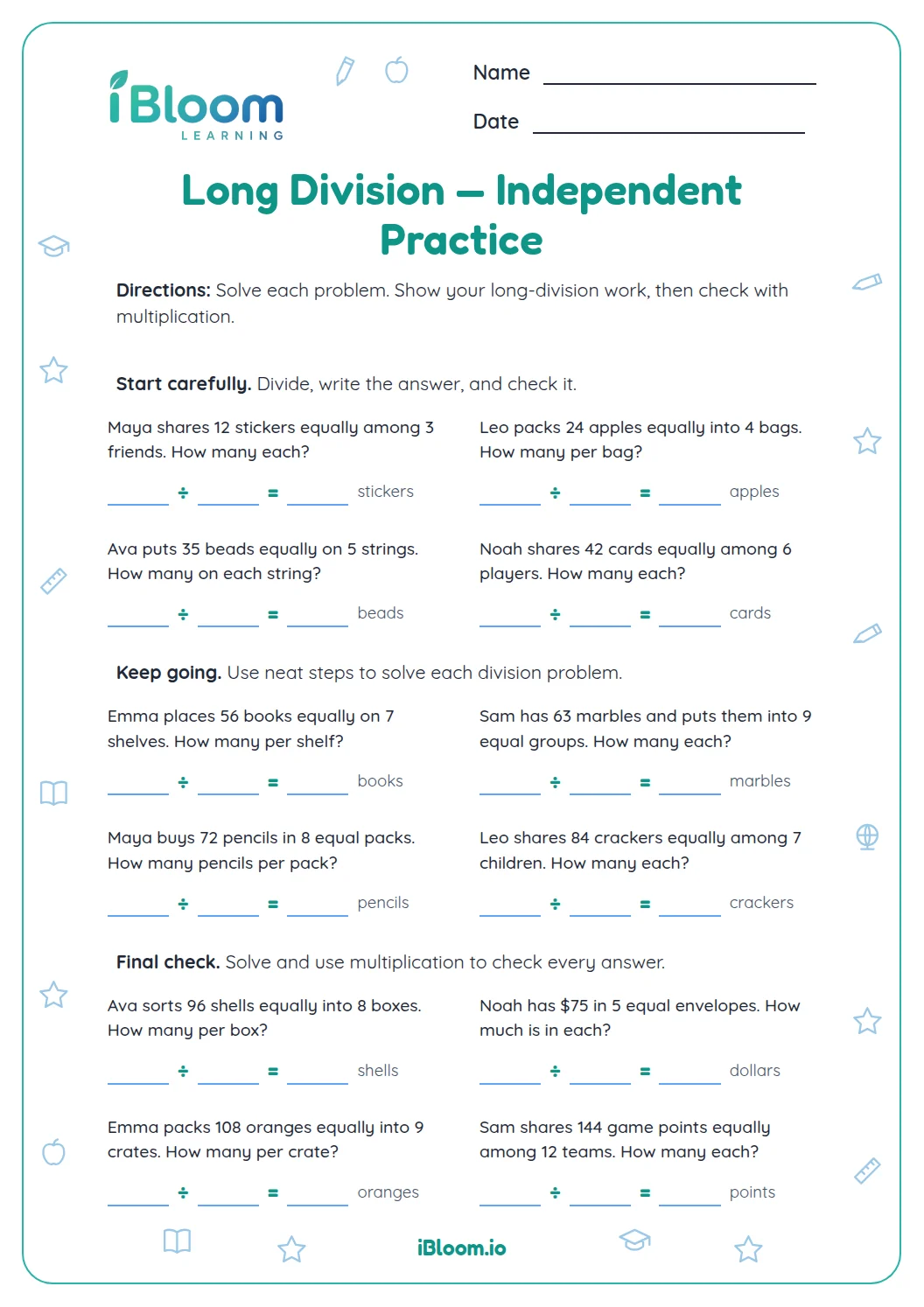
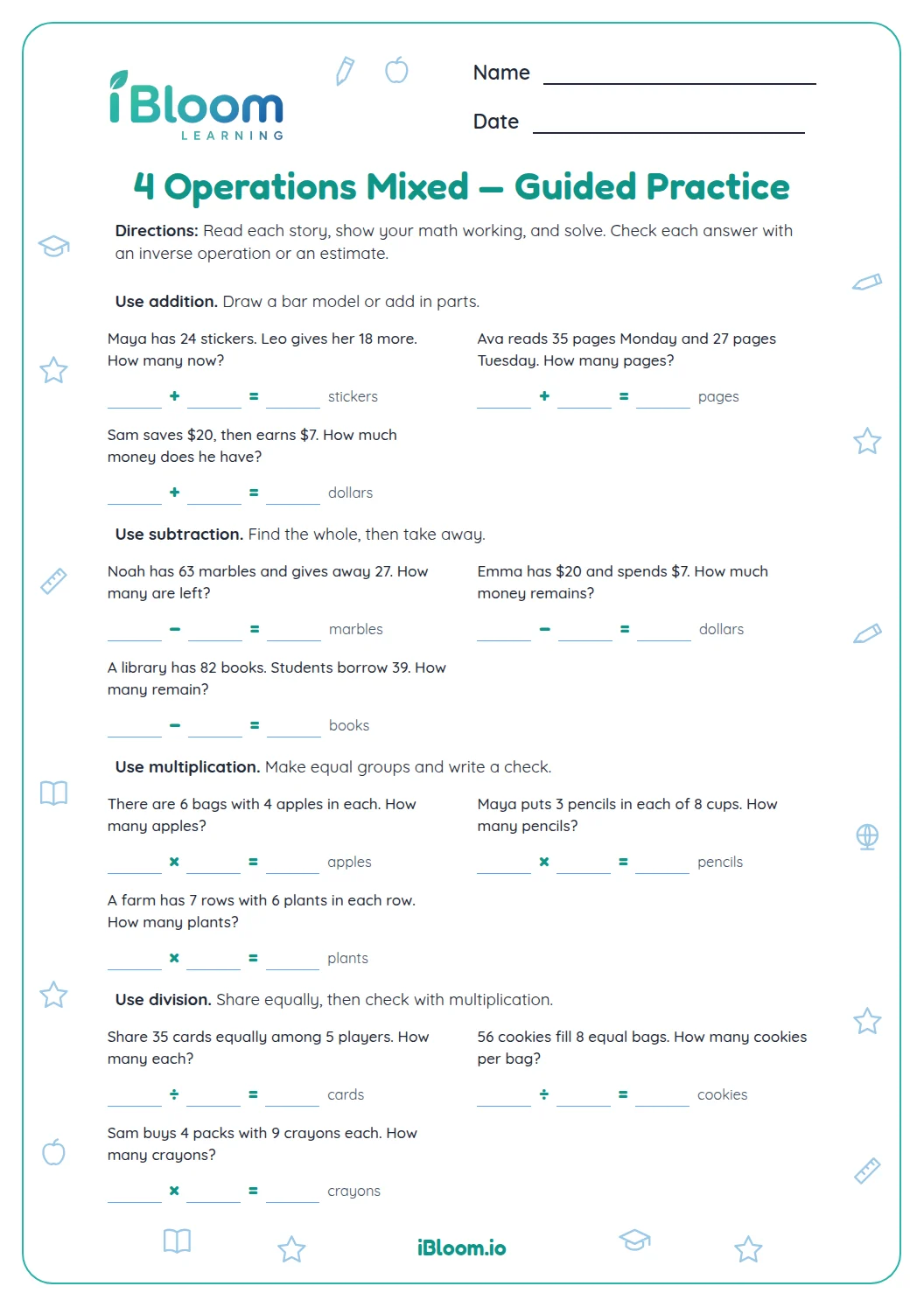
This free Grade 3 worksheet gives students 14 independent word problems using multiplication and division within 100. Seven multiplication stories come first; seven division stories follow, including equal shares and a length problem. Students choose an answer for each story and identify multiplication or division. It practices CCSS 3.OA.A.3 and 3.OA.B.5, with an answer key that shows the operation and result.
Aligned to 3.OA.A.3 and 3.OA.B.5
How do you represent equal groups?
When a story gives the number of groups and the number in each group, multiply to find the total. In question 1, six boxes hold seven markers each, so 6 × 7 gives the total number of markers.
- 16 boxes × 7 markers in each box = 42 markers
- 2Check: 7 + 7 + 7 + 7 + 7 + 7 = 42
When does a story call for division?
Division fits when a total is shared equally or placed into equal groups. Read carefully to decide whether the unknown is the number in each group or the number of groups. For question 11, 36 apples split into bags of 4 makes 9 bags.
How can students check a division answer?
Multiply the number of groups by the amount in each group. For 48 cards shared among 6 friends, 6 × 8 = 48, so each friend receives 8 cards.
How to use this worksheet
- 1Underline what the story tells you and circle what it asks you to find.
- 2Decide whether the unknown is a total, number of groups, or amount in each group.
- 3Choose multiplication when the story asks for a total of equal groups; choose division when it asks for an equal share or group count.
- 4If a fact is hard to recall, sketch equal groups on scrap paper, then select the answer that matches.
- 5Attach the correct unit or object to the answer.
- 6Check division by multiplying the quotient by the divisor.
Common mistakes and quick fixes
The mistake
Multiplying when the total is already given and one share is unknown.
The fix
Ask whether the story gives a total to share equally; if so, divide.
The mistake
Confusing number of groups with amount in each group.
The fix
Label each number in the equation with what it counts.
The mistake
Writing a bare number without the story unit.
The fix
Finish with markers, cards, books, inches, or the item named.
Common Core alignment
These equal-group and equal-share stories use multiplication and division facts within 100.
Solve equal-group and equal-share stories with multiplication or division within 100.
On this sheet: Every item is an equal-group, equal-share, or measurement story solved within 100.
Show the official wordingHide the official wording
Use multiplication and division within 100 to solve word problems in situations involving equal groups, arrays, and measurement quantities, e.g., by using drawings and equations with a symbol for the unknown number to represent the problem.
Use multiplication properties to find products efficiently.
On this sheet: The multiplication section supports use of familiar products and equal groups.
Show the official wordingHide the official wording
Apply properties of operations as strategies to multiply and divide.
What to practice next
Make more practice
Further reading
Questions parents and teachers ask
How many problems are on the worksheet?
There are 14 word problems: seven multiplication stories and seven division stories. The first part asks for equal-group totals; the second asks for equal shares or the number of groups. The separate key gives the numeric result for each story.
How do I know whether to multiply or divide?
Multiply when the story gives a number of groups and the amount in each group, then asks for a total. Divide when it gives a total and asks for equal shares or groups. Sharing 48 cards among six friends is division.
Are the answers within Grade 3 facts?
Yes. Every product and quotient is a whole number within 100. Students can use familiar multiplication facts, skip counting, equal groups, or the inverse relationship between multiplication and division. The problems use whole-number products and quotients no greater than 100. Students may use multiplication facts, equal groups, skip counting, or a related division fact to reach the answer.
Should students write an equation?
The prompts provide a blank for the missing total, share, or group count. For the marker story, six boxes with seven markers each give 42 markers. Students can write a multiplication or division equation on scratch paper to check their result.
How can students check a division problem?
The key gives each expected answer with its unit. To check division, multiply the quotient by the group size or number of groups, as appropriate. If the product returns the original total, the division answer fits. For example, 6 × 8 = 48.