

About this worksheet
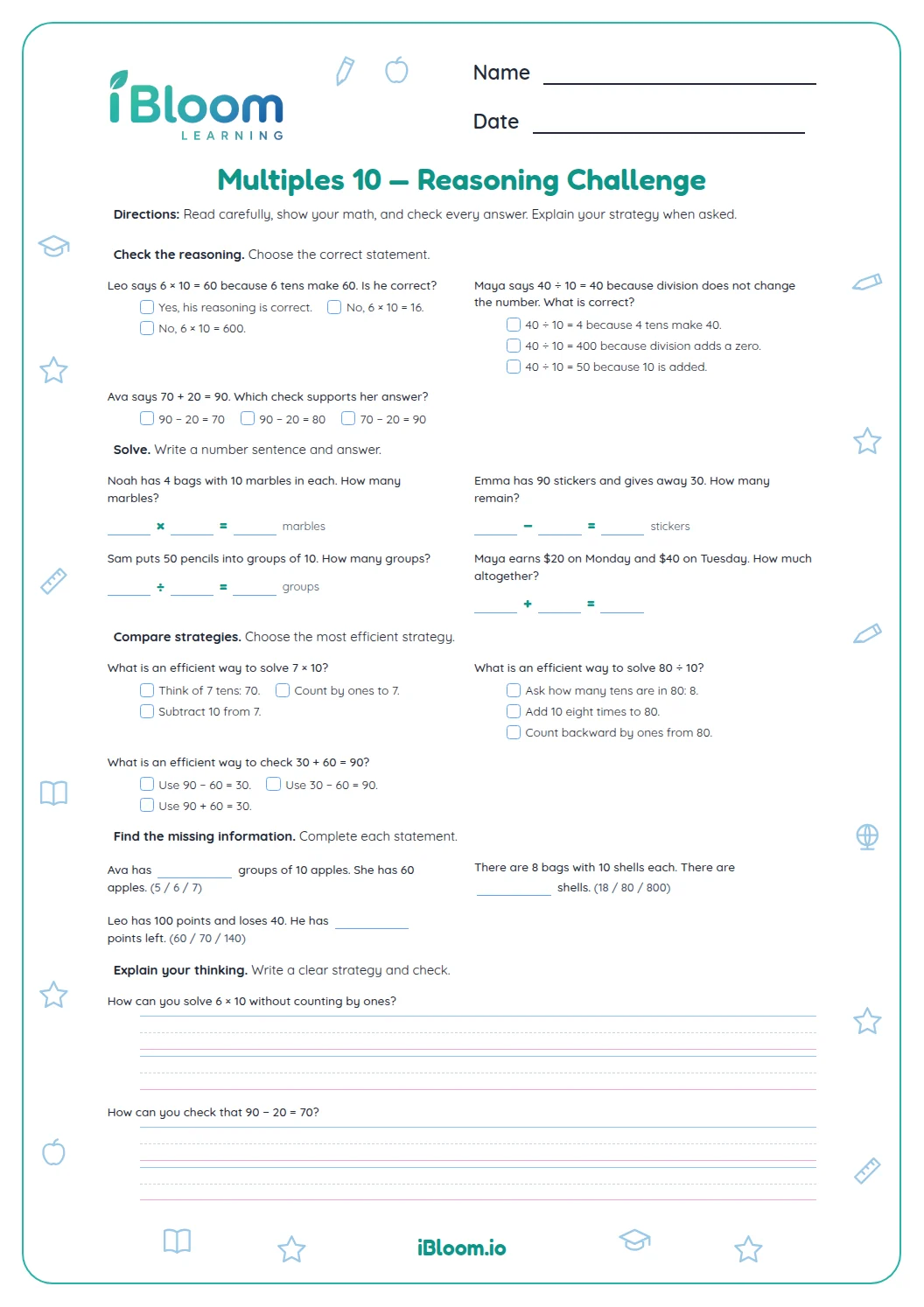
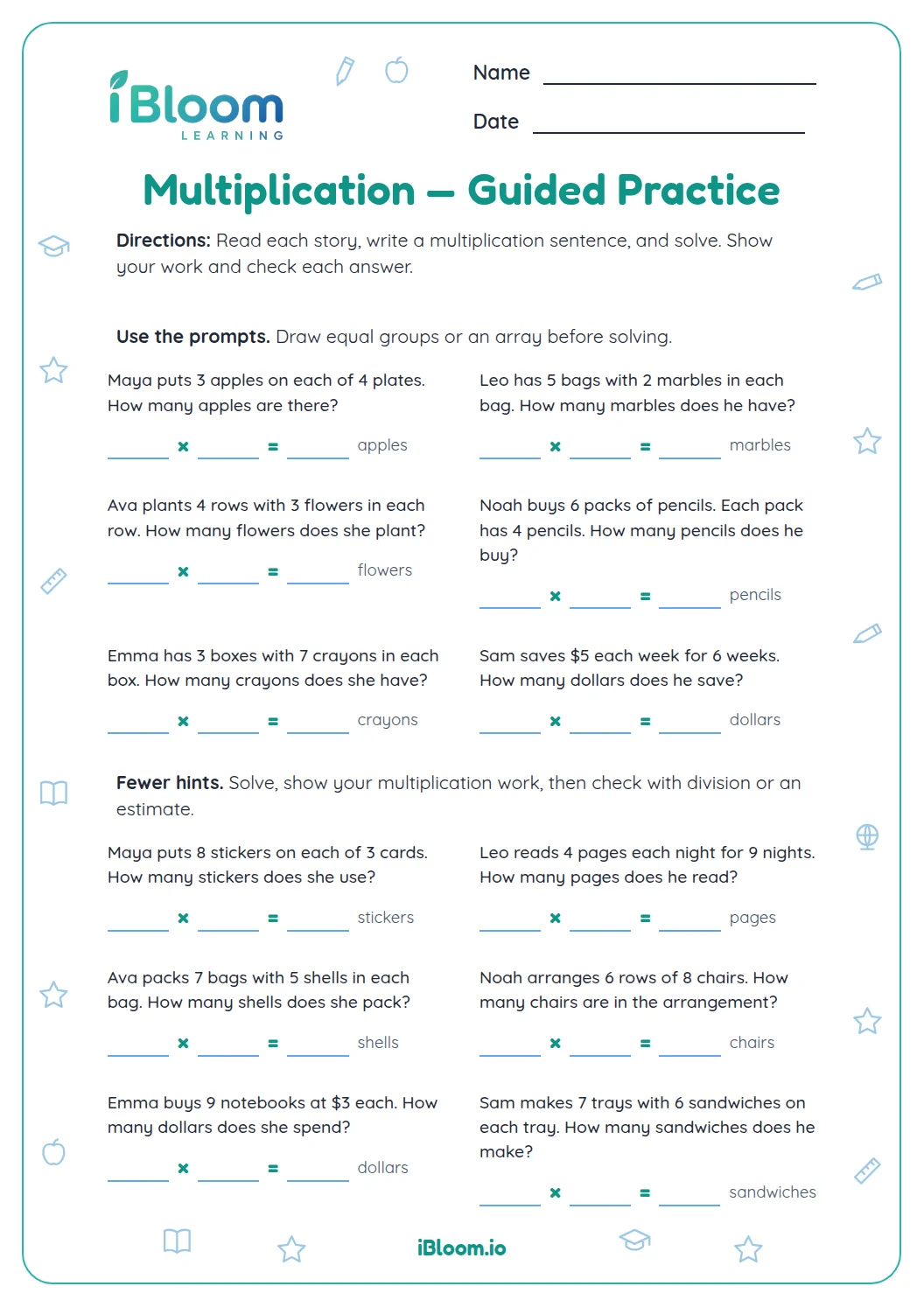
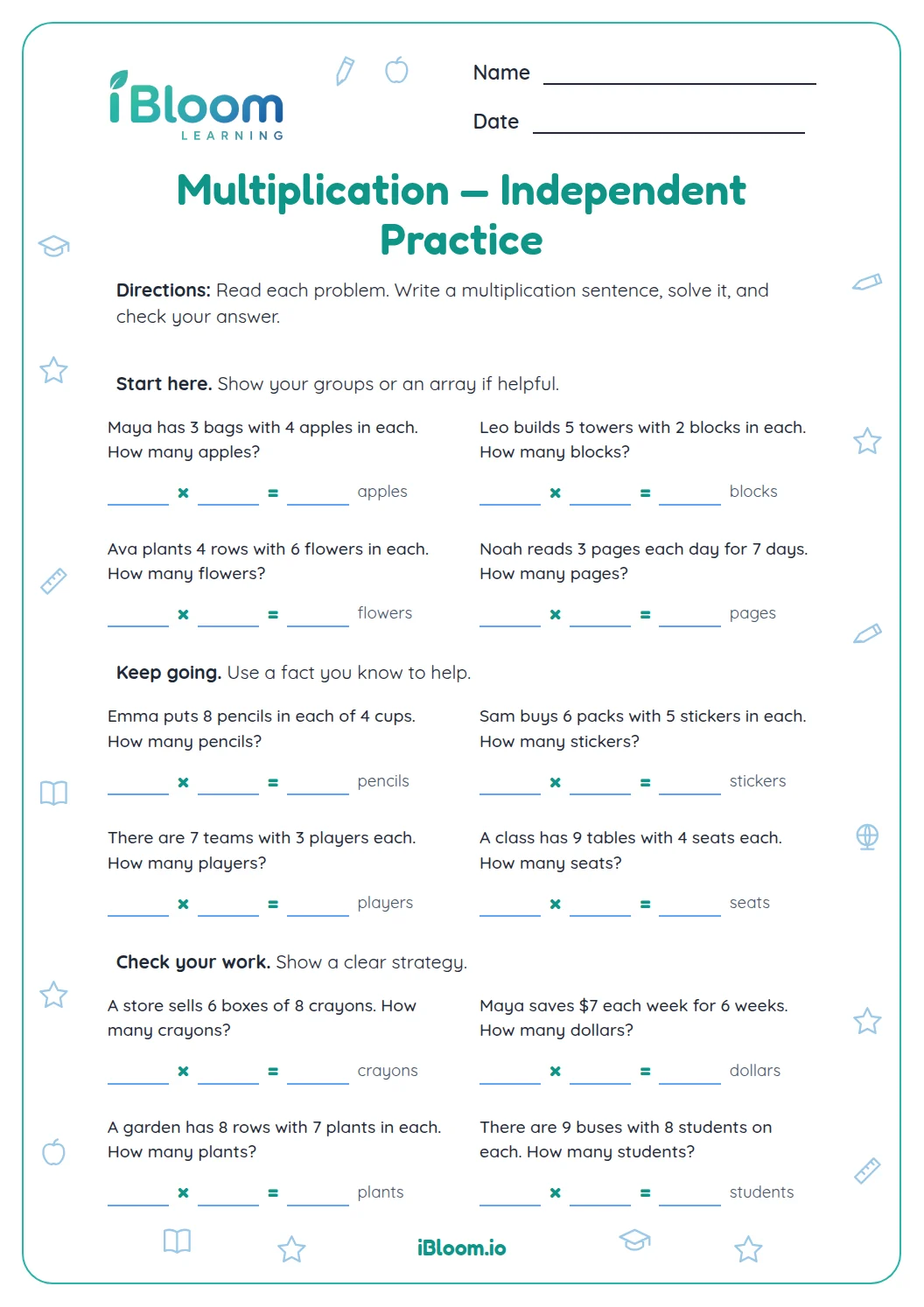
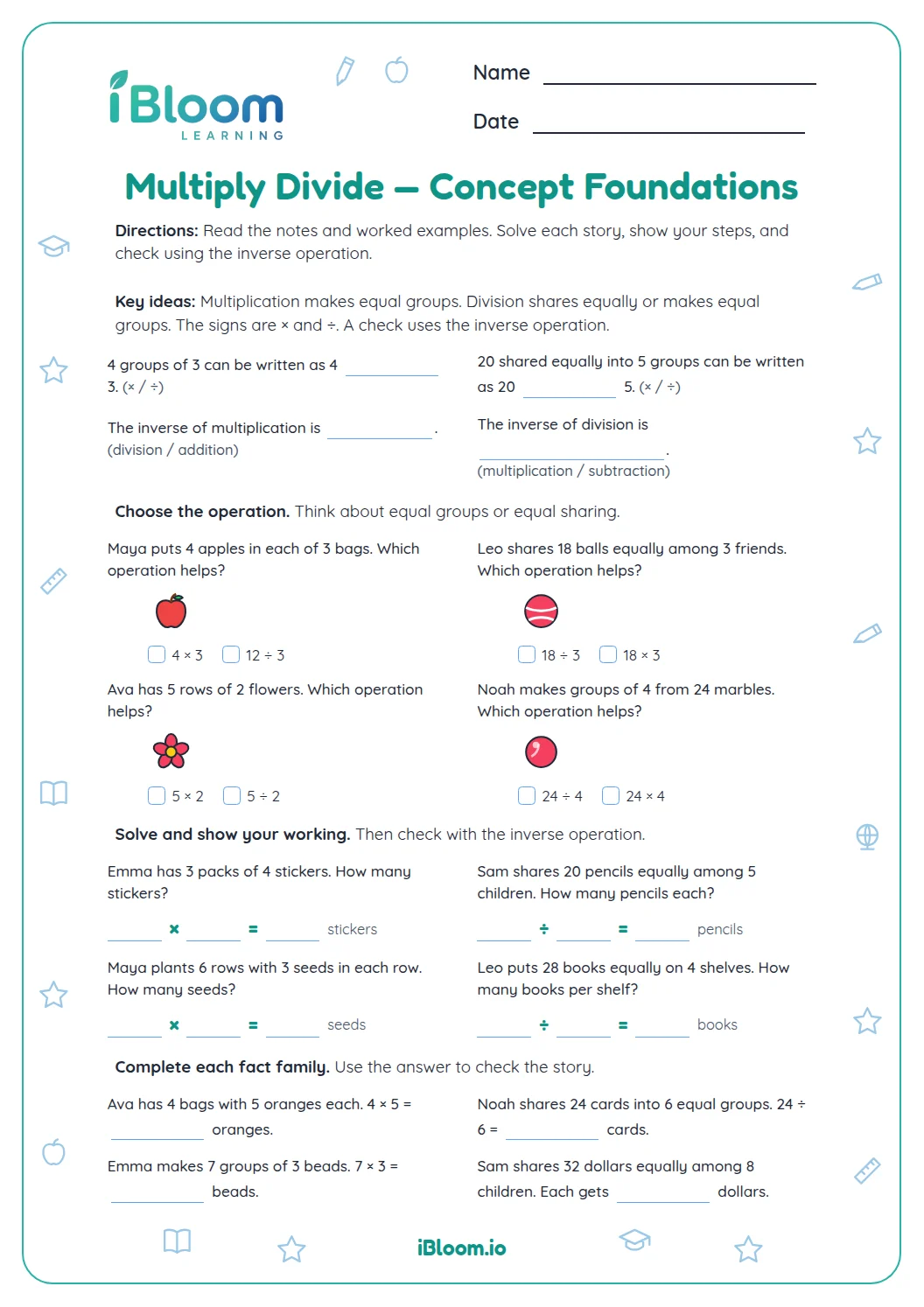
This Grade 3 printable has 14 multiple-choice word problems using multiples of 10. Learners solve equal-group and equal-sharing situations, find what remains, and combine operations in two-step stories. They can estimate and check whether each choice fits the story. The practice aligns with CCSS 3.OA.D.8, with a separate two-page answer key.
Aligned to 3.OA.D.8
What kinds of problems are included?
Part A starts with equal groups. Part B mixes multiplication, division, and subtraction, including two-step situations near the end.
- Part A: seven equal-group and sharing stories
- Part B: seven mixed-operation stories, including two-step situations
How do you choose an operation?
Look for the relationship, not only a keyword. If the same number is in each group and you need the total, multiply. If a total is shared equally, divide. If items are sold or used, subtract. Then match your result to a choice.
- 16 boxes × 20 books in each box = ?
- 26 × 20 = 120
- 3Choose 120 books.
How can you check a story answer?
Use the story units and estimate. Six groups of 20 should be more than 100 and less than 200, so 120 books is reasonable. For division, multiply the quotient by the number of groups to check.
How to use this worksheet
- 1Identify the quantity in each group and the number of groups.
- 2Decide whether the story describes a total, an equal share, or a change.
- 3Solve with an operation or a two-step plan.
- 4Compare the result with the answer choices.
- 5Check that the number and unit make sense in the story.
Common mistakes and quick fixes
The mistake
Multiplying when the story shares equally
The fix
If the total is split into equal groups, divide the total by the number of groups.
The mistake
Subtracting before finding a total
The fix
For equal groups, multiply first; subtract only if the story later removes some items.
The mistake
Choosing a number that does not match the story unit.
The fix
Check what the question asks for: books, seats, miles, packs, or another quantity.
Common Core alignment
The stories use whole-number operations in familiar equal-group and change situations.
Solve two-step word problems with whole-number operations and check if answers are reasonable.
On this sheet: Two stories require two operations; the set also asks learners to interpret equal groups, sharing, and changes in whole-number quantities.
Show the official wordingHide the official wording
Solve two-step word problems using the four operations. Represent these problems using equations with a letter standing for the unknown quantity. Assess the reasonableness of answers using mental computation and estimation strategies including rounding.
What to practice next
Make more practice
Further reading
Questions parents and teachers ask
Which operations do the stories use?
The problems use multiplication for equal groups, division for equal shares, and subtraction for amounts sold or used. Several stories take two steps. For example, first find the total in equal groups, then subtract the number that is sold.
What does multiples of 10 mean here?
The stories use quantities such as 20 books per box, 40 seats per table, or 100 cups per carton. Learners use these tens as factors, totals, or group sizes. They still need to decide whether the story calls for multiplication, division, or subtraction.
How many problems are included?
There are 14 multiple-choice word problems across two worksheet pages, with three choices for each. The separate answer key takes two pages and marks the correct choice. The stories include equal groups, sharing, remaining amounts, and two-step situations.
How can a learner choose the operation?
Ask what the story is finding. Equal groups usually call for multiplication when finding a total; sharing a total equally calls for division; finding what remains calls for subtraction. A two-step story may need one operation to find a total and another to change it.
Is an answer key included?
Yes. A separate two-page key marks the correct answer choice for all 14 stories. After checking, have the learner name the operation used and connect the result to the unit in the story, such as books, packs, miles, or seats.