

About this worksheet
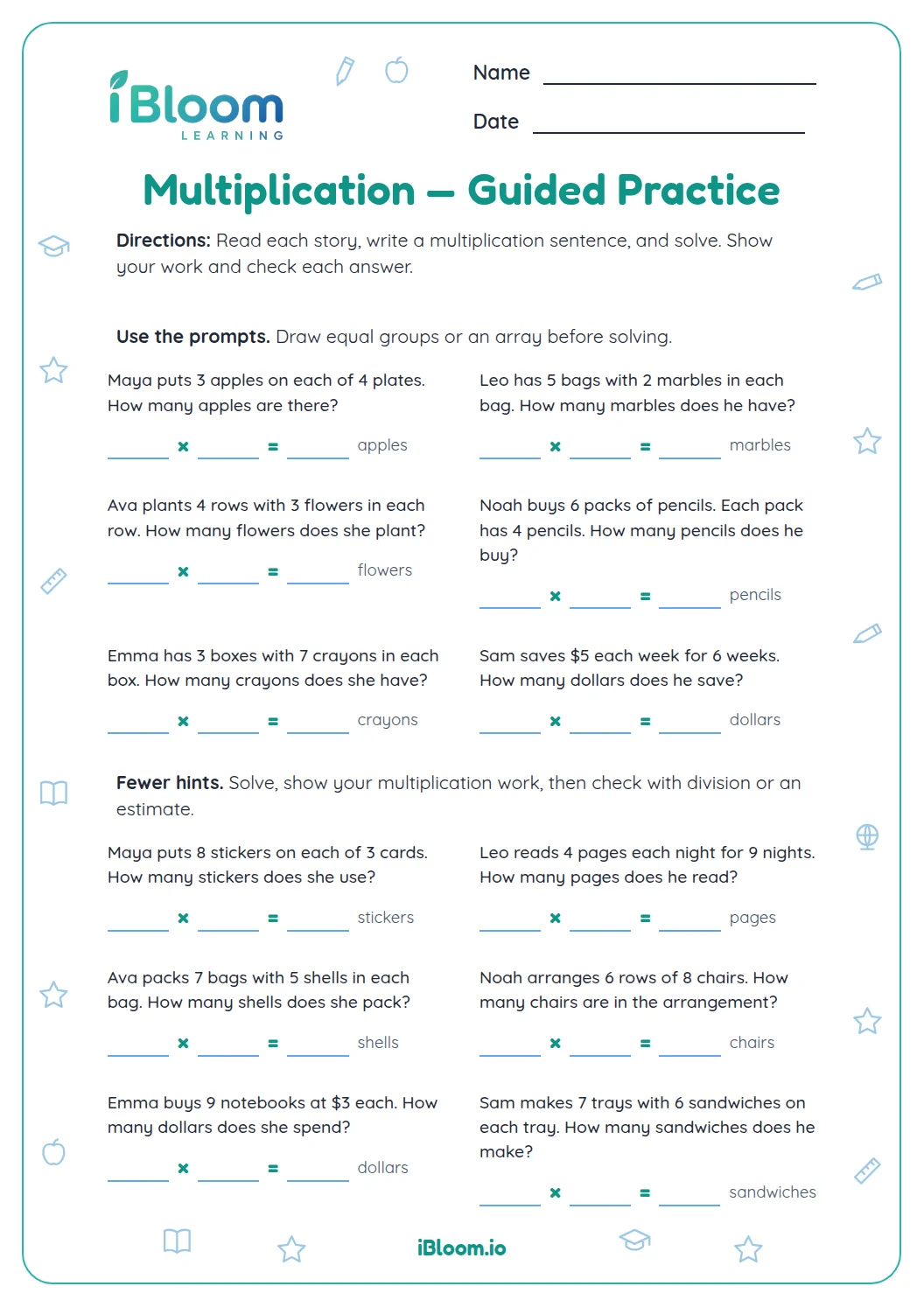
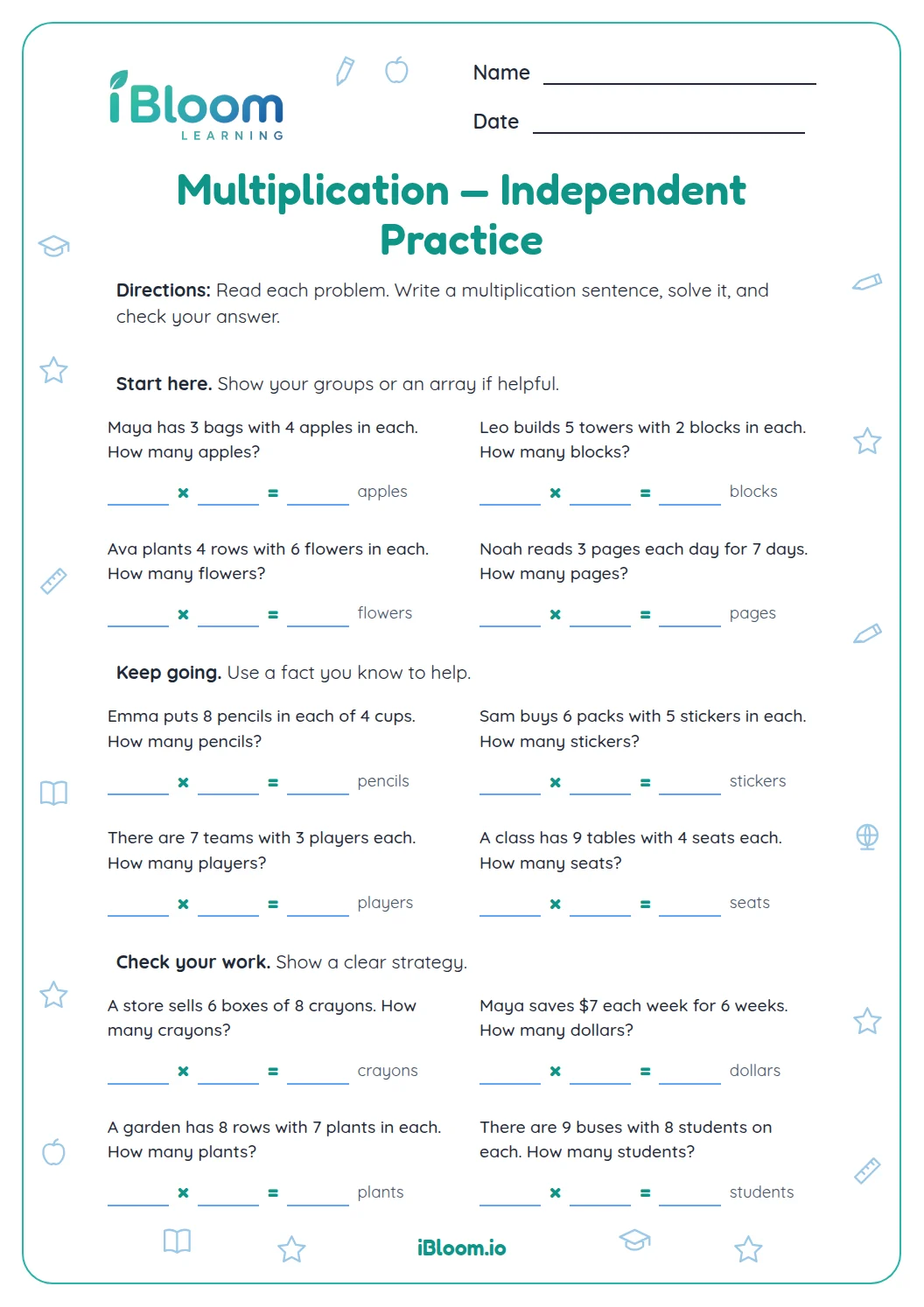
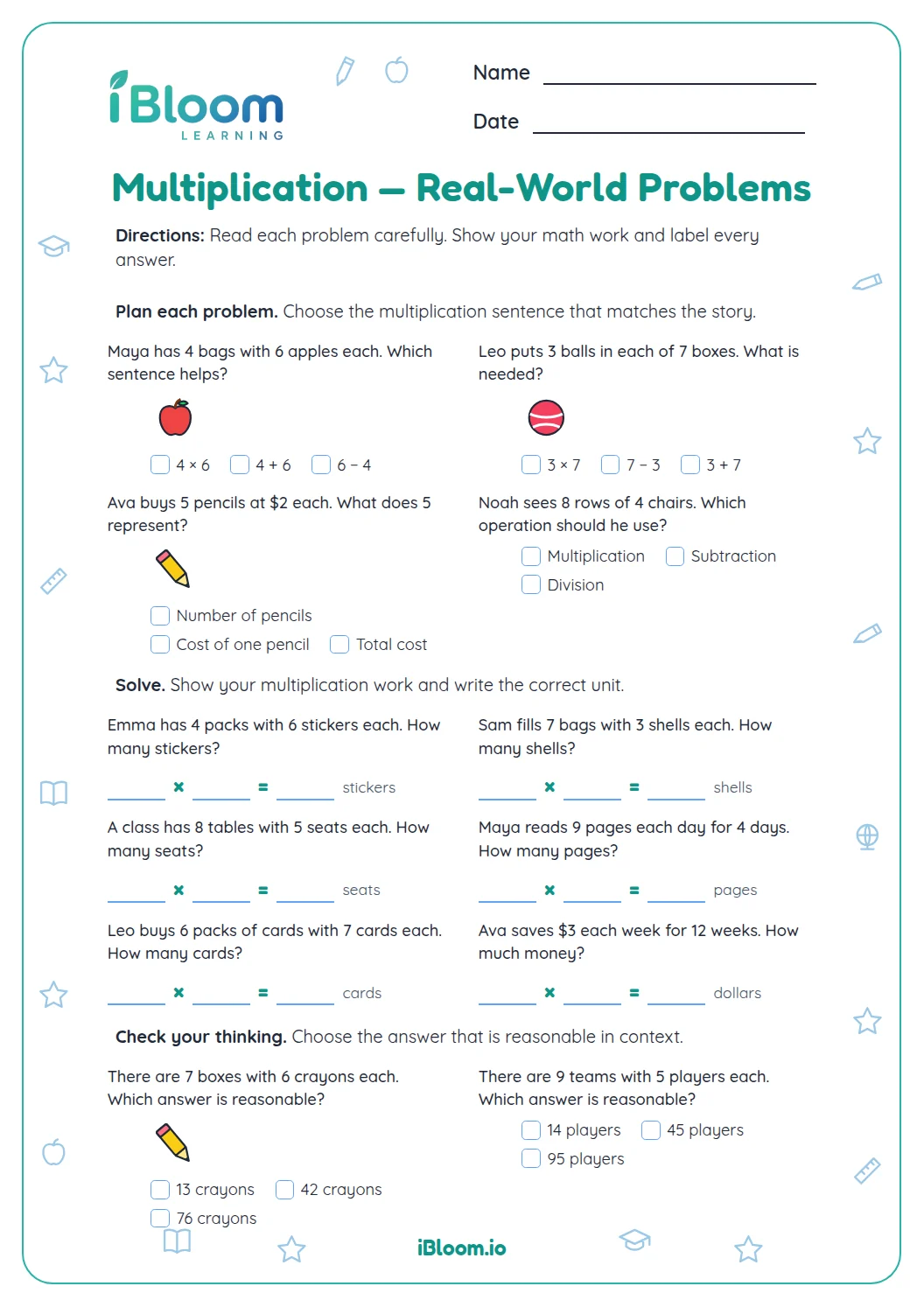
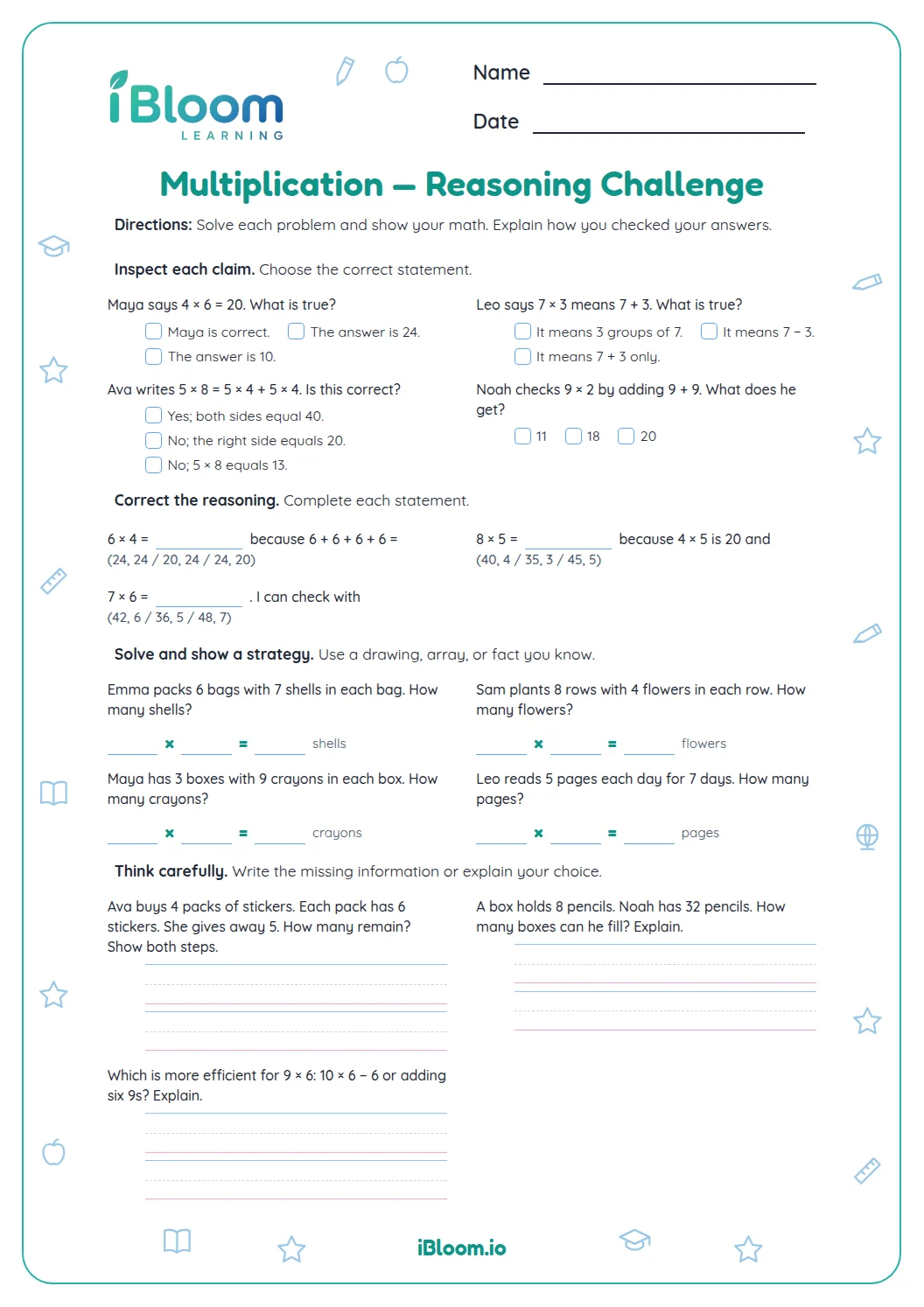
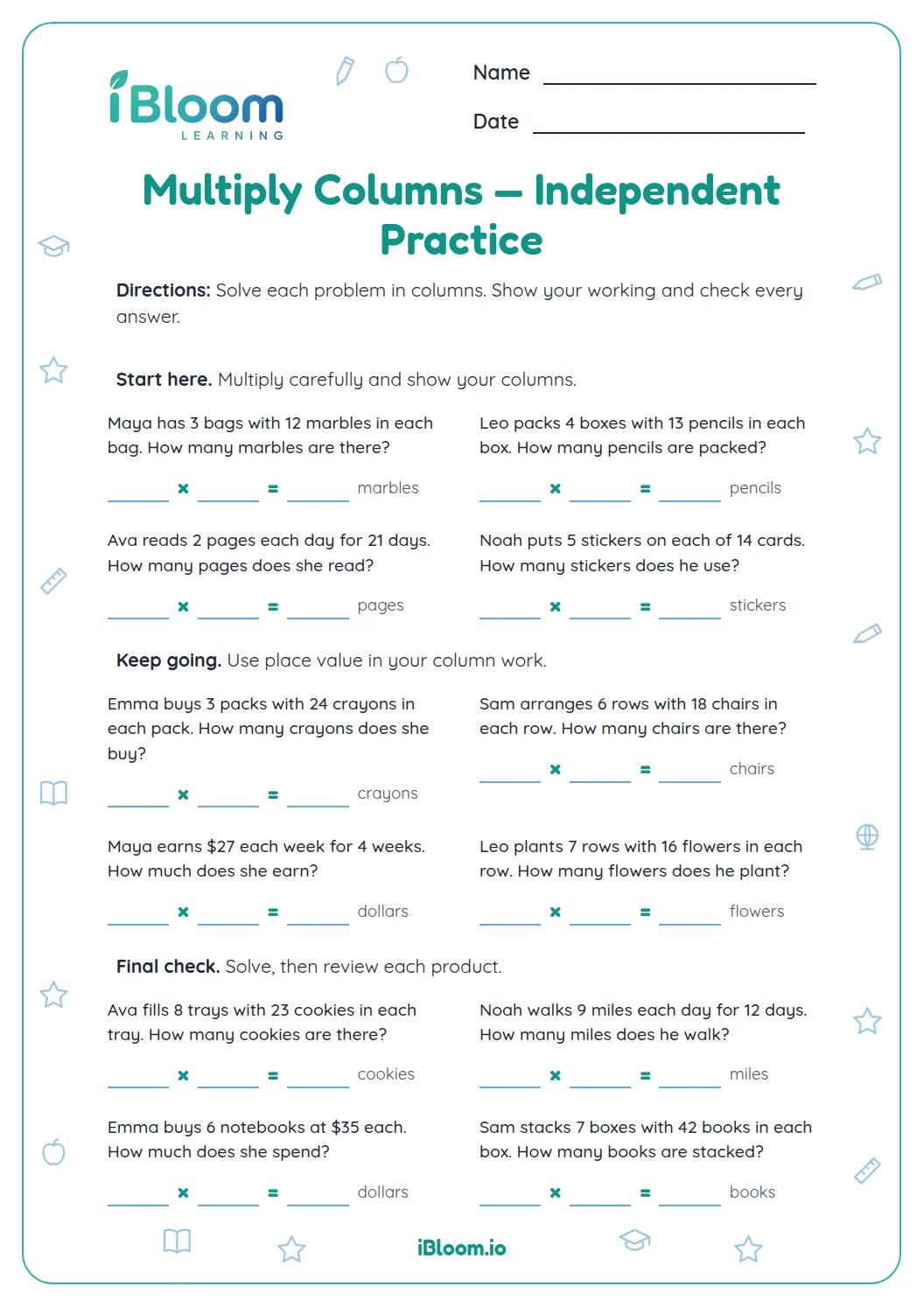
This Grade 3 worksheet connects multiplication word problems to visual arrays. The first situation includes an array that matches the story, so students can see the number of groups and the number in each group. The remaining thirteen stories ask students to apply the same equal-group reasoning without a model. Students find each total and label what it counts. The separate answer key gives each product; the first answer includes its unit. The practice aligns with CCSS 3.OA.A.3, solving equal-group and array word problems.
Aligned to 3.OA.A.3
How can an array represent equal groups?
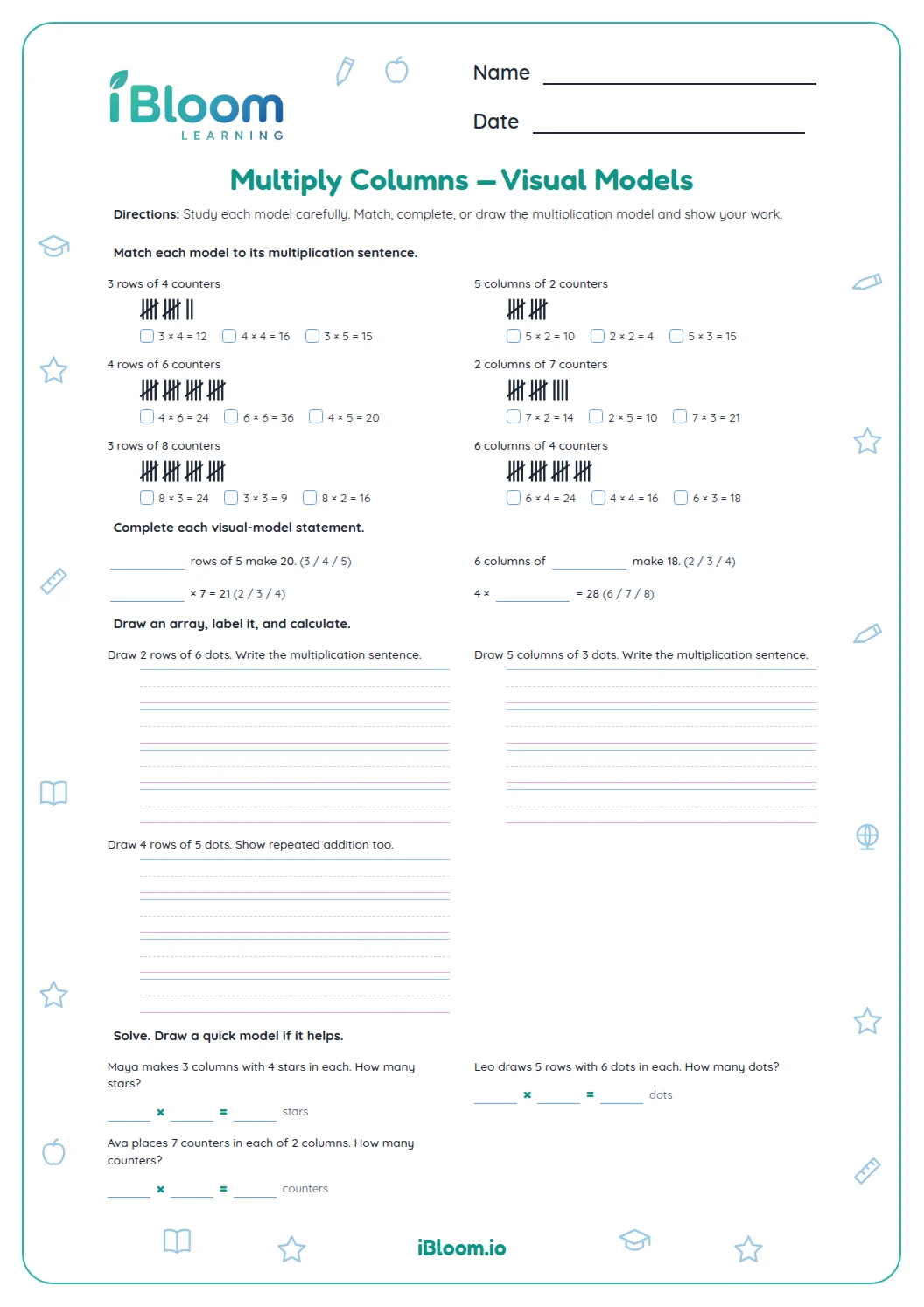
An array organizes equal groups into rows and columns. In the first story, 3 trays with 4 muffins on each tray match 3 rows of 4, so 3 × 4 = 12.
For the first story, match the group count and items per group to the array. Then label the product with what the question counts.
- 13 trays, 4 muffins on each tray
- 23 × 4 = 12
- 3There are 12 muffins.
What should students write after finding a product?
The equation records the multiplication, and the answer label names the counted objects. For 5 shelves with 3 books each, 5 × 3 = 15, so the answer is 15 books.
After the modeled story, the remaining thirteen problems ask students to apply equal-group reasoning without an array printed beside each story.
How can students check an equal-groups answer?
Multiply the number of groups by the number in each group. Check that the product matches the story and label it with the objects counted. For 4 plates with 4 crackers each, 4 × 4 = 16 crackers.
How to use this worksheet
- 1Read the story and underline the equal-group information.
- 2Identify how many groups there are.
- 3Identify how many items belong in each group.
- 4Multiply the two numbers or add equal groups.
- 5Write the total with the correct unit.
Mistakes to watch for
The mistake
Multiplying the right numbers in the wrong order of meaning
The fix
Name the groups and the amount in each before writing the factors.
The mistake
Adding the two numbers in the story
The fix
Ask whether the story combines two amounts or repeats equal groups.
The mistake
Giving a number without what it counts
The fix
Finish with the item named in the question, such as 12 muffins.
Common Core alignment
Represent equal groups with an array and multiplication equation, then solve.
On this sheet: Every question describes equal groups and supplies an array model.
Show the official wordingHide the official wording
Use multiplication and division within 100 to solve word problems in situations involving equal groups, arrays, and measurement quantities, e.g., by using drawings and equations with a symbol for the unknown number to represent the problem.
What to practice next
Make more practice
Further reading
Questions parents and teachers ask
How do students read the array model?
Count the array’s rows to find the number of groups, then count the objects in one row to find the amount in each group. For three rows of four, the equation is 3 × 4 = 12. The story tells what that product represents.
Should students write an equation for every problem?
Writing an equation is a useful way to record the group count, the amount in each group, and the total. The first question includes an array, and the remaining stories ask students to apply equal-group reasoning without a model. Students can use repeated addition to check a product.
Why does the answer need a label?
A label tells what the number counts. If the product is 12 in a muffin problem, “12 muffins” makes the answer clear. It also helps students check that they answered the question asked in the story and did not report a factor instead of the total.
What grade is this multiplication worksheet for?
This worksheet is designed for Grade 3 students practicing multiplication in equal-group word problems. The first story includes an array to support the connection between a story and a model. The other thirteen give students a chance to apply the same structure without a drawing.
How can I help if a student adds the group numbers?
Ask the student to point to one group and count the items in it. Then count how many equal groups there are. The total comes from repeating the group amount that many times, which multiplication represents. A quick equation or sketch can help verify the result.