
About this worksheet
This Grade 3 worksheet connects equal groups with multiplication, then gives students products and short stories to solve using place value. Across 18 questions in four parts, children identify what factors mean, work out one-digit by two-digit products within 100, and apply multiplication to situations. The answer key shows each product.
Aligned to 3.OA.A.1
How do equal groups connect to multiplication?
For 3 groups of 12, write 12 × 3. The factors name the group size and number of groups; the product is 36.
How does place value help with columns?
For 14 × 5, multiply 5 ones by 4 ones to get 20 ones, then 5 × 1 ten is 5 tens. Regroup and combine to get 70. Keep digits in their place-value columns as you work.
- 114 × 5
- 25 × 4 ones and 5 × 1 ten
- 314 × 5 = 70
What does this worksheet practice?
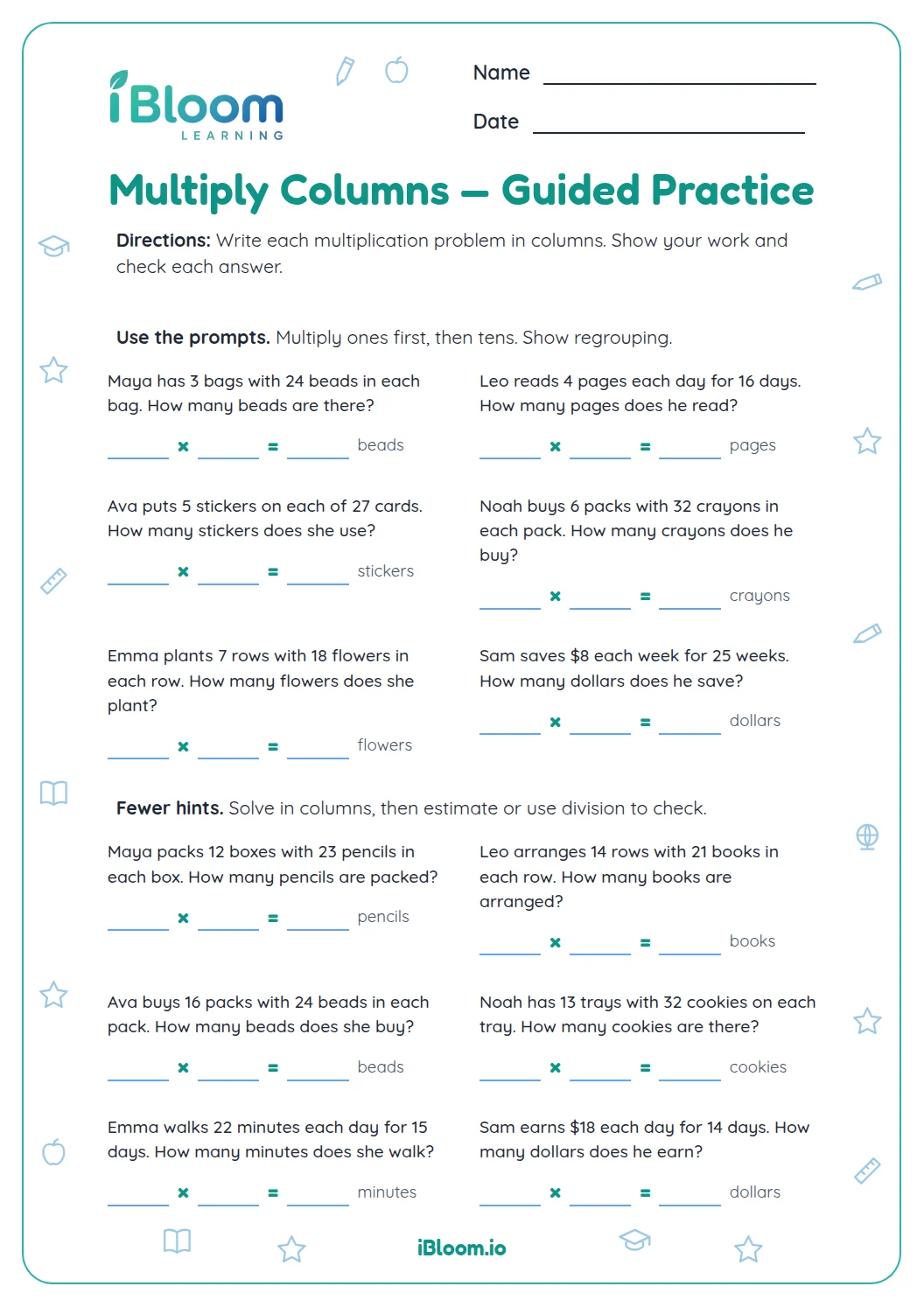
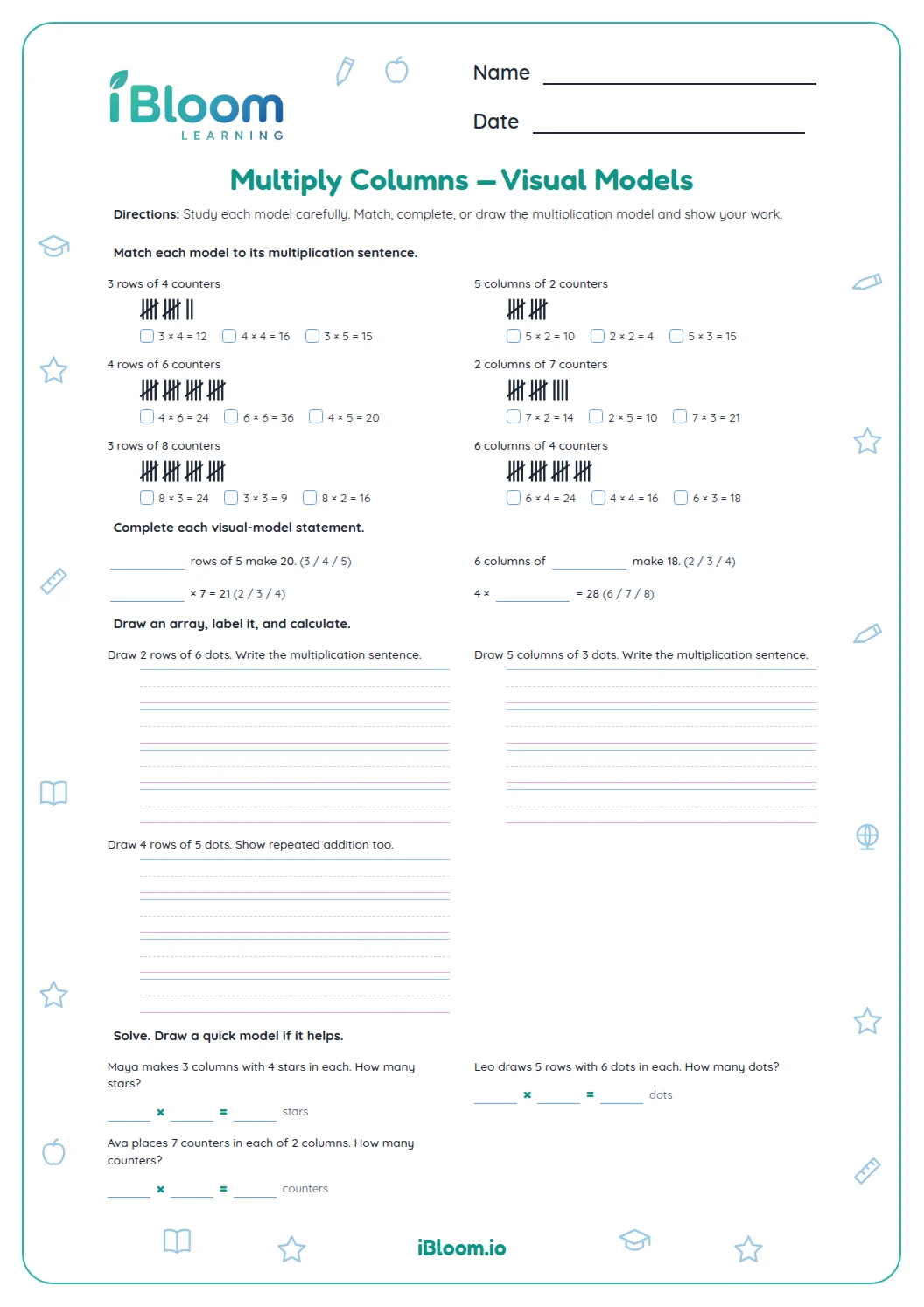
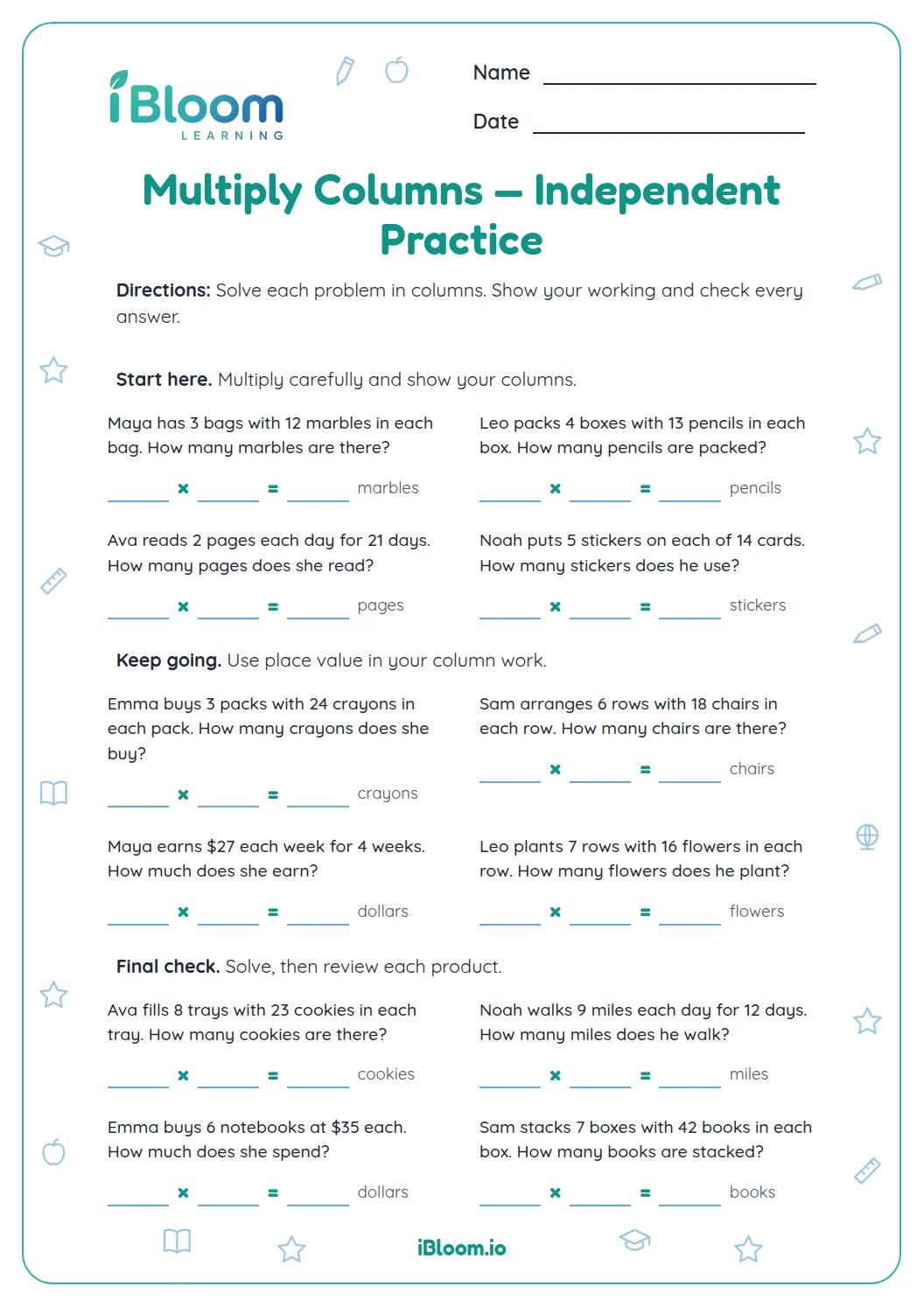
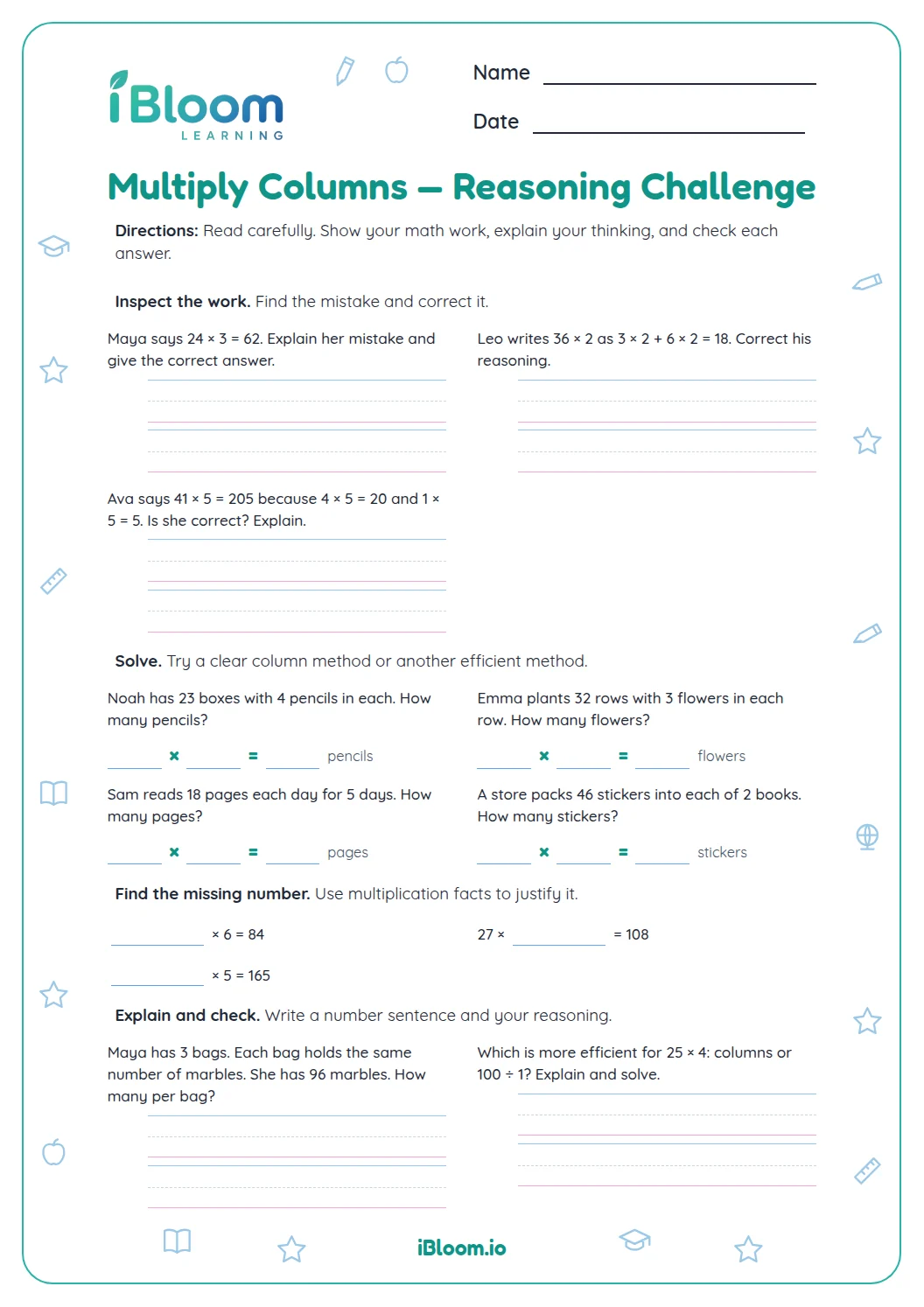
There are 18 questions in four parts: four group and place-value checks, six products to work out, four missing products, and four short stories. The products stay within 100. The computation items leave room to show column steps.
How to use this worksheet
- 1Read what each factor represents in a group story.
- 2For a product, write the factors in the correct place-value columns.
- 3Multiply the ones, regroup when needed, and multiply the tens.
- 4Check the product with an equal-groups drawing or addition.
Common mistakes and quick fixes
The mistake
Switching the group size and number of groups.
The fix
Name each factor before writing the equation.
The mistake
Putting a regrouped ten in the ones column.
The fix
Write the regrouped ten above the tens digit.
The mistake
Forgetting to multiply the tens digit.
The fix
Complete the ones and tens steps before adding.
Curriculum alignment
This practice builds the named skill through short, grade-appropriate examples.
Interpret each product as a number of equal groups.
On this sheet: Interpret each product as a number of equal groups.
Show the official wordingHide the official wording
Interpret products of whole numbers, e.g., interpret 5 × 7 as the total number of objects in 5 groups of 7 objects each.
What to practice next
Make more practice
Further reading
Questions parents and teachers ask
How many questions are on the worksheet?
There are 14 questions in three parts. Students interpret groups, solve products, and use multiplication in short stories. The products stay within 100, and the answer key gives a quick way to check the calculations. An adult can read the prompt aloud, give the child time to work, and then check the response together with the answer key.
Does the worksheet practice multiplication in columns?
Yes. Six items ask students to work out products and leave room for written steps. The directions prompt children to keep ones and tens in place while multiplying. An adult can read the prompt aloud, give the child time to work, and then check the response together with the answer key.
What multiplication facts appear?
The sheet uses one-digit factors with factors from 12 to 32. Students can use known facts and place value to find products such as 14 × 5 and 23 × 2. An adult can read the prompt aloud, give the child time to work, and then check the response together with the answer key.
How can I help a child who is stuck?
Ask the child to say what each factor means. For a product such as 14 × 5, break 14 into 10 and 4, multiply each part by 5, and combine 50 and 20. An adult can read the prompt aloud, give the child time to work, and then check the response together with the answer key.
What is the answer key for?
The key lists the correct answer for every item. Compare the final product first, then ask the learner to check the written steps if the answer differs. An adult can read the prompt aloud, give the child time to work, and then check the response together with the answer key.