

About this worksheet
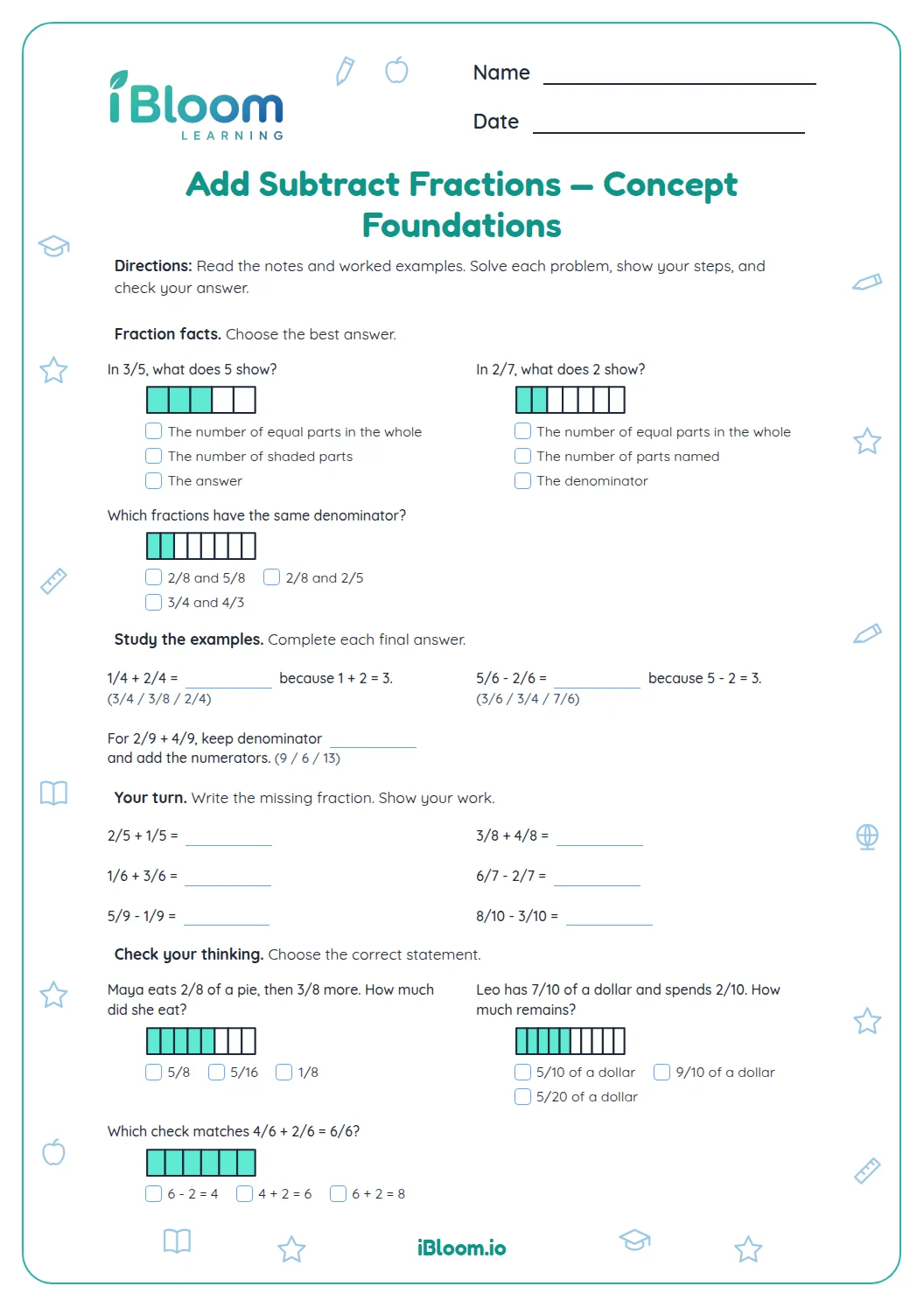
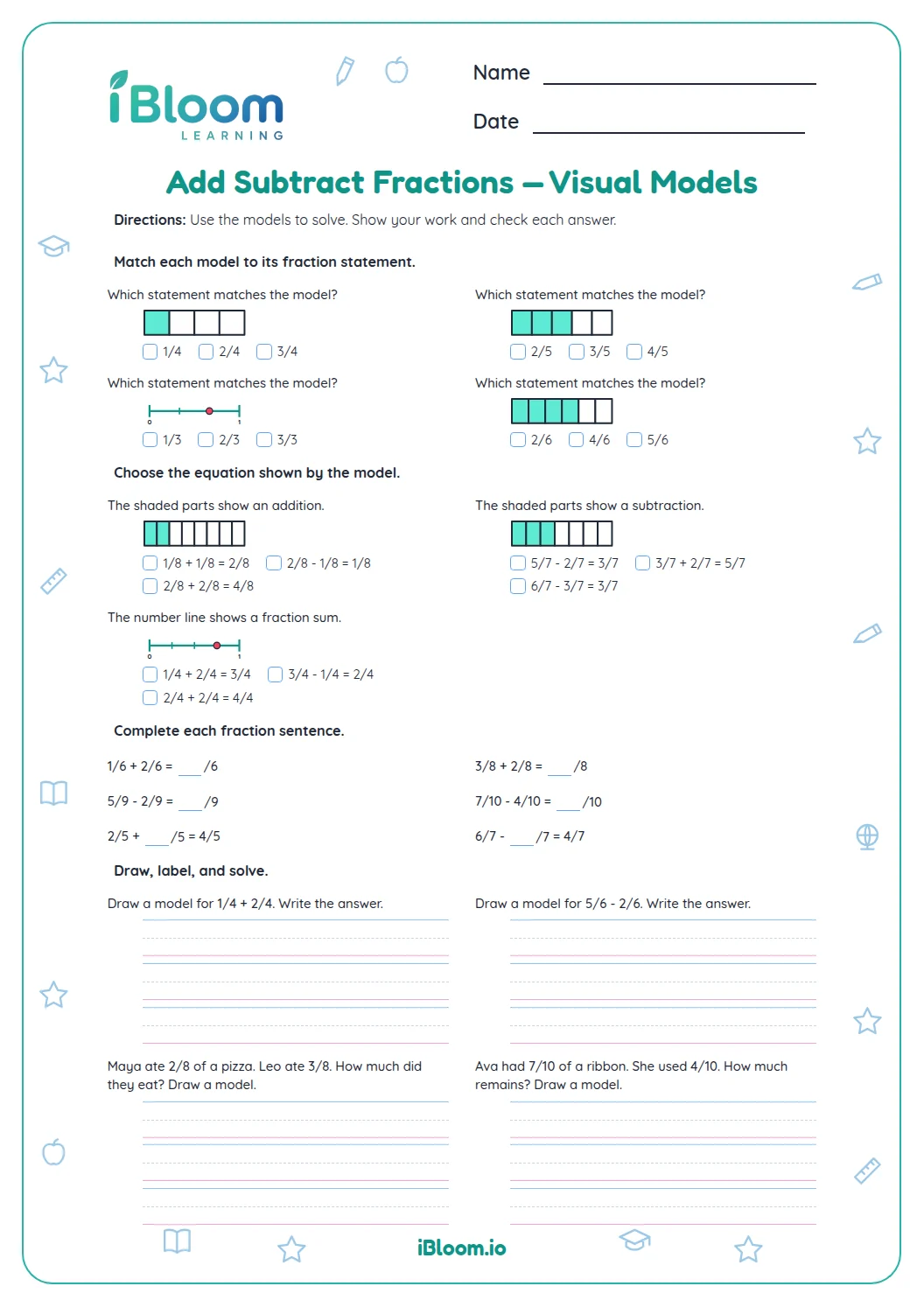
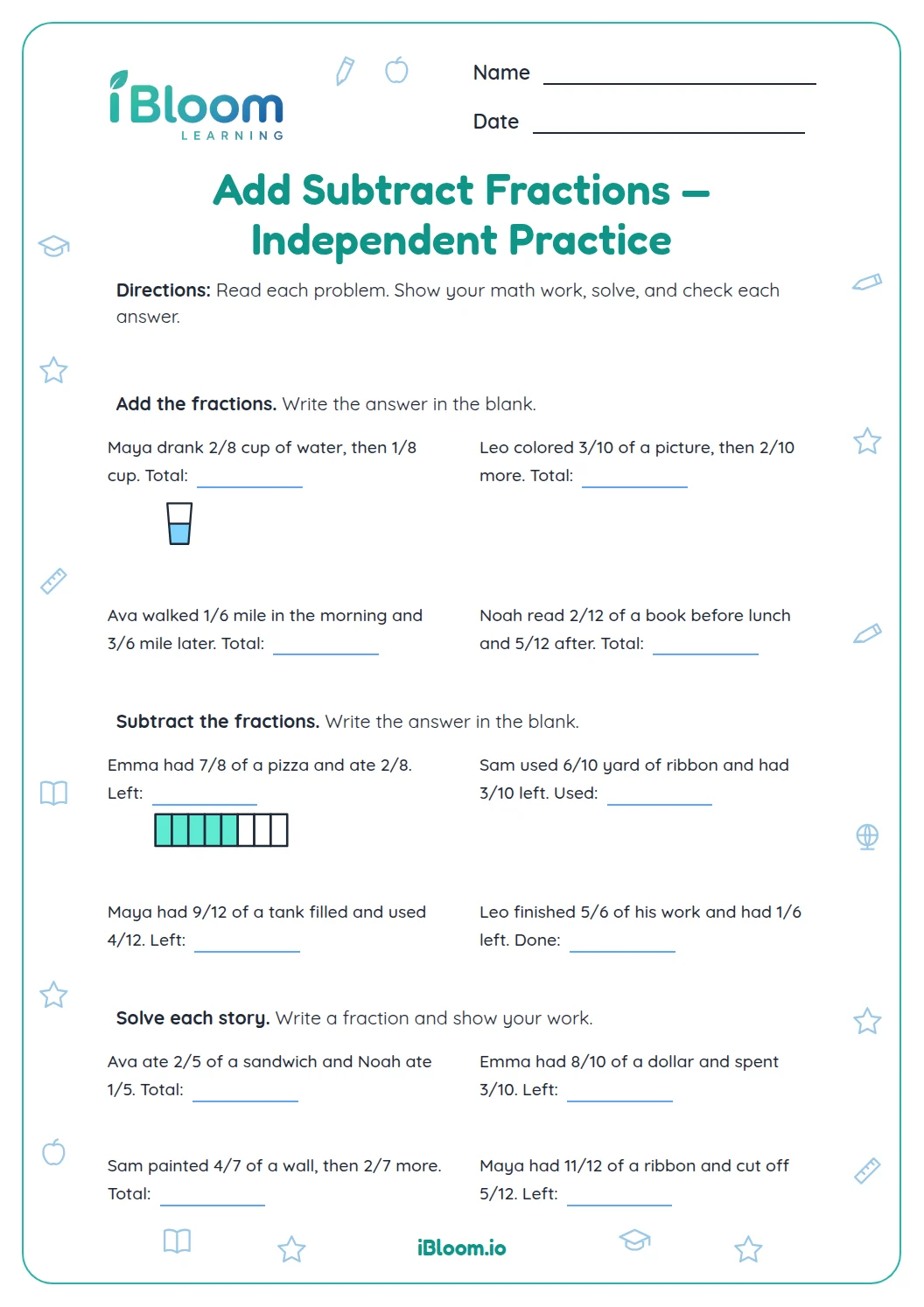
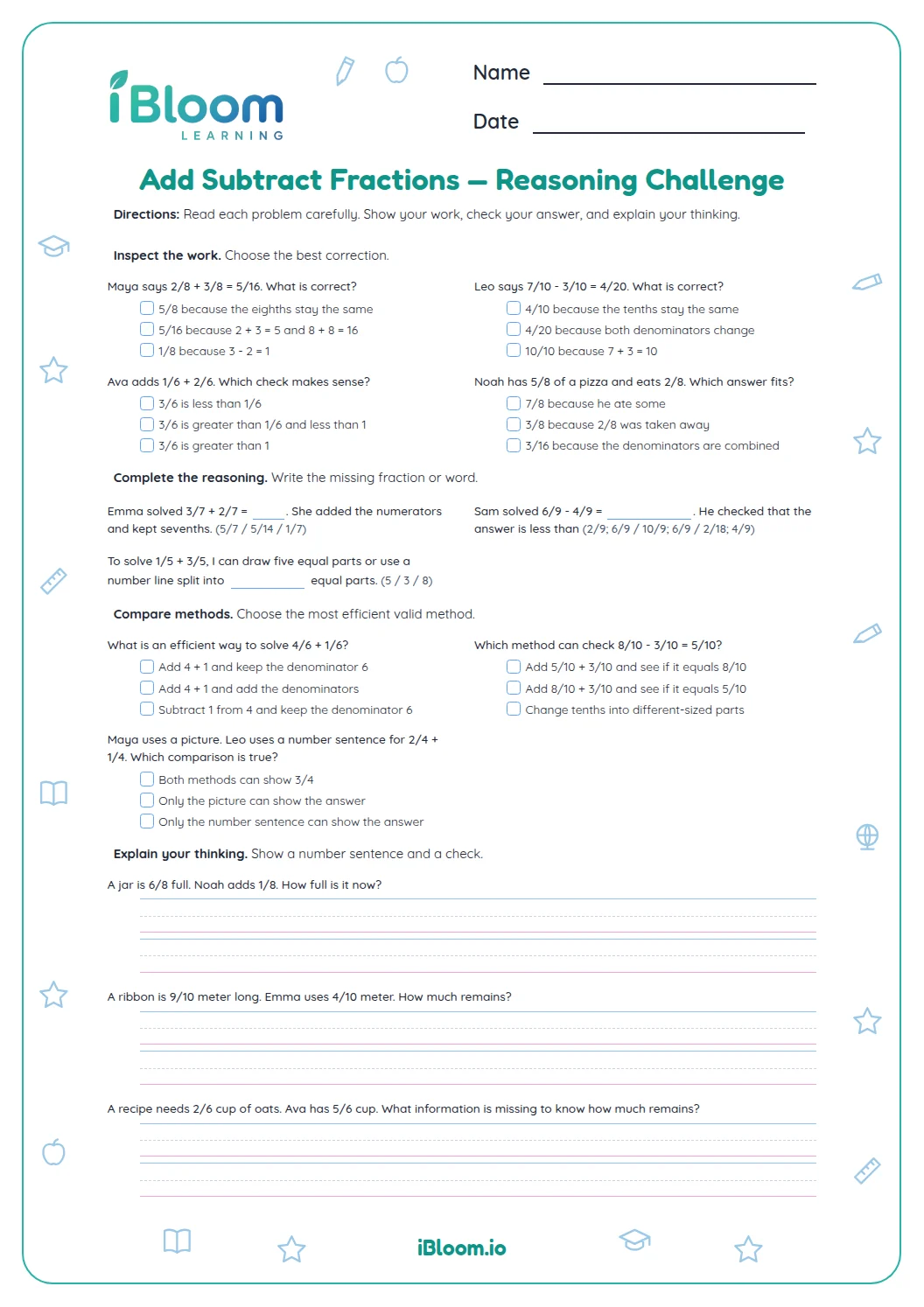
This Grade 3 worksheet gives children 14 short stories about portions of familiar items and distances. They solve each problem using fractions with like denominators using fractions with like denominators. Denominators stay within halves, thirds, fourths, sixths, and eighths. Some answers equal one whole, which helps children connect several equal parts to the full item. The separate key lists each result.
How do you choose addition or subtraction?
Look at what changes in the story. When two portions are joined, add. When some of a portion is used or removed, subtract. The denominators match, so the parts being counted are the same size.
How can you write a number sentence?
Name the fractions in the story in the order they are combined or separated. Keep the denominator because the parts are the same size, then add or subtract the numerator parts.
- 1Lena drank 2/8, then 3/8.
- 2Join the portions: 2/8 + 3/8.
- 3Answer: 5/8 of the bottle.
What does an answer of one whole mean?
When the numerator equals the denominator, all of the equal parts are present. For example, 4/4 is one whole. Several stories use portions that combine to make one complete item or unit.
How to use this worksheet
- 1Read the whole story before choosing an operation.
- 2Underline the amounts being joined or taken away.
- 3Write an addition or subtraction sentence with the same denominator.
- 4Combine or remove the numerator parts.
- 5Check that the answer fits the story and its whole.
Common mistakes and quick fixes
The mistake
Adding denominators when the parts are the same size.
The fix
Keep the denominator; count how many same-sized parts there are.
The mistake
Subtracting the smaller amount from the wrong amount.
The fix
Start with the amount the story says was there, then remove what was used.
The mistake
Missing that all parts make one whole.
The fix
When numerator and denominator match, name one whole.
What to practice next
Make more practice
Further reading
Questions parents and teachers ask
Which fraction denominators appear?
The problems use halves, thirds, fourths, sixths, and eighths. Each story uses like denominators so children can focus on identifying whether the portions are joined or taken away. Use the passage and printed questions as the reference when checking each response with the separate answer key.
Does each problem have room for an equation?
Yes. Each question uses an equation work space. Children can write the fraction sentence and solve it before recording the result. Use the passage and printed questions as the reference when checking each response with the separate answer key.
Why do the denominators stay the same?
Each fraction names parts of the same size in its story. When equal-sized parts are joined or removed, the numerator changes while the denominator continues to name the size of each part. Use the passage and printed questions as the reference when checking each response with the separate answer key.
What does 4/4 mean?
Four fourths make one whole. When every equal part of the item is counted, a fraction such as 4/4 or 6/6 can be written as one whole. Use the passage and printed questions as the reference when checking each response with the separate answer key.
How can an adult help without giving the answer?
Ask what the story says happened to the first amount: were more same-sized parts added, or were some removed? Have the child write that operation with the fractions and explain what each number represents. Use the passage and printed questions as the reference when checking each response with the separate answer key.