
About this worksheet
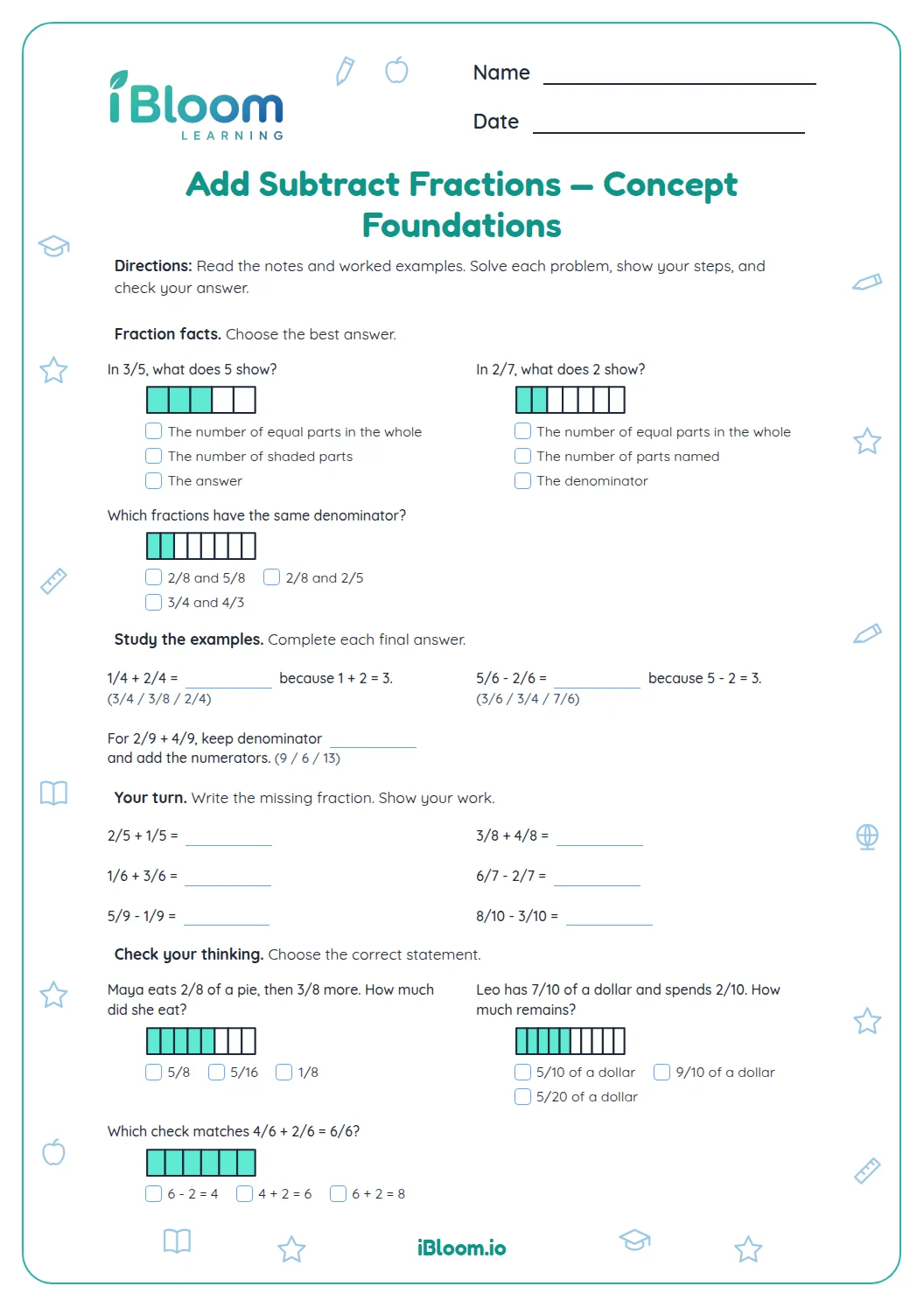
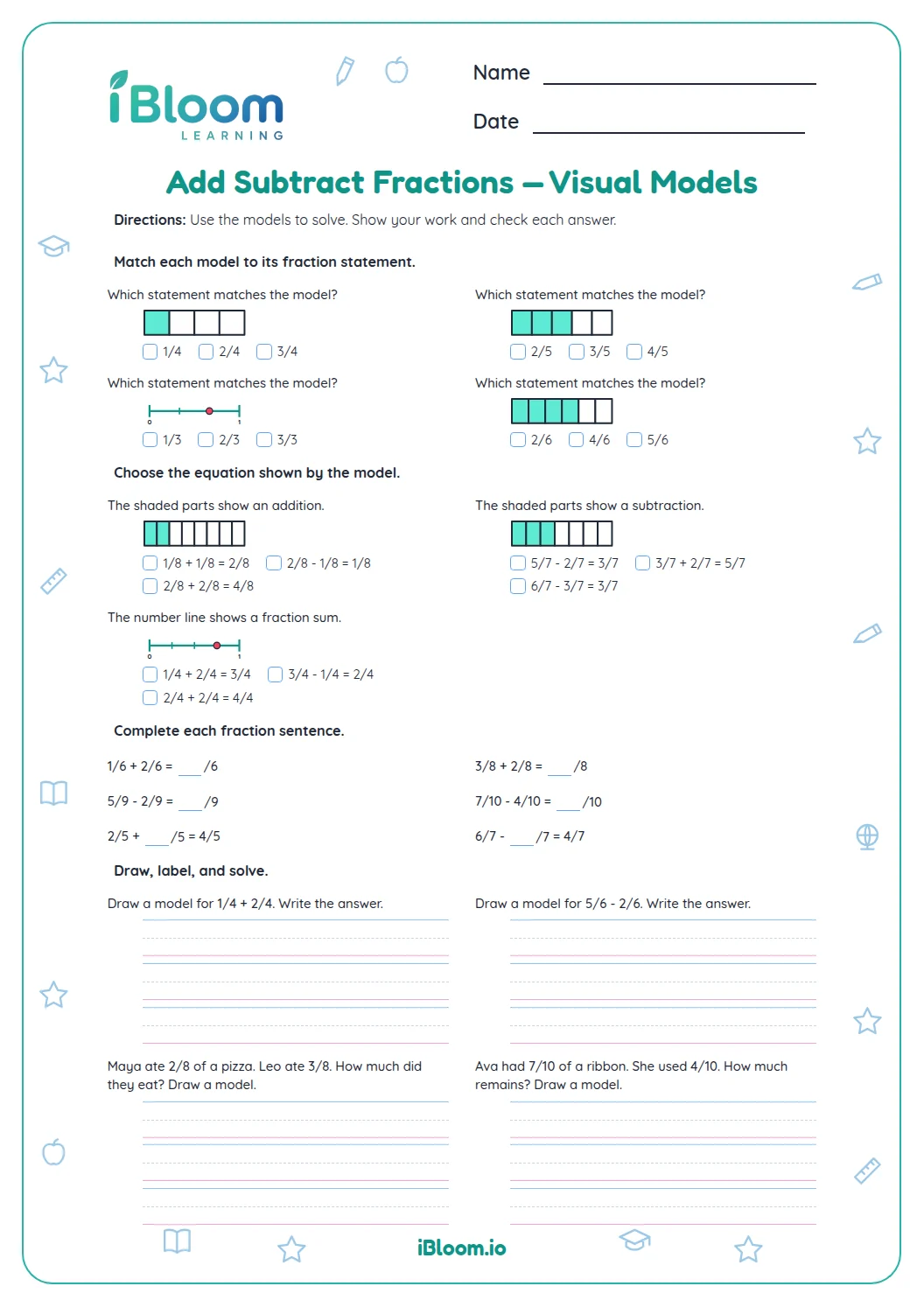
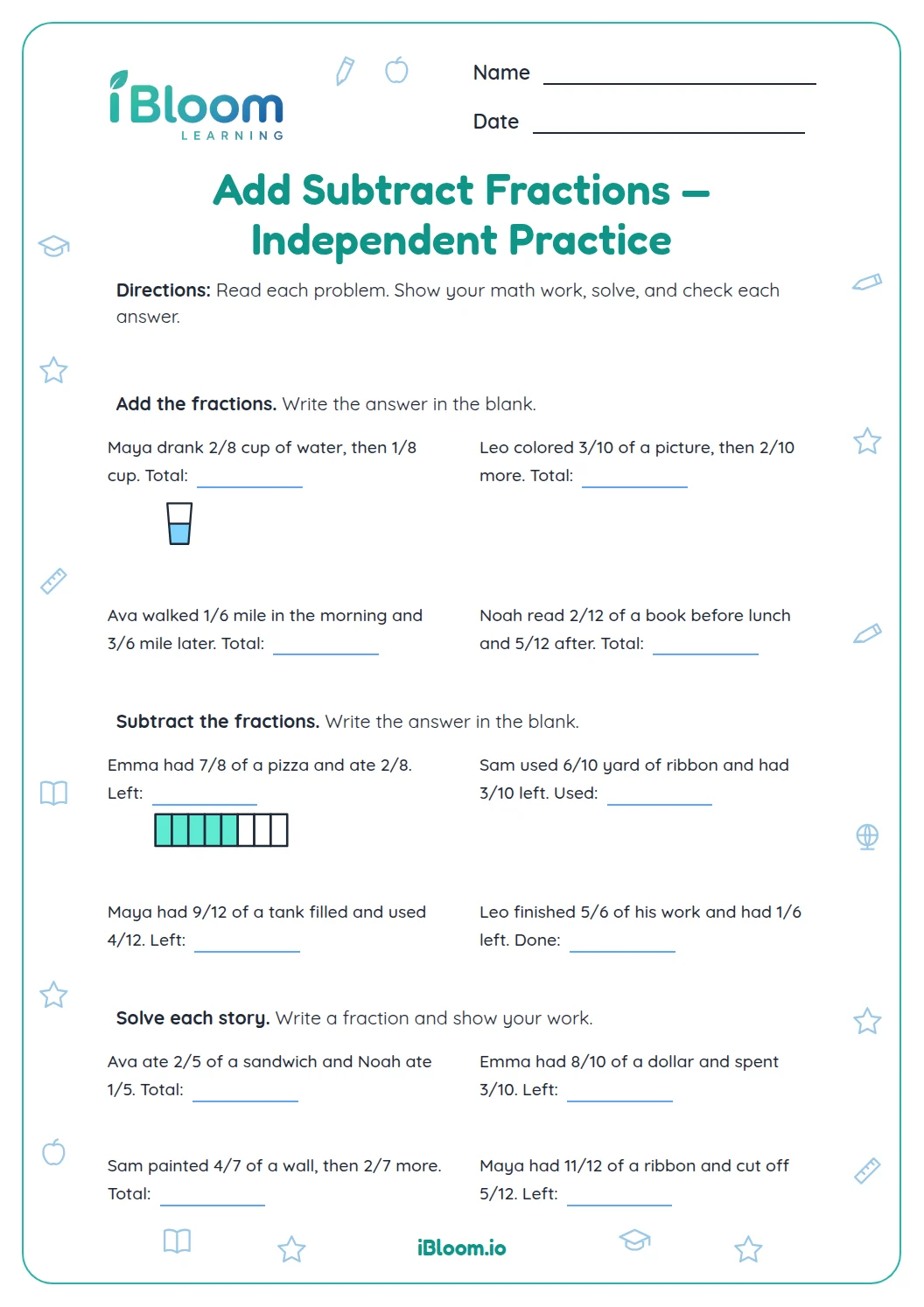
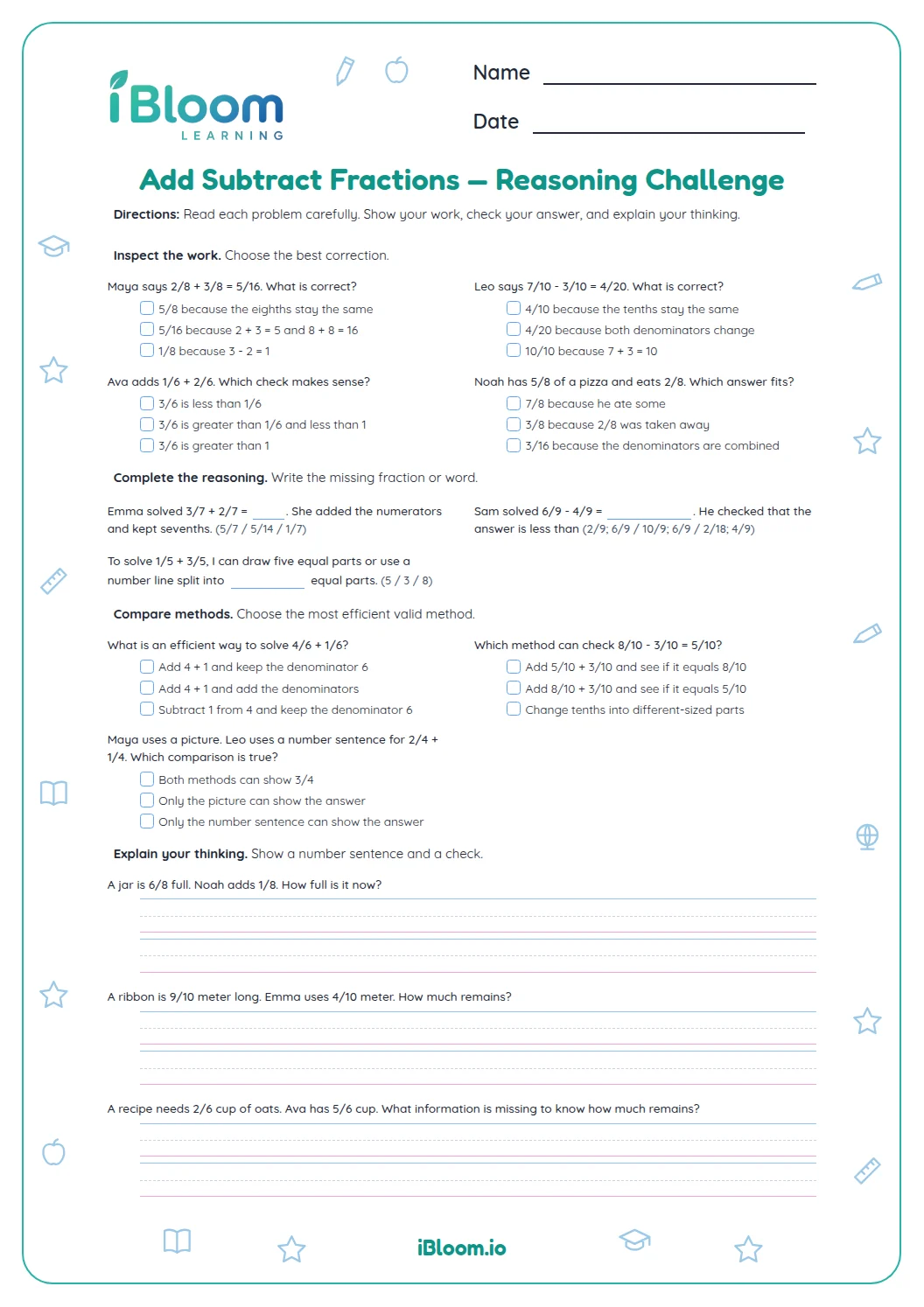
This Grade 3 word-problem worksheet gives children practice adding and subtracting fractions in everyday contexts. Each of the 12 problems uses like denominators from thirds, fourths, sixths, and eighths and asks for one clear total or remainder. Children decide which operation fits and write the missing fraction. A separate answer key is included. The problems align with CCSS 4.NF.B.3.d, solving same-whole fraction word problems with like denominators.
Aligned to 4.NF.B.3.d
How do I add like fractions in a story?
When the denominators match, each fraction names pieces of the same size. Add the numerators and keep that denominator. In question 1, Ava ate 2/8 and 3/8, so 2/8 + 3/8 = 5/8.
- 12/8 + 3/8 = 5/8
- 2Ava ate 5/8 of the pan
How do I know when to subtract?
Look for what was used, poured out, cut off, or left. Those stories ask for a difference. For the ribbon story, 7/8 − 2/8 = 5/8 yard remains. Keep the denominator because each piece is still an eighth.
How can an equation help with a story?
An equation records how the story changes the amount. Words such as altogether and in all often point to addition; used and remains often point to subtraction. Check that the equation answers the question being asked.
What contexts are included?
The questions use food, ribbons, walking, reading, gardens, and other familiar situations. Every problem uses like denominators from thirds, fourths, sixths, or eighths and refers to one whole or one route.
How to use this worksheet
- 1Read the whole story and underline what is being asked.
- 2Decide whether the amount grows or gets smaller.
- 3Write the resulting fraction in the blank.
- 4Work with the numerators and keep the common denominator.
- 5Include the unit or object in your answer when the story gives one.
Mistakes to watch for
The mistake
Adding denominators as well as numerators.
The fix
For 2/8 + 3/8, add only 2 + 3; the pieces stay eighths.
The mistake
Subtracting the smaller numerator from the denominator.
The fix
Use 7/8 − 2/8 = 5/8, not 7/8 − 2/8 = 5/6.
The mistake
Choosing an operation from one word without reading the question.
The fix
Decide what the story asks: the amount used, the amount left, or the total.
Common Core alignment
This worksheet practices the following Common Core skills.
Solve same-whole fraction addition and subtraction stories with like denominators.
On this sheet: Each story asks for the sum or difference of fractions with like denominators.
Show the official wordingHide the official wording
Solve word problems involving addition and subtraction of fractions referring to the same whole and having like denominators, e.g., by using visual fraction models and equations to represent the problem.
What to practice next
Make more practice
Further reading
Questions parents and teachers ask
How do children add fractions with like denominators?
They add the numerators and keep the denominator. The denominator tells the size of the equal pieces, so eighths plus eighths stay eighths. For question 1, 2/8 + 3/8 = 5/8 of the pan. A quick drawing divided into equal parts can help make the pieces clear.
How can I tell whether a story needs addition or subtraction?
Ask whether the amount is being combined or reduced. “Altogether” and “in all” often signal a total; words such as used, drank, or remains often signal subtraction. The full question matters, so children should identify what quantity they need before choosing an operation.
Why do some answers simplify?
The answer key keeps fractions in the same denominator form used in the story, so children can see the operation clearly. For example, 3/6 remains a valid fraction even though it is also equal to 1/2. Ask the child to explain what the numerator and denominator represent.
How many problems are included?
The worksheet contains 12 short story problems in two parts. The stories use familiar settings such as food, walking, reading, gardens, and household tasks. Each problem asks for one sum or difference and has a blank for the fraction answer.
Does this worksheet include an answer key?
Yes. A separate key page lists the fraction answer for all 12 problems. It can be used to check the result after the child decides which operation fits and fills the blank. Encourage the child to include a word or unit from the story when explaining the answer.