


About this worksheet
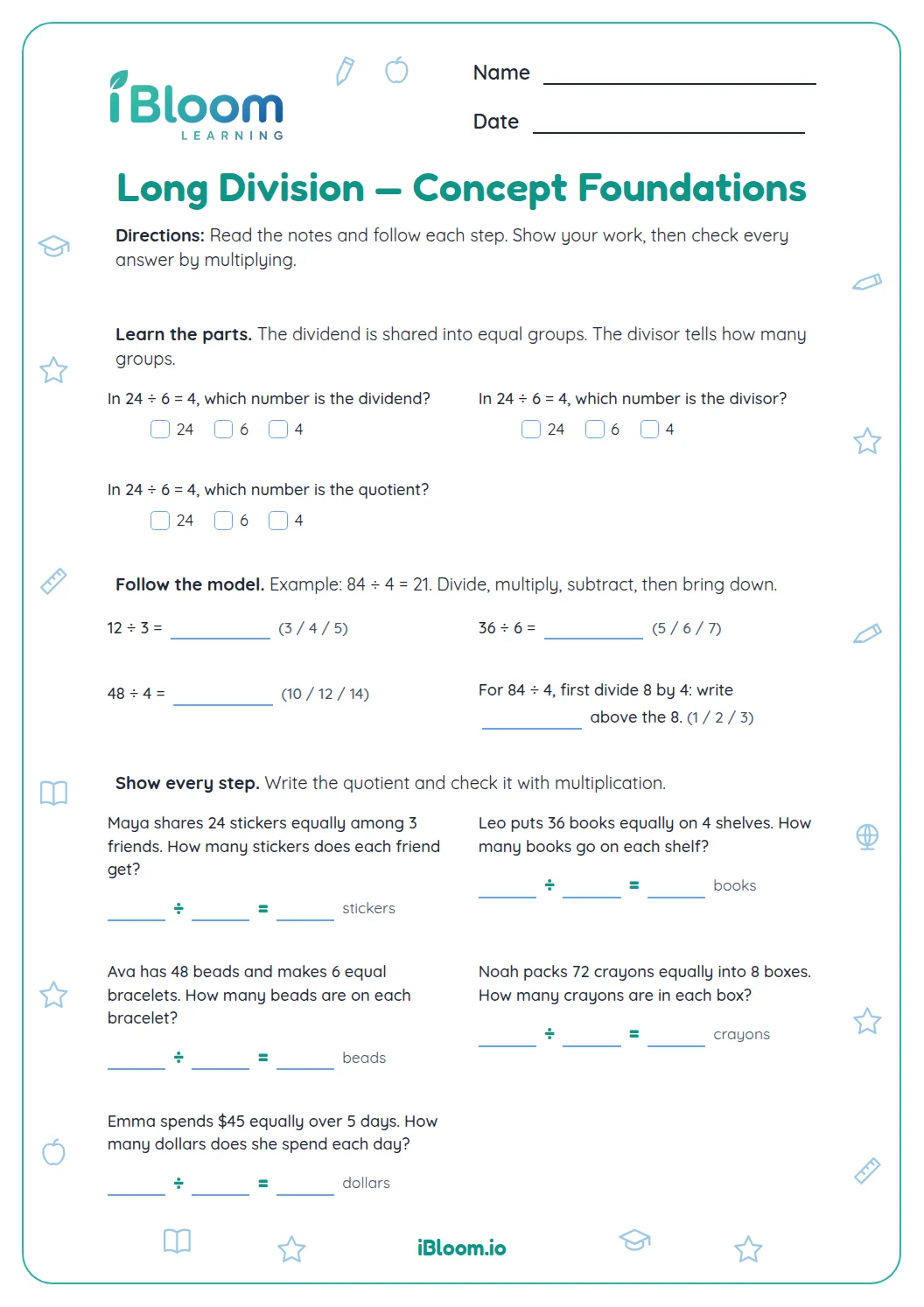
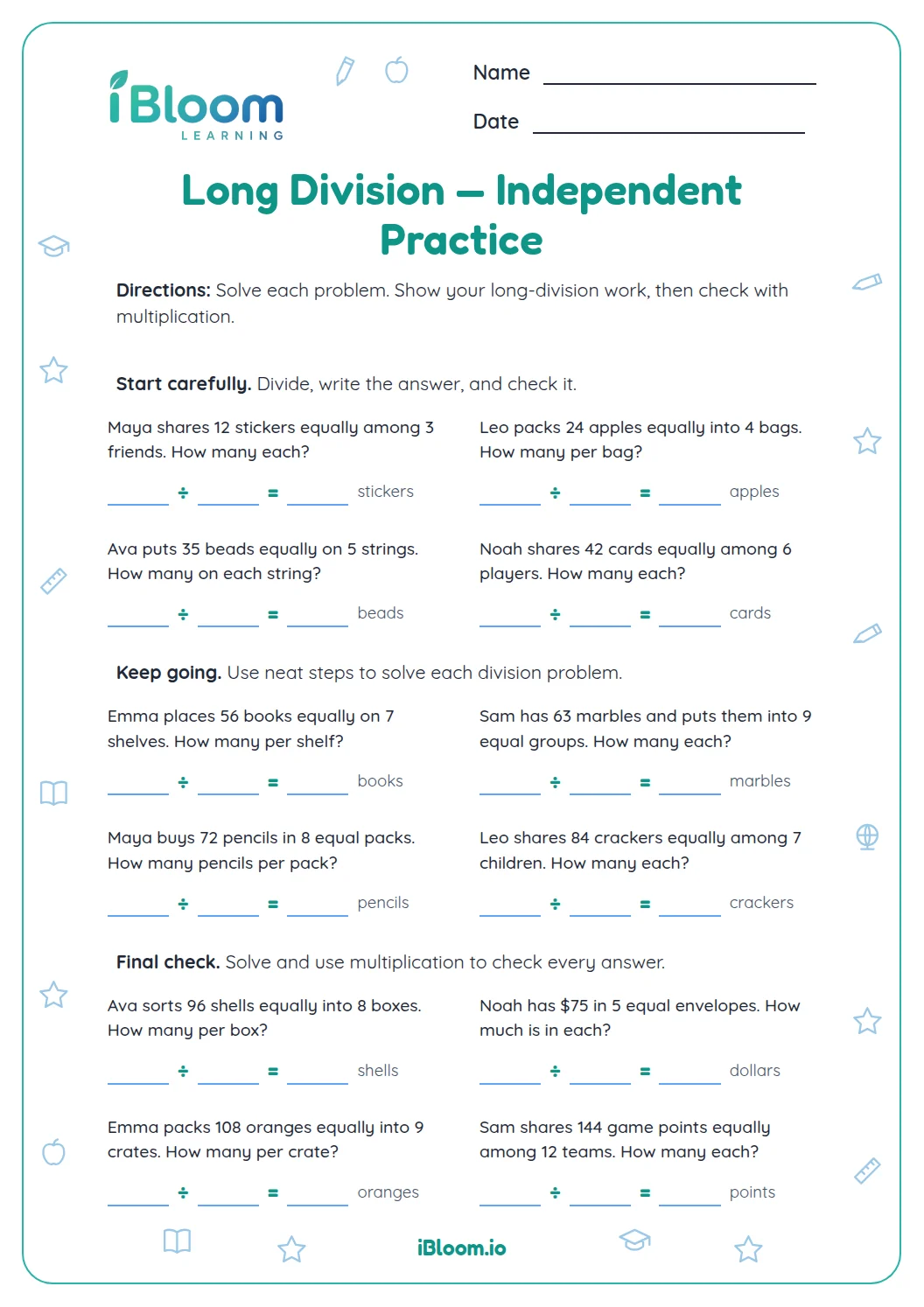
This guided practice keeps the long-division method from the original sheet and uses two-digit dividends with one-digit divisors. Students solve equal-sharing stories, write each division calculation in the work area, and check the quotient by multiplying. All 15 problems have exact whole-number answers. The worksheet practices the Grade 4 division procedure named in CCSS 4.NBT.B.6 while using a short, accessible range of dividends.
Aligned to 4.NBT.B.6
How can long division solve an equal-sharing story?
Identify the total and the number of equal groups. Divide the total by the group count to find the amount in each group, then check by multiplying the quotient by the group count.
For example, 84 cones shared among 4 teams gives 84 ÷ 4 = 21. Check: 21 × 4 = 84, so each team gets 21 cones.
How does the practice build?
Four story problems include a work area for the division and multiplication check. Eleven more division sentences provide focused quotient practice. Every problem has an exact whole-number answer.
- Solve four equal-sharing stories in the work areas.
- Practice 11 more two-digit division calculations.
- Check each quotient by multiplying.
A routine for each division story
- 1Underline the total and the number of equal groups.
- 2Write total ÷ number of groups.
- 3Divide using the long-division steps practiced in class.
- 4Multiply the quotient by the number of groups.
- 5Label the answer with the unit from the story.
Common division mistakes
The mistake
Dividing by the total instead of the number of groups.
The fix
Use the group count as the divisor and the total as the dividend.
The mistake
Giving the number of groups when the question asks for the amount in each group.
The fix
Check what one team, box, row, or person receives.
The mistake
Forgetting to check the quotient.
The fix
Multiply the quotient by the divisor and compare the product with the starting total.
Common Core alignment
This worksheet practices a short long-division range with equal-group stories and multiplication checks.
Find whole-number quotients with up to four-digit dividends and one-digit divisors.
On this sheet: Students divide two-digit dividends by one-digit divisors and check with multiplication.
Show the official wordingHide the official wording
Find whole-number quotients and remainders with up to four-digit dividends and one-digit divisors, using strategies based on place value, the properties of operations, and/or the relationship between multiplication and division. Illustrate and explain the calculation by using equations, rectangular arrays, and/or area models.
What to practice next
Make more practice
Further reading
Questions parents and teachers ask
Are there remainders in these problems?
No. Each two-digit total divides evenly by the one-digit number of groups in its story. The quotient is a whole number, and multiplying it by the group count returns the starting total. The answer key lists the quotient with the requested unit.
Why does the worksheet ask for a multiplication check?
Multiplication reverses the division relationship. If 84 cones are shared among 4 teams, 21 cones per team gives 21 × 4 = 84. A matching product confirms that the quotient and number of equal groups account for the whole total.
What does each word problem ask students to find?
Every story gives a total and a number of equal groups, then asks for the amount in one group. Students use the total as the dividend and the group count as the divisor. The key includes units such as cones, books, or apples.
Which division range appears on this page?
The problems use two-digit dividends and one-digit divisors, with exact whole-number quotients. This is a focused range for practicing long division and checking with multiplication. Students can show their division work in the answer space provided on the worksheet.
What standard does this page practice?
CCSS 4.NBT.B.6 describes finding whole-number quotients with up to four-digit dividends and one-digit divisors. These problems practice a shorter two-digit range and use multiplication to verify each quotient, giving students a clear way to connect division with a related operation.