


About this worksheet
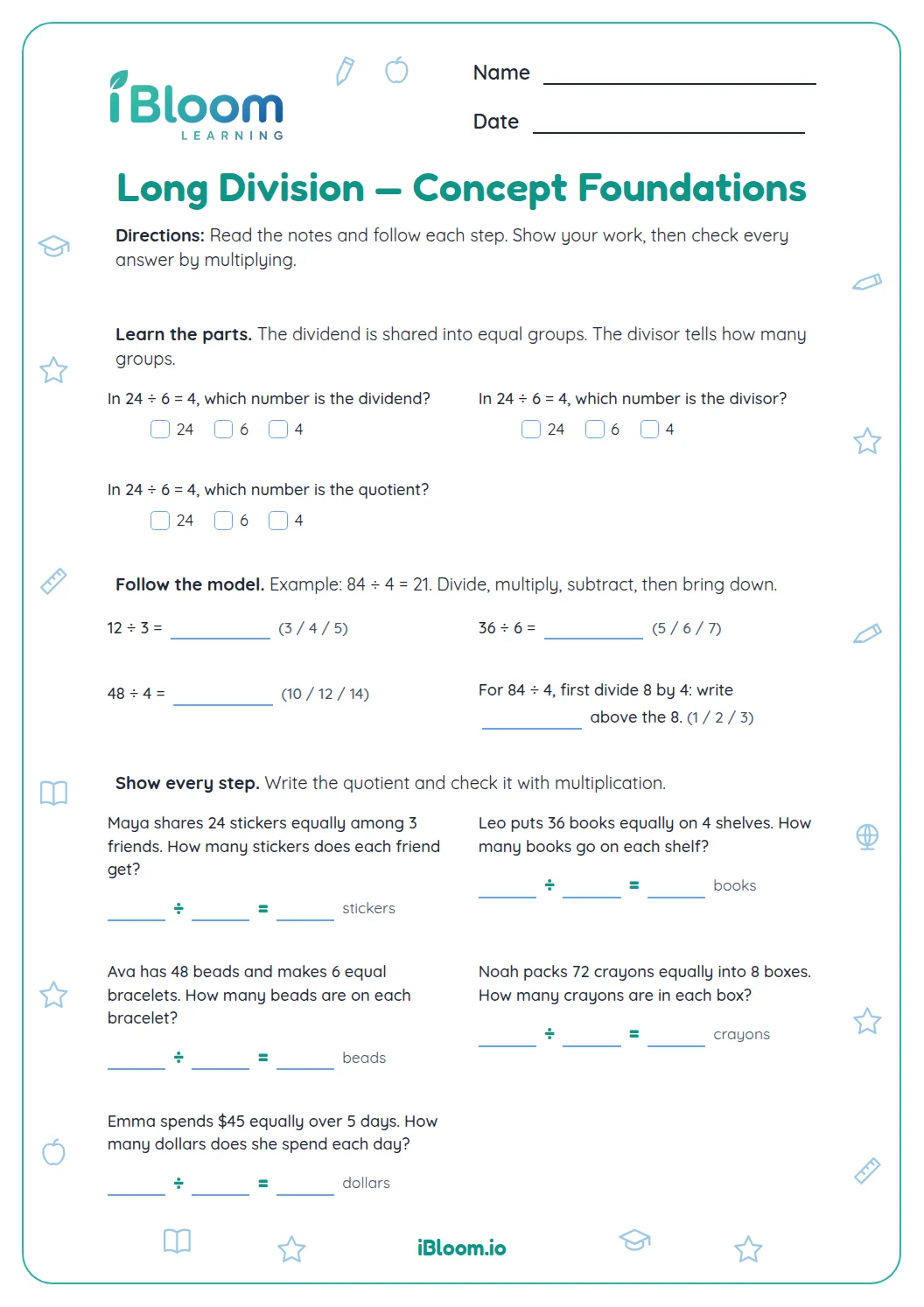
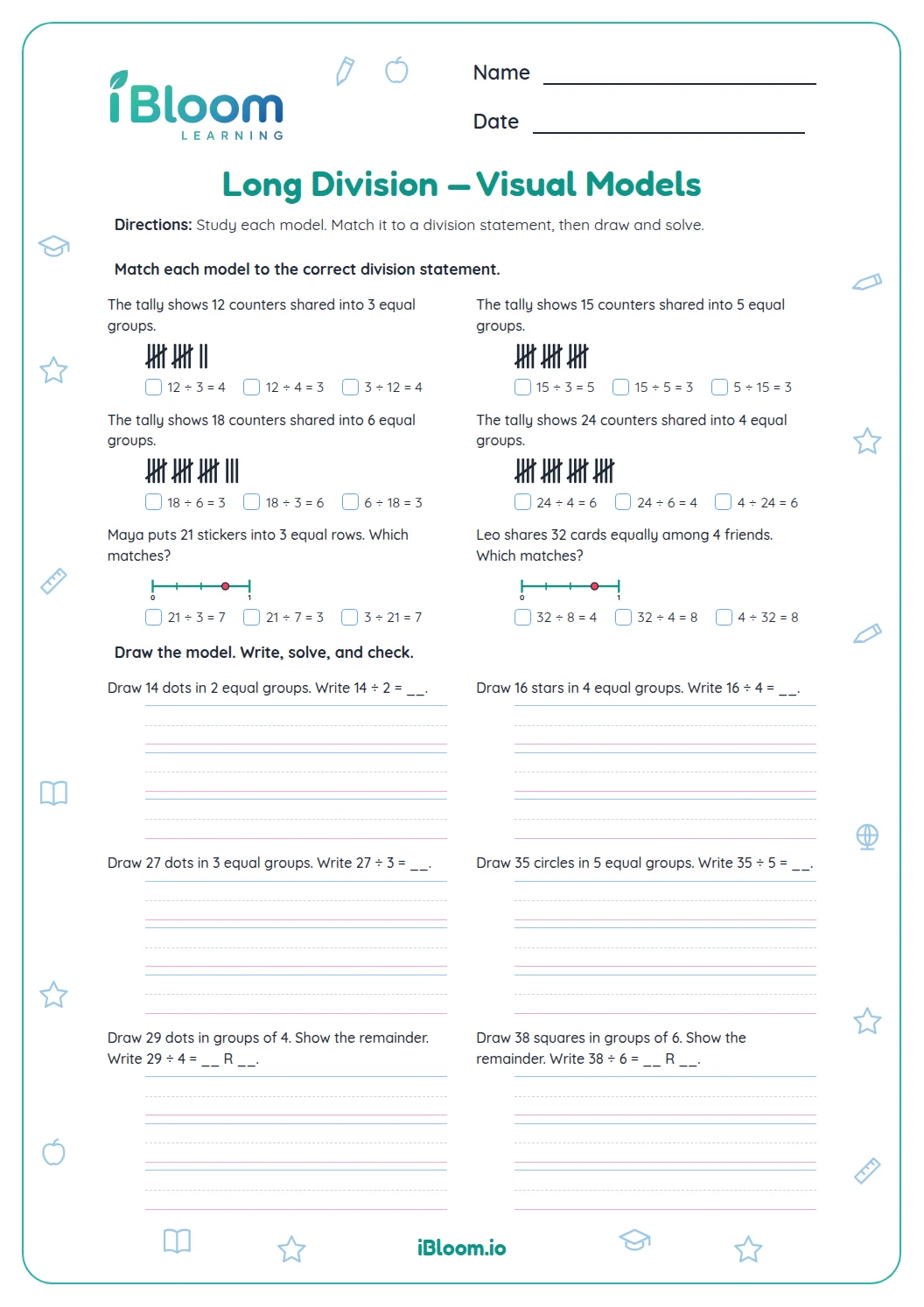
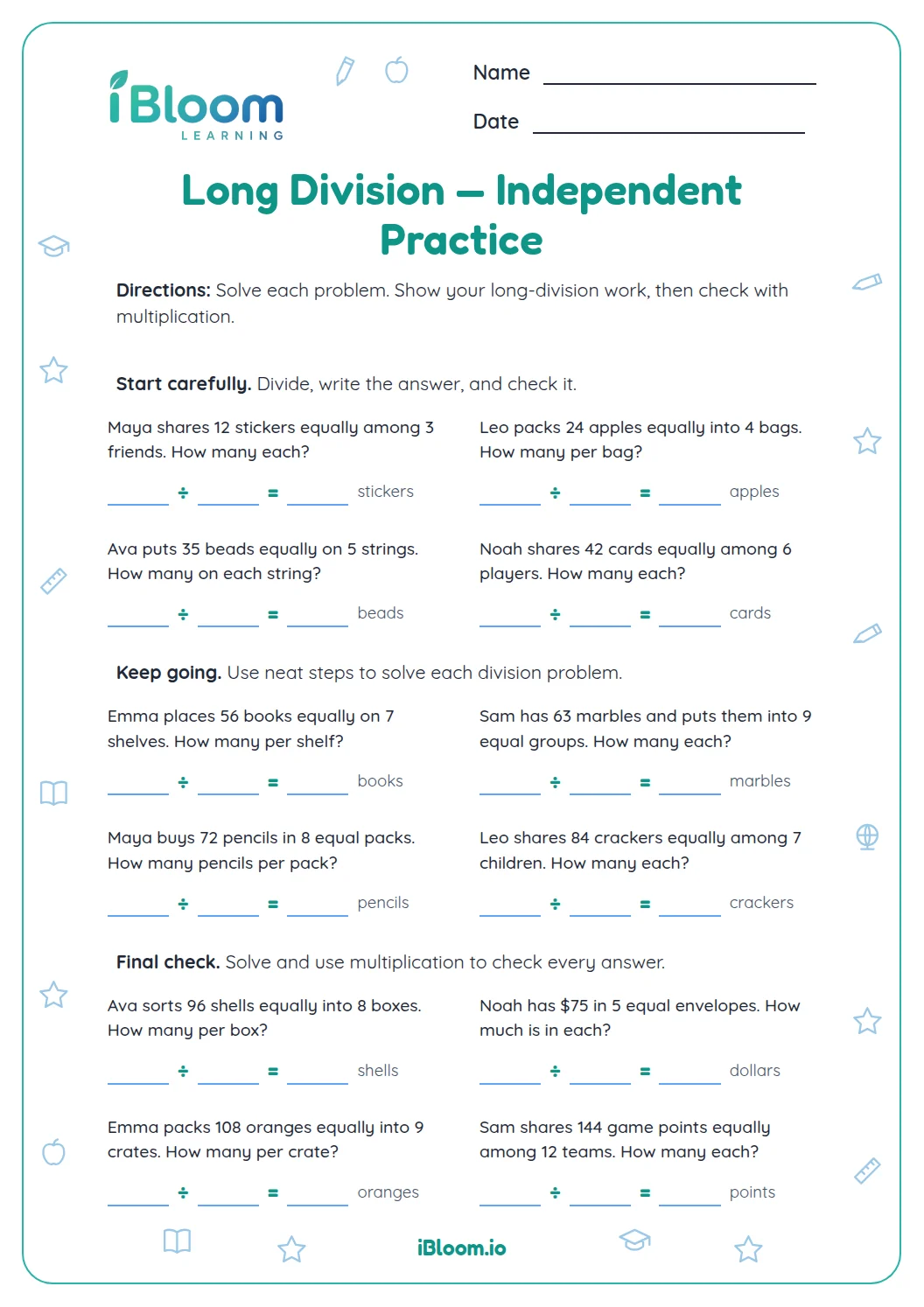
This free printable worksheet gives Grade 3 learners 14 real-world division problems with two-digit totals and one-digit divisors. In Part A, children find the amount in each equal share. In Part B, they find how many equal groups can be made, first by solving and then by choosing a checked quotient. The first five problems ask for division equations and long-division working. The remaining nine ask children to choose a quotient and check the group count. Every total is within 100 and every answer is a whole number. The 14 stories practice Common Core 3.OA.A.3, representing equal-group situations with division. A separate key supplies the answers to all 14 problems.
Aligned to 3.OA.A.3
What changes between sharing and making groups?
In Part A, the number of groups is given and children find the size of each group. The first story has 48 crayons and 2 tables, so the answer names crayons per table.
In Part B, the size of each group is given and children find the number of groups. Question 6 puts 52 pencils in boxes of 4, so the answer names boxes. Ask “What are we counting?” before doing the arithmetic.
How does long division work in the pencil problem?
Question 6 is 52 ÷ 4. Divide the tens first, keep track of what remains, then bring down the ones. Write the quotient digits above their matching place-value positions.
- 152 ÷ 4: 4 goes into 5 tens 1 ten time.
- 2Subtract 4 tens from 5 tens to leave 1 ten.
- 3Bring down 2 ones to make 12 ones.
- 412 ÷ 4 = 3, so the quotient is 13.
- 5Check: 13 × 4 = 52. Answer: 13 boxes.
How can a multiplication check confirm the story answer?
Multiply the quotient by the divisor to get back to the original total. Then reread the question and add the unit it asks for. A correct number with the wrong unit can still misdescribe the story.
For the ribbon problem, 24 badges each use 3 feet, and 24 × 3 = 72 feet. That check accounts for all the ribbon and explains why the answer names badges.
How to work through the sheet
- 1Read each story and name its total, number of groups and unknown amount.
- 2For the first five stories, write the division equation before setting up long division.
- 3In Part A, put the quotient digits over the correct tens and ones positions.
- 4In Part B, find how many groups fit in the total and check by multiplying.
- 5For each remaining story, choose the quotient that fits and check it by multiplication.
Mistakes to look for and how to fix them
The mistake
Writing 2 ÷ 48 for 48 crayons shared between 2 tables.
The fix
Start with the total being shared: 48 ÷ 2.
The mistake
Dropping the remaining ten in 52 ÷ 4 and writing 12.
The fix
After subtracting 4 tens, combine the remaining ten with 2 ones to make 12 ones; divide those by 4.
The mistake
Answering the pencil story with “13 pencils.”
The fix
The question asks for the number of boxes. Each box holds 4 pencils, so the answer is 13 boxes.
Common Core alignment
Represent equal-share and equal-group word problems within 100 with division equations.
On this sheet: All ten stories involve equal groups within 100, including a ribbon length divided into equal portions.
Show the official wordingHide the official wording
Use multiplication and division within 100 to solve word problems in situations involving equal groups, arrays, and measurement quantities, e.g., by using drawings and equations with a symbol for the unknown number to represent the problem.
What to practice next
Make more practice
Further reading
Questions parents and teachers ask
What kinds of stories are on this worksheet?
The 14 stories use supplies, books, food, seeds, ribbon and photos. Five ask how much goes in each equal share; nine ask how many groups can be made. The first five include long-division work space. In the remaining nine, children choose the quotient that fits the story.
Are there any remainders in the final answers?
Every final answer is a whole number with nothing left over. Some long-division steps leave a ten to combine with the ones, as in 52 ÷ 4. That temporary amount is part of the working, and the completed calculation gives exactly 13 boxes of pencils.
How should children set up the long division?
Place the total inside the long-division bracket and the divisor outside. For a worked story, put the total inside and the divisor outside. For the first one, put 48 inside and 2 outside. Divide tens and then ones, recording the quotient above the matching places. Finally, reread the story and label the result as 24 crayons for each table.
Can my child use multiplication to check?
Yes, multiplying the quotient by the divisor checks each calculation. In the photo problem, 13 pages with 7 photos on each page account for 91 photos. Ask your child to say what each number represents so the check confirms both the arithmetic and the meaning of the answer.
What does the answer key include?
The key has all 14 answers. Use it after children try each problem. For the first five, check the equation and long-division steps; for the remaining nine, check the selected quotient. Then reread the story to confirm the answer names the right unit.