


About this worksheet
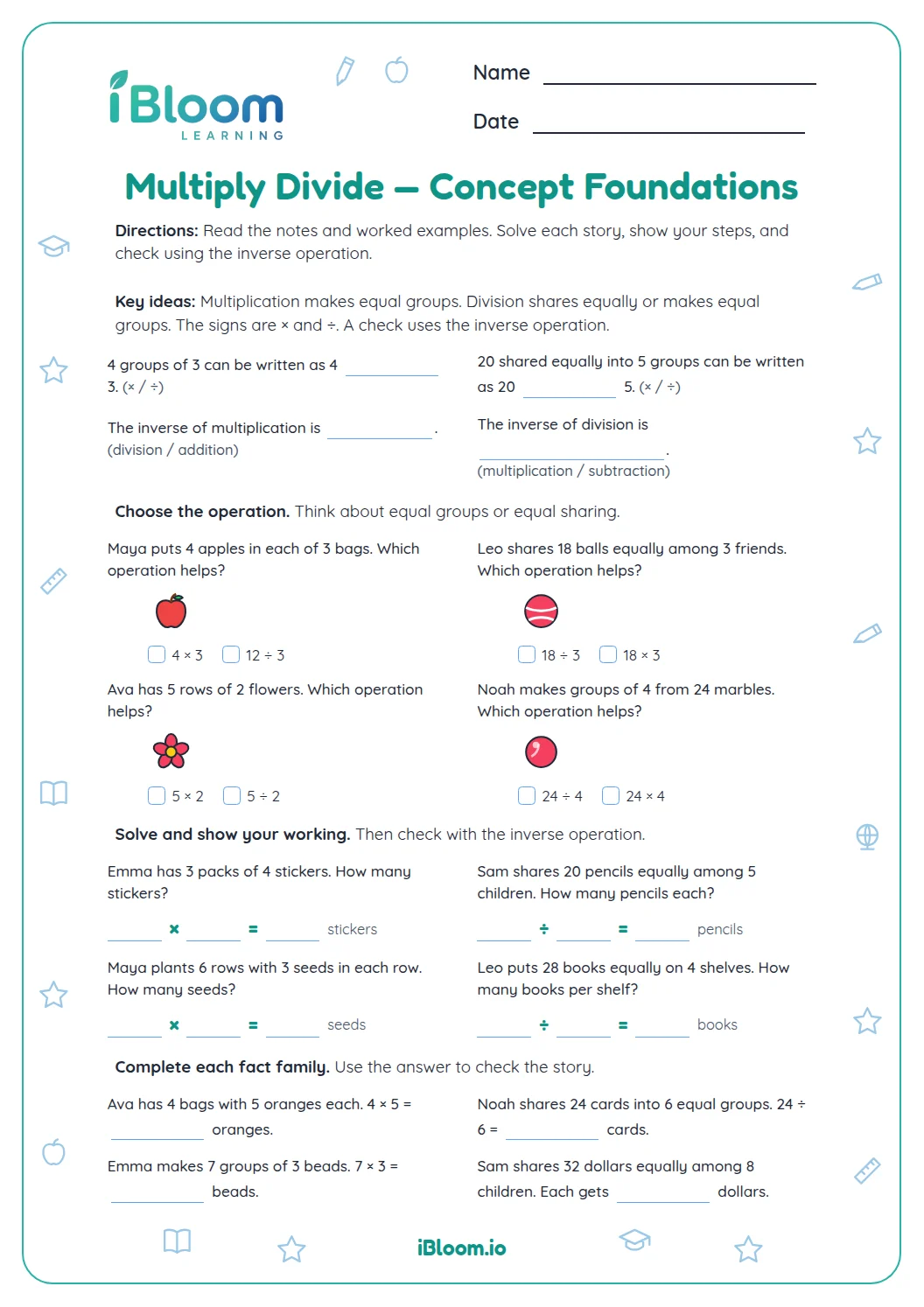
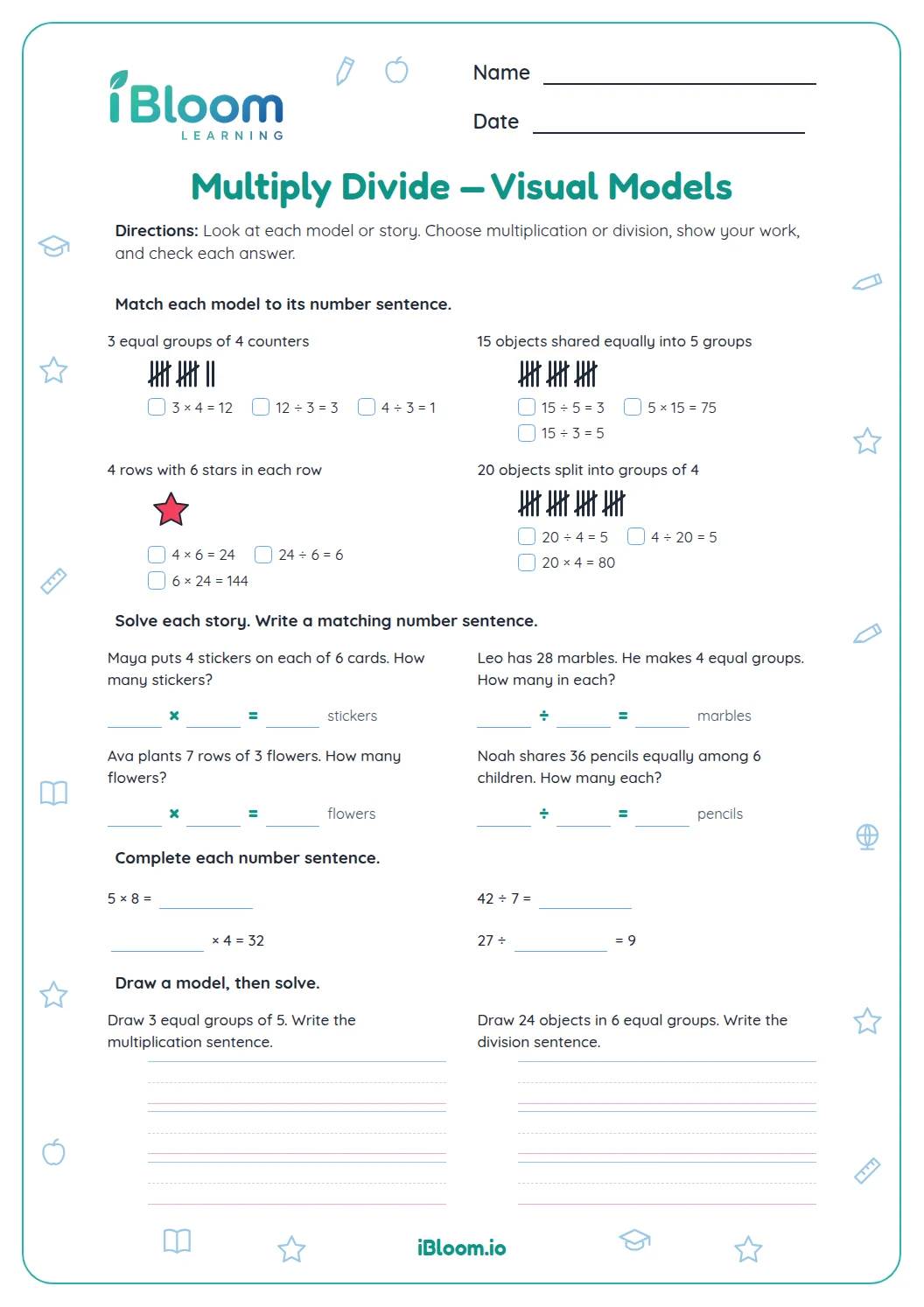
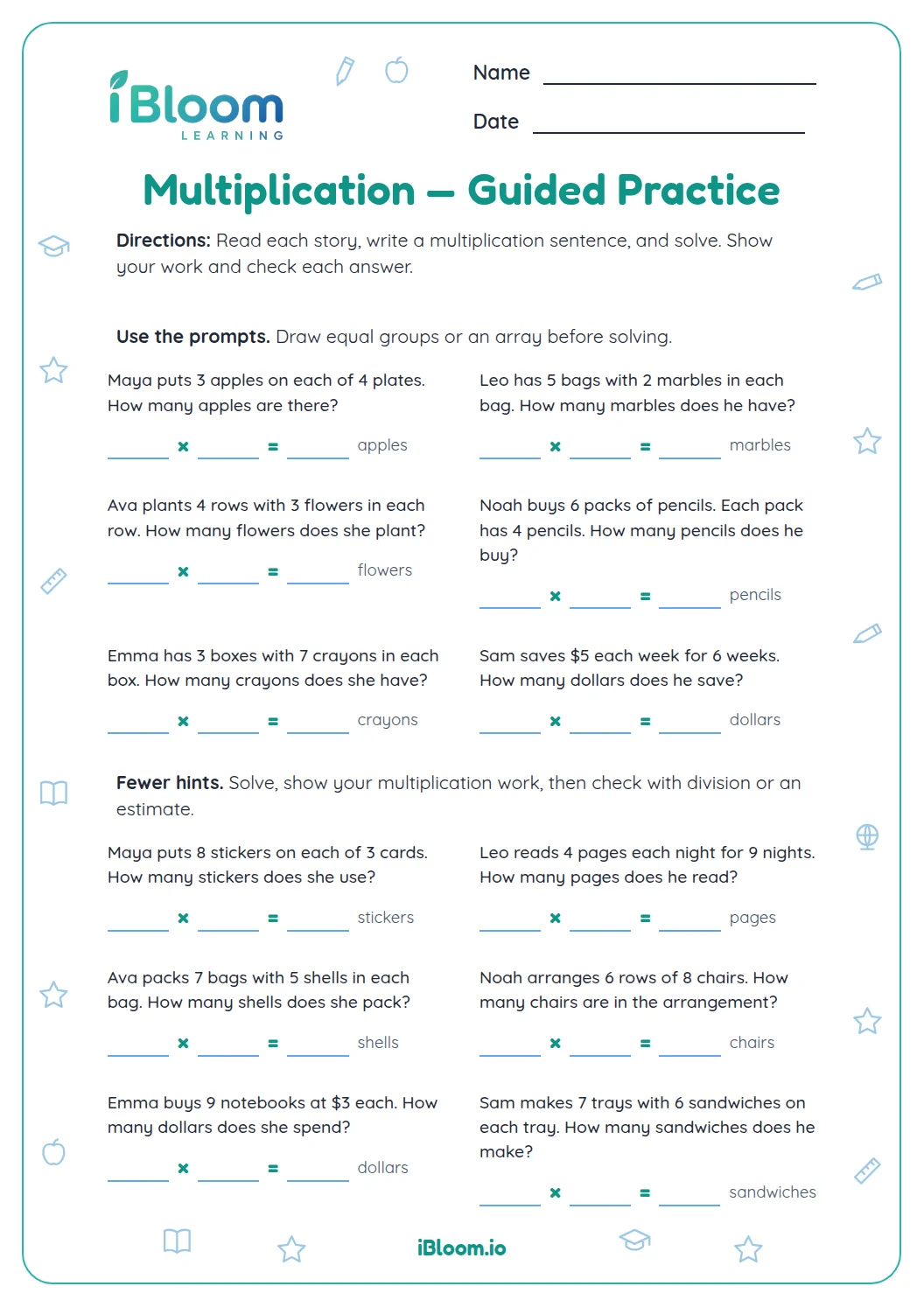
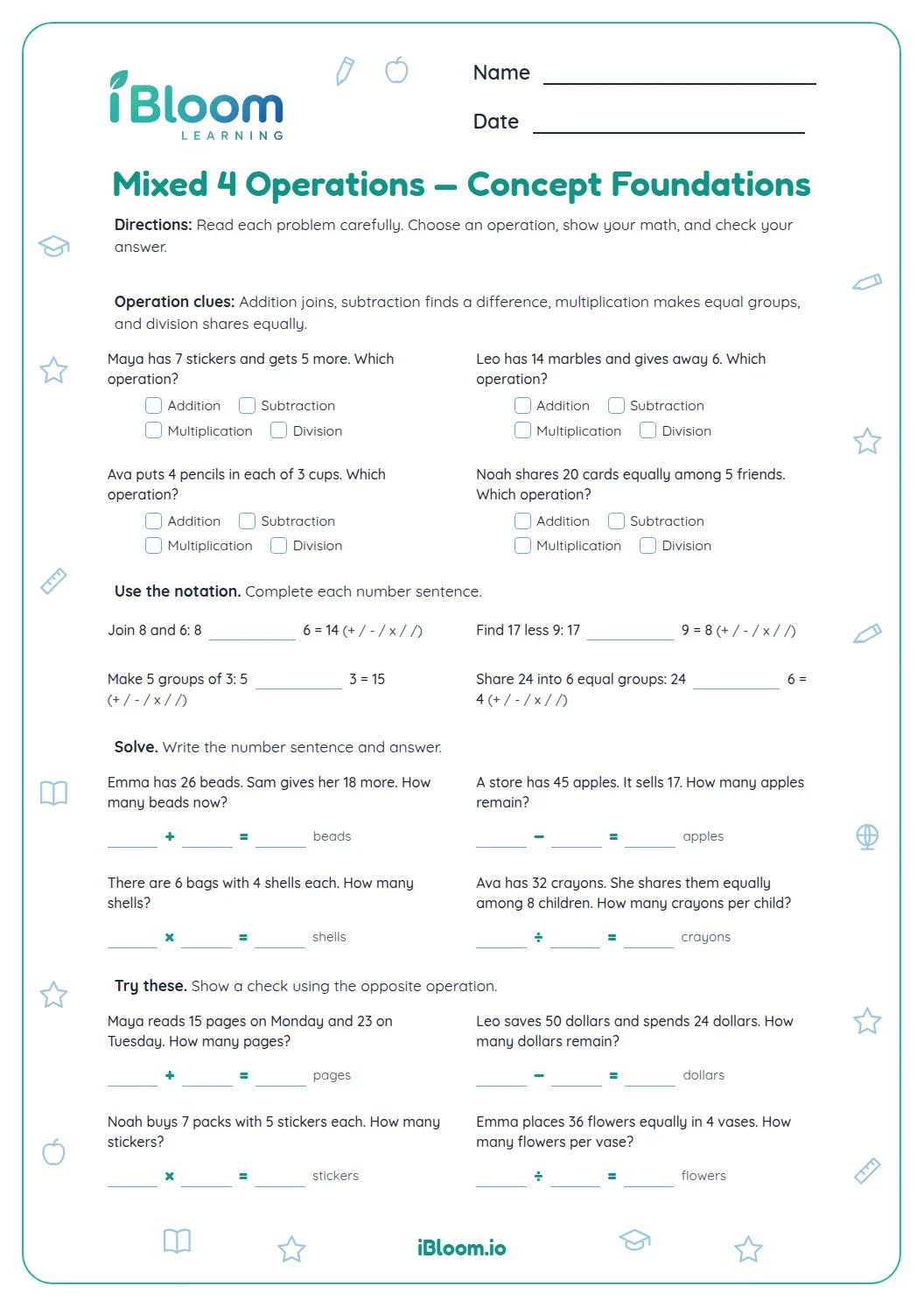
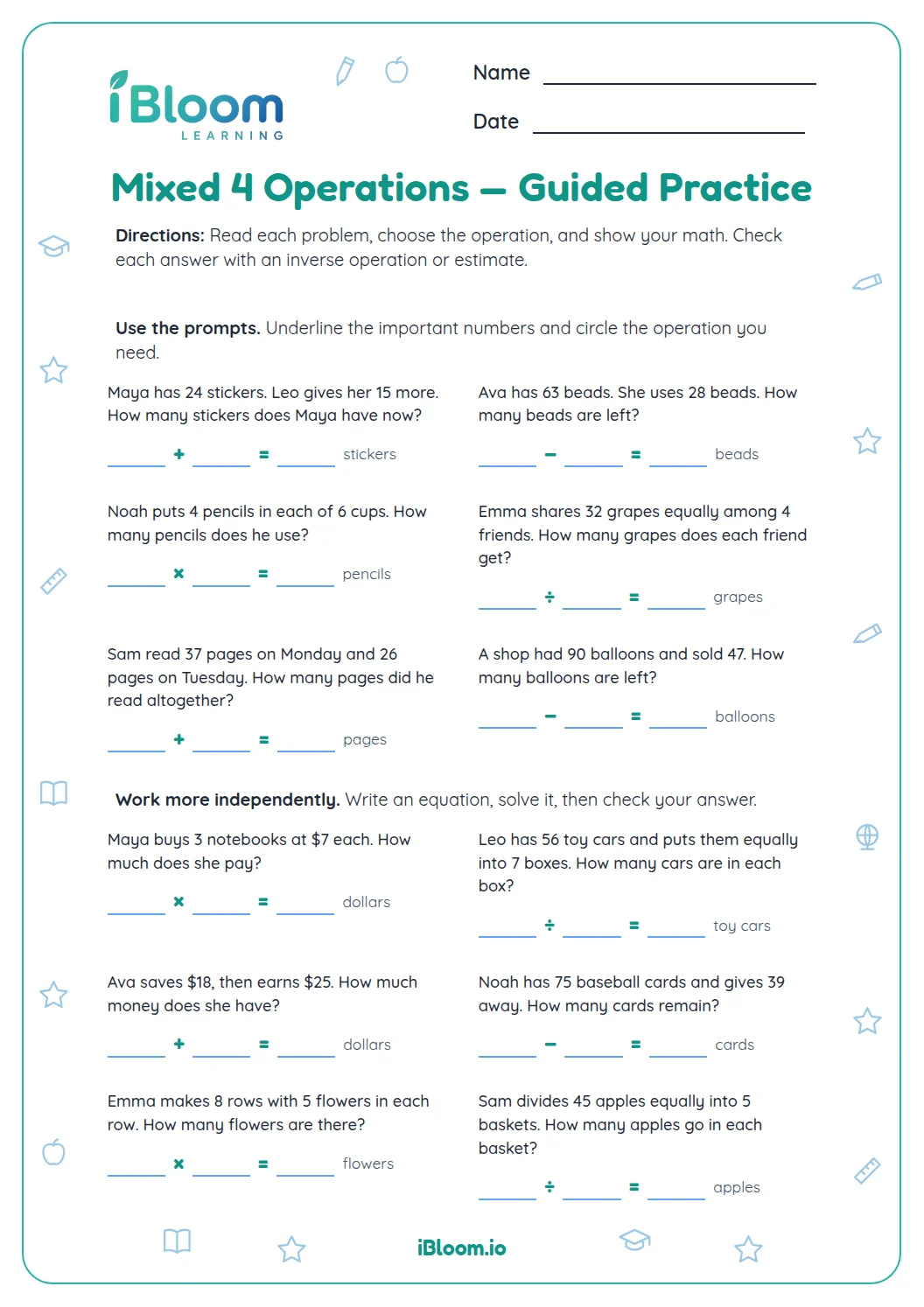
This free Grade 3 worksheet practices choosing multiplication or division in everyday equal-group stories. Students read 14 situations, choose the operation, and write an equation with a solution and unit. All products and quotients are within 100. The page practices CCSS 3.OA.A.3 and includes a separate answer key.
Aligned to 3.OA.A.3
When should a student multiply or divide?
Multiply when the story gives the size of each group and asks for the total. Divide when it gives a total and asks how many are in each group or how many groups can be made. The 14 stories mix both operations.
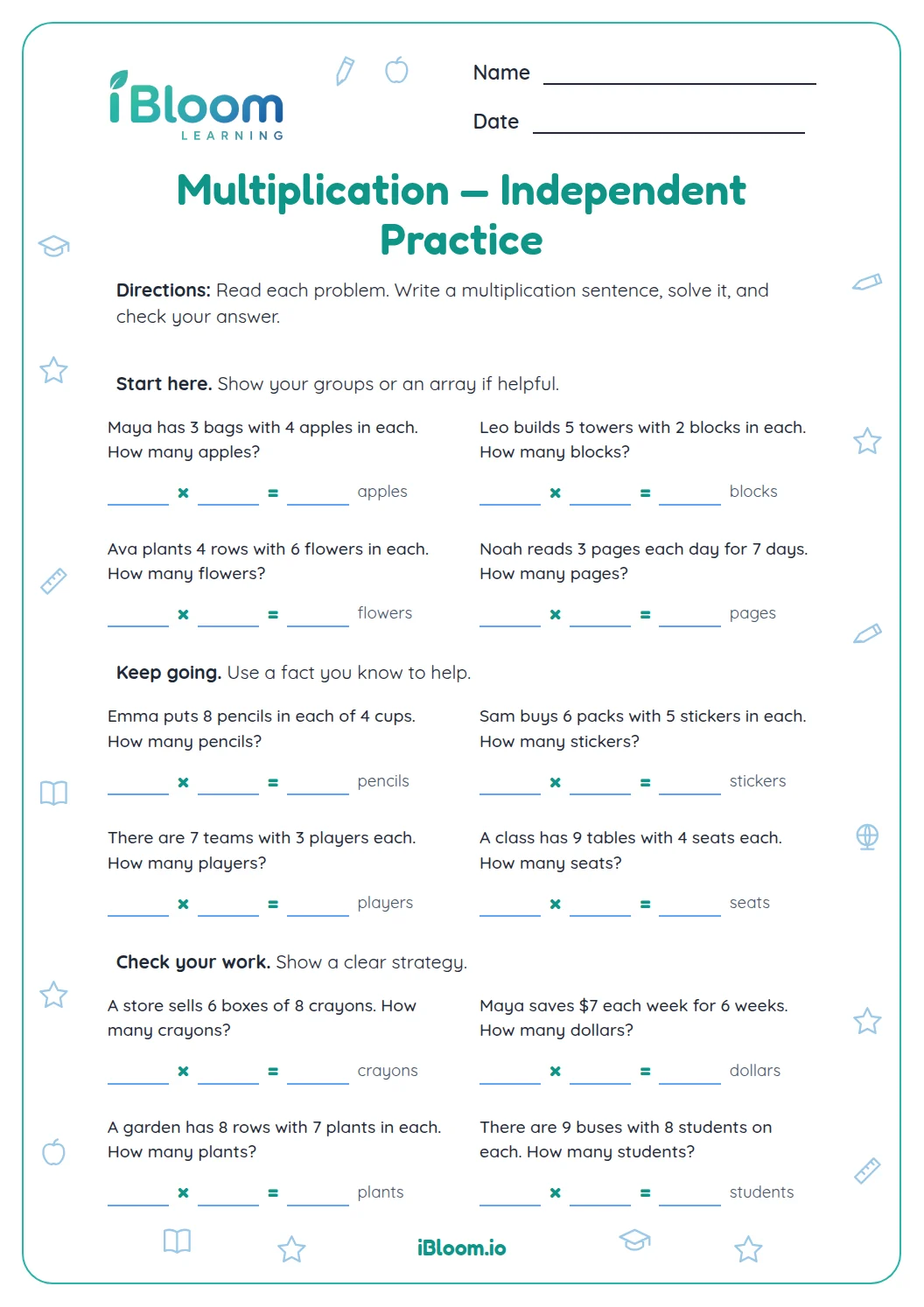
- 1Six bags hold 4 apples each. Multiply: 6 × 4 = 24 apples.
How can an equation represent a story?
Name the known quantities, choose the operation, and write an equation before computing. Include the unit in the answer. Part B uses new settings so students apply the operation choice to more stories.
- 1Ava reads 8 pages each day for 6 days: 8 × 6 = 48 pages.
How can a student check the answer?
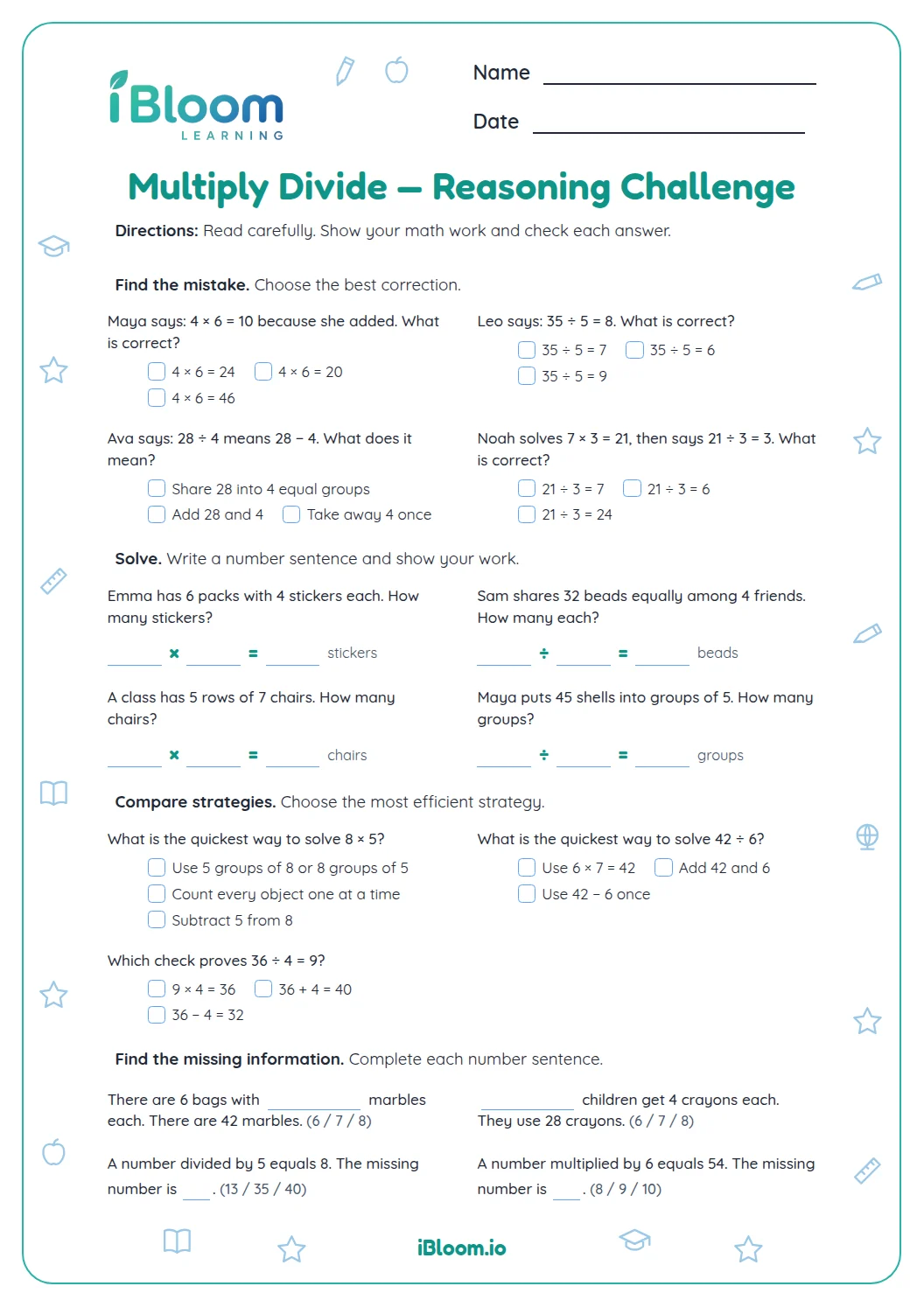
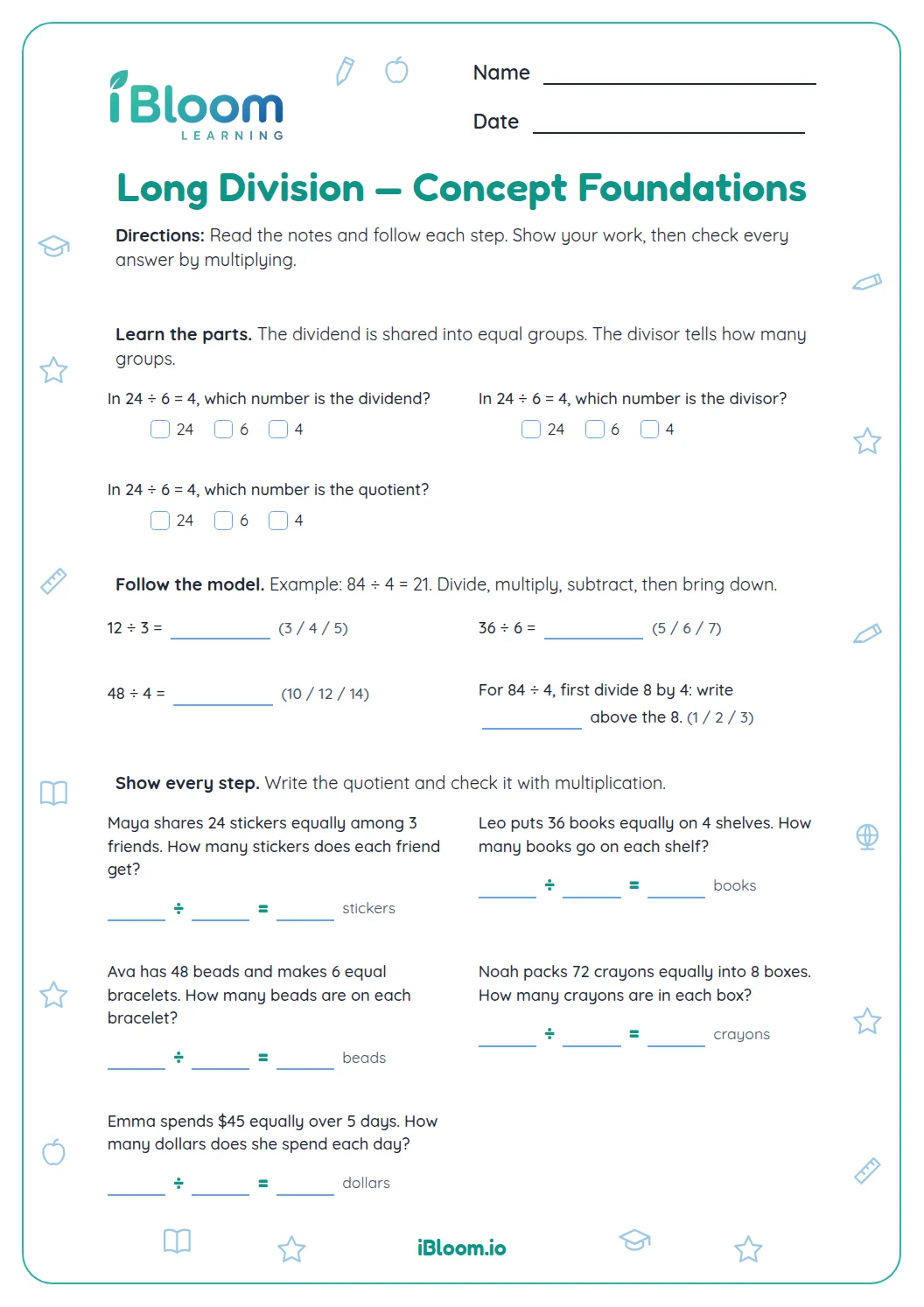
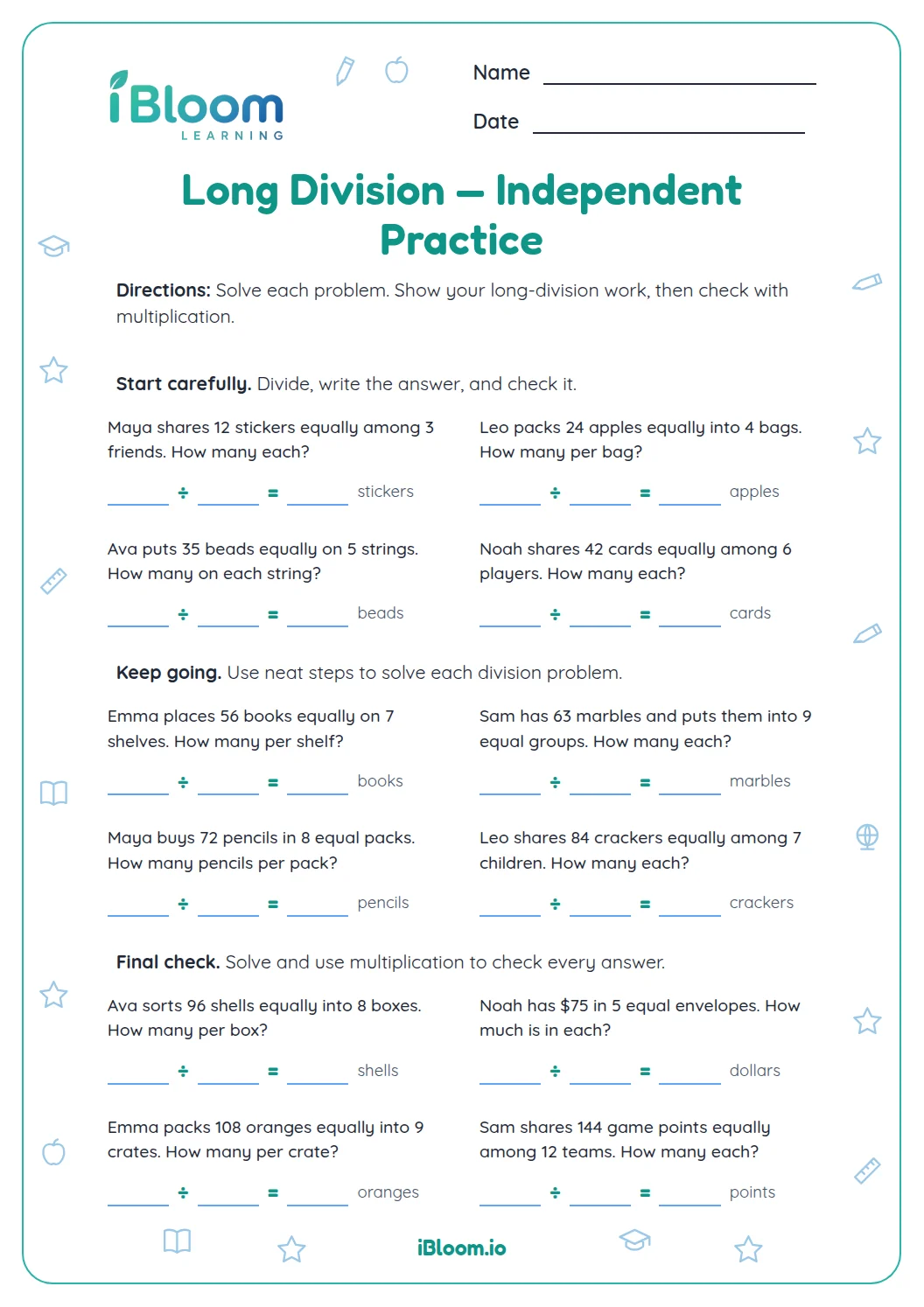
Use the inverse operation or estimate with a nearby fact. If 32 pencils are shared equally among 4 cups, 4 × 8 returns 32, so 8 pencils per cup is reasonable.
How to use this worksheet
- 1Underline what the story tells you and what it asks you to find.
- 2Choose multiplication for a total from equal groups.
- 3Choose division when sharing a total or finding the number of groups.
- 4In Part B, write an equation and solve it with the correct unit.
- 5Check a division answer by multiplying the quotient by the group size.
Common mistakes and quick fixes
The mistake
Multiplying whenever a story mentions groups.
The fix
Check what is unknown: a total suggests multiplication; an equal share often suggests division.
The mistake
Giving the number of groups when the question asks how many are in each group.
The fix
Reread the final question and label the answer with its unit.
The mistake
Accepting a quotient without checking it.
The fix
Multiply the answer by the group size and see whether you get the original total.
Curriculum alignment
This worksheet practices the following Common Core skill.
Solve multiplication and division word problems within 100.
On this sheet: All fourteen questions describe equal groups, sharing, or grouping with products and quotients within 100.
Show the official wordingHide the official wording
Use multiplication and division within 100 to solve word problems in situations involving equal groups, arrays, and measurement quantities, e.g., by using drawings and equations with a symbol for the unknown number to represent the problem.
What to practice next
Make more practice
Further reading
Questions parents and teachers ask
How can I tell when a word problem uses multiplication?
Multiply when the story gives the amount in each equal group and asks for the total. For example, seven packs with eight stickers each can be represented by 7 × 8. This worksheet starts with operation choices, then asks students to write and solve equations.
When should a student use division?
Use division when a total is split into equal groups or when the group size is known and the number of groups is unknown. The story’s question tells which quantity to find, so students should read that final sentence carefully.
Do students need to show an equation?
Yes. The seven Part B problems provide working space for an equation and a solution. Students should include the unit named in the story, such as pages, pencils, or chairs, so the answer describes what was counted in the story.
How can a student check a division answer?
Multiply the answer by the number of equal groups or the group size. If 32 pencils are shared among 4 cups and each gets 8, then 4 × 8 = 32. The check should return to the original total exactly.
How many problems are included?
There are 14 word problems in two parts, with seven multiplication situations and seven division situations. Students choose an operation and write an equation for each. The worksheet is two pages, with a separate two-page answer key and answers with units.
What does the answer key include?
The key gives the operation for the first four questions and the result with units for each Part B story. Students can compare their equation as well as their final answer, then use multiplication to check a division result quickly.