

About this worksheet
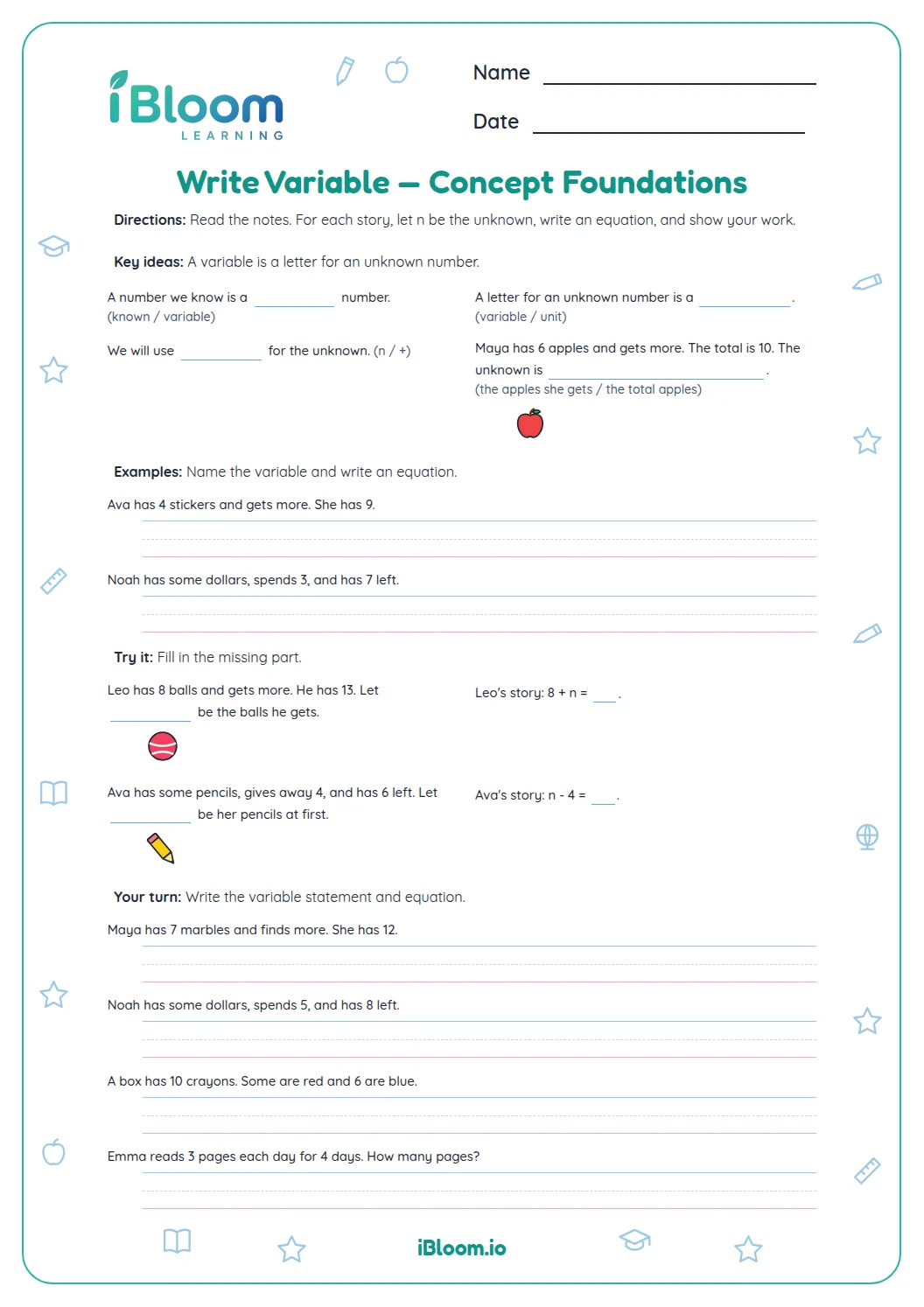
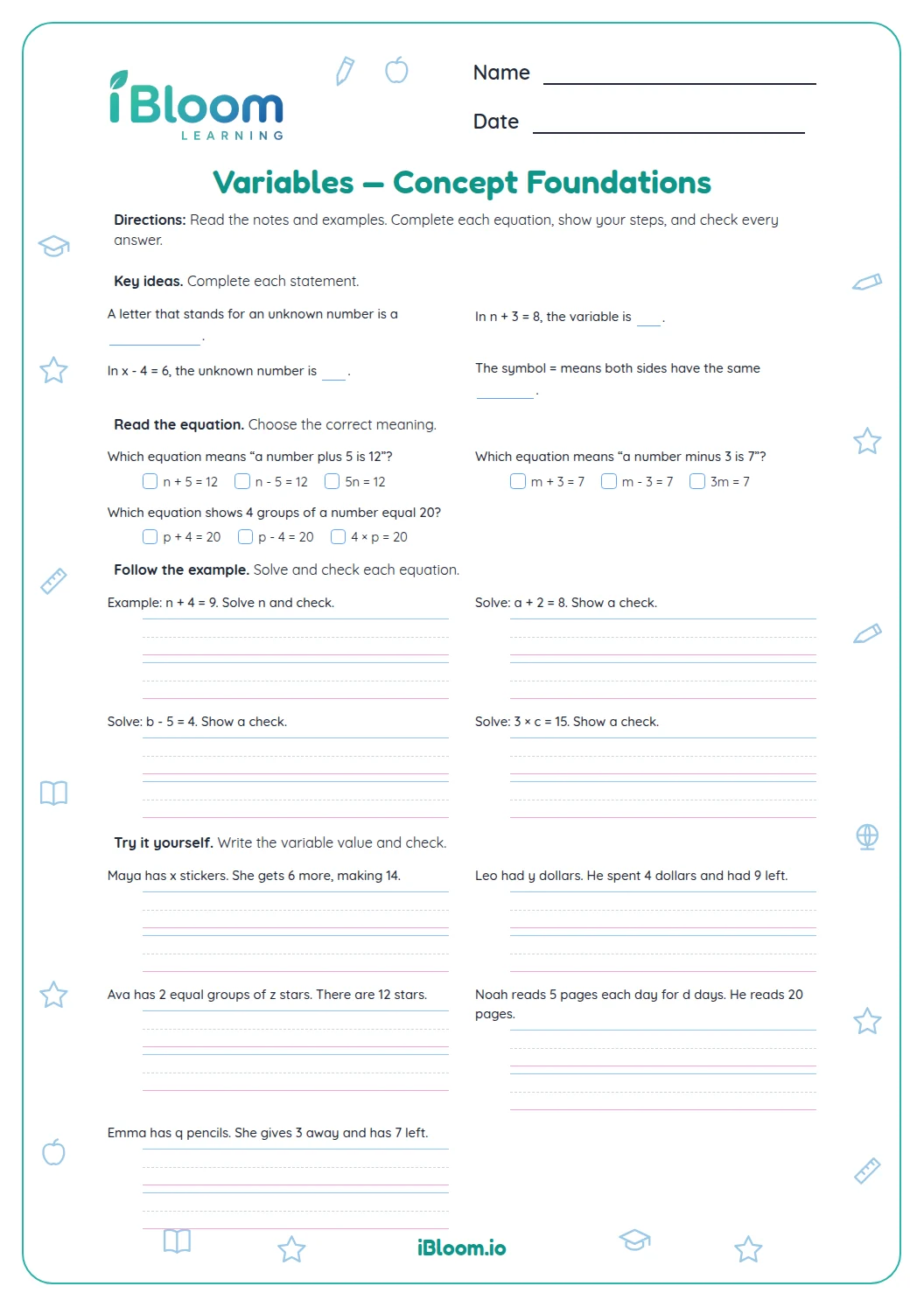
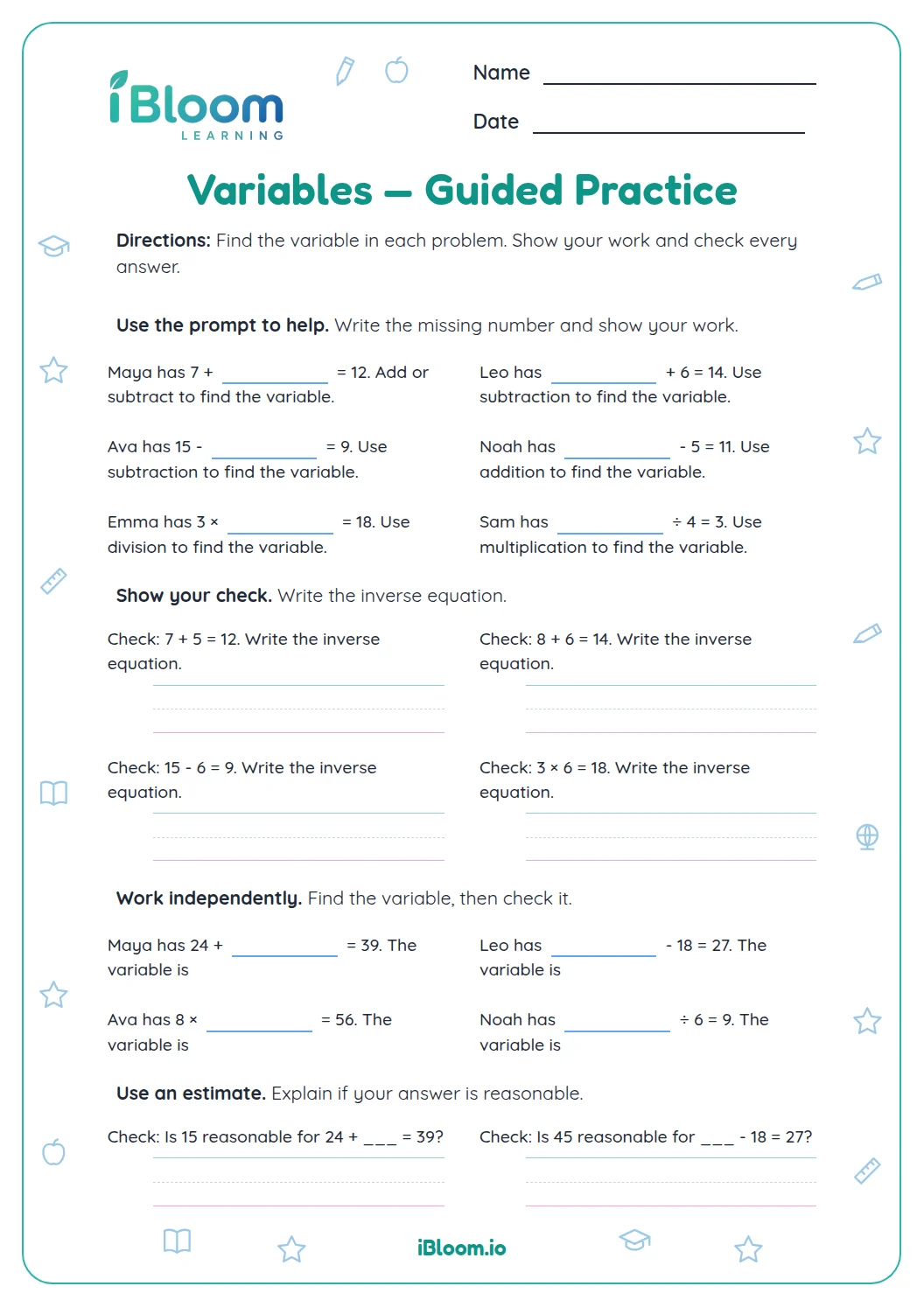
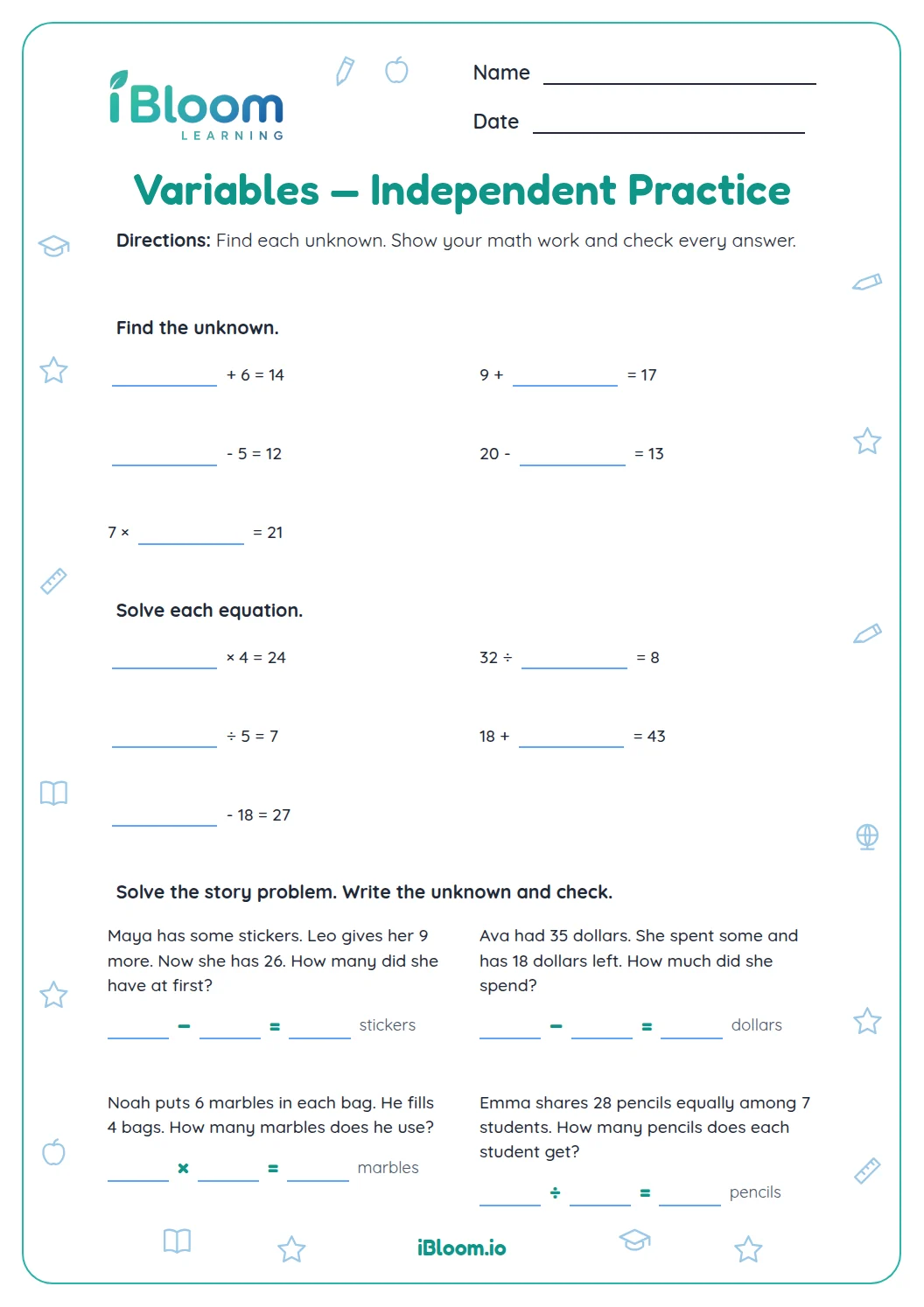
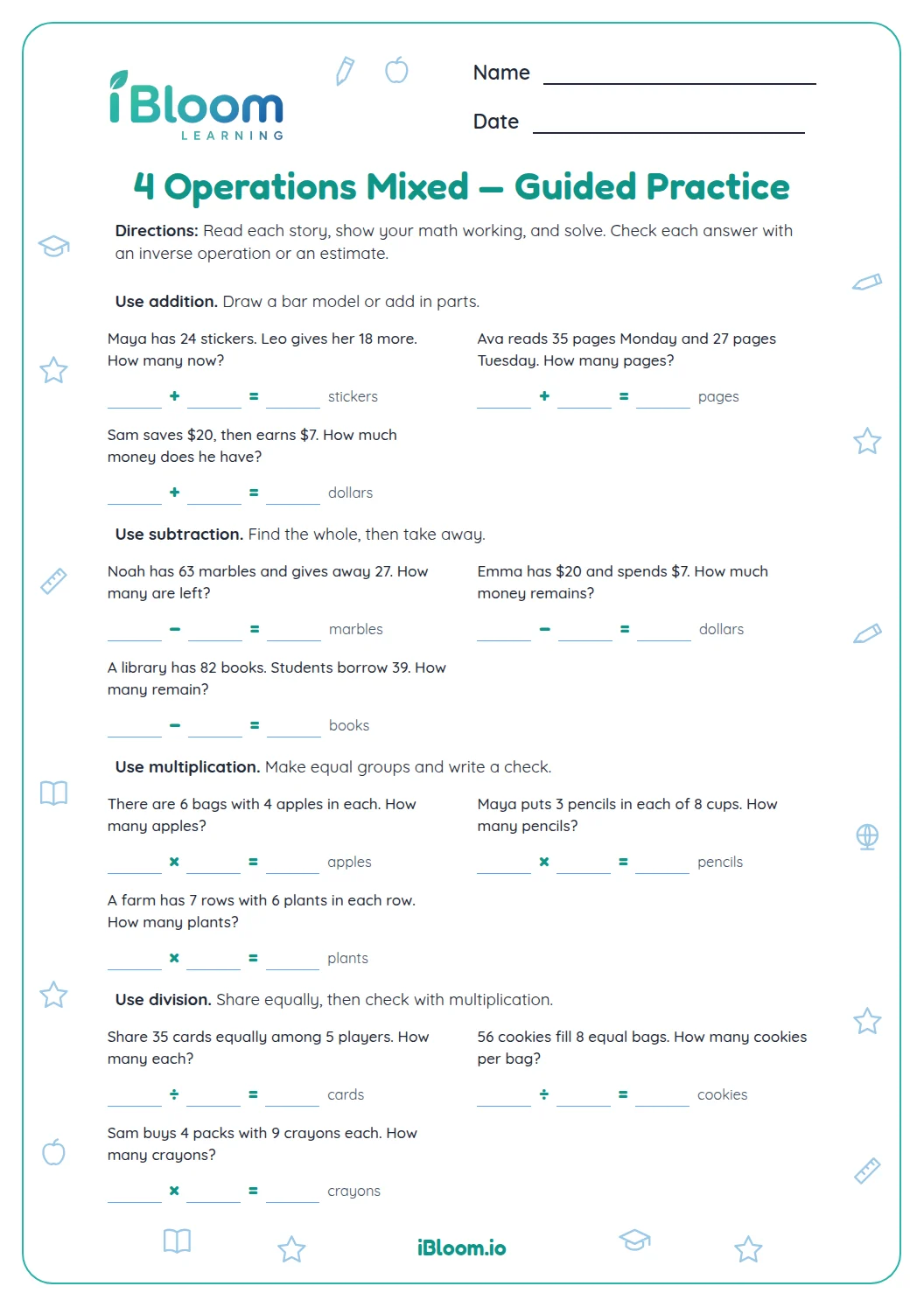
This free Grade 3 worksheet turns ten everyday stories into equations with a letter for the unknown. Children use n for the quantity they need to find, then solve and label the answer. Part A has four one-step situations involving the four operations. Part B has five two-step situations. Part C finishes with a two-step bus problem and a mental check. The work practices Common Core 3.OA.D.8. The separate answer key supplies model equations, labeled values for n, and a check for the final problem.
Aligned to 3.OA.D.8
What does n stand for?
The letter n stands for a number that has not yet been found. Its meaning changes from story to story: books in question 1, balls per team in question 4, and bags in question 9. Read the sentence that defines n before choosing an operation.
An equation says two amounts are equal. In question 1, Mia has 18 books before she gets more and 24 afterward. Write 18 + n = 24, then find n = 6 books. The letter marks the unknown addition, so it belongs beside 18 in the equation.
How do you turn two actions into one equation?
Read the events in order, then decide which calculations belong together. In question 5, the packs tell how many pencils the teacher starts with. Giving away five pencils reduces that amount.
The unknown can appear inside the calculation. In question 8, 50 − 8 × n = 26 shows that n stacks of eight cups were used. Find 50 − 26 = 24 cups used, then 24 ÷ 8 = 3 stacks.
- 1Question 5: 4 packs of 6 pencils, then 5 given away.
- 2n = 4 × 6 − 5
- 3n = 24 − 5 = 19 pencils.
How can children check the meaning of an answer?
Have children put the result back into the story with its unit. In question 9, 6 means six bags, each holding five apples. Six groups of five account for all 30 apples.
Question 10 asks for a mental check. Three groups of 20 give 60 children; 53 left plus the 7 who leave return to 60. This checks the result against the original total.
How to use this worksheet
- 1Read each story and say what n represents.
- 2Underline quantities and circle words that describe an action or equal groups.
- 3Write an equation with n before calculating.
- 4Solve and attach the unit, such as books or bags.
- 5For question 10, use mental arithmetic to check the answer against 60 children.
Mistakes to catch and correct
The mistake
Writing only 19 for the pencil story.
The fix
Add the equation n = 4 × 6 − 5 so the unknown and both actions are represented.
The mistake
Adding 4 and 6 for four packs of six pencils.
The fix
Say “four equal groups of six” and use 4 × 6.
The mistake
Dividing only the green apples in question 9.
The fix
Combine both colors first: (12 + 18) ÷ 5.
Common Core alignment
Use a letter for an unknown, solve two-step stories, and check whether answers make sense.
On this sheet: Children write equations with n, solve mixed-operation stories, and check a final answer mentally.
Show the official wordingHide the official wording
Solve two-step word problems using the four operations. Represent these problems using equations with a letter standing for the unknown quantity. Assess the reasonableness of answers using mental computation and estimation strategies including rounding.
What to practice next
Make more practice
Further reading
Questions parents and teachers ask
Must my child use the letter n?
Use n on this sheet because each prompt defines it for a particular quantity. Explain that another letter could represent an unknown in other work. Keeping one letter here helps children concentrate on choosing operations and matching the equation to the story rather than choosing a symbol.
Does every problem have two steps?
Part A has four one-step problems, while Parts B and C have six two-step problems altogether. Children first use n with each of the four operations, then combine actions. The final bus problem adds a mental check so they connect the answer back to the starting total.
Are different equations acceptable?
Yes, equivalent equations are acceptable when they represent the quantities and actions correctly. For the pencils, n = 4 × 6 − 5 and 4 × 6 − 5 = n both work. Use the answer key as a model and ask the child to explain any different arrangement.
Why does the apple problem use parentheses?
The parentheses show that the red and green apples must be counted together before dividing them into bags. There are 12 + 18 = 30 apples, and 30 ÷ 5 = 6 bags. Ask the child to explain what the number inside the parentheses represents in the story.
What should I check besides the final number?
Check that the equation includes n, represents every action, and leads to an answer with the correct unit. In the final problem, also check the mental arithmetic explanation. A child who writes 53 children and verifies that 53 + 7 = 60 has connected the result back to the story.