

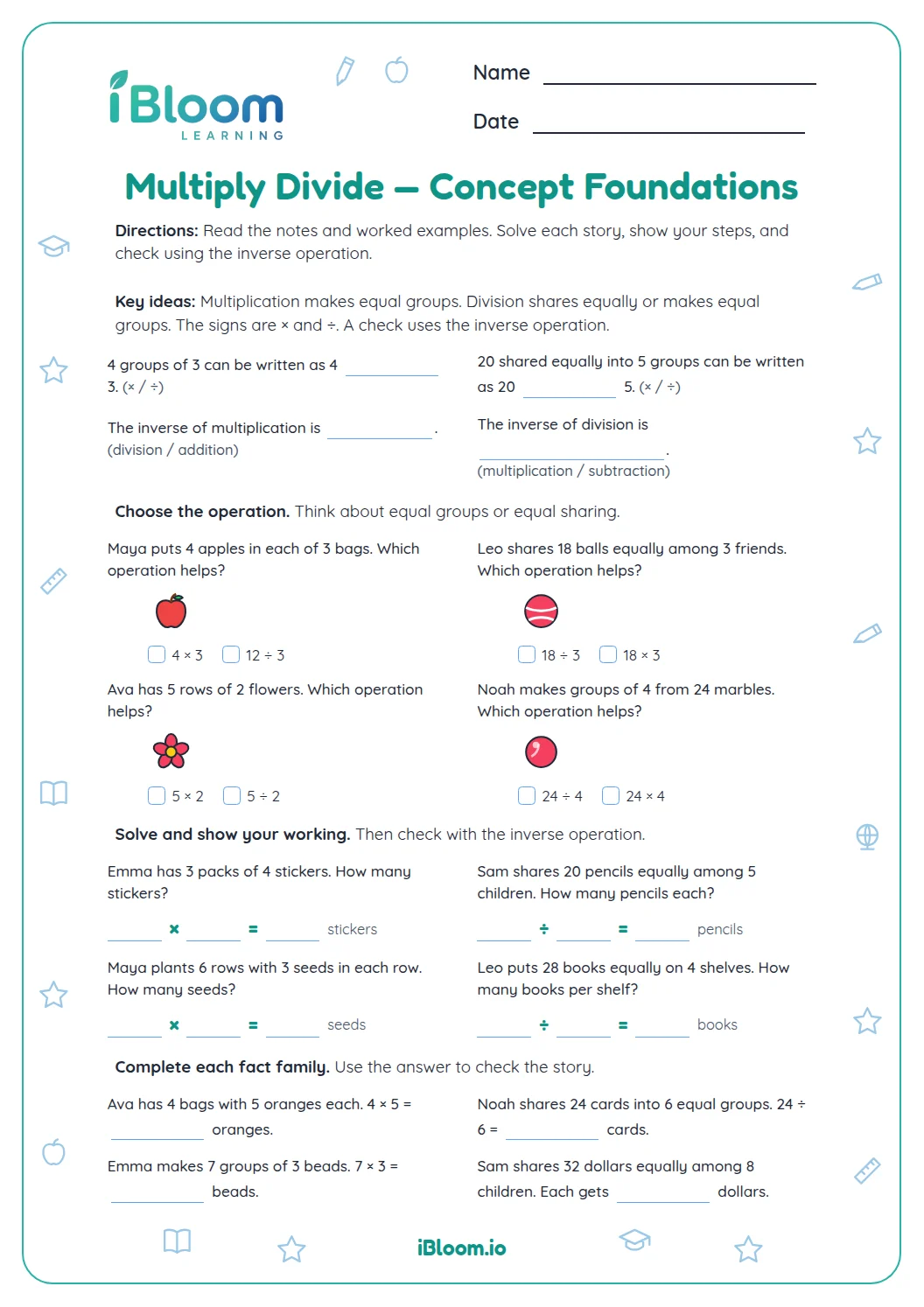
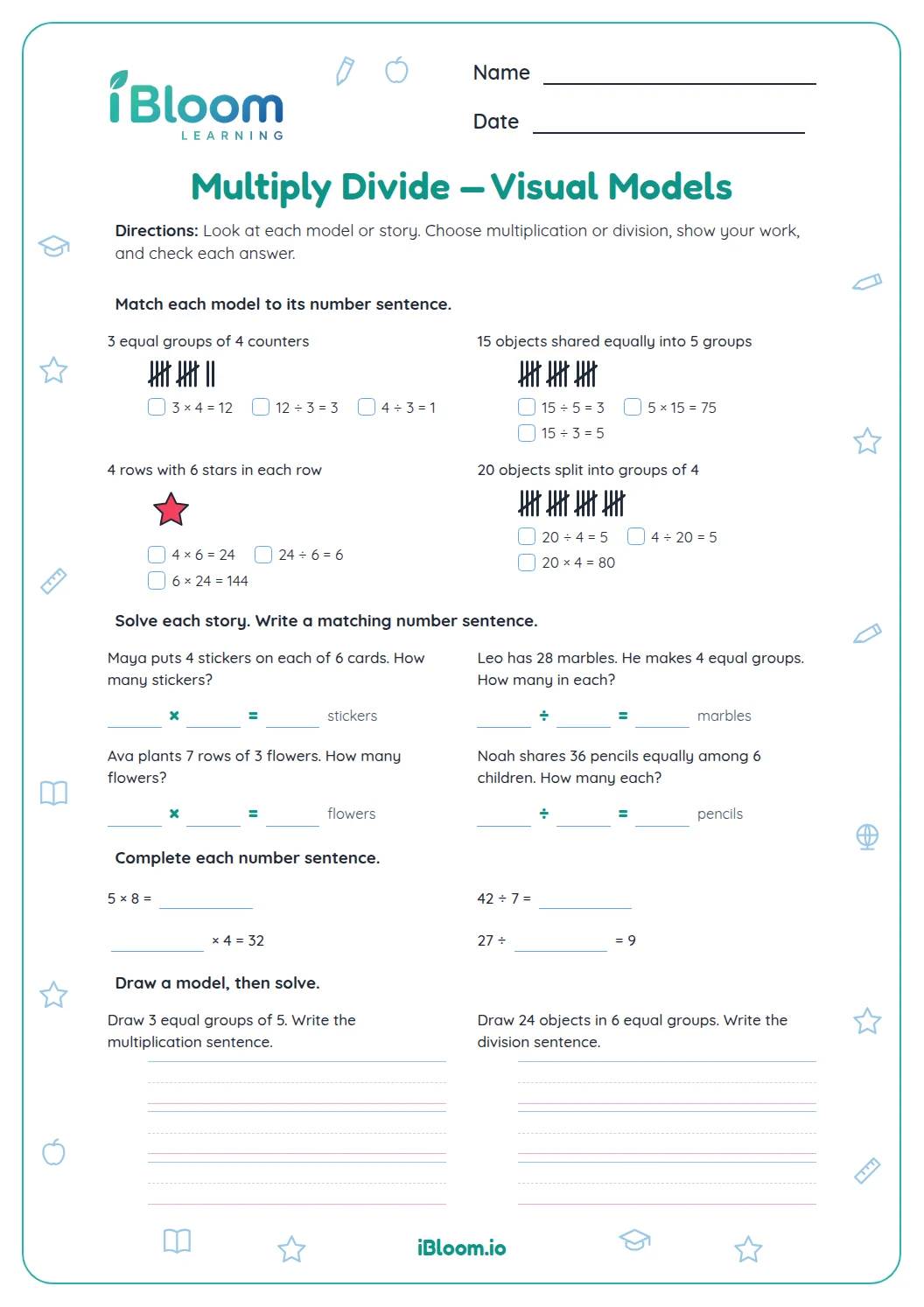
About this worksheet
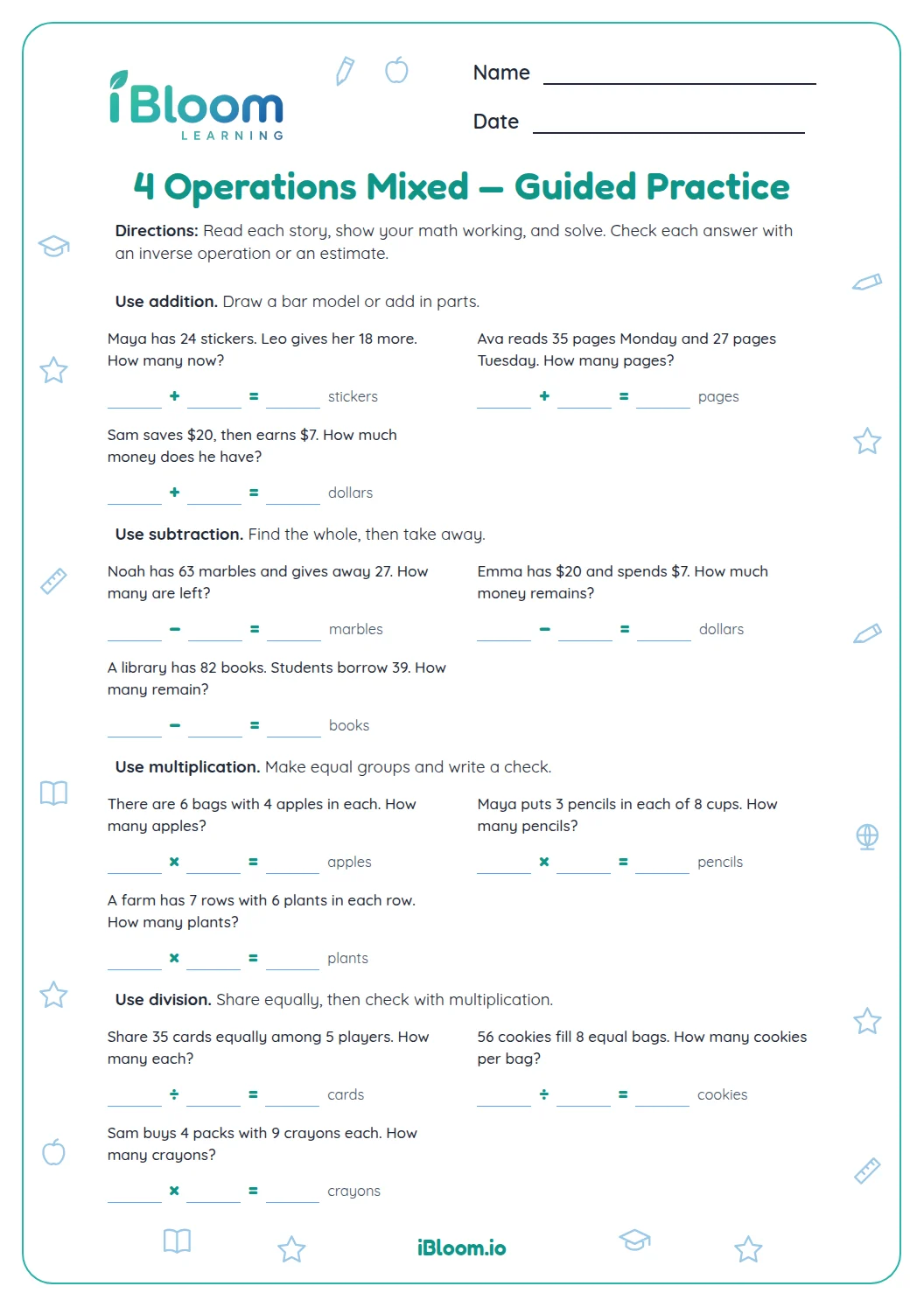
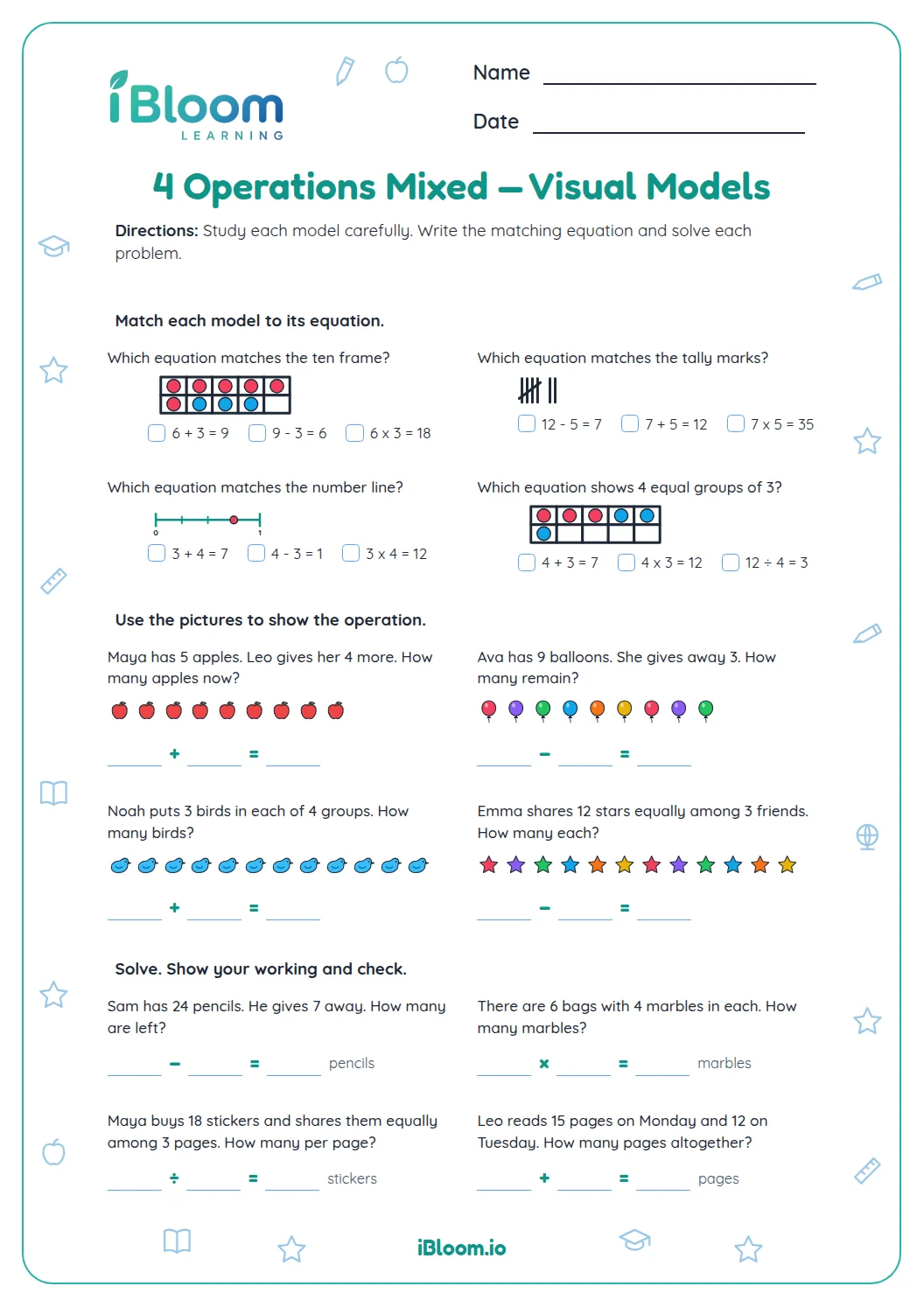
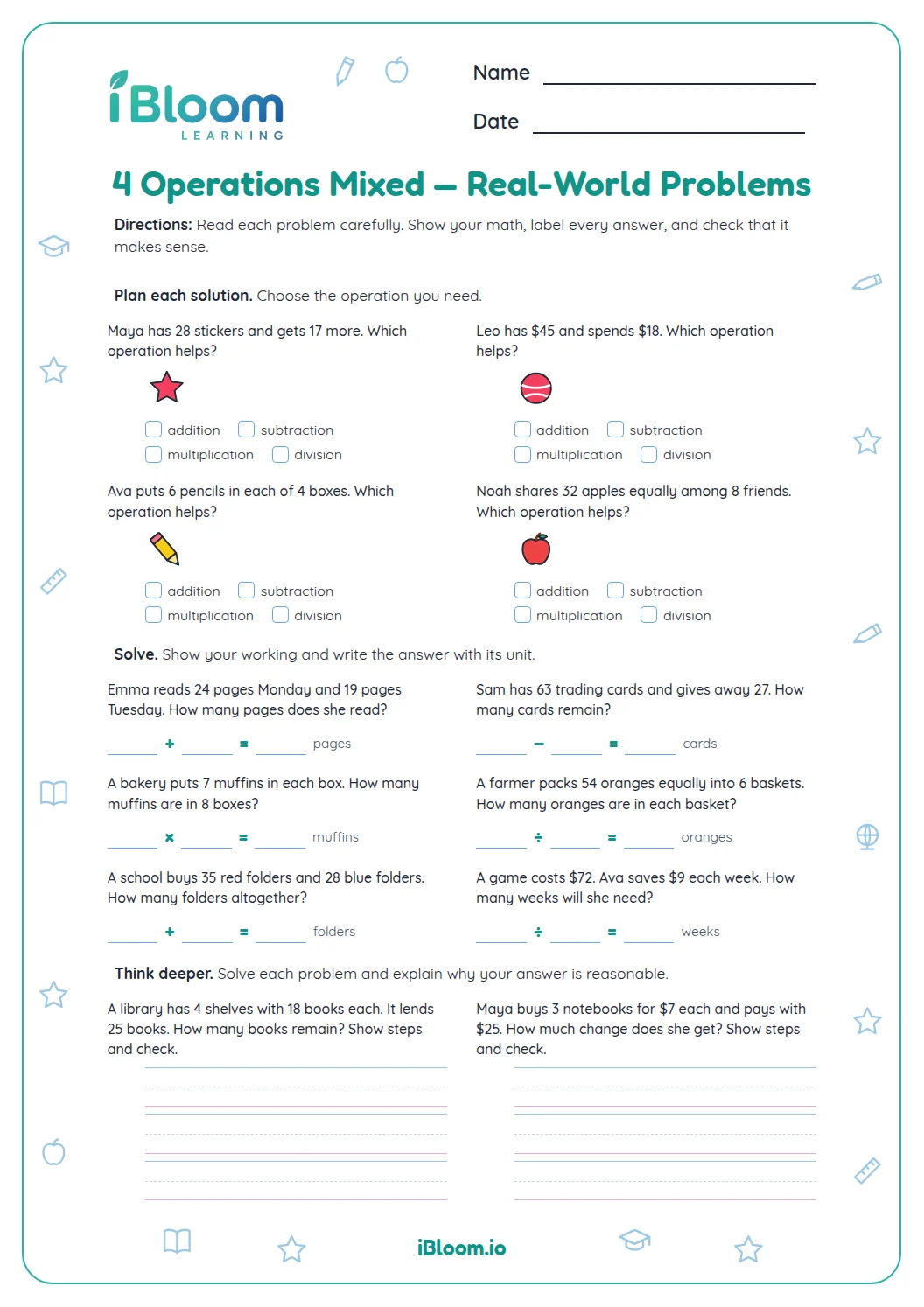
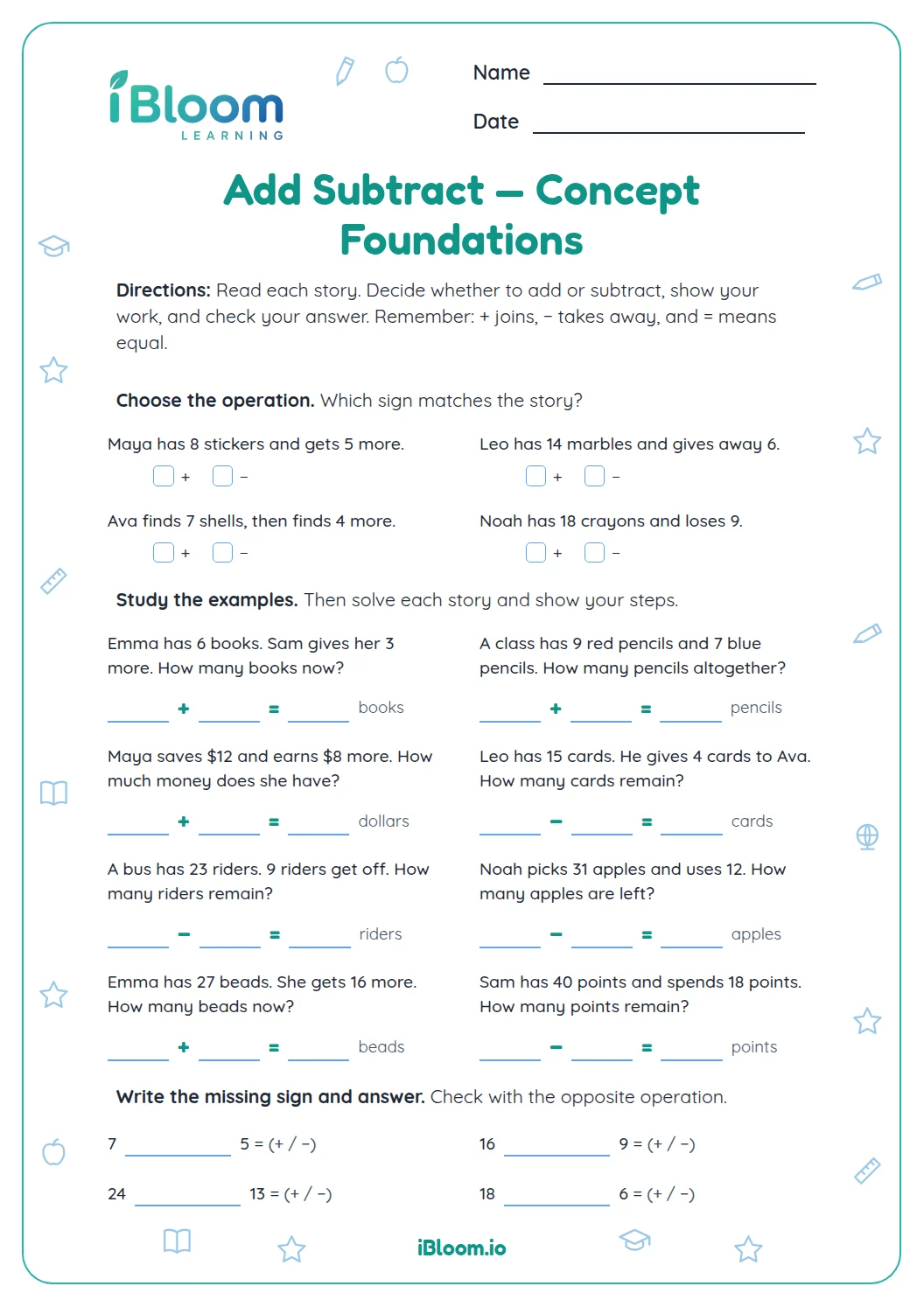
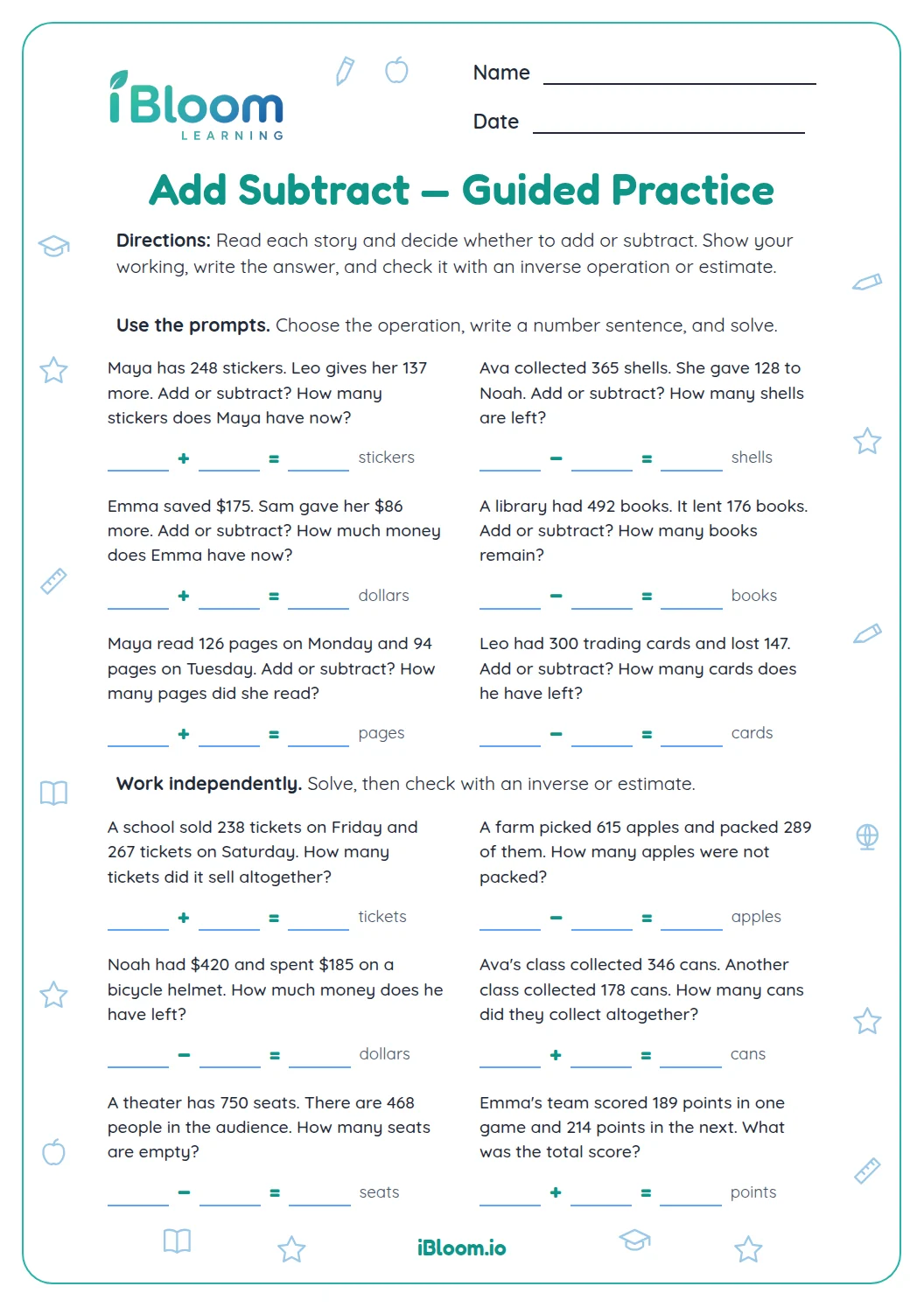
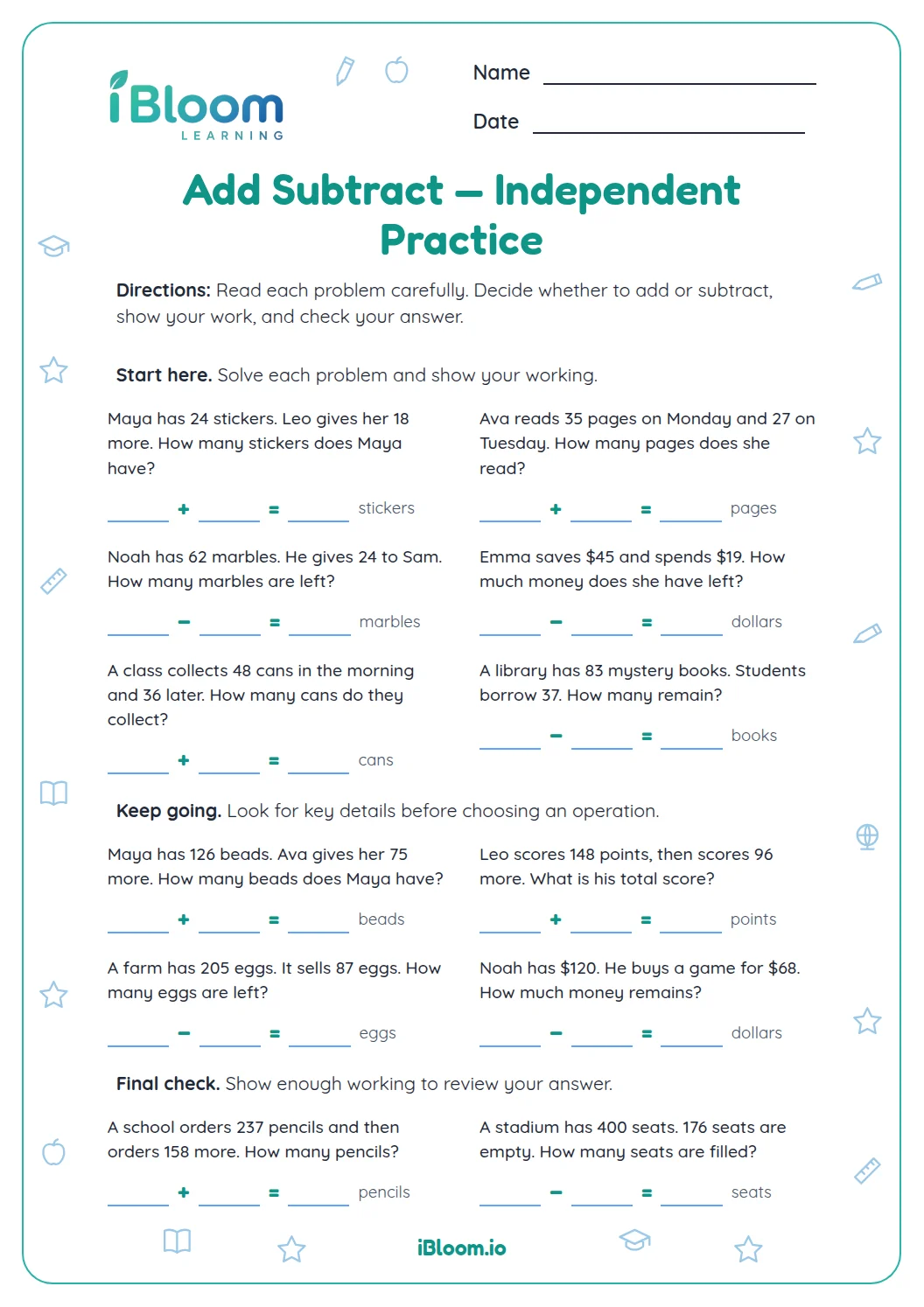
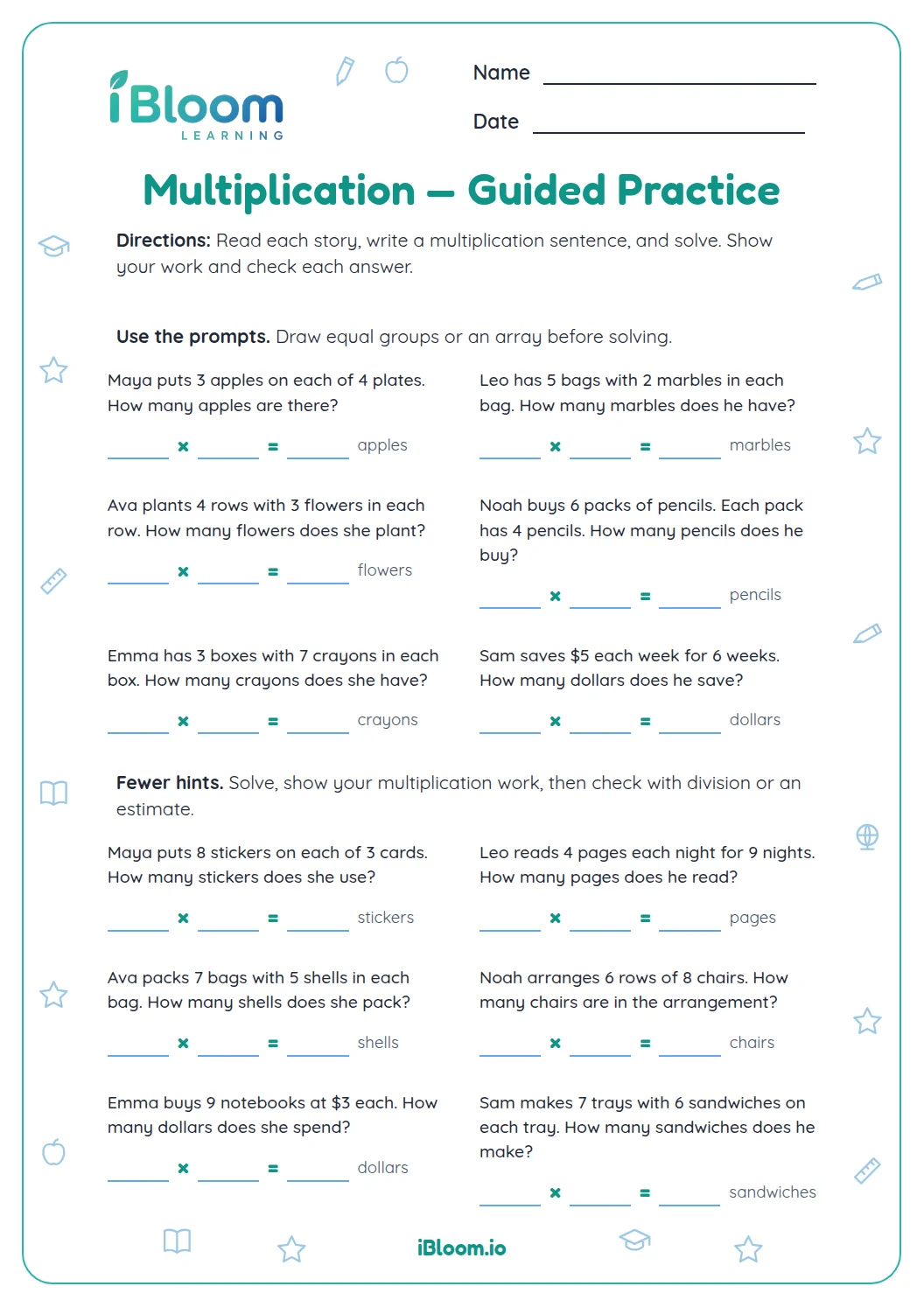
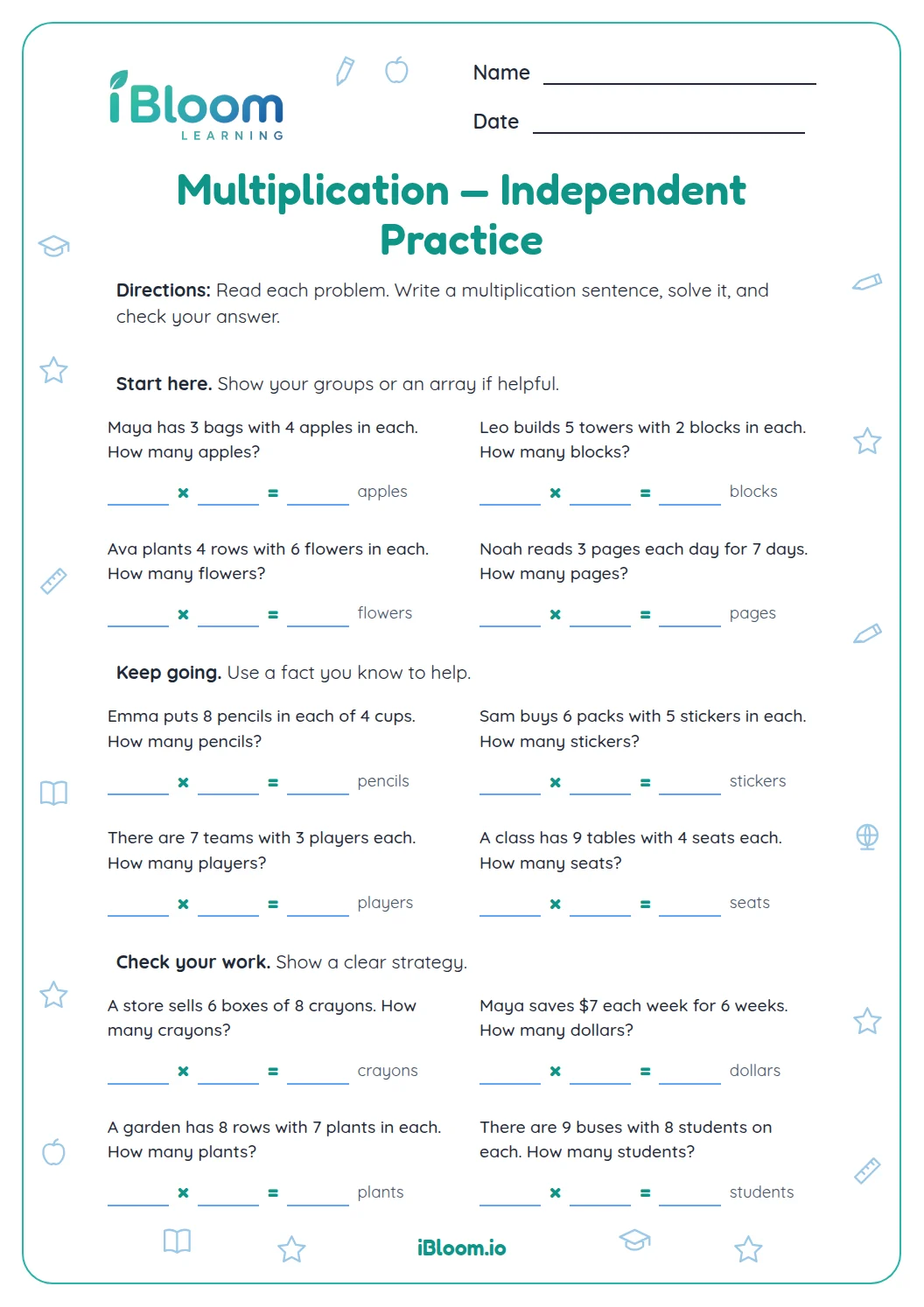
This Grade 3 printable contains 16 short word problems interleaved across two mixed sets, so learners identify the operation before solving. Addition and subtraction use three-digit amounts; multiplication and division use facts within 100. A separate key gives each result and its story unit.
Aligned to 3.NBT.A.2 and 3.OA.A.3
How do I choose an operation?
Joining amounts suggests addition; finding what remains suggests subtraction. Equal groups can call for multiplication, while sharing equally can call for division. For question 4, divide the 48 markers into 6 equal groups.
- 148 markers shared equally among 6 tables
- 248 ÷ 6 = 8
- 3Each table gets 8 markers.
Why write an equation first?
An equation records the story’s quantities and the unknown. It also makes it easier to check the result with an estimate or inverse operation.
What belongs in the answer?
Include a noun or unit from the story, such as pencils, pages, or markers. A number without its context may not fully answer the question.
How can I use this worksheet?
- 1Read the full story and identify what is unknown.
- 2Decide whether the amounts join, separate, form equal groups, or are shared.
- 3Write an equation that matches the story.
- 4Calculate and include the requested unit.
- 5Estimate or use the inverse operation to check.
What mistakes should I watch for?
The mistake
Adding when the story describes items being removed.
The fix
Look for the final amount after something is sold, used, or sent away.
The mistake
Using the wrong order in subtraction.
The fix
Start with the amount available, then subtract the amount taken away.
The mistake
Dividing the total by the number of groups incorrectly.
The fix
Check that group size times number of groups returns the total.
Common Core alignment
This practice connects the worksheet tasks to the standard below.
Fluently add and subtract within 1,000.
On this sheet: The addition and subtraction stories use three-digit quantities.
Show the official wordingHide the official wording
Fluently add and subtract within 1000 using strategies and algorithms based on place value, properties of operations, and/or the relationship between addition and subtraction.
Solve equal-group multiplication and division stories within 100.
On this sheet: The equal-group stories practice multiplication and division facts.
Show the official wordingHide the official wording
Use multiplication and division within 100 to solve word problems in situations involving equal groups, arrays, and measurement quantities, e.g., by using drawings and equations with a symbol for the unknown number to represent the problem.
What to practice next
Make more practice
Further reading
Questions parents and teachers ask
Which operations appear on the page?
The 16 stories include four addition, four subtraction, four multiplication, and four division problems. They are interleaved in two mixed sets, so the heading does not identify the operation for each item. Answers include the relevant story unit. The problems are not grouped by operation.
Are the problems at a Grade 3 level?
Addition and subtraction use three-digit amounts up to 800. Multiplication and division use equal groups and facts with products up to 63. Each story has a whole-number answer, and the key labels the result with its context. This keeps the calculation demands within Grade 3 ranges.
Should a child write an equation?
The printed response is a number blank with a story unit. A child may write an equation on scratch paper first, such as 238 + 145, then enter the total in the blank. This keeps the worksheet concise while leaving room for independent reasoning.
How can I tell whether to multiply or divide?
Look at what the story gives and what it asks for. Multiply when the number of equal groups and the amount in each group are known. Divide when a total is shared or sorted into equal groups and one amount is unknown.
How should the answer key be used?
Have the learner solve a complete mixed set before checking the key. Compare both the number and the unit with the story. If they differ, identify the action in the prompt and write a matching equation on scratch paper. A quick estimate can also catch an unreasonable result.