



About this worksheet
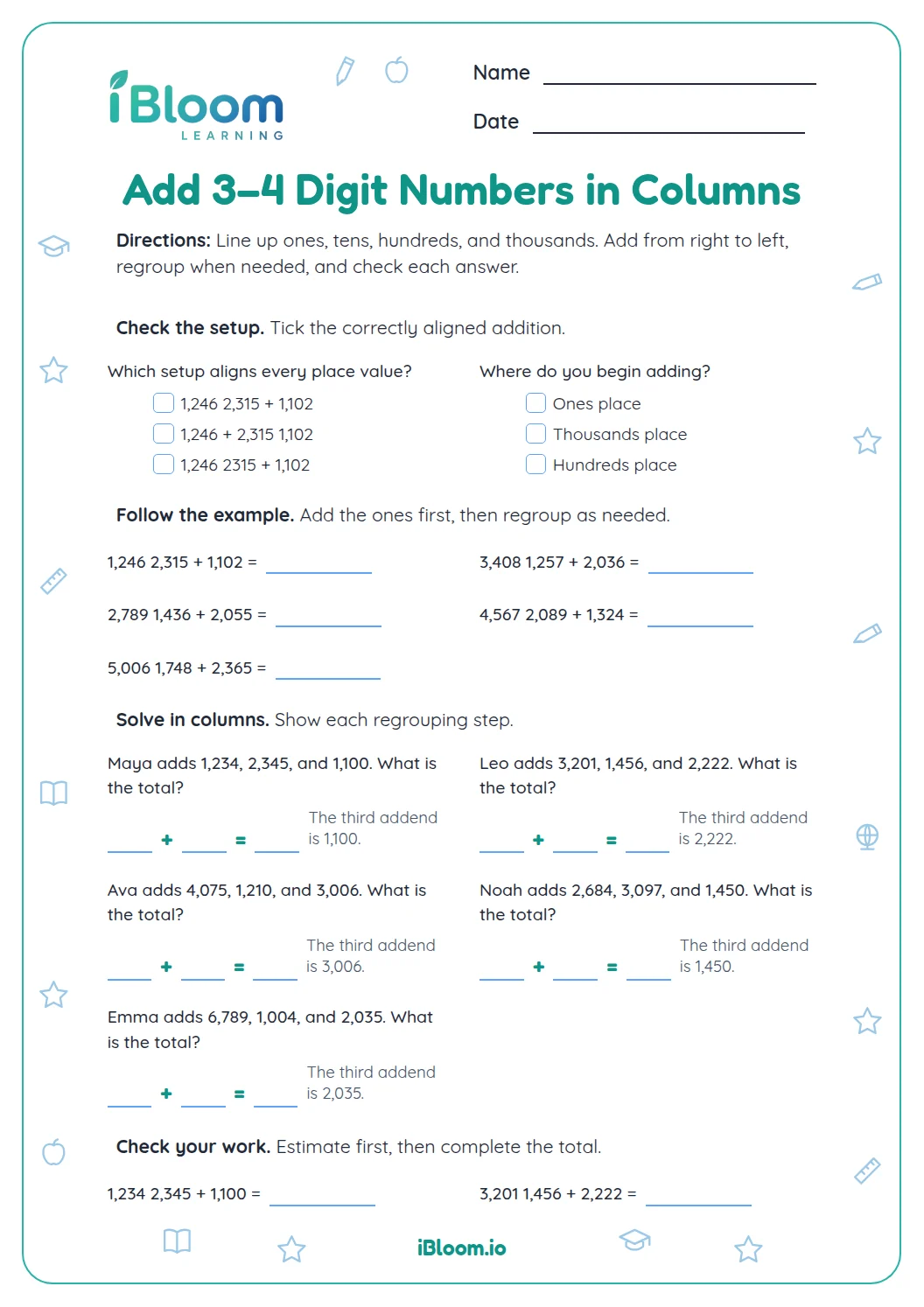
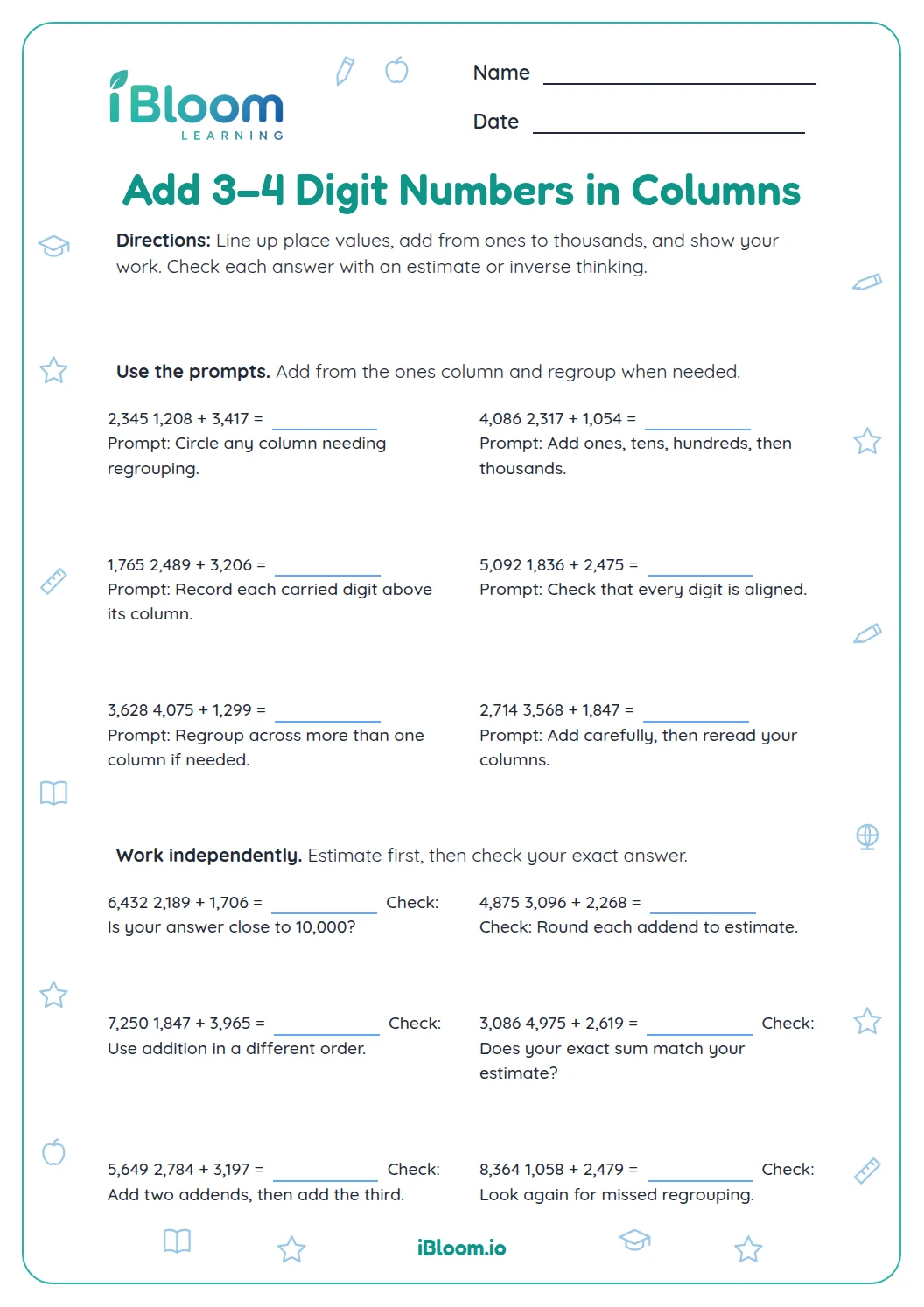
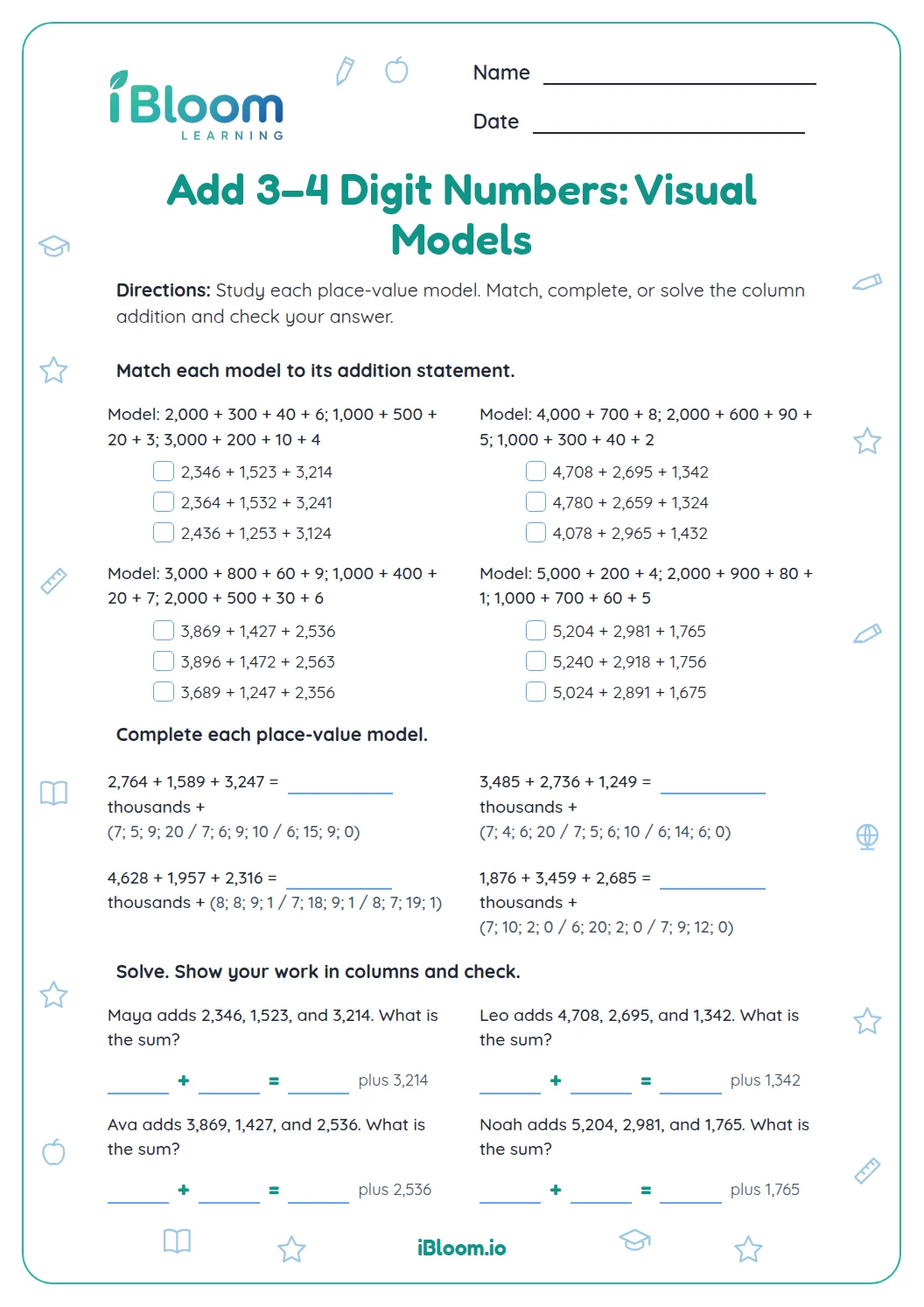
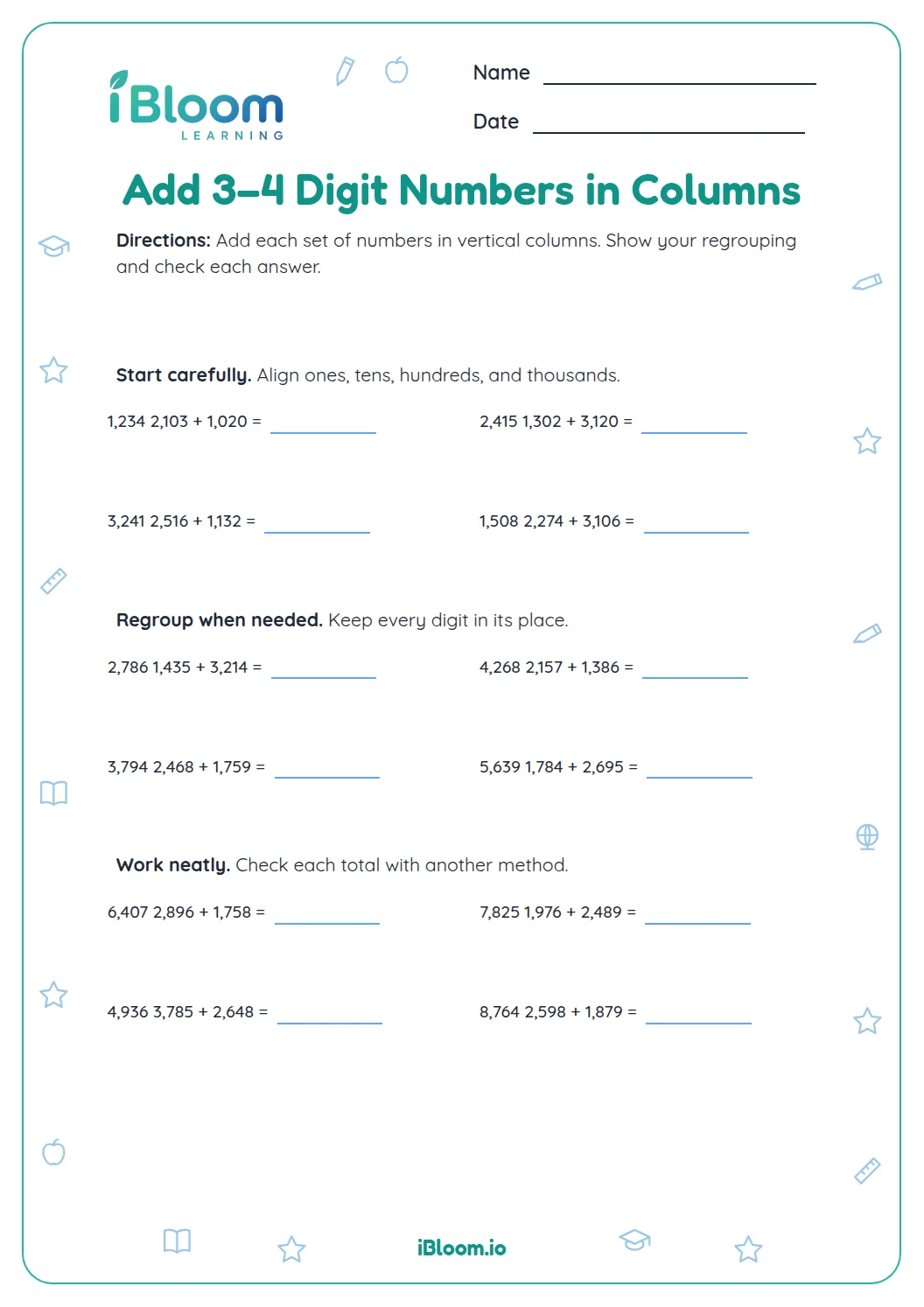
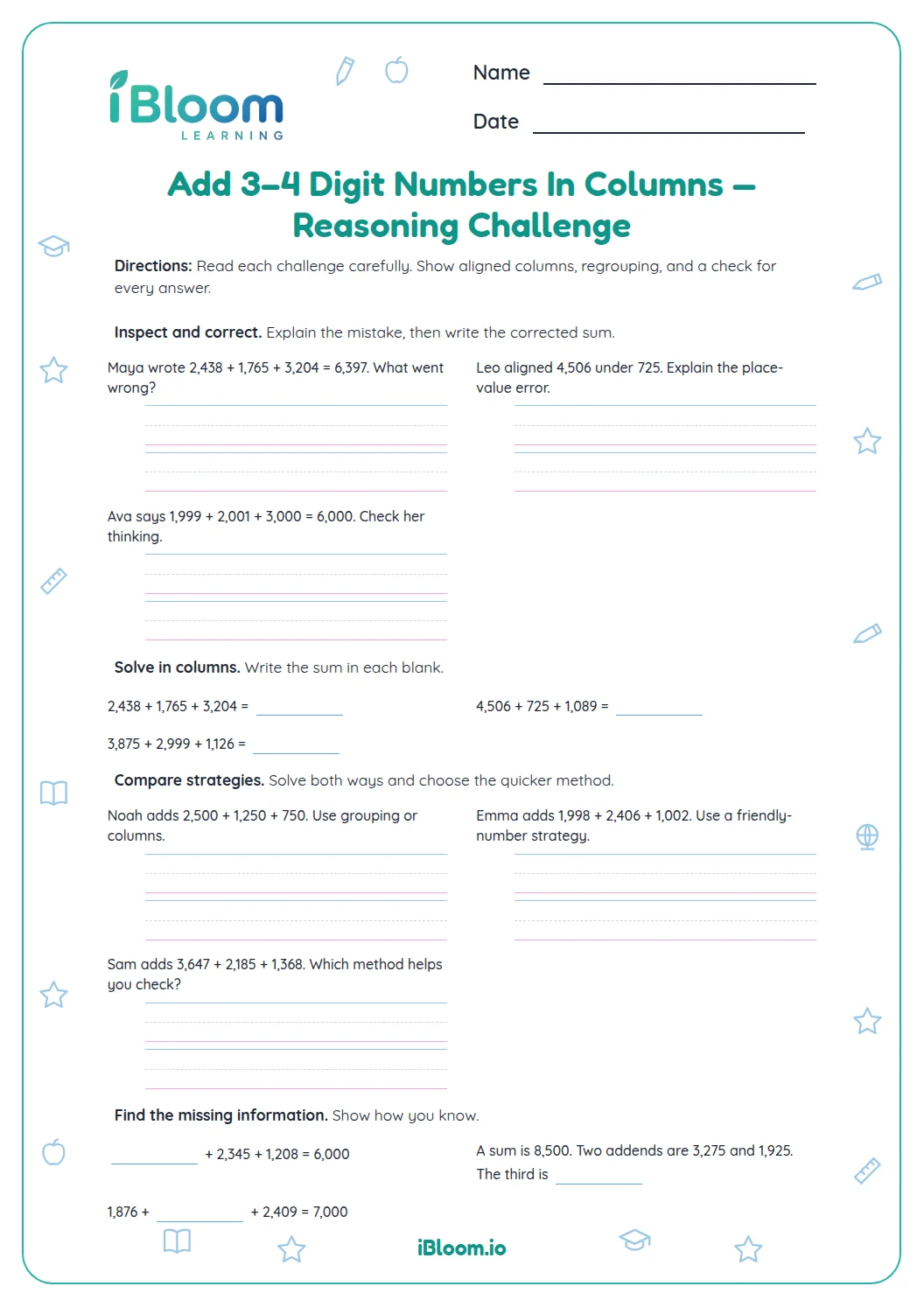
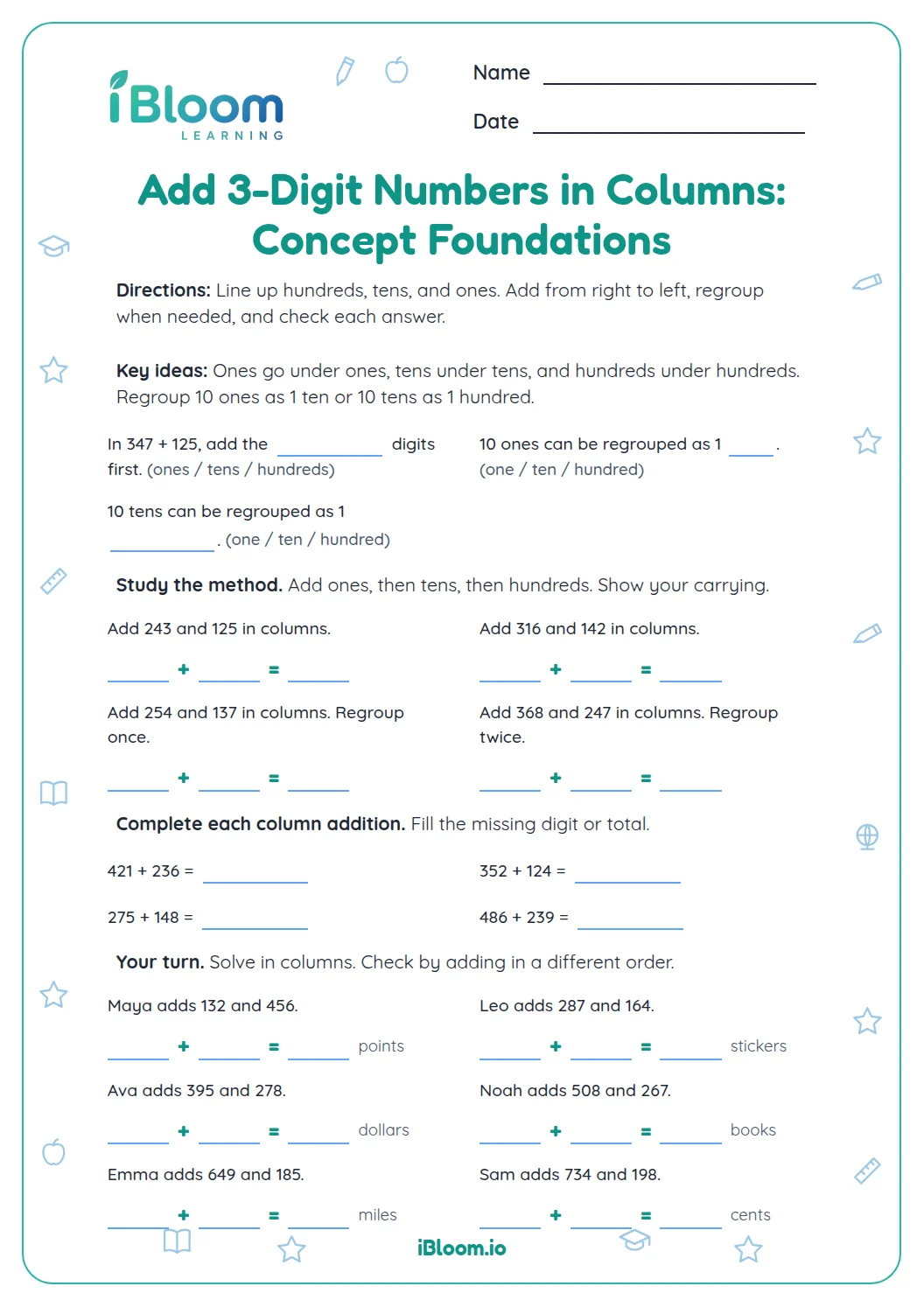
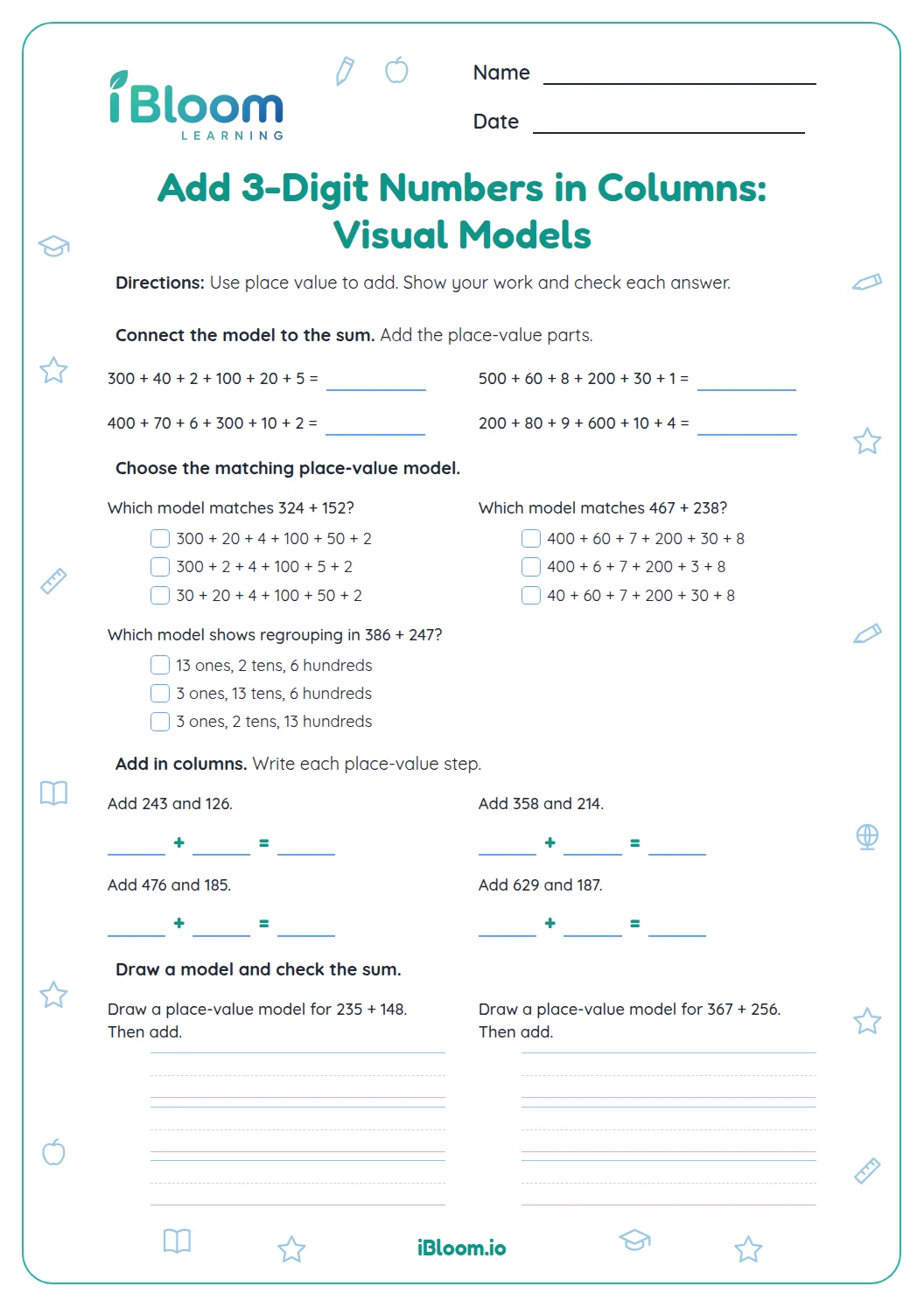
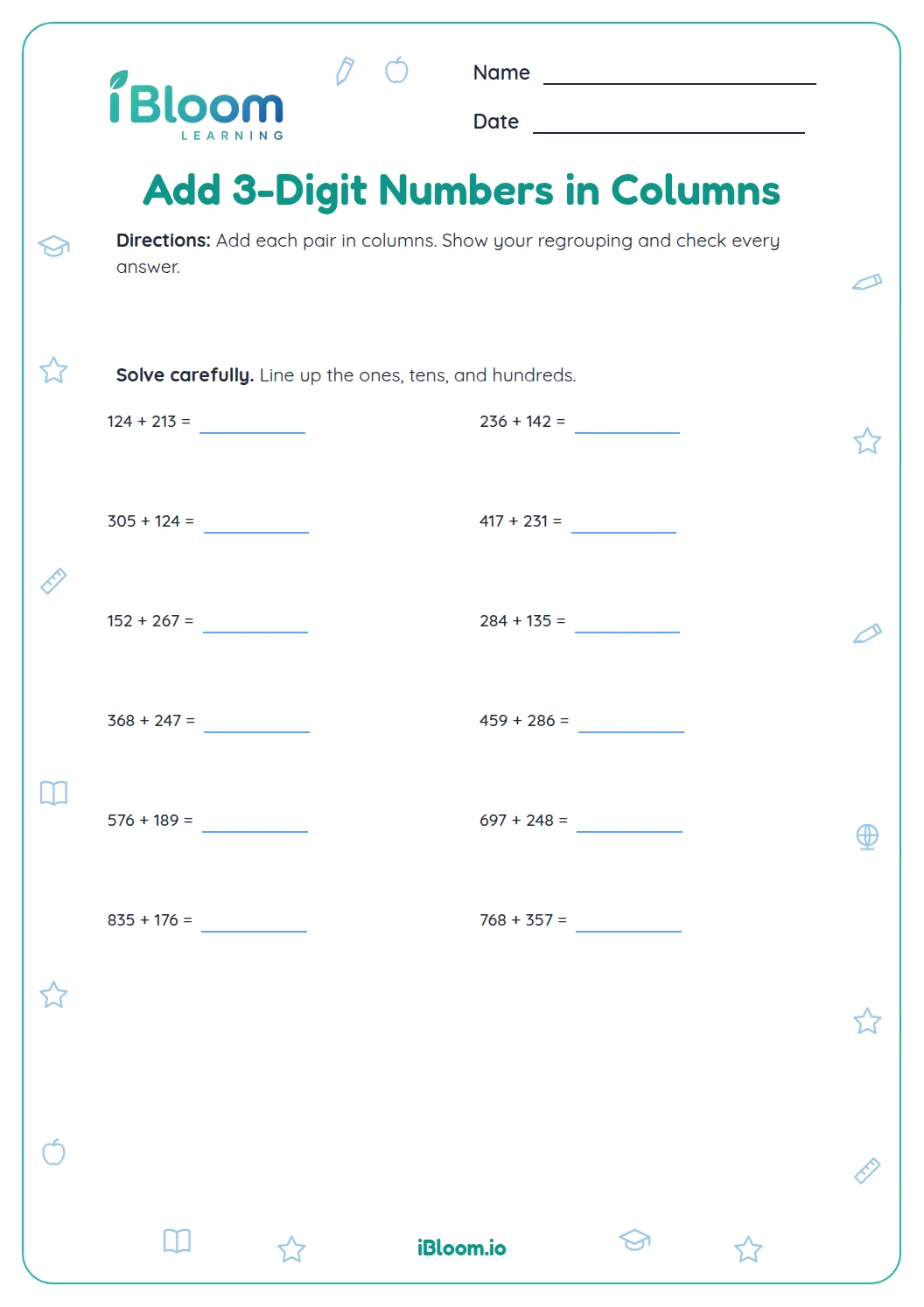
This free Grade 4 worksheet gives students 12 real-world reasons to add three whole numbers. Each problem combines 3- or 4-digit amounts, with space to set them up in vertical columns. Students total books, visitors, supplies, and other quantities while practicing the standard addition algorithm in CCSS 4.NBT.B.4. Part A starts with three-digit addends, Part B mixes three- and four-digit amounts, and Part C uses larger totals. A separate answer key gives each exact total. Students should also check the unit named in each question.
Aligned to 4.NBT.B.4
How should students set up each word problem?
Identify the three amounts and what they count before writing any digits. All three amounts in a question belong in the total. Copy them vertically with ones under ones, then put an addition sign to the left and a line under the last addend.
The 806 in question 5 has no thousands digit. Leave that position empty or write a zero there; do not slide the number left to match the first digits of 1,245 and 1,118. Use the grid for the vertical setup and regrouping marks; write the total in the answer box and check its unit against the question.
How does regrouping work with three addends?
Add all digits in a column, including any amount carried from the previous column. Write the ones digit of that column’s total in the answer and move its remaining tens into the next column. With three addends, a column can total 20 or more, so the carried amount can be 2.
Question 1 needs regrouping from both the ones and tens columns. Students can check the exact total by adding in a different order after finishing their vertical calculation.
- 1248 + 376 + 159 books
- 2Ones: 8 + 6 + 9 = 23. Write 3; carry 2 tens.
- 3Tens: 4 + 7 + 5 + 2 = 18. Write 8; carry 1 hundred.
- 4Hundreds: 2 + 3 + 1 + 1 = 7.
- 5Total: 783 books.
What changes from Part A to Part C?
Part A has four totals made from three-digit quantities. Part B has four problems that mix three- and four-digit addends, including a zero within an amount. Part C has four larger problems that keep the same three-addend structure.
The final problem totals 12,999 concert tickets. That extra digit is expected: adding several four-digit amounts can create a five-digit answer. Encourage students to say the unit when reading each total so “12,999” becomes a statement about tickets.
For Part C, round each addend to the nearest hundred and compare that estimated total with the exact sum. In question 9, 1,900 + 3,500 + 2,600 = 8,000, close to 7,971 items. A large difference is a reason to check the column work.
How to use this worksheet
- 1Read the question and name the unit that belongs with the answer.
- 2Underline all three amounts and copy them into columns with ones aligned.
- 3Add the ones; record the answer digit and any regrouped tens.
- 4Continue left, including all regrouped amounts in the next column.
- 5Write the total with its unit. In Part C, round the addends to hundreds and compare the estimated and exact totals.
Mistakes to notice and how to help
The mistake
Aligning the left edges of 1,245 and 806.
The fix
Align the ones digits at the right edge; the 8 in 806 belongs under the hundreds digit 2.
The mistake
Carrying 1 automatically when a column totals 23.
The fix
Twenty-three ones are 2 tens and 3 ones, so carry 2 into the tens column.
The mistake
Leaving out one of the three quantities.
The fix
Point to each amount in the word problem and its matching row before calculating.
Common Core alignment
Add three multi-digit amounts with the standard algorithm.
On this sheet: All 12 problems ask students to align multi-digit addends and regroup in vertical columns.
Show the official wordingHide the official wording
Fluently add and subtract multi-digit whole numbers using the standard algorithm.
What to practice next
Make more practice
Further reading
Questions parents and teachers ask
Does “3- and 4-digit” mean three or four numbers?
It describes the length of the numbers being added. Every problem on this sheet has exactly three addends, and each addend has either three or four digits. Part A uses three-digit amounts; Parts B and C bring in four-digit amounts while keeping the same column method.
Where should my child put 806 when adding it to 1,245?
Put the 6 under the 5, the 0 under the 4, and the 8 under the 2. That keeps ones, tens, and hundreds together. In question 5, add 1,118 as the third row with its ones digit aligned too; the total is 3,169 books.
Can the number carried into the next column be 2?
Yes, adding three digits can create twenty or more units in a column. In question 1, the ones total is 8 + 6 + 9 = 23. Write 3 in the ones place and carry 2 tens, then include those tens in the next column’s sum.
What should students write in the working space?
Students should write the three amounts in vertical columns, include any regrouping marks, and calculate the sum. They can then put the total in the answer box and say its unit aloud. The key supplies exact totals, so an adult should also check alignment and regrouping in the student’s work.
Is a five-digit answer possible on this worksheet?
Yes, question 12 has a five-digit total: 12,999 tickets. Its three four-digit addends are 4,865, 3,978, and 4,156. If a final column produces ten or more thousands, students need a new ten-thousands place. The answer can have more digits than any single addend.