
About this worksheet
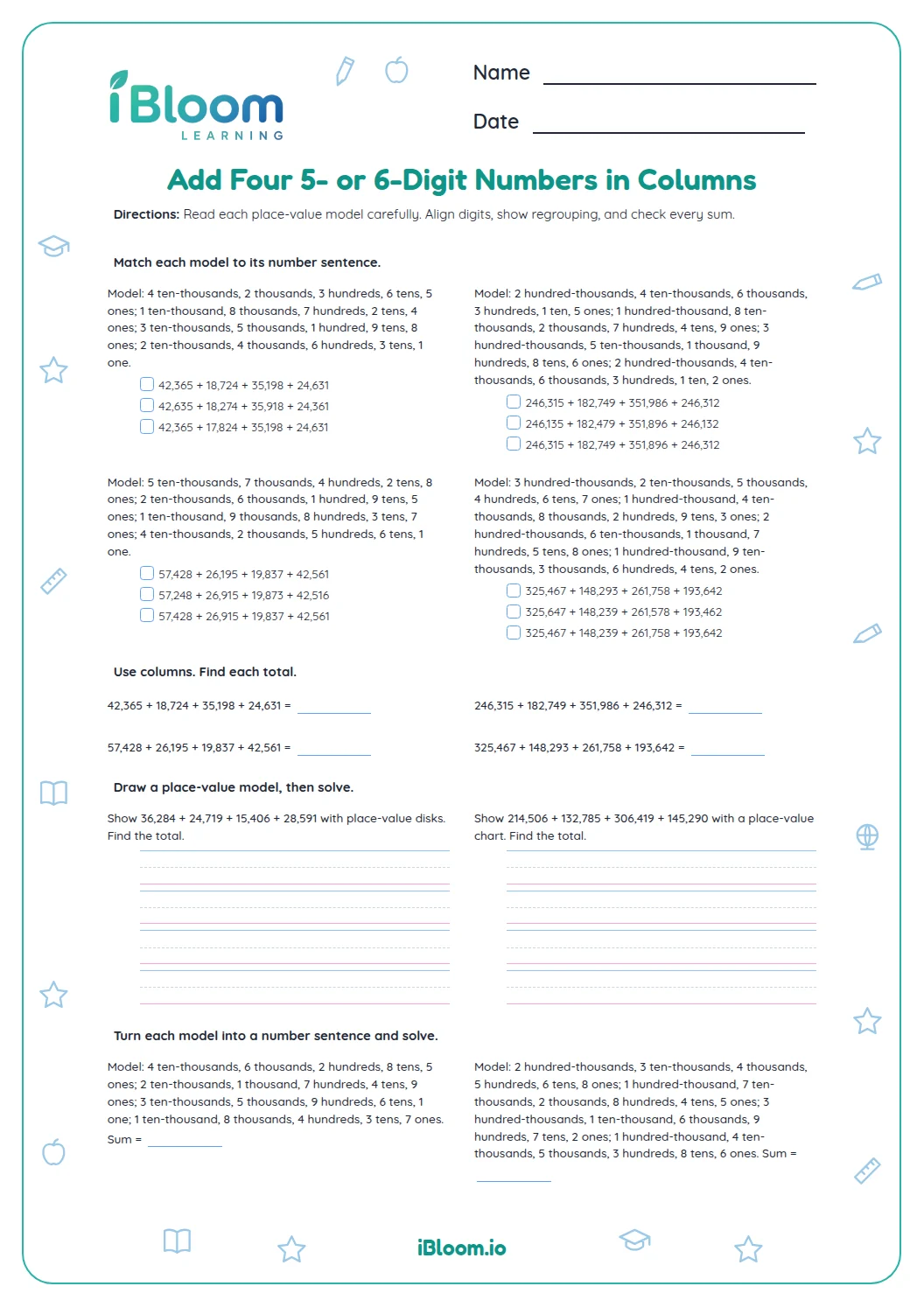
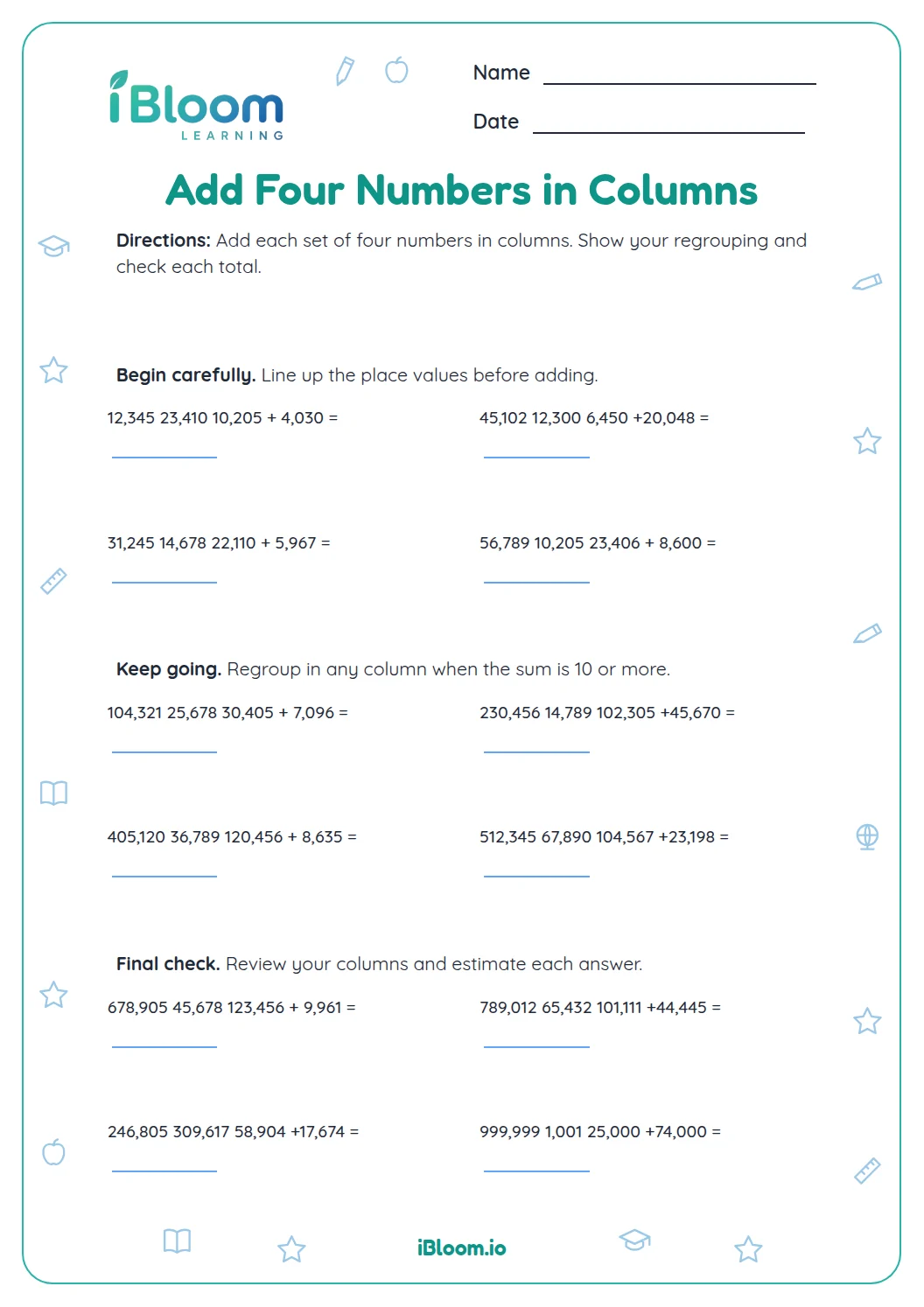
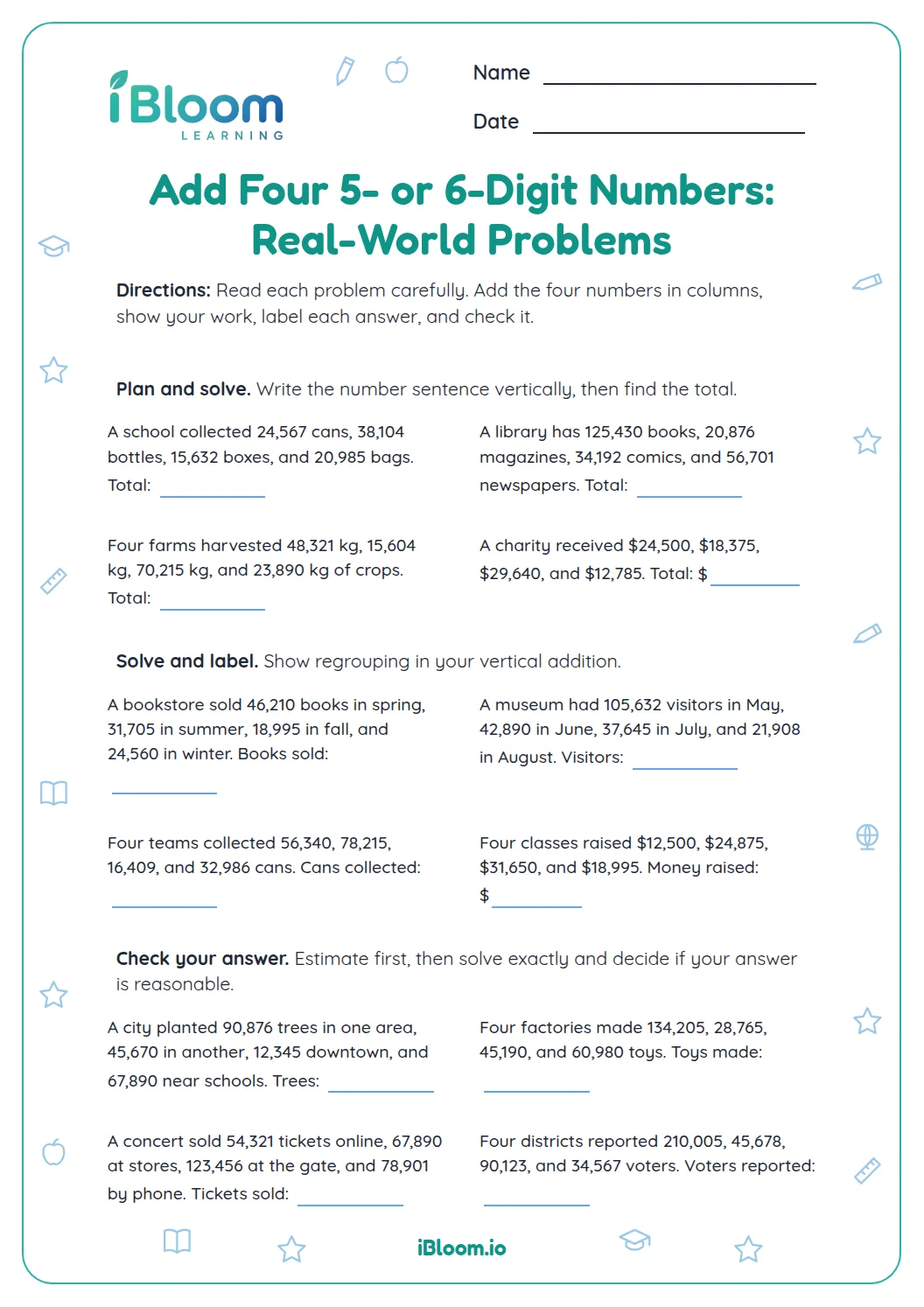
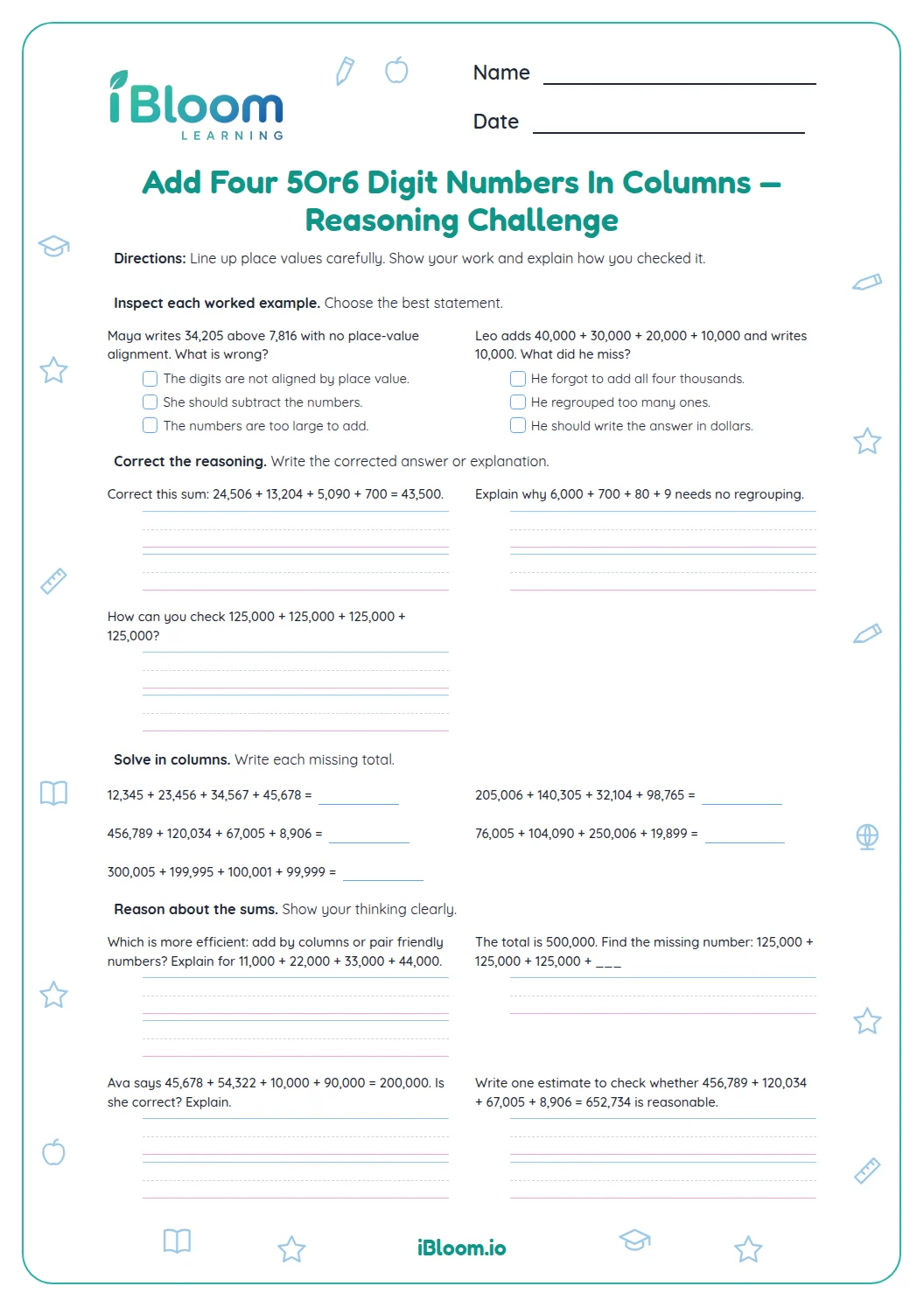
This free printable Grade 4 worksheet gives students 14 problems adding four five- or six-digit whole numbers. Students line up place values and regroup as needed, using the printed work grids or their own paper to show column work. The set includes a missing addend and totals that require careful alignment through the hundred-thousands place. It practices the addition part of CCSS 4.NBT.B.4. A separate answer key lists the completed sums.
Aligned to 4.NBT.B.4
Why line up the addends before adding?
Each digit must be added with digits in the same place. Use a printed grid or spare paper to write all four numbers vertically with the ones aligned, then add from right to left. For question 1, the ones column is 8 + 2 + 6 + 7 = 23, so write 3 ones and carry 2 tens.
- 124,618 + 35,472 + 18,906 + 12,347
- 2Ones: 8 + 2 + 6 + 7 = 23; write 3, carry 2
- 3Tens: 1 + 7 + 0 + 4 + 2 = 14; write 4, carry 1
- 4Continue by place value. Sum: 91,343
When should students regroup?
Regroup when the digits and any carried amount total 10 or more. Write the ones digit in its column and add the tens to the next column. Continue the same way through the hundred-thousands place.
How do you find a missing addend?
Add the three known addends first, then subtract that subtotal from the given total. In question 10, the missing number is 400,000 minus the sum of 124,675, 80,409, and 96,218, which is 98,698.
How to use this worksheet
- 1Write the four addends one above another.
- 2Align digits by place value, including any blank places.
- 3Add the ones column and regroup when needed.
- 4Continue left through tens, hundreds, and higher places.
- 5For a missing addend, subtract the known subtotal from the total.
- 6Estimate or add the columns again to check.
Common mistakes and quick fixes
The mistake
Starting a number one place too far left or right.
The fix
Line up the final digit of every addend in the ones column before calculating.
The mistake
Forgetting a carried ten in the next column.
The fix
Write each carry above the next place and include it in that column total.
The mistake
Subtracting one known addend instead of their subtotal for the missing value.
The fix
Add all three known addends first, then subtract that subtotal from the target.
Common Core alignment
This worksheet gives students practice with the standard below.
Add four five- or six-digit whole numbers with the standard algorithm and regrouping.
On this sheet: Every item requires adding multi-digit whole numbers; several sums require regrouping across place values.
Show the official wordingHide the official wording
Fluently add and subtract multi-digit whole numbers using the standard algorithm.
What to practice next
Make more practice
Further reading
Questions parents and teachers ask
How should students set up four addends in columns?
Write each addend on a separate line and align the ones, tens, hundreds, and higher places. The sheet has large grids for two sums; students can use spare paper to show columns for the other problems. Question 1 demonstrates the setup with four five-digit addends.
What does regrouping mean in addition?
When a column totals 10 or more, write the ones digit in that place and carry the remaining tens to the next column. In question 1, 23 ones means writing 3 in the ones place and carrying 2 tens.
How do I find the missing addend in question 10?
Add 124,675, 80,409, and 96,218 to get 301,302. Then subtract that subtotal from 400,000. The missing addend is 98,698, which can be checked by adding all four numbers back to 400,000. Add the missing amount back to the subtotal to check the total.
Does the worksheet include a separate answer key?
Yes. The answer key has two pages and lists the result for all 14 questions, including the missing addend. Students can check one part at a time after they have aligned and added the numbers themselves. The answer key is separate from the student worksheet pages.
How long should the practice take?
Plan for about 25 minutes. Four addends create several digits in each column, and many items require regrouping. Students may benefit from doing the first few sums slowly and checking their column alignment before moving on. A brief estimate can help students notice a misplaced digit before they check the exact total.