

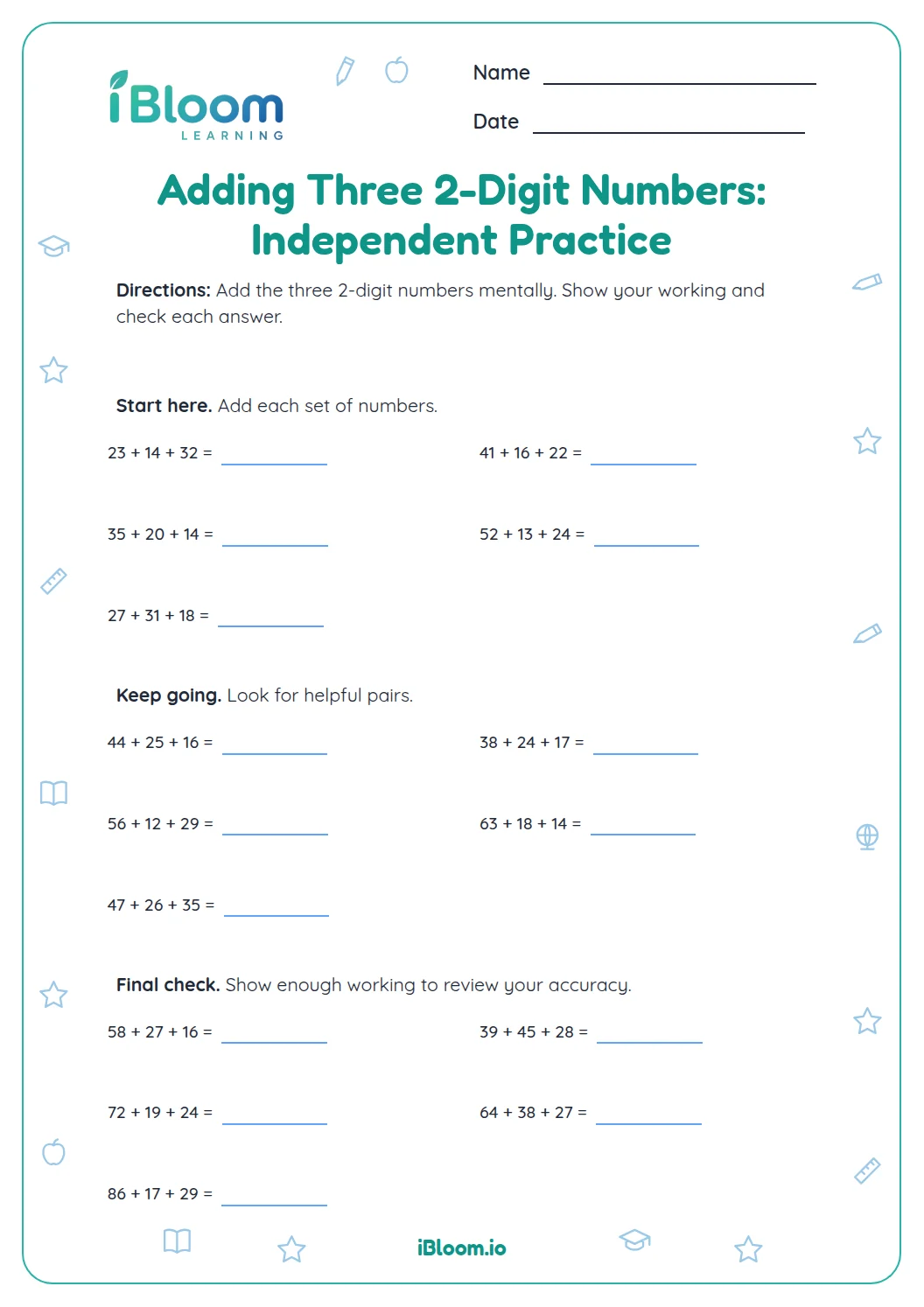
About this worksheet
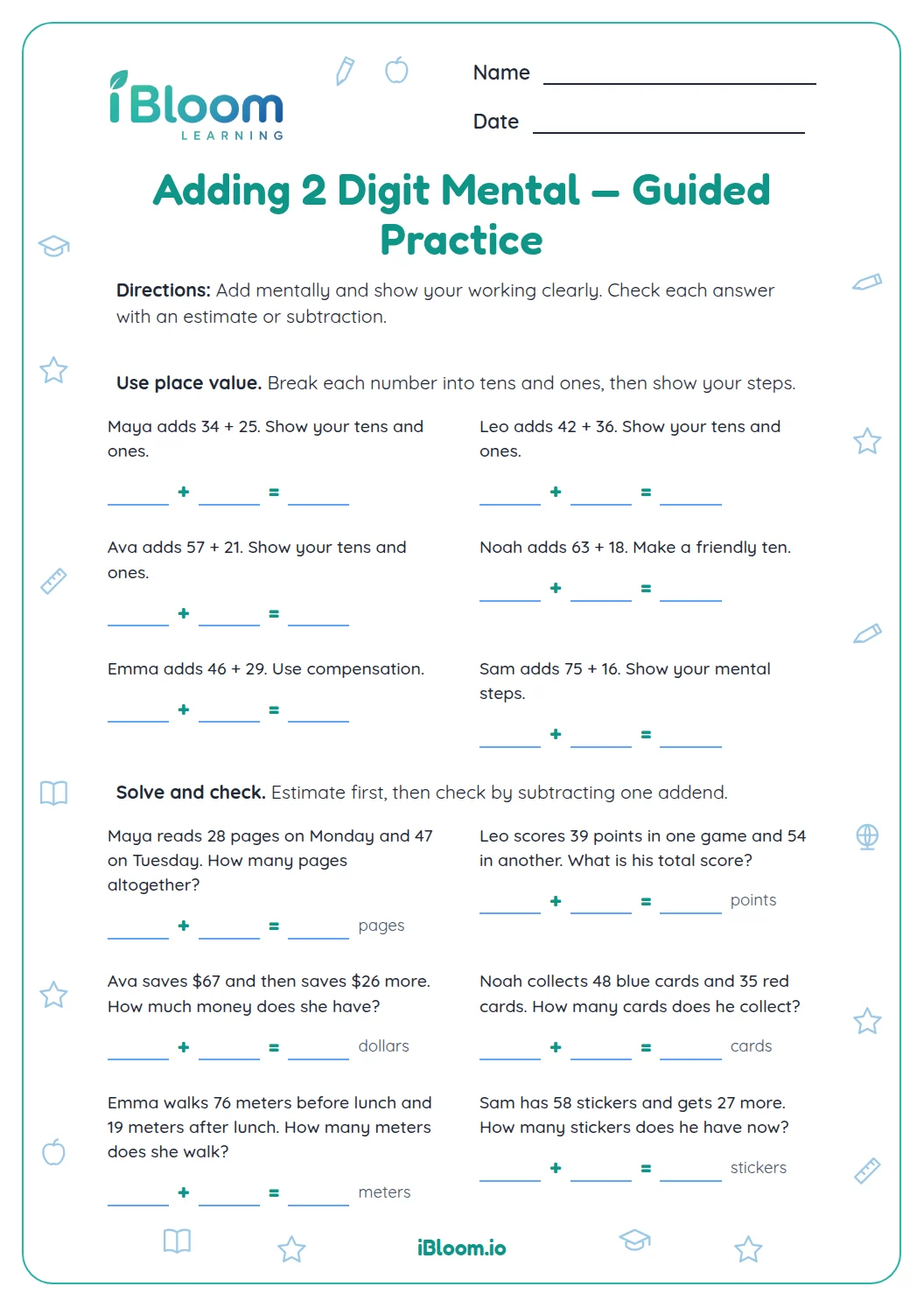
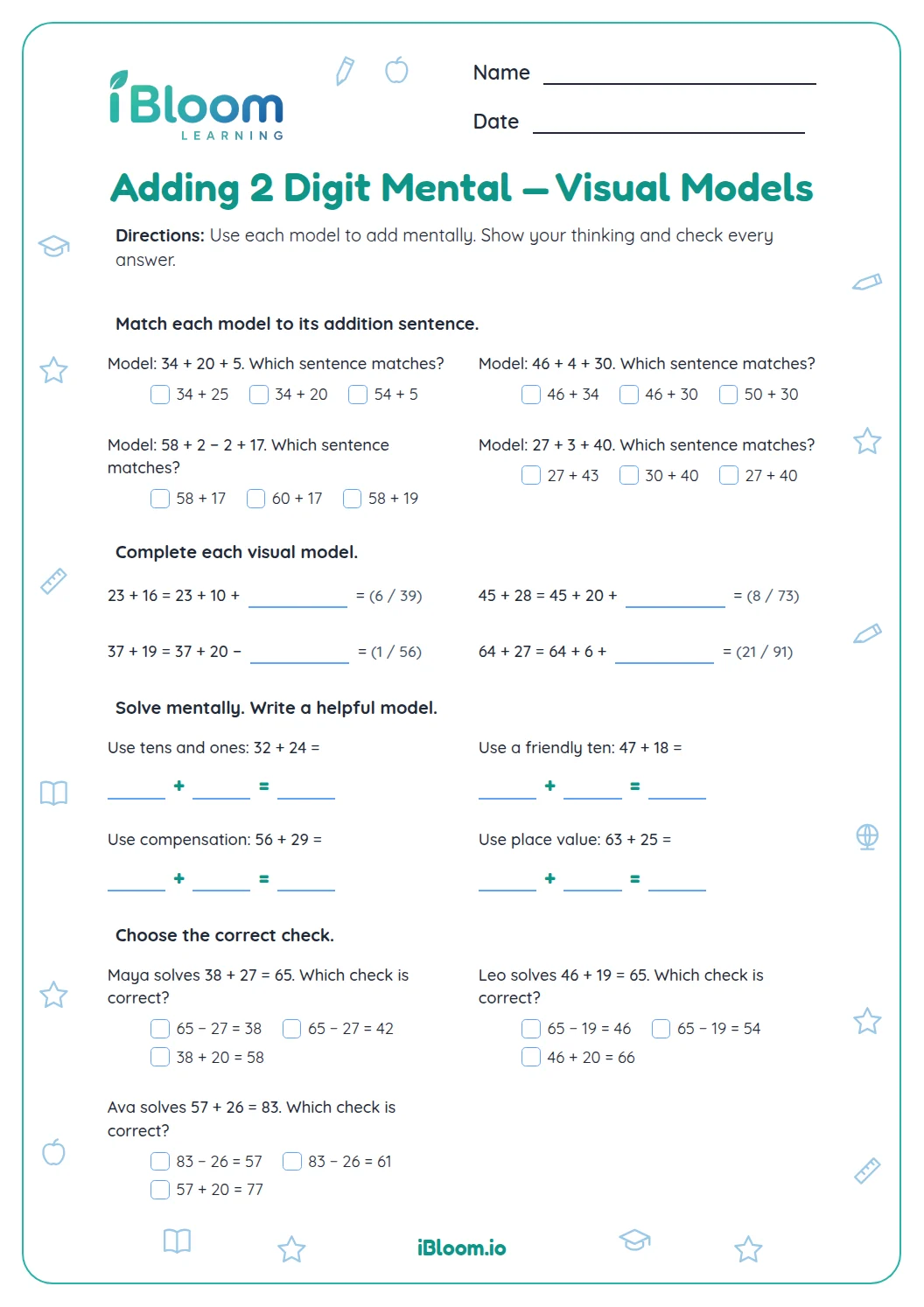
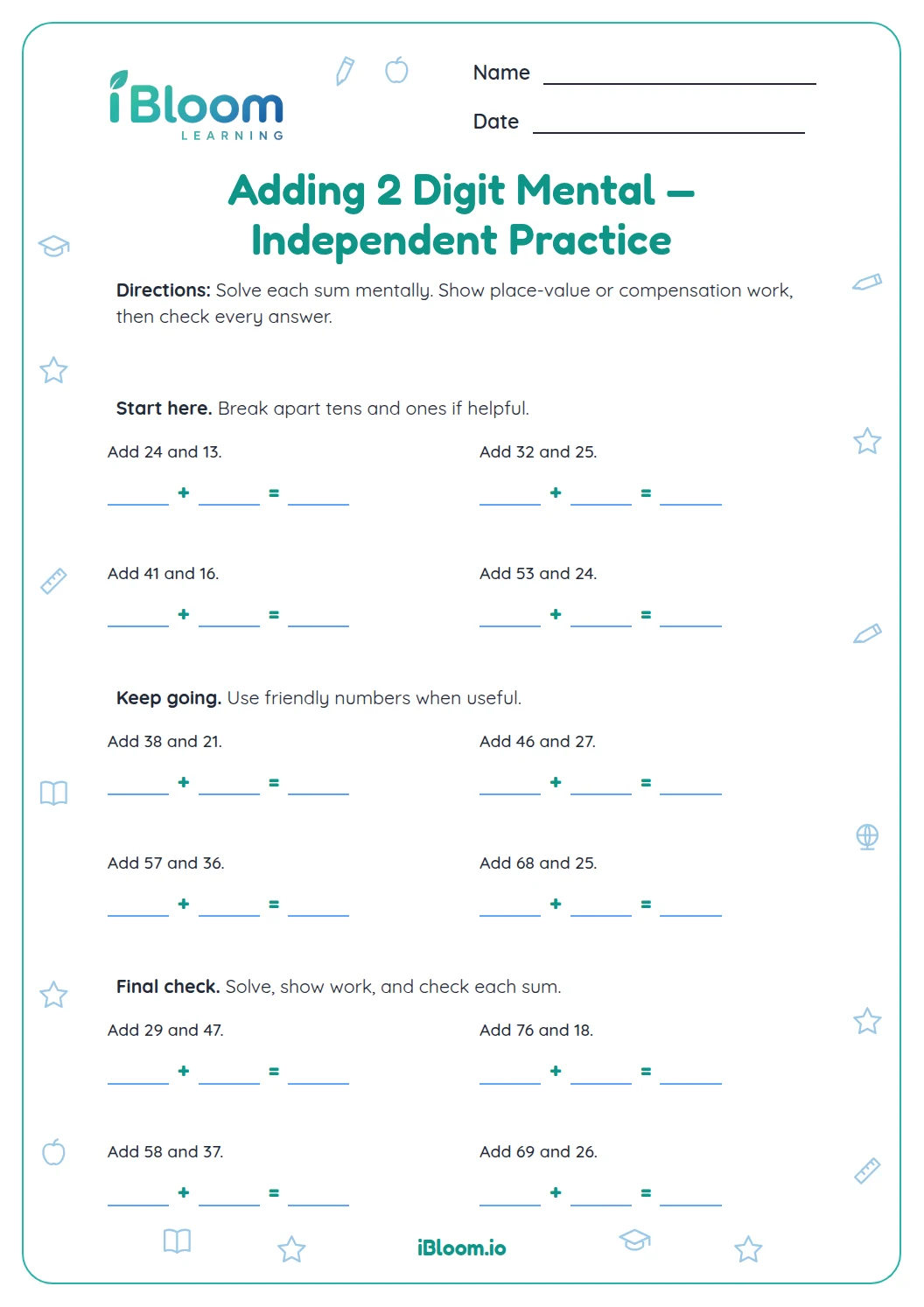
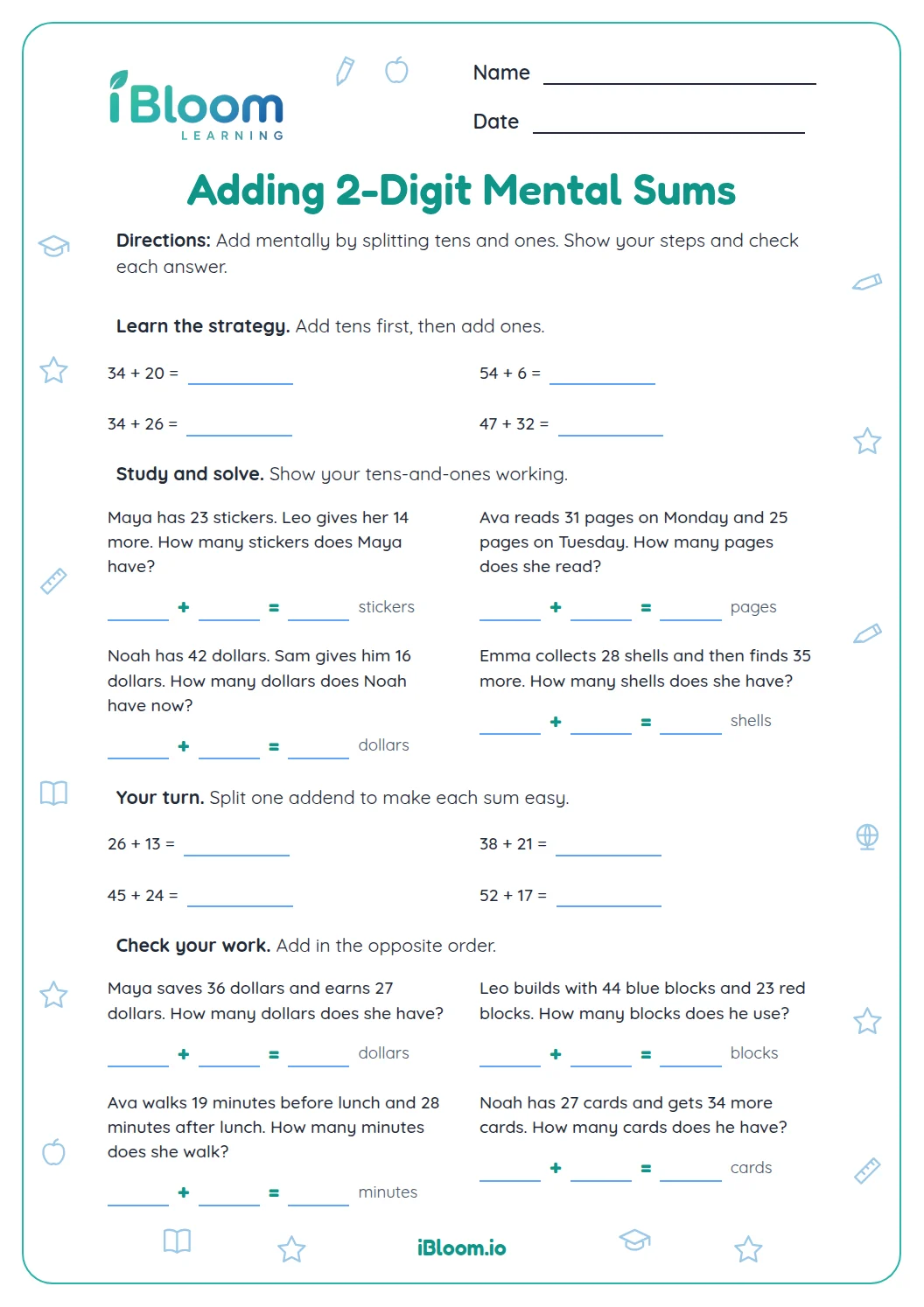
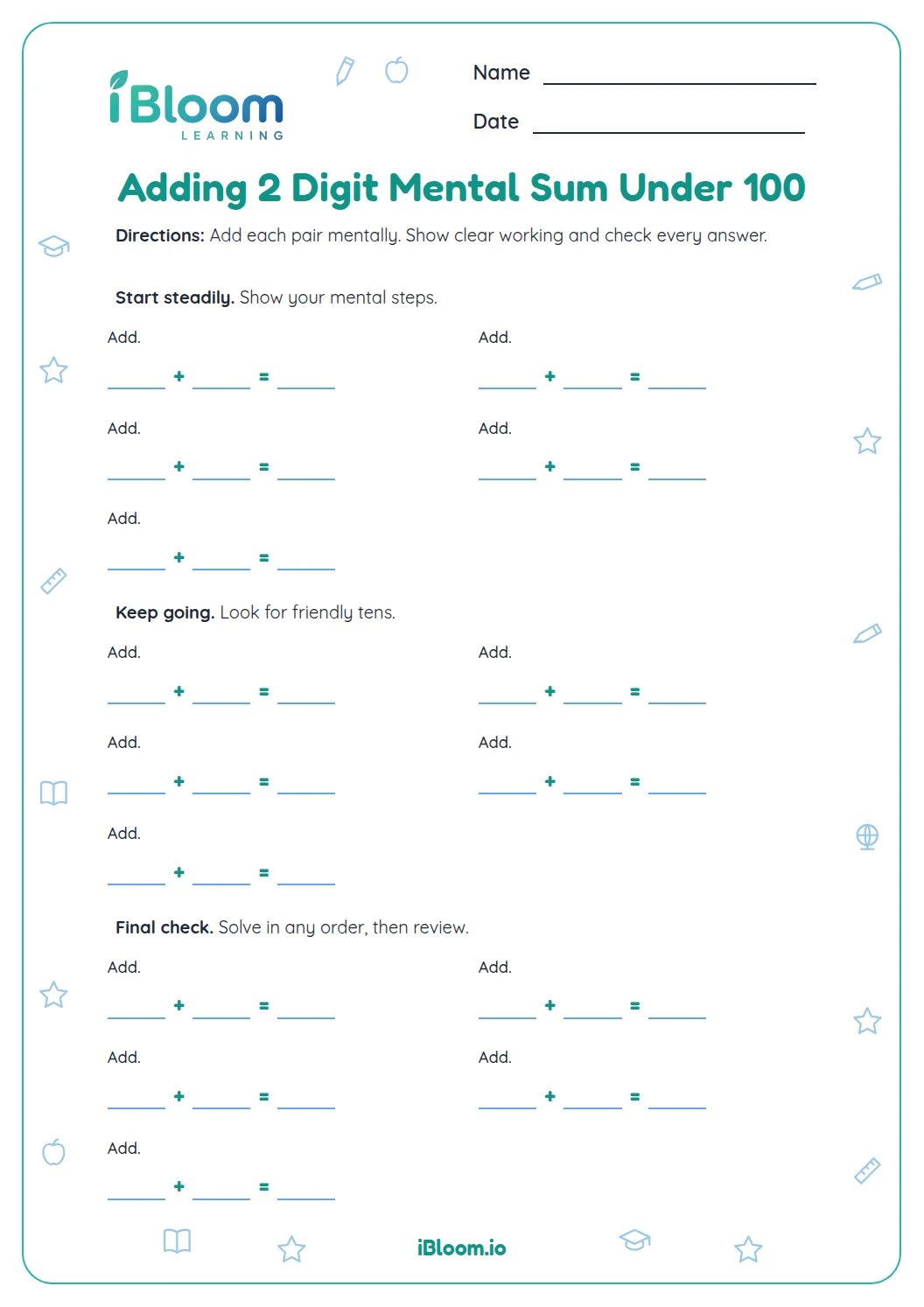
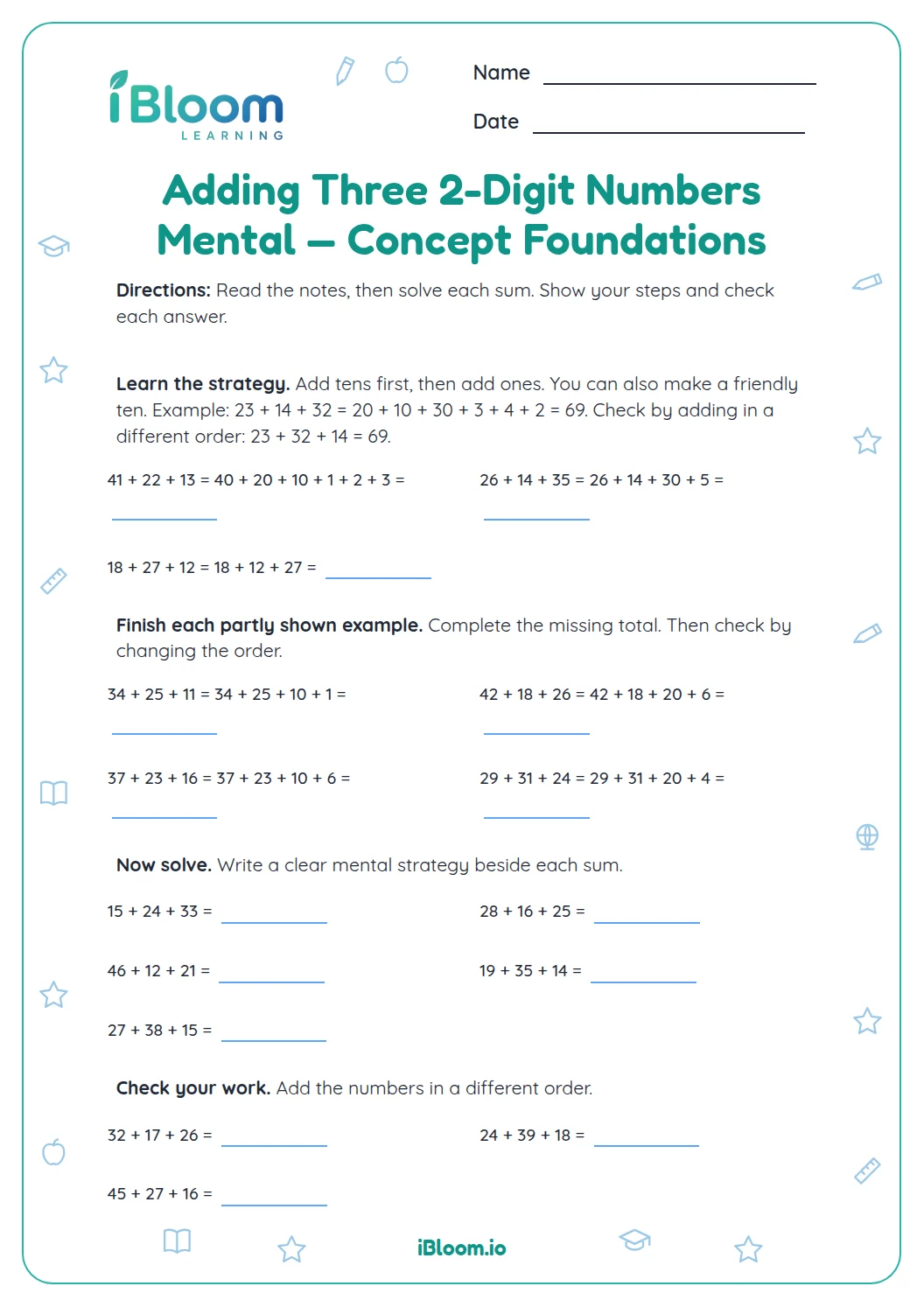
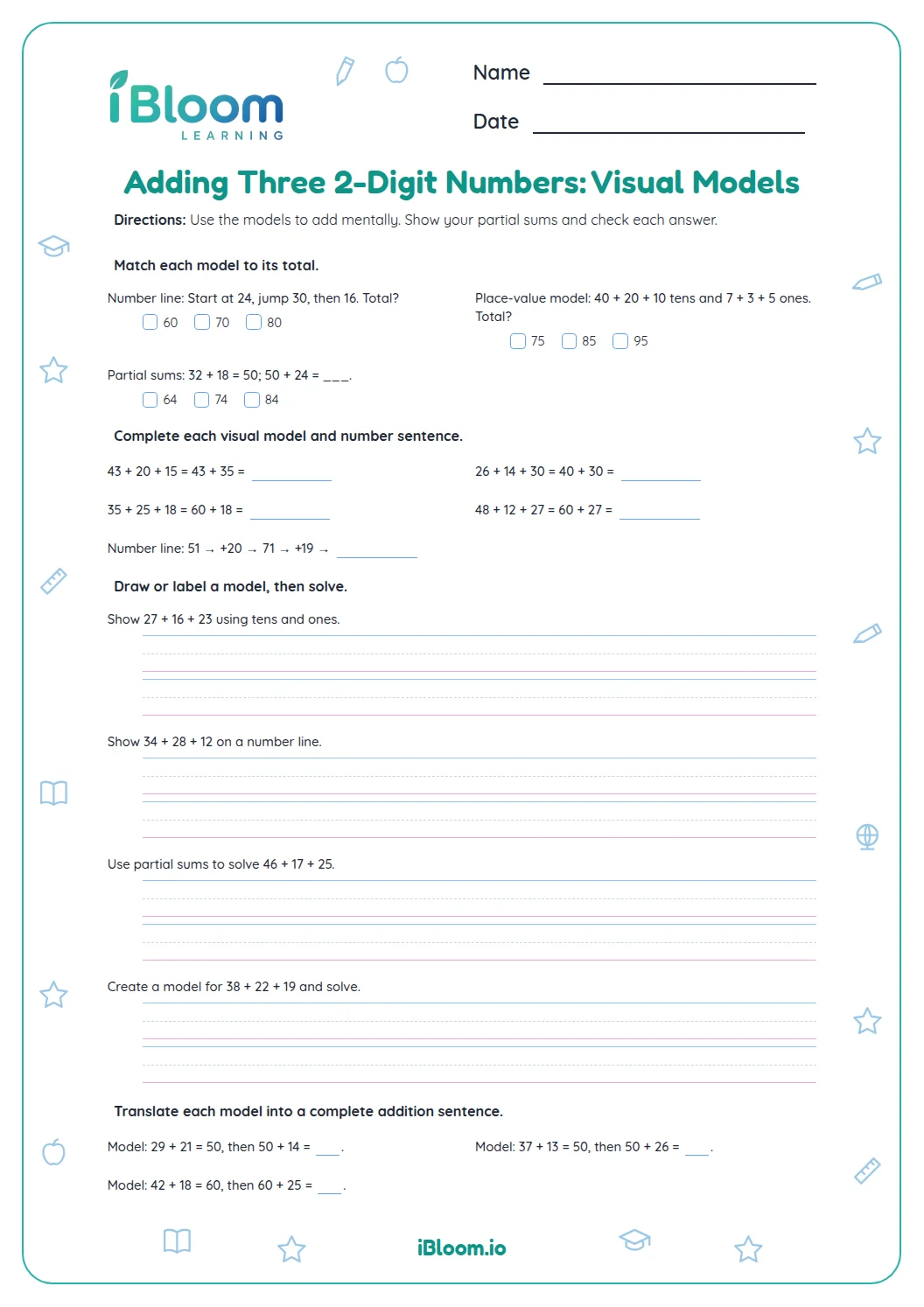
This Grade 4 printable builds a mental approach to adding two-digit numbers. Learners first split addends into tens and ones, then practice making a friendly ten, and finally choose a strategy in short situations. The sums stay below 100, so attention can stay on the mental strategy. A separate answer key is included.
Aligned to 2.NBT.B.5
How can children add two-digit numbers mentally?
Two-digit sums can be worked out mentally by keeping tens and ones organized. For 38 + 24, add 20 to 38, then add 4: 58 + 4 = 62.
Another route is to move a few ones to make a friendly ten. In 46 + 37, use 4 from 37 to make 46 into 50, then add the remaining 33.
- 138 + 20 = 58
- 258 + 4 = 62
- 3So, 38 + 24 = 62
What does each part practice?
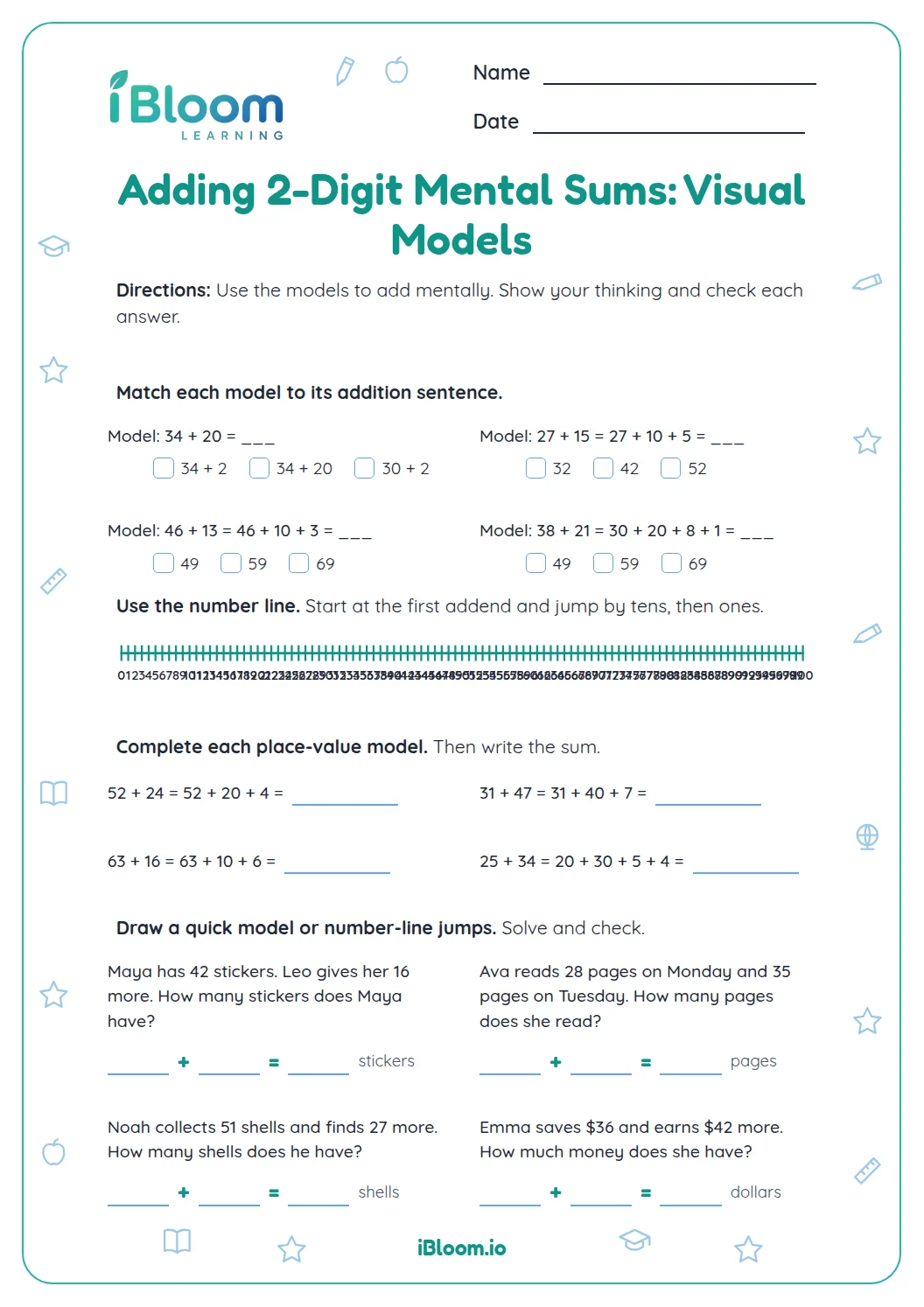
The 16 questions move from a named strategy to choosing one independently. The story problems keep the same two-digit addition focus and ask learners to record a number sentence.
- Part A: Break apart and add — add tens, then ones.
- Part B: Bridge to the next ten — regroup ones mentally to reach a multiple of ten.
- Part C: Choose a mental strategy — solve sums without a strategy label.
- Part D: Use addition in context — model each story with an equation and find the total.
How can a learner check a mental sum?
Estimate by rounding each addend to the nearest ten, then compare the estimate with the exact answer. A result far away from the estimate may signal a missed ten or an added digit. A second check is to reverse the partial steps and confirm that all tens and ones were included.
Work through the page
- 1For Part A, say the tens and ones aloud and write the two partial sums if useful.
- 2In Part B, identify how many ones are needed to reach the next ten.
- 3For Part C, pick a method that feels efficient and record only enough work to explain it.
- 4For each story, underline the two quantities, write an addition equation, and solve.
- 5Use the key to check each result; revisit any sum that differs by ten or more.
Common mental-math errors
The mistake
Adding only the tens and forgetting the ones.
The fix
After the tens subtotal, point back to the ones in the split addend and add them too.
The mistake
Moving some ones to make a ten but not subtracting those same ones from the other addend.
The fix
Keep the total unchanged: whatever is added to one number must be taken from the other.
The mistake
Reading a story’s two amounts as a difference instead of a total.
The fix
Ask whether the story joins two groups or describes a change; these four prompts ask for a combined amount.
Common Core alignment
This page practices mental addition strategies for two-digit numbers.
Fluently add and subtract within 100 using strategies.
On this sheet: Learners split addends by place value, bridge to a friendly ten, and use addition strategies to find sums within 100.
Show the official wordingHide the official wording
Fluently add and subtract within 100 using strategies based on place value, properties of operations, and/or the relationship between addition and subtraction.
What to practice next
Make more practice
Questions parents and teachers ask
What does mental addition mean on this page?
Mental addition means using place value and number relationships to find a sum without relying on a written column algorithm. Learners may still jot down partial sums or a number sentence to explain their thinking. The page practices two-digit sums below 100 and short situations using the same strategy.
How can I split a two-digit addend?
Break one addend into tens and ones, then add in two steps. For 38 + 24, add 38 + 20 to get 58, then add 4 to get 62. This keeps the place values clear and gives a learner a quick way to check that both parts of 24 were included.
What is a friendly ten strategy?
Make a multiple of ten first, then add what remains. For 46 + 37, move 4 from 37 to 46: 46 + 4 = 50. The remaining 33 makes 50 + 33 = 83. The total stays the same because the four moved to one addend are taken from the other.
How do the story problems use mental addition?
Each story gives two amounts that belong in one total, so learners can choose a mental addition strategy and write an equation. They should identify both quantities, decide that the groups are being joined, and calculate the sum. The unit word in the story helps them label what the answer represents.
Is an answer key included with this worksheet?
Yes. A separate answer key page lists the 12 sums and answers to all four story problems. Learners can first estimate or explain a strategy, then use the key to check results. If a sum is off by ten, revisit the tens; if it is off by a few, recheck the ones.