

About this worksheet
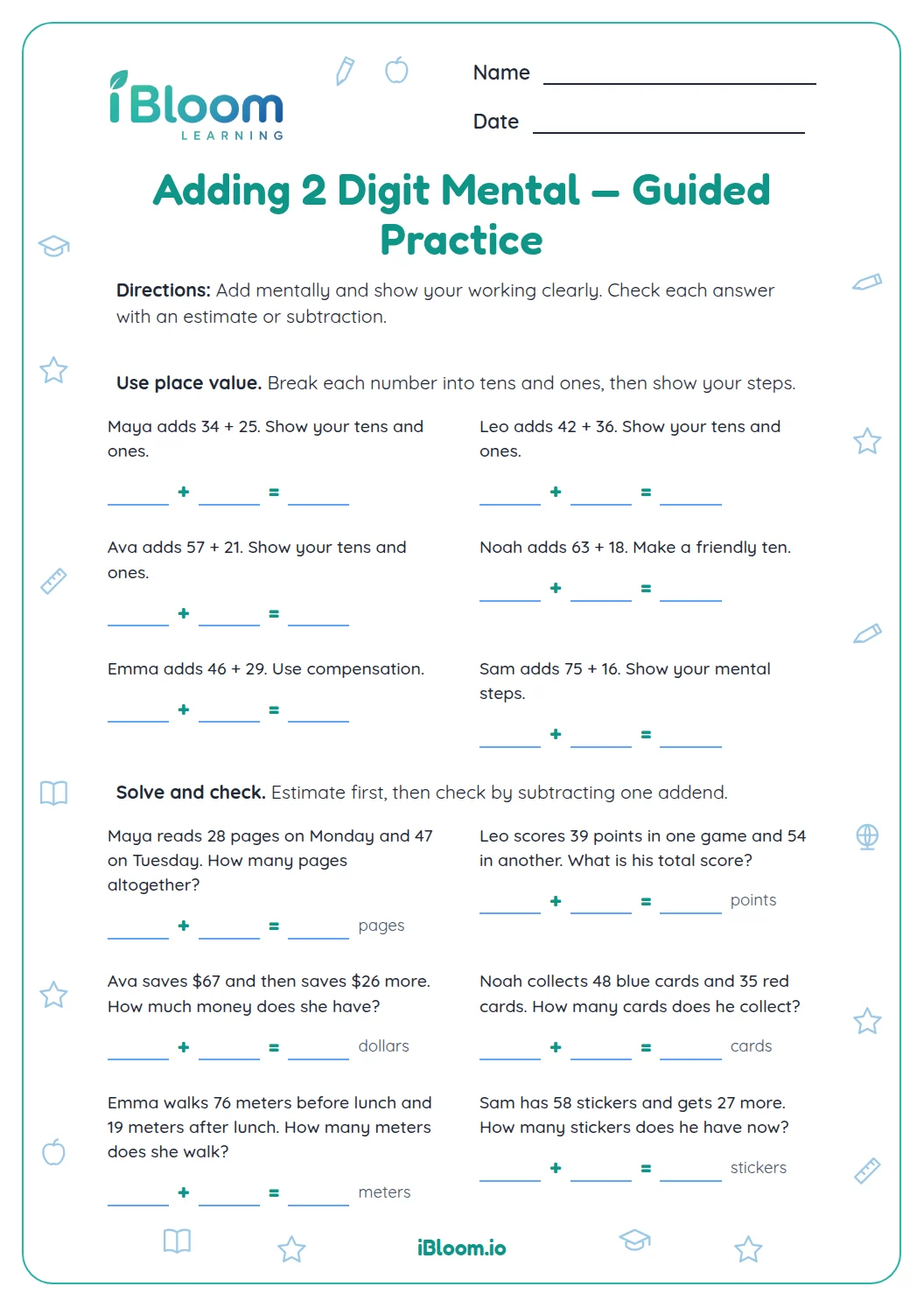
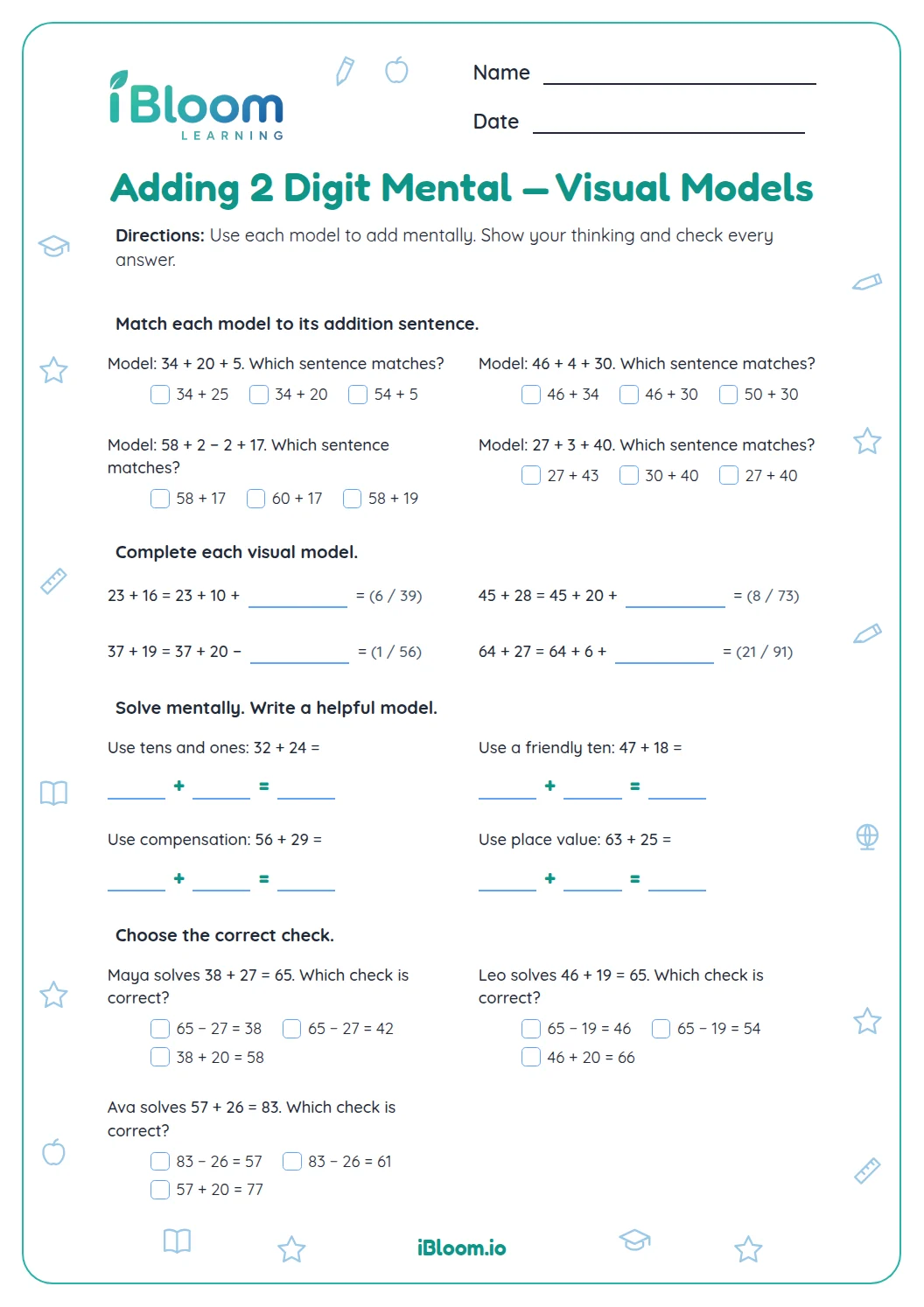
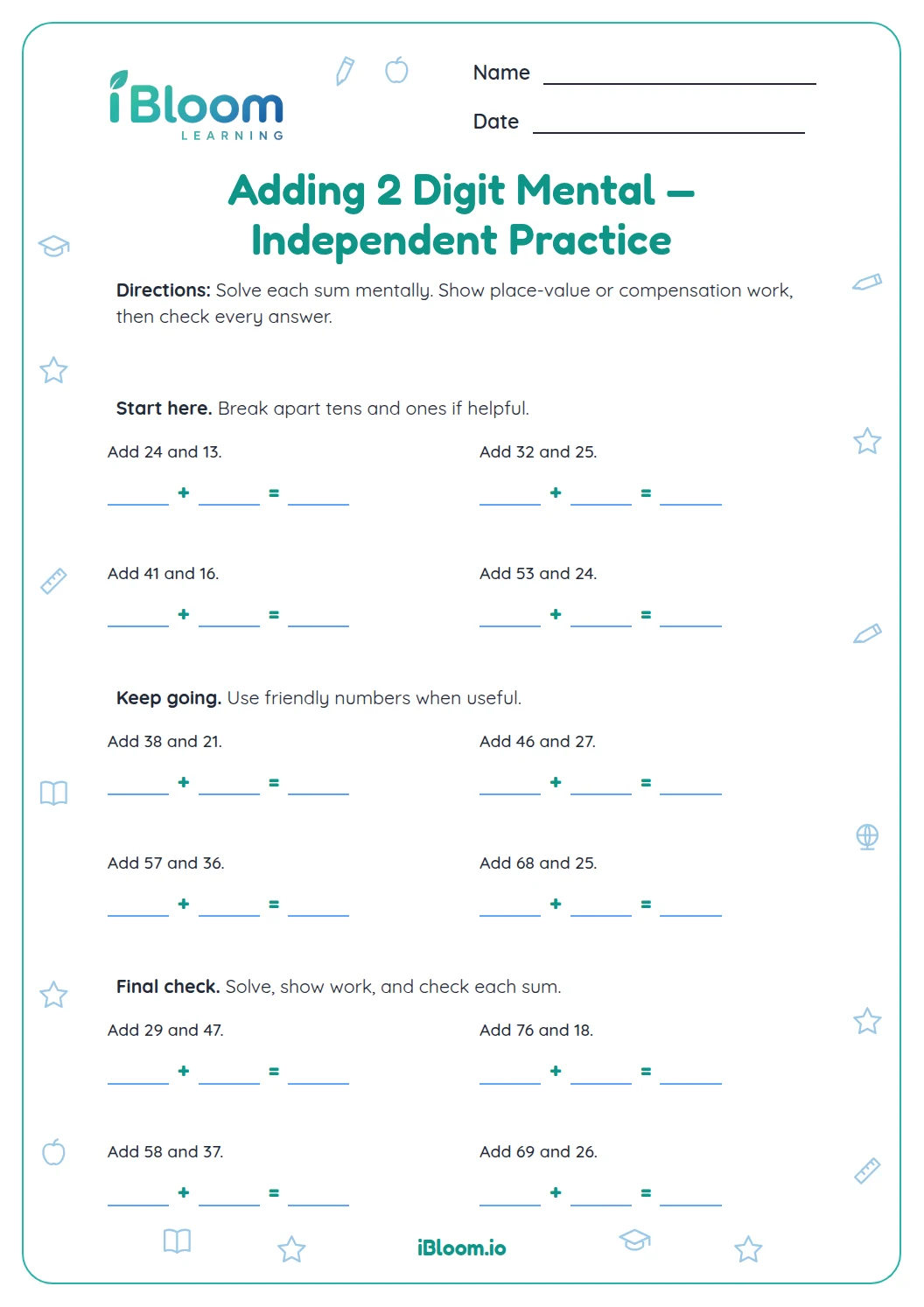
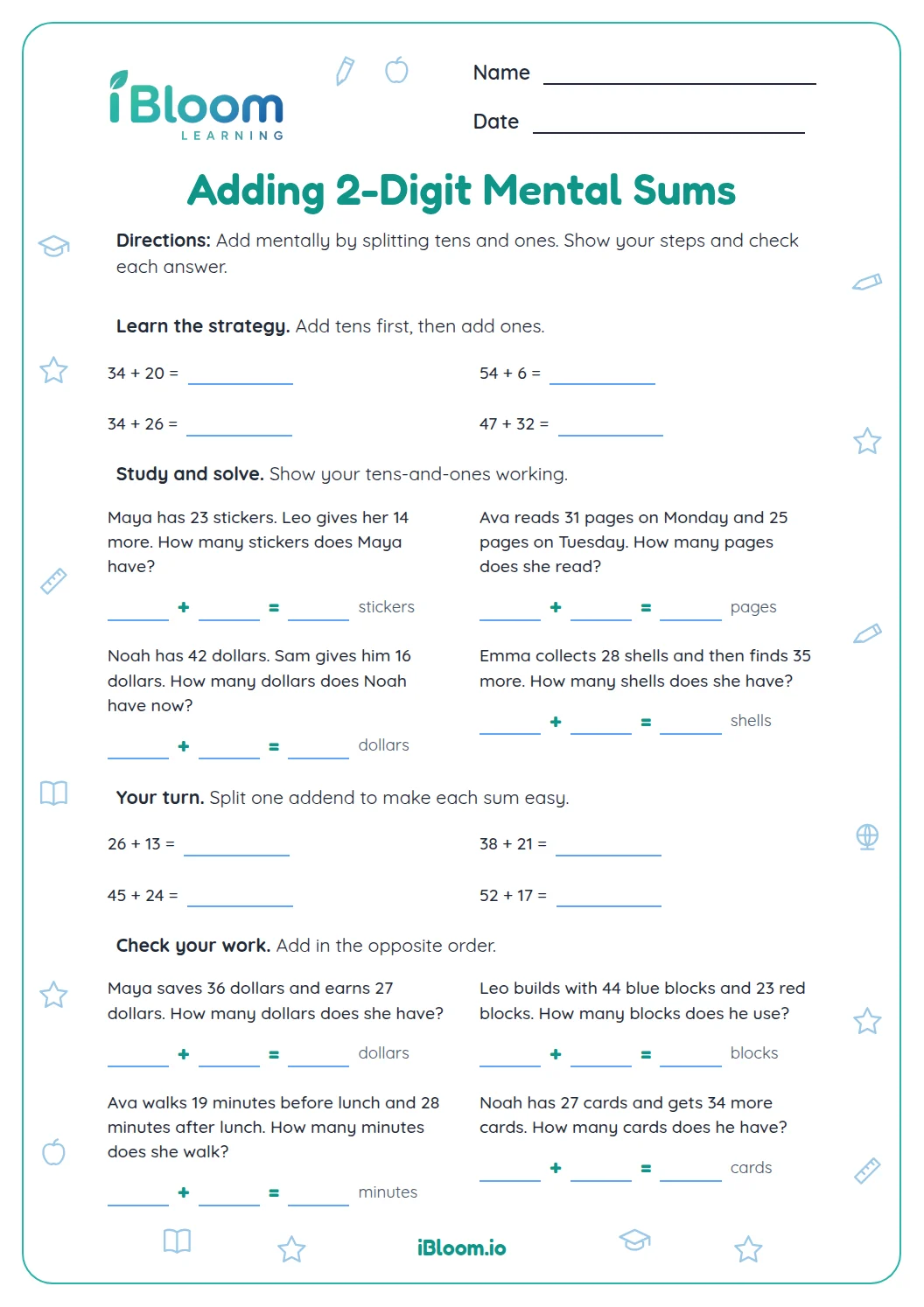
This printable practices two-digit mental addition through eight concise everyday stories and six compact calculations. Students combine two or three two-digit quantities, including multi-step totals, and keep story units with their answers. Several totals pass 100, so children can use friendly tens and partial sums. The answer key supports checking each result. The addition strategies align with CCSS 3.NBT.A.2.
Aligned to 3.NBT.A.2
How do mental strategies help with stories?
Eight short stories and six compact mental calculations practice addition with two-digit quantities. The worked example and questions use the same skill throughout.
- 148 + 37 + 26
- 248 + 37 = 85
- 385 + 26 = 111 books
How do you keep track of a story unit?
Split an addend into tens and ones or combine friendly quantities first. Several stories combine three amounts or ask students to track a change.
How can you check a mental total?
Estimate the total before calculating, then use a second strategy or recompute one step at a time. The final six questions provide compact mental calculations.
How can you use this worksheet?
- 1Read the story and identify what each number counts.
- 2Choose a mental method: make a ten, split tens and ones, or add in stages.
- 3Write an equation to keep the calculation connected to the story.
- 4In a multi-step question, update the total after each action.
- 5Estimate and check the final number and its unit.
Common mistakes and quick fixes
The mistake
Adding tens and ones without regrouping the ones.
The fix
Combine the ones first and trade each group of ten.
The mistake
Losing track of a running total in a multi-step story.
The fix
Write each step on its own line before continuing.
The mistake
Giving a correct number with the wrong unit.
The fix
Copy the story’s unit, such as books, points, or minutes, into the answer.
Common Core alignment
Students use mental computation and equations to solve real-world quantity problems.
Use place-value strategies to add multi-digit whole numbers within 1,000.
On this sheet: The questions add two-digit quantities or add 2 to three-digit numbers using mental place-value strategies.
Show the official wordingHide the official wording
Fluently add and subtract within 1000 using strategies and algorithms based on place value, properties of operations, and/or the relationship between addition and subtraction.
What to practice next
Make more practice
Further reading
Questions parents and teachers ask
How can a student add mentally in a story?
Break one addend into tens and ones, or add friendly quantities first. In question 1, combine 48 and 37 to make 85, then add 26 for 111 books. Keep the unit from the story with the total. Use its question number to find the matching entry in the separate answer key.
Why are there two-digit quantities?
Every story uses two-digit amounts so students can practice mental addition strategies such as making a ten or adding tens and ones. Some problems combine three amounts or continue with another step, so totals may be greater than 100. Use its question number to find the matching entry in the separate answer key.
How many problems are on the page?
The sheet contains 14 questions: eight short real-world stories and six compact mental calculations. Students can work through the stories first, then use the final number sentences for a quick check of the same addition strategies. Use its question number to find the matching entry in the separate answer key.
How should money answers be written?
Include the dollar sign when the story asks about money. For example, Ava has $36, earns $48, and gets $27 more, so the total is $111. The key keeps the same unit and money format as the question. Use its question number to find the matching entry in the separate answer key.
How can a student check a multi-step total?
These stories practice addition of whole-number quantities using mental place-value strategies. Some totals pass 100, so the page cites CCSS 3.NBT.A.2, which addresses addition and subtraction within 1,000. The official standard wording appears with the curriculum details. Use its question number to find the matching entry in the separate answer key.