

About this worksheet
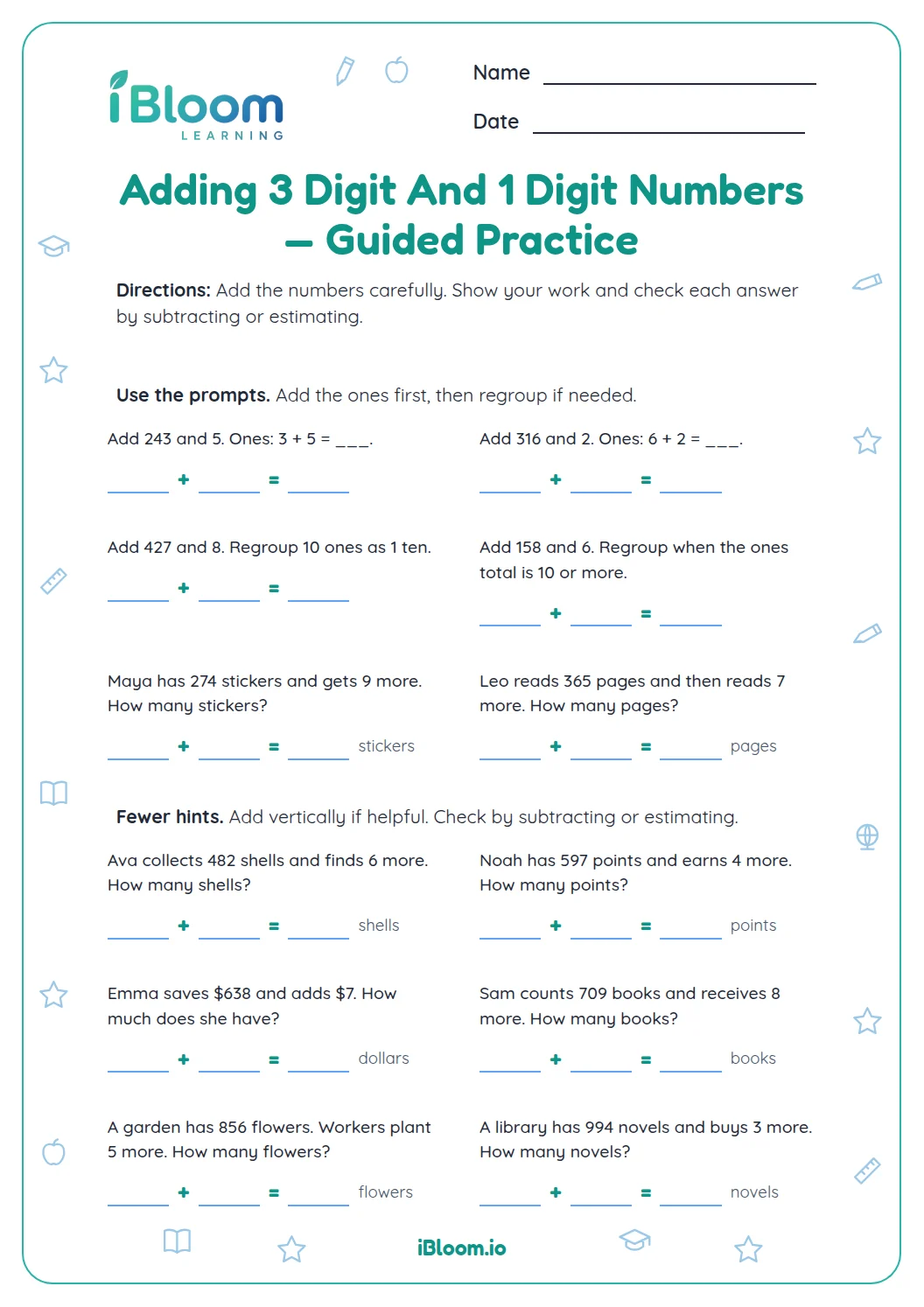
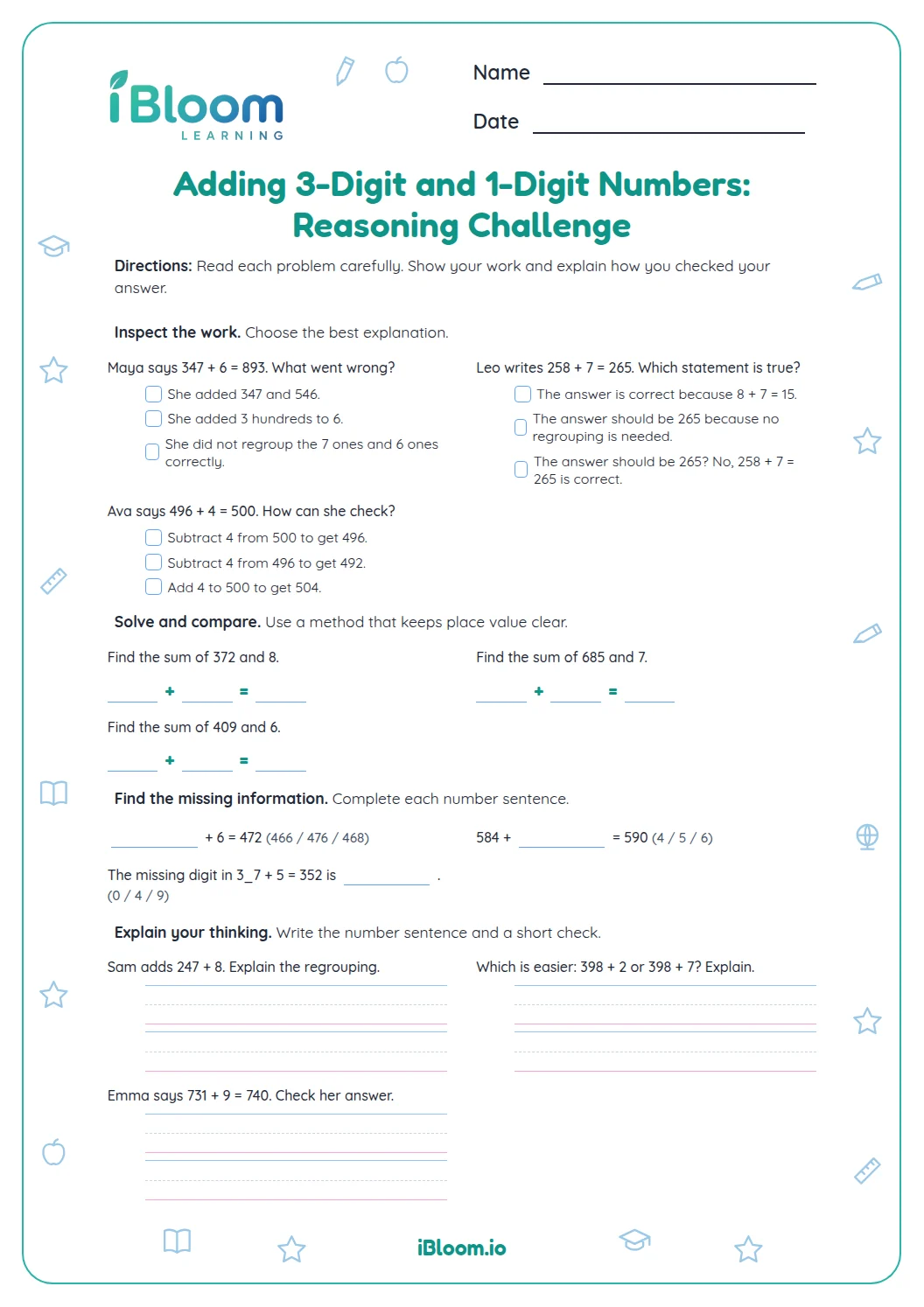
This free addition worksheet gives Grade 4 students twelve sums that pair a three-digit number with a one-digit number. Two base-ten drawings show regrouping into a ten or a hundred, two number lines support counting across a ten, and six expanded-form equations make the place values explicit. Two word problems ask students to write and check an addition equation. The practice develops addition within 1,000 using place-value strategies, as described in CCSS 3.NBT.A.2. A separate answer key records every total.
Aligned to 3.NBT.A.2
How do children read the base-ten drawings?
A large flat represents 100, a long rod represents 10, and a small cube represents 1. The model above each Part A sum shows its three-digit starting number. The one-digit addend tells how many new ones to join.
Students can sketch extra cubes beside the model and circle ten ones for an exchange. Question 1, 326 + 4, makes exactly one new ten. Question 2, 596 + 4, needs a second exchange: ten tens become one hundred.
What happens when the ones reach ten?
Ten ones have the same value as one ten. Exchanging them changes how the quantity is grouped, while keeping its total value. When the tens also reach ten, exchange those tens for one hundred.
- 1Question 2: 596 + 4 = ___
- 26 ones + 4 ones = 10 ones = 1 ten.
- 39 tens + 1 ten = 10 tens = 1 hundred.
- 45 hundreds + 1 hundred = 600.
How do number lines connect to expanded form?
Each tick is one unit. For 367 + 8, start at 367 and mark eight jumps to the right. After three jumps, the line reaches 370; five jumps remain, giving 375.
Part C writes the starting number as hundreds, tens, and ones. For 398 + 5, combine 8 + 5 to make 13 ones. Regroup those as one ten and three ones; the new ten joins nine tens to make a hundred. The result is 403. In Part D, students choose an addition equation for each story and check it with expanded form.
How to use this worksheet
- 1Name the value of each kind of block before starting Part A.
- 2Read the first addend from the blocks and join the extra ones.
- 3Exchange ten ones for a ten; exchange ten tens for a hundred when necessary.
- 4Mark unit jumps on each Part B number line, counting moves rather than ticks.
- 5Complete the expanded-form sums in Part C, then write and check equations for the two Part D stories.
Mistakes to notice and fix
The mistake
Treating a hundred flat as one because it is one drawn object.
The fix
Name the value of the piece before counting: 100, 10, or 1.
The mistake
Writing 326 + 4 as 3210.
The fix
Exchange the ten ones for a ten and leave zero ones: 330.
The mistake
Counting the starting tick as the first added one.
The fix
Place the pencil at the start; count one only after the first jump.
Common Core alignment
Add within 1,000 by joining ones and regrouping with place-value strategies.
On this sheet: Block models, number lines, expanded-form sums, and word problems connect addition to tens and hundreds.
Show the official wordingHide the official wording
Fluently add and subtract within 1000 using strategies and algorithms based on place value, properties of operations, and/or the relationship between addition and subtraction.
What to practice next
Make more practice
Further reading
Questions parents and teachers ask
Which numbers do the two block drawings represent?
The drawings represent 326 and 596; students add four ones to each. In the first model, ten ones become one ten. In the second, the new ten also makes ten tens, which become one hundred. Comparing the two models makes each exchange visible.
Why does 596 + 4 equal 600?
Six ones and four ones combine to make ten ones, which become one ten. That new ten joins the nine tens already in 596. Ten tens become one hundred, joining the five hundreds. The final total has six hundreds, zero tens, and zero ones.
Should children draw their own blocks?
Children can add small cubes and exchange marks beside the printed blocks if that helps them reason. The two starting models are already provided. Part C gives six expanded-form sums; Part D provides working space for an addition equation and an expanded-form check for each story.
How should a child use the number lines?
Start at the left endpoint and count one move to the right for each added one. The first number line begins at 367, so eight moves end at 375. Marking each jump helps distinguish the starting tick from the first move and makes crossing 370 visible.
What is included in the answer key?
The answer key gives all twelve totals beside the same questions and models, with units for the word problems. Use it after students attempt the calculations. When an answer differs, revisit the blocks, jumps, or expanded form and ask the student to explain each regrouping.