

About this worksheet
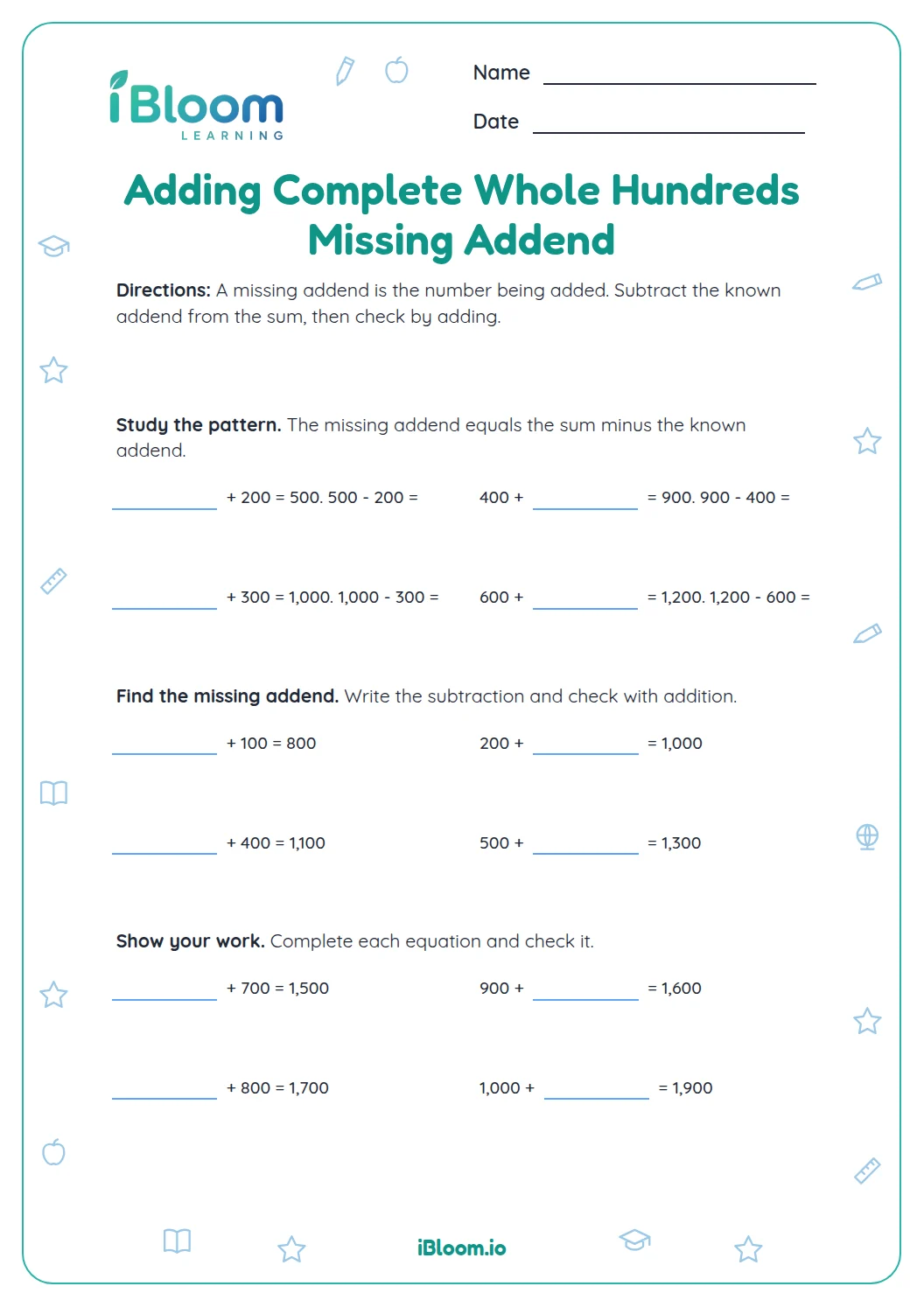
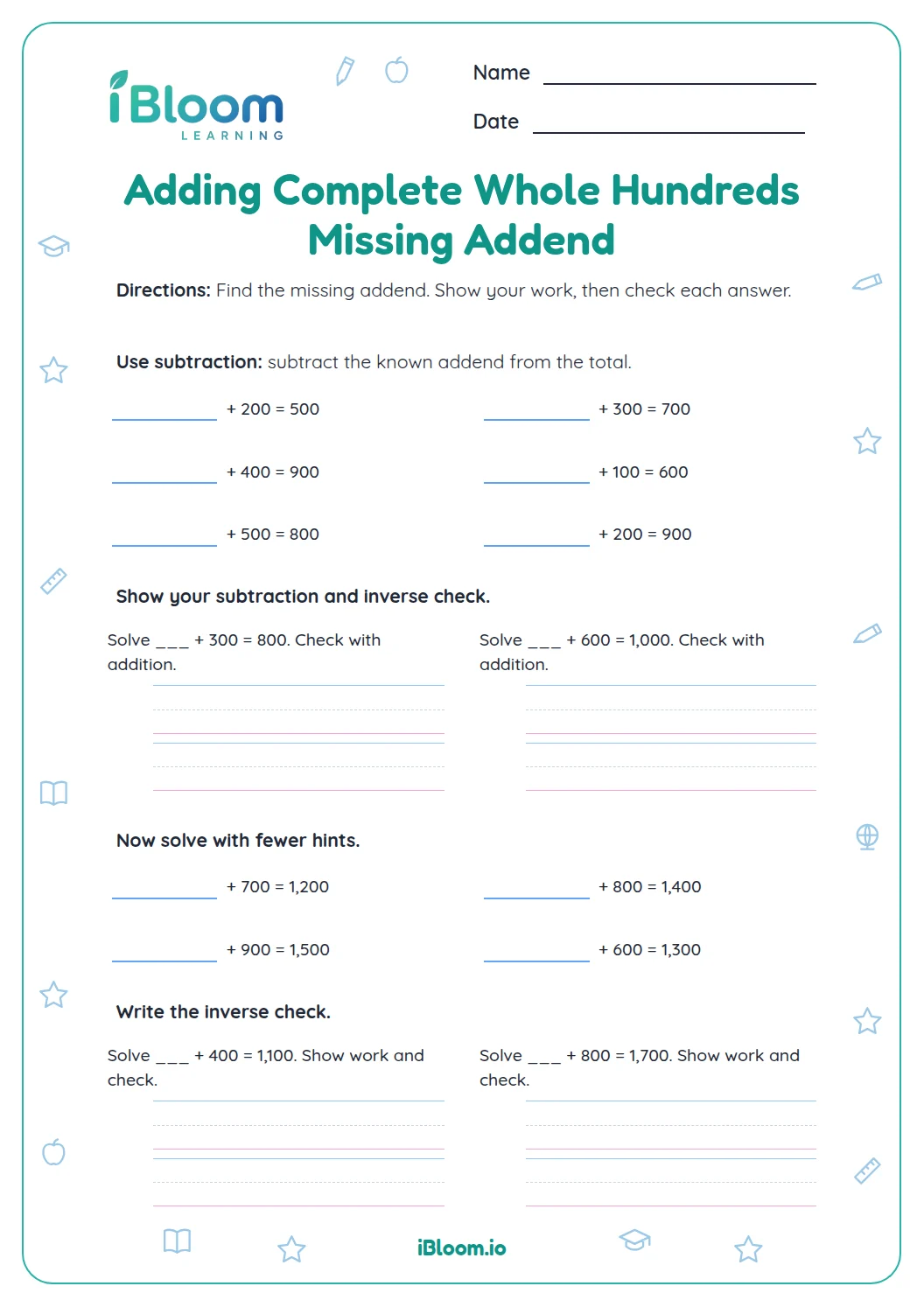
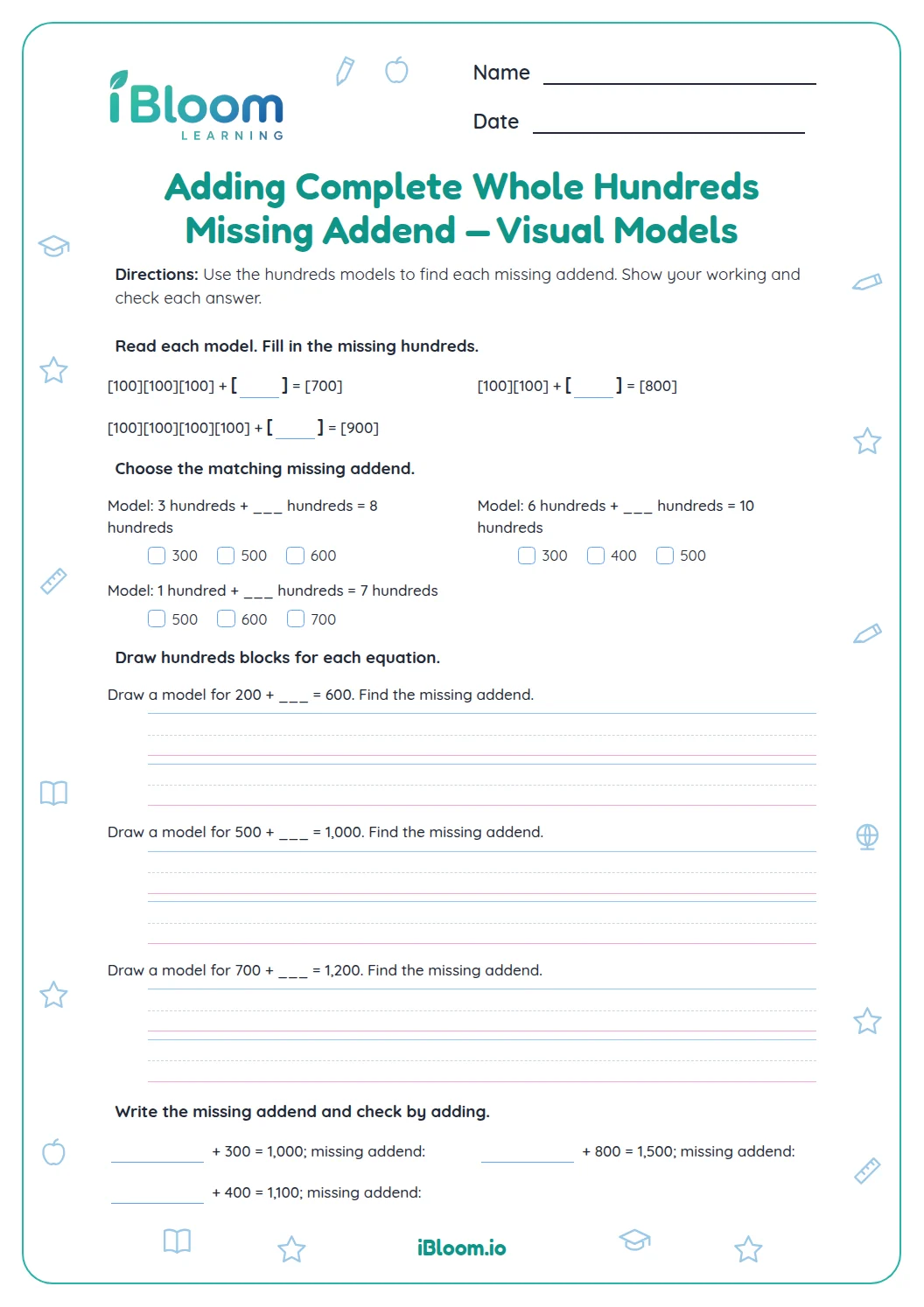
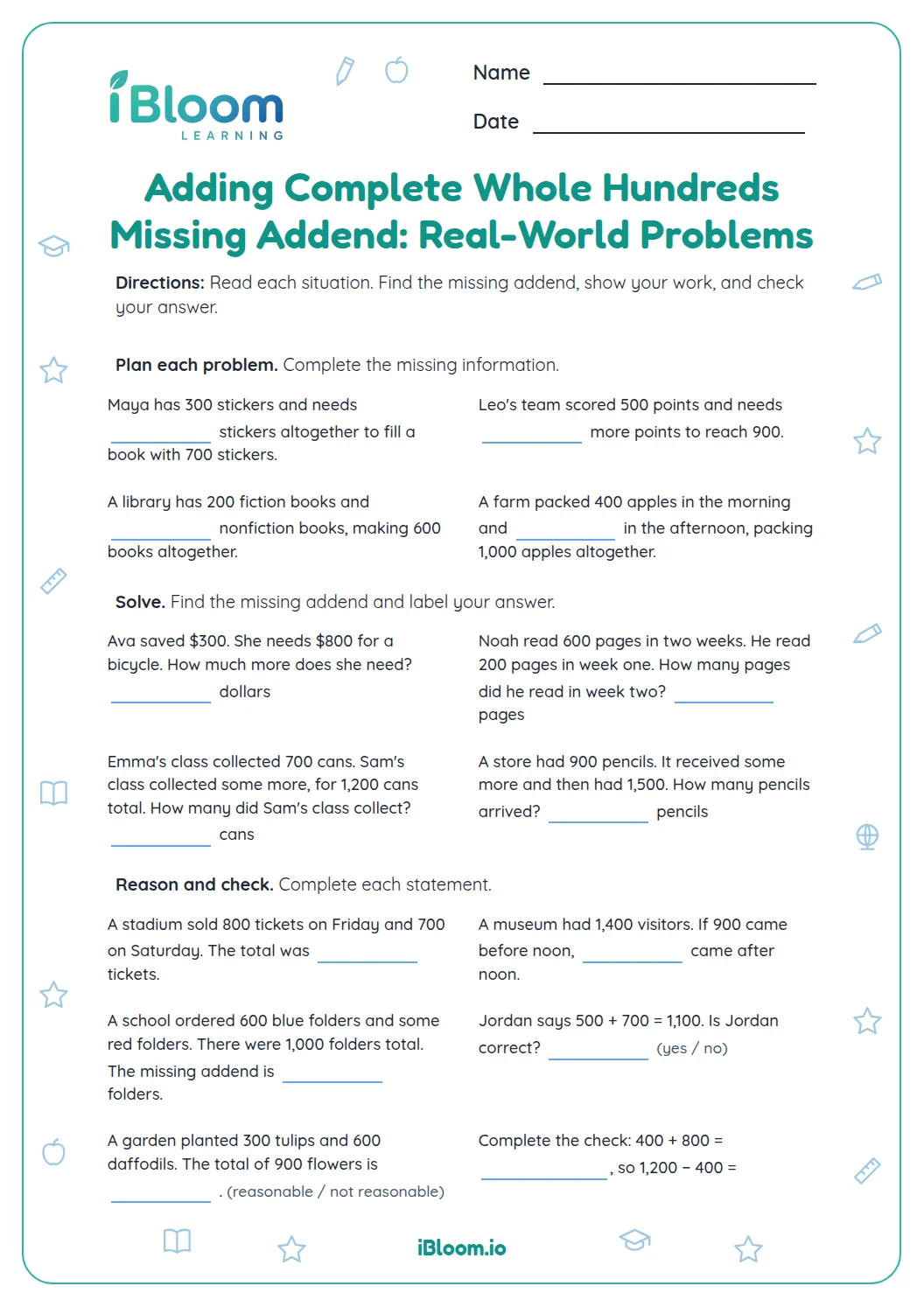
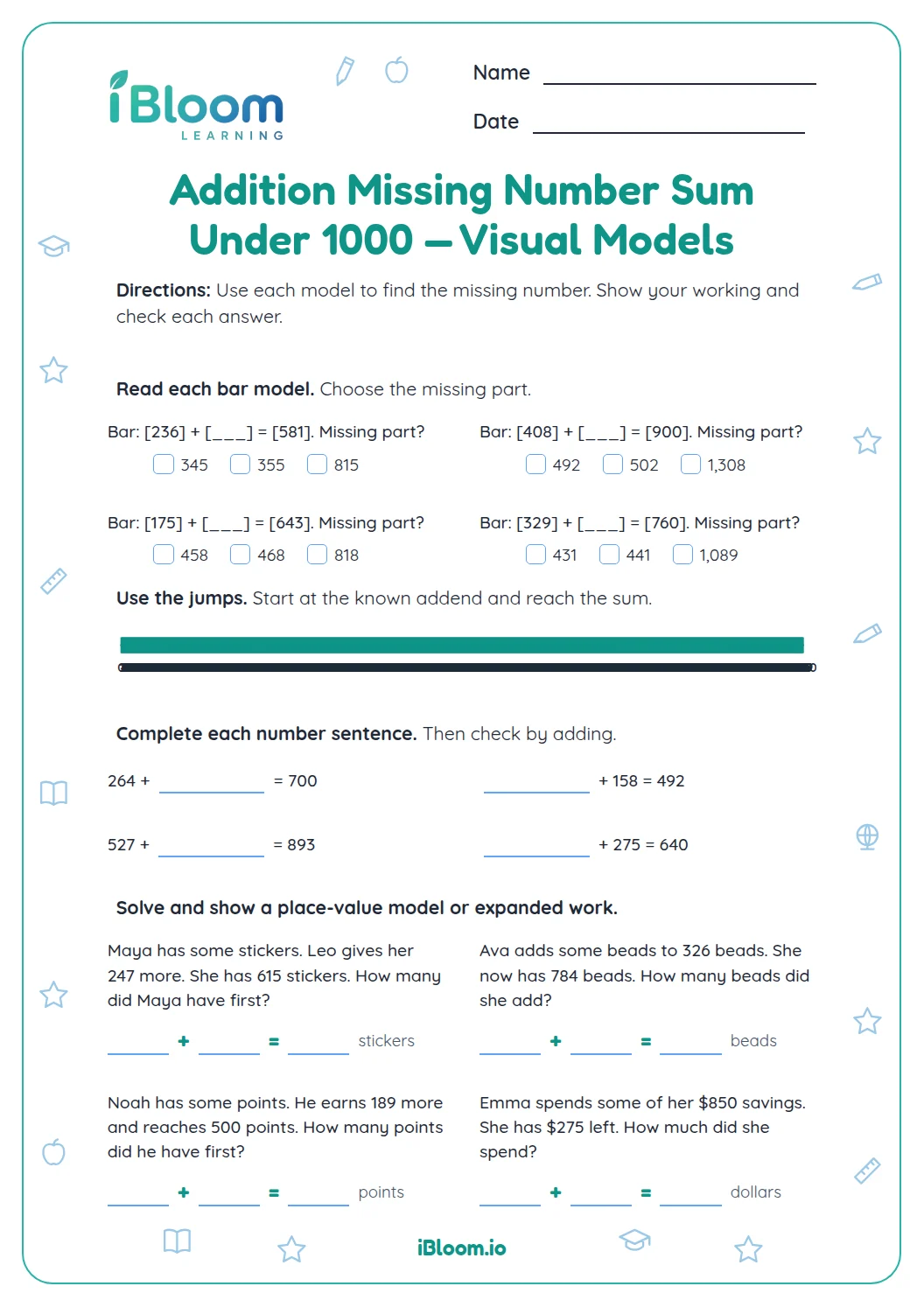
This Grade 4 independent-practice worksheet asks children to find a missing whole-hundred addend in multi-digit sums. The first equations use three- and four-digit amounts, then the page advances to larger totals and four short story problems. Children can subtract the known addend from the total or use an addition strategy to check the missing amount. The skill supports fluency with multi-digit whole-number addition and subtraction, aligned with Common Core 4.NBT.B.4. A separate answer key lists each missing addend.
Aligned to 4.NBT.B.4
What makes an addend a whole hundred?
A whole-hundred addend is a multiple of 100, such as 700 or 1,400. In each equation, the missing value has that form, even when the known addend includes tens and ones.
How can children check a missing amount?
Subtract the known addend from the total to find the unknown. Then add the known amount and the result to confirm that the sum reaches the printed total.
What is one worked example?
Question 1 is 438 + ___ = 1,038. Subtract 438 from 1,038 to get 600. Check: 438 + 600 = 1,038, so the missing addend is 600.
How to use this worksheet at home or in class
- 1Read the total and the known addend carefully.
- 2Subtract the known addend from the total to find the unknown.
- 3Check that the difference is a complete hundred.
- 4Add the missing value back to the known addend.
- 5For a story, identify the known amount and the total before writing an equation.
Common mistakes and quick fixes
The mistake
Subtracting the total from the known addend.
The fix
Begin with the total and subtract the amount already shown.
The mistake
Dropping a zero from the missing hundreds.
The fix
Use place-value columns or expand the hundreds before writing the answer.
The mistake
Writing the known amount instead of the difference.
The fix
Check by adding your answer to the known addend; it must equal the total.
Common Core alignment
The page practices multi-digit whole-number addition and subtraction to find unknown addends.
Add multi-digit whole numbers and use place value to find each missing addend.
On this sheet: Each unknown is a whole-hundred addend in a multi-digit addition equation; the story problems use the same operation.
Show the official wordingHide the official wording
Fluently add and subtract multi-digit whole numbers using the standard algorithm.
What to practice next
Make more practice
Further reading
Questions parents and teachers ask
What is a missing addend?
A missing addend is the unknown amount being added to a known amount to make a total. For example, in 438 + ___ = 1,038, subtract 438 from 1,038 to find 600. Add 600 back to 438 to check that the total is correct.
Are all the missing values whole hundreds?
Yes. Each missing value is a multiple of 100, such as 600, 1,200, or 1,500. The known addend can include tens and ones, so children still need to work carefully with multi-digit numbers when finding the difference. They can check by adding the difference back.
How many questions are included?
There are 16 questions: twelve equations and four story problems. The equations progress from three-digit amounts to larger multi-digit amounts. Each story describes a known part and a total, so the child can write a missing-addend equation and solve it.
How can my child check each answer?
Add the proposed missing amount to the known addend. The result must match the total in the equation or story. This check catches a subtraction error or a misplaced zero before the worksheet is finished, and helps connect subtraction with addition as inverse operations.
Does the answer key show the story-problem answers?
Yes. The separate key lists the missing amount for each equation and each story. For a story, the amount represents the missing room’s books, additional visitors, cans still needed, or planned ticket sales, depending on the question. The equation answers are grouped in the same order as the worksheet.