

About this worksheet
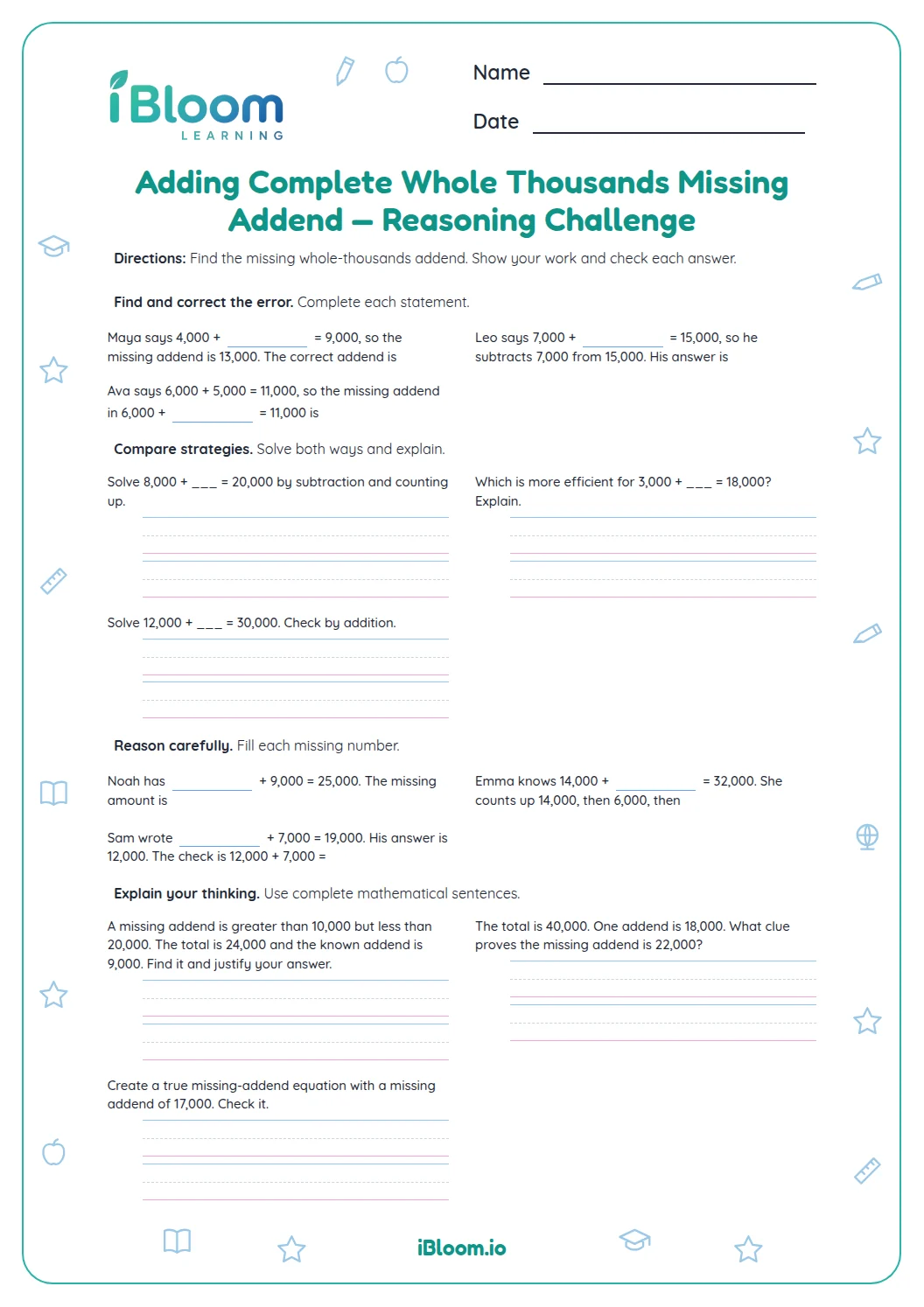
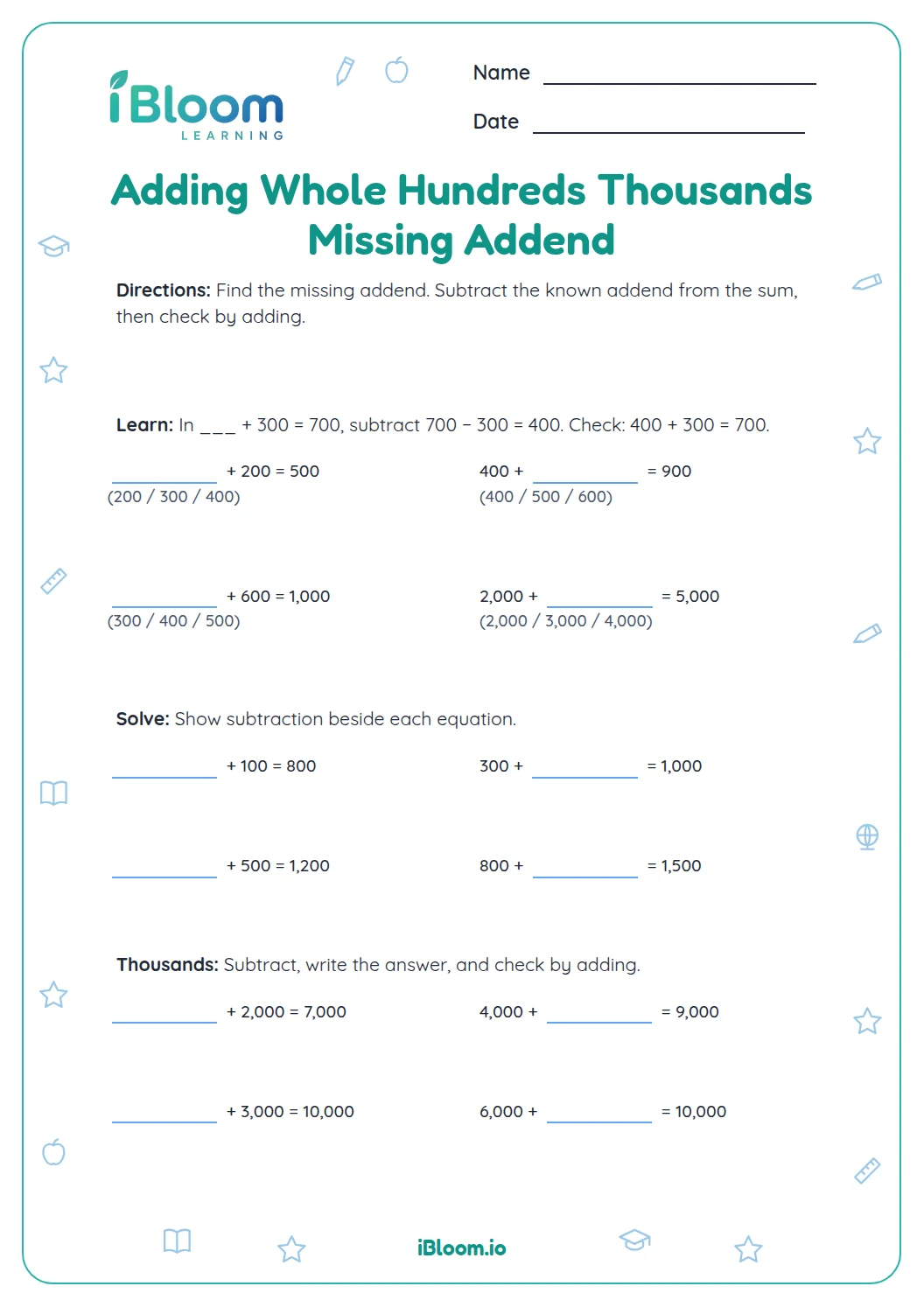
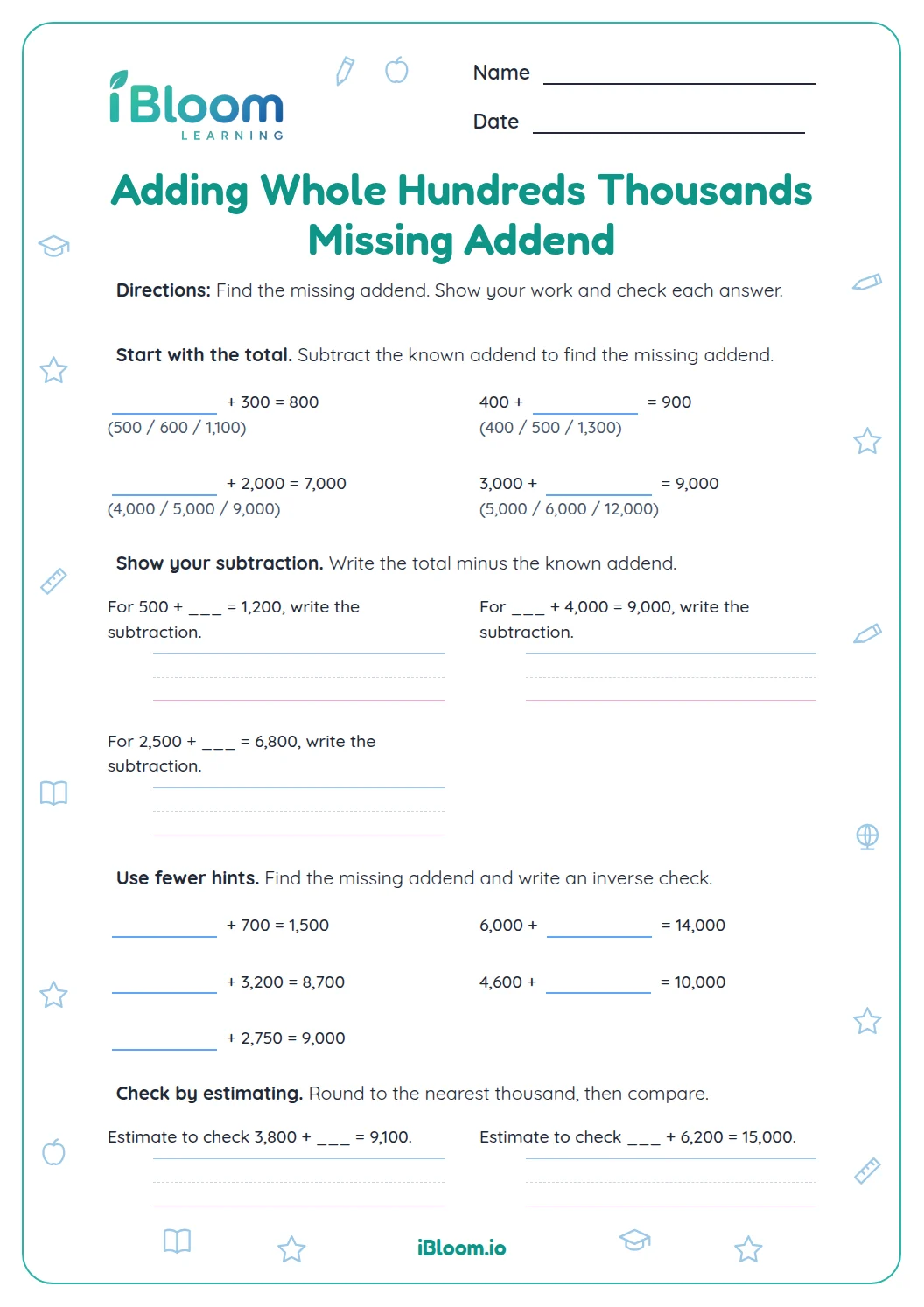
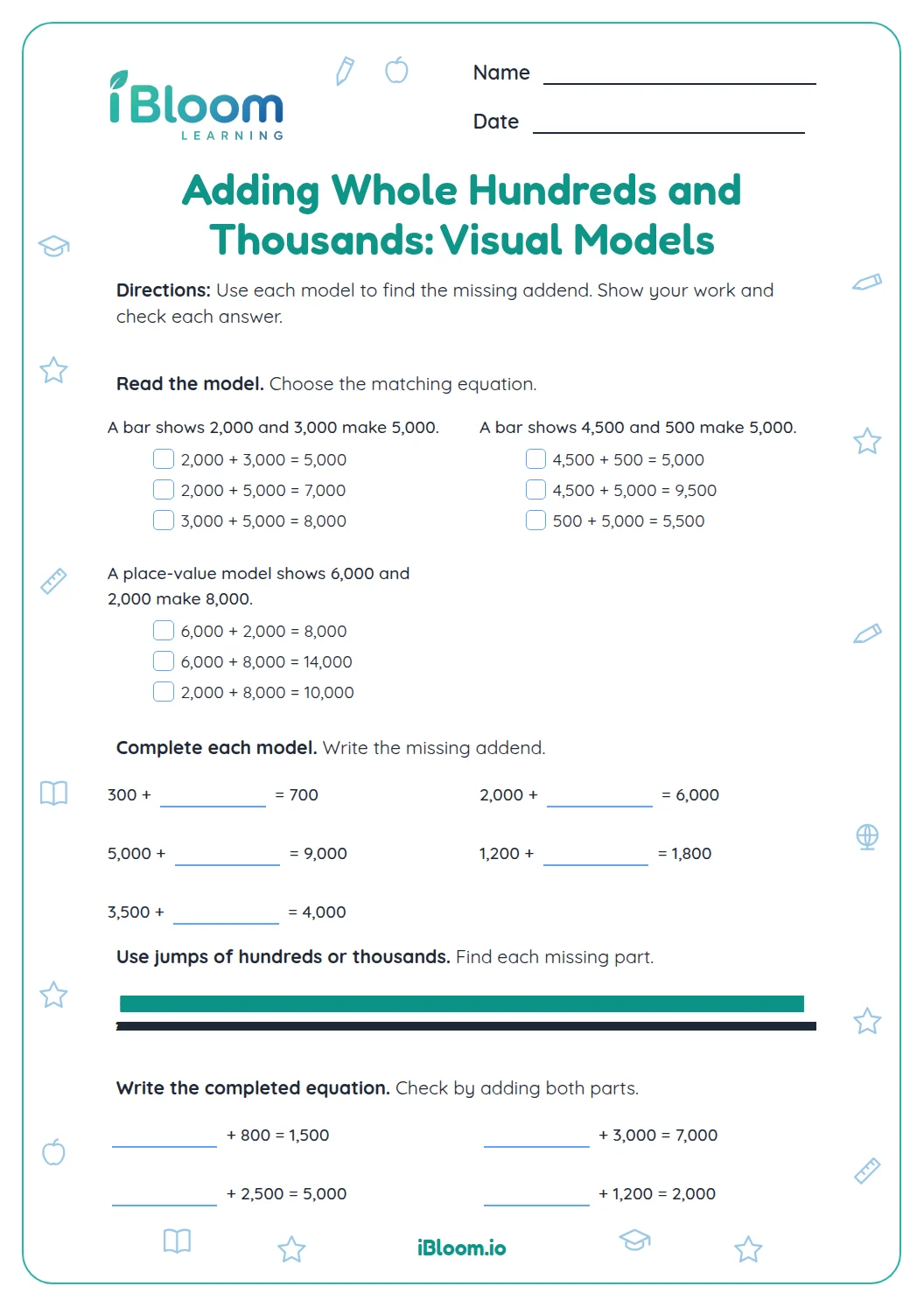
This Grade 4 sheet gives 16 whole-thousand missing-addend equations in three parts. Students use subtraction to find the unknown part, then use addition to check that both parts make the stated total. The answer key shows all 16 answers.
Aligned to 4.NBT.B.4
What subtraction fact finds the missing part?
In Part A, solve 3,000 + ___ = 5,000 by subtracting 3,000 from 5,000. The missing addend is 2,000; adding 3,000 + 2,000 checks the total.
- The total is the whole.
- The known addend is one part.
- Subtract to find the other part.
What if the blank comes first?
Part B changes where the blank sits, but the relationship stays the same. For ___ + 5,000 = 14,000, compute 14,000 − 5,000. The unknown is 9,000.
- Locate the total after the equals sign.
- Subtract the known part.
How can addition check the answer?
Part C returns to a blank after the known addend and asks students to write a subtraction check. For 5,000 + ___ = 9,000, write 9,000 − 5,000 = 4,000, then check 5,000 + 4,000 = 9,000.
- Keep the total and known addend in the correct order.
How to use this worksheet
- 1Read the equation and identify the total.
- 2Subtract the known addend from the total.
- 3Write the missing whole thousand.
- 4Add the parts to check the total.
- 5In Part C, write the subtraction check in the work box.
Common mistakes and quick fixes
The mistake
Subtracting the total from the known addend.
The fix
Start with the total, then subtract the known part.
The mistake
Treating the blank as the total.
The fix
Use the number after the equals sign as the total.
The mistake
Stopping after subtraction.
The fix
Add the two parts to confirm the stated sum.
Curriculum alignment
This worksheet gives students practice with the named skill at the listed grade level.
Fluently add and subtract multi-digit whole numbers.
On this sheet: The missing addends are found by subtracting a known whole-thousand addend from the total.
Show the official wordingHide the official wording
Fluently add and subtract multi-digit whole numbers using the standard algorithm.
What to practice next
Make more practice
Questions parents and teachers ask
Does the blank always come after the known addend?
No. Part A places it after the known addend, while Part B places it first. In either form, the number after the equals sign is the total. Subtract the known part from that total to find the missing addend, then add both parts to check.
Why does subtraction help with addition?
Addition joins two parts to make a total. If the total and one part are known, subtracting that part leaves the other one. For example, 7,000 + ___ = 8,000 becomes 8,000 − 7,000, so the missing addend is 1,000.
What does “whole thousand” mean here?
Every number in the equations is a multiple of 1,000, such as 5,000 or 14,000. This lets students focus on the relationship between the addends and the total while practicing addition and subtraction with multi-digit whole numbers. Have the learner point to the total and known addend before subtracting.
How is the answer key useful?
The key lists a result for each of the 14 questions. Ask the learner to compare the equation with the answer and verify it by adding the two parts. In Part C, the learner can also compare the written subtraction check with the key.
What should a student check after finding the blank?
Check that the answer is a whole thousand and then add it to the known addend. For example, 3,000 + 2,000 returns the stated total of 5,000. Part C also provides space for a subtraction equation as a second check.