


About this worksheet
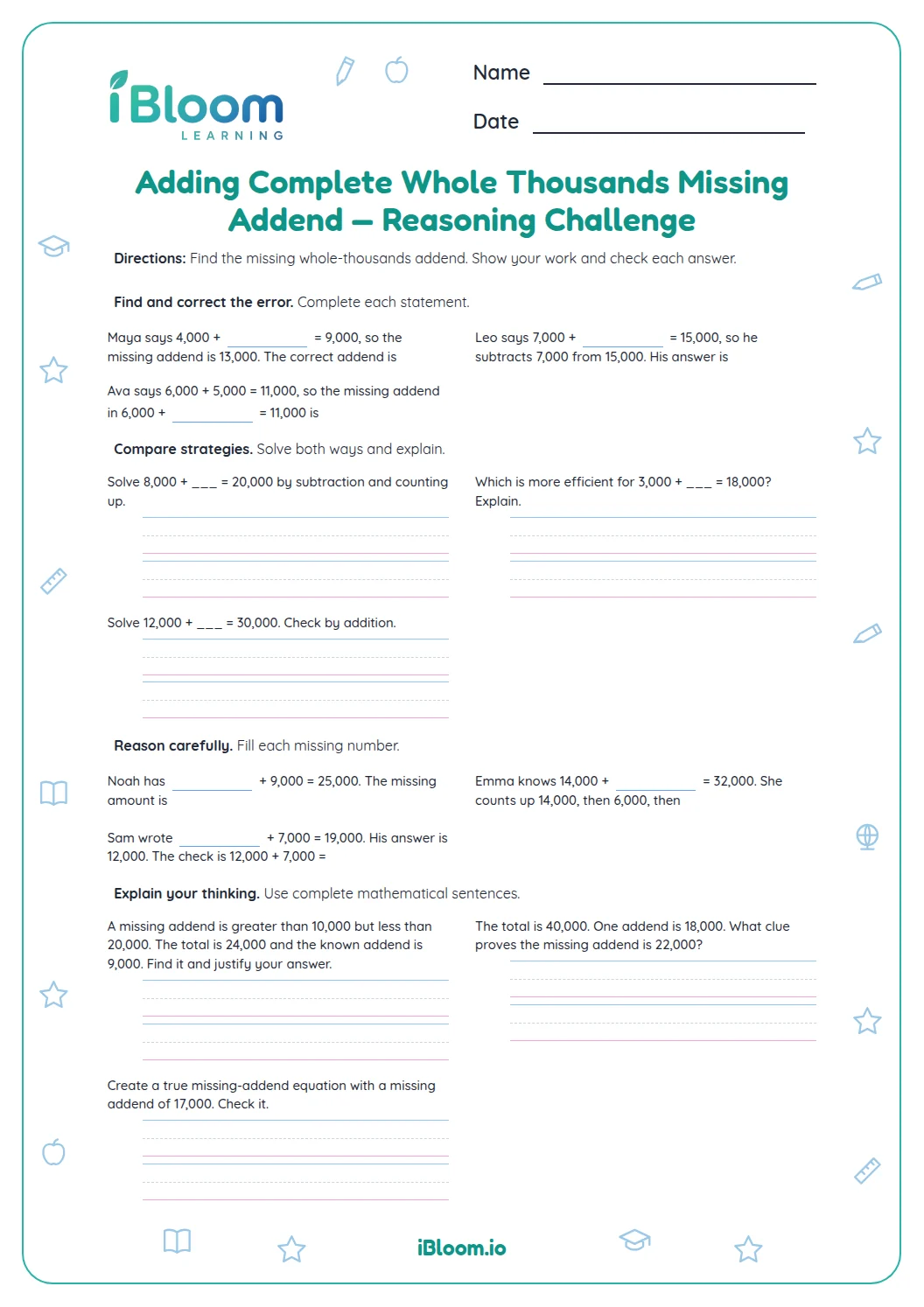
This printable Grade 4 worksheet gives 14 practice questions on finding a missing whole-thousand addend. Children solve equations with the blank in either position and tackle two short situations. It practices CCSS 4.NBT.B.4, with a separate answer key for review.
Aligned to 4.NBT.B.4
How do you find a missing addend?
A sum is the total after adding. If one addend is hidden, subtract the addend you know from the sum. The answer tells you how many thousands are missing.
For question 1, 7,000 − 2,000 = 5,000, so 2,000 + 5,000 = 7,000. Adding the two addends back checks the result.
- 12,000 + ___ = 7,000
- 27,000 − 2,000 = 5,000
- 3Check: 2,000 + 5,000 = 7,000
What kinds of sums will children solve?
The first part uses sums through 10,000. Later equations include larger totals and put the blank in either addend position. Two short situations ask children to find an unknown amount.
How can a child check an answer?
Subtract the known addend from the total, then add the result back to the known addend. Both calculations should agree with the original sum.
How to solve whole-thousand missing addends
- 1Locate the sum and the addend that is given.
- 2Subtract the known addend from the sum.
- 3Write the difference in the blank.
- 4Add both addends to check the sum.
Common mistakes and quick fixes
The mistake
Subtract the smaller visible number from the blank instead of from the sum.
The fix
Point to the equals sign and identify the total before subtracting.
The mistake
Write 5 instead of 5,000.
The fix
Keep the thousands unit in the answer.
The mistake
Change the known addend when checking.
The fix
Copy the original addend and add the found value back.
Common Core alignment
This worksheet gives children practice with the following Common Core skill.
Add multi-digit whole numbers accurately using place-value strategies.
On this sheet: Each missing-addend equation uses whole-thousand addends and sums.
Show the official wordingHide the official wording
Fluently add and subtract multi-digit whole numbers using the standard algorithm.
What to practice next
Make more practice
Further reading
Questions parents and teachers ask
How does subtraction find the missing addend?
Subtraction undoes addition. In 2,000 + ___ = 7,000, subtract the known 2,000 from 7,000; the difference, 5,000, is the missing addend. Add 2,000 and 5,000 to check that they make 7,000. Writing the subtraction sentence beside the addition sentence makes the inverse relationship visible.
What does “complete whole thousands” mean?
Each number is a multiple of 1,000, such as 4,000 or 12,000. The missing number is also a whole number of thousands. Children can think in groups of a thousand or subtract the known addend from the total. The comma-separated digits keep each amount readable while the thousands place stays clear.
Can the blank come before the plus sign?
Yes. A sum does not change when the addends switch places. For ___ + 4,000 = 9,000, subtract 4,000 from 9,000 to find 5,000. The worksheet includes blanks in both positions so children read the entire equation carefully. For example, both 5,000 + 4,000 and 4,000 + 5,000 make 9,000.
How should children solve the story questions?
First identify the total and the amount already known. Subtract the known amount from the total to find the unknown part, then state the answer in thousands. A number sentence can help keep the relationship between the quantities clear. The answer should be a multiple of one thousand, just like the amounts in the equation.
How can I use the answer key?
Have the learner complete a few questions before checking. Ask them to show one subtraction and its addition check, then use the separate key page to review results and revisit any equation where the check does not match. The key is most useful when the learner explains how one answer was checked.
What is the main idea to remember?
The two addends combine to make the sum. When one addend is missing, subtract the other addend from the sum; adding the answer back confirms it. This works whether the blank appears first or second. Ask the learner to name the sum and known addend before choosing the subtraction.