

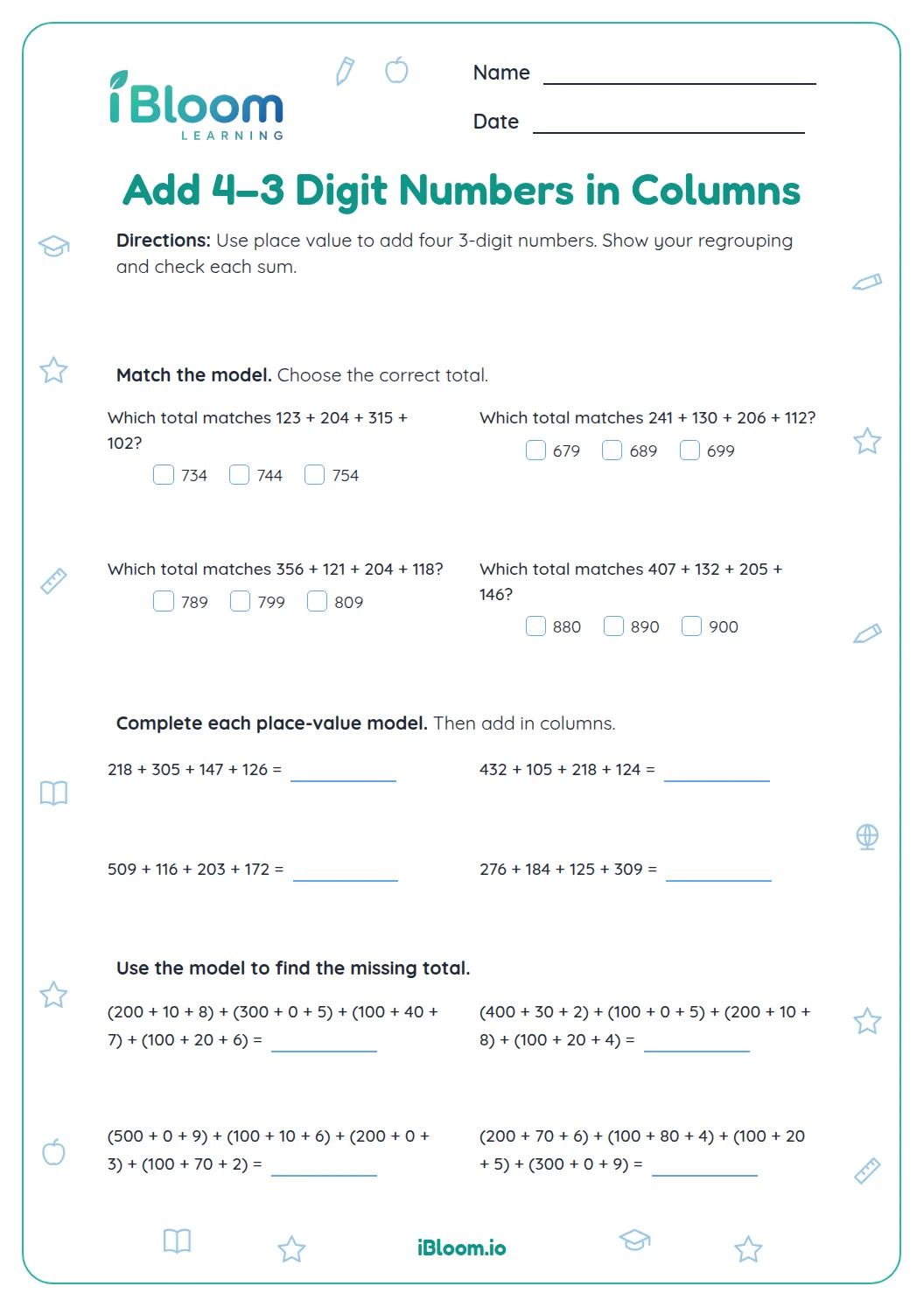
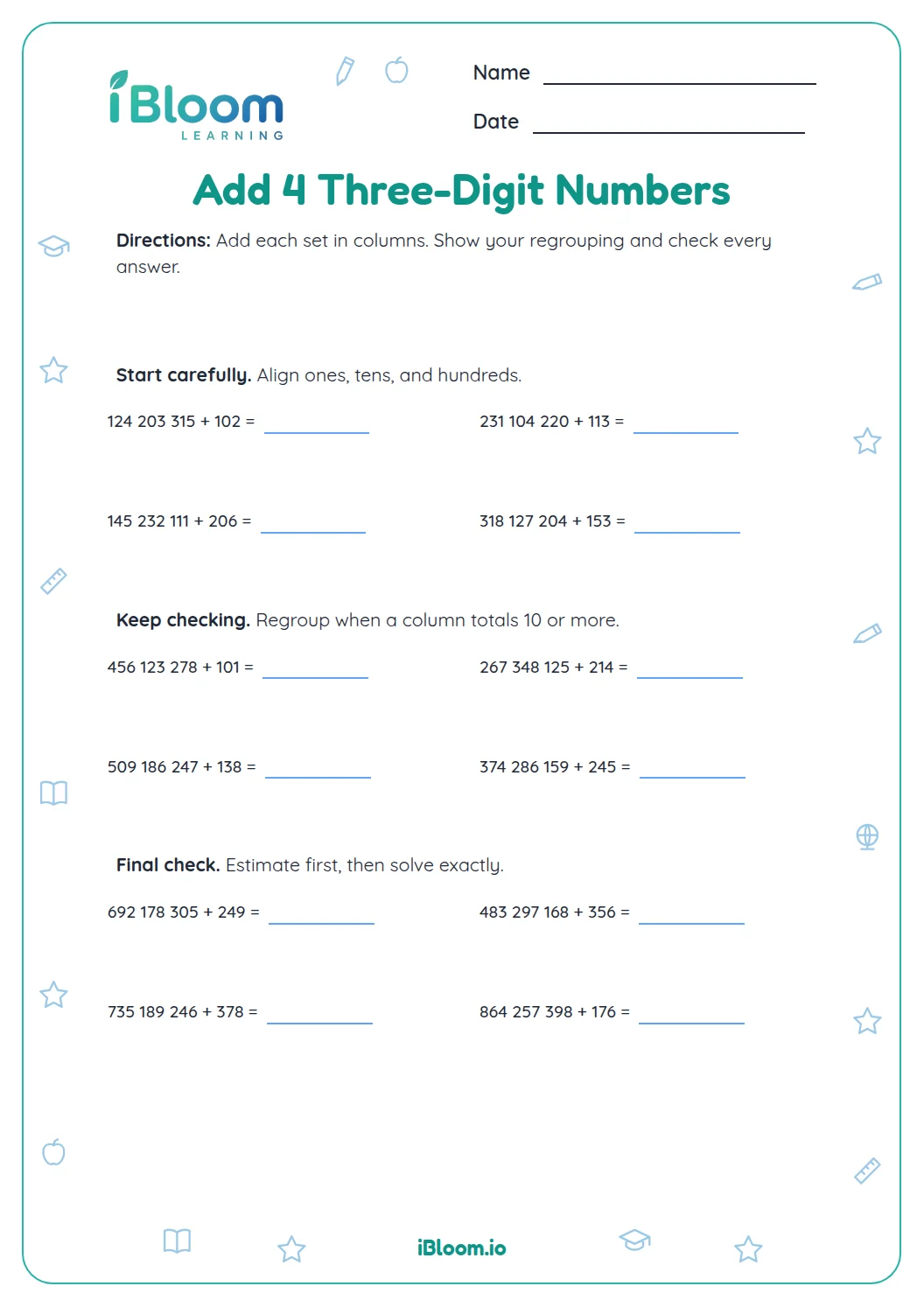
About this worksheet
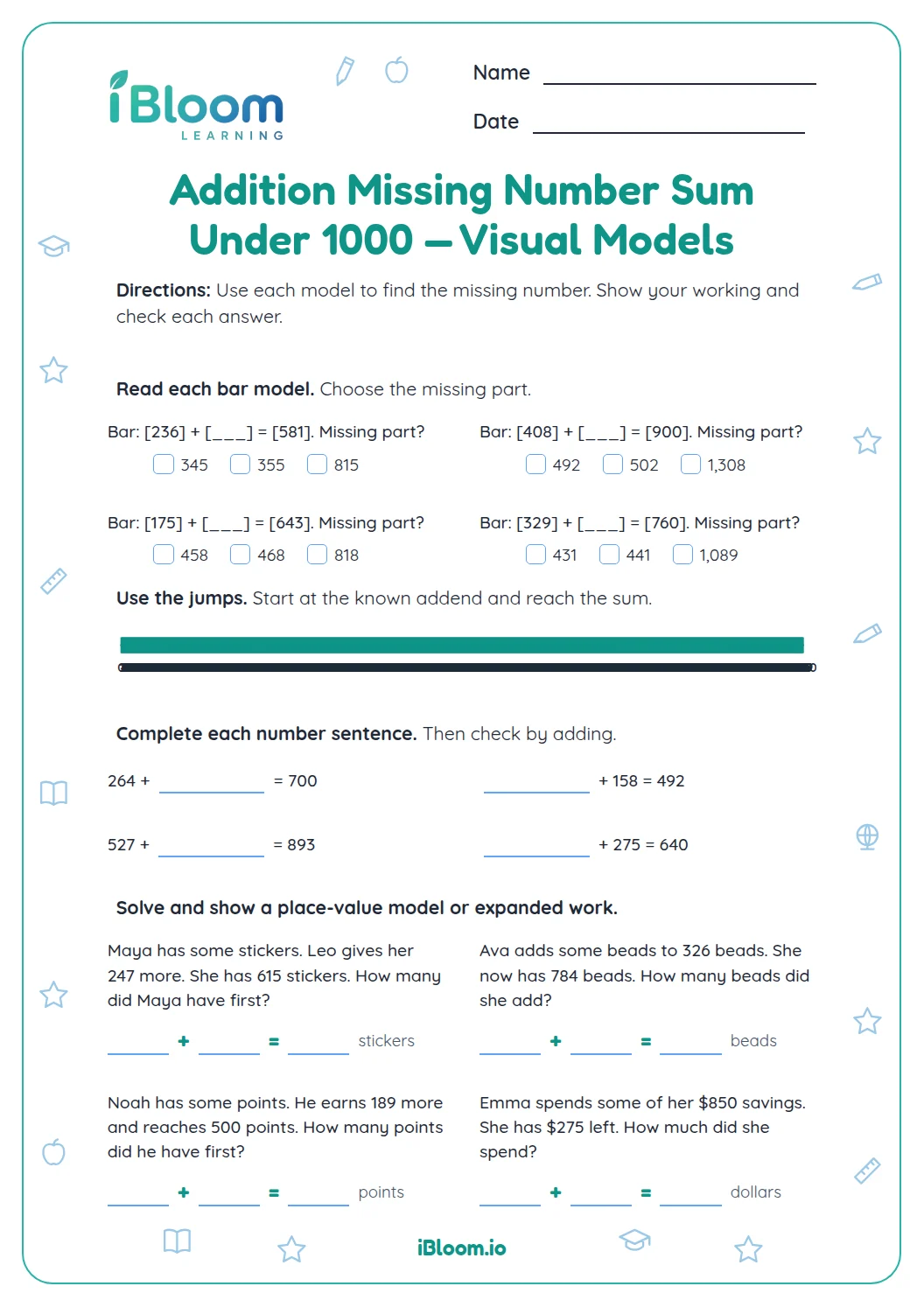
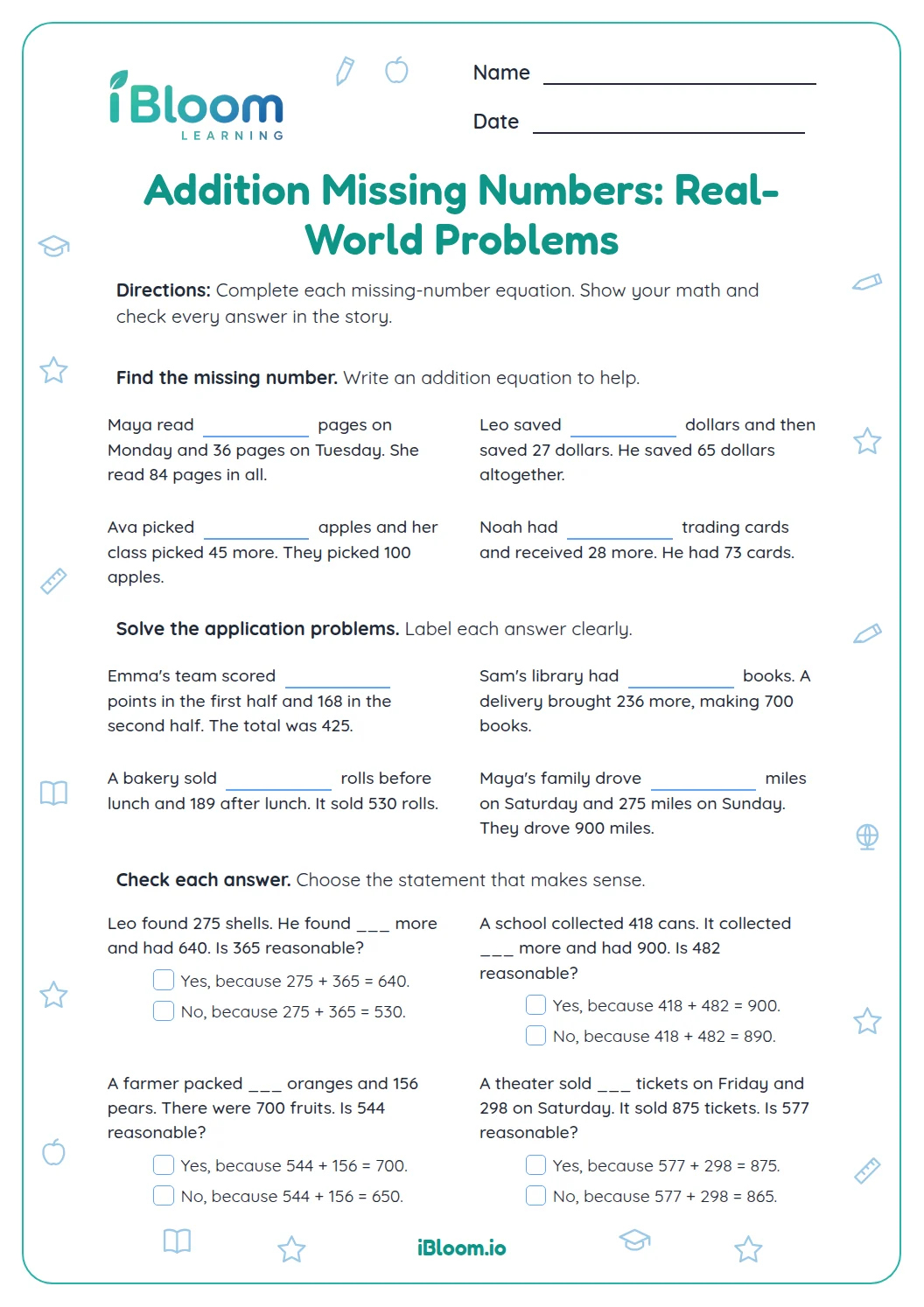
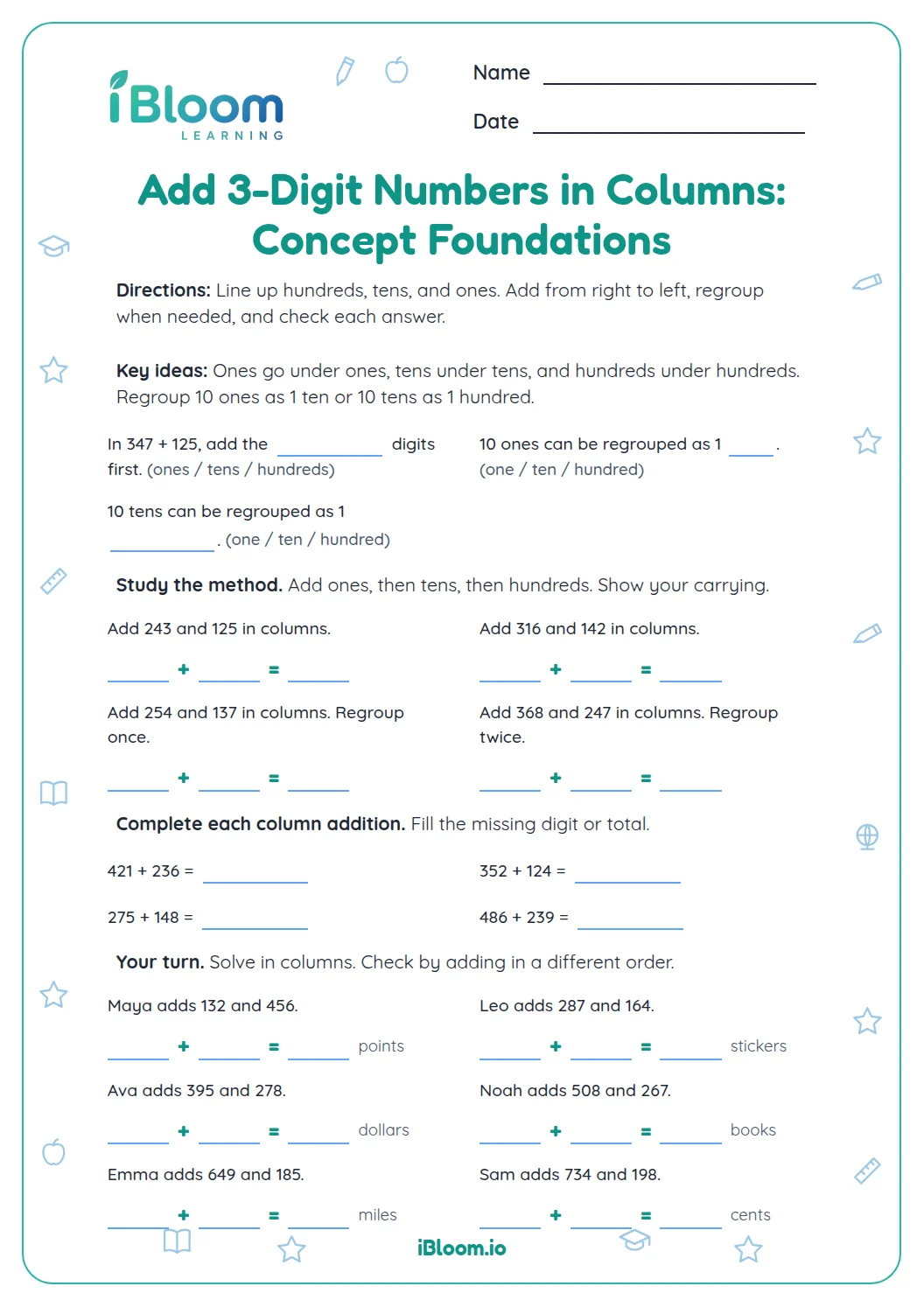
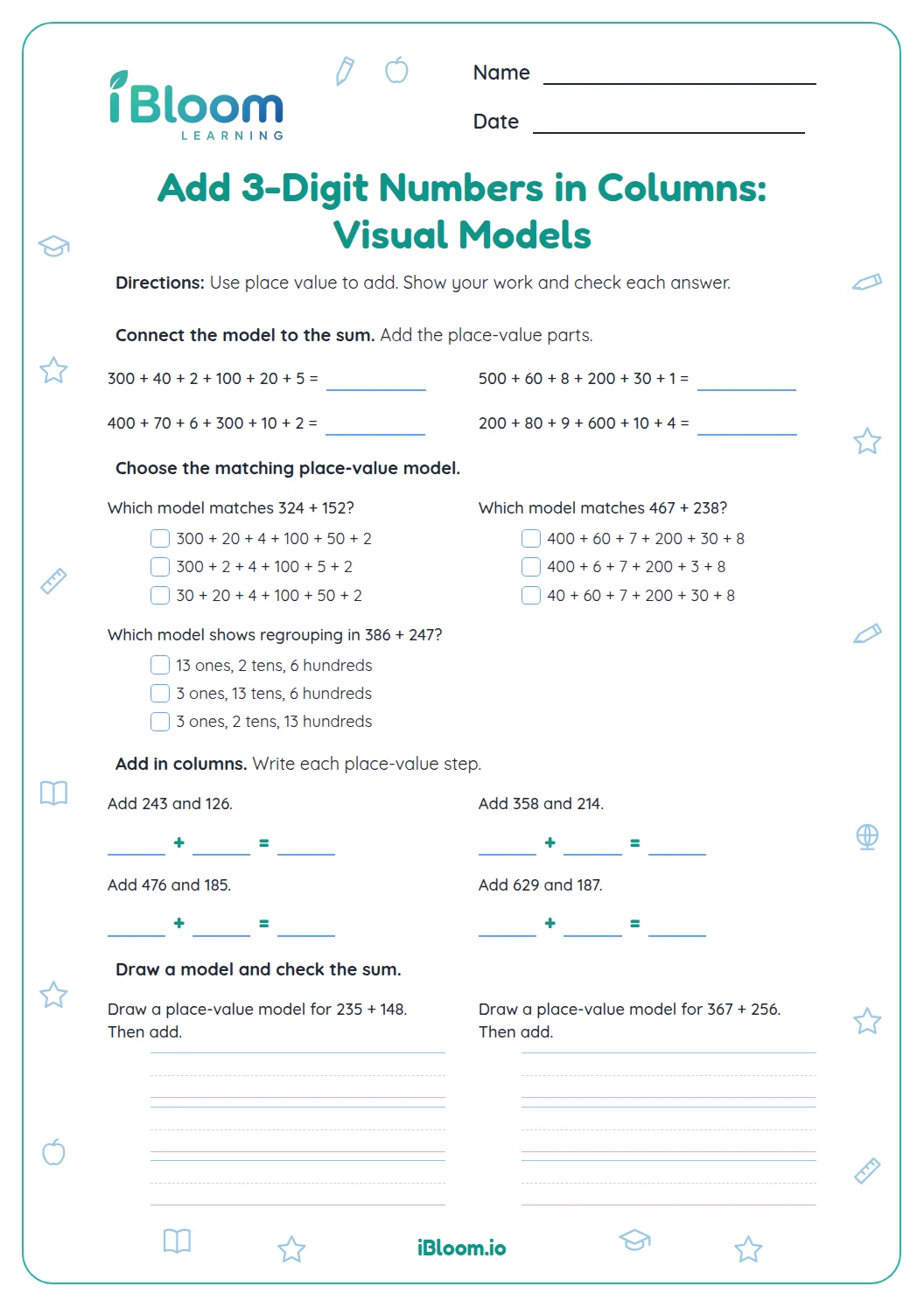
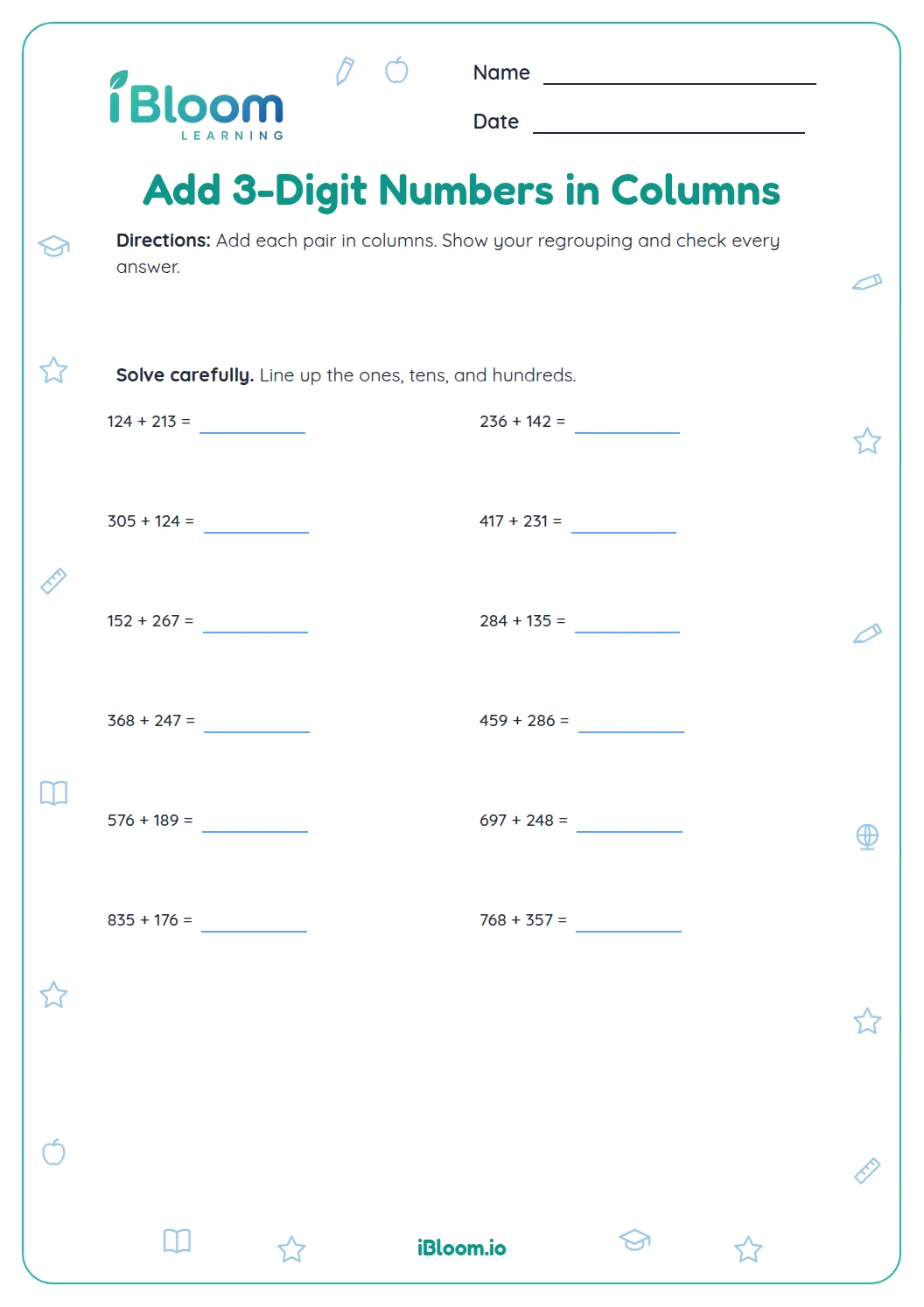
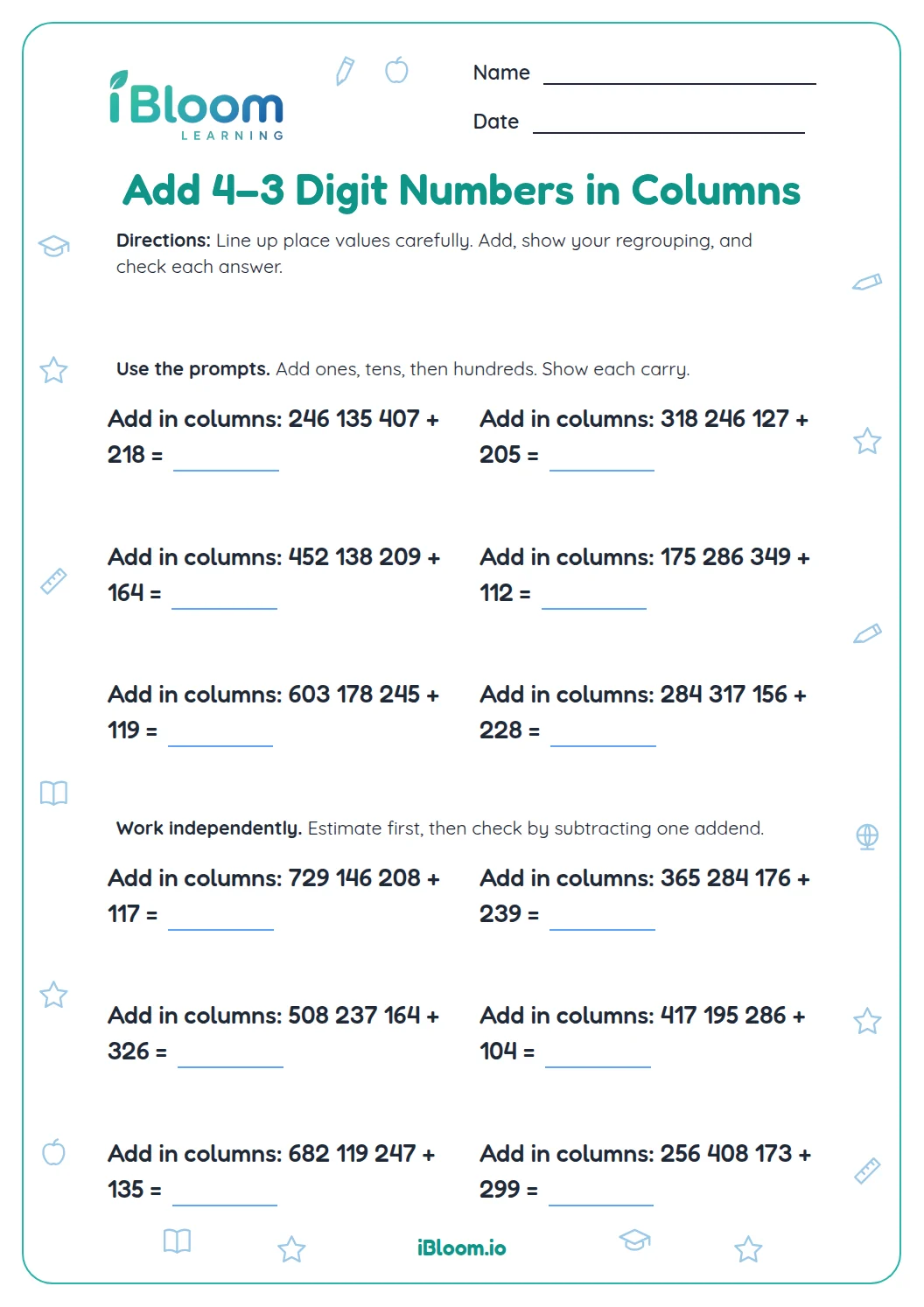
This free Grade 4 addition worksheet has 20 equations with one missing addend and a total below 1,000. Students find the unknown by subtracting the known addend or by counting up with place value, including examples that require regrouping. The page moves from straightforward equations to less familiar place-value combinations, and the answer key lists each missing number. It connects addition and subtraction while practicing multi-digit addition under CCSS 4.NBT.B.4.
Aligned to 4.NBT.B.4
What does a missing addend represent?
An addition equation names two parts and their total. The missing addend is the part that combines with the known addend to make the sum. To uncover it, subtract the known part from the total.
- 1___ + 236 = 581
- 2581 − 236 = 345
- 3Check: 345 + 236 = 581
Can you count up instead of subtracting?
Yes. Start at the known addend and make friendly jumps to the total. For 347 + ___ = 800, jump 3 to 350, 50 to 400, then 400 to 800. The jumps total 453, so the missing addend is 453.
How can place value help with regrouping?
Subtract hundreds, tens, and ones carefully. When a place has too few units, regroup from the next place. After finding the unknown, add it to the known addend to confirm that the original sum is restored.
More Grade 4 missing-addend practice at home or in class
- 1Read the equation and identify the total and the addend you already know.
- 2Write a subtraction equation: total minus known addend.
- 3Subtract by place value, regrouping when needed.
- 4Or count up in friendly jumps and add the jumps.
- 5Put the missing addend back into the equation and check the sum.
Common mistakes and quick fixes
The mistake
Subtracting the total from the known addend.
The fix
The total is the larger whole; subtract the known part from it.
The mistake
Forgetting to regroup when a top digit is smaller than the digit below it.
The fix
Trade one hundred for ten tens, or one ten for ten ones, before subtracting.
The mistake
Stopping after finding a number without checking it in the original addition.
The fix
Add the known addend and your answer; the result must equal the given sum.
Curriculum alignment
Use place-value strategies and the standard algorithm to add multi-digit numbers.
On this sheet: The worksheet directly practices this skill in its questions.
Show the official wordingHide the official wording
Fluently add and subtract multi-digit whole numbers using the standard algorithm.
What to practice next
Make more practice
Further reading
Questions parents and teachers ask
What is a missing addend?
It is the number that completes an addition equation when one addend and the sum are already known. In 347 + ___ = 800, the missing addend is 453 because 347 + 453 equals 800. Every prompt leaves room to state the unknown clearly.
Should my child subtract or count up?
Either strategy works. Subtracting the known addend from the sum is direct, while counting up in place-value jumps can make the difference easier to see. The sheet encourages students to check either approach by adding the two addends. This keeps the question focused on the relationship between a part and a total.
Why does the worksheet include regrouping?
Some equations cross a tens or hundreds boundary, so students need to regroup when using subtraction. This reinforces place-value understanding and gives a useful way to verify the unknown through addition. Students should show each place-value trade in their written work.
Are all the sums below 1,000?
Yes. Each of the 20 equations has a sum less than 1,000, and each answer is a whole-number addend that completes the equation. The questions move through several hundreds and include both missing-first and missing-second addends. Repeating the check with addition confirms the original equation.
What should I look for when checking the answer?
Put the student’s number back in the blank and add. The known addend plus the proposed missing addend must equal the printed sum. The answer key gives the missing addend for every question, and students can verify each one by adding it to the known addend. This also helps confirm the original equation, not just the subtraction.
How long does the practice take?
Most students can complete the 20 equations in about 20 minutes, with more time if they write out each subtraction or count-up strategy. A short break between the first and second page can help keep the checking step careful.