


About this worksheet
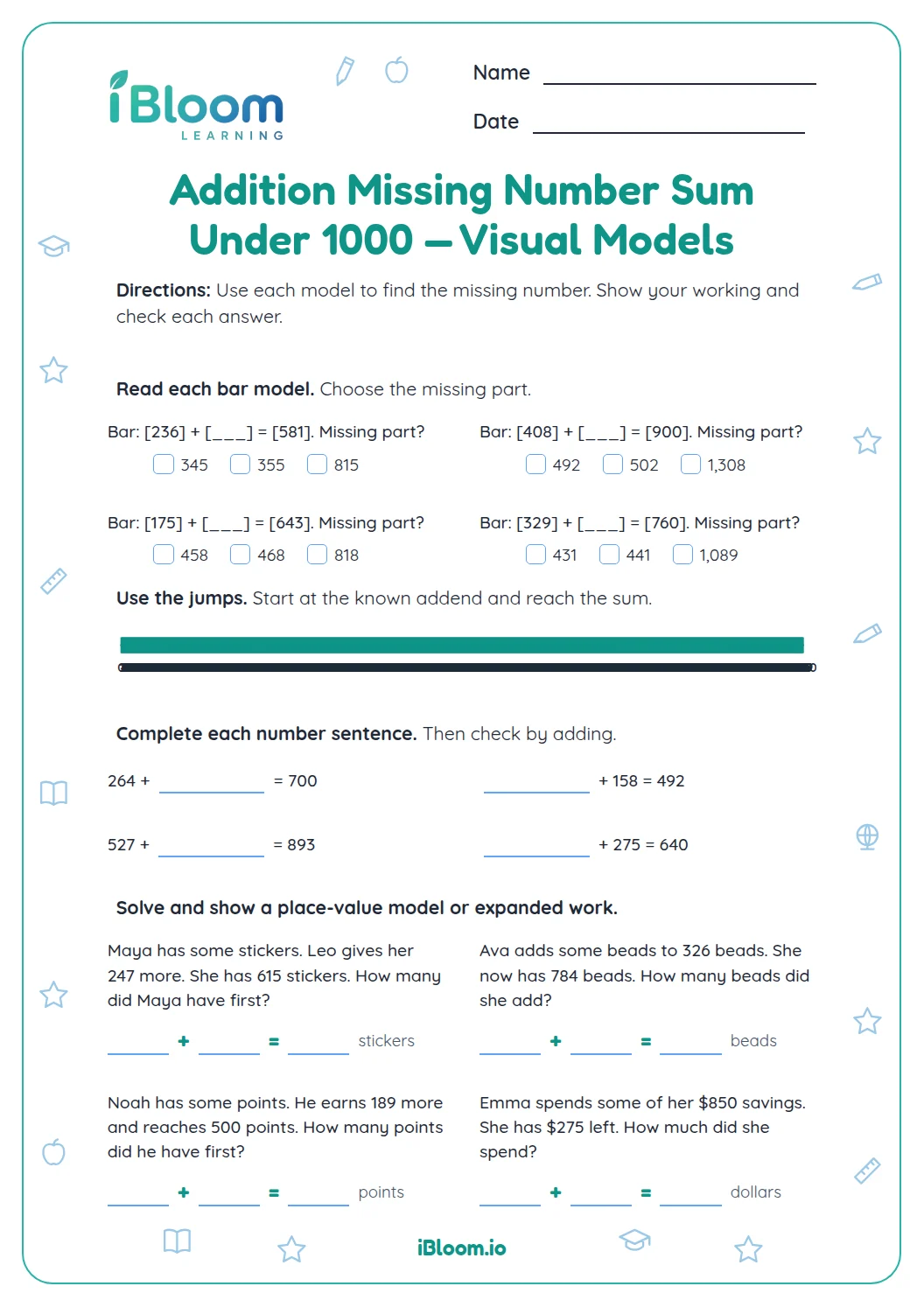
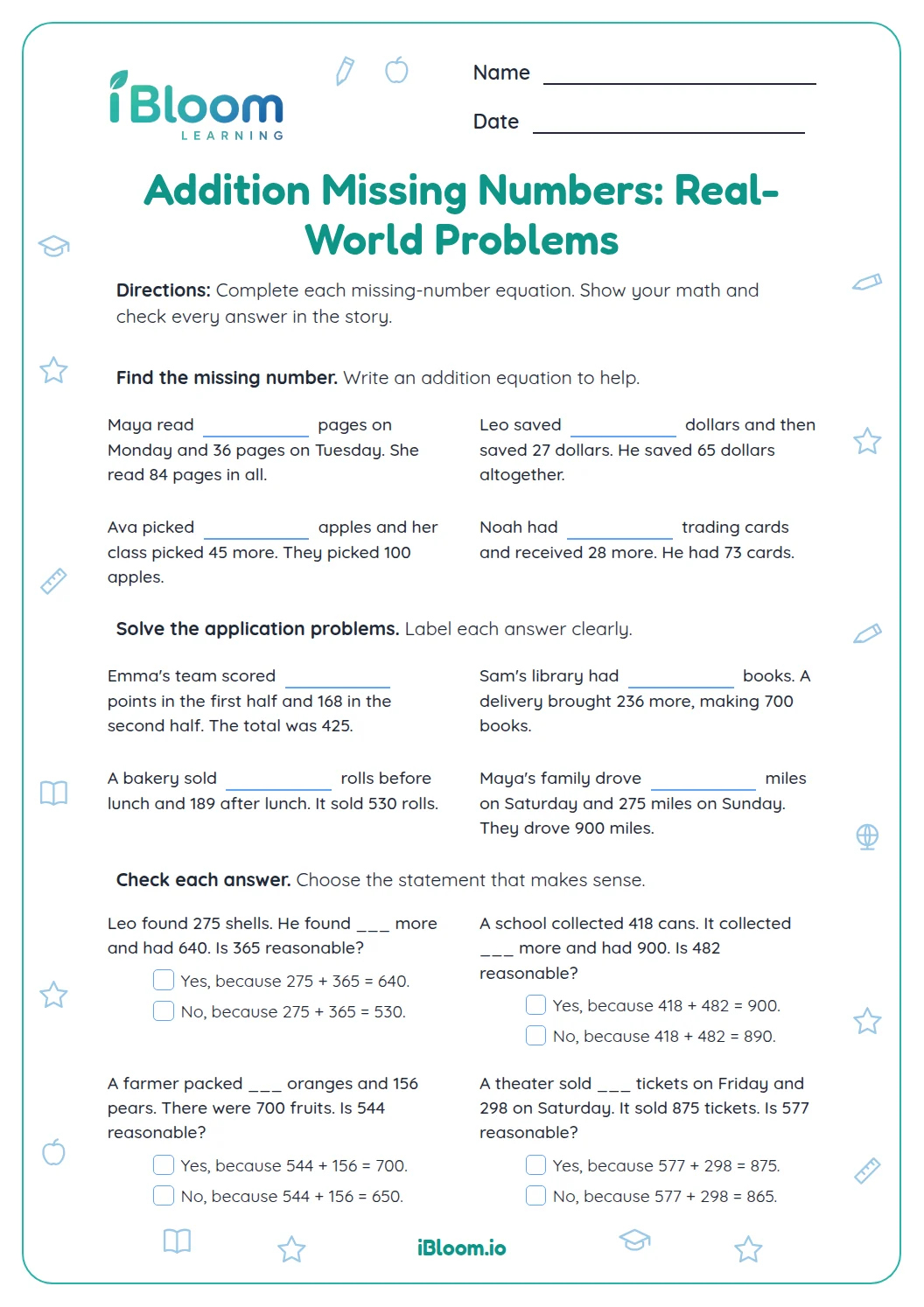
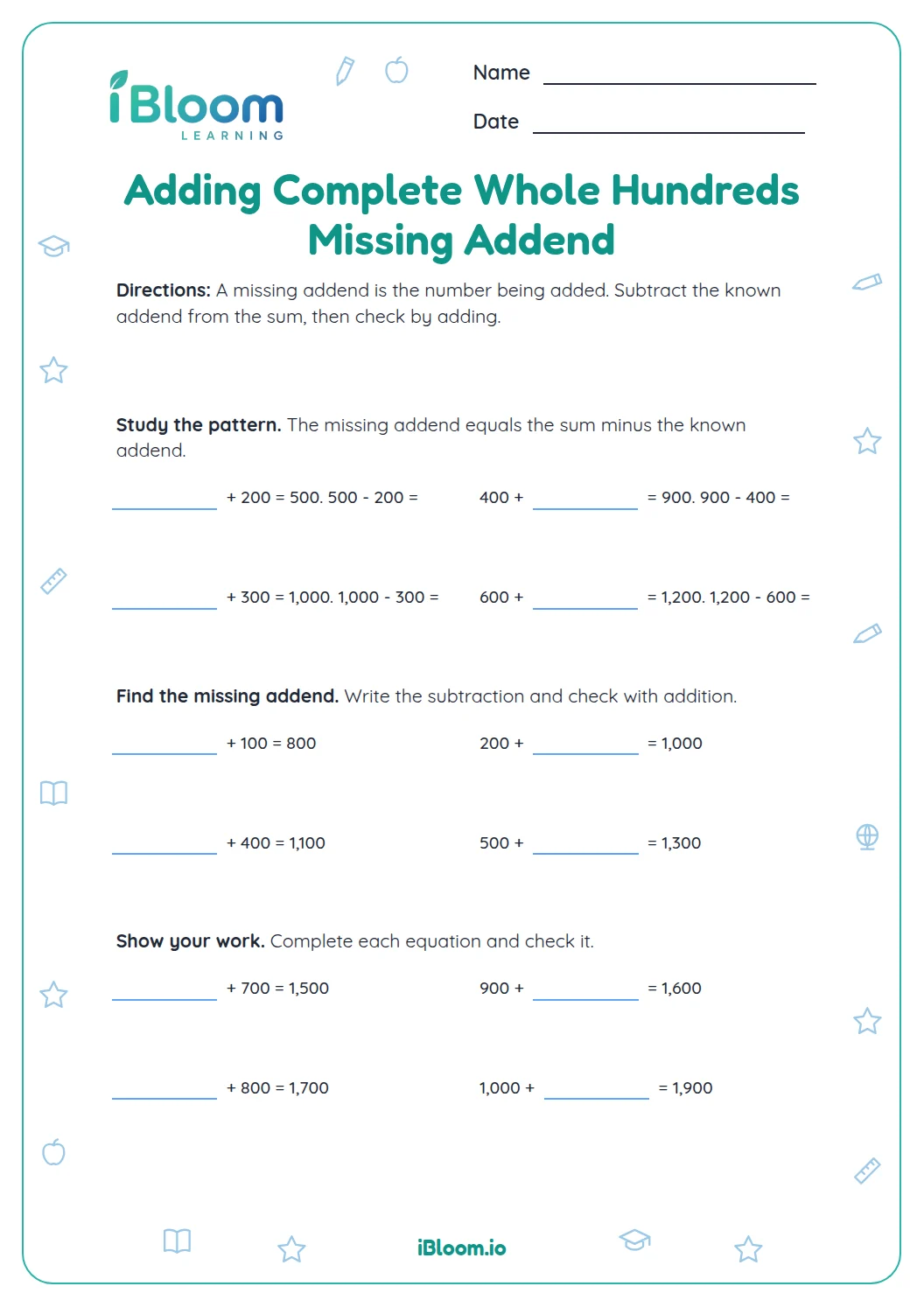
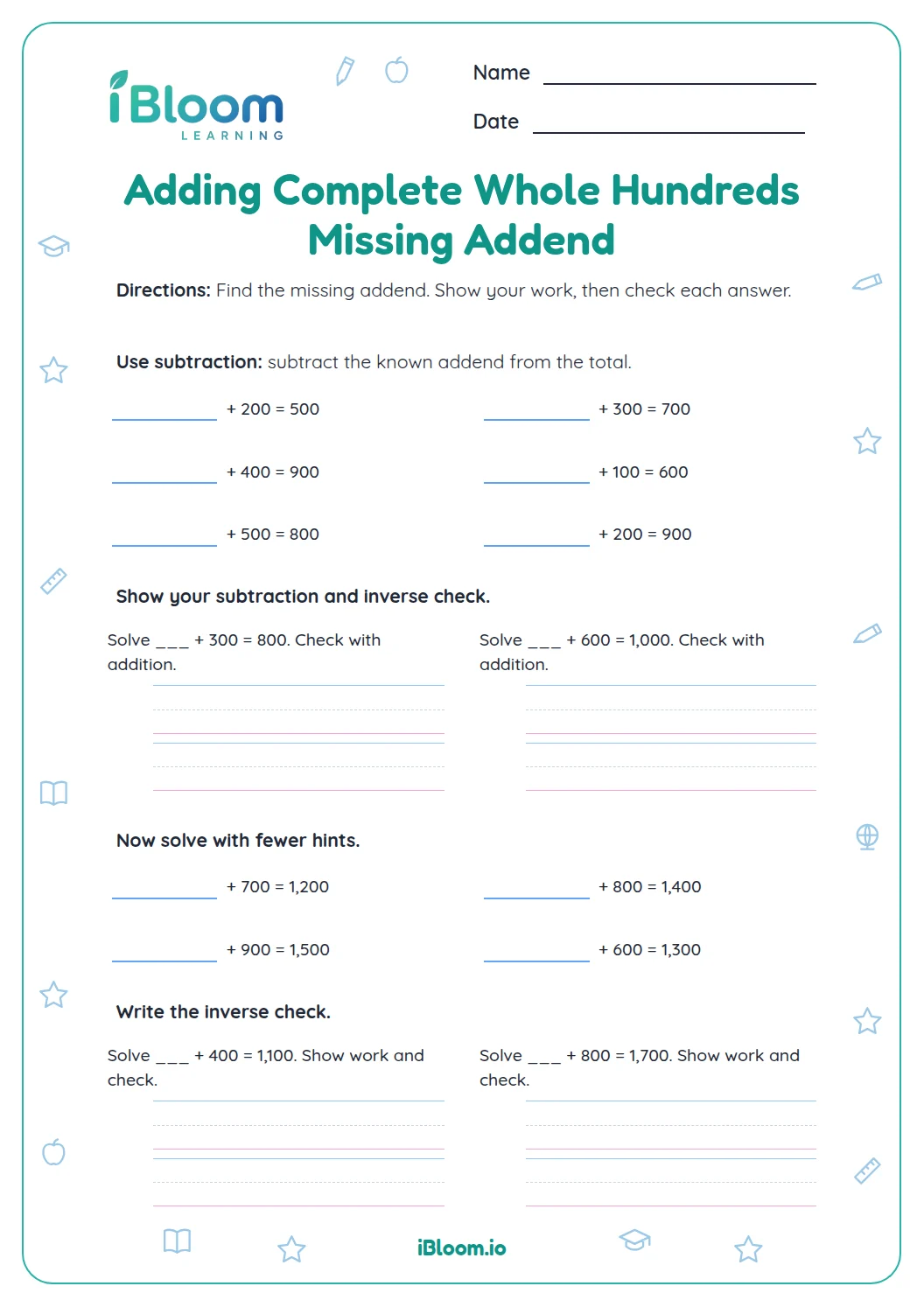
This free Grade 4 worksheet gives students 20 missing-addend equations with sums under 1,000. Three parts move from straightforward place-value subtraction to regrouping and then mixed equations with the total on either side of the equals sign. Students use the standard subtraction algorithm to find a missing part and add to check it, practicing Common Core 4.NBT.B.4. The sheet is designed for independent work after an introduction to missing addends. Every blank has one whole-number answer, and the separate answer key makes it easy to check a completed equation.
Aligned to 4.NBT.B.4
What changes from one part to the next?
Part A has six equations that can be solved without regrouping. Part B has four that require regrouping, including subtraction through a zero. Part C has ten more equations that mix regrouping and equation order.
Part C combines ten regrouping and mixed-order equations, including totals on either side of the equals sign. Students identify the total, subtract the known addend, and check by adding.
How does regrouping help with 268 + ___ = 503?
Set up 503 − 268 with hundreds, tens and ones aligned. To subtract 8 ones, first exchange a hundred for ten tens, then exchange one of those tens for ten ones. Keep a written record of both exchanges.
- 1268 + ___ = 503
- 2503 becomes 4 hundreds, 9 tens and 13 ones.
- 313 − 8 = 5; 9 − 6 = 3; 4 − 2 = 2.
- 4The missing number is 235. Check: 268 + 235 = 503.
How can I check independent work without giving the answer?
Ask the student to name the total and the known part, then write a subtraction calculation on scratch paper. For a wrong answer, have the student fill it into the original equation and add.
If the addition does not equal the stated total, return to the regrouping marks. A correct subtraction and a matching addition check provide two ways to confirm the missing number.
How to use this sheet
- 1Read the whole equation and identify the total, even when it is on the left.
- 2Write total minus known addend in columns on scratch paper.
- 3Solve Part A, then continue through the regrouping in Part B.
- 4Complete the four mixed equations in Part C.
- 5Fill each answer back into its equation and add to check before using the key.
Mistakes to notice and how to help
The mistake
Adding the two visible numbers in 268 + ___ = 503.
The fix
The total is already 503. Subtract 268 from it to find the missing part.
The mistake
Regrouping 503 as 4 hundreds, 10 tens and 13 ones.
The fix
The extra ten ones came from one ten. Cross out 10 tens and write 9 tens.
The mistake
Treating 945 = 378 + ___ as a different kind of equation.
The fix
Read it as “945 is the same amount as 378 plus what?” The missing part is 945 − 378.
Common Core alignment
Subtract to find missing addends, then check with column addition.
On this sheet: Students subtract three-digit numbers using the standard algorithm and verify their missing addends by adding.
Show the official wordingHide the official wording
Fluently add and subtract multi-digit whole numbers using the standard algorithm.
What to practice next
Make more practice
Further reading
Questions parents and teachers ask
Are all the sums below 1,000?
Yes, every completed equation has a total below 1,000. The largest total is 999 in question 16. Students find missing addends rather than new totals, so they should identify the given sum first and check that the completed addition equals that number.
Does this worksheet require regrouping?
Yes, regrouping is needed in Part B and in several questions in Part C. For example, finding the missing part in 268 + ___ = 503 requires exchanging through the zero tens. Part A starts with six equations that can be solved without regrouping.
Why do some equations have the total on the left?
They help students read the equals sign as a statement that two amounts match. In 945 = 378 + ___, 945 is still the total. Students subtract 378 from 945 to find 567, then check that 378 plus 567 equals 945.
Should students use mental math or written columns?
Use written columns for the subtraction and addition checks in this practice. Students can notice an answer mentally, then verify it with aligned hundreds, tens and ones on scratch paper. The written exchanges are especially useful for the zero-containing totals in Part B.
What does the answer key show?
The answer key gives the missing whole number for each of the 20 equations. Have students complete their own addition checks before opening it. If an answer differs, compare the completed equation with the given total and review any regrouping marks in the subtraction.