


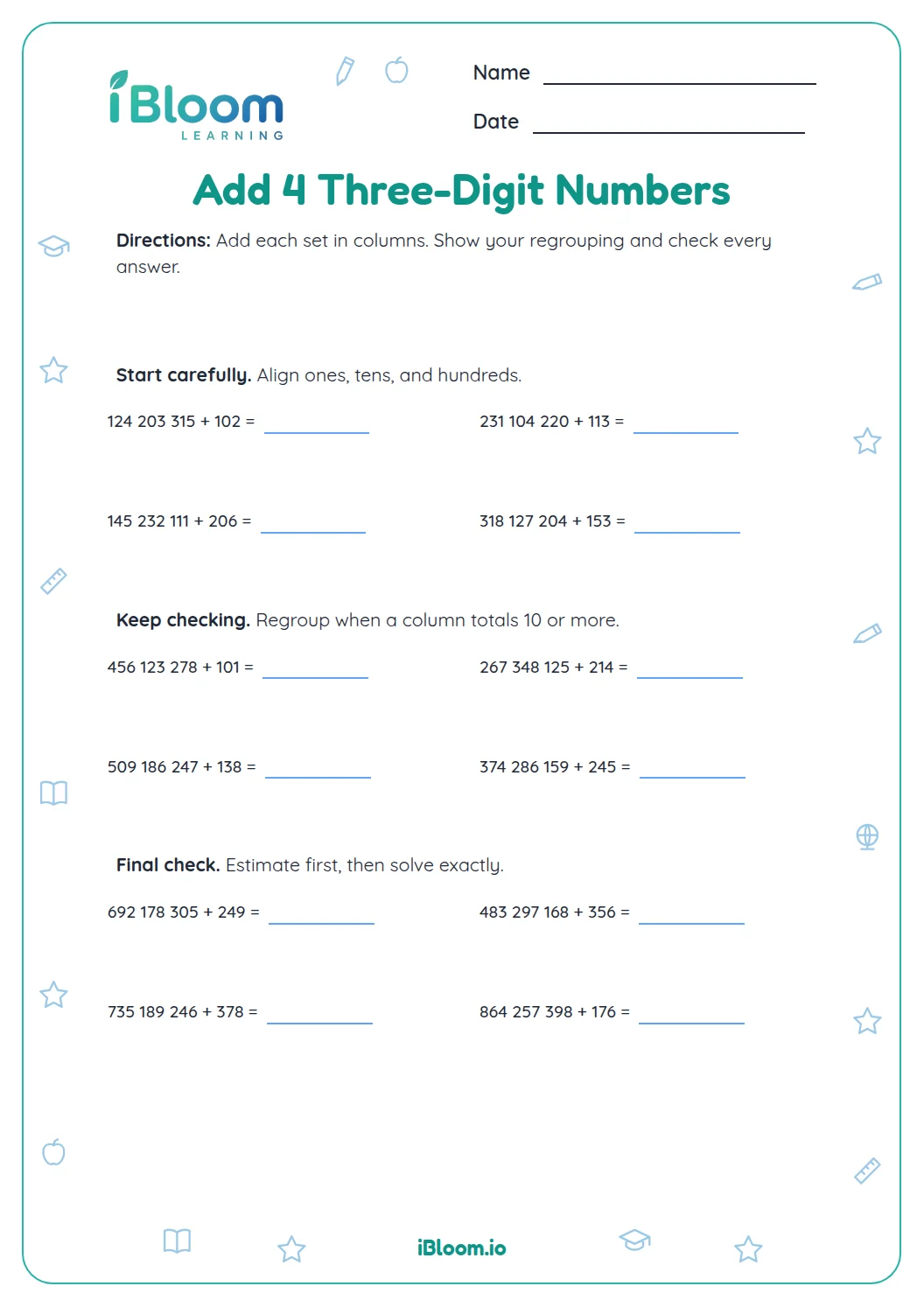
About this worksheet
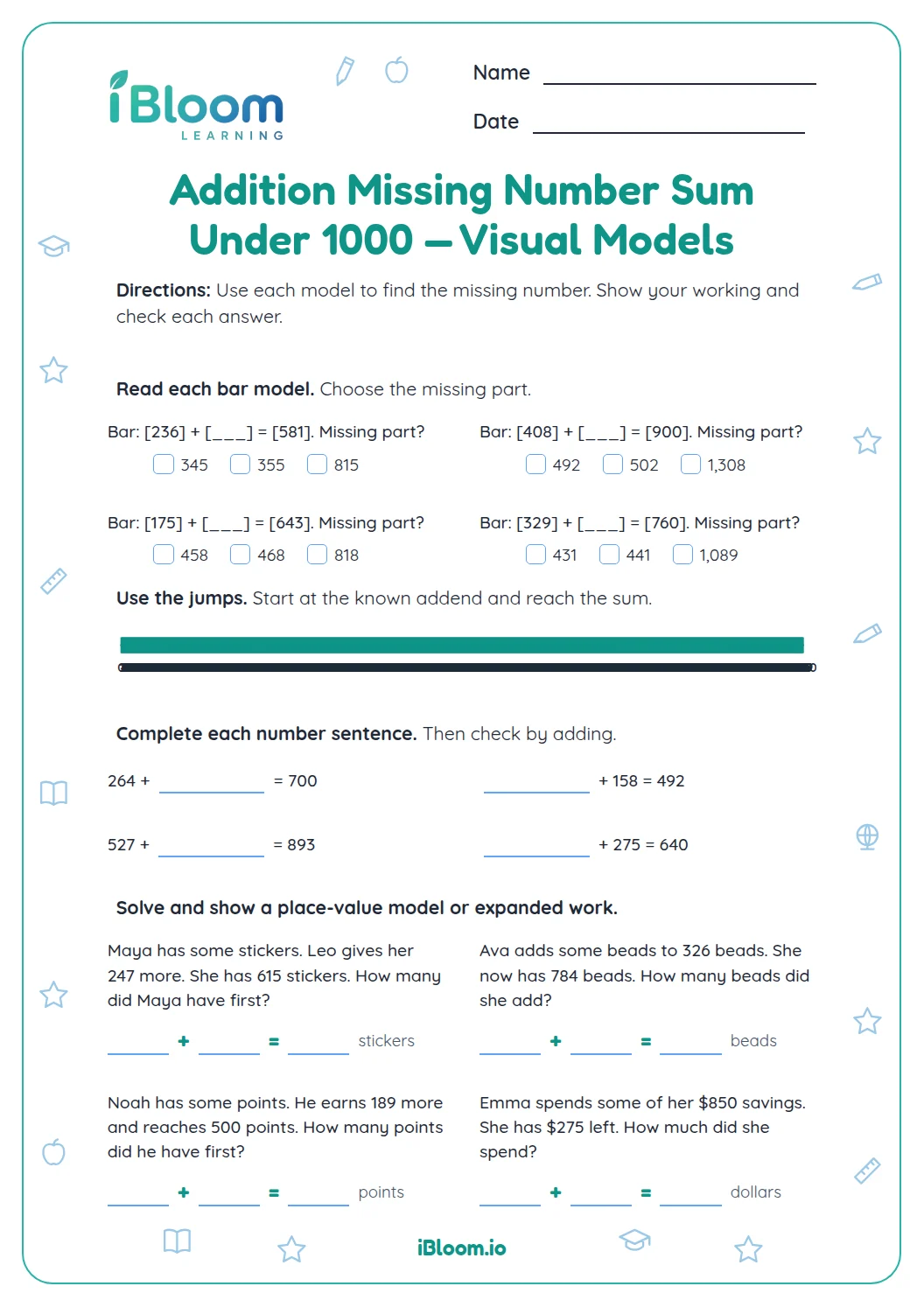
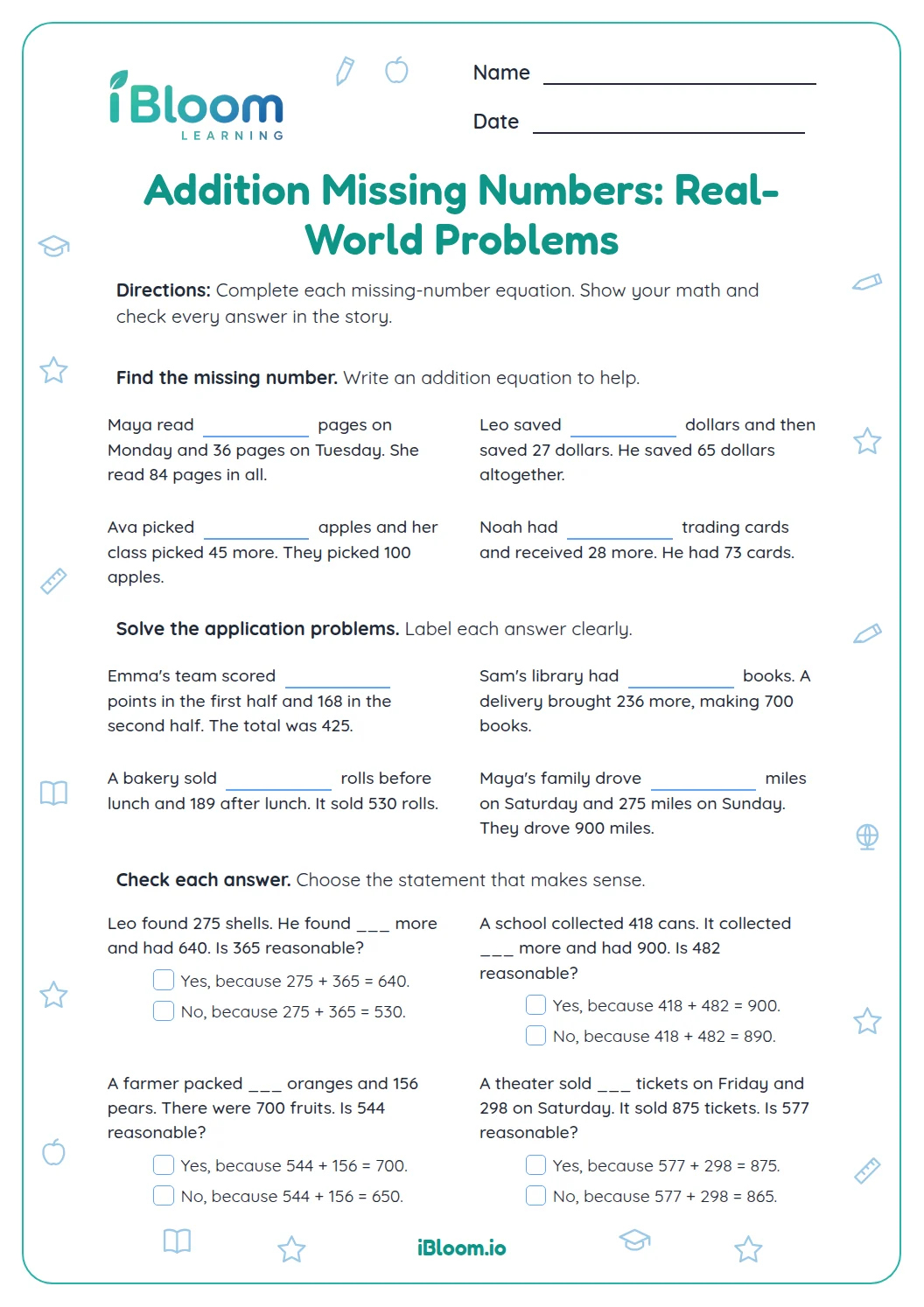
Fifteen problems practice missing addends and sums below 1,000, with addition checks for each equation. A separate answer key supports checking after learners try the problems.
Aligned to 4.NBT.B.4
How do you find a missing addend?
Subtract the known addend from the sum. For 236 + ___ = 481, calculate 481 − 236 = 245.
How do you check the answer?
Add the known addend and your answer. If their sum matches the total, the equation is correct.
How is subtraction connected?
Subtraction can undo addition. In ___ + 175 = 640, subtract 175 from 640 to find the missing addend. Then add the two addends to check the equation.
How to use this worksheet
- 1Identify the total and known addend.
- 2Subtract the known addend from the total.
- 3Place the result in the blank.
- 4Add the two addends to check.
Common mistakes and quick fixes
The mistake
Subtracting the total from the known addend.
The fix
Start with the total, then subtract the known addend.
The mistake
Forgetting to regroup when subtracting.
The fix
Line up hundreds, tens, and ones and regroup as needed.
The mistake
Treating the missing addend as the total.
The fix
Find the total on the other side of the equals sign, then subtract the known addend.
Common Core alignment
This worksheet practices the standard below through its questions.
Use place-value strategies and the standard algorithm to add and subtract multi-digit whole numbers.
On this sheet:
Show the official wordingHide the official wording
Fluently add and subtract multi-digit whole numbers using the standard algorithm.
What to practice next
Make more practice
Further reading
Questions parents and teachers ask
What operation finds a missing addend?
Subtract the known addend from the sum. For example, in 236 + ___ = 481, calculate 481 − 236 to get 245. Put 245 in the blank, then add 236 and 245 to check that their total is 481.
How can I check a missing addend?
Add the two addends and compare their total with the sum shown in the equation. If the totals match, the missing number is correct. This check uses addition directly and can catch a subtraction error or a regrouping mistake.
Can subtraction help find a missing addend?
Yes. Subtract the known addend from the total to find the missing number. Then add the two addends to check that they make the original total. The worksheet asks learners to solve these missing-addend and sum equations. This check works for every equation.
Is an answer key included?
Yes. The key provides answers to all 15 problems. After trying the equations, check a missing addend by adding it to the known addend. The sum should match the total shown. This gives a quick way to review both the calculation and the inverse operation.