


About this worksheet
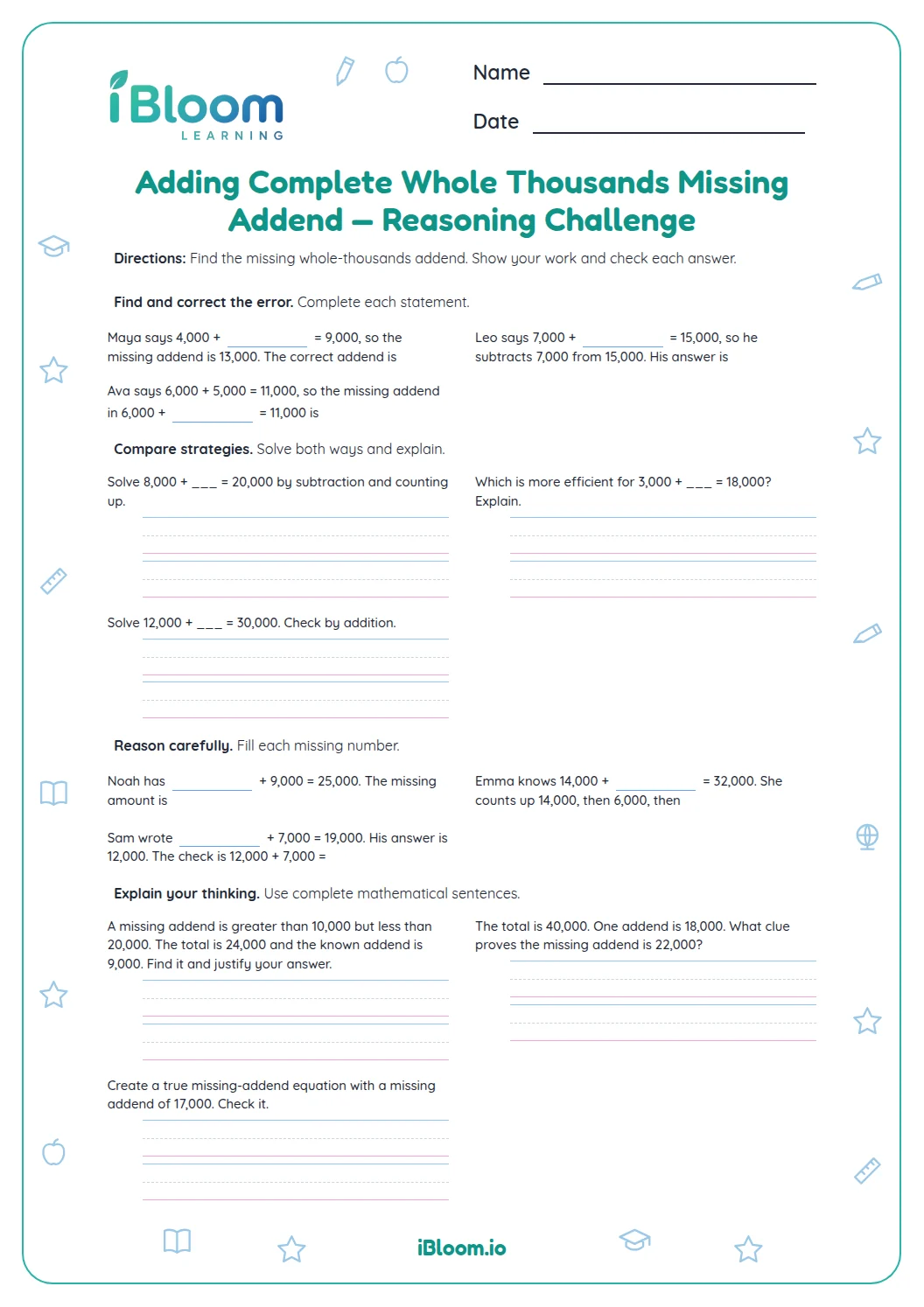
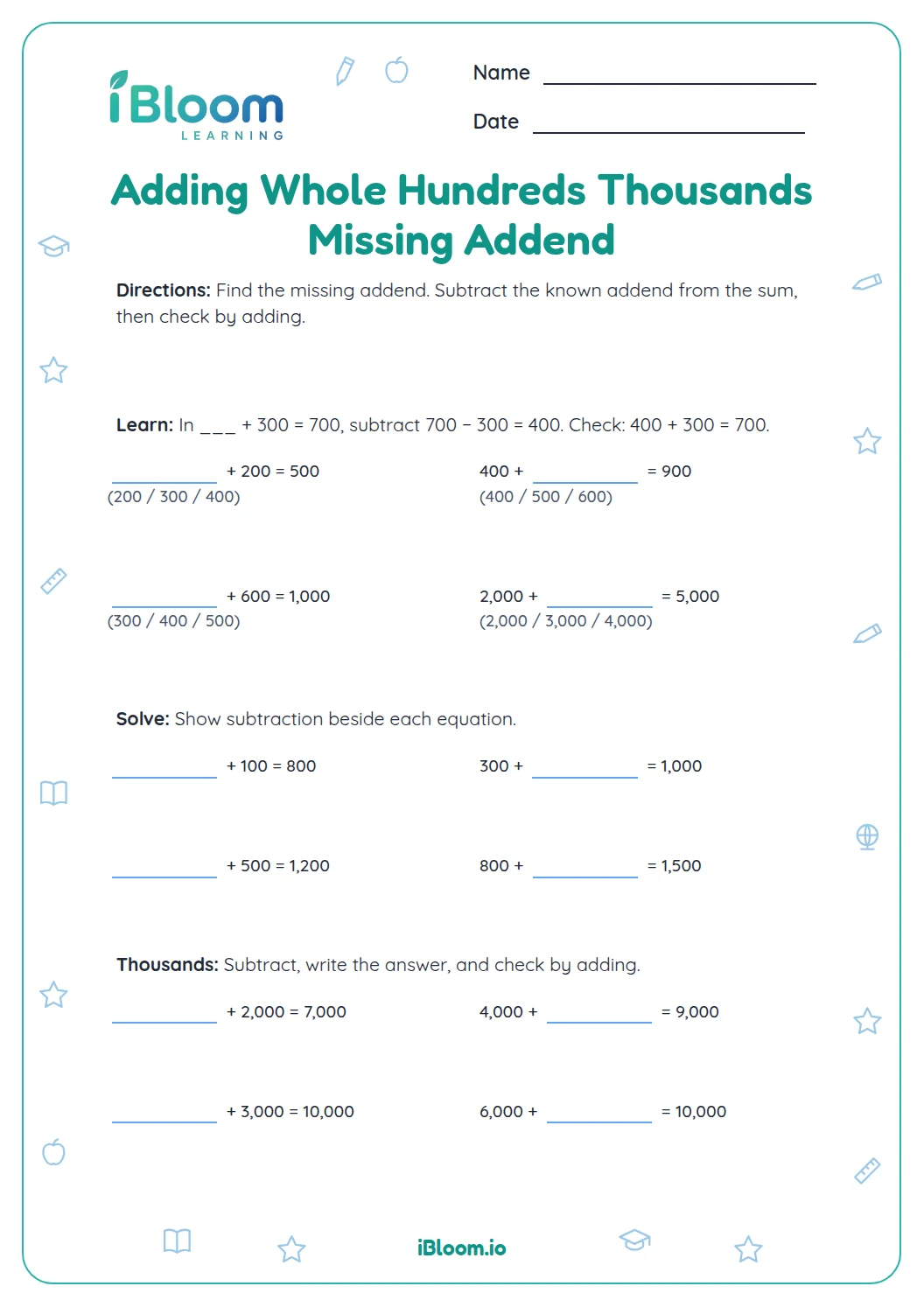
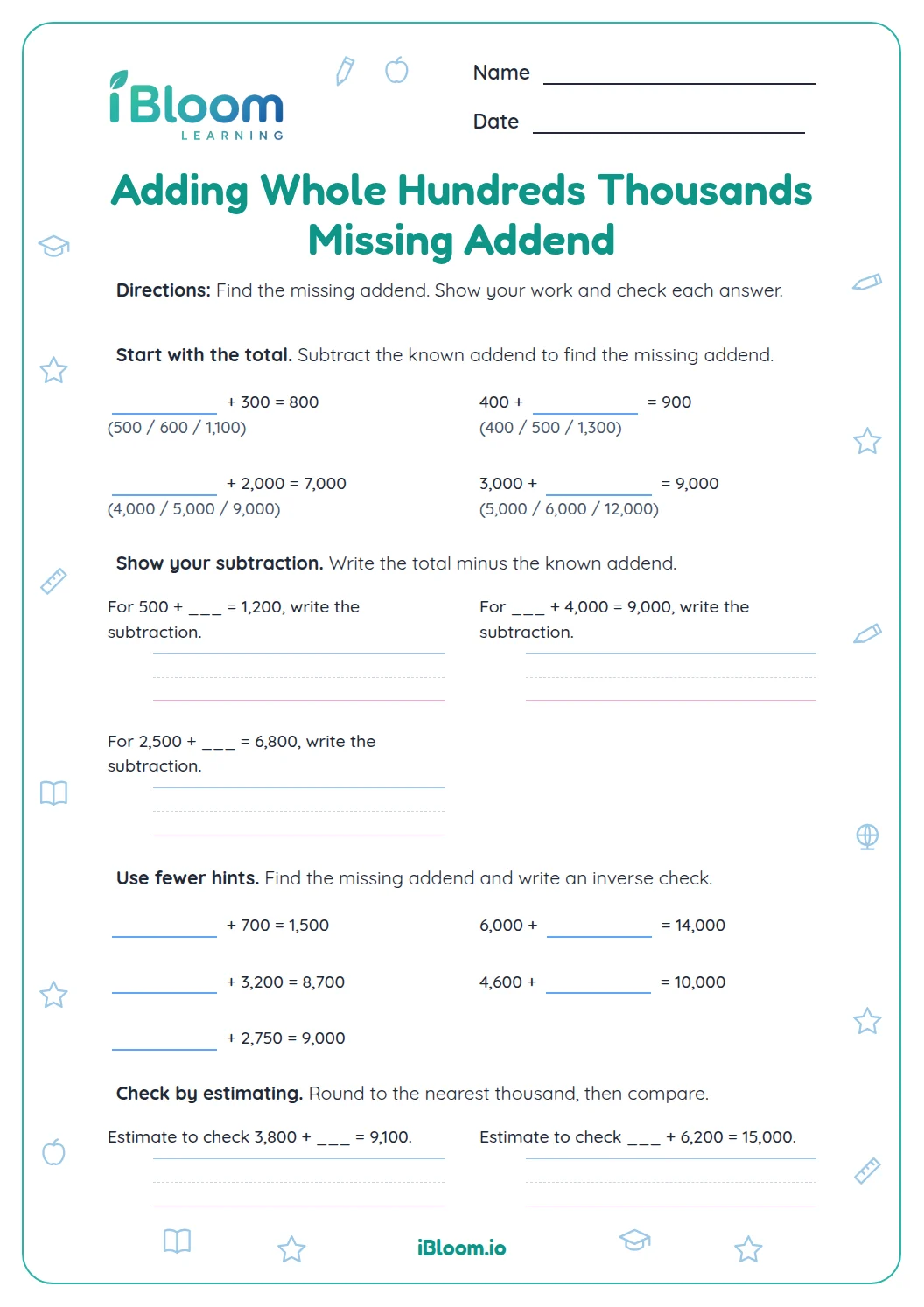
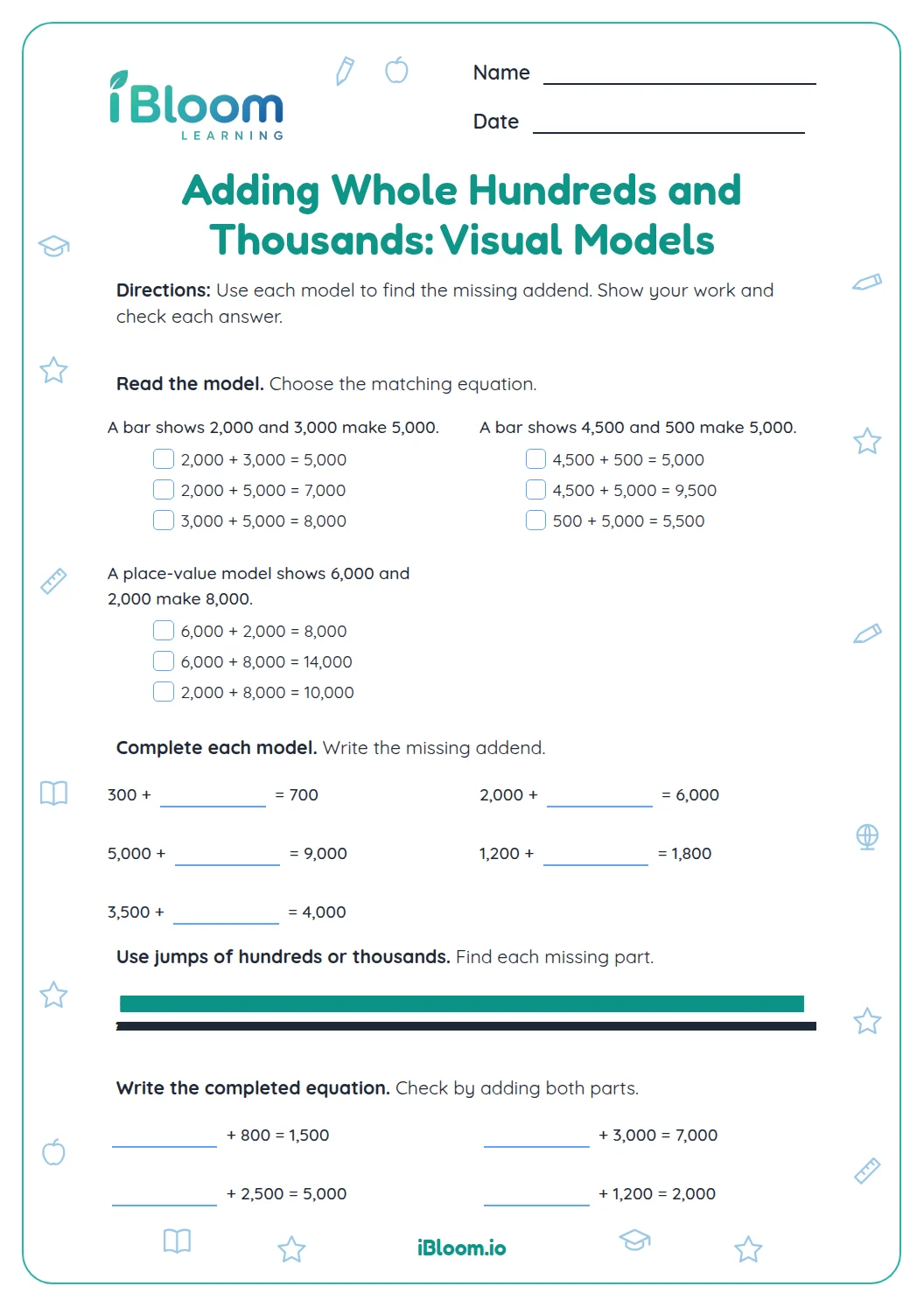
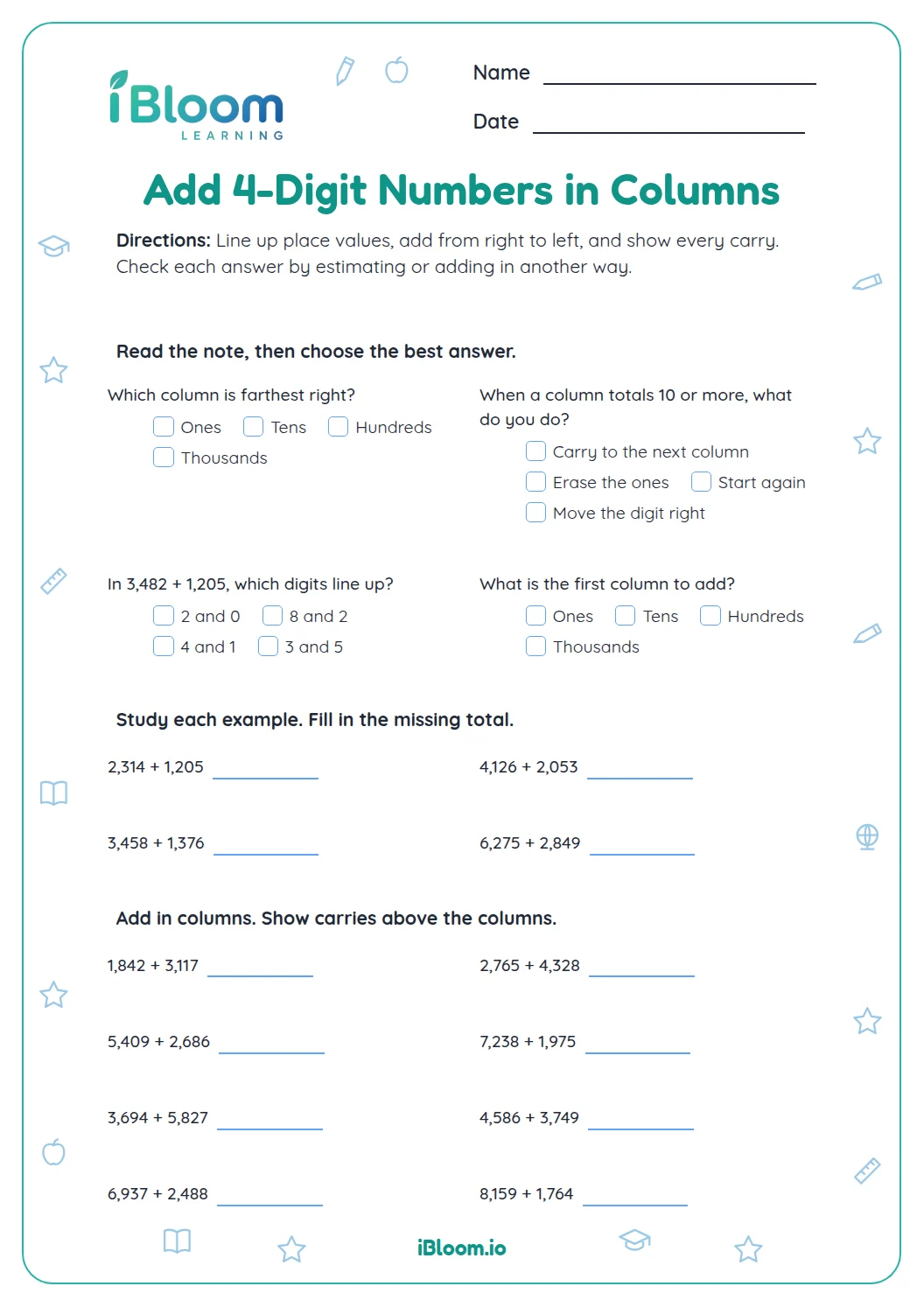
This free Grade 4 worksheet helps students find an unknown addend when every quantity is a multiple of 1,000. Part A starts with a worked subtraction hint and then uses thousands as units. Part B removes the hints and moves the blank between the first and second addend. Part C asks students to subtract in columns and check by adding, practicing CCSS 4.NBT.B.4. The fourteen questions include totals above 10,000 and come with a separate answer key.
Aligned to 4.NBT.B.4
What help is printed on the sheet?
Question 1 prints 9,000 − 4,000 = 5,000 as a hint beside 4,000 + ___ = 9,000. Questions 2 through 4 give a shorter cue to think in thousands, with no answer supplied.
Part B has six equations without hints. In Part C, students organize subtraction in columns and use addition to check that the two parts make the total.
Why say “thousands” while calculating?
Naming the unit keeps a small subtraction fact connected to a larger quantity. Nine thousands minus four thousands leaves five thousands, which is written 5,000.
- 14,000 + ___ = 9,000
- 29 thousands − 4 thousands = 5 thousands
- 3Missing addend: 5,000
- 4Check: 4,000 + 5,000 = 9,000
How do students check an answer in columns?
For 15,000 + ___ = 32,000, subtract 15,000 from 32,000. Regroup one ten-thousand as ten thousands to subtract 5 thousands from 12 thousands. The difference is 17,000.
Write the addition check beside the subtraction: 15,000 + 17,000 = 32,000. Align place values in both calculations. The blank can come before or after the known addend, but the total still tells students what the two parts must make.
How to use this worksheet
- 1Read the worked hint in question 1 together and identify the total and known addend.
- 2For questions 2 through 4, say the quantities in thousands before writing the missing amount.
- 3Let the student complete Part B, checking where the blank appears.
- 4In Part C, line up the digits in columns and subtract the known addend from the total.
- 5Add the two addends in columns to check each Part C result, then compare with the answer key.
Mistakes to check together
The mistake
Writing 5 instead of 5,000 in question 1.
The fix
Five is the number of thousands; write five thousands as 5,000.
The mistake
Adding 9,000 and 4,000 to find the missing part.
The fix
The 9,000 is already the total. Subtract the known part, 4,000.
The mistake
Subtracting 12,000 from 7,000 because the blank comes first.
The fix
In ___ + 7,000 = 12,000, the total is still 12,000. Start the subtraction with that total.
Common Core alignment
Subtract whole thousands in columns and check the missing addend with addition.
On this sheet: Part C explicitly uses column subtraction and addition checks to solve missing-addend equations.
Show the official wordingHide the official wording
Fluently add and subtract multi-digit whole numbers using the standard algorithm.
What to practice next
Make more practice
Further reading
Questions parents and teachers ask
What does “whole thousands” mean here?
Every given number and every missing addend is a multiple of 1,000, such as 4,000, 12,000, or 35,000. Students can name the quantities as four thousands or twelve thousands while thinking. They still write the complete number, including the three zeros, in each blank.
How much guidance is included?
Part A supplies one worked subtraction hint and three shorter thousands cues. Part B removes those cues, and Part C directs students to subtract in columns and check by adding. This lets you see whether a child can carry the same method into less supported questions.
Do students need to regroup in this worksheet?
Yes. Some Part C subtractions require regrouping across the thousands and ten-thousands columns. For 32,000 − 15,000, rename one ten-thousand as ten thousands. Subtract 5 thousands from 12 thousands, then subtract the remaining ten-thousands. The missing addend is 17,000, which can be checked by addition.
What if the blank is the first addend?
Use the same subtraction method regardless of the blank’s position. In ___ + 7,000 = 12,000, the unknown and 7,000 together make 12,000. Subtract 7,000 from 12,000 to get 5,000. Then read the completed equation aloud to confirm that the two parts make the total.
What should the written work in Part C include?
Students should write a column subtraction and a column addition check side by side for each of the four questions. The subtraction finds the missing addend; the addition confirms that it fits. The key gives the missing amounts, while the column-check explanation on this page shows how to regroup.