


About this worksheet
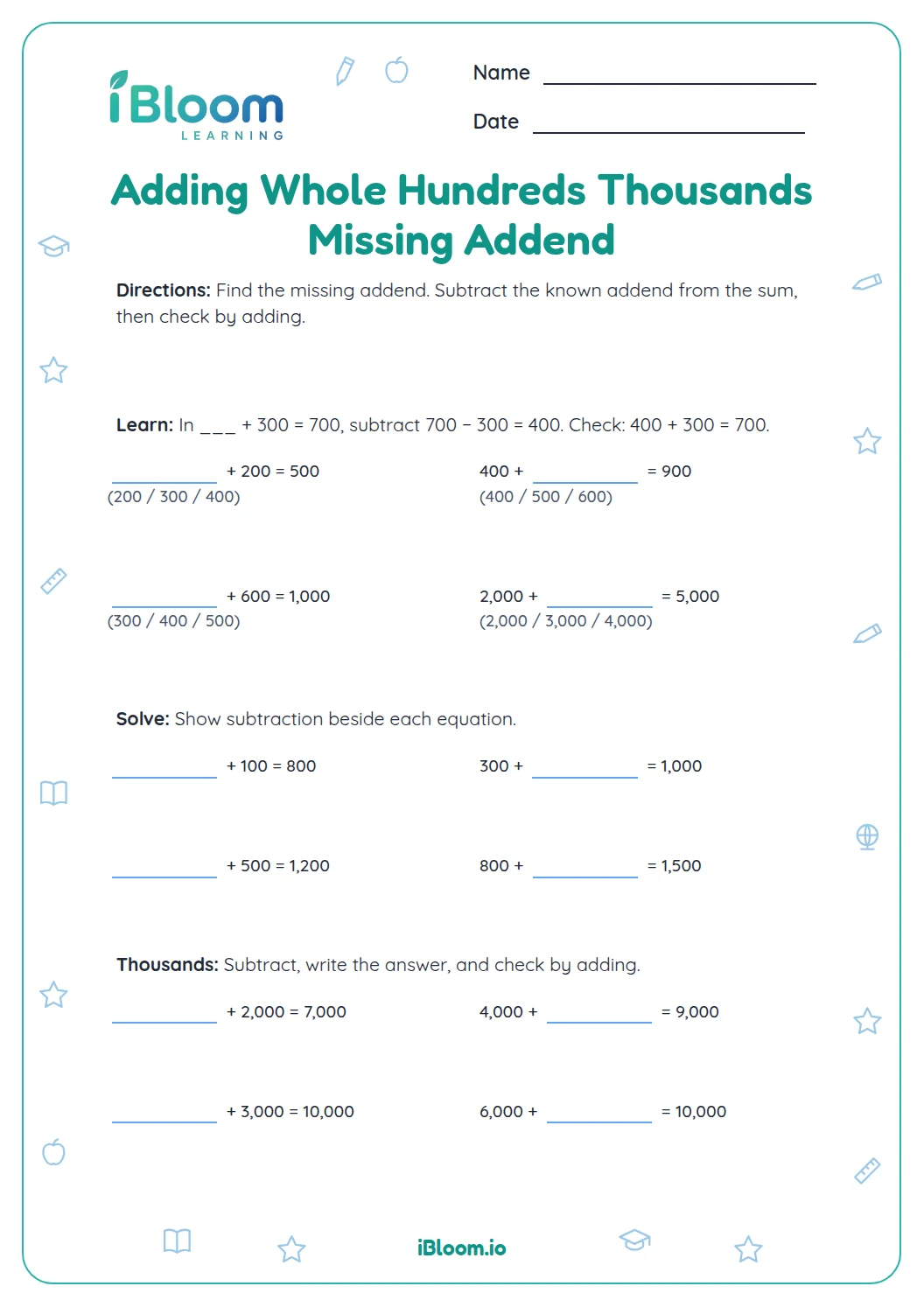
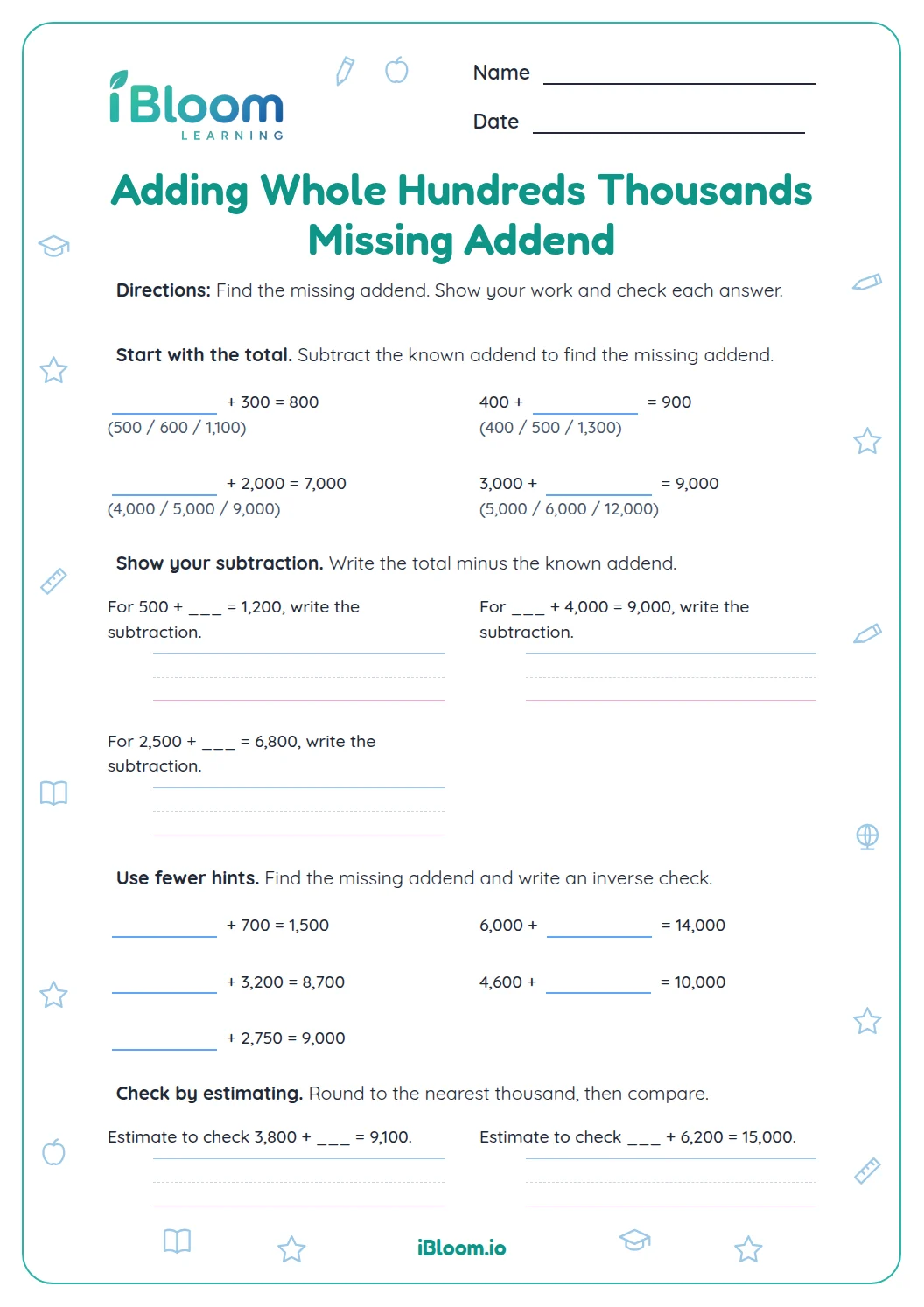
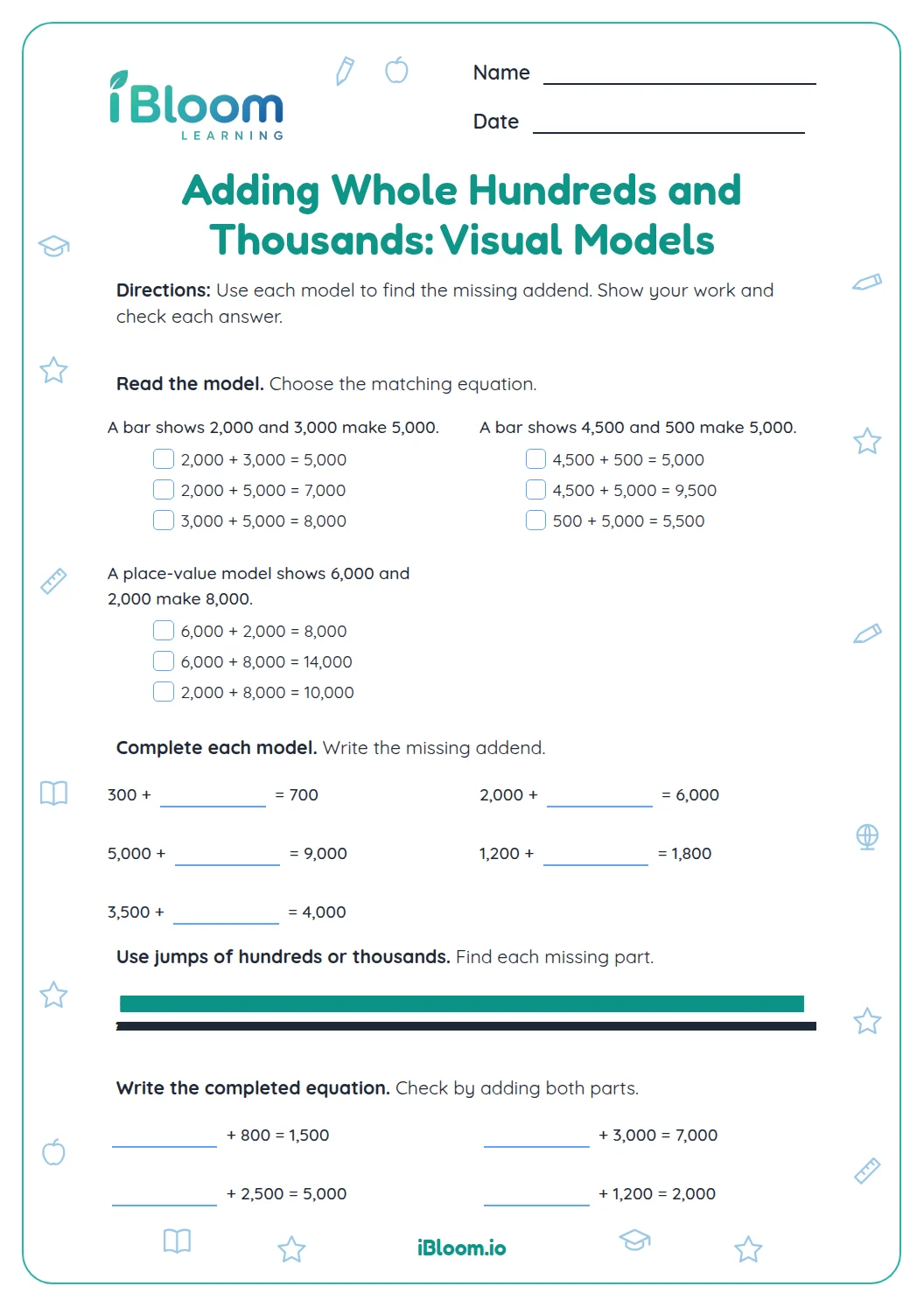
This free Grade 4 worksheet makes a missing addend visible as the distance between two numbers. Part A pairs four equations with number lines whose steps are 1,000. Part B moves to six equations with the blank in either addend position. Part C gives a reading-goal problem and a bottle-collection problem and asks children to subtract in columns, then check by adding. All quantities are whole thousands, with totals up to 18,000. The practice supports Common Core 4.NBT.B.4 through multi-digit addition and subtraction. A separate answer key supplies all 12 missing amounts.
Aligned to 4.NBT.B.4
What does each number line show?
Each model begins at the known addend and ends at the total. The labels at the ends identify those two values. Every interval between adjacent tick marks represents 1,000, so children count the spaces they travel, not the number of marks.
For question 1, moving from 3,000 to 8,000 takes five intervals. Those five intervals represent 5,000, the amount added. This is different from starting at zero and reading a marked point: here the distance itself is the missing quantity.
- 13,000 + ___ = 8,000
- 2Move from 3,000 to 8,000 in five steps of 1,000.
- 35 × 1,000 = 5,000
- 4Check: 8,000 − 3,000 = 5,000 and 3,000 + 5,000 = 8,000.
Does moving the blank change how children solve?
No. In both ___ + 4,000 = 11,000 and 4,000 + ___ = 11,000, the unknown is the part needed to make 11,000. Subtracting 4,000 from 11,000 gives 7,000 in either arrangement.
Part B places blanks before and after the plus sign so children have to identify the known part and the total. Ask them to point to the total before calculating, then insert their answer and read the complete equation.
How do the models connect to column arithmetic?
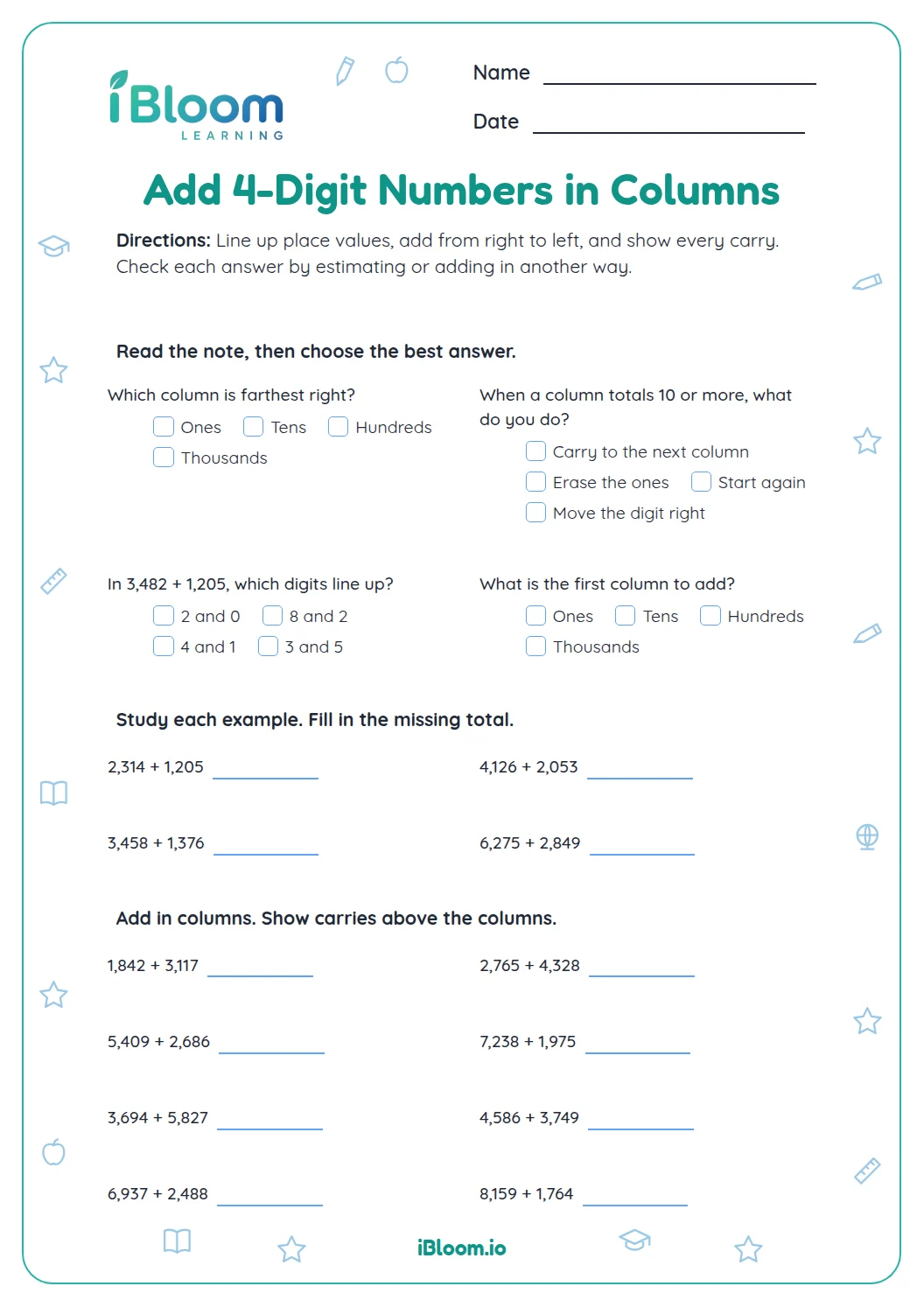
Part C applies the same idea to a reading goal and a bottle collection. Children write the total over the known amount, align the place values, and subtract. They then add the two parts in columns to confirm the total.
For the reading goal, 15,000 − 8,000 = 7,000 pages remain. The ten-thousands unit can be regrouped as ten thousands. Adding 8,000 and 7,000 gives 15 thousands, or 15,000. The number-line work gives meaning to that column calculation.
How to use this worksheet
- 1Point to the two end labels of the first number line and read them aloud.
- 2Move a finger across each interval from 3,000 to 8,000, counting 4,000, 5,000, 6,000, 7,000, 8,000.
- 3Count the five moves and write 5,000 in the blank; finish the other number-line problems.
- 4Complete Part B by subtracting the known addend from the total and checking the finished equation.
- 5For Part C, align digits in columns, subtract, and add the answer to the known amount.
- 6Use the key to review the missing amounts, then revisit any error on a thousand-step line.
Mistakes to watch for
The mistake
Counting both end tick marks and answering 6,000 for question 1.
The fix
Count the spaces crossed. Six tick marks enclose five intervals, and five intervals mean 5,000.
The mistake
Writing 5 instead of 5,000 after counting five intervals.
The fix
Say “five thousands” before writing. Each interval represents 1,000, not one.
The mistake
Adding the known part to the total, such as 4,000 + 11,000 in question 7.
The fix
Identify 11,000 as the whole. Find its missing part with 11,000 − 4,000, then add back to check.
Common Core alignment
Find missing thousands by subtraction and check by adding in columns.
On this sheet: Part C explicitly asks for column subtraction and addition checks, building on the number-line models.
Show the official wordingHide the official wording
Fluently add and subtract multi-digit whole numbers using the standard algorithm.
What to practice next
Make more practice
Further reading
Questions parents and teachers ask
Why do these number lines start above zero?
They start at the known addend so children can see only the distance they need to add. In question 1, the line begins at 3,000 and ends at 8,000. Counting the five intervals gives the missing 5,000 directly, without counting the part that is already known.
Should my child count tick marks or spaces?
Count the spaces between adjacent tick marks. Those intervals represent moves of 1,000 each. The starting mark identifies where the child begins, so it is not an added thousand. Trace the line from 6,000 to 10,000 together to see four moves and a missing addend of 4,000.
Can children solve the equations mentally?
Yes; thinking in thousands is useful for Parts A and B. For example, 16 thousands minus 9 thousands leaves 7 thousands. Part C then asks children to record subtraction and addition in columns, connecting that mental reasoning with the written calculation and a check of each answer.
What should children write for the two word problems?
Children should record the missing amount with its unit and show a column subtraction and addition check. The school needs 7,000 more pages, and the town needs 9,000 more bottles. The answer key gives those final amounts; the working space lets you check how the child found them.
What if my child gets the amount right but drops a zero?
Have your child read the answer aloud in thousands and compare it with one interval on a model. An answer of 7 means seven ones, while seven intervals represent 7,000. Inserting the written answer into the original equation makes the difference visible and provides a useful final check.