
About this worksheet
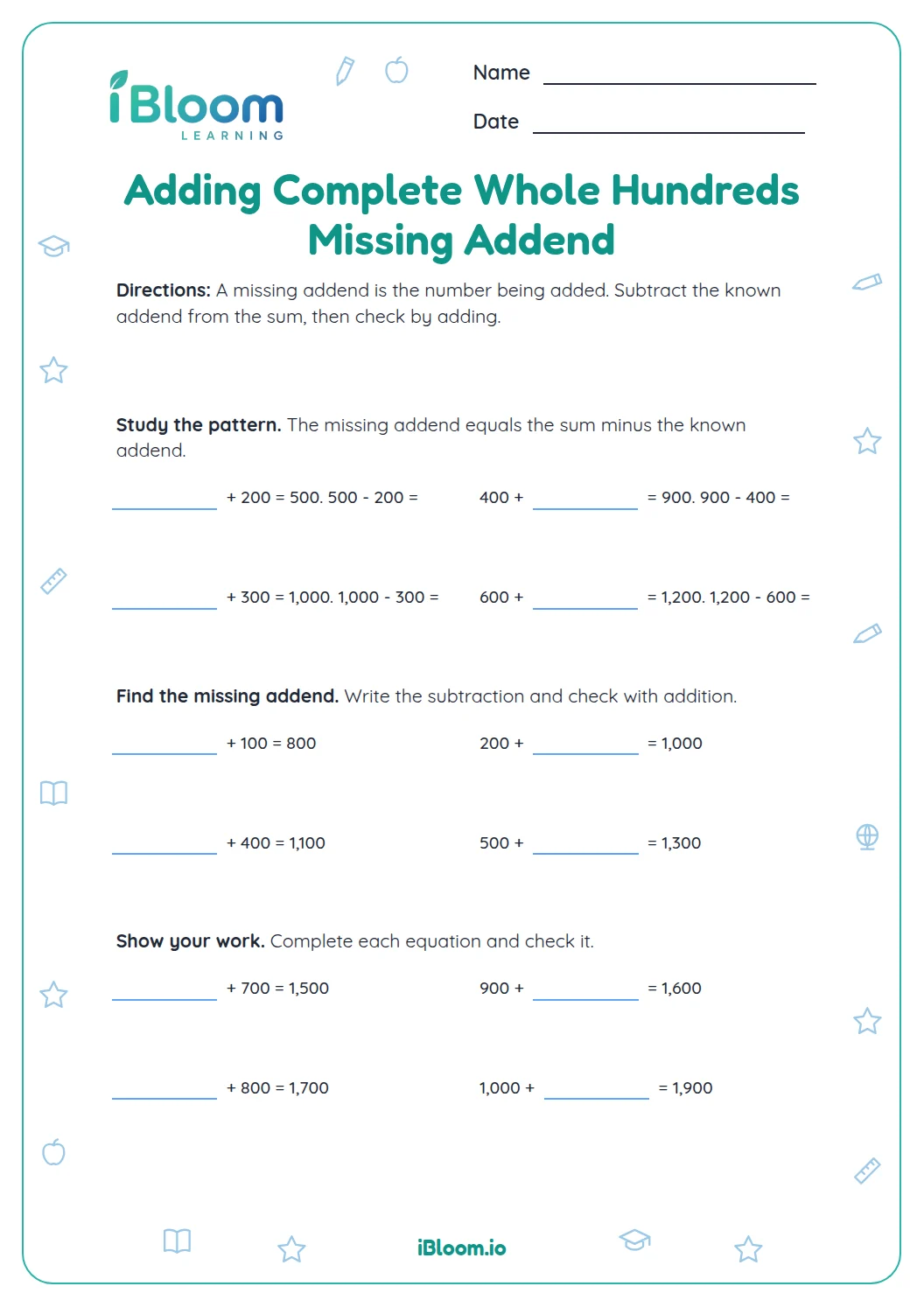
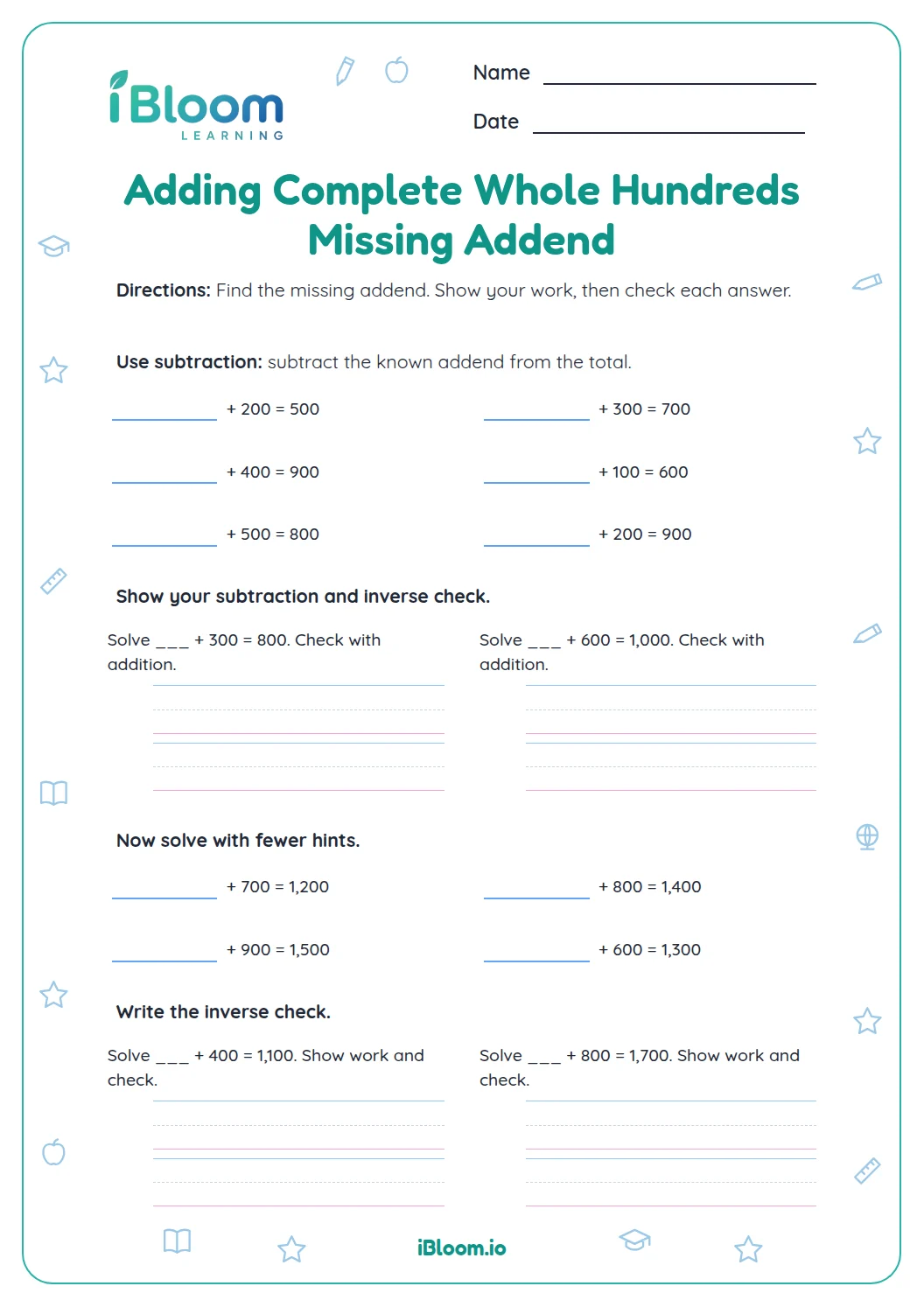
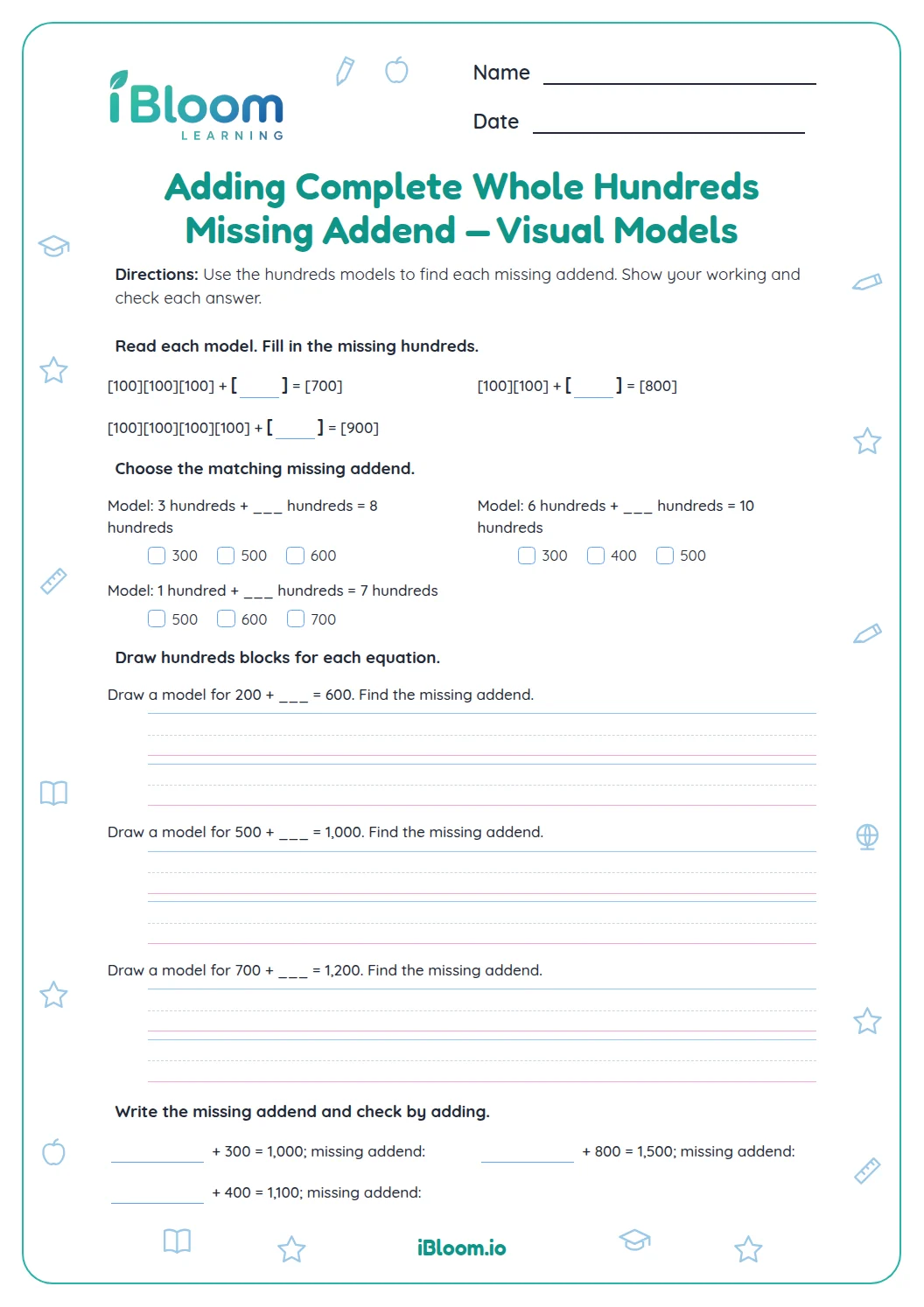
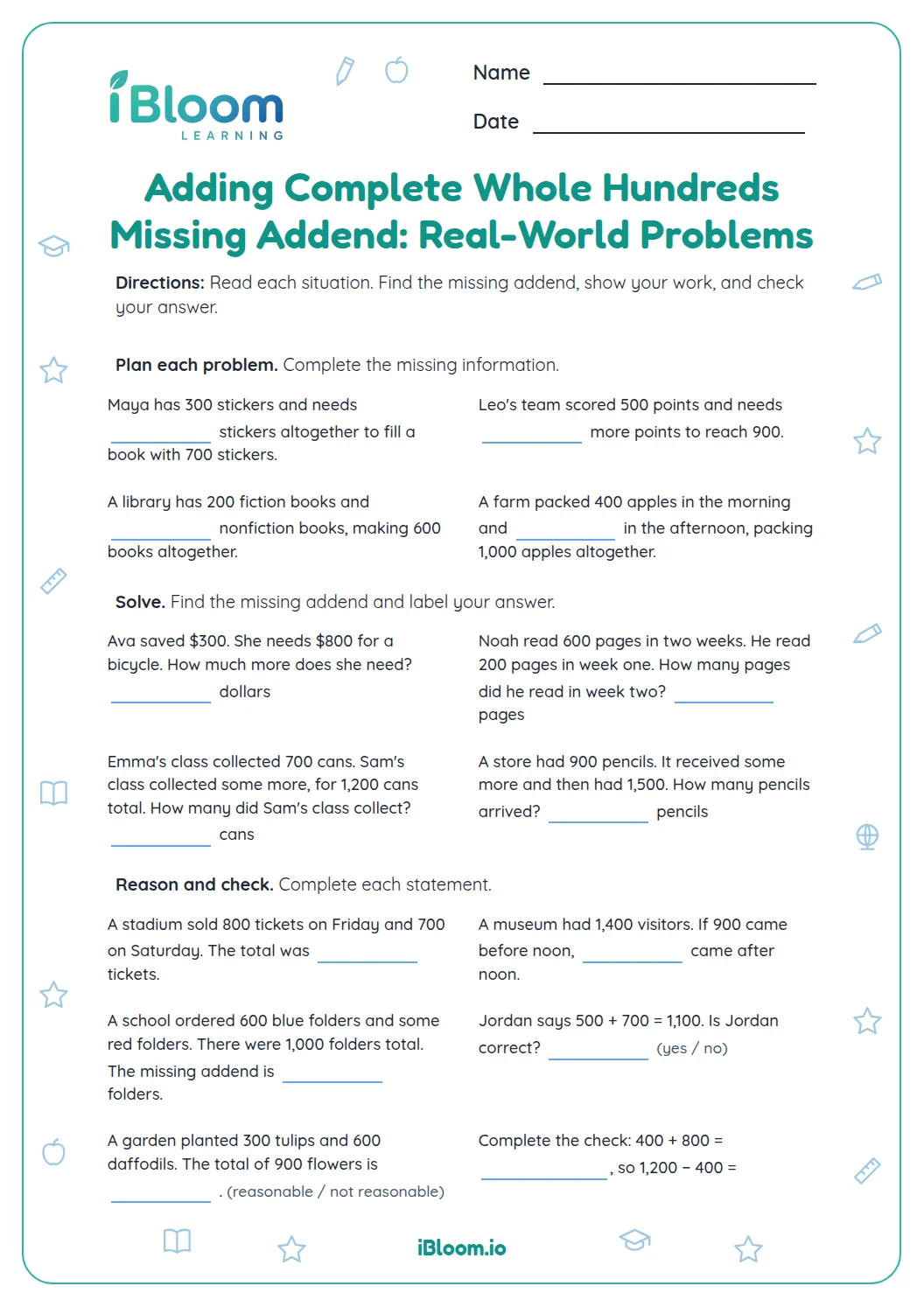
This Grade 4 worksheet practices finding a missing whole-hundred addend. Learners solve ten number sentences and six short word problems, then check by addition. It practices CCSS 4.NBT.B.4 and includes a separate answer key for reviewing each result.
Aligned to 4.NBT.B.4
How do you find a missing whole-hundred addend?
Subtract the known addend from the total, then add to check. The first ten questions vary which addend is missing; the last six put the same relationship into short situations.
- 1300 + ___ = 1,000
- 21,000 − 300 = 700
- 3Check: 300 + 700 = 1,000
How do the word problems use the same idea?
Each situation gives a starting amount and a total, or gives one addend and the total. Subtract the known amount from the total to find the missing amount.
How can an adult check the reasoning?
Ask the learner to name the total and the known addend before calculating. Then check by adding the two parts.
How to use this worksheet
- 1Find the total and the addend already given.
- 2Subtract the known addend from the total.
- 3Write the missing amount in the blank.
- 4Add both addends to check the total.
Common mistakes and quick fixes
The mistake
Subtracting in the wrong order
The fix
Subtract the known addend from the total, then add to check.
The mistake
Dropping a zero in a whole hundred
The fix
Read each amount by hundreds; 1,600 is sixteen hundreds.
The mistake
Writing the known addend in the blank
The fix
Check the equation by adding both addends to the total.
Curriculum alignment
Add and subtract multi-digit whole numbers, including whole-hundred amounts.
On this sheet: Learners find missing whole-hundred addends by subtraction and check with addition.
Show the official wordingHide the official wording
Fluently add and subtract multi-digit whole numbers using the standard algorithm.
What to practice next
Make more practice
Further reading
Questions parents and teachers ask
What is a missing addend?
A missing addend is the amount that completes an addition sentence. In 300 + ___ = 1,000, subtract 300 from 1,000 to get 700. Check by adding 300 + 700 to make 1,000. The worksheet practices this with equations and short situations.
How can a learner solve 1,100 + ___ = 2,700?
Subtract the known addend, 1,100, from the total, 2,700: 2,700 − 1,100 = 1,600. The missing addend is 1,600. Check it with 1,100 + 1,600 = 2,700, just as learners do on the equation section. This gives a way to check the answer without relying on guesswork.
Why are the numbers multiples of 100?
Every equation uses amounts that are complete hundreds, such as 400, 1,200, or 3,600. That lets learners focus on how addition and subtraction connect while reasoning about whole-hundred amounts in equations and stories. The equations and stories use the same addition relationship throughout.
What is in the word problem section?
The six situations involve chairs, fruit, books, walking distance, visitors, and boxes. Each gives a known amount and a total, then asks for the amount that is missing. Subtract to find it and add the two amounts to check. Learners can write the matching addition sentence before solving.
Is an answer key included?
Yes. The answer key lists all 16 results, including the missing addends in the equations and the amounts in the six stories. Learners can check by adding the known and missing amounts to confirm each total. For checking, add the known amount and the answer together.