


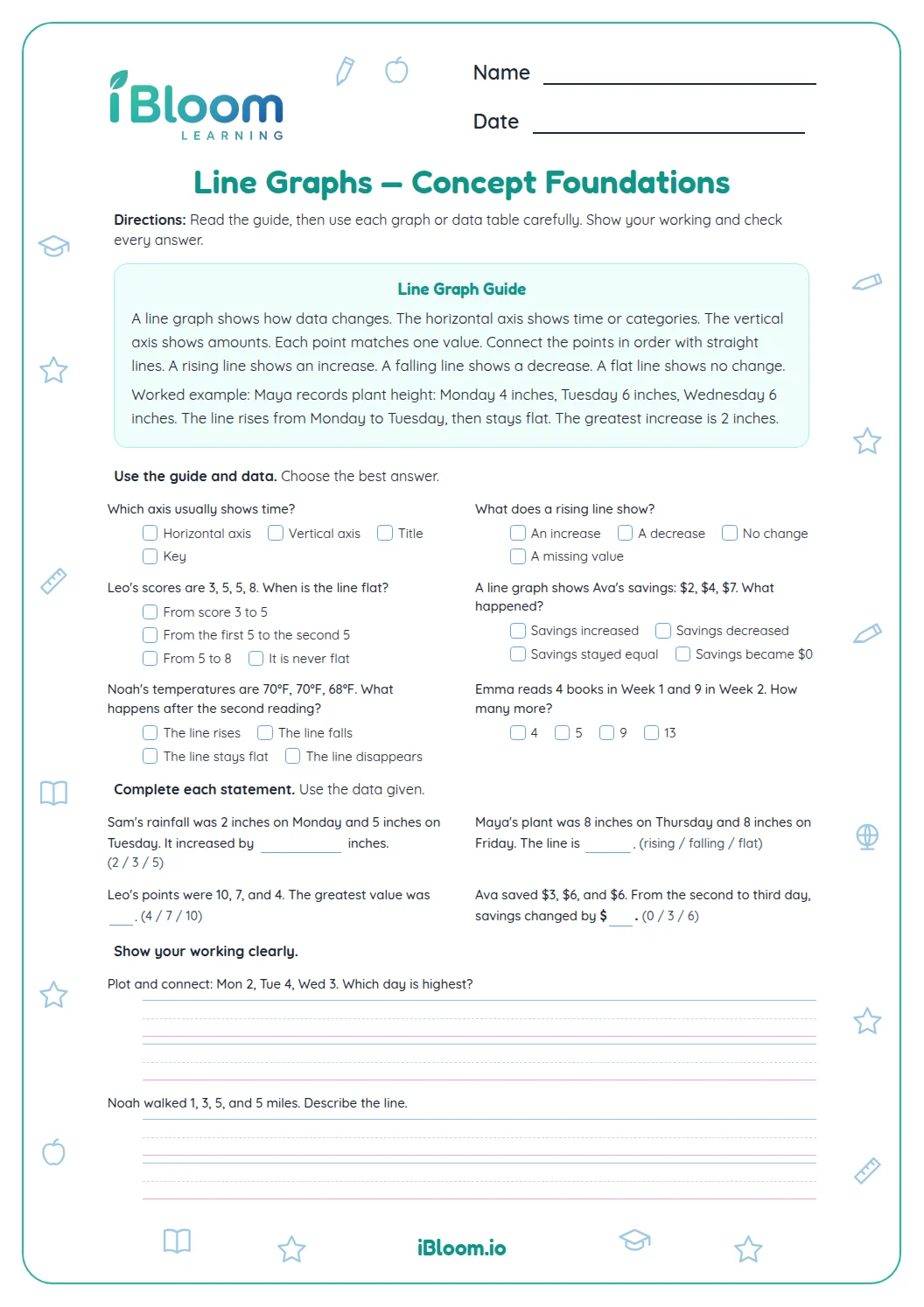
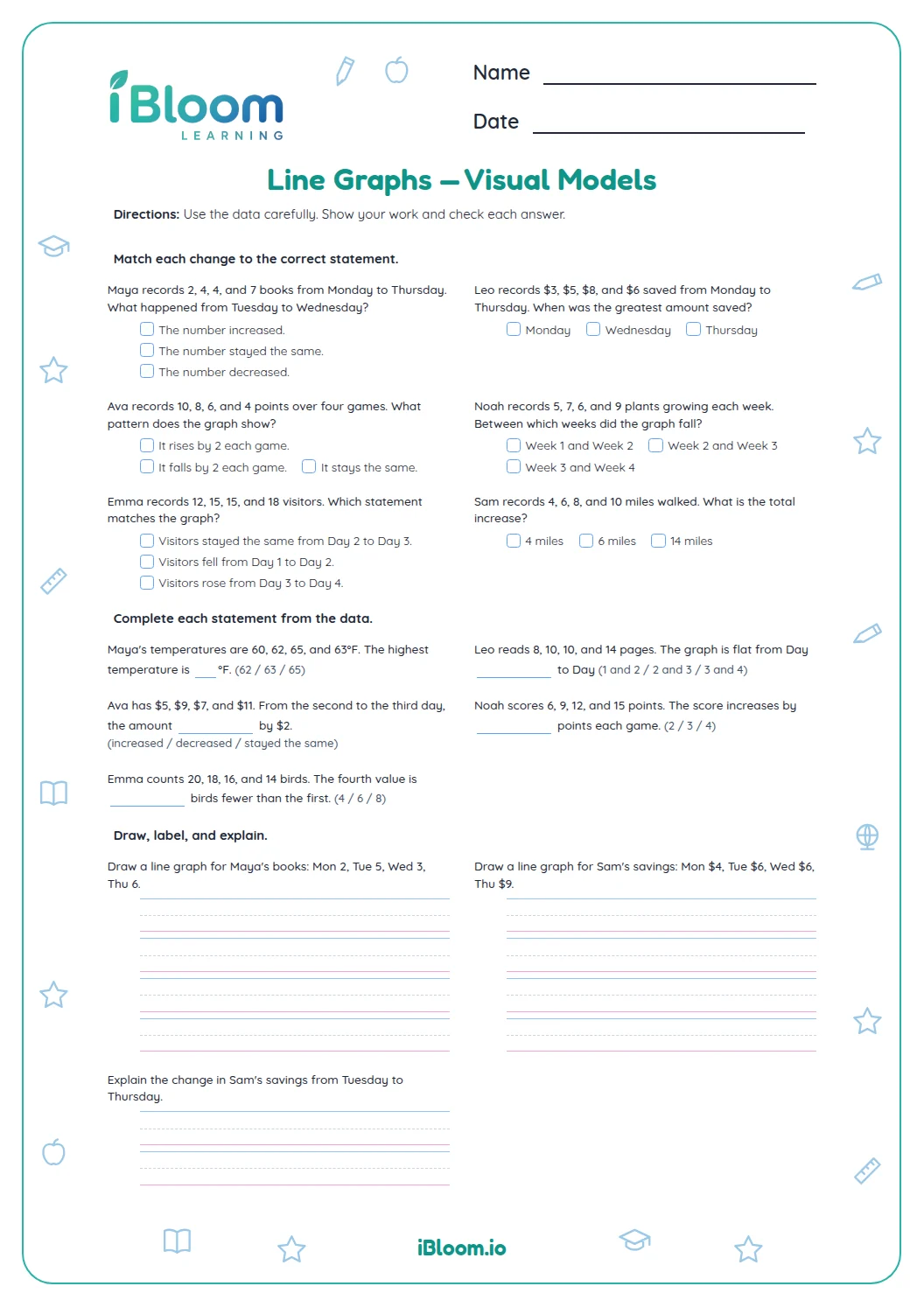
About this worksheet
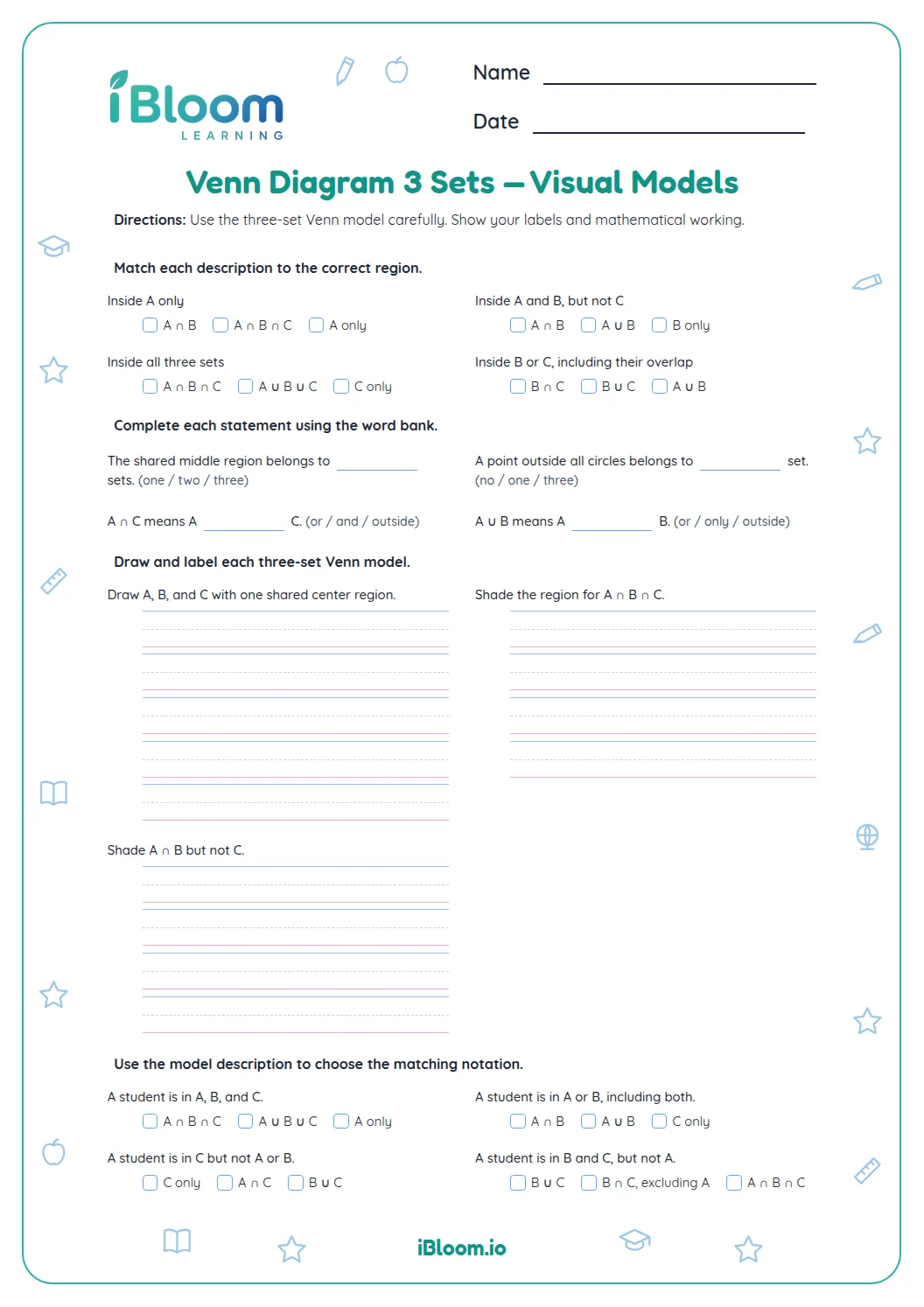
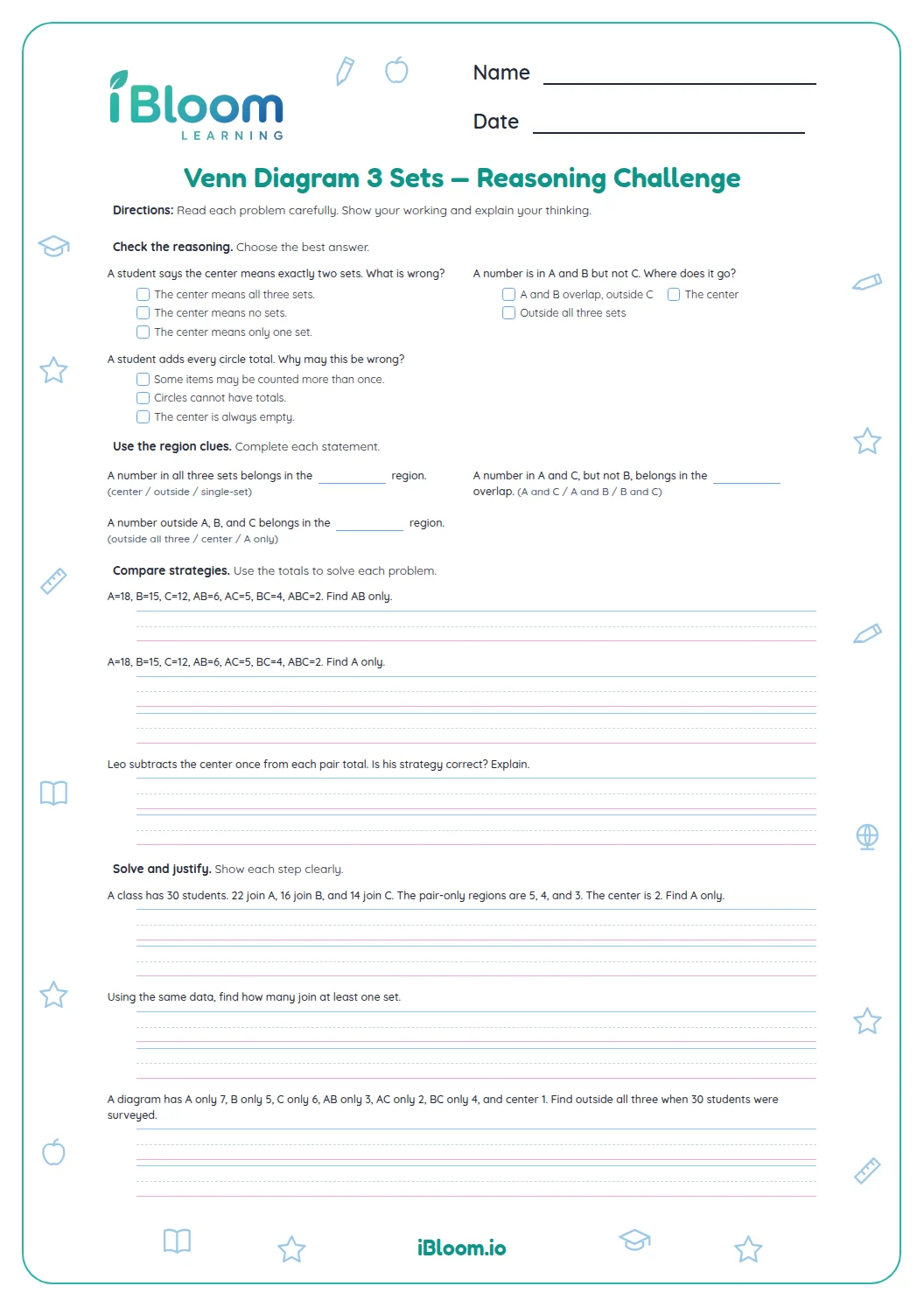
This Grade 4 worksheet practices reading three-set Venn diagram regions and set notation. Learners distinguish unions from intersections, sort examples by which sets contain them, and explain membership using the letters A, B, and C. It includes 16 questions and a separate answer key.
What do the regions show?
Each circle stands for one set. A region inside two circles represents membership in both sets, while the center represents membership in all three. A point outside a circle does not belong to that set.
For example, A and B but not C belongs in the overlap of A and B outside C.
How do union and intersection differ?
The intersection A ∩ B means an item is in both A and B. The union A ∪ B means an item is in A, in B, or in both. A ∩ B ∩ C names the center shared by all three circles.
What does this worksheet practice?
Part A introduces the three circles and notation. Part B matches specific membership clues to regions. Part C explains why each region includes or excludes named sets.
Use the worksheet
- 1Label circles A, B, and C before placing any examples.
- 2For “and,” check that every named set contains the item.
- 3For “or,” include membership in either set or both.
- 4Use the answer key to discuss why an item belongs in a region.
Common mix-ups
The mistake
Reading A ∩ B as A or B.
The fix
The intersection requires membership in both sets.
The mistake
Putting an A-and-B item in the center automatically.
The fix
The center also requires membership in C.
What to practice next
Make more practice
Questions parents and teachers ask
What does the middle region of a three-set Venn diagram represent?
The middle region is shared by all three circles. An item belongs there only when it is a member of A, B, and C at the same time. If it belongs to just A and B, place it in the A-and-B overlap outside circle C. That distinction helps make each region precise.
What is the difference between union and intersection?
Union, written with ∪, collects items in either named set or in both sets. Intersection, written with ∩, collects only items that belong to both named sets. For three sets, A ∩ B ∩ C is the region shared by all three circles. Say “or, or both” for union and “both” for intersection.
Does an item in A and B always belong in the center?
No. The center requires membership in C as well as A and B. If the item belongs to A and B but not C, it goes in the overlap between A and B outside the third circle. To check, ask whether the description includes all three set names.
How should a learner use the answer key?
Use the key to check the named region, then ask which sets contain the item. The short written explanations are examples; another clear answer is correct when it names the same region and describes the same memberships. Ask the learner to point to each set clue that supports the choice.
How many questions and pages are included?
The printable has 16 questions in three parts. The worksheet fills three pages, followed by a three-page answer key. Learners first identify set relationships, then match membership clues to regions, and finally explain their reasoning. The key supports checking each response.