


About this worksheet
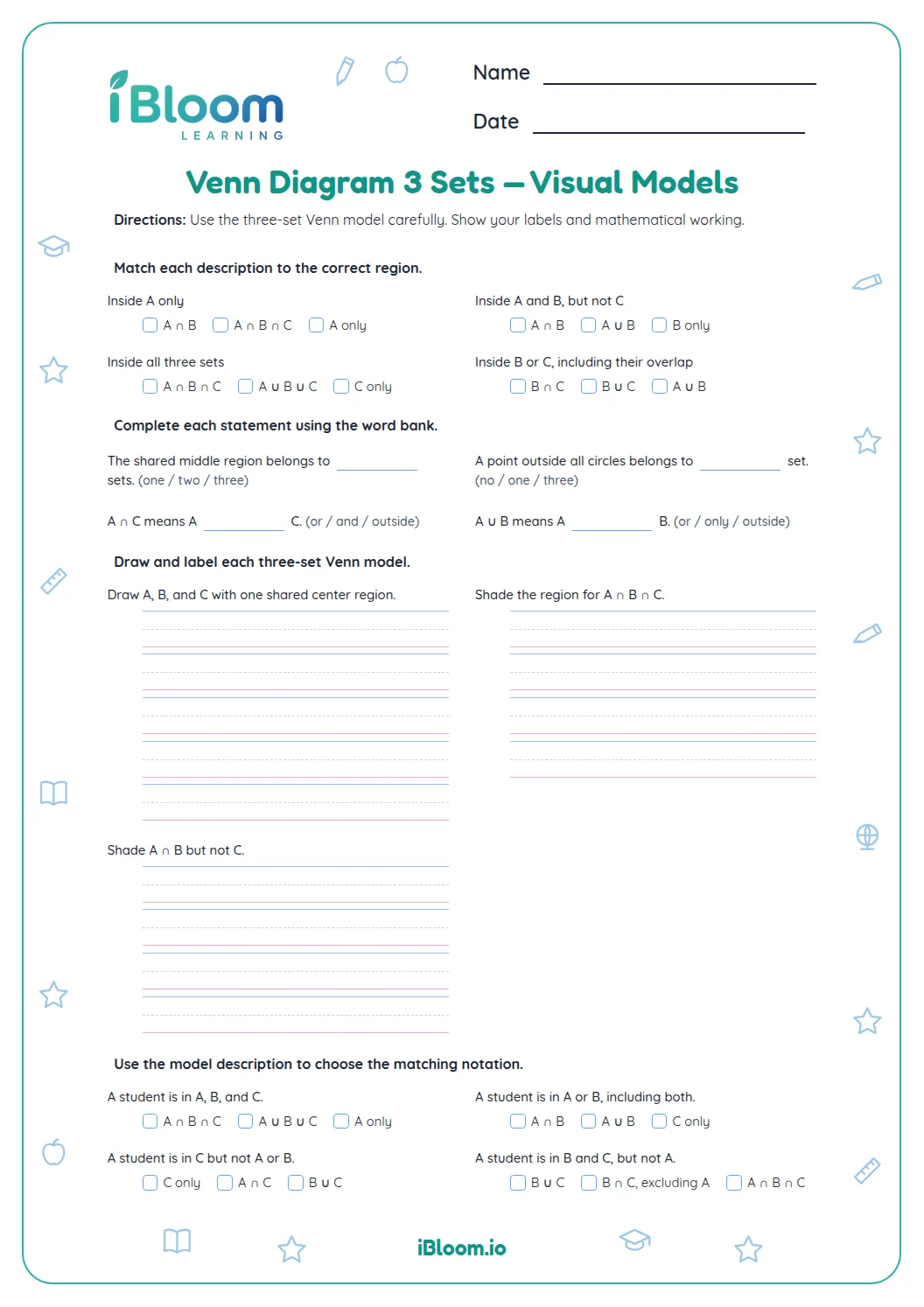
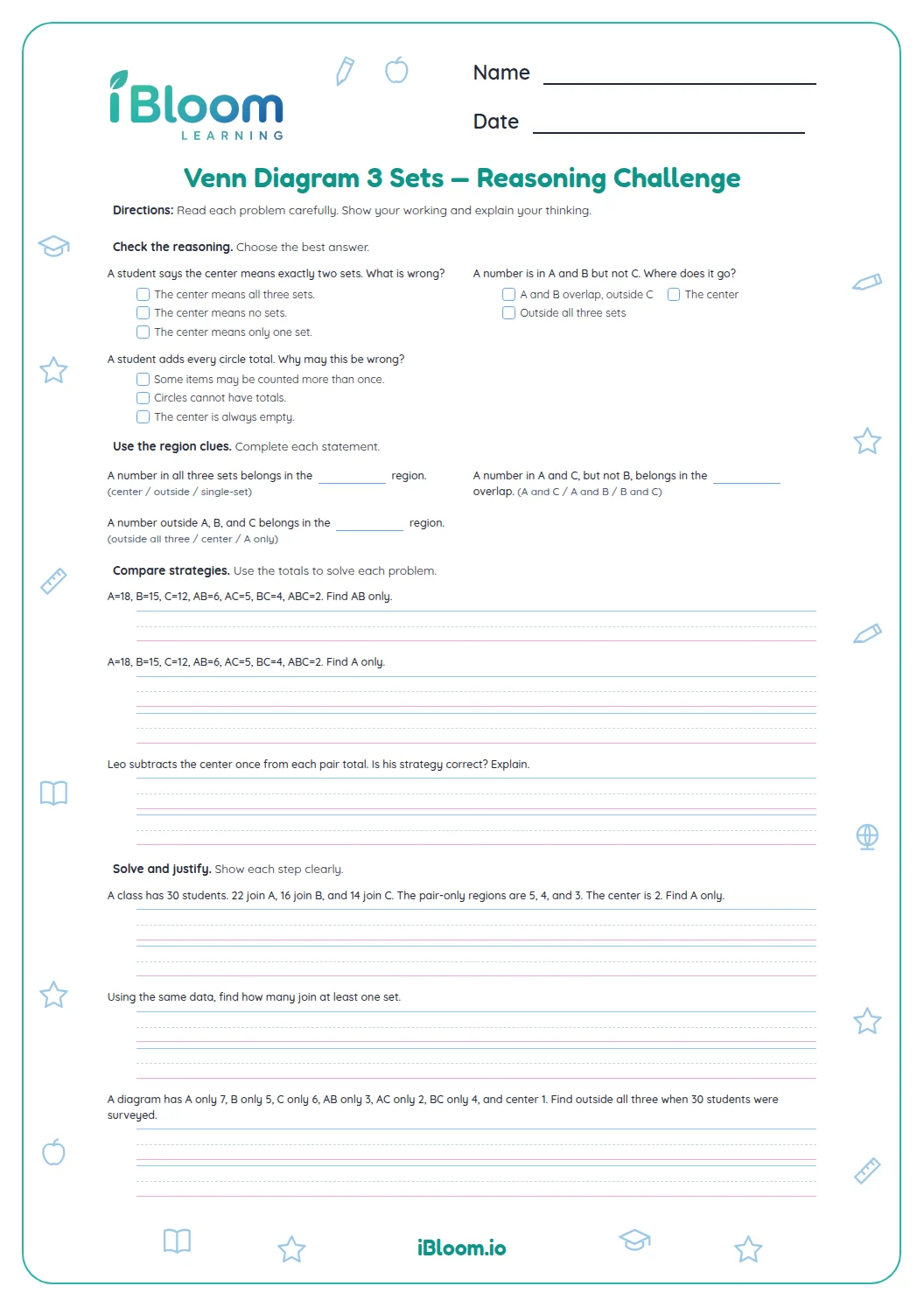
This Grade 4 worksheet builds the set-reading skill behind a three-set Venn diagram. Children inspect membership marks for reading, swimming, and cycling, then identify shared groups, single-category groups, and counts. The 16 questions move from direct lookups to comparisons. The old sheet asked children to place items in overlapping circles; this printable uses a membership table to preserve the same set relationships in a legible format.
How do you read three sets at once?
Check each category column separately. A Y means the person belongs to that set; an N means they do not. For “Reads and Cycles,” count only rows with Y in both columns. The table is repeated only at the start of the page.
How do you find an overlap?
Start with the two named columns and scan for two Y marks. Add the third condition only when the question says “but not” or “all three.”
- 1Cal has Y for Swims and Cycles, and N for Reads.
- 2So Cal is in Swims and Cycles but not Reads.
- 3Answer: Cal
What does this sheet ask children to find?
The 16 items move from naming one person to counting overlaps, single-set regions, and comparing totals. The repeated table keeps the data visible while children focus on set relationships.
How to use this worksheet
- 1Name the three categories before starting.
- 2For each question, underline the membership conditions.
- 3Scan the relevant columns and check every row.
- 4For “only,” confirm the other two columns say N.
- 5Use the answer key to review any missed row.
Common mistakes and quick fixes
The mistake
Counting an overlap when one condition is missing
The fix
Check every condition named in the prompt; an “and” requires both columns to be Y.
The mistake
Treating “only” as “includes”
The fix
For “Swims only,” require Y for Swims and N for the other two categories.
The mistake
Counting the same row twice
The fix
Mark each qualifying name once, then recount the names before writing the total.
What to practice next
Make more practice
Questions parents and teachers ask
How does the table connect to a three-set Venn diagram?
Each row records whether one person belongs to Reads, Swims, and Cycles. The yes and no marks correspond to regions in overlapping circles, so children can identify shared, single-set, and excluded groups. This printable uses a membership table because the worksheet template cannot draw overlapping circles.
What does “exactly two sets” mean?
It means a person belongs to two of the three groups and not the third. Cal, for example, belongs to Swims and Cycles but not Reads. Check all three columns before counting someone in that region, including the column for the set the person does not belong to.
How many people belong to Reads?
Five people belong to Reads: Ava, Ben, Dee, Flo, and Hal. Count each Y in the Reads column once. The other questions ask children to find overlaps and compare set totals, so they can use the same table for several kinds of set relationships.
Who belongs to all three sets?
Dee is the only person with a Y in Reads, Swims, and Cycles. Scan across each row and look for three yes marks; checking every column prevents counting someone who belongs to only two sets. A row-by-row check is a reliable way to find the all-three region.
How many questions are included?
The worksheet has 16 questions in two parts. The first part reads membership from the table; the second asks about exact regions, set totals, and comparisons. The answer key follows the same question numbers so adults can check each response.
How can I help if a learner is stuck?
Have the learner name each condition in the question, then check the matching columns one row at a time. For a “but not” question, look for a no in the excluded set. Count only after all of the conditions match the row.