





About this worksheet
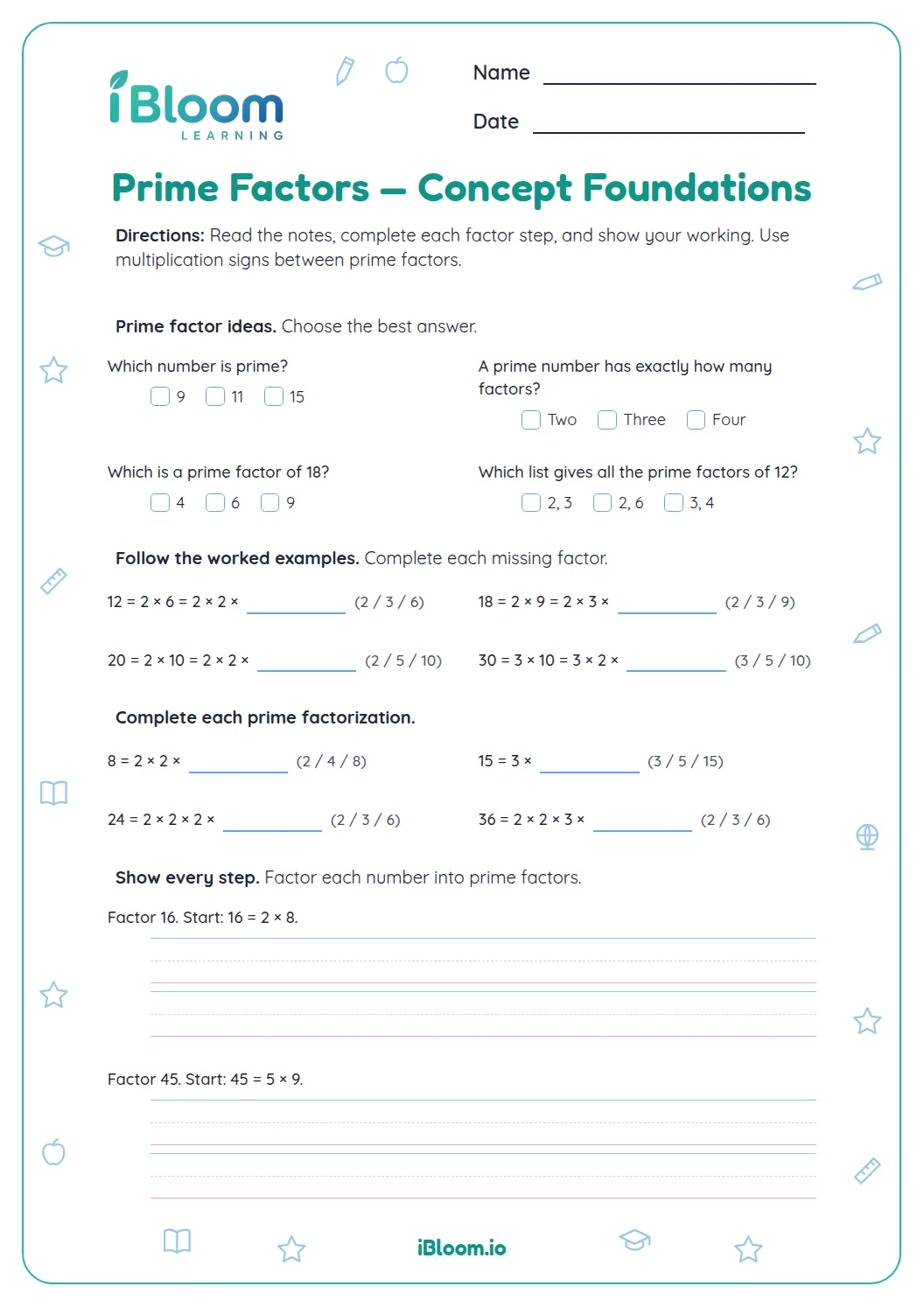
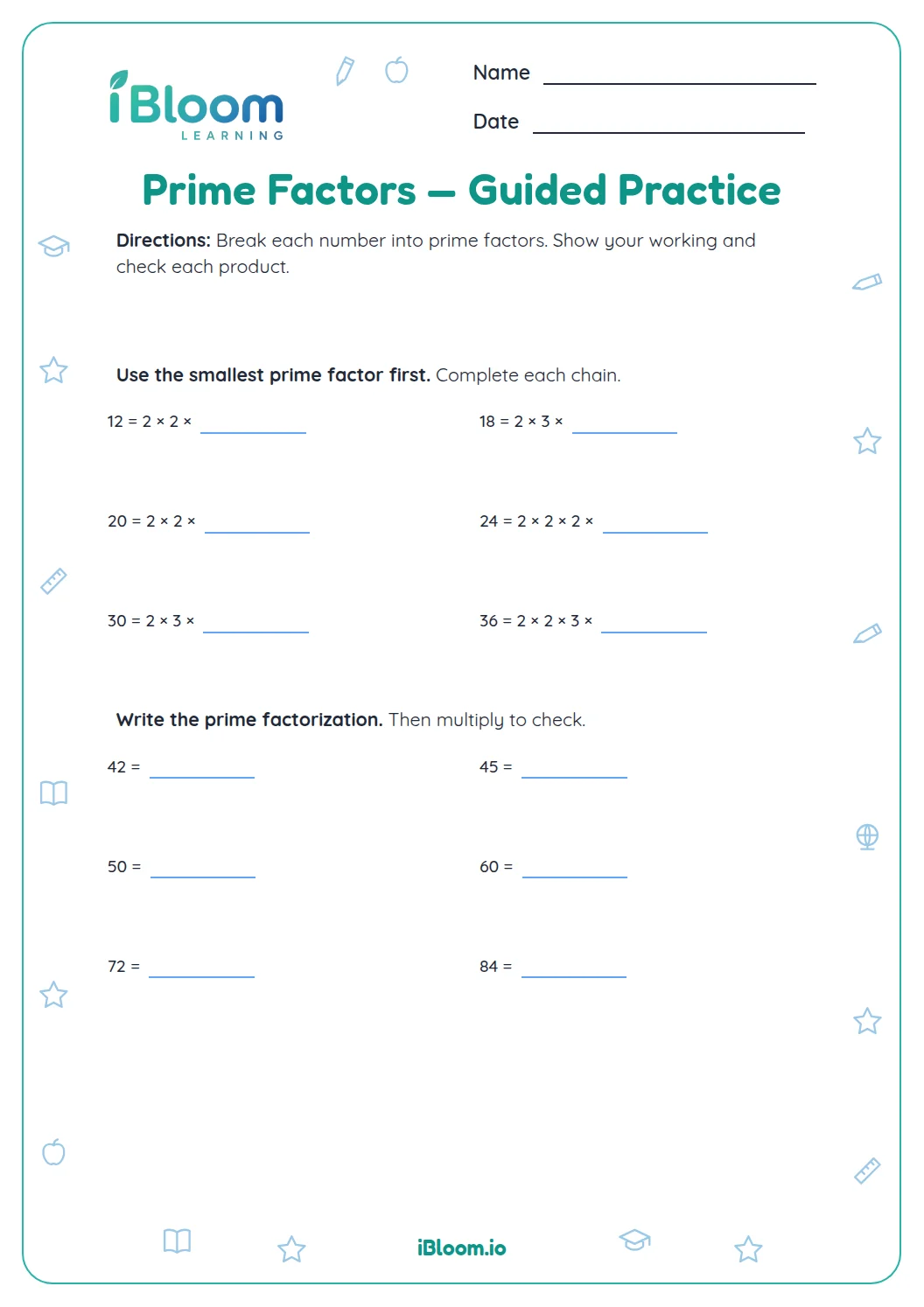
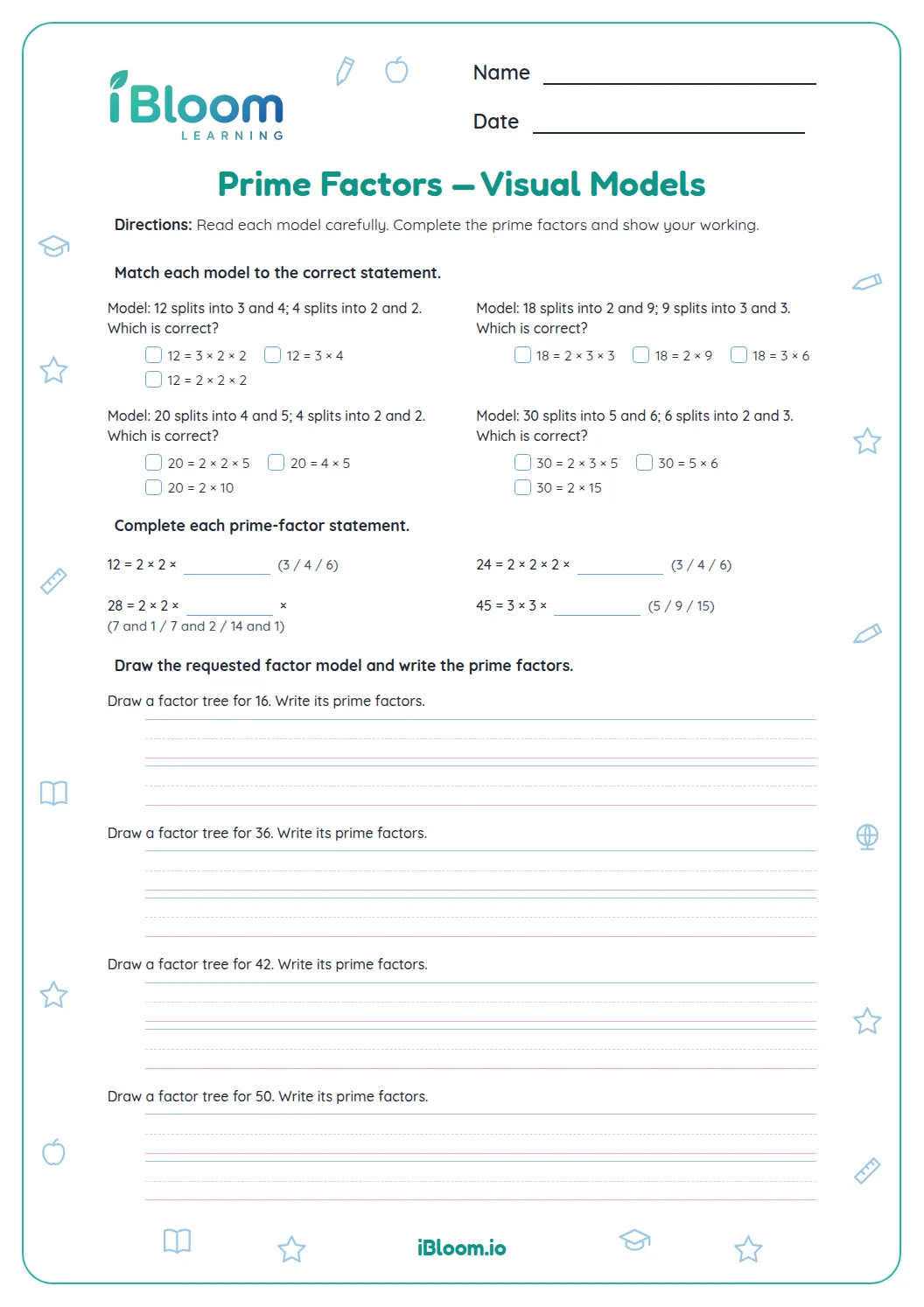
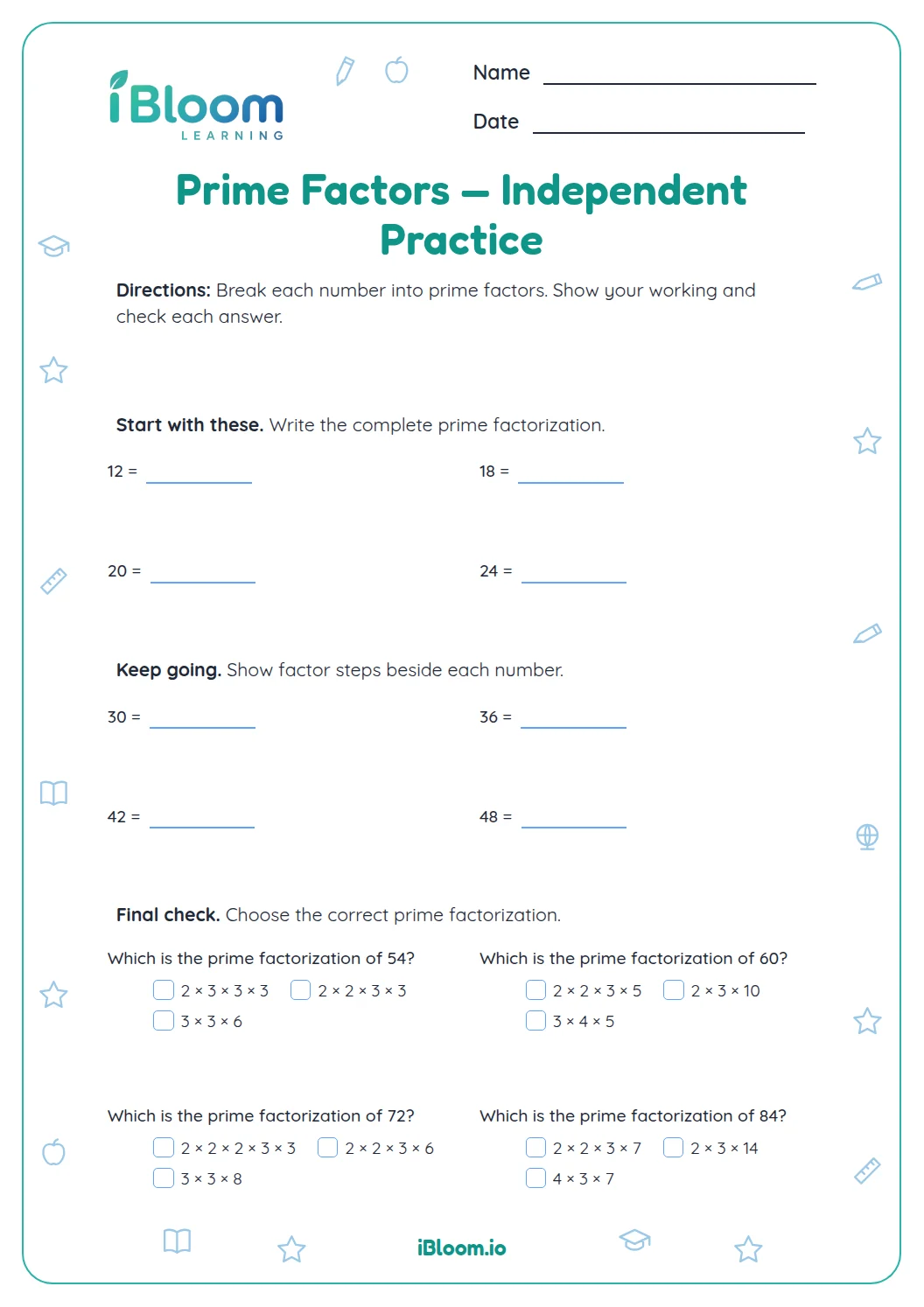
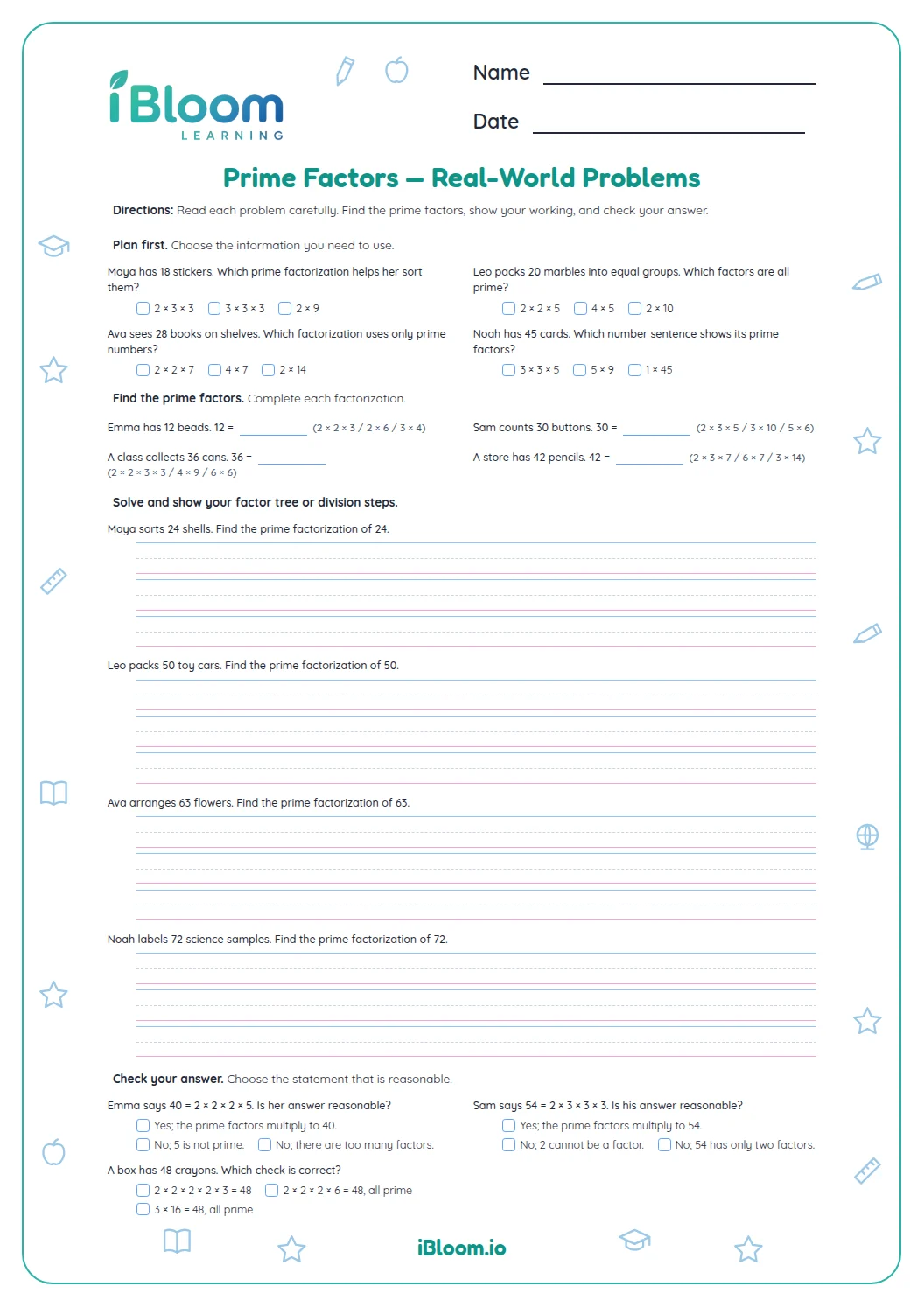
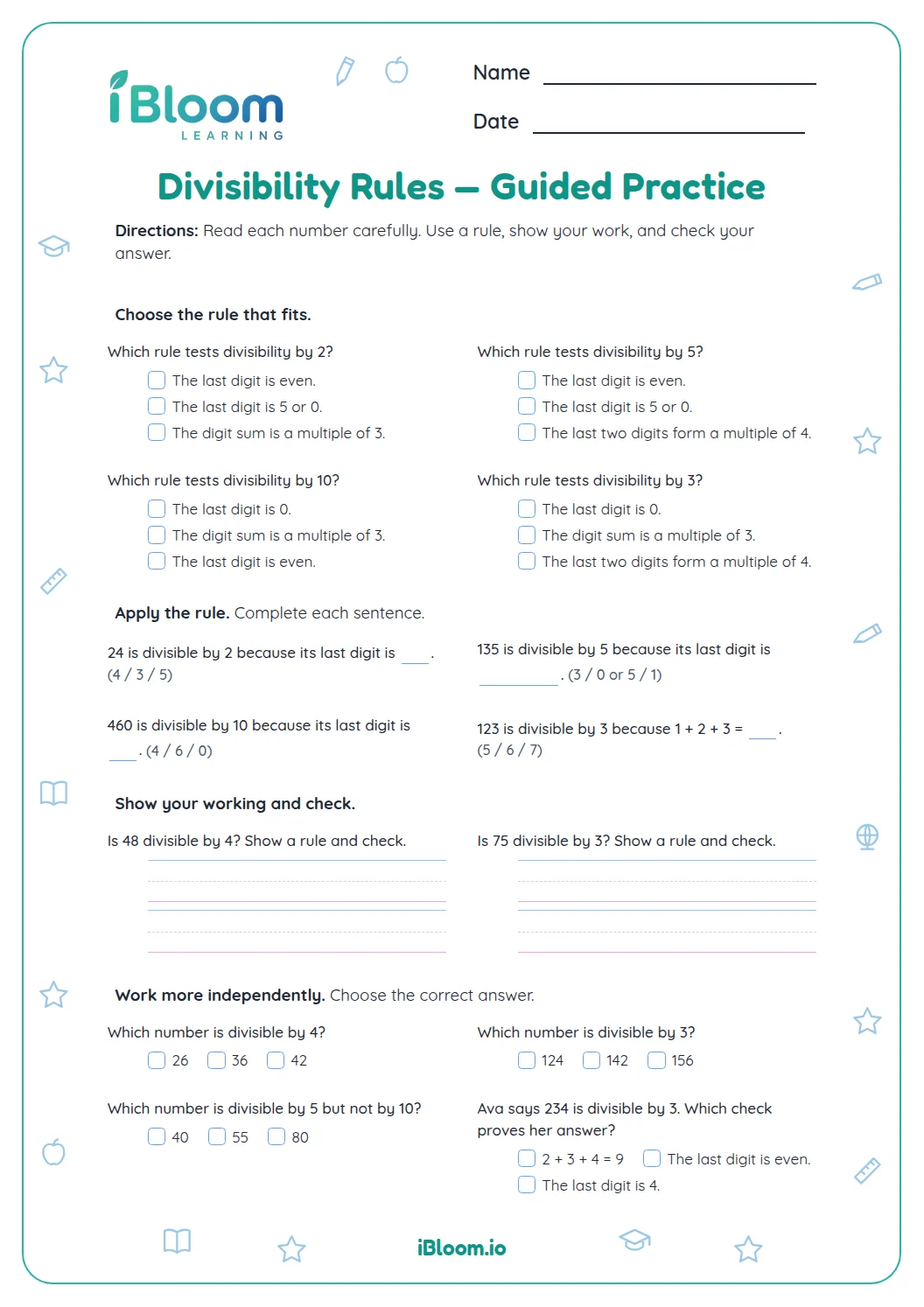
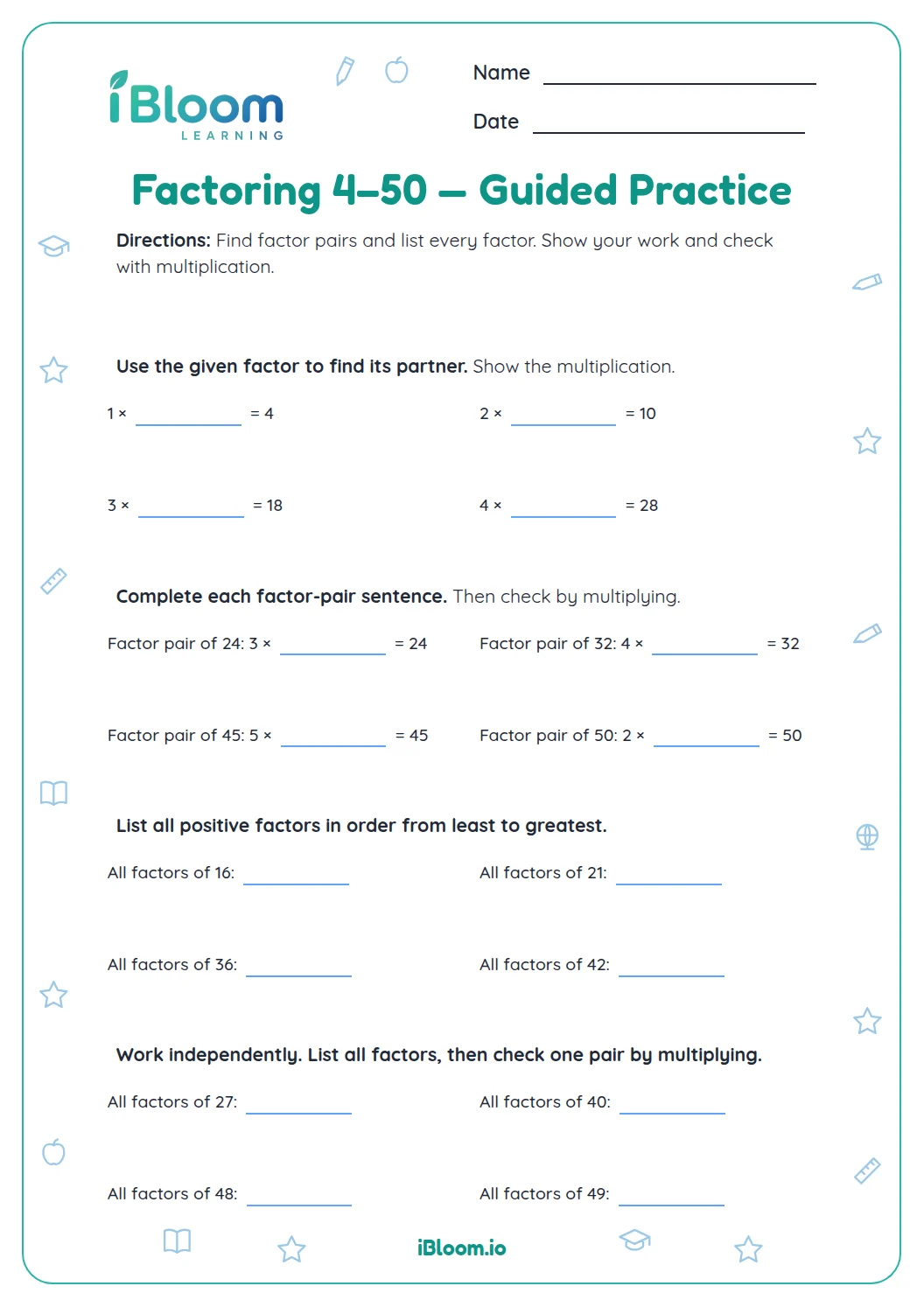
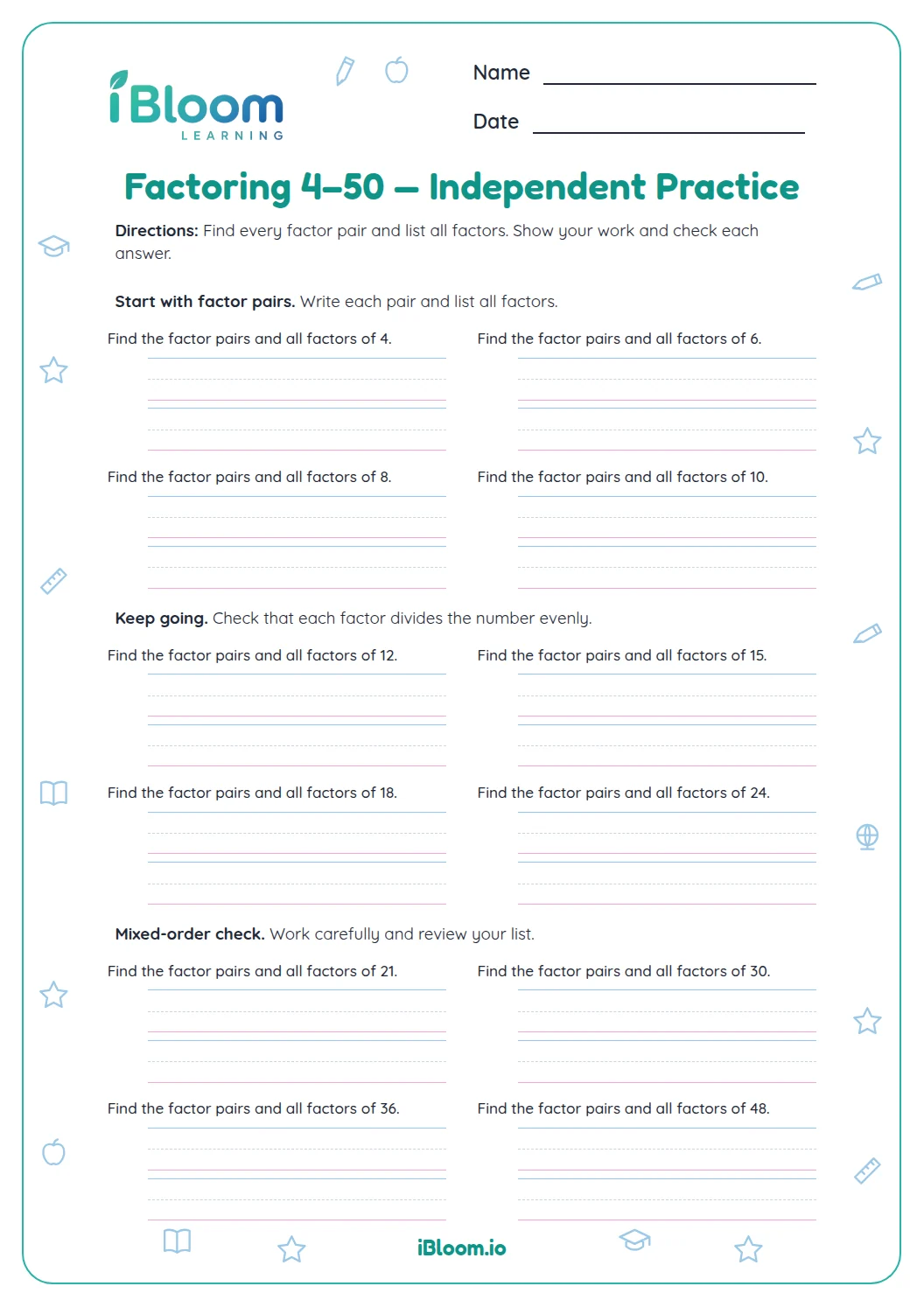
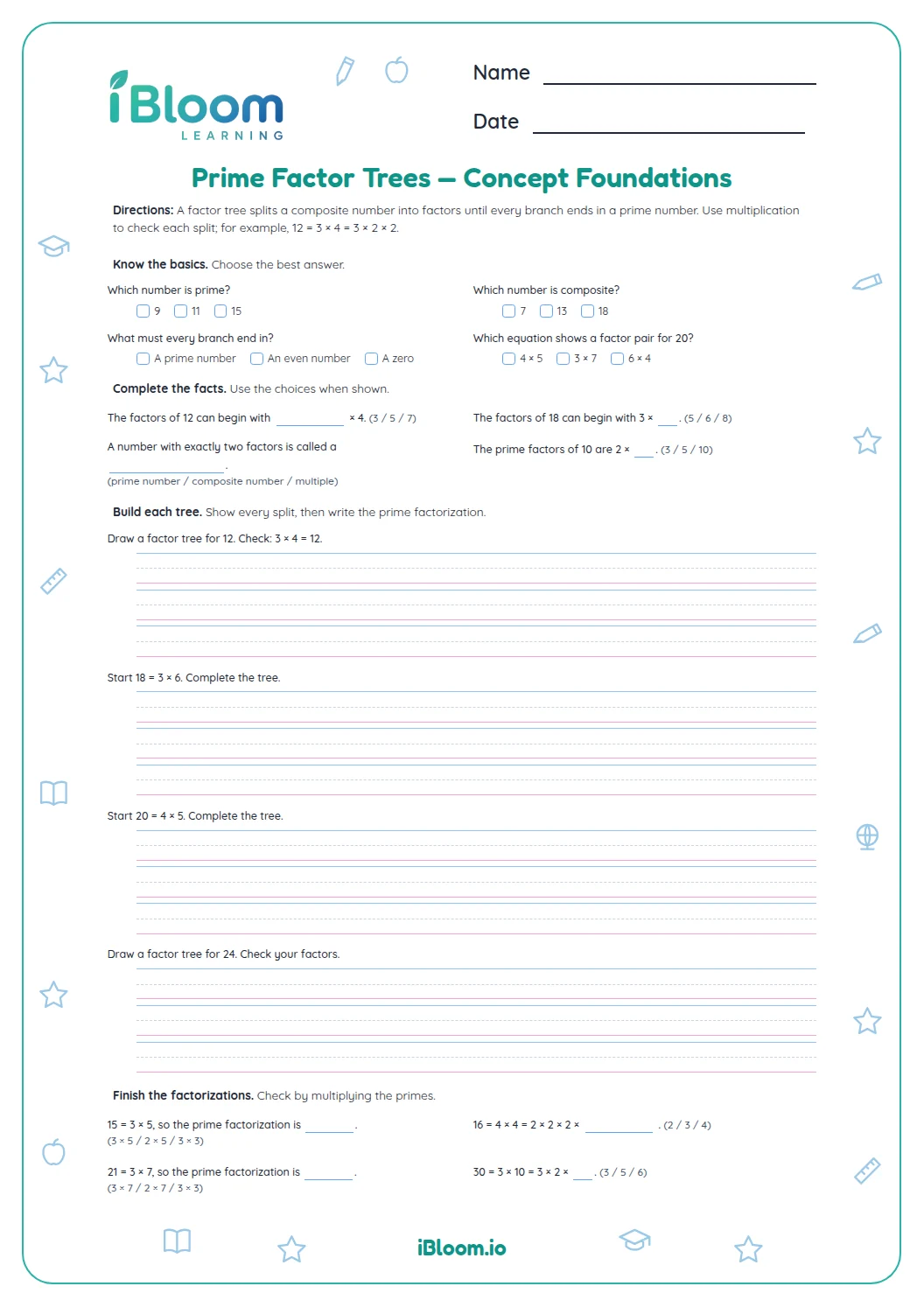
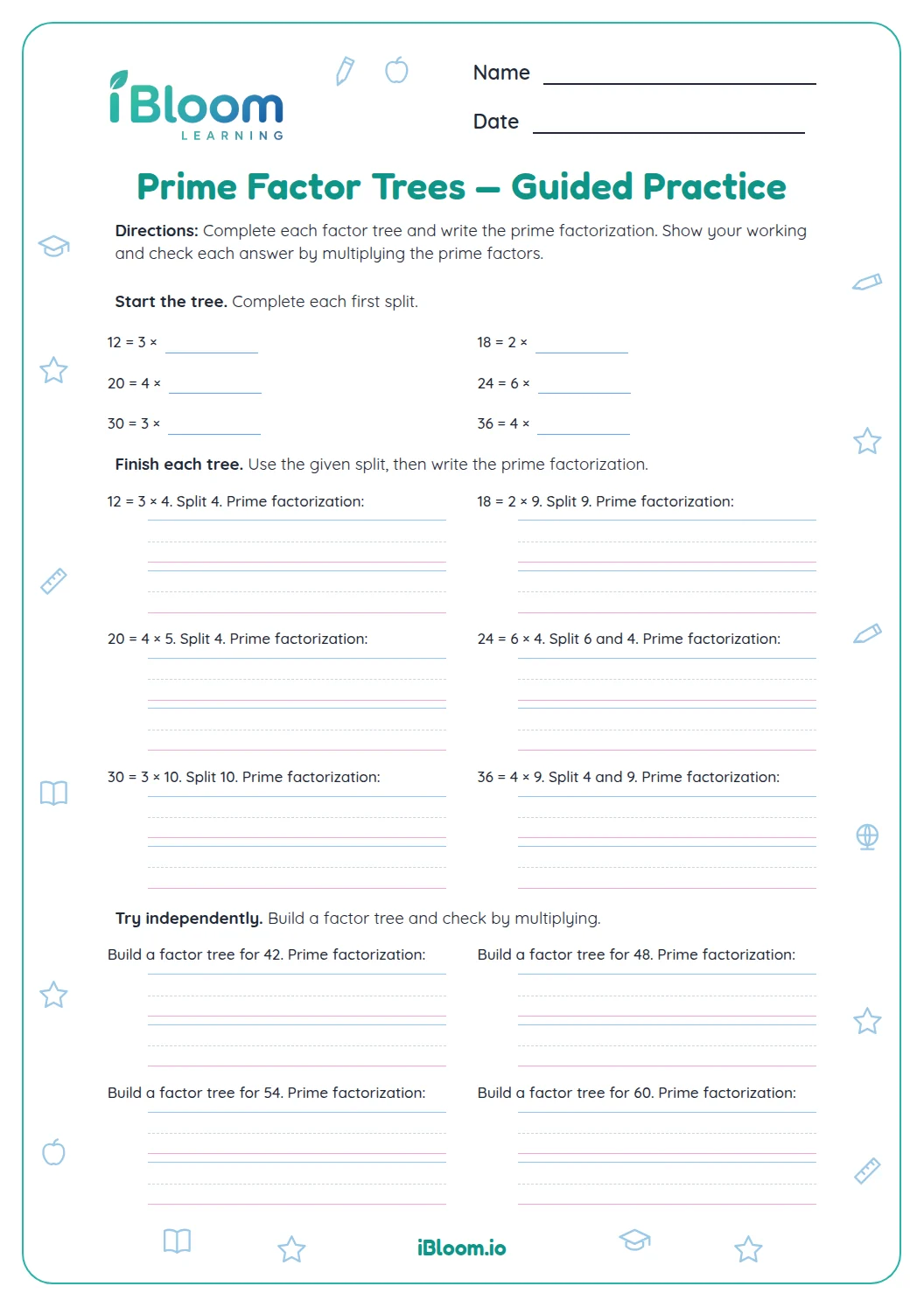
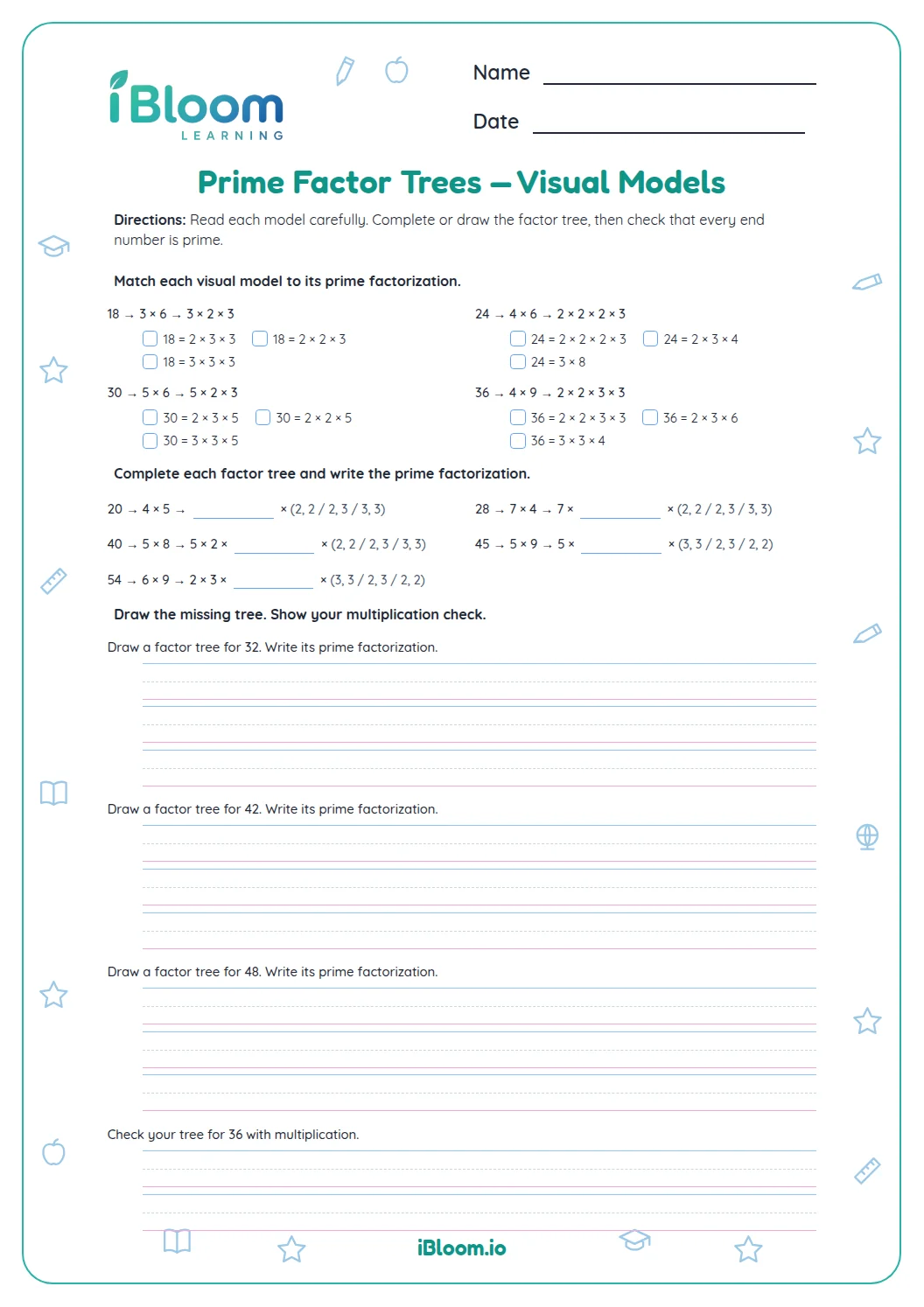
This Grade 4 math worksheet builds prime-factor reasoning through 14 questions. Students identify factor pairs, decide whether numbers are prime or composite, write prime factorizations, find a missing prime factor, correct an incomplete factorization, and use a factor pair in a tile-row situation. The separate two-page answer key includes a sample response for the final open-ended item. These tasks practice Common Core 4.OA.B.4, including factor pairs and prime or composite classification.
Aligned to 4.OA.B.4
How do factor pairs help you check a number?
A factor pair multiplies to make the number. To decide whether a number is prime, check whether it has a factor pair other than 1 and itself. Question 4 is composite because 5 × 7 = 35.
- 135 = 5 × 7.
- 2Both factors are greater than 1, so 35 is composite.
How do you build a prime factorization?
Keep splitting composite factors until each factor is prime, then check the product. For question 5, 24 = 2 × 2 × 2 × 3 = 2³ × 3. The exponent records the three factors of 2.
How can a factor pair model equal rows?
For 48 tiles, a factor pair gives the number of rows and the number of tiles in each row. The final question accepts any pair with both values greater than 1, such as 6 and 8.
How to use this worksheet
- 1Check whether a number has divisors other than 1 and itself before classifying it.
- 2Split composite factors until only primes remain.
- 3Multiply the prime factors back together to verify the product.
- 4For a missing factor, divide the target number by the factors already given.
- 5Use a factor pair for the tile question and confirm that its product is 48.
Common mistakes and quick fixes
The mistake
Stopping at 2 × 15 when writing a prime factorization of 30.
The fix
Keep factoring 15 into 3 × 5; every factor in the final product must be prime.
The mistake
Calling 29 composite because it is odd.
The fix
Test possible factors: no whole number greater than 1 besides 29 divides it evenly.
The mistake
Giving a row arrangement whose factors do not make 48.
The fix
Multiply the number of rows by tiles per row and check the product.
Curriculum alignment
This worksheet practices 4.OA.B.4 through its question set.
Find factor pairs and identify prime and composite numbers through factorization practice.
On this sheet: The questions directly practice the named skill through identification, application, and explanation.
Show the official wordingHide the official wording
Find all factor pairs for a whole number in the range 1-100. Recognize that a whole number is a multiple of each of its factors. Determine whether a given whole number in the range 1-100 is a multiple of a given one-digit number. Determine whether a given whole number in the range 1-100 is prime or composite.
What to practice next
Make more practice
Further reading
Questions parents and teachers ask
What is a prime factorization?
A prime factorization writes a number as a product of prime numbers. For example, 24 = 2 × 2 × 2 × 3, or 2³ × 3; each factor in the product is prime. Have students point to the clue in the question or passage and explain how it supports the choice they made.
How many questions are included?
There are 14 questions in four parts. Students begin with factor and prime checks, then write factorizations, complete missing factors, and apply the idea to a factor-pair situation. Have students point to the clue in the question or passage and explain how it supports the choice they made.
What does the last question ask students to do?
The final question asks for one factor pair for 48 tiles arranged in equal rows, with more than one row and more than one tile in each row. For example, 6 rows of 8 tiles is one valid arrangement. Have students point to the clue in the question or passage and explain how it supports the choice they made.
Can answers use a different order of prime factors?
Yes. Multiplication is commutative, so 2 × 2 × 2 × 3 and 3 × 2 × 2 × 2 represent the same prime factorization. The important checks are that every factor is prime and the product is correct. Have students point to the clue in the question or passage and explain how it supports the choice they made.
Which standard does this worksheet practice?
The worksheet practices CCSS 4.OA.B.4 through factor pairs for whole numbers and identifying primes and composites. Students also build those ideas into prime factorizations. Have students point to the clue in the question or passage and explain how it supports the choice they made.