






About this worksheet
This Grade 4 reasoning challenge keeps the old sheet’s focus on spotting comparison errors and choosing a strategy. Students work through 18 prompts: they diagnose a faulty comparison, use common denominators or matching parts, complete comparisons, and order fractions. A separate answer key lists each response. The practice includes mixed numbers and fractions and asks students to reason about which value is greater.
Aligned to 4.NF.A.2
What error can happen when comparing mixed numbers?
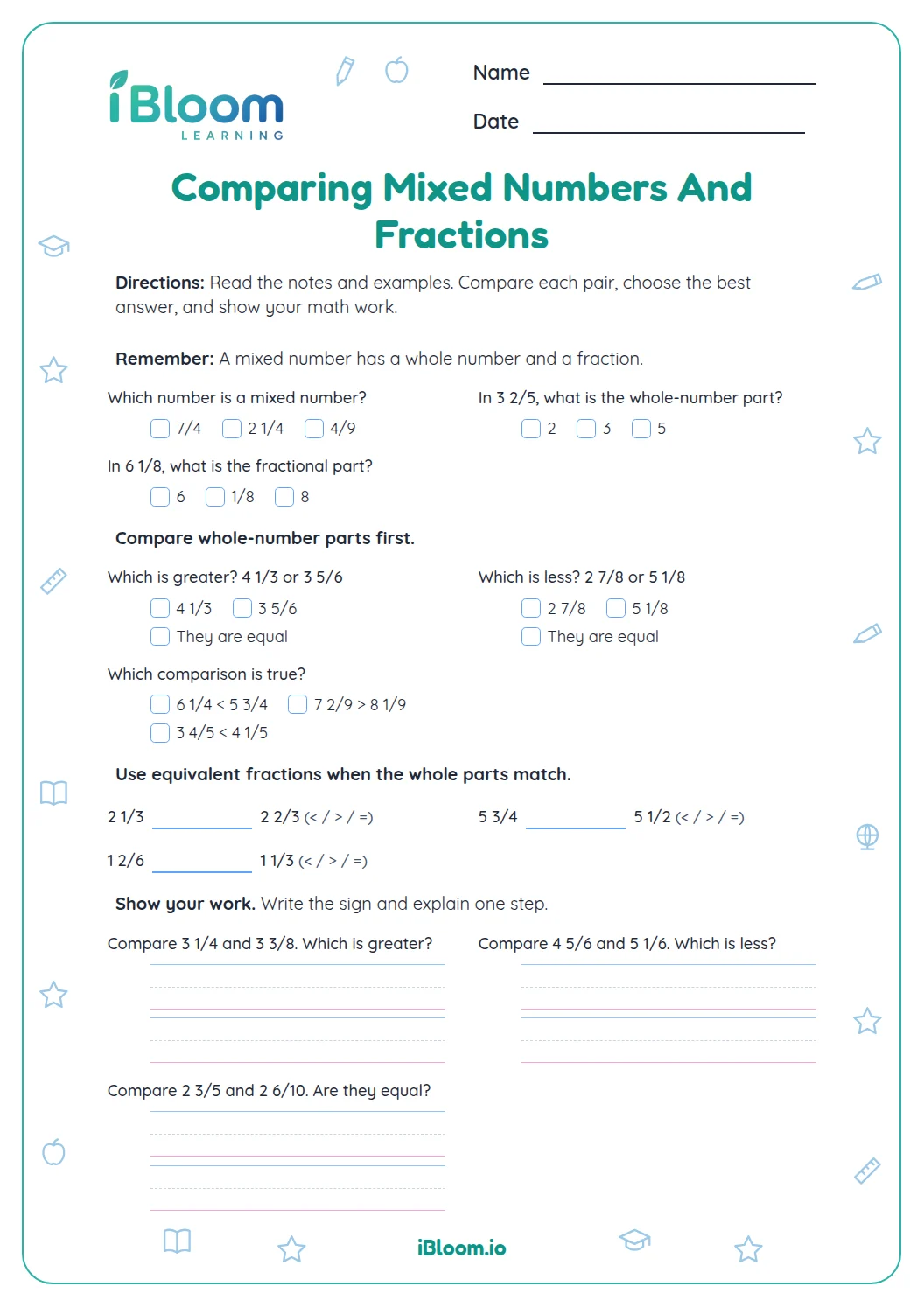
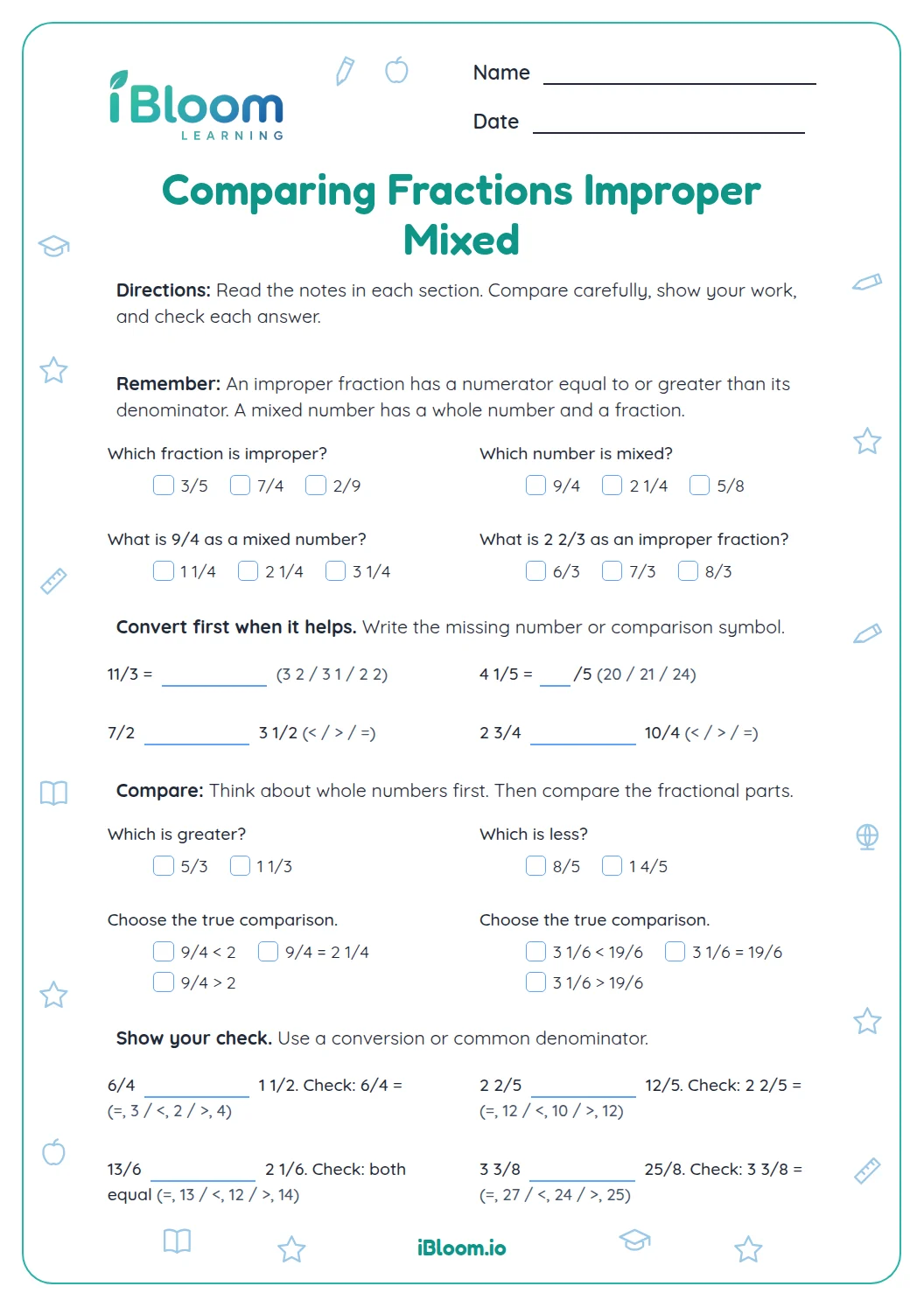
A student may compare only the fractional parts even when the whole numbers differ. In 3 1/4 and 2 3/4, compare 3 and 2 first; that makes 3 1/4 greater.
- 13 1/4 ___ 2 3/4
- 2Compare whole numbers: 3 > 2
- 3So 3 1/4 > 2 3/4
Which strategy helps with unlike fractions?
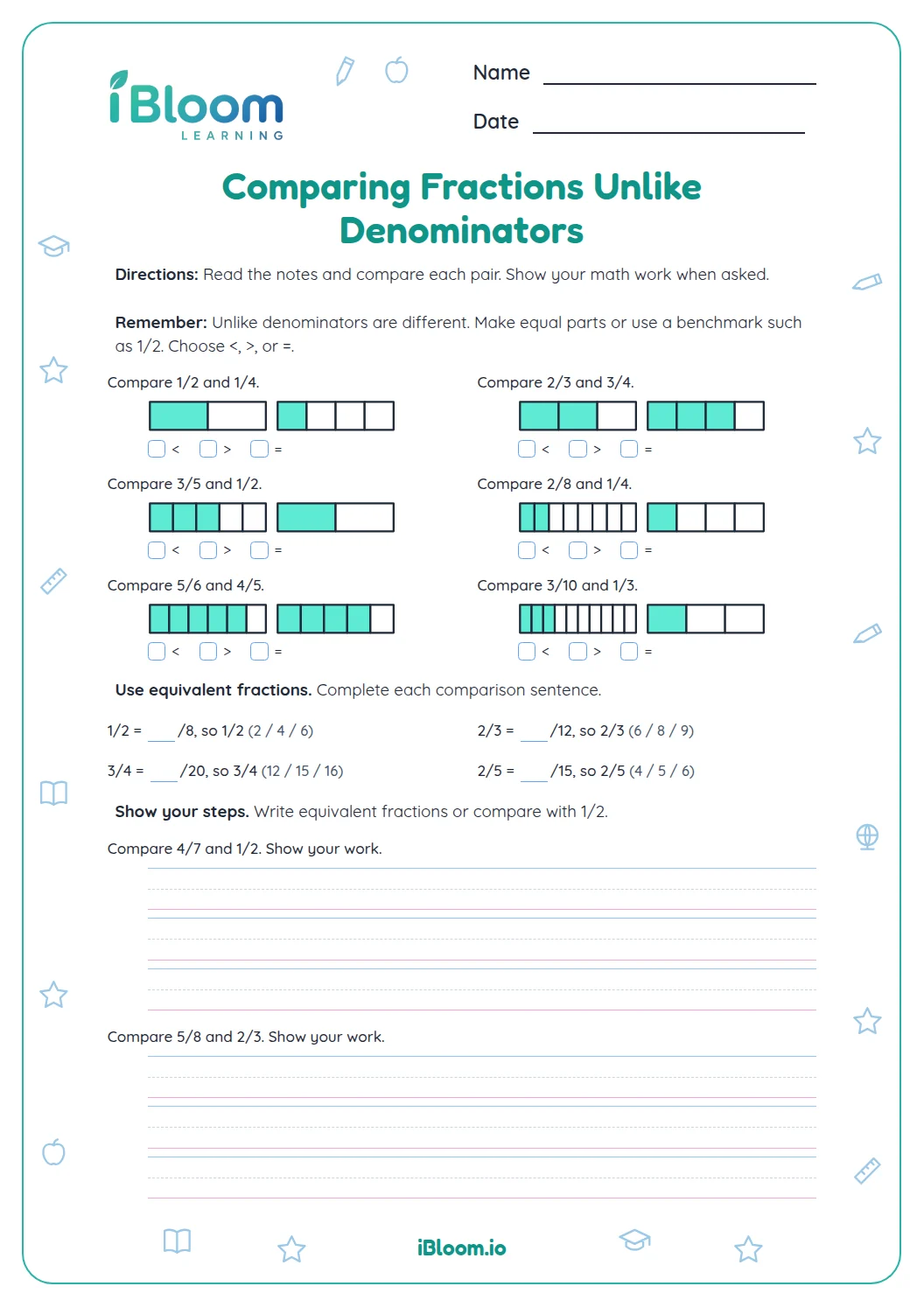
When denominators differ, rewrite the fractions with a common denominator or compare them with a familiar benchmark. For 5/6 and 3/4, twelfths give 10/12 and 9/12, so 5/6 is greater.
What do the comparison prompts ask students to do?
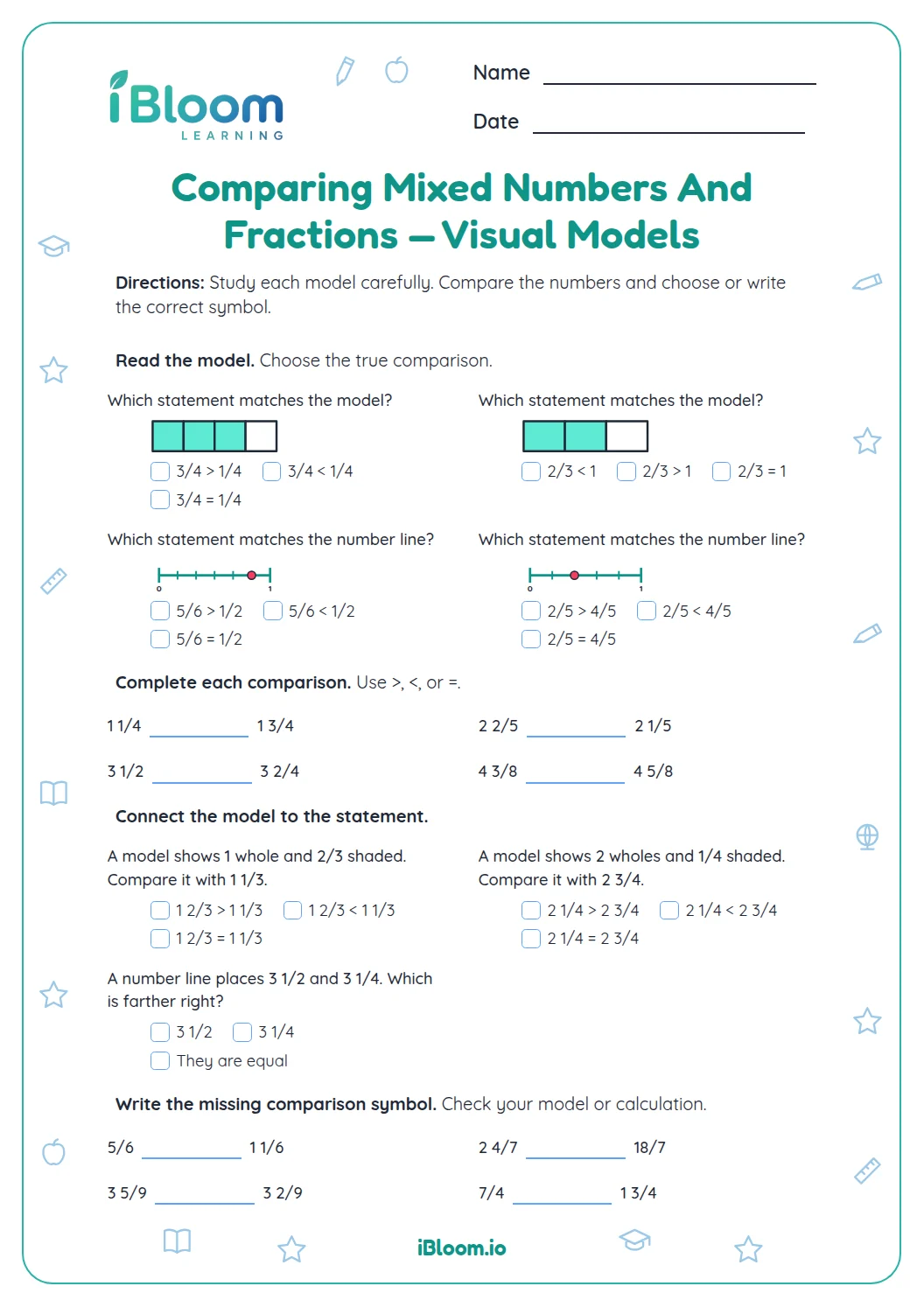
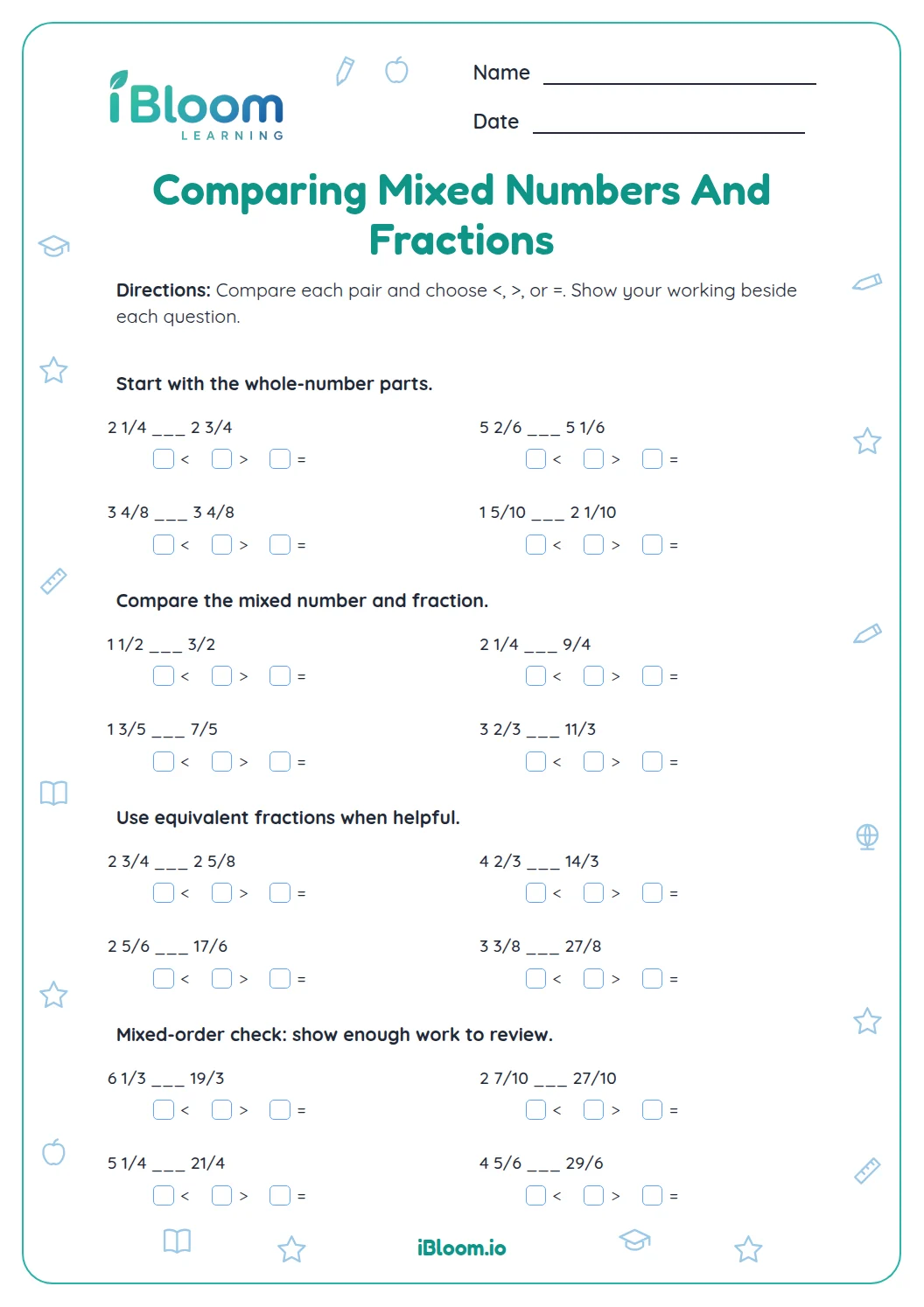
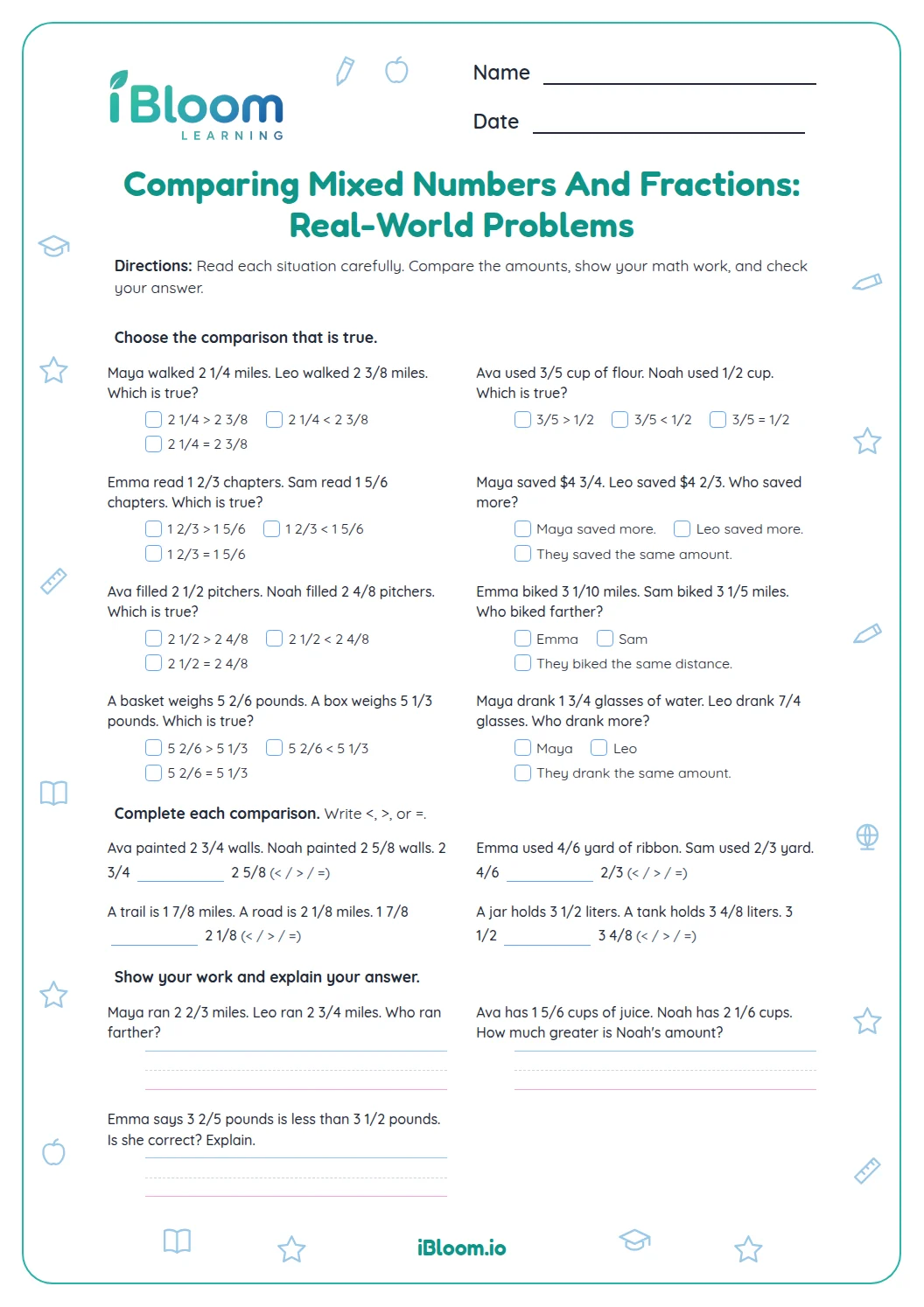
Questions 9–18 include symbol comparisons, equivalent-fraction blanks, one fraction between two endpoints, and a least-to-greatest list. Each answer follows from comparing whole numbers first or reasoning about equal-sized parts.
How to use this worksheet
- 1For each Part A claim, identify the comparison mistake before choosing a correction.
- 2Use matching whole numbers, numerators, or denominators when possible.
- 3For unlike fractions, choose a common denominator or a familiar benchmark.
- 4Complete Part C with a comparison symbol or a fraction that fits between the endpoints.
- 5In Part D, state the conclusion and give one clear reason.
Common mistakes and quick fixes
The mistake
Comparing only the fractional parts of mixed numbers
The fix
Compare whole numbers first; compare fractional parts only when the wholes match.
The mistake
Assuming the larger denominator makes a larger fraction
The fix
Check the size of each part or rewrite both fractions with a common denominator.
The mistake
Giving a conclusion without a reason
The fix
Show the equivalent fractions or the matching parts that support the comparison.
Common Core alignment
Compare fractions and justify conclusions with symbols and sound reasoning.
On this sheet: Students reason about fraction size, record comparisons, and explain conclusions, including mixed-number comparisons.
Show the official wordingHide the official wording
Compare two fractions with different numerators and different denominators, e.g., by creating common denominators or numerators, or by comparing to a benchmark fraction such as 1/2. Recognize that comparisons are valid only when the two fractions refer to the same whole. Record the results of comparisons with symbols >, =, or <, and justify the conclusions, e.g., by using a visual fraction model.
What to practice next
Make more practice
Further reading
Questions parents and teachers ask
How do you compare mixed numbers?
Compare the whole-number parts first. If they differ, the mixed number with the greater whole number is greater. If the wholes match, compare the fractional parts using matching denominators, a common denominator, or another sound strategy. This prevents a larger fractional part from overriding a larger whole number.
What is the old-sheet method this challenge keeps?
The worksheet retains error analysis and strategy selection. Students identify a comparison mistake, choose useful equivalent-fraction reasoning, and apply strategies to mixed numbers and fractions. The final prompts ask them to complete comparisons and order values, keeping the old sheet’s focus on explaining why one value is greater.
How can I explain 1/6 < 11/12?
Rewrite 1/6 as 2/12. Since 2/12 is less than 11/12, the comparison is true. A student can also explain with a model or another valid method that clearly shows the two fractions refer to the same whole. Naming the equivalent fractions makes the reasoning easy to check.
How many questions are included?
There are 18 prompts in two parts: eight error-analysis and strategy prompts, followed by ten comparisons and ordering prompts. Students move from recognizing how a comparison can go wrong to applying a sound method with mixed numbers and fractions.
Does the key accept different explanations?
Yes. The answer key lists the completed symbol, number, or ordered set for all 18 prompts. Students can complete the sheet first and check afterward. For any missed comparison, ask which whole-number parts or equivalent fractions support the correct answer.
Is the worksheet intended for Grade 4?
Plan for about 25 minutes. Students work through 18 short prompts, including fraction comparisons, equivalent-fraction blanks, and an ordering set. Learners who pause to write common denominators or check each comparison may need a little longer. Review the answer key together afterward.