






About this worksheet
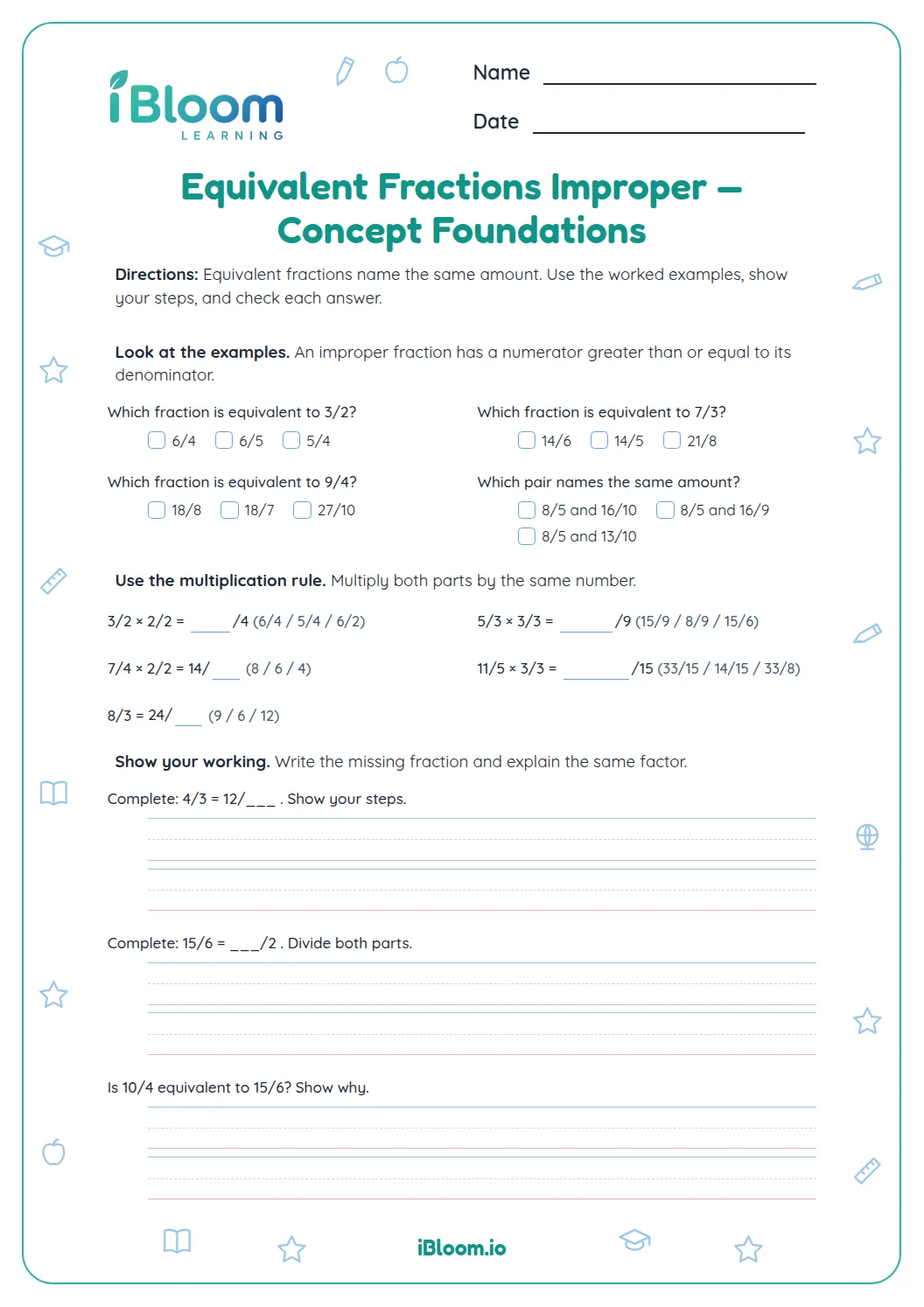
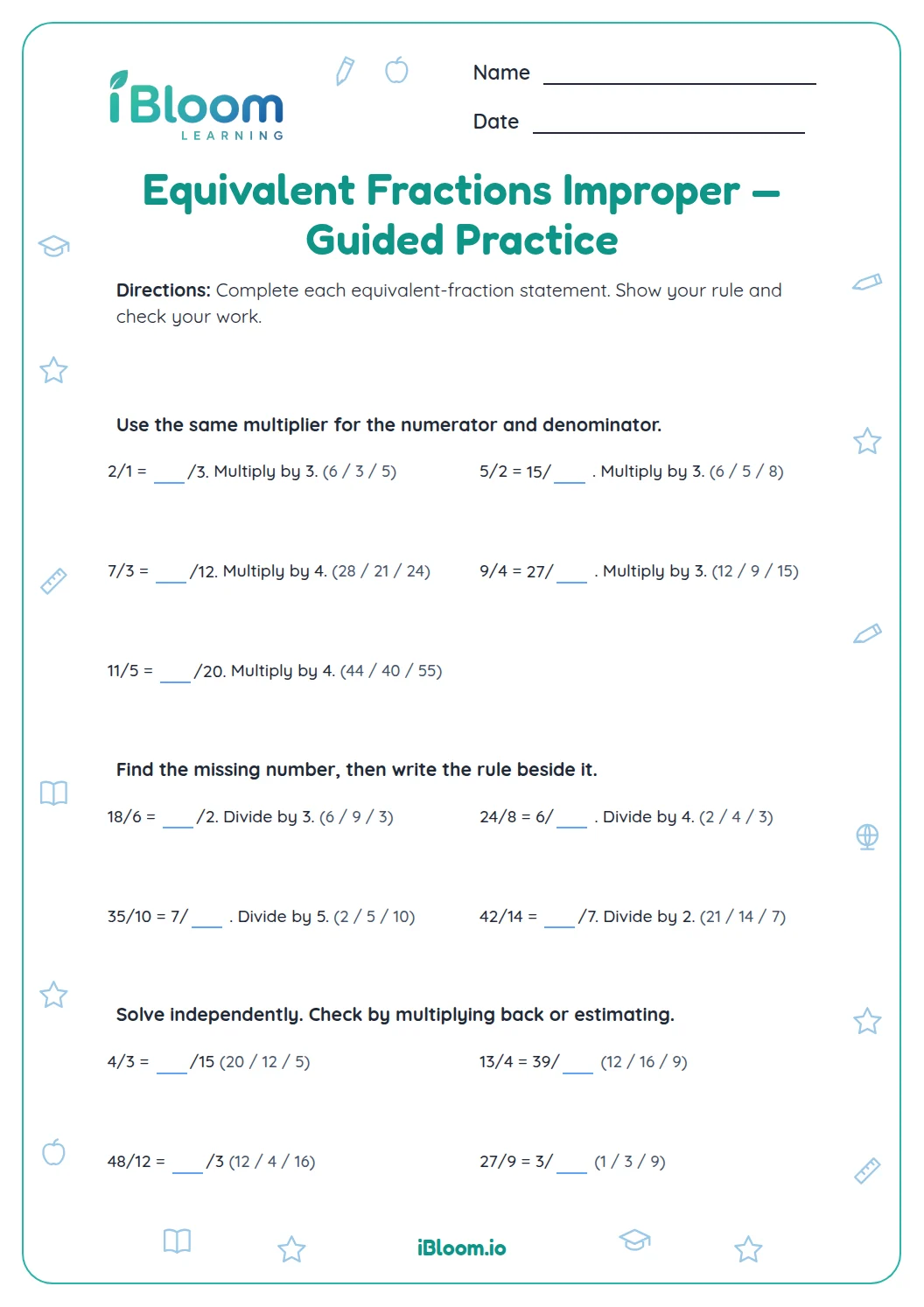
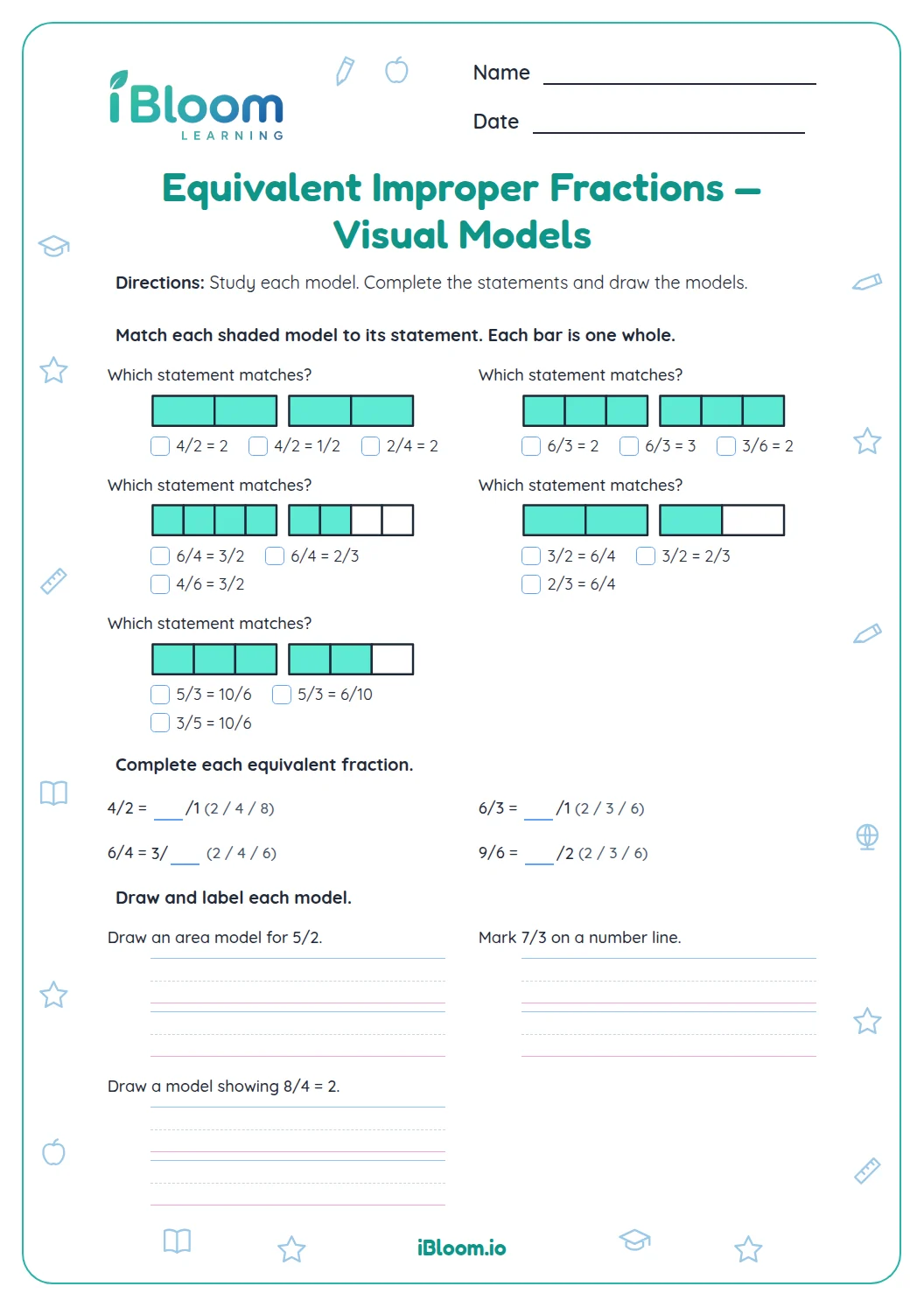
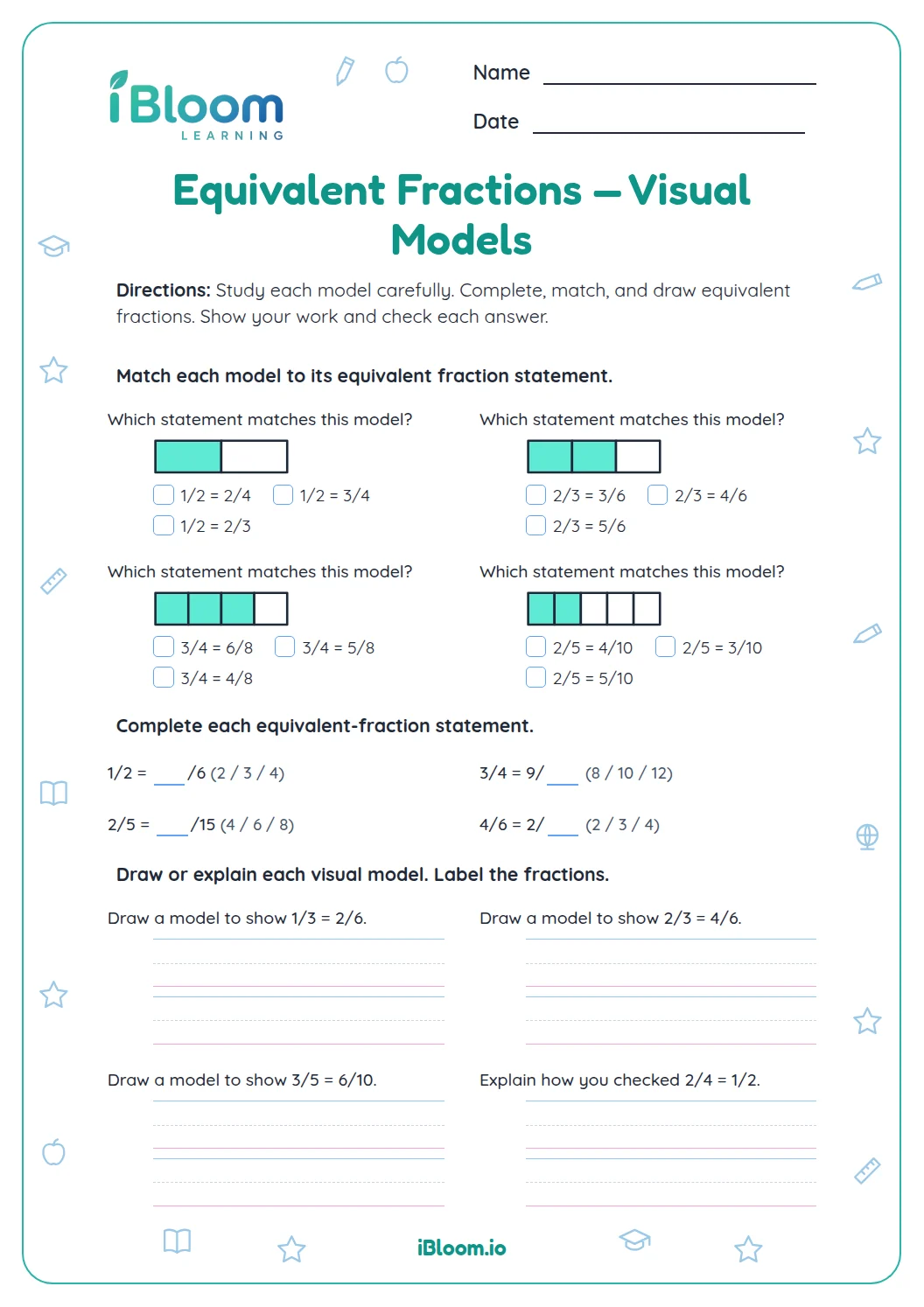
This Grade 4 worksheet builds reasoning with equivalent fractions and improper fractions. Students complete equivalent-fraction statements, compare fractions, read shaded models and a number line, and explain two classmates’ errors. It practices CCSS 4.NF.A.1 and 4.NF.B.3, using denominators such as 3, 4, 5, 6, 8, 10, and 12. The separate answer key gives concise responses and model explanations.
Aligned to 4.NF.A.1
How do you make an equivalent fraction?
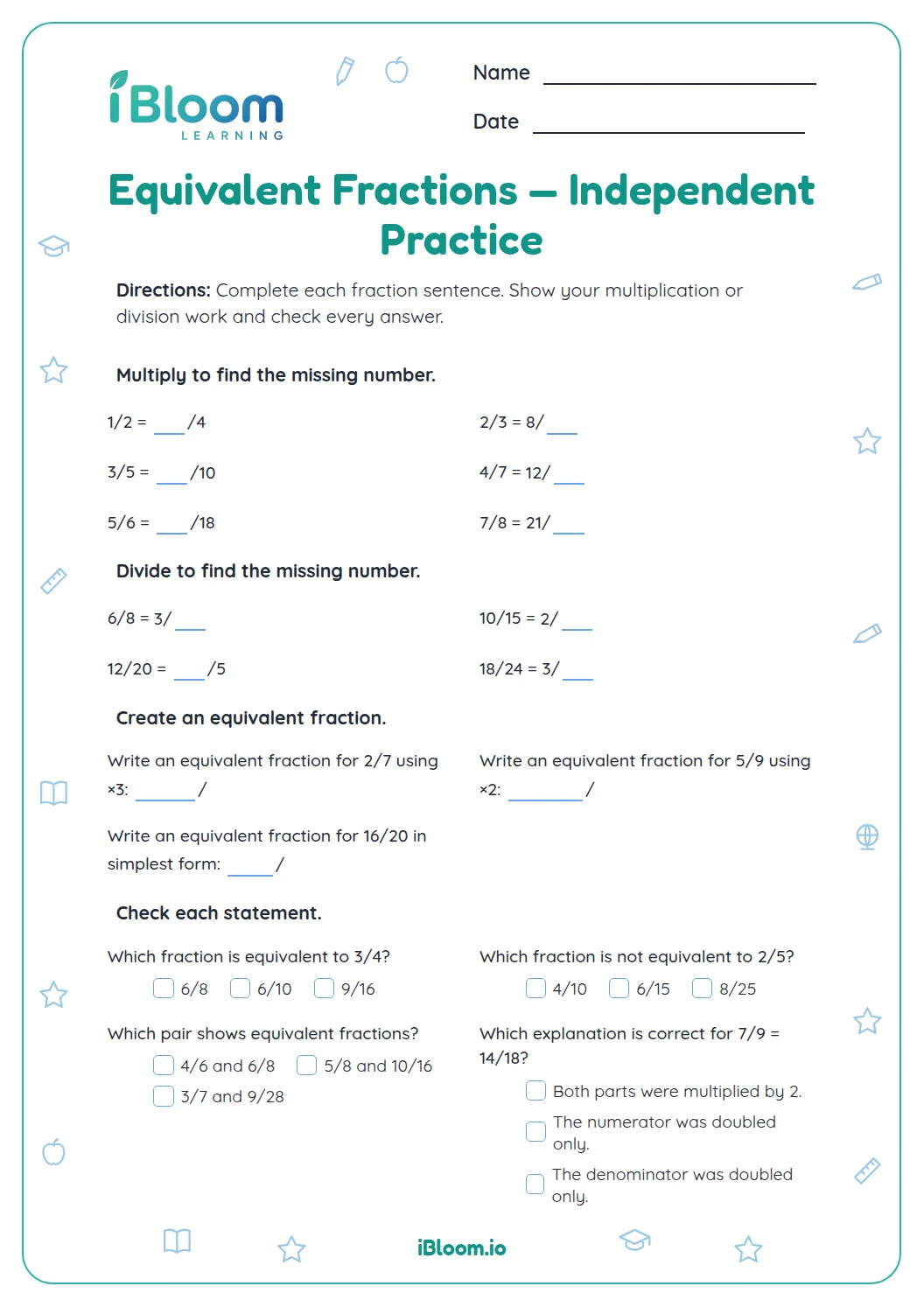
An equivalent fraction names the same amount with a different number of equal parts. To keep the amount unchanged, multiply or divide both numerator and denominator by the same number.
Question 1 changes thirds to twelfths. Since 3 × 4 = 12, multiply 2 by 4 as well.
- 12/3 = ___/12
- 23 × 4 = 12
- 32 × 4 = 8
- 4So 2/3 = 8/12
How can an improper fraction be written as a mixed number?
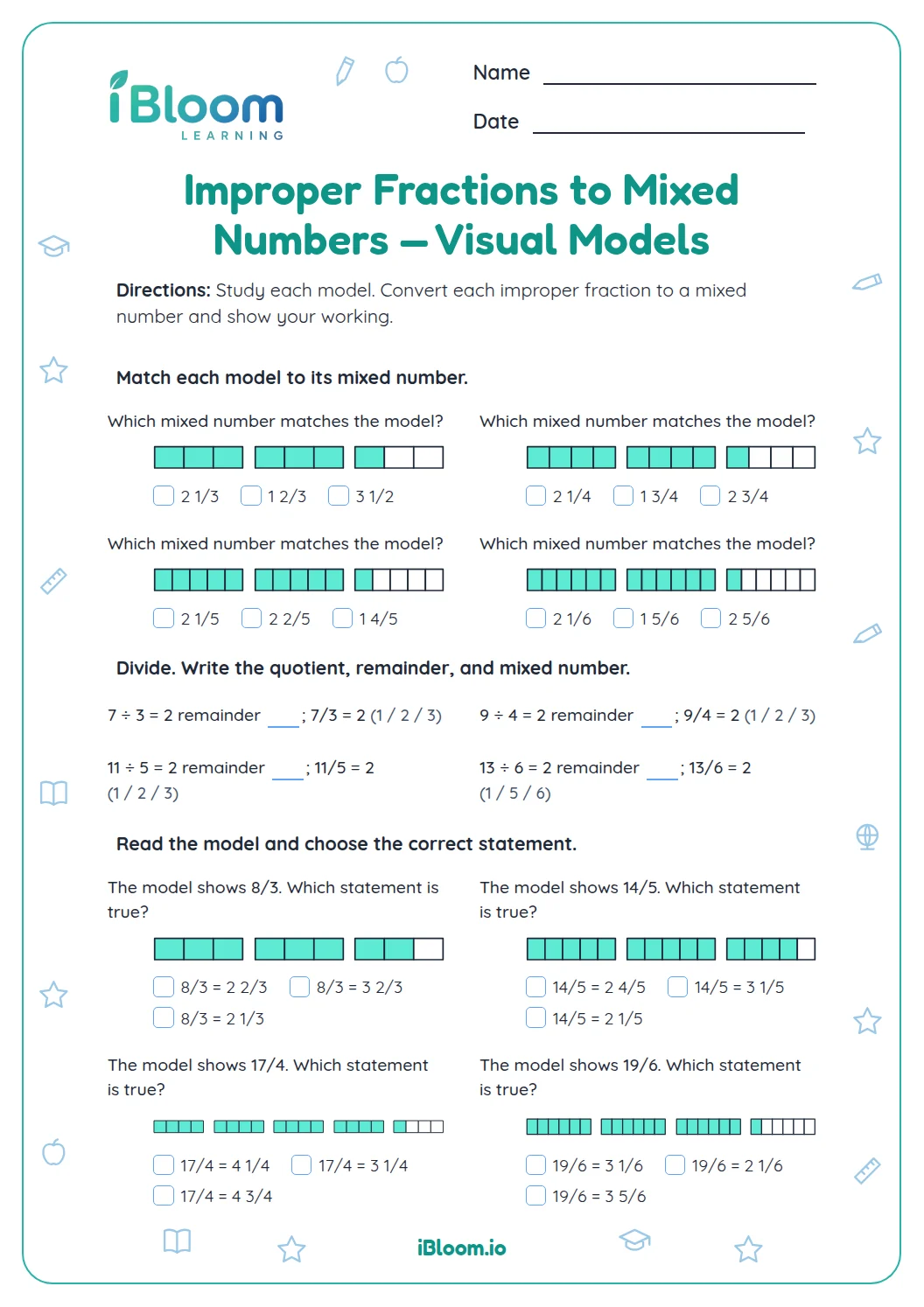
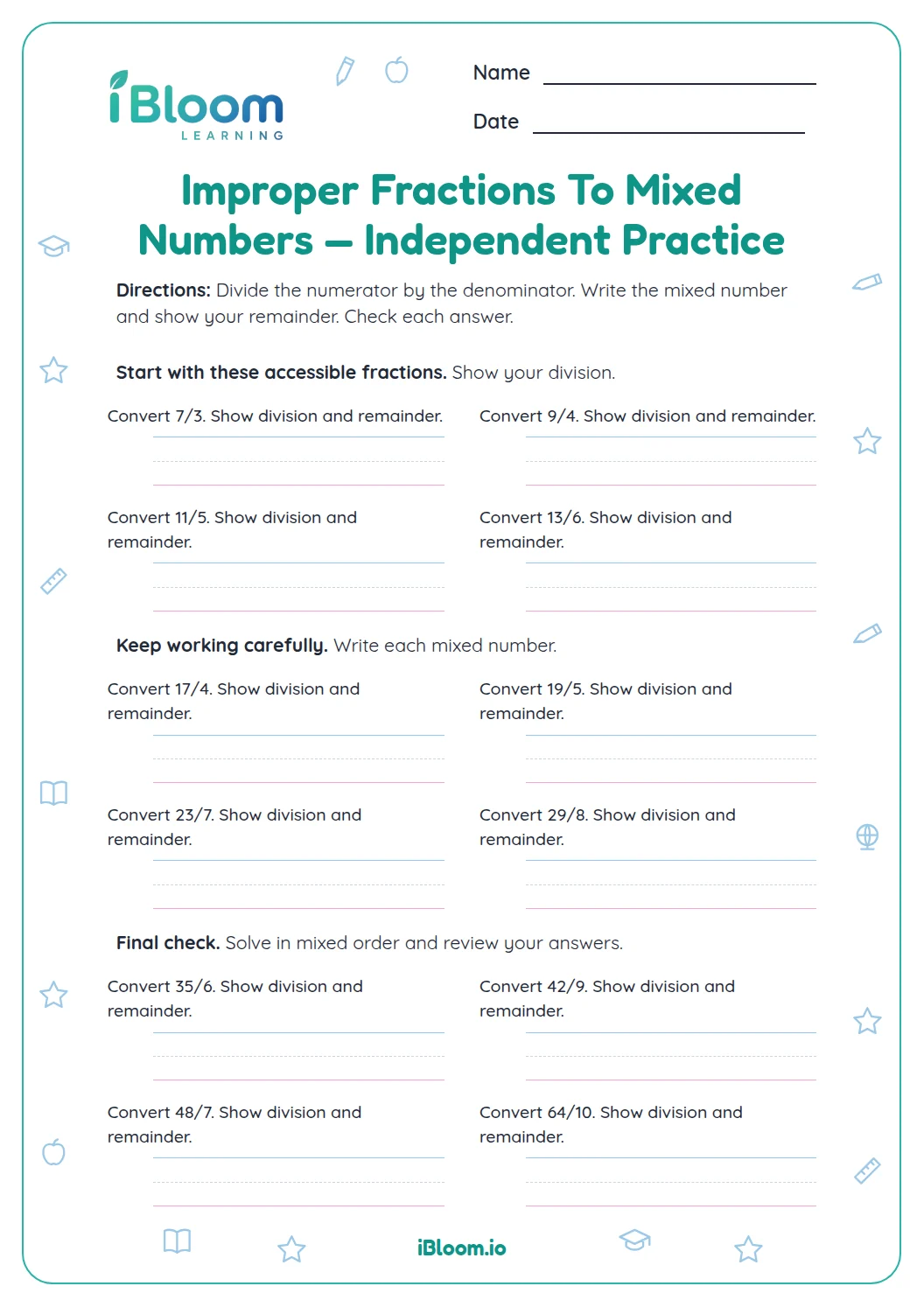
An improper fraction has a numerator at least as large as its denominator. Group the numerator into whole groups of the denominator, then keep the leftover pieces as a fraction.
In question 11, nine sixths makes one complete group of six sixths, with three sixths remaining: 9/6 = 1 3/6 = 1 1/2.
What can a model show about a fraction?
The shaded fraction bars and circles make one whole visible. In question 6, one full circle is 4/4 and the shaded pieces in the next circle are 3/4, so altogether the model shows 7/4.
Question 7 uses sixths on a number line. The labeled point is three sixths past 1, which is 1 3/6 or 1 1/2.
How should a student check a fraction claim?
Check whether the same operation was applied to the numerator and denominator, then check whether the size makes sense. A fraction with numerator larger than denominator is at least one whole.
Question 9 changes 2/5 incorrectly by doubling the numerator but adding to the denominator. Multiplying both by 3 would give 6/15.
How to use this worksheet
- 1Ask the student to explain why an equivalent fraction keeps the same size.
- 2Work question 1 together and name the factor used on both numbers.
- 3Use the shaded models in Part B to count full wholes and remaining parts.
- 4For the error questions in Part C, identify the rule before correcting the work.
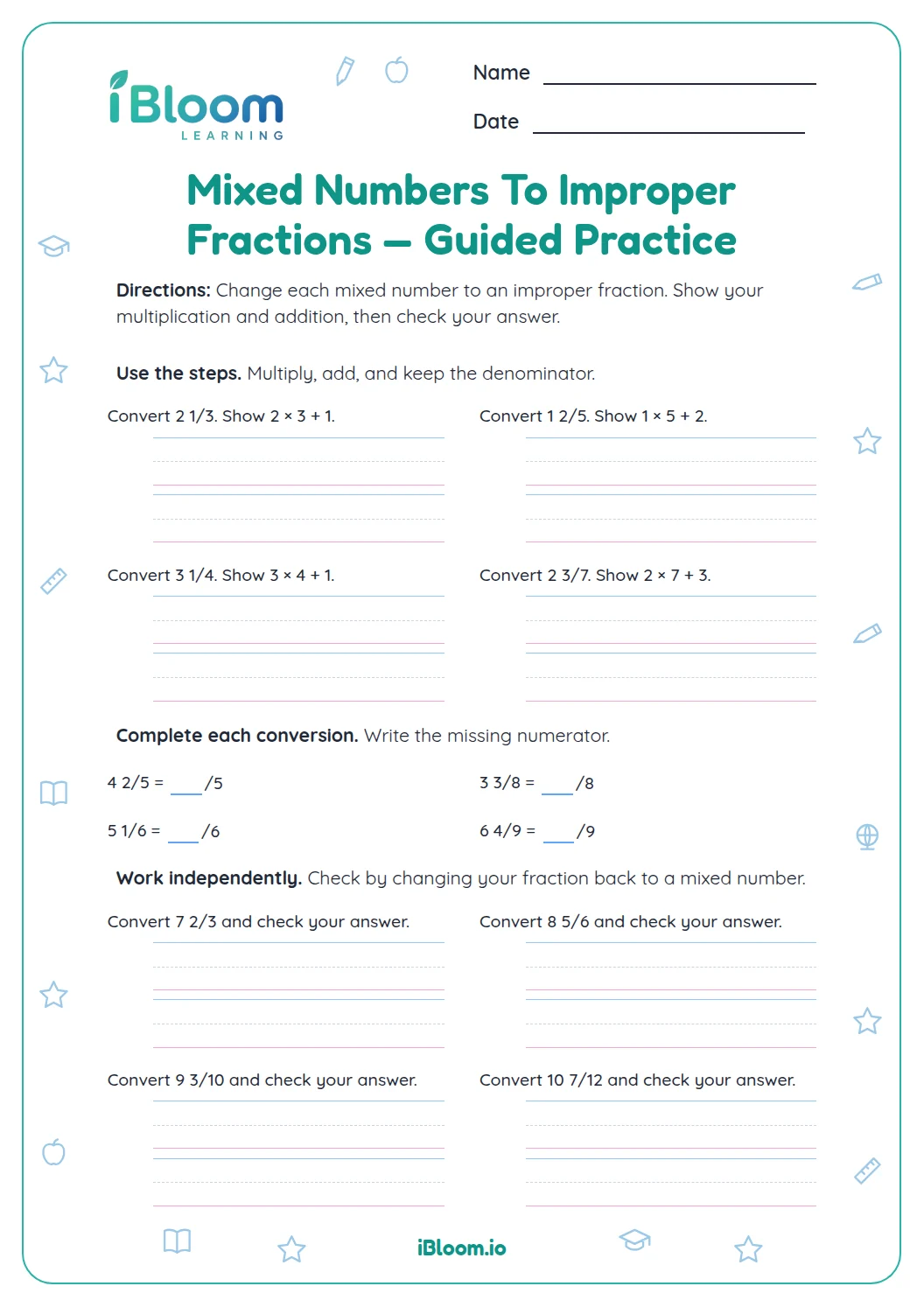
- 5Check mixed-number answers by converting them back to improper fractions.
Common mistakes and quick fixes
The mistake
Changing only the numerator or using a different operation on the denominator.
The fix
Write the same multiplier above both parts; for 2/3 to twelfths, multiply both by 4.
The mistake
Reading 7/4 as seven wholes and four parts.
The fix
Group fourths into sets of four; one set is a whole and three fourths remain.
The mistake
Calling 9/6 less than one because 9 is less than 6.
The fix
Compare the numerator with the denominator: nine sixths includes one full group of six sixths.
Common Core alignment
This worksheet practices fraction equivalence and fraction addition concepts named in Grade 4 Common Core.
Generate equivalent fractions by multiplying or dividing both parts by the same number.
On this sheet: Questions 1–3, 9–10, 13 and 15 practice recognizing or generating equivalent fractions.
Show the official wordingHide the official wording
Explain why a fraction a/b is equivalent to a fraction (n × a)/(n × b) by using visual fraction models, with attention to how the number and size of the parts differ even though the two fractions themselves are the same size. Use this principle to recognize and generate equivalent fractions.
What to practice next
Make more practice
Further reading
Questions parents and teachers ask
What does equivalent mean in a fraction?
Equivalent fractions are different names for the same amount. For example, 2/3 and 8/12 cover the same part of a whole because each third is divided into four smaller equal parts. Questions 1–3 and 9–10 ask students to generate or recognize these matches.
How do you change 2/3 into twelfths?
Ask how many times the denominator 3 must be multiplied to make 12. The factor is 4, so multiply the numerator by 4 as well: 2/3 = 8/12. Applying the same factor keeps the amount equal. The answer key supports a second check after students finish the worksheet.
What makes a fraction improper?
A fraction is improper when its numerator is at least as large as its denominator. For instance, 7/4 is more than one whole. The worksheet uses bars, circles, and a number line to connect improper fractions with mixed numbers. The answer key supports a second check after students finish the worksheet.
How does the model in question 6 show 7/4?
One fully shaded circle represents 4/4, and three shaded fourths in the next circle represent 3/4. Add the parts to get 7/4, or 1 3/4 as a mixed number. The whole circle is one full unit. The answer key supports a second check after students finish the worksheet.
Is an answer key included?
Yes. A separate answer key page lists all sixteen responses and gives sample explanations for the two reasoning questions. Students can first complete the worksheet independently, then use the key to check each fraction and revisit any step that changed the value.