


About this worksheet
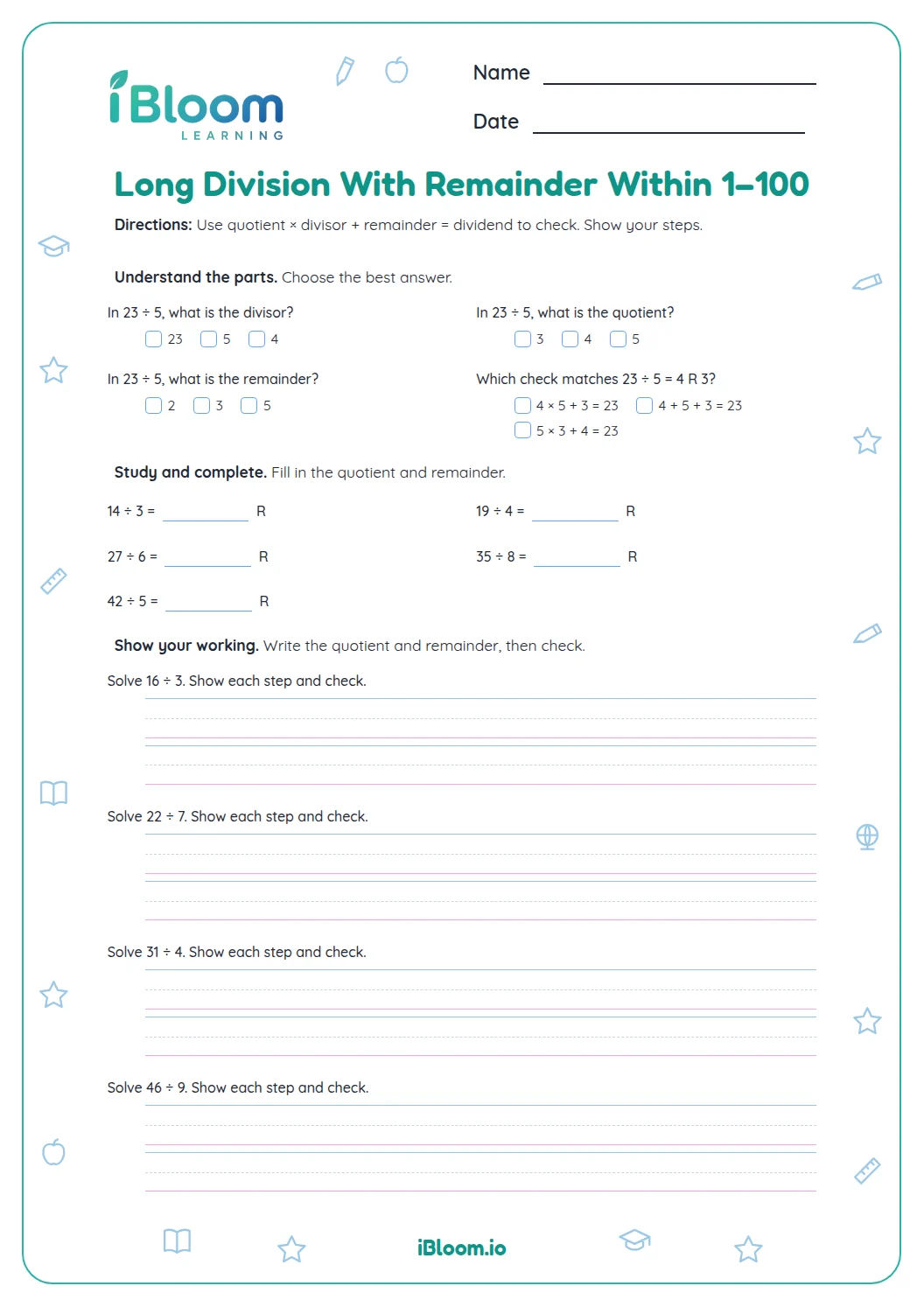
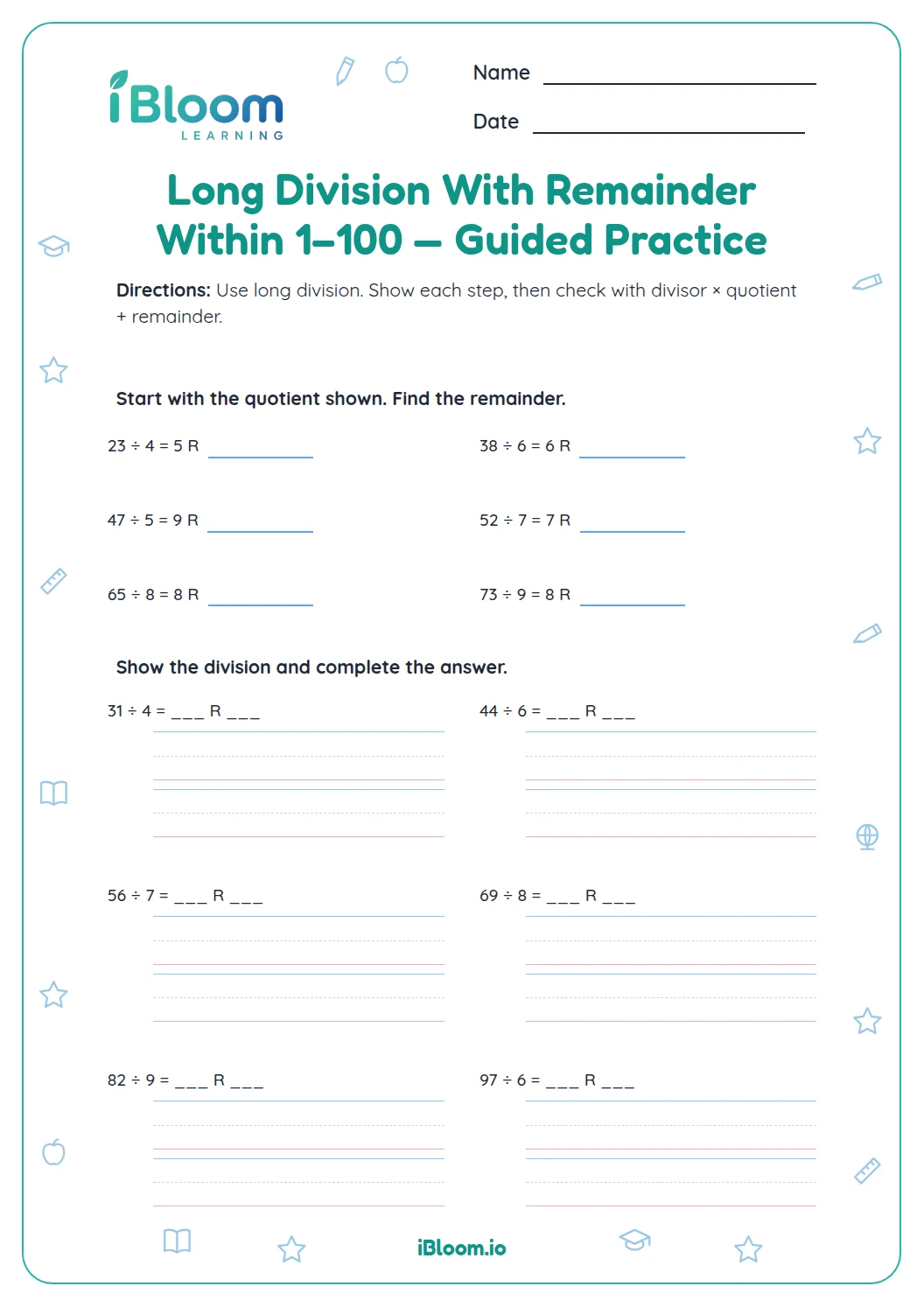
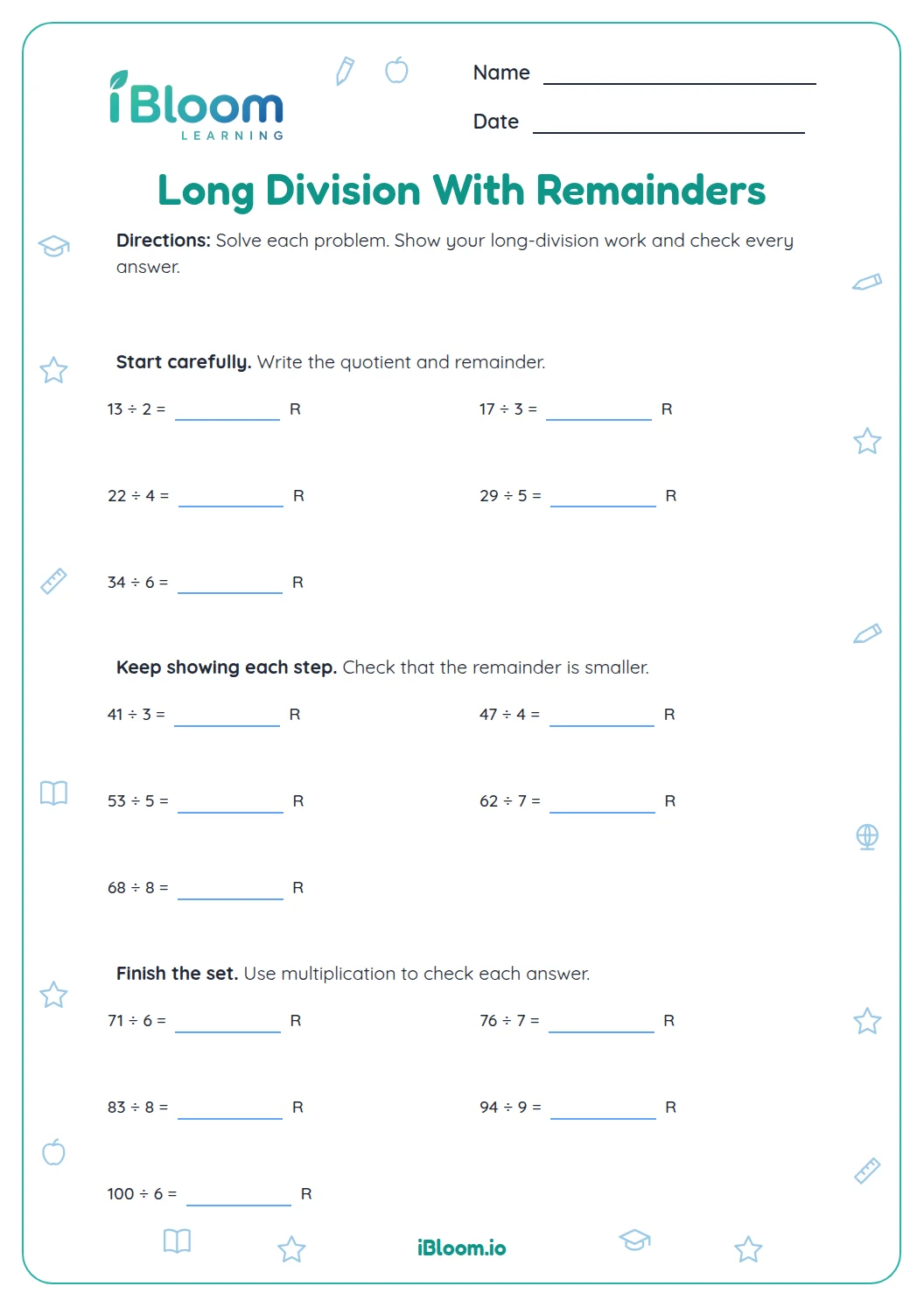
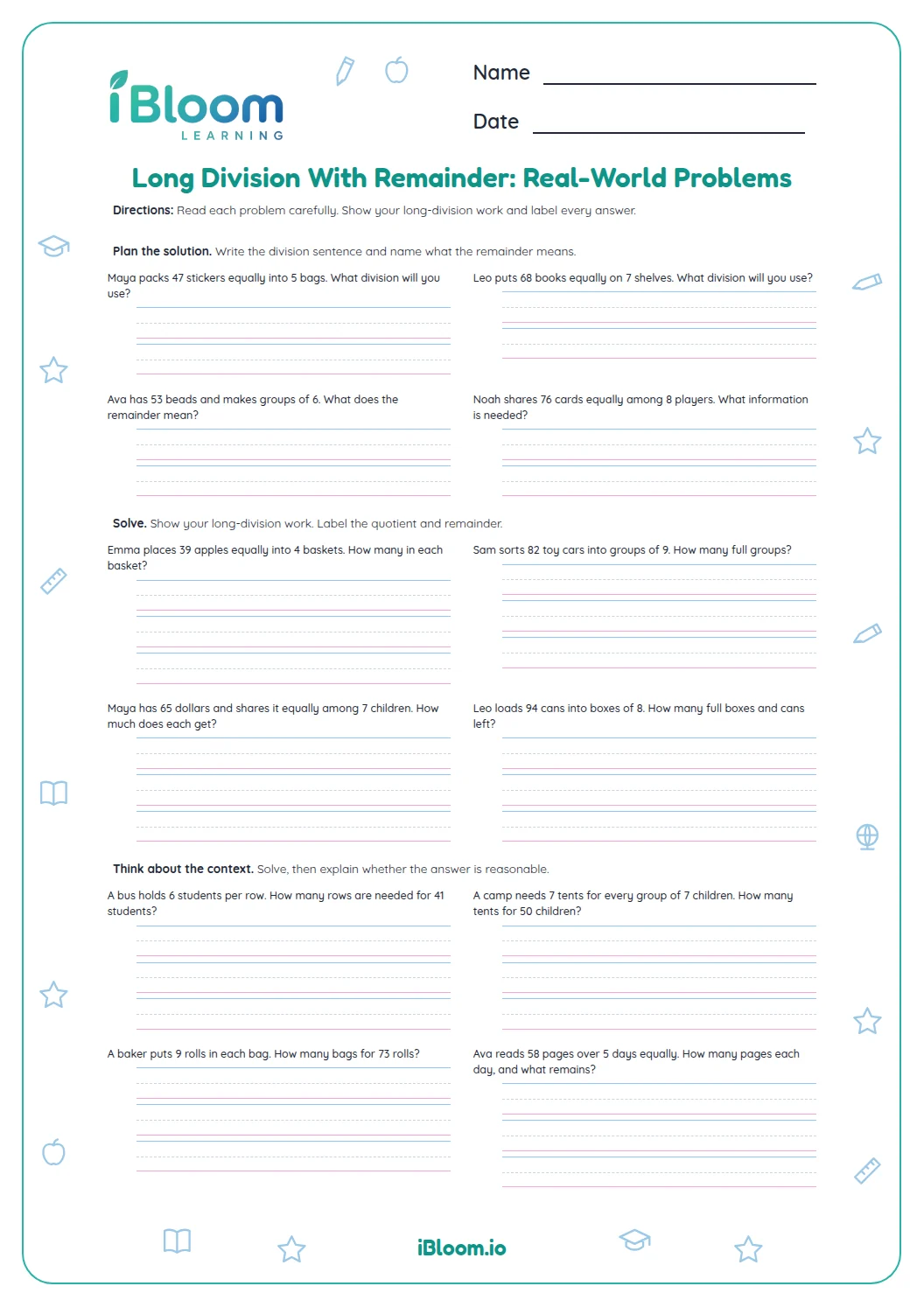
This page starts with pictured counters that can be shared into equal groups. Students then solve six two-digit division problems and finish by deciding what a remainder means in a situation. Every dividend is below 100, each divisor is one digit, and every answer uses quotient R remainder.
Aligned to 4.NBT.B.6
What is on this worksheet?
Part A uses counters to show equal sharing. Part B moves to two-digit division with a one-digit divisor. Part C asks students to interpret the remainder in a short situation. Each answer is written as a quotient followed by R and the remainder.
- Part A: share pictured counters into equal groups.
- Part B: calculate with long division.
- Part C: connect the quotient and remainder to the story.
What does the remainder mean?
The quotient counts complete groups. The remainder counts items that cannot make another full group. If 17 apples are shared among 4 teams, each team gets 4 and 1 apple is left. The leftover must always be fewer than the number of groups.
How can students check their work?
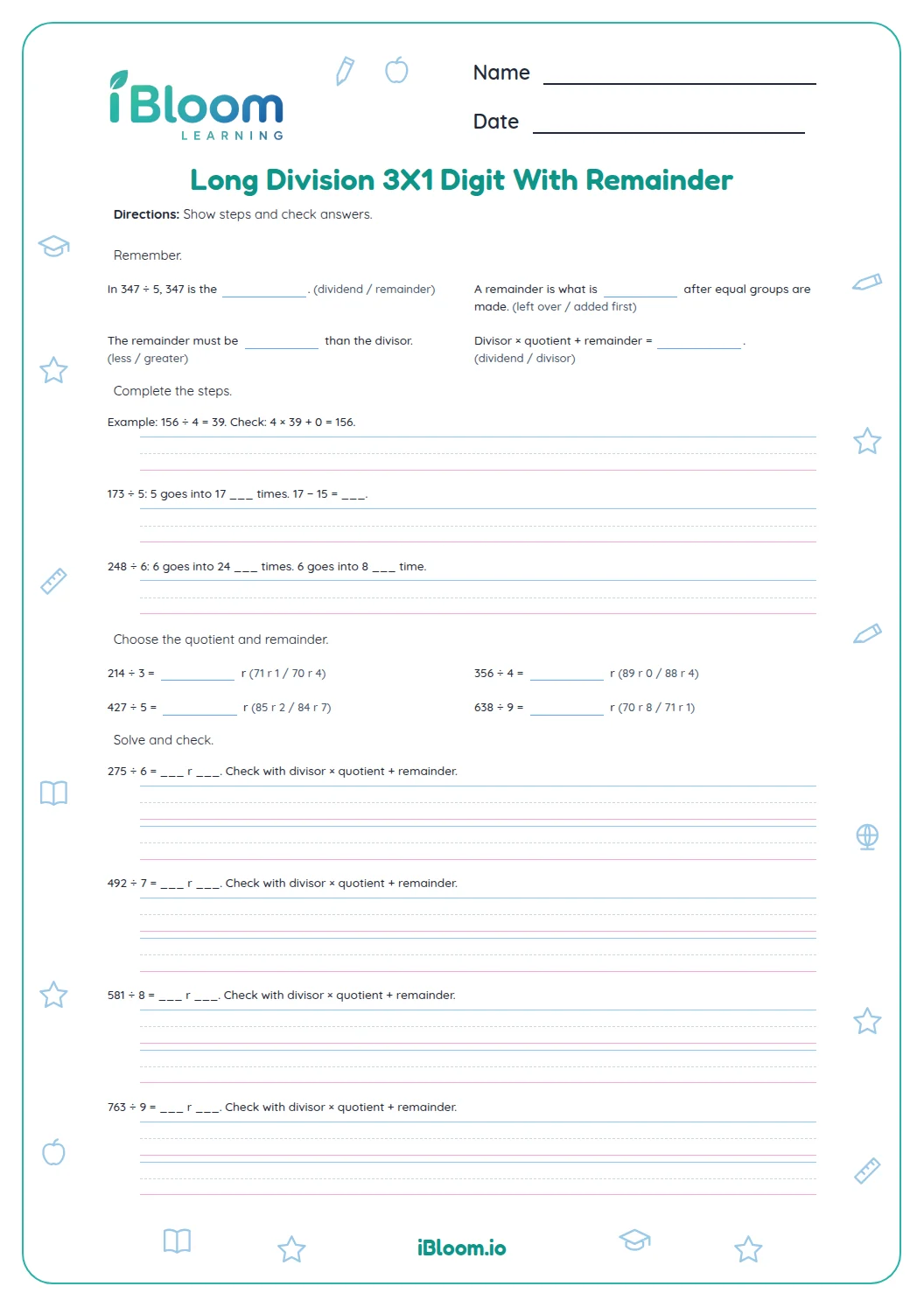
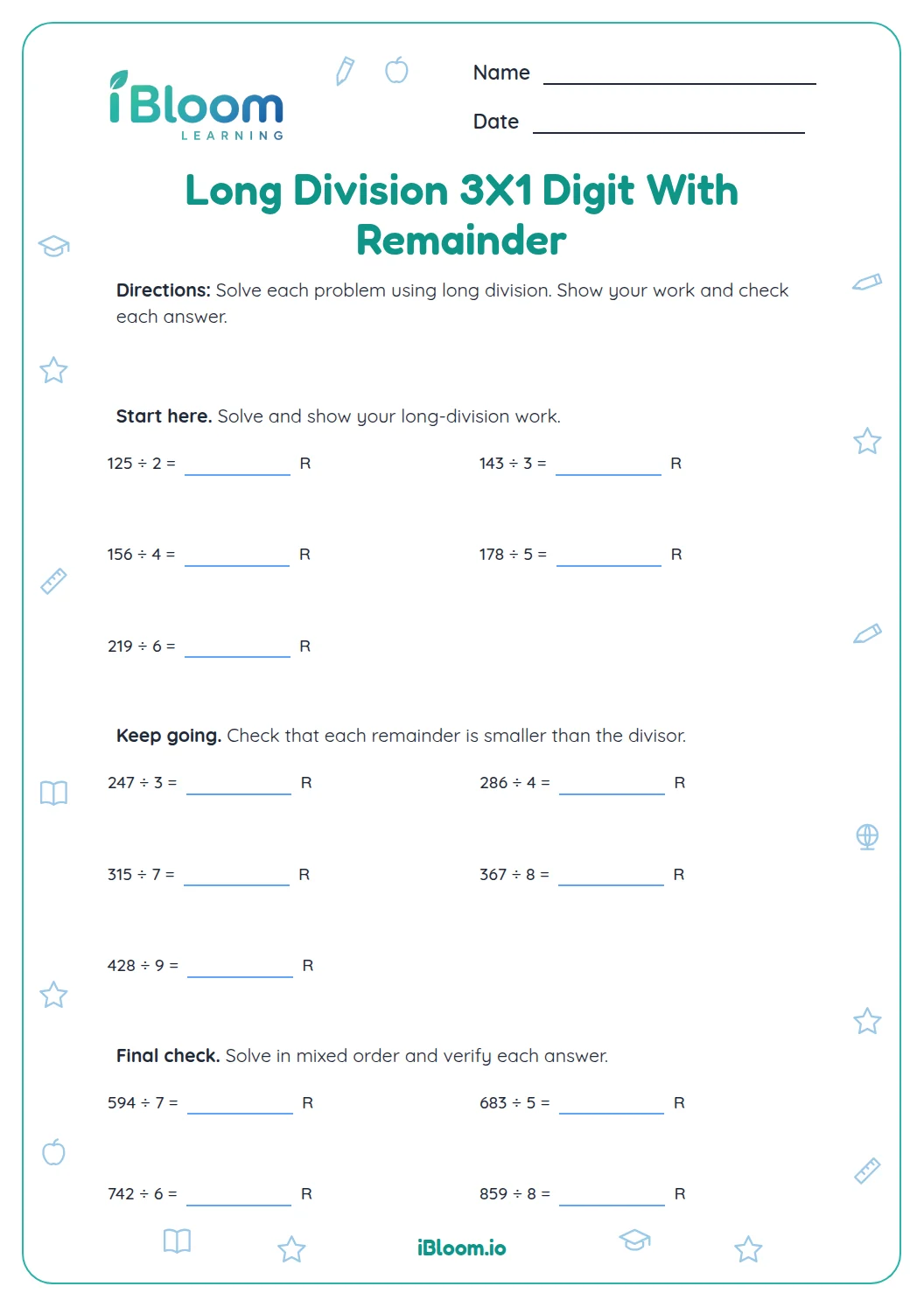
Use divisor × quotient + remainder = dividend. For 47 ÷ 5, 5 × 9 + 2 = 47. If the check misses the dividend, revisit the multiplication or subtraction step. Also confirm that the remainder is less than 5.
How to use this worksheet
- 1In Part A, count the pictured objects and imagine one at a time going to each team.
- 2In Part B, write the quotient, multiply, subtract, and bring down any remaining value as needed.
- 3In Part C, label the quotient as complete groups and the remainder as objects left over.
- 4Check each result with divisor × quotient + remainder = dividend.
Common mistakes and quick fixes
The mistake
Writing a remainder equal to or larger than the divisor.
The fix
If the remainder is as large as the divisor, one more full group can be made. Divide again until the remainder is smaller.
The mistake
Dropping the remainder in a story problem.
The fix
Ask what happens to the items that do not fill a group. State both the complete groups and the leftovers, as the answer line requests.
The mistake
Multiplying the quotient by the dividend during the check.
The fix
Use divisor × quotient + remainder. The product counts the items in complete groups; adding leftovers should recover the starting total.
Common Core alignment
This page practices a Common Core standard for the stated grade.
Use place value and multiplication facts to find quotients and remainders.
On this sheet: Use place value and multiplication facts to find quotients and remainders.
Show the official wordingHide the official wording
Find whole-number quotients and remainders with up to four-digit dividends and one-digit divisors, using strategies based on place value, the properties of operations, and/or the relationship between multiplication and division.
What to practice next
Make more practice
Further reading
Questions parents and teachers ask
How should an answer with a remainder be written?
Write the whole-number quotient, then R, then the remainder, such as 4 R 1. This page asks for that form in every part, so students can compare their work consistently. In story questions, explain the numbers as full groups and items left over.
Can the remainder be bigger than the divisor?
No. If the remainder is equal to or greater than the divisor, another full group can be made. Keep dividing until fewer items remain than the group size. For example, 19 ÷ 3 is 6 R 1, because one more group of three would need two more items.
How do the counters in Part A help?
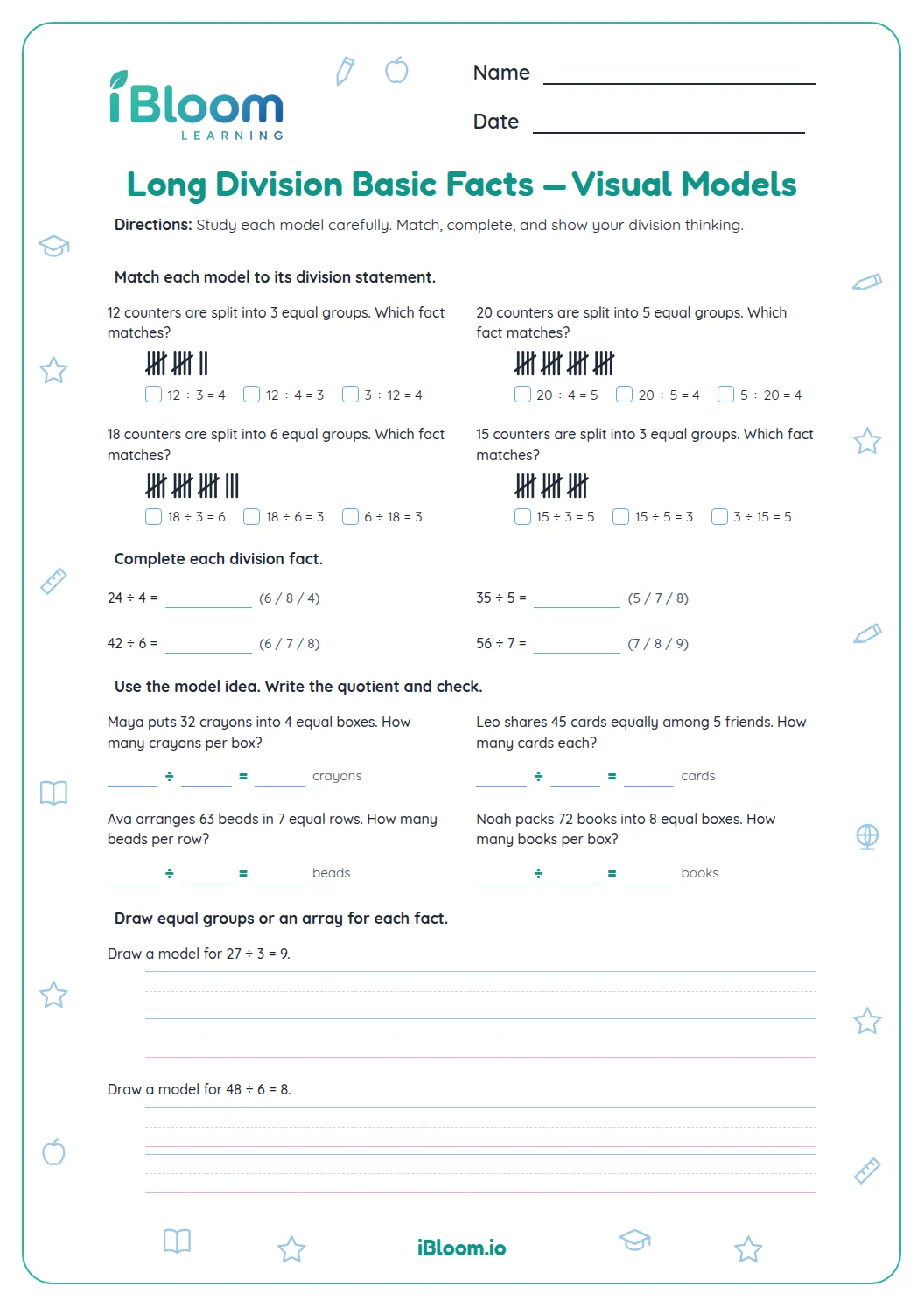
They make the starting amount visible. Children can distribute the pictured objects one at a time to the named teams, then count how many each team has and how many are left. That connects sharing to quotient and remainder notation.
What is the check for division with remainders?
Multiply the divisor by the quotient and add the remainder. The result should equal the original dividend. For 17 ÷ 4, the check is 4 × 4 + 1 = 17. Also make sure the remainder is smaller than 4.
Why does Part C ask about full groups?
A quotient can describe completed bags, trays or teams, while a remainder describes what did not fit into another full group. For example, 53 cones in bags of 6 make 8 full bags with 5 cones left. Interpreting both values helps connect division to a situation.