


About this worksheet
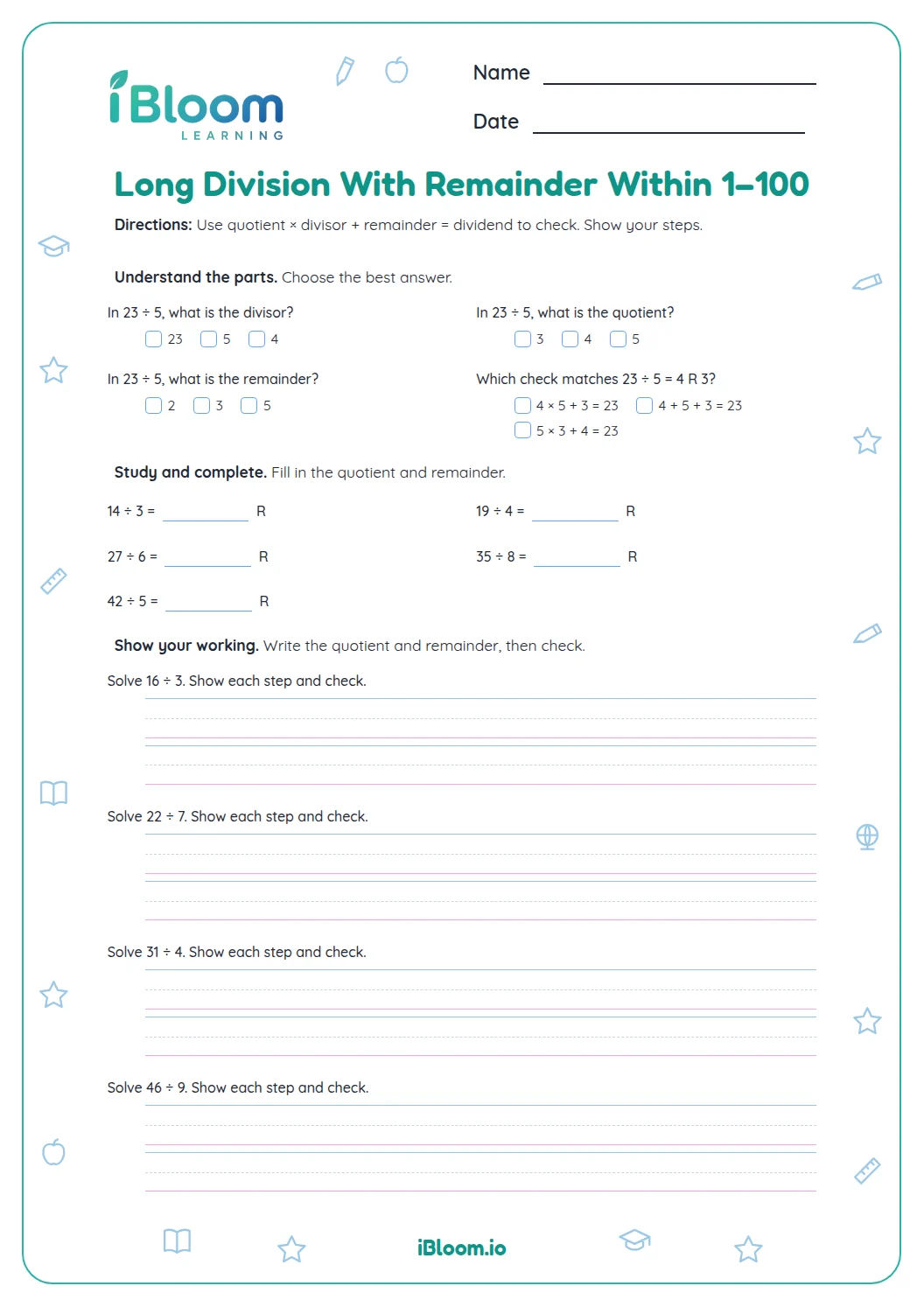
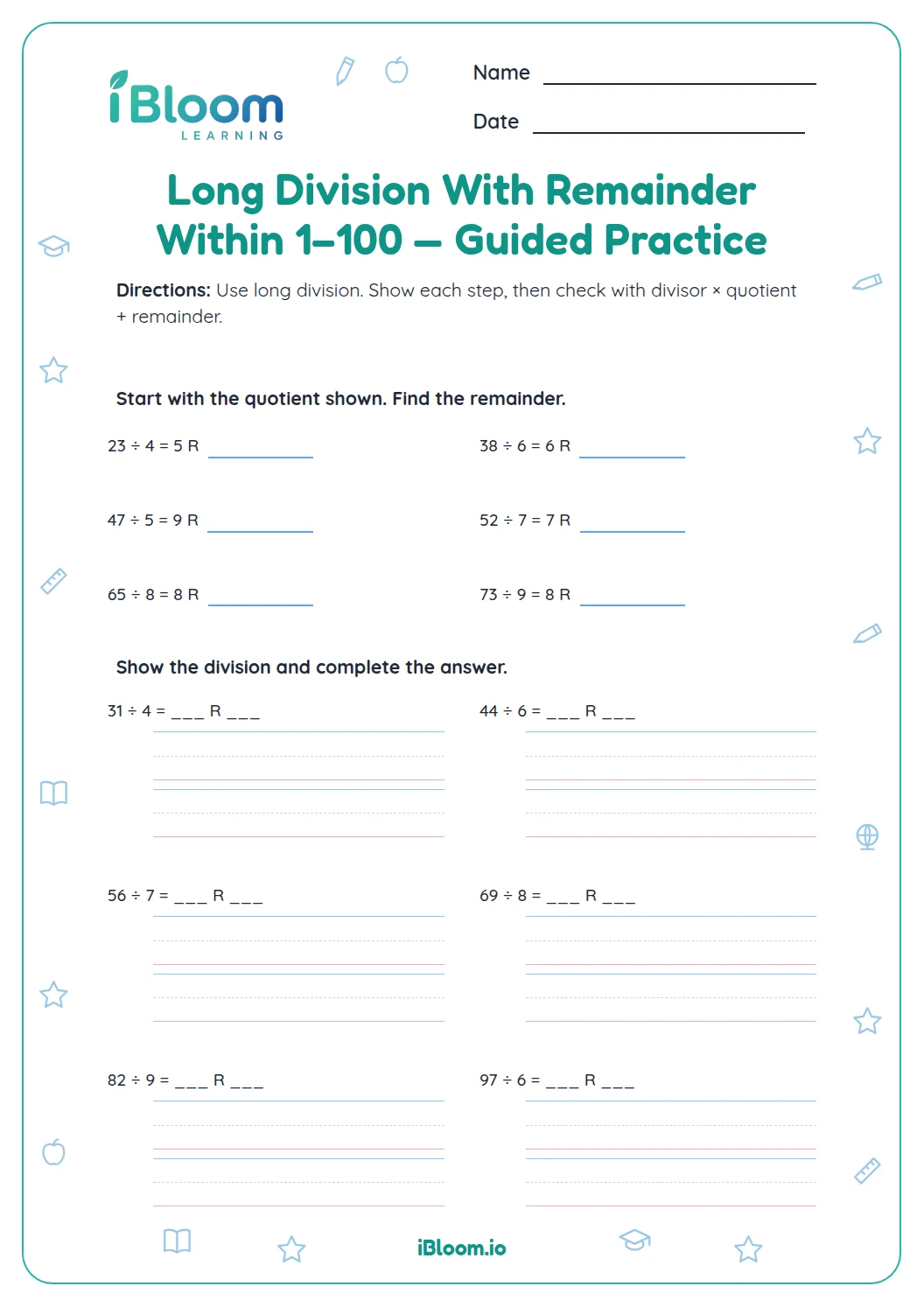
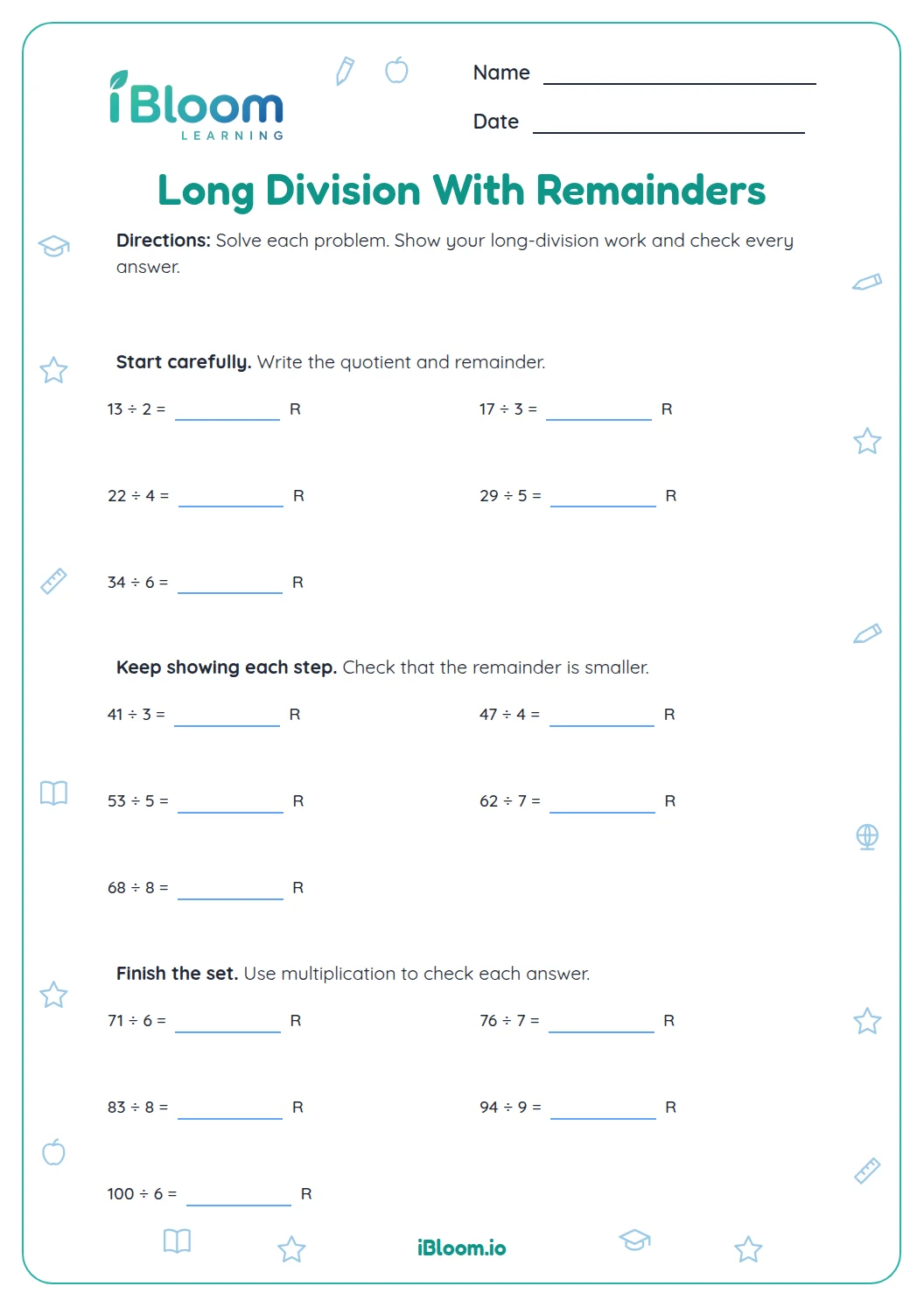
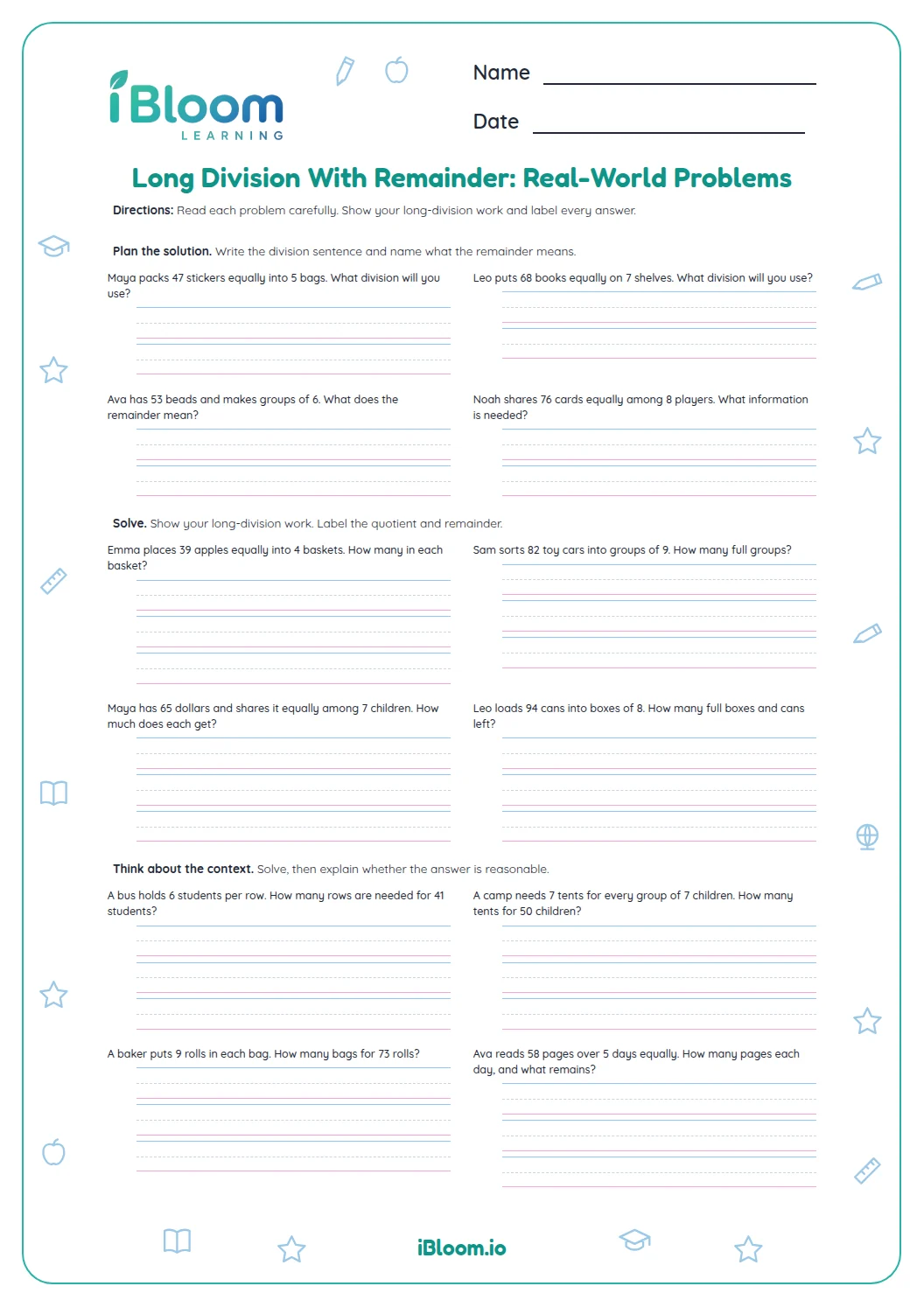
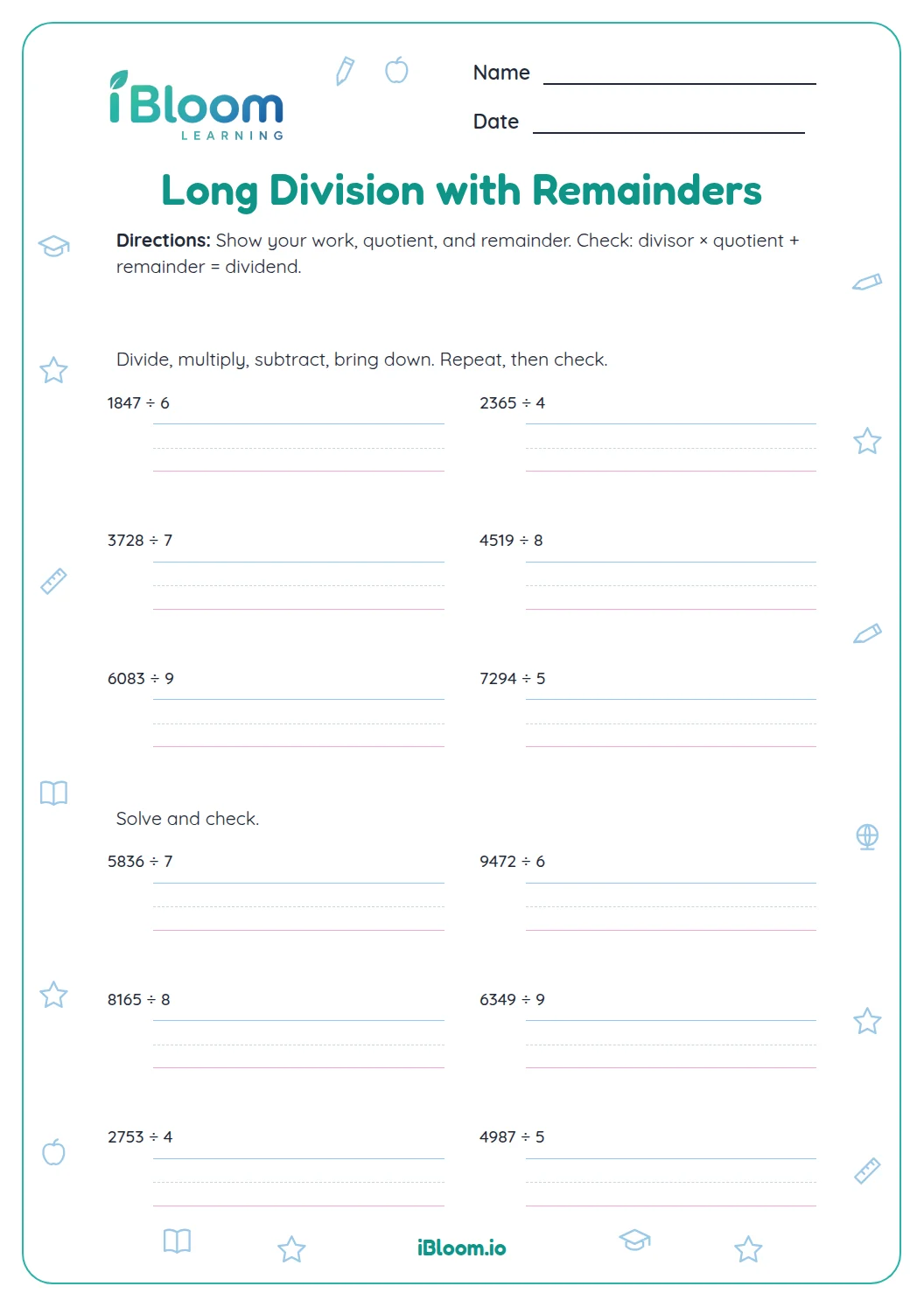
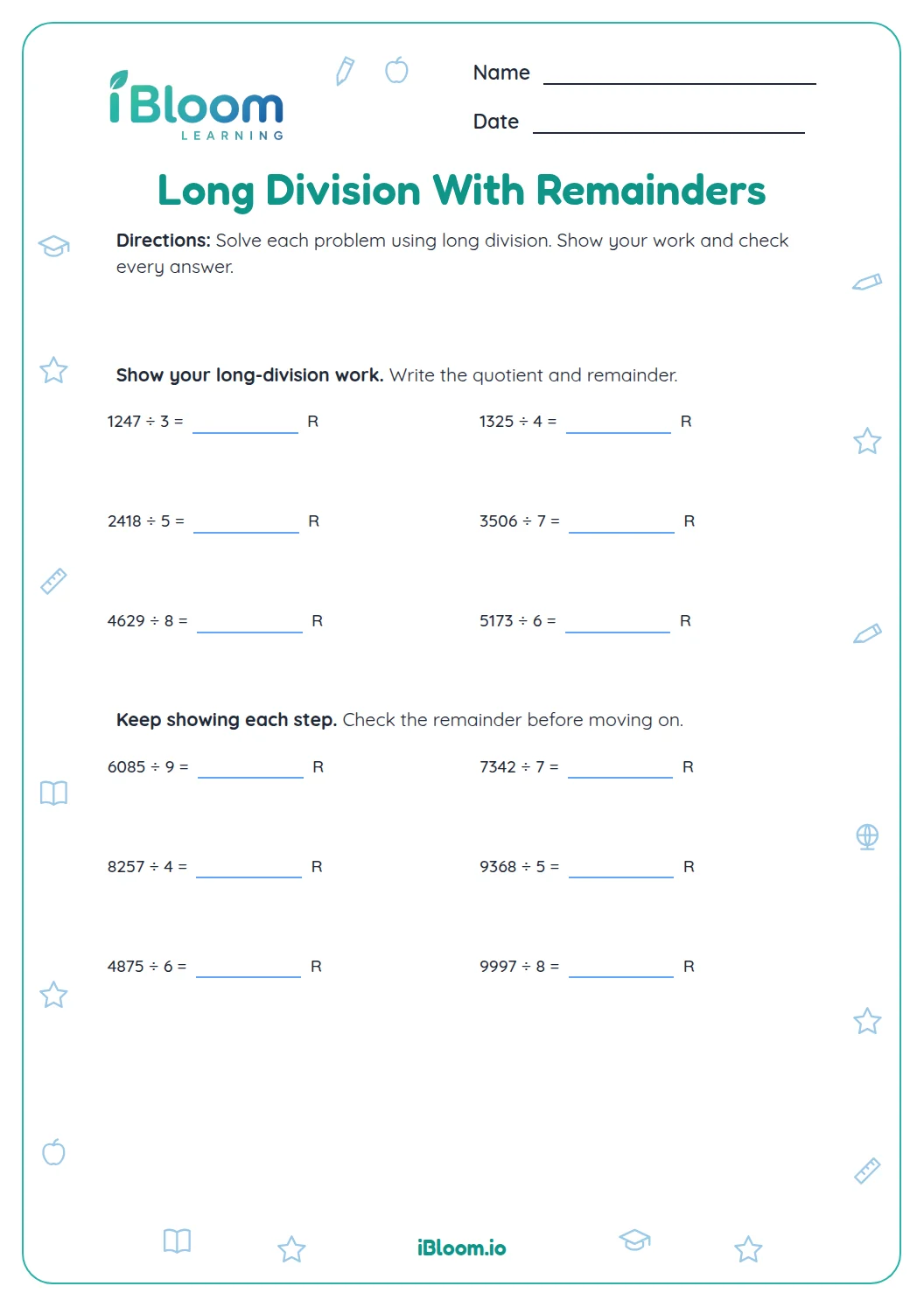
This Grade 4 reasoning challenge includes one question with room for long-division work, eleven compact quotient-and-remainder choices, and two reasoning items. Each remainder is smaller than its divisor.
Aligned to 4.NBT.B.6
How do quotient and remainder work together?
The quotient counts complete groups. The remainder is what is left after making those groups, and it must be smaller than the divisor. For 100 ÷ 9, eleven groups use 99, leaving 1: 100 ÷ 9 = 11 R 1.
Part A practices this relationship across varied divisors. Part B applies it to equal sharing and checking.
- 1100 ÷ 9 = 11 R 1
- 2Check: 9 × 11 + 1 = 100; 1 is less than 9.
How can multiplication check a division answer?
Multiply the divisor by the quotient and add the remainder. The result should be the original dividend. Question 15 uses 7 × 9 + 5 = 68, and 5 is smaller than 7, so 68 ÷ 7 = 9 R 5 is valid.
When do remainders matter in a word problem?
A sharing problem may describe leftovers, while a packaging question may ask how many full groups are possible. Read what the question asks before deciding how to report the remainder.
How to use this worksheet
- 1Divide to find the greatest complete quotient.
- 2Multiply the divisor by that quotient.
- 3Subtract the product from the dividend to find the remainder.
- 4Check that the remainder is smaller than the divisor.
- 5For word problems, state what the quotient and leftover mean.
Common mistakes and quick fixes
The mistake
Writing a remainder as large as the divisor.
The fix
Make one more group and reduce the remainder.
The mistake
Adding the remainder to the quotient.
The fix
Keep quotient and leftover as separate parts of the answer.
The mistake
Skipping the multiplication check.
The fix
Use divisor × quotient + remainder to recover the dividend.
Common Core alignment
The questions practice finding and checking whole-number quotients and remainders.
Use division and multiplication to find and check quotients with remainders.
On this sheet: All questions use one-digit divisors and dividends below 100.
Show the official wordingHide the official wording
Find whole-number quotients and remainders with up to four-digit dividends and one-digit divisors, using strategies based on place value, the properties of operations, and/or the relationship between multiplication and division. Illustrate and explain the calculation by using equations, rectangular arrays, and/or area models.
What to practice next
Make more practice
Further reading
Questions parents and teachers ask
How do you check division with a remainder?
Multiply the divisor by the quotient, then add the remainder. The result should equal the dividend, and the remainder must be smaller than the divisor. For 68 ÷ 7, 7 × 9 + 5 = 68, so 9 R 5 is correct.
How many questions are included?
There are 14 problems across the worksheet pages, followed by a separate answer key. The sheet includes long-division work, compact quotient-and-remainder choices, and short reasoning applications. Students can complete the work in order and use the key after they finish.
Is there room to show long division?
Yes. The first division question provides writing lines for long-division steps before the quotient and remainder. The remaining questions use compact choices and applications to keep the worksheet readable and preserve practice across the skill. The first item models a complete division process.
What makes a remainder valid?
A remainder must be smaller than its divisor. If it is as large as the divisor, another full group can be made. Check by multiplying the divisor by the quotient and adding the remainder; the result should match the dividend.