



About this worksheet
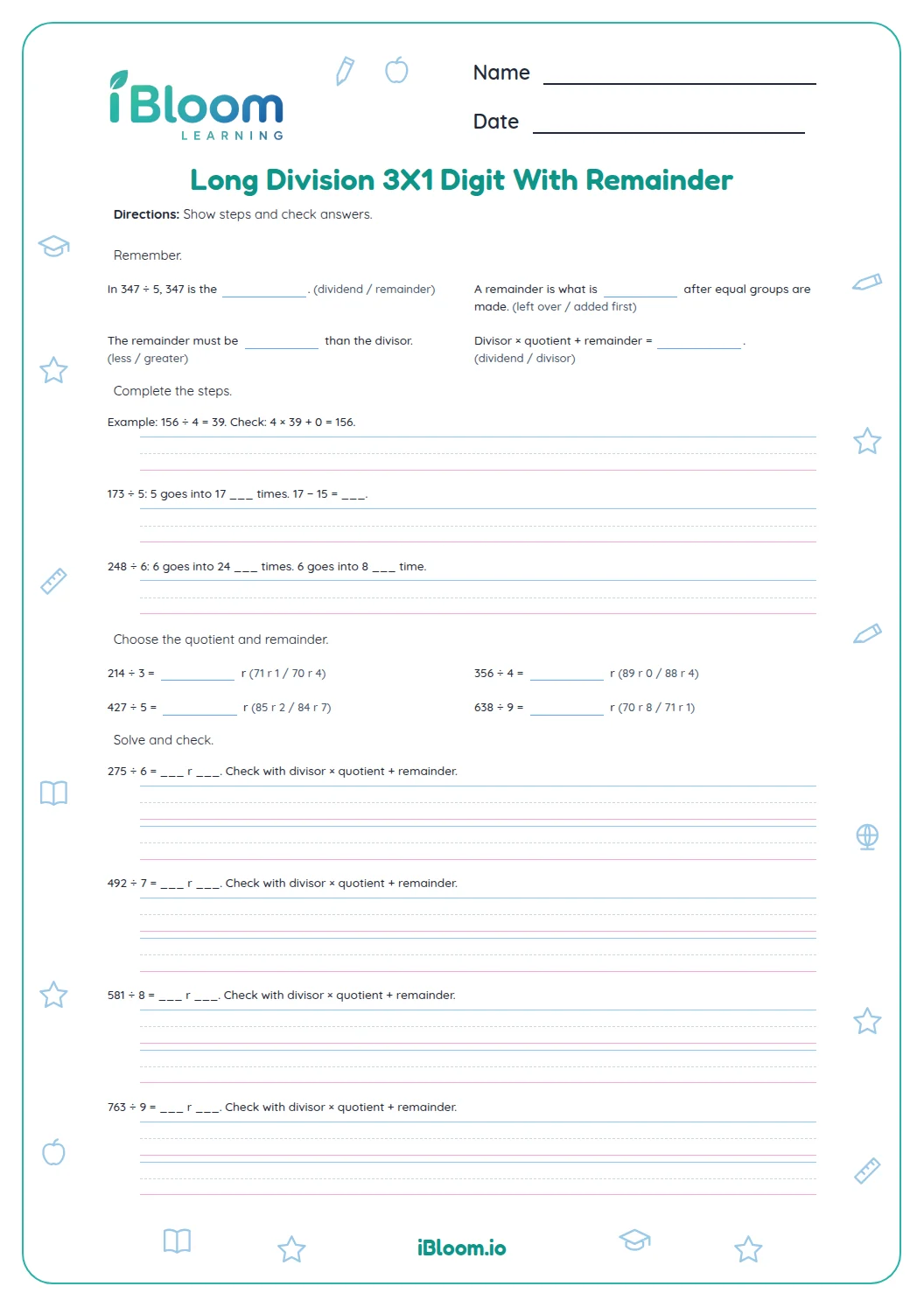
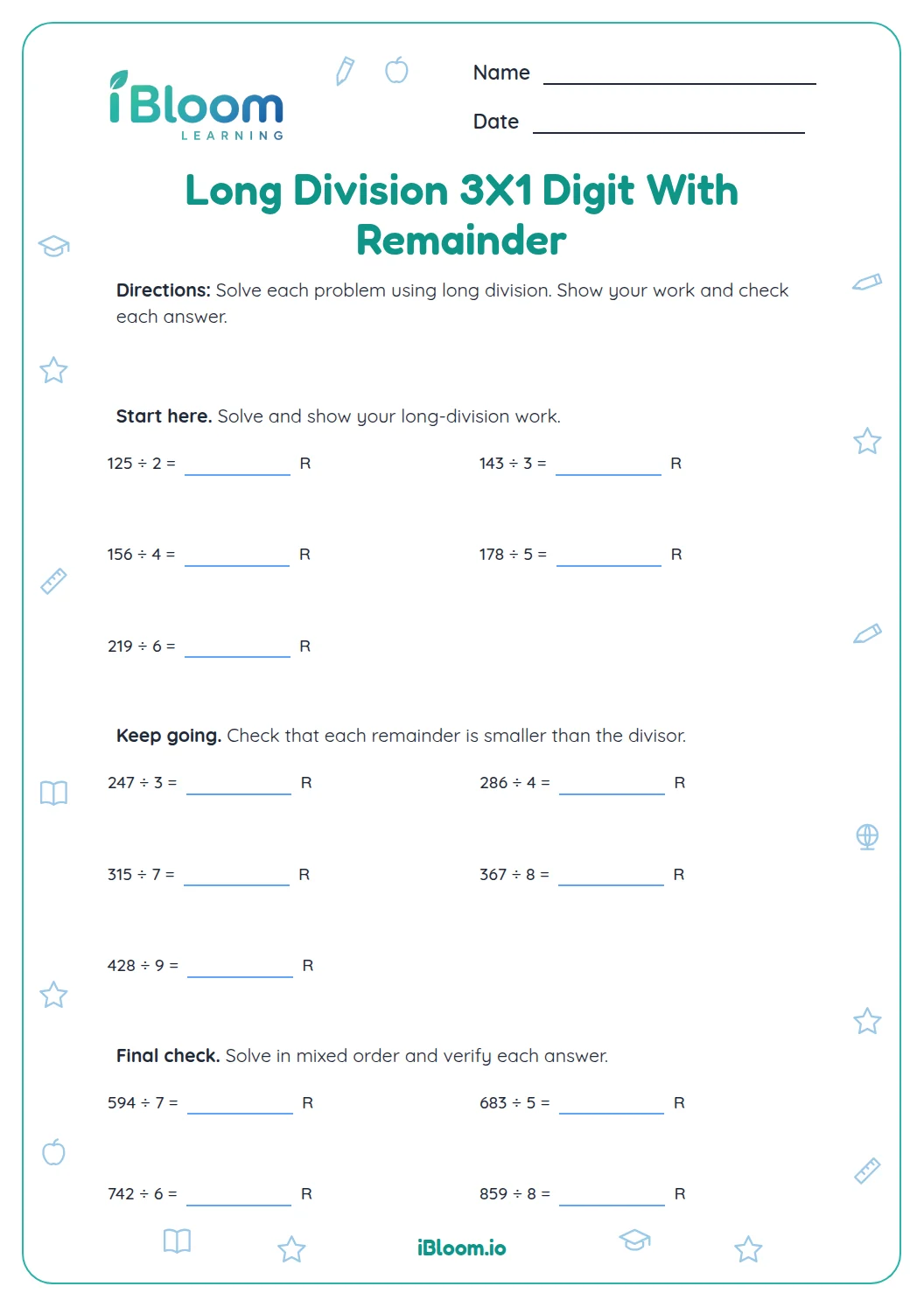
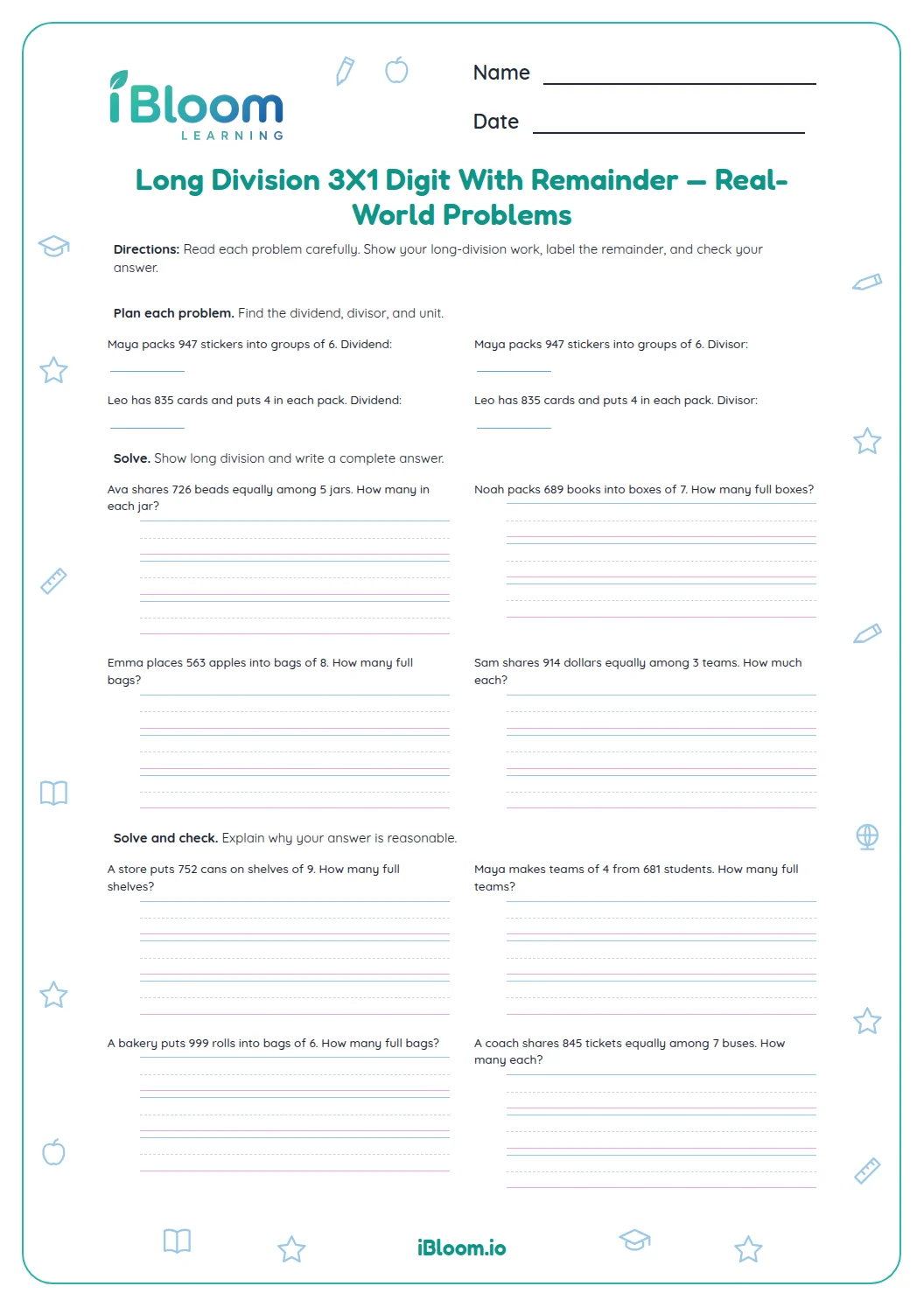
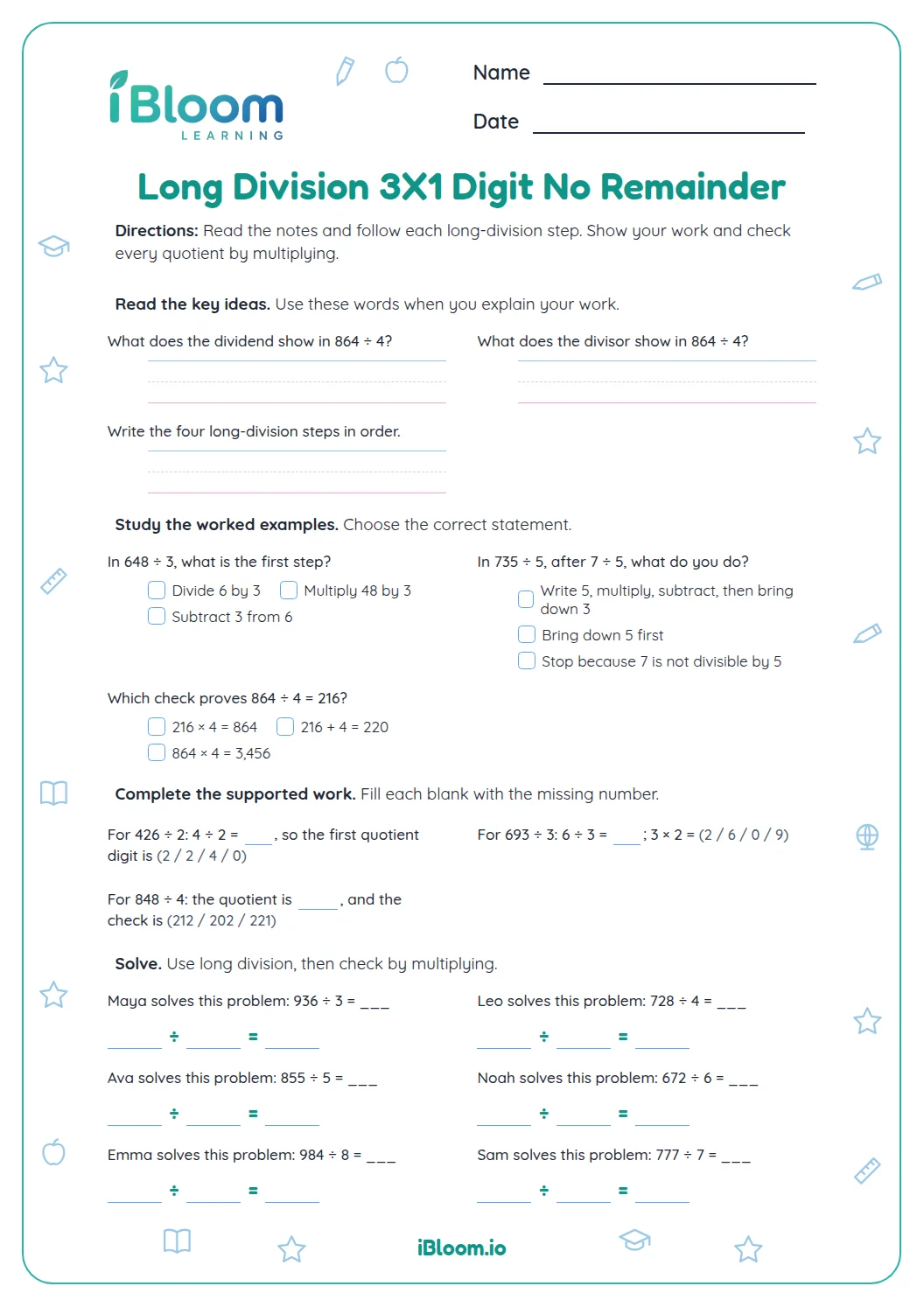
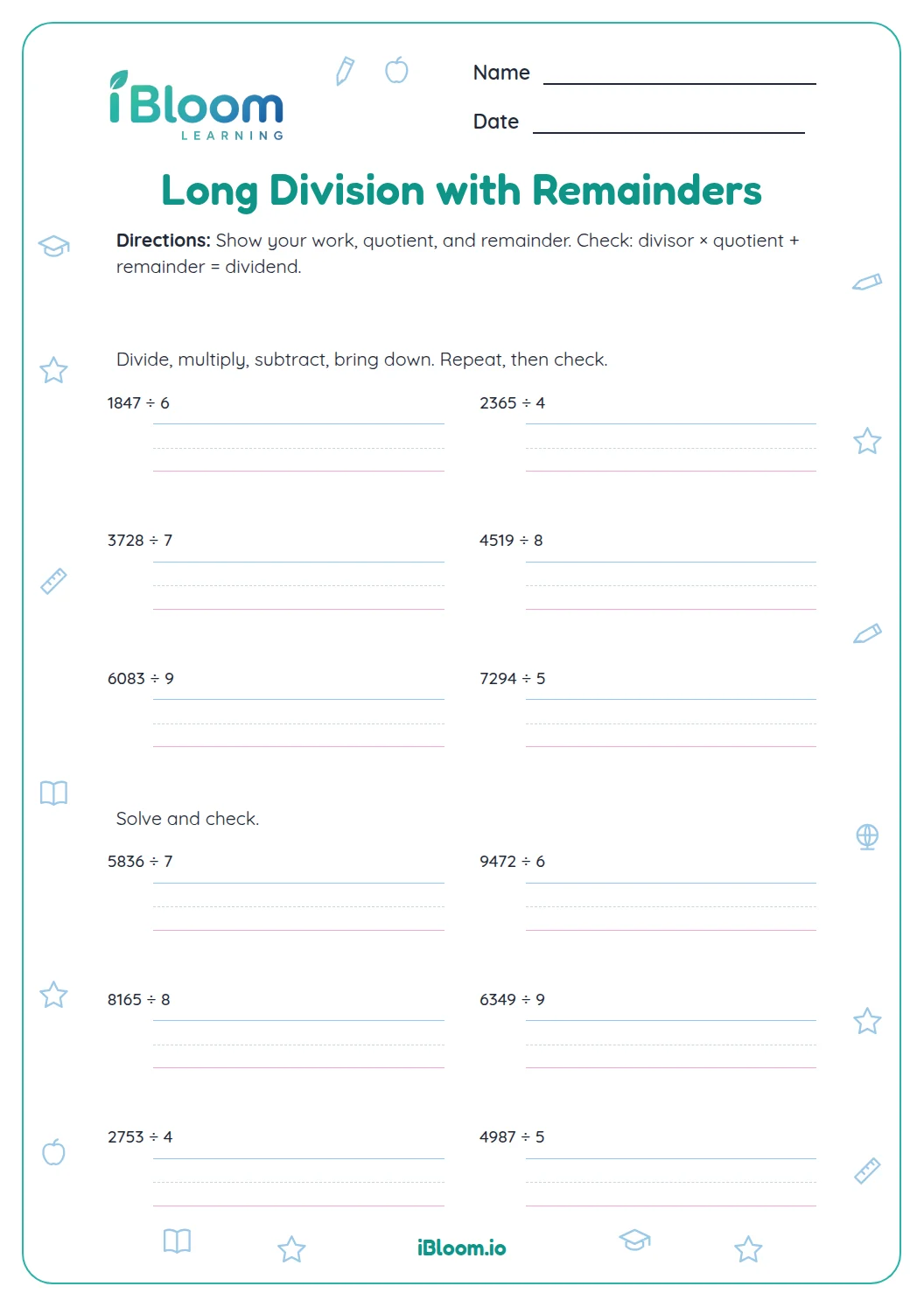
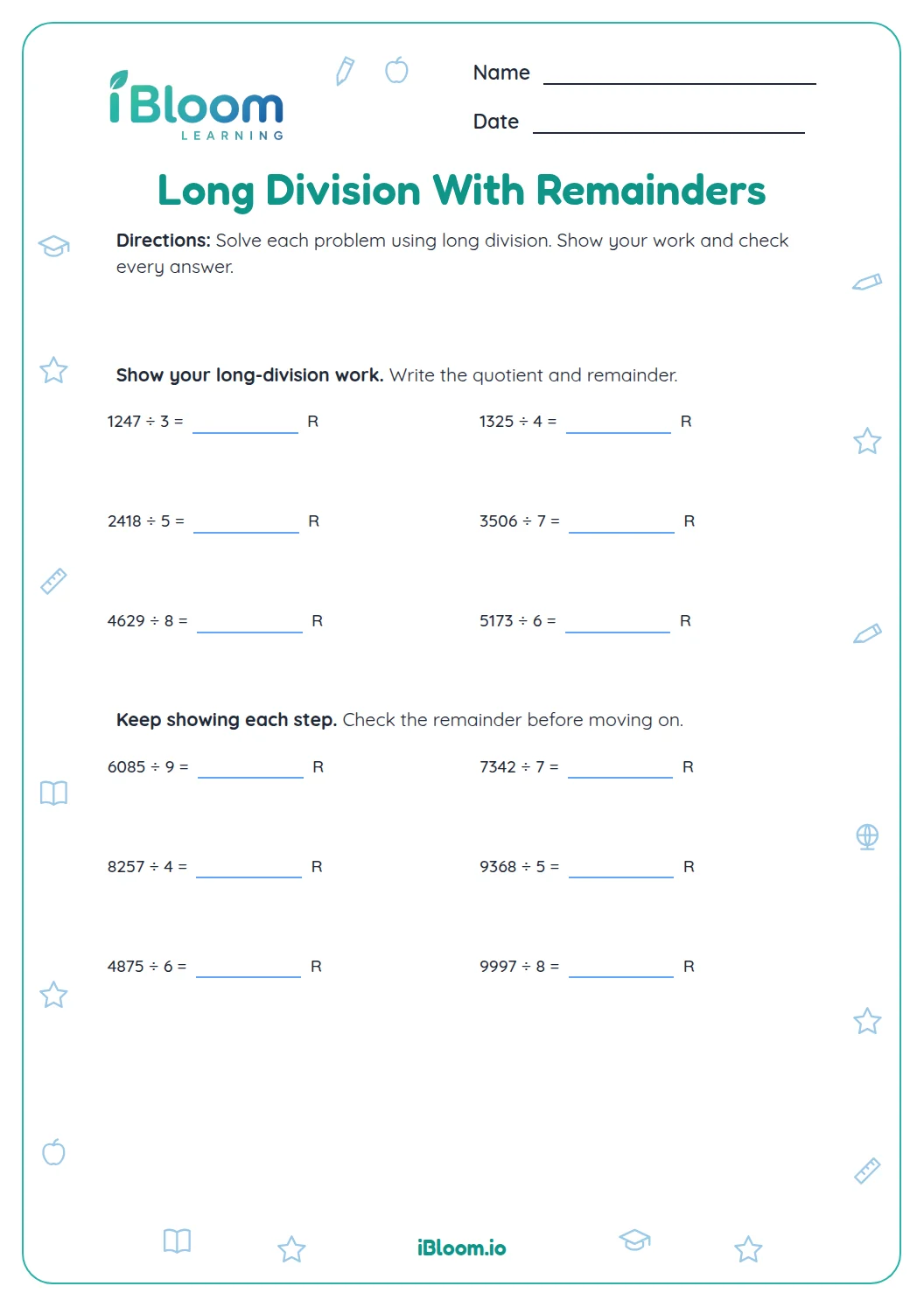
This Grade 4 printable gives students 18 long-division problems with three-digit dividends and one-digit divisors. Each item shows base-ten blocks for the dividend and has separate blanks for the quotient and remainder. Students can connect the place-value model to the division equation and use multiplication to check. A separate answer key is included.
Aligned to 4.NBT.B.6
What is the main idea in divide with remainders?
This Grade 4 printable gives students 18 long-division problems with three-digit dividends and one-digit divisors. Each item shows base-ten blocks for the dividend and has separate blanks for the quotient and remainder. Students can connect the place-value model to the division equation and use multiplication to check. A separate answer key is included.
Use place value to divide. Write the quotient and remainder in order.
- 1125 ÷ 4 = ___ R ___
- 231, 1
How does the practice build?
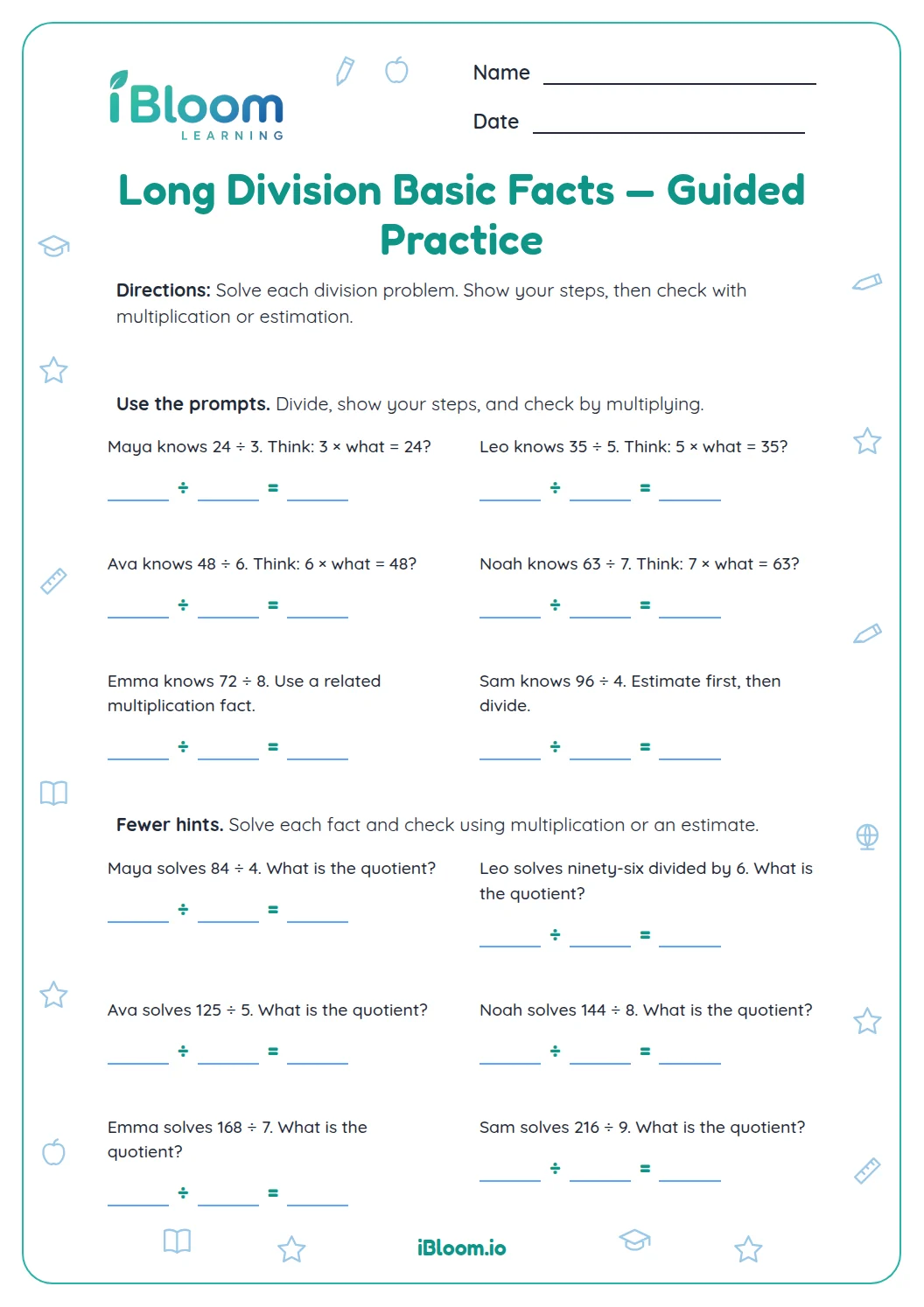
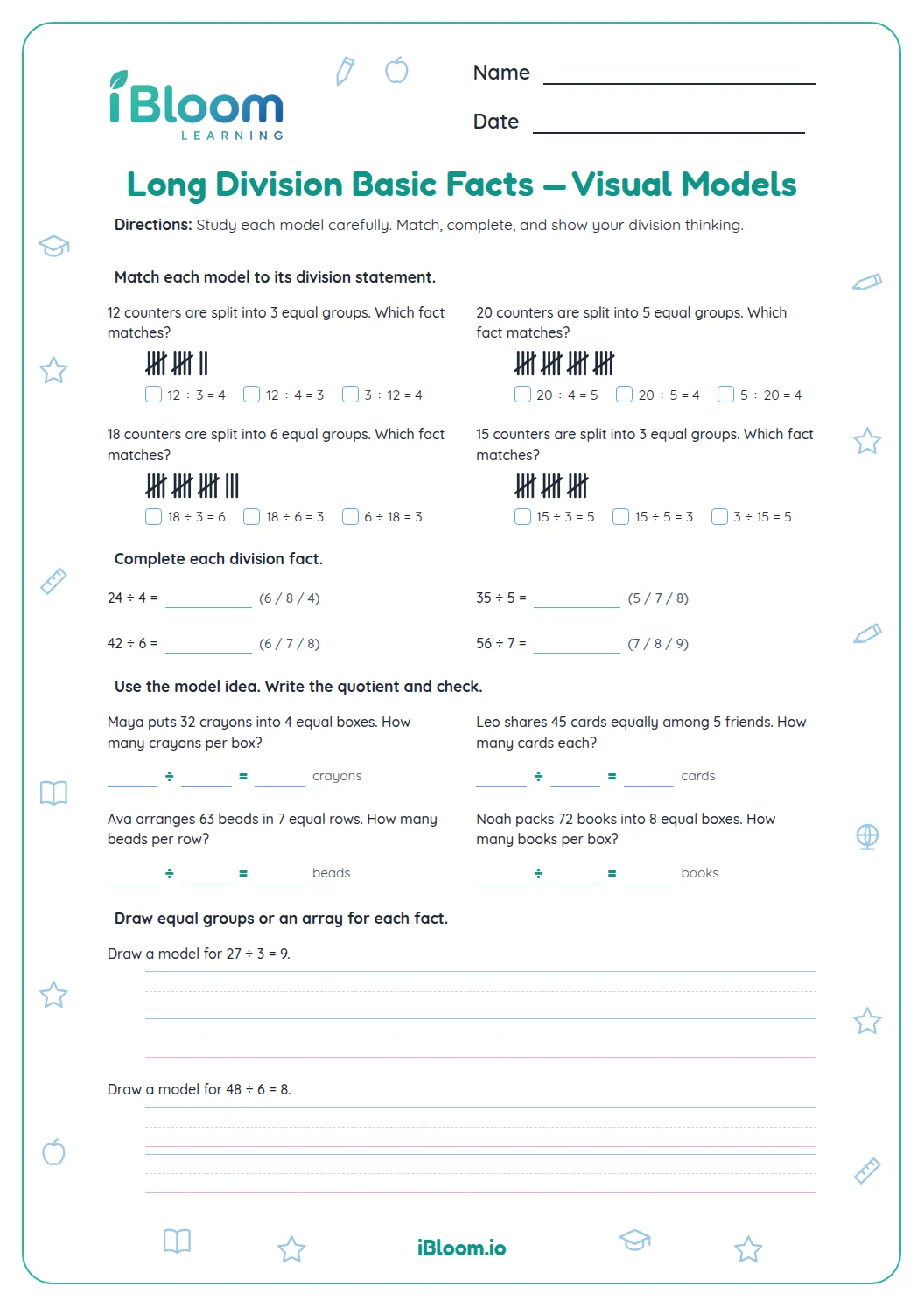
The worksheet has 14 questions in 4 parts. Each part has a single clear direction, and the separate key follows the same question order.
How to use this worksheet
- 1Read the direction for each part and identify the operation or comparison needed.
- 2Complete the first question together, using the worked example on this page.
- 3Work through the remaining questions in order and keep units with measurement answers.
- 4Check each answer with the answer key; redo any missed item and explain the correction.
Common mistakes and quick fixes
The mistake
Choosing an operation before identifying what the quantities represent.
The fix
Underline the relevant numbers and name the relationship before calculating.
The mistake
Recording a correct number with a missing unit or an incomplete answer.
The fix
Reread the question and include the requested unit, comparison sign, quotient, or remainder.
The mistake
Accepting an answer without checking its size.
The fix
Estimate first, then substitute the result or use the inverse operation to check.
Common Core alignment
This worksheet practices long division with remainders through use place value and multiplication to check a quotient and remainder..
Divide up to four-digit numbers by one-digit numbers using place value and models.
On this sheet: The questions repeatedly ask students to long division with remainders in the worksheet contexts.
Show the official wordingHide the official wording
Find whole-number quotients and remainders with up to four-digit dividends and one-digit divisors, using strategies based on place value, the properties of operations, and/or the relationship between multiplication and division. Illustrate and explain the calculation by using equations, rectangular arrays, and/or area models.
What to practice next
Make more practice
Further reading
Questions parents and teachers ask
What skill does this long division with remainders worksheet practice?
It gives Grade 4 students focused practice with long division with remainders. The questions move from a direct calculation to a slightly more demanding application, and the separate answer key supports checking each result. The page is designed to be printed with the worksheet and key together.
How many questions are on the printable?
There are 14 questions arranged in a short progression across two worksheet pages. Each question has one keyed answer, and the separate key pages show the answers in the same order as the student sheet. Students can complete one part at a time.
What is the key idea for long division with remainders?
Use place value and multiplication to check a quotient and remainder.. Students can use that idea to choose a strategy, calculate carefully, and check whether the result fits the quantities in the question. The worked example on this page uses one of the printable’s actual question types.
Is an answer key included?
Yes. A separate answer key is included with the printable. It lists one answer for every question, including all requested parts when a question has more than one blank, so an adult can check the work in order.
How can an adult help without solving every problem?
Ask the student to explain what each number represents and which relationship the question asks about. After the student works independently, use the answer key to find any mismatch, then have them check the calculation with an estimate or inverse operation.