



About this worksheet
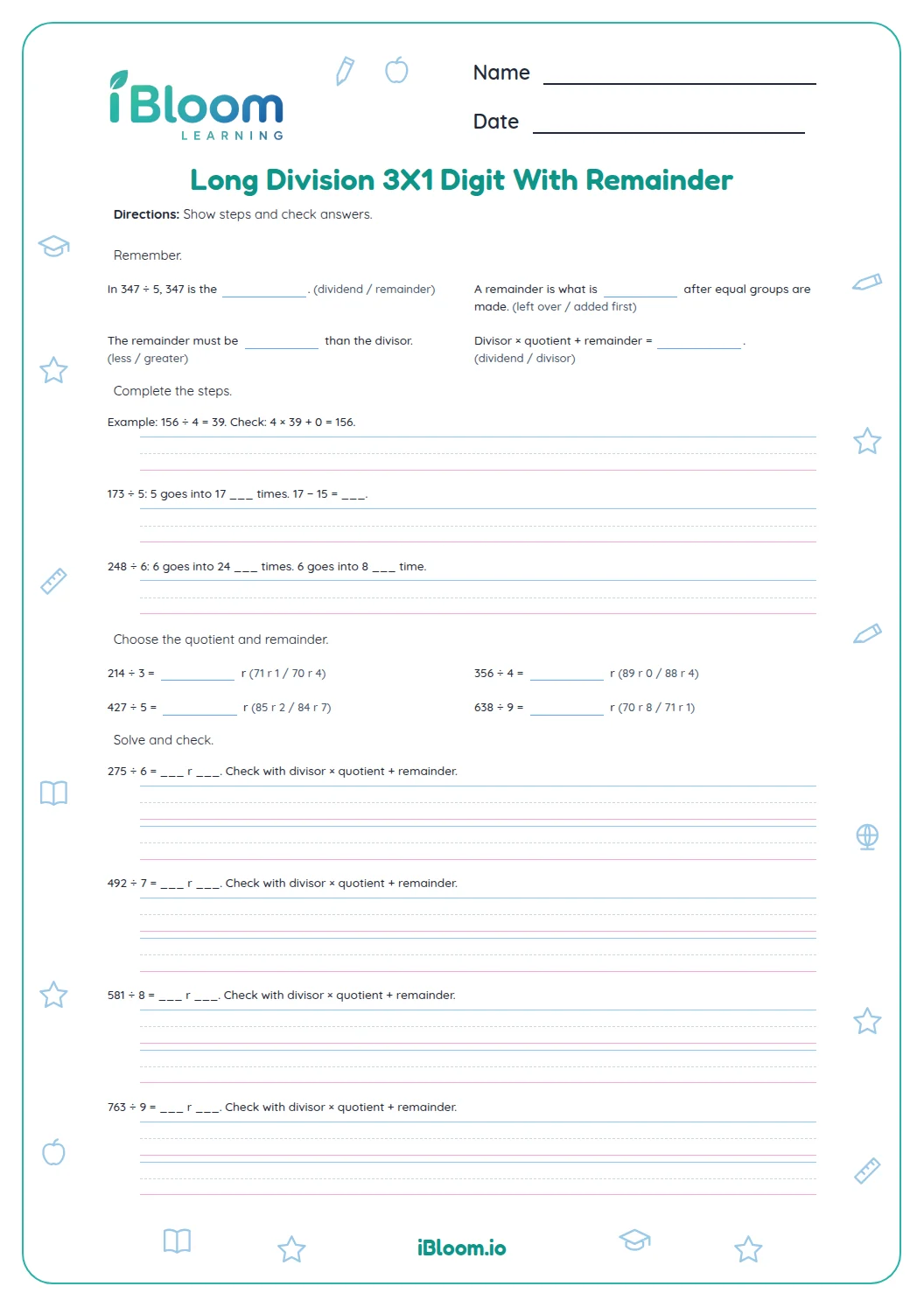
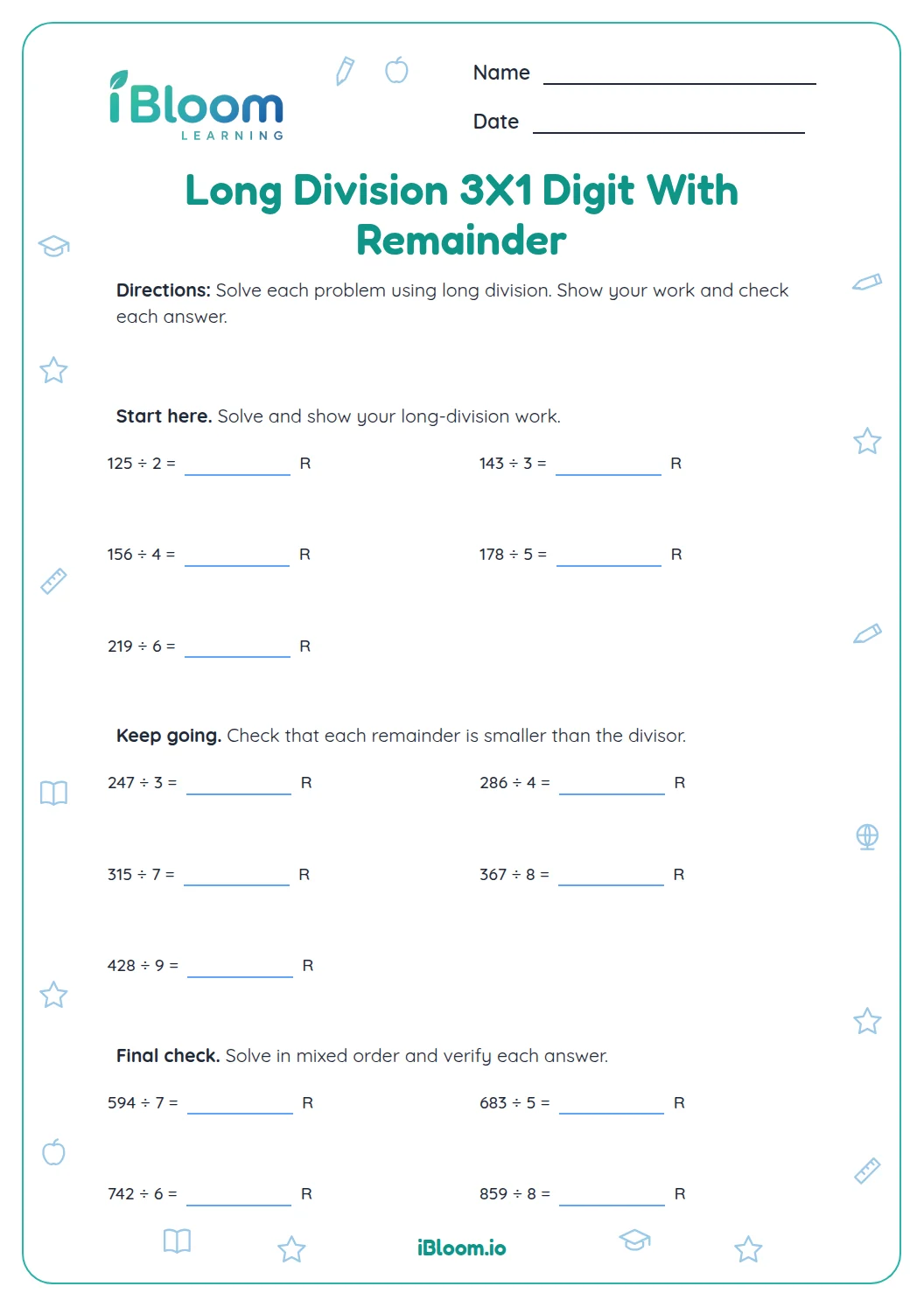
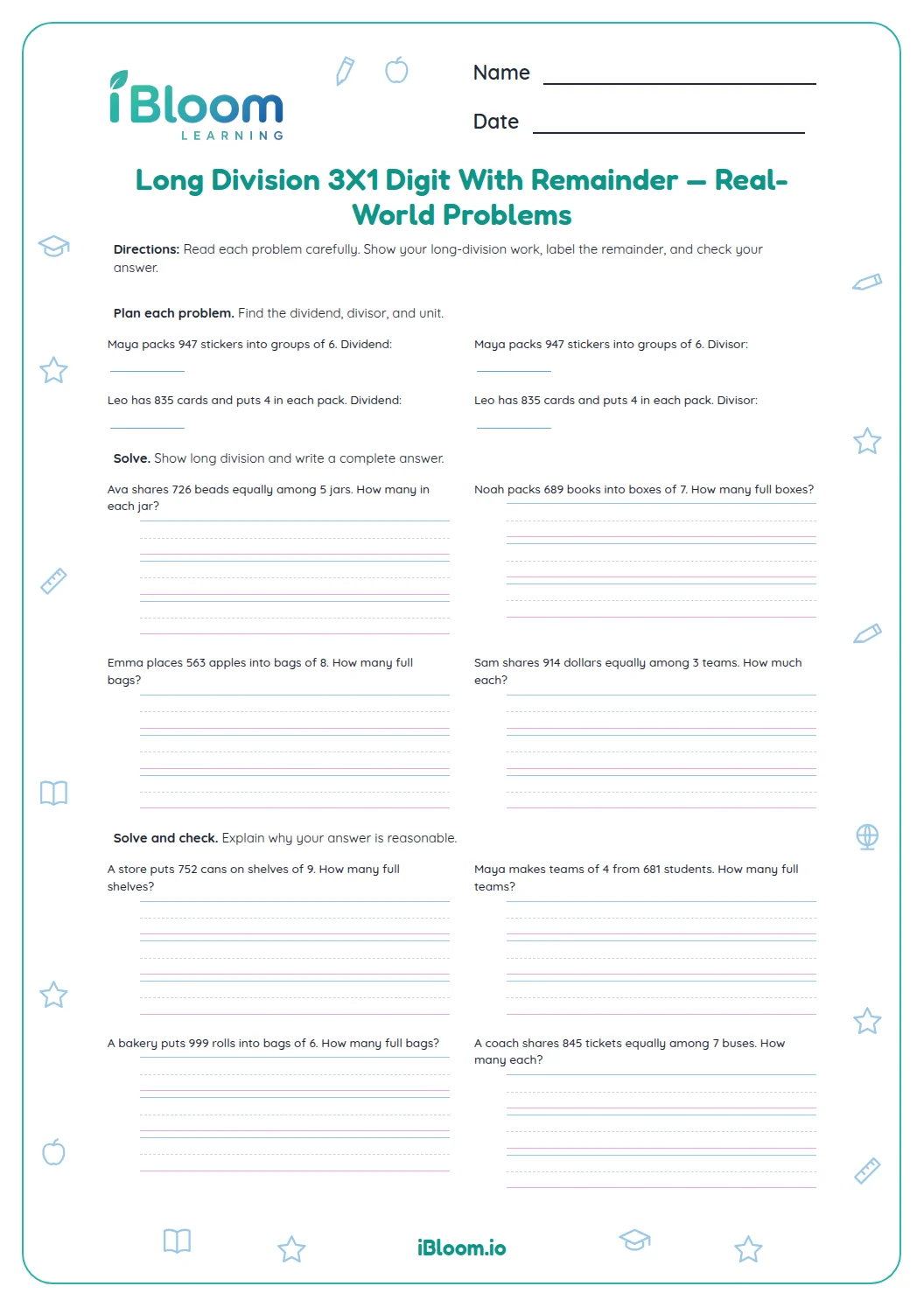
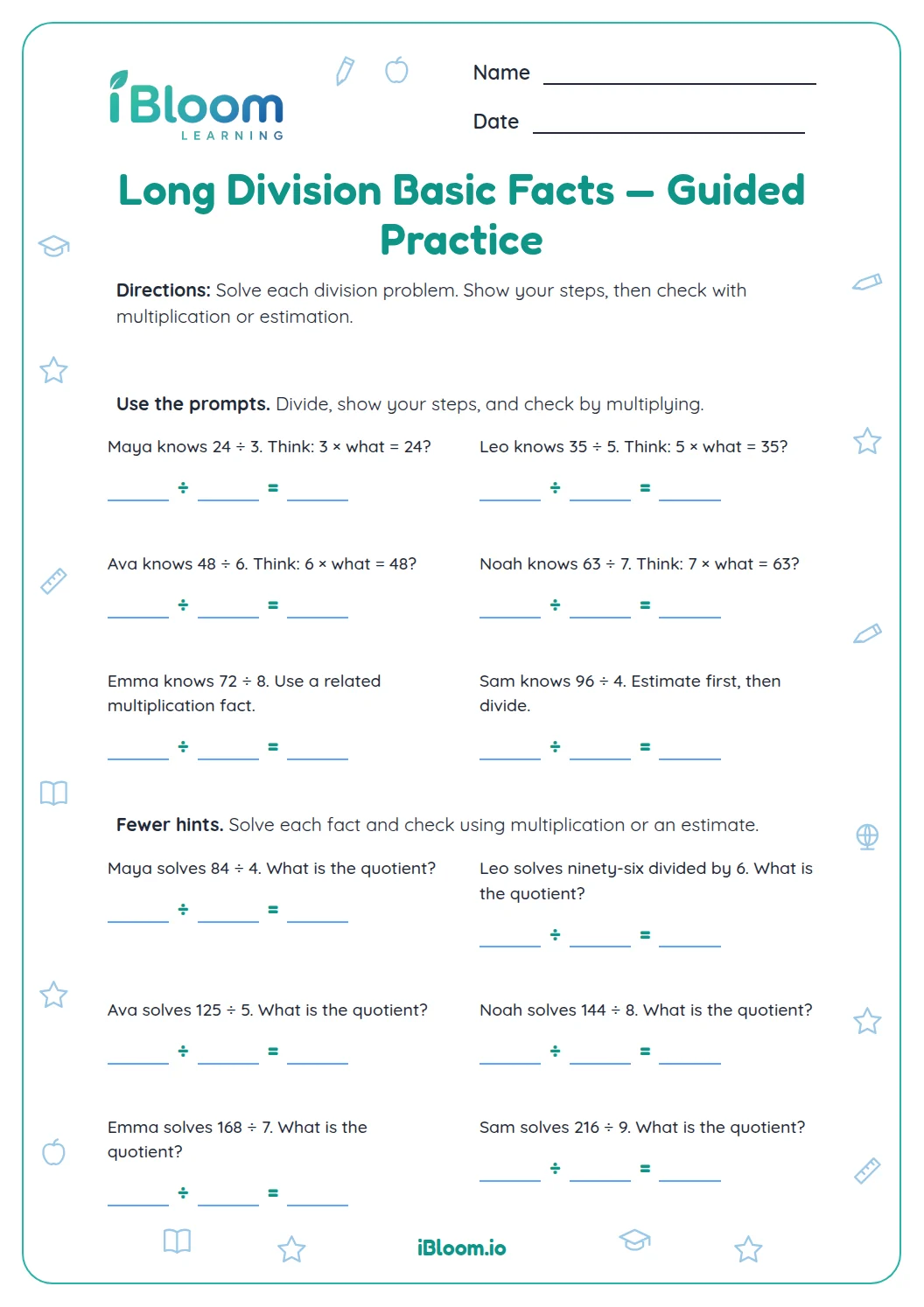
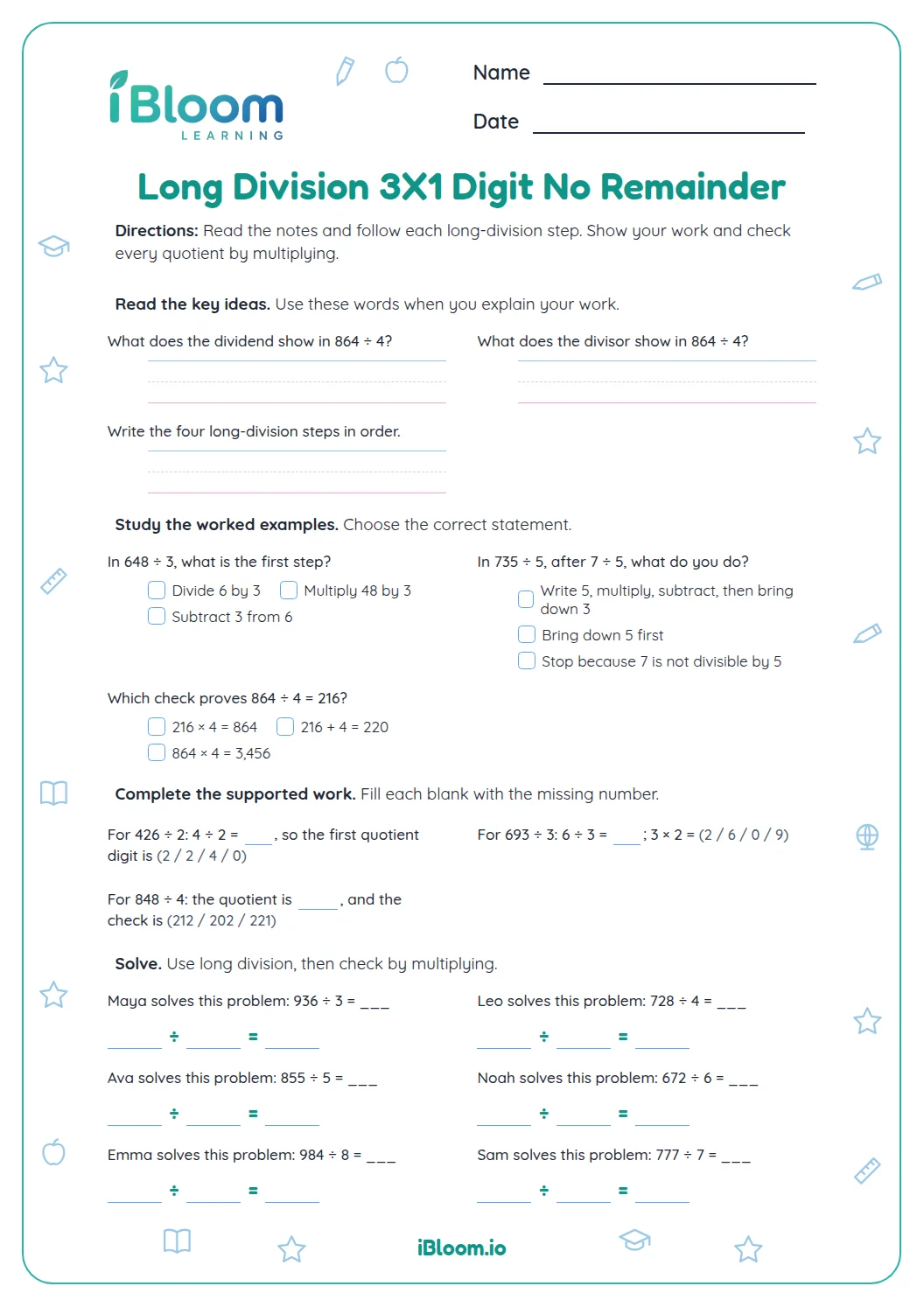
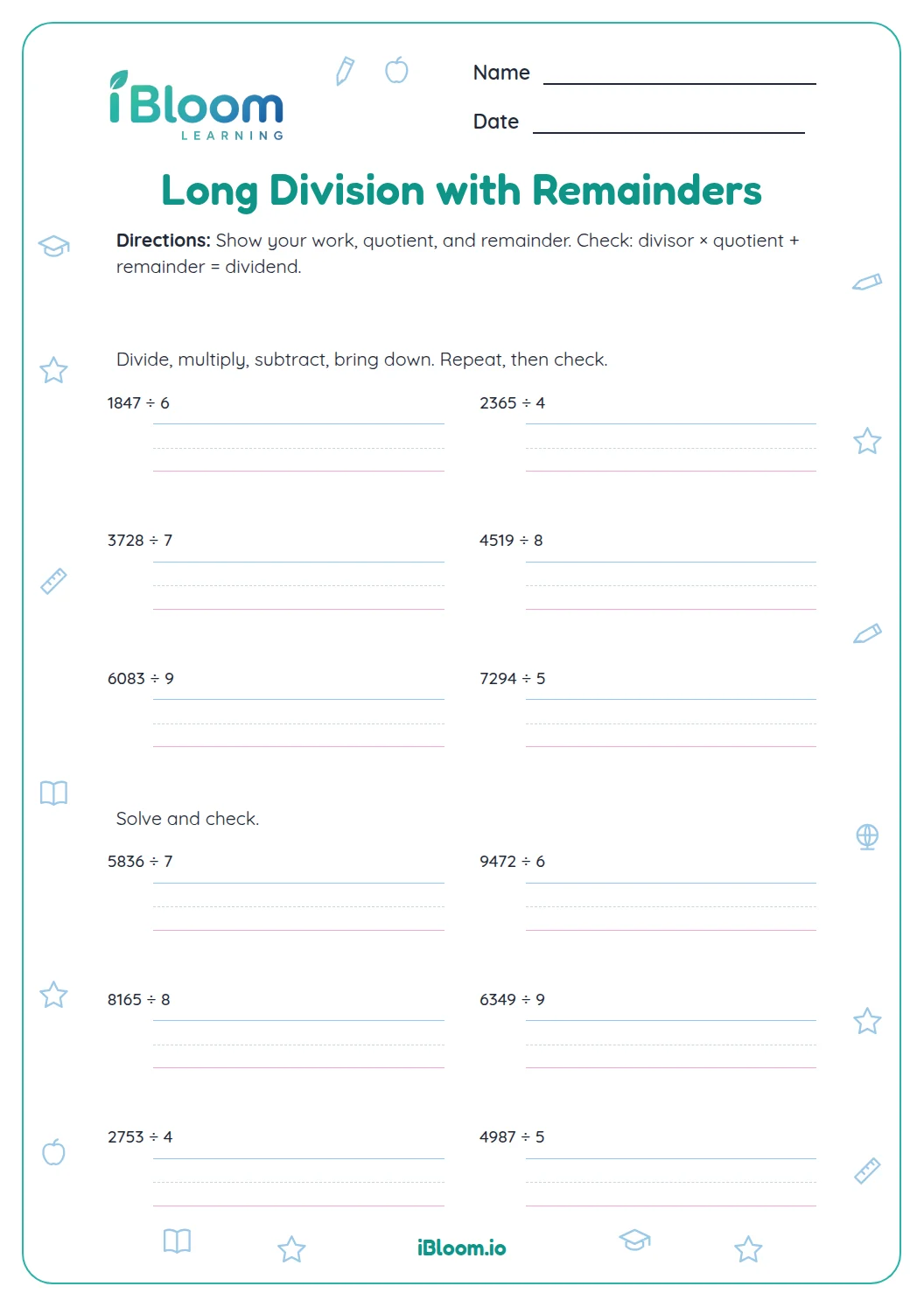
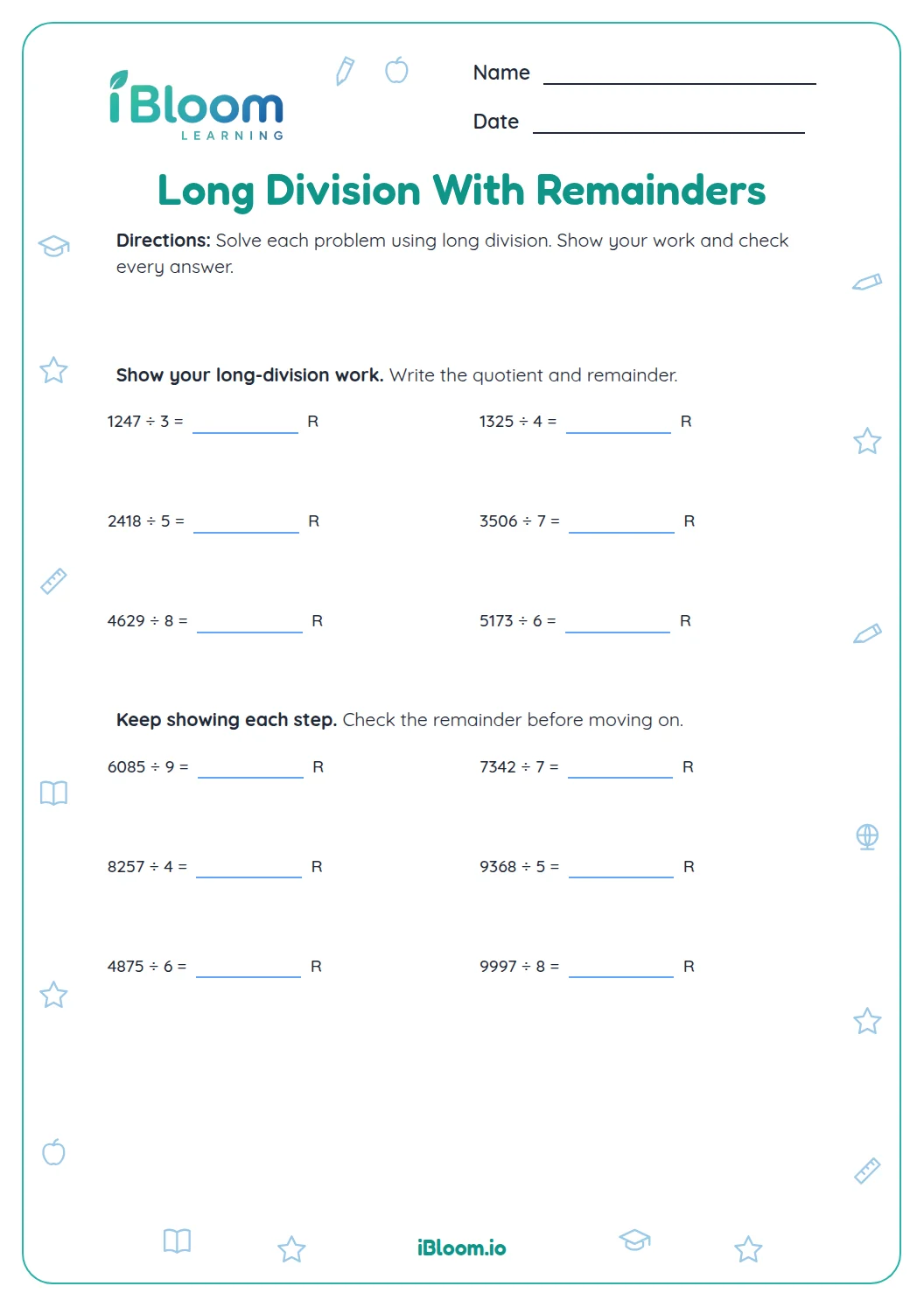
This free Grade 4 worksheet asks students to reason about three-digit division by one-digit divisors. Part A gives four divisions with working grids. Part B asks students to repair quotient-and-remainder errors and choose checks. Part C works backward from multiplication equations, and Part D asks for two short explanations. Every division involves a three-digit dividend and a one-digit divisor. The fourteen tasks practice Common Core 4.NBT.B.6 through division and equations that explain the result. The separate answer key includes corrected answers and model reasoning for the final questions.
Aligned to 4.NBT.B.6
Why does a division answer need two checks?
The equation divisor × quotient + remainder = dividend shows that all the original objects are accounted for. The remainder rule shows that no more full groups can be made. A nonnegative remainder must be smaller than the divisor.
For 456 ÷ 7, the statement 64 R8 gives 7 × 64 + 8 = 456, but the eight leftovers can make another group of seven. The correct result is 65 R1.
How do students repair Ava’s answer?
Ava’s 73 R9 for 593 ÷ 8 has too many leftovers. Trade eight of the nine leftovers for one more full group. That increases the quotient by one and reduces the remainder by eight.
- 1Ava wrote 593 ÷ 8 = 73 R9.
- 29 leftovers make 1 more group of 8 with 1 left.
- 3Correct result: 74 R1.
- 4Check: 8 × 74 + 1 = 593, and 1 < 8.
What does working backward reveal?
Part C gives the structure of a division check and asks for the missing value. In question 9, 6 × 54 + 4 recovers a dividend of 328. In question 10, the missing factor is the quotient.
For 7 × ___ + 3 = 514, subtract the remainder first: 514 − 3 = 511. Then 511 ÷ 7 = 73. Students can verify the answer by restoring it to the original equation.
What does the remainder mean in the pencil problem?
Question 12 asks for full groups of six and the number left over. With 725 pencils, 120 full groups use 720 pencils, leaving five. Those five pencils cannot make another full group of six.
The written answer should give both amounts and the checking equation. This links the quotient and remainder to what they count, making it clear why the final five are left over.
How to use this worksheet
- 1Set up each Part A division and use the working grid for long division.
- 2Write a quotient and remainder, then multiply back and add the remainder.
- 3Compare each remainder with the divisor before accepting the result.
- 4For Part B, test the proposed answer instead of assuming it is correct.
- 5In Part C, identify whether the blank is the dividend or the quotient.
- 6Write a short reason and checking equation for each Part D answer.
Mistakes to check
The mistake
Accepting 73 R9 for 593 ÷ 8 because it multiplies back correctly.
The fix
Nine leftovers can make another group of eight. Increase 73 to 74 and leave a remainder of 1.
The mistake
Checking only that the remainder is small.
The fix
Also multiply back: 6 × 71 + 4 = 430, so 71 R4 cannot be the answer to 428 ÷ 6.
The mistake
Dividing 514 by 7 before removing the remainder in question 10.
The fix
Subtract 3 first, then divide 511 by 7 to get the whole-number quotient 73.
Common Core alignment
Divide three-digit numbers by one digit and check quotients and remainders with equations.
On this sheet: Students divide three-digit dividends by one-digit divisors, repair errors, and explain multiplication checks.
Show the official wordingHide the official wording
Find whole-number quotients and remainders with up to four-digit dividends and one-digit divisors, using strategies based on place value, the properties of operations, and/or the relationship between multiplication and division. Illustrate and explain the calculation by using equations, rectangular arrays, and/or area models.
What to practice next
Make more practice
Further reading
Questions parents and teachers ask
Why can a correct multiplication check still give a wrong division answer?
A multiplication check can account for the dividend while leaving too many objects ungrouped. In question 11, 7 × 64 + 8 = 456 is true, but eight leftovers make one more group of seven. The final quotient and remainder must be 65 R1.
What is wrong with Leo’s 71 R4?
Leo’s answer does not recover the dividend of 428. Multiplying 71 by 6 gives 426, and adding 4 gives 430. Only two more are needed to reach 428, so the correct answer is 71 R2. The remainder 2 is also smaller than 6.
Does every problem need a long-division calculation?
Part A asks for long division and a multiplication check. Later parts ask students to inspect errors, complete check equations, and explain remainders. Students can use known multiples or subtraction to reason through those tasks, as long as their final quotient, remainder, and checks are correct.
How do I solve the missing quotient in question 10?
First remove the remainder: 514 − 3 = 511. Then divide 511 by 7 to get 73. Put 73 back in the blank and check that 7 × 73 + 3 = 514. The final remainder of 3 is smaller than the divisor 7.
What should the final pencil answer include?
It should name 120 full groups and 5 leftover pencils, with a checking equation such as 6 × 120 + 5 = 725. The five leftover pencils are fewer than the six needed for another full group. Equivalent explanations are acceptable when both quantities and the reasoning are clear.