

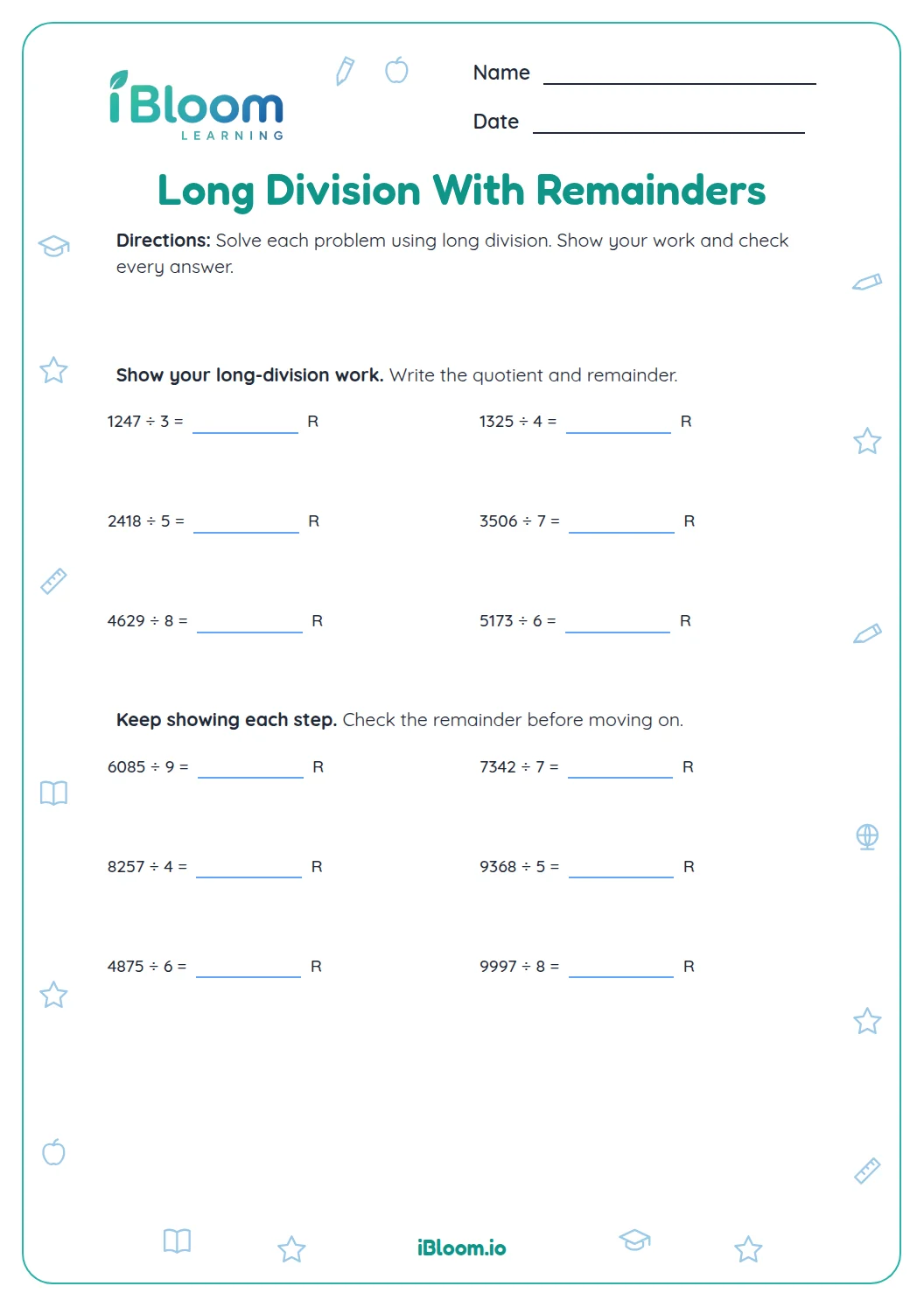
About this worksheet
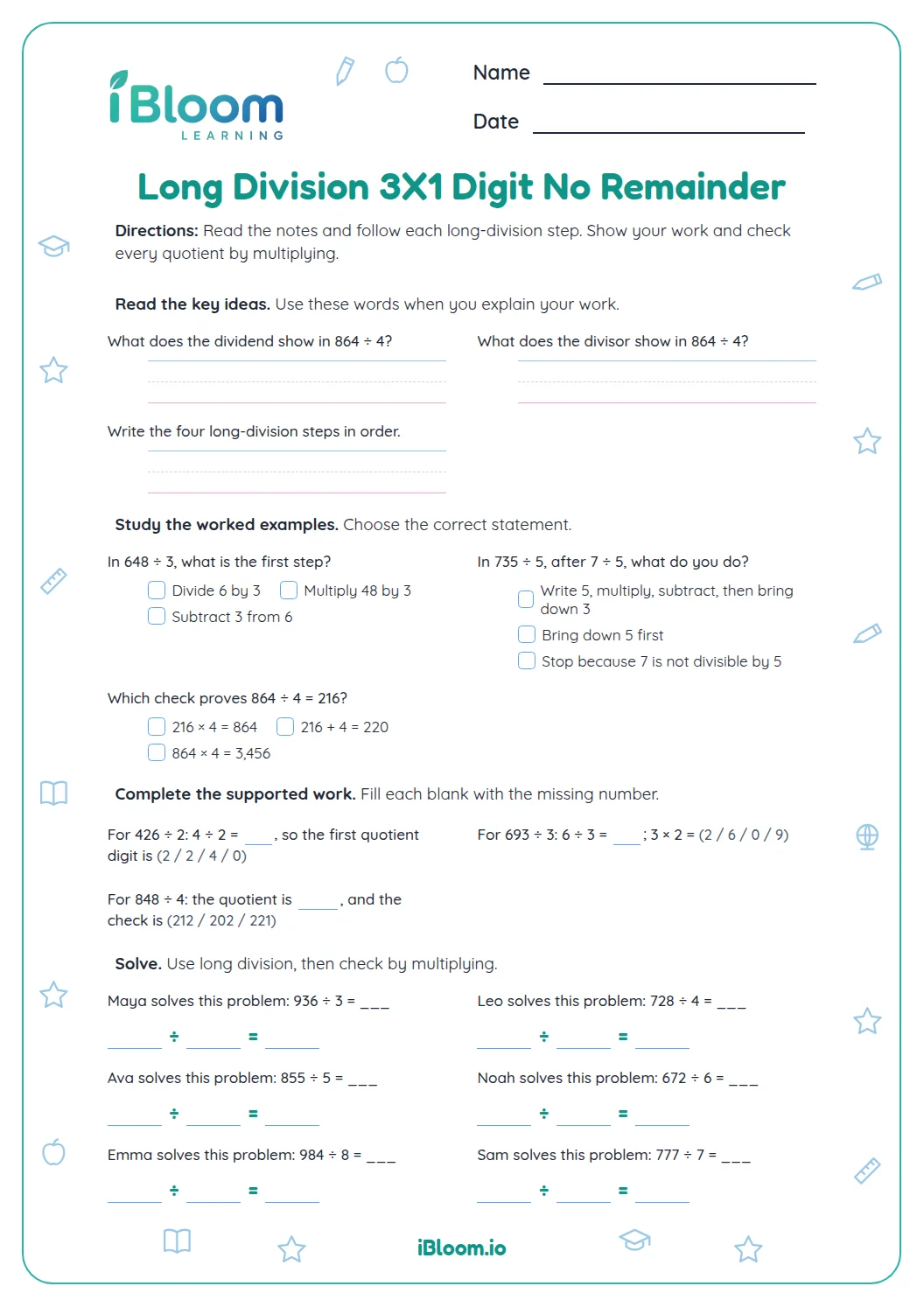
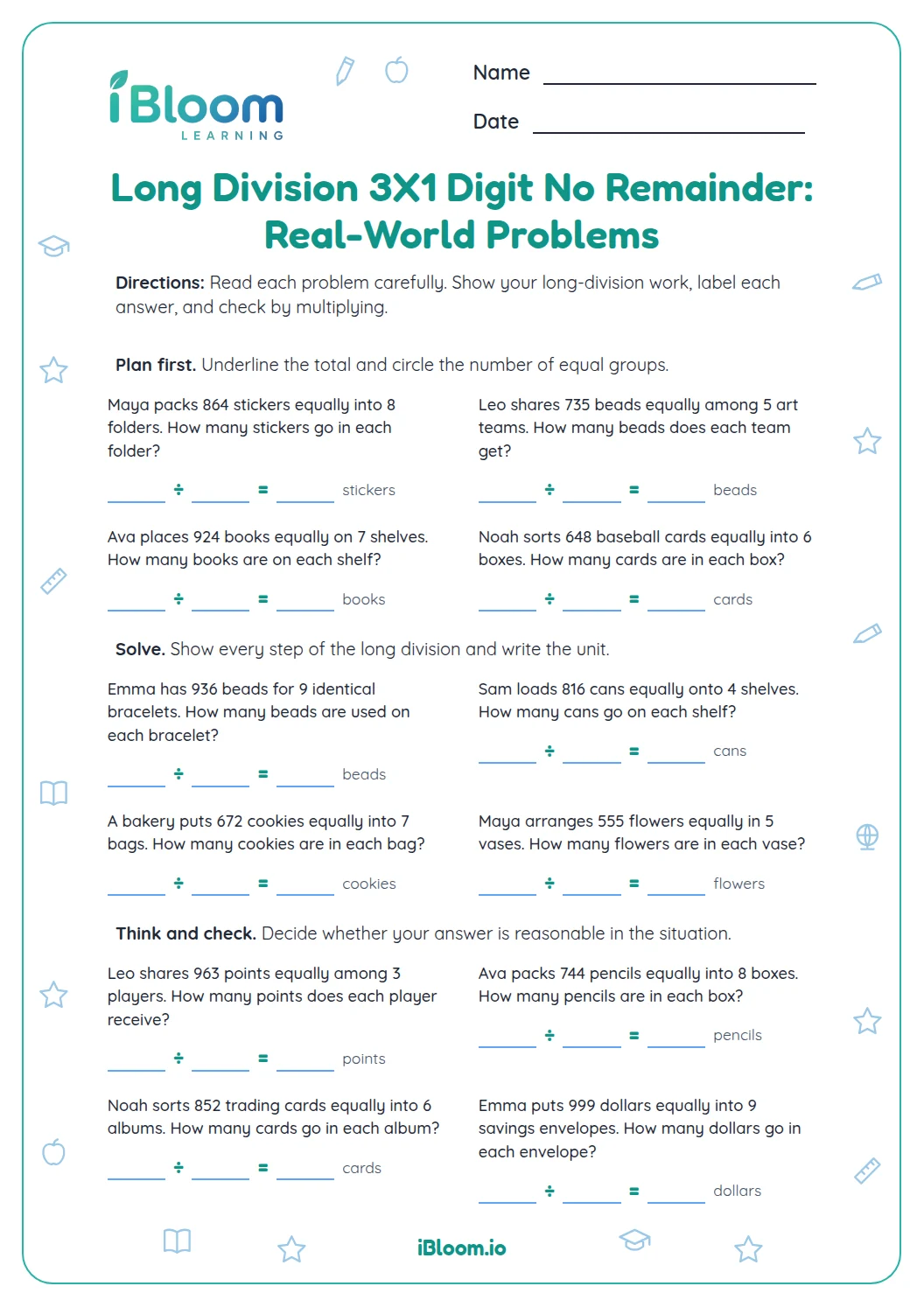
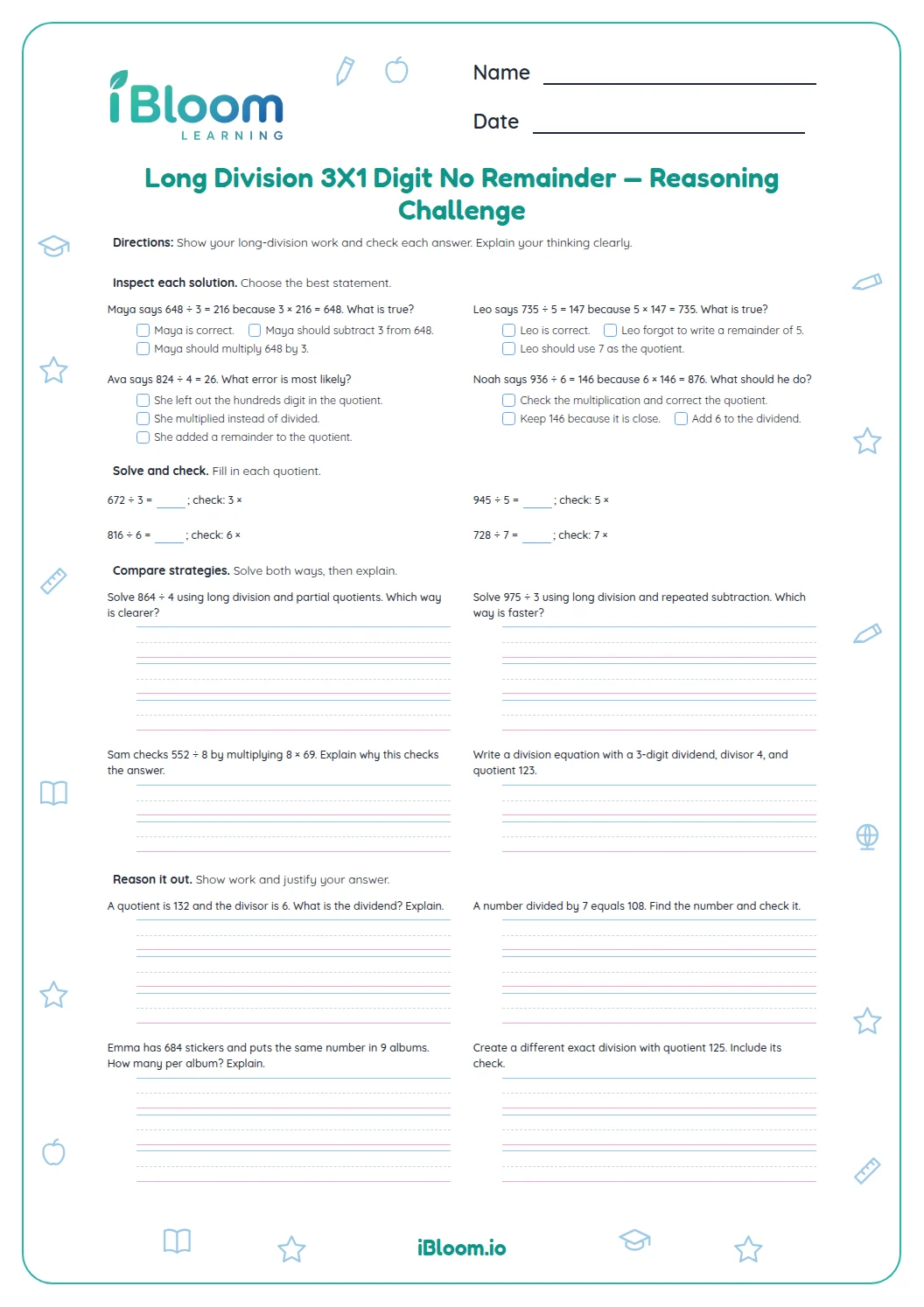
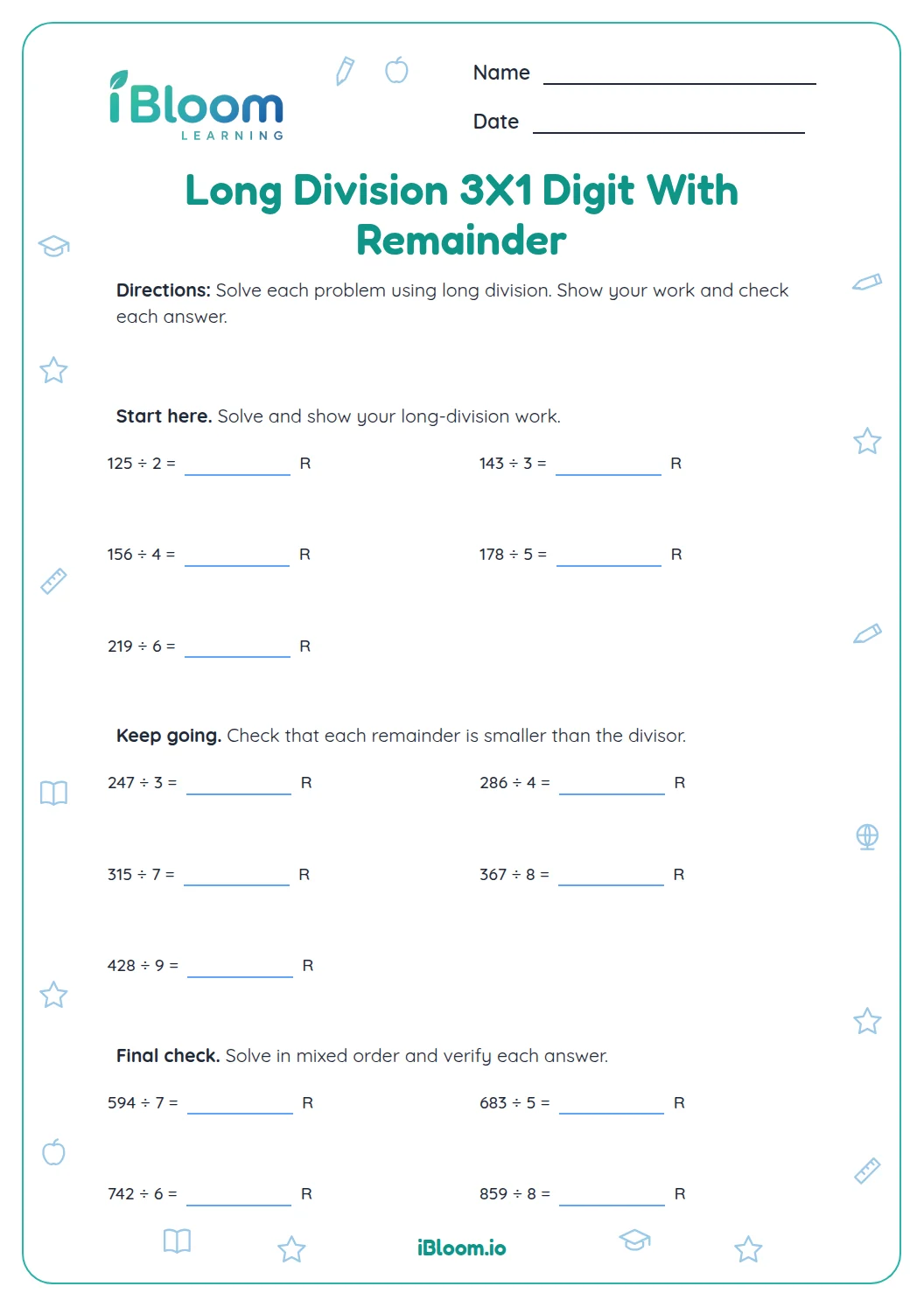
This printable worksheet gives grade 4 learners practice with three-digit dividends divided by one digit with no remainder. It contains 16 questions in clear parts, plus a separate answer key. Use the worked example below to model the first step, then invite learners to explain how they checked an answer.
Aligned to 4.NBT.B.6
What will learners do on this worksheet?
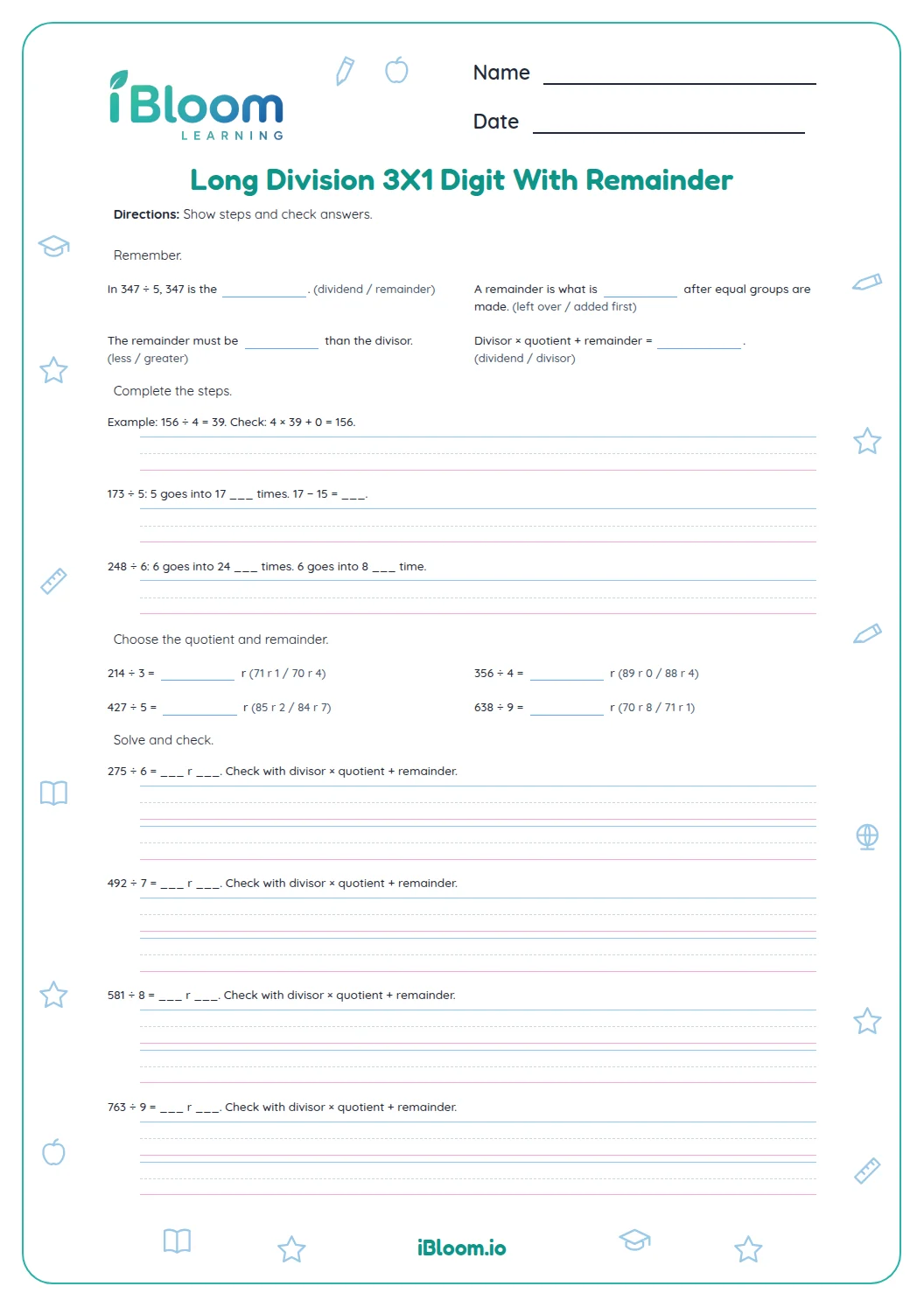
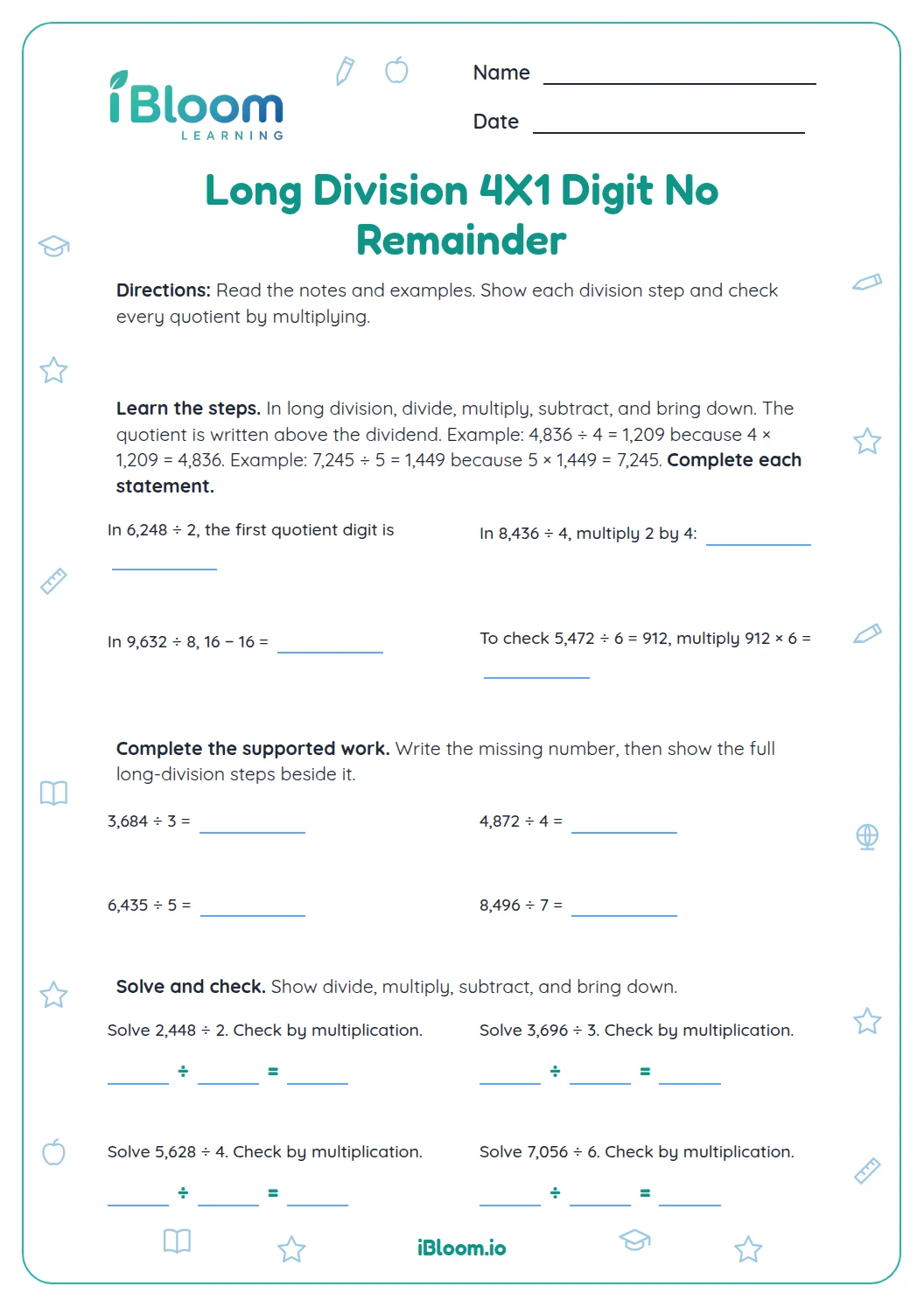
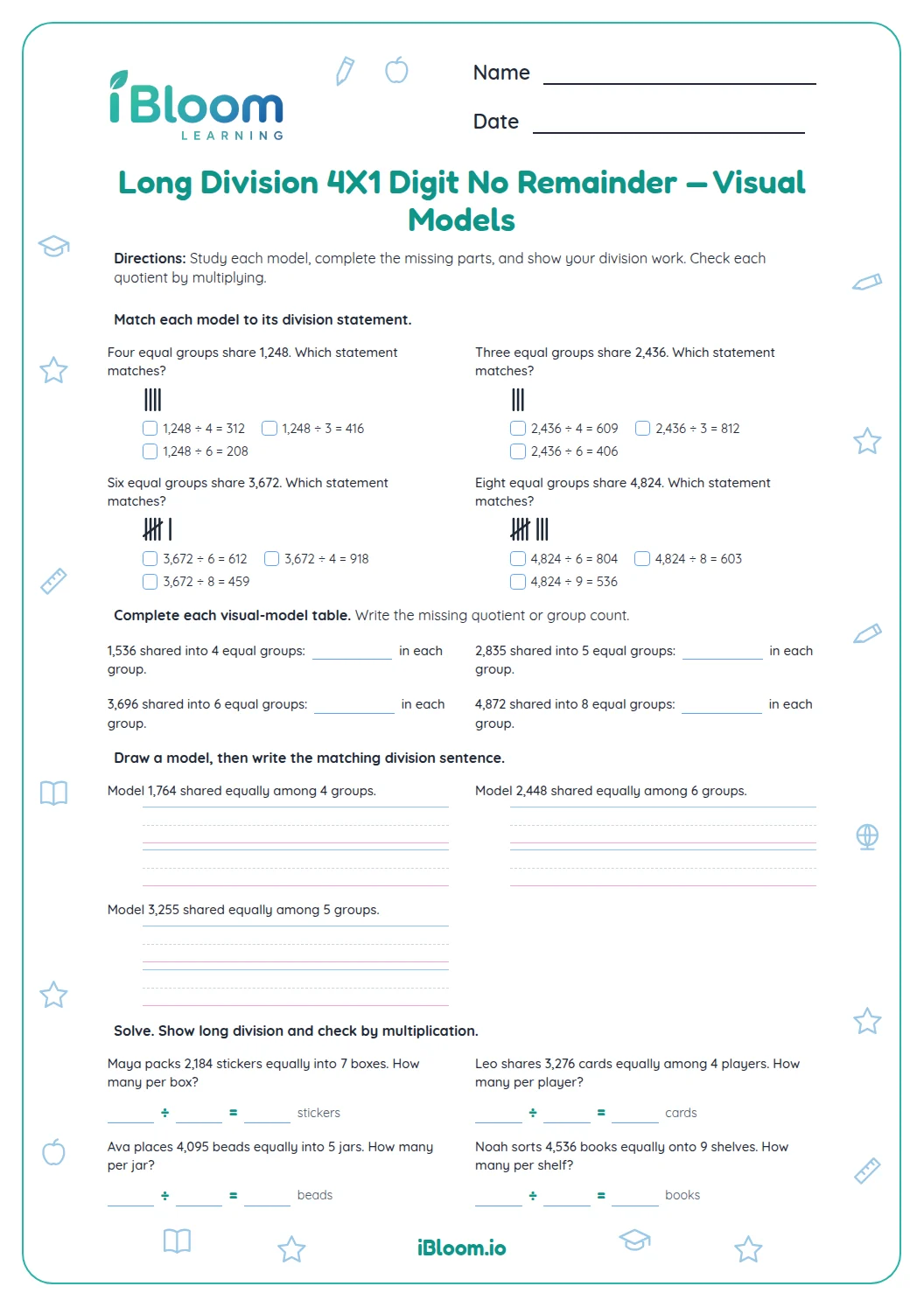
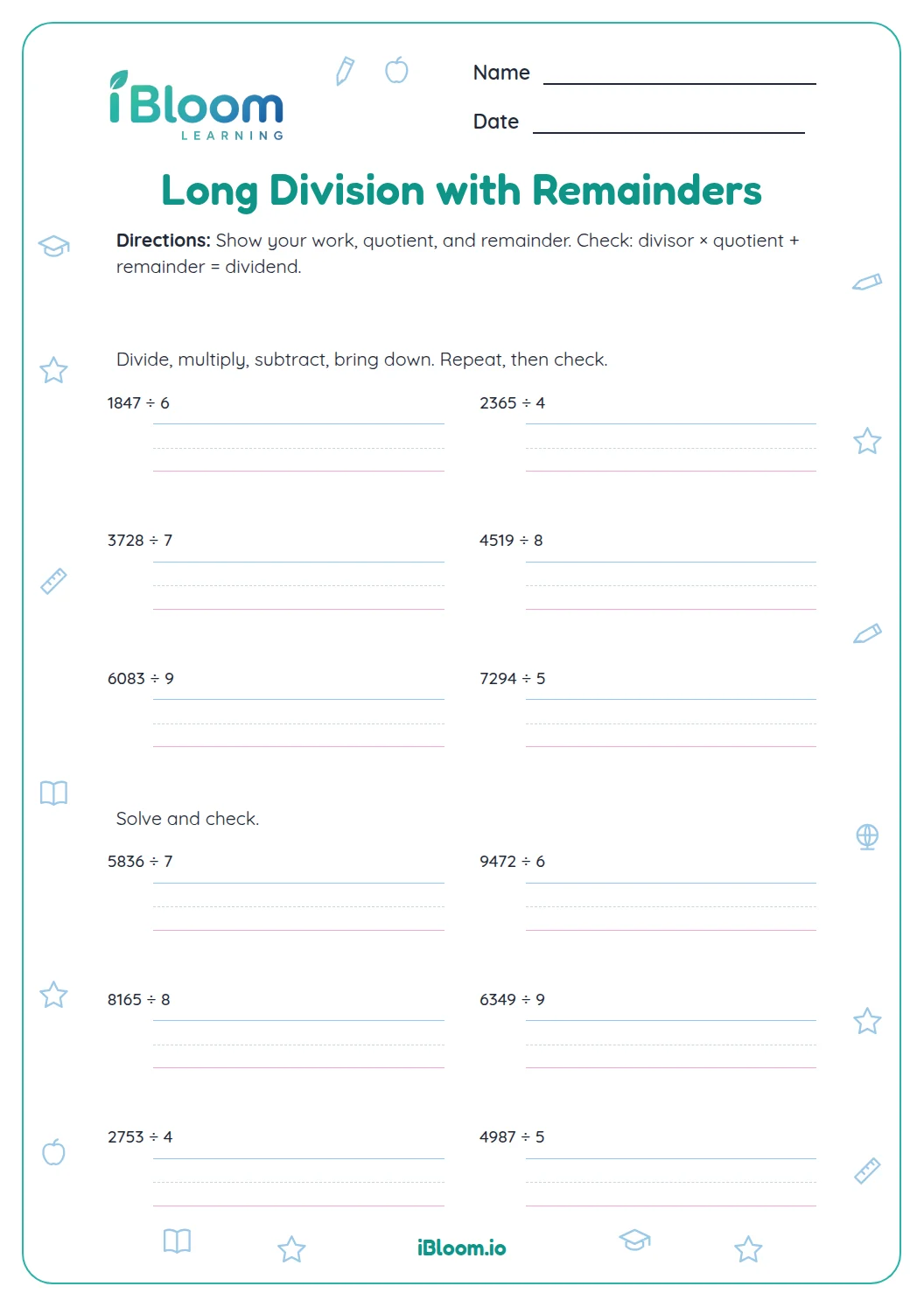
The worksheet has 16 questions in parts that focus on three-digit dividends divided by one digit with no remainder. Directions tell learners what to notice and how to record each answer. The separate key gives a quick way to check work.
- 16 questions across two practice pages
- A separate answer key
How can I model one question?
Read the whole question, identify the clue that matters for three-digit dividends divided by one digit with no remainder, and explain why the answer fits. Then ask the learner to use the same reasoning on the next item.
- 1864 ÷ 4 = 216. Check: 216 × 4 = 864.
- 2For 848 ÷ 8, divide the hundreds, tens, and ones in order; the quotient is 106.
What should I do if an answer is missed?
Return to the exact direction for that part. Ask the learner to point to the number, word, or feature that supports the answer, then try a similar item before checking the key again.
How can we use the answer key?
Check answers after a part is complete. For a missed response, compare the learner’s reasoning with the key and name the step that changes the result.
How to use this worksheet
- 1Read the directions for Part A before starting.
- 2Work through each part in order and show the steps requested.
- 3Pause after each part to check that every item has an answer.
- 4Use the separate key to check work and explain one correction aloud.
Common mistakes and quick fixes
The mistake
Rushing past a direction.
The fix
Read the part direction again before answering.
The mistake
Using a clue from only part of the item.
The fix
Read the whole prompt and check how the answer fits.
The mistake
Copying an answer without checking it.
The fix
Explain the step or clue that supports the answer.
This worksheet practices three-digit dividends divided by one digit with no remainder.
On this sheet: Learners apply three-digit dividends divided by one digit with no remainder in each part.
Show the official wordingHide the official wording
Find whole-number quotients and remainders with up to four-digit dividends and one-digit divisors, using strategies based on place value, the properties of operations, and/or the relationship between multiplication and division. Illustrate and explain the calculation by using equations, rectangular arrays, and/or area models.
What to practice next
Make more practice
Further reading
Questions parents and teachers ask
What does “no remainder” mean?
The dividend divides evenly by the divisor, so the quotient is a whole number and nothing is left over. Each problem on this sheet has that form; multiplication can confirm the quotient. Ask the learner to name the divisor and quotient while checking the multiplication.
How should learners check a quotient?
Multiply the quotient by the divisor. For 864 ÷ 4 = 216, calculate 216 × 4 and check that the product is 864. If the product differs, revisit the division steps. Ask the learner to name the divisor and quotient while checking the multiplication.
Why show long-division steps?
The written steps make place-value decisions visible, especially when a quotient digit is zero as in 848 ÷ 8 = 106. The worksheet leaves working space so learners can record the process. Ask the learner to name the divisor and quotient while checking the multiplication.
What is in the second part?
Part B contains eight more three-digit division problems. Learners solve each quotient and use multiplication to check; the divisor stays one digit throughout. Ask the learner to name the divisor and quotient while checking the multiplication. Ask the learner to name the divisor and quotient while checking the multiplication.
What does the answer key include?
The key lists the quotient for every problem. Learners can compare their result and use the multiplication check to find where a different quotient began. Ask the learner to name the divisor and quotient while checking the multiplication. Ask the learner to name the divisor and quotient while checking the multiplication.