




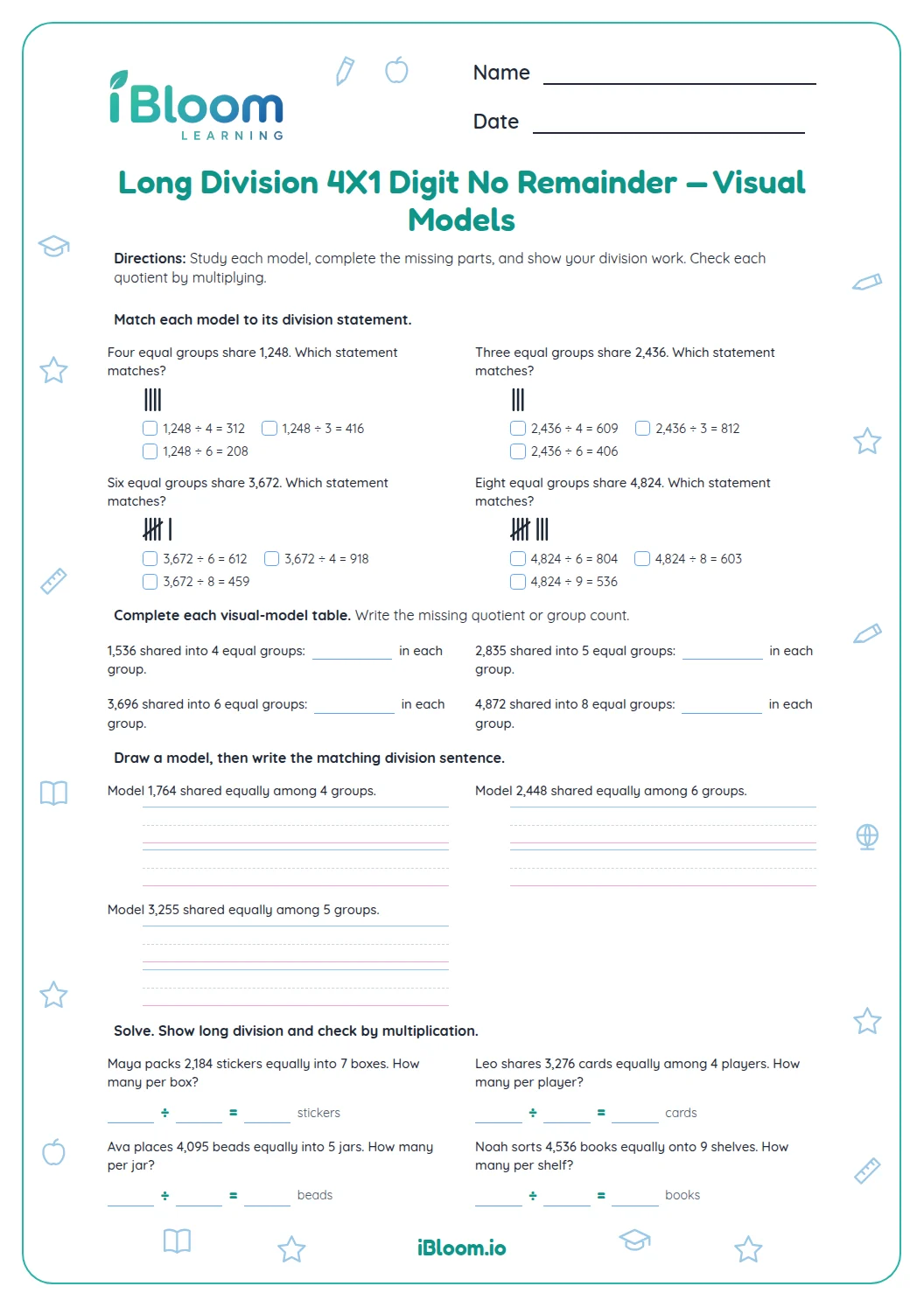
About this worksheet
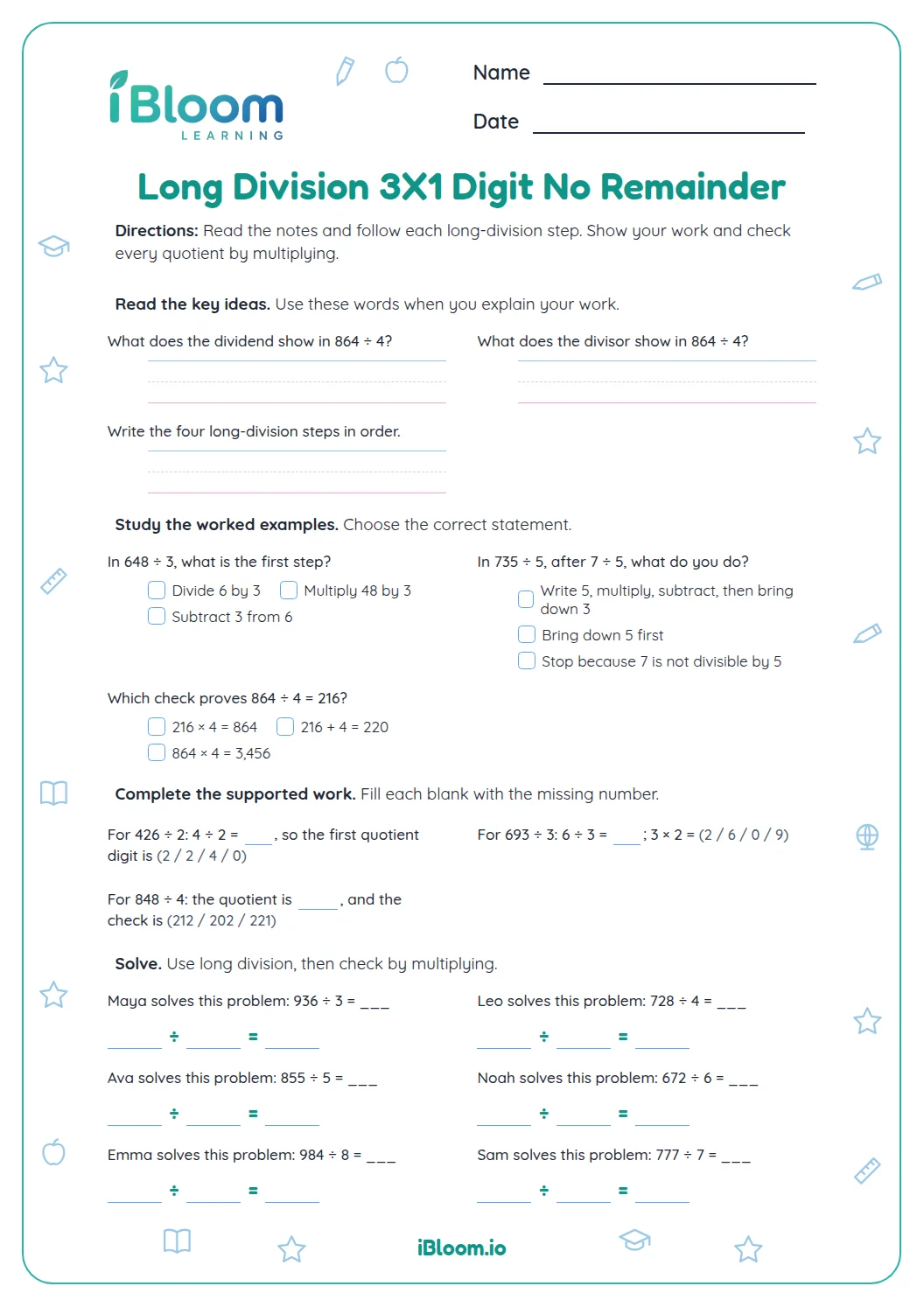
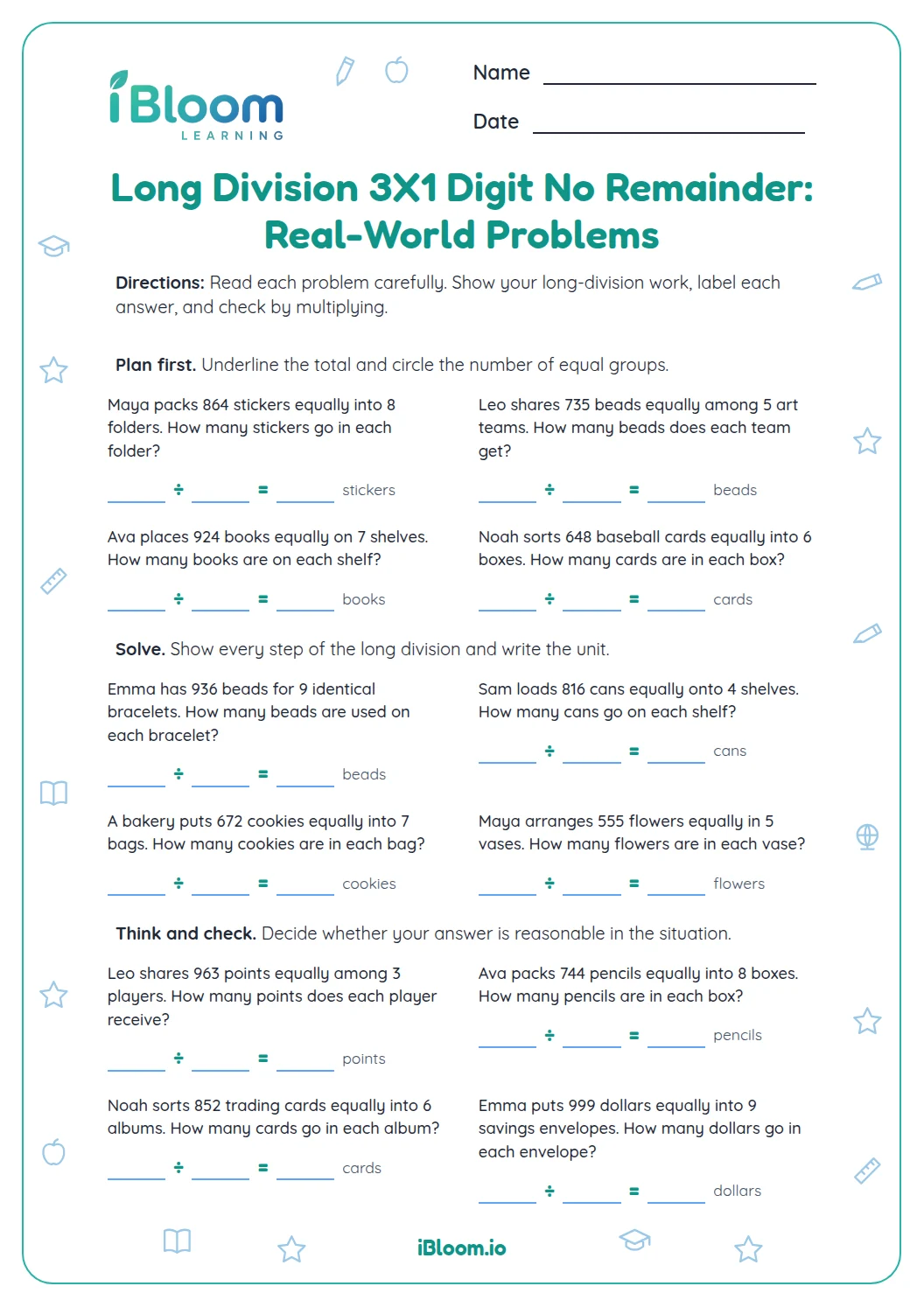
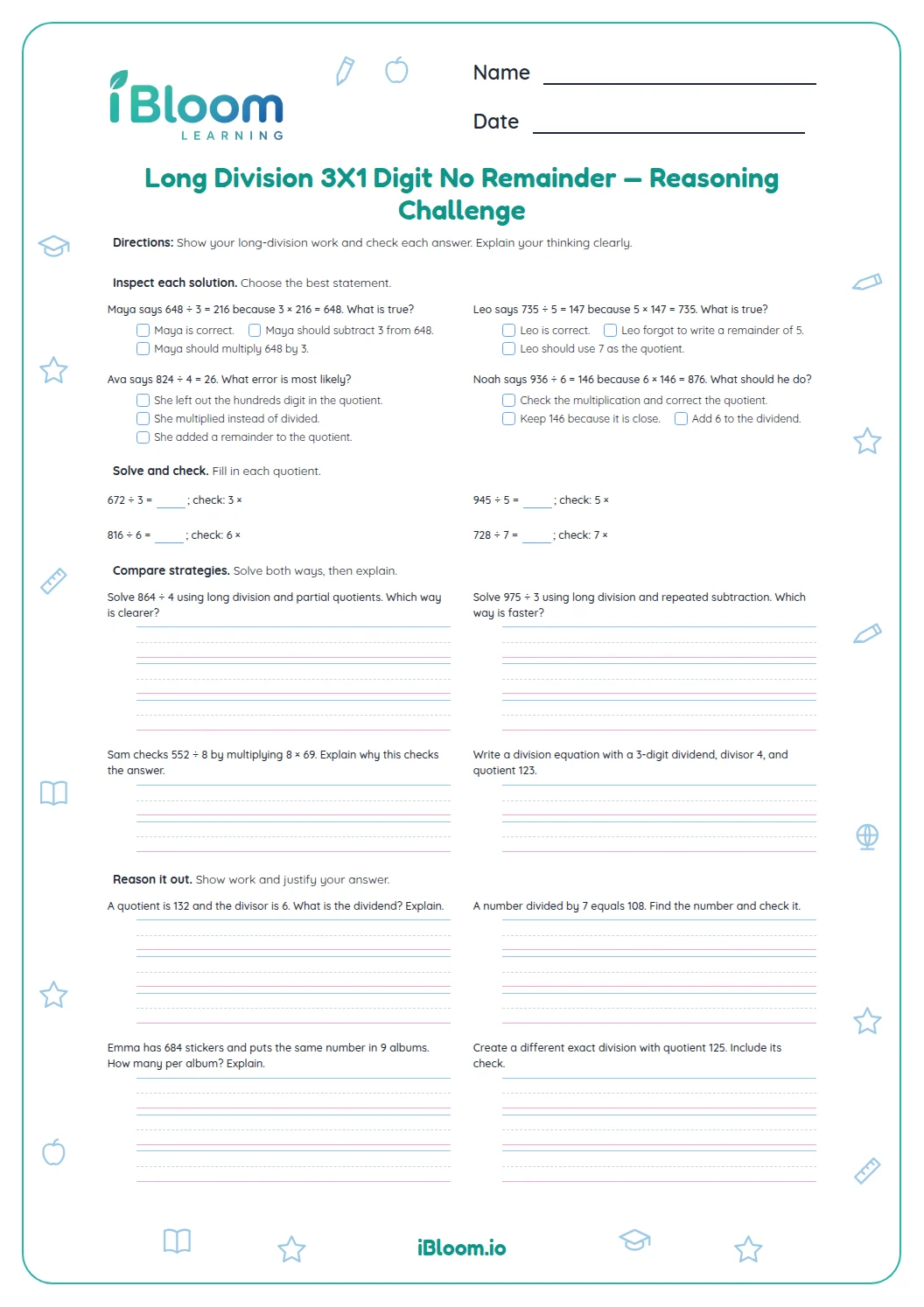
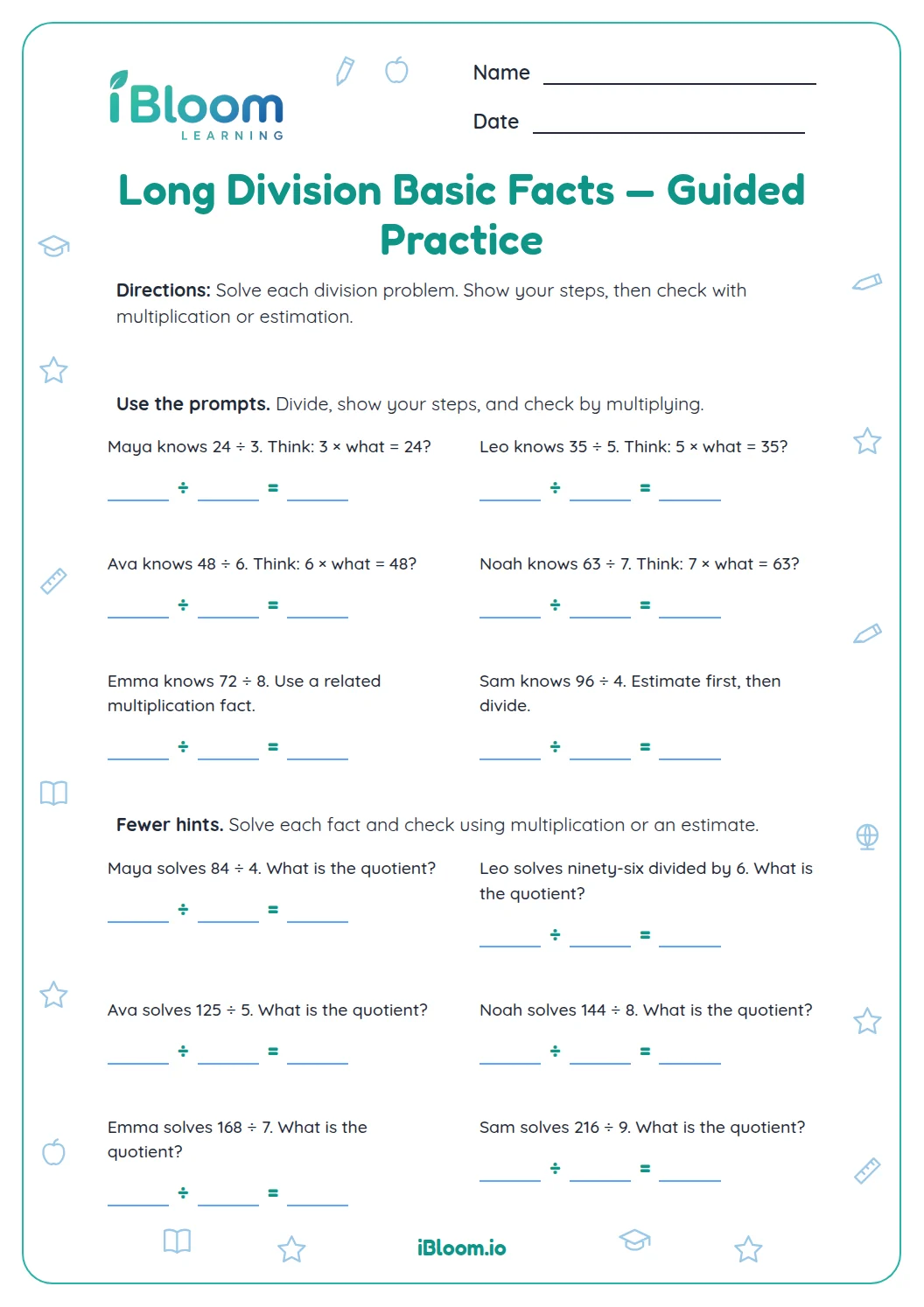
This free Grade 4 worksheet connects three-digit division to equal sharing with base-ten blocks. Students first divide hundreds, tens, and ones that share evenly, then use trading clues when a place cannot be shared as it stands. Six final problems ask them to use long division and check by multiplying. The 14 questions practice place-value strategies in Common Core 4.NBT.B.6. Every quotient is a whole number, and the separate answer key gives the result for each problem.
Aligned to 4.NBT.B.6
What do the base-ten blocks represent?
Each large flat represents 100, each rod represents 10, and each small cube represents 1. Part A shows the entire dividend; children decide how to share those blocks equally among the stated number of groups.
For 248 ÷ 2, each group receives 1 hundred, 2 tens, and 4 ones. Ask the child to say 124 aloud as a whole number after naming its parts.
Why do we trade before dividing?
Part B makes the regrouping step explicit. A hundred can become ten tens, and a ten can become ten ones, while the total stays the same. This is the model behind carrying an unshared amount into the next place.
- 1156 ÷ 3: 1 hundred and 5 tens become 15 tens.
- 215 tens ÷ 3 = 5 tens; 6 ones ÷ 3 = 2 ones.
- 35 tens + 2 ones = 52. Check: 52 × 3 = 156.
How does the model explain a zero in the quotient?
In 324 ÷ 3, each group gets 1 hundred, but 2 tens cannot give a whole ten to every group. Trade the 2 tens for 20 ones and combine them with the 4 ones. Each group receives 8 ones.
The quotient is 108: 1 hundred, 0 tens, and 8 ones. Writing 18 would lose the hundreds place. Part C lets children carry this attention to place value into their own long-division work.
How to use this worksheet
- 1Name the three block sizes before beginning Part A.
- 2Share the blocks in question 1 orally, starting with hundreds.
- 3Read each Part B trading clue and name the units being divided.
- 4Set up the six Part C problems as long division in the working spaces.
- 5Multiply each quotient by its divisor, then compare with the starting dividend.
Mistakes to discuss and fix
The mistake
Writing 18 for 324 ÷ 3.
The fix
Keep a zero in the tens place: each group has 1 hundred, 0 tens, and 8 ones.
The mistake
Treating the 15 in 15 tens as 15 ones.
The fix
Name the unit after every step; 15 tens divided by 3 is 5 tens, or 50.
The mistake
Dropping an unshared hundred.
The fix
Exchange it for ten tens and add those tens to the tens already present.
Common Core alignment
Divide three-digit numbers using place value, equal sharing, and equations.
On this sheet: Students connect base-ten sharing to three-digit division and check quotients by multiplication.
Show the official wordingHide the official wording
Find whole-number quotients and remainders with up to four-digit dividends and one-digit divisors, using strategies based on place value, the properties of operations, and/or the relationship between multiplication and division. Illustrate and explain the calculation by using equations, rectangular arrays, and/or area models.
What to practice next
Make more practice
Further reading
Questions parents and teachers ask
Does every problem divide evenly?
Yes, all 14 divisions have whole-number quotients with no remainder. Some require a trade between places, so an amount that cannot be shared at the hundreds or tens step is still used. Have children finish the ones step before deciding whether anything is left.
How should children use the blocks in Part A?
Children should treat the blocks as the total to be shared. For 248 divided into two equal groups, they can point to one hundred, two tens, and four ones for each group. Saying the place names helps connect the model with the written quotient of 124.
Why are there trading clues in Part B?
The clues make the regrouping step visible in words before children handle it alone. For 156 ÷ 3, the hundred becomes ten tens, making fifteen tens altogether. Children then divide tens and ones separately and combine those shares into a single quotient of 52.
Can my child use physical base-ten blocks too?
Yes, physical blocks can make the printed models easier to discuss. Build a Part A dividend, share it into equal groups, and record each group’s value. For Part B, exchange a hundred flat for ten rods or a rod for ten cubes before continuing the sharing.
How can we check the long-division answers?
Multiply the quotient by the divisor to recover the dividend. For example, question 9 gives 246 ÷ 2, so the quotient 123 can be checked with 123 × 2 = 246. If the product differs, revisit each place and check whether a trade or zero was missed.