




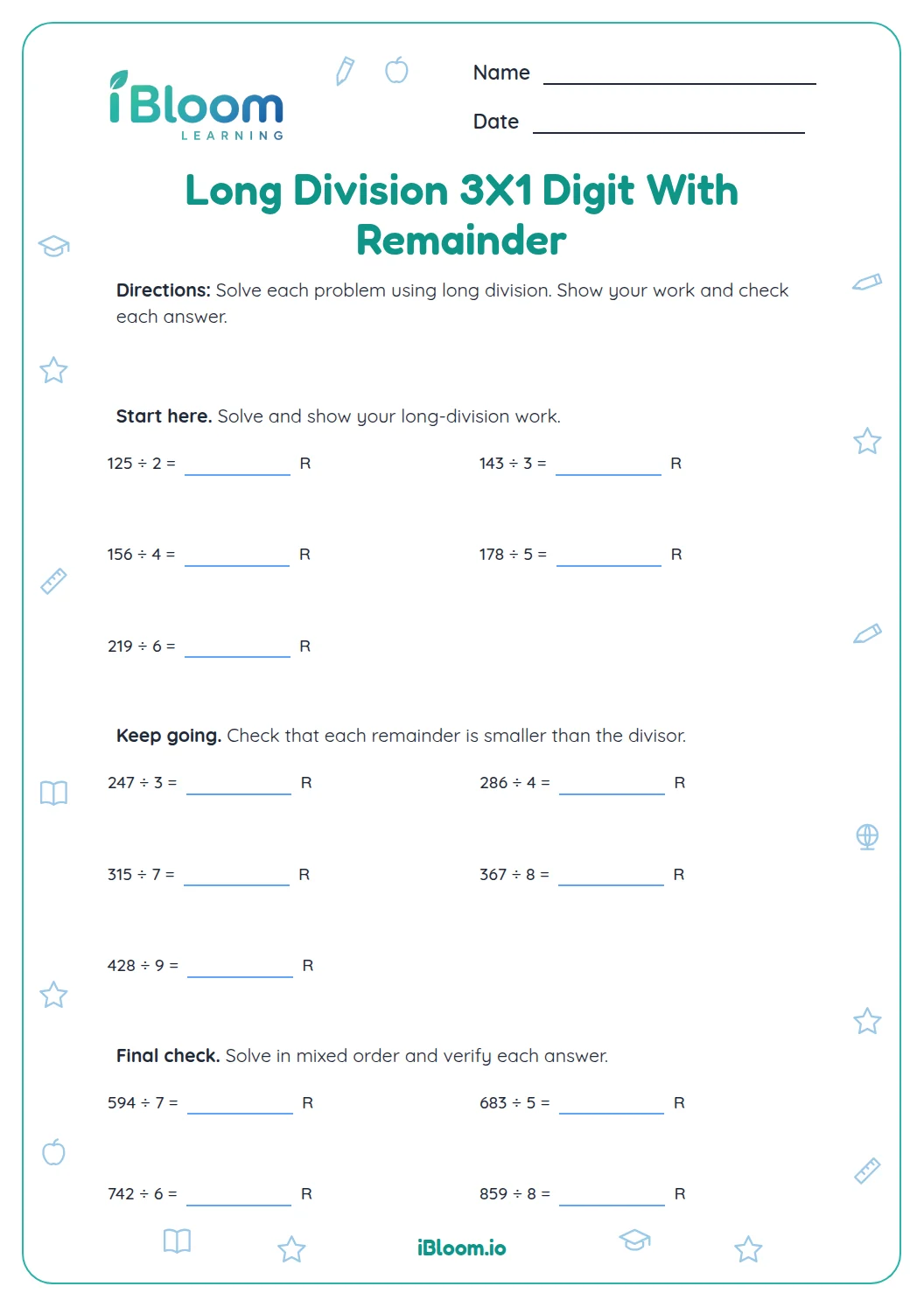
About this worksheet
Division answers how many are in each equal group. For 84 ÷ 4, split 84 into 80 and 4: 80 ÷ 4 is 20 and 4 ÷ 4 is 1, so the quotient is 21. The worksheet builds from quotients to equal-sharing situations.
Aligned to 4.NBT.B.6
What do the numbers in division mean?
The dividend is the amount being shared, the divisor tells how many equal groups to make, and the quotient tells how many are in each group.
What will students solve?
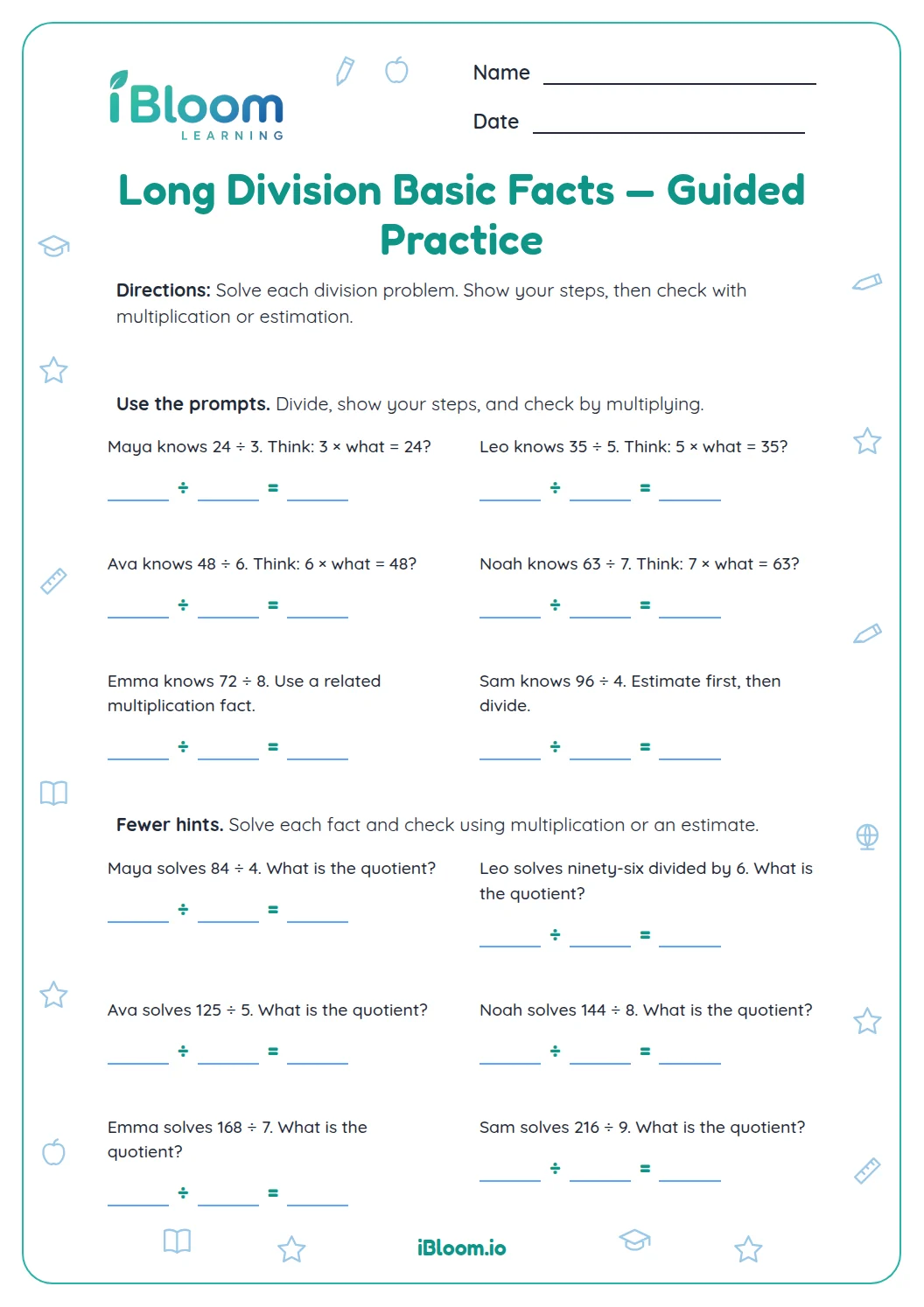
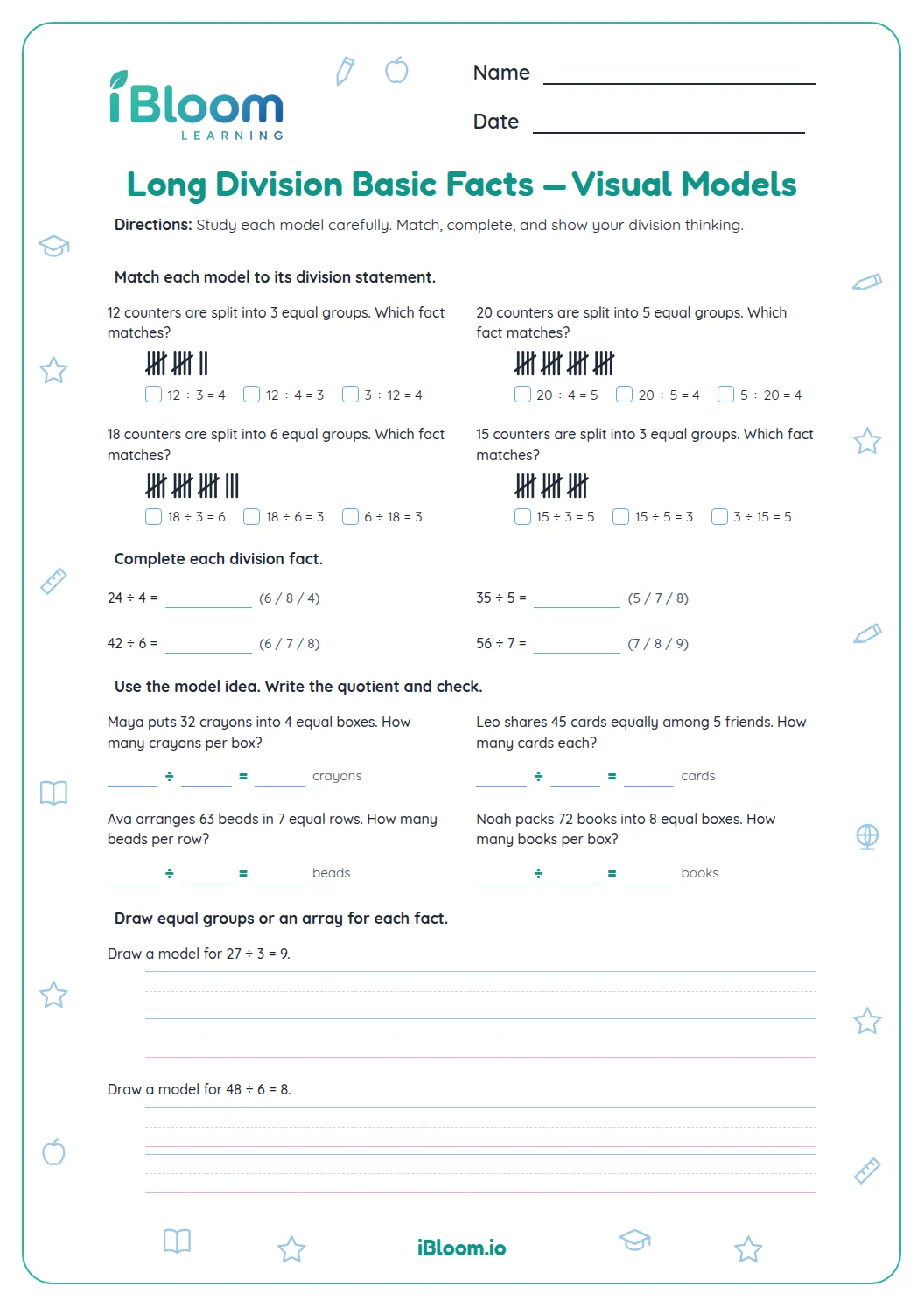
The first part gives 12 division questions with one-digit divisors and no remainders. Four equal-sharing situations apply the same skill.
- 184 ÷ 4
- 280 ÷ 4 = 20 and 4 ÷ 4 = 1
- 320 + 1 = 21
- 4Check: 21 × 4 = 84
How can multiplication check a quotient?
Multiply the quotient by the divisor. The product should equal the dividend, which confirms the groups account for the full amount.
How to use this worksheet
- 1Identify the dividend and the one-digit divisor.
- 2Find how many are in each equal group.
- 3Record the quotient.
- 4Multiply the quotient by the divisor to check the dividend.
Common mistakes and quick fixes
The mistake
Multiplying the quotient by the wrong number.
The fix
Use the divisor from the original division sentence.
The mistake
Stopping before all place-value parts are divided.
The fix
Check that every digit in the dividend has been used.
The mistake
Using the dividend as the number of groups.
The fix
The divisor is the number of groups; the quotient is the amount in each group.
Common Core alignment
This page targets the named skill at its stated grade level.
Find whole-number quotients with one-digit divisors using place value and multiplication relationships.
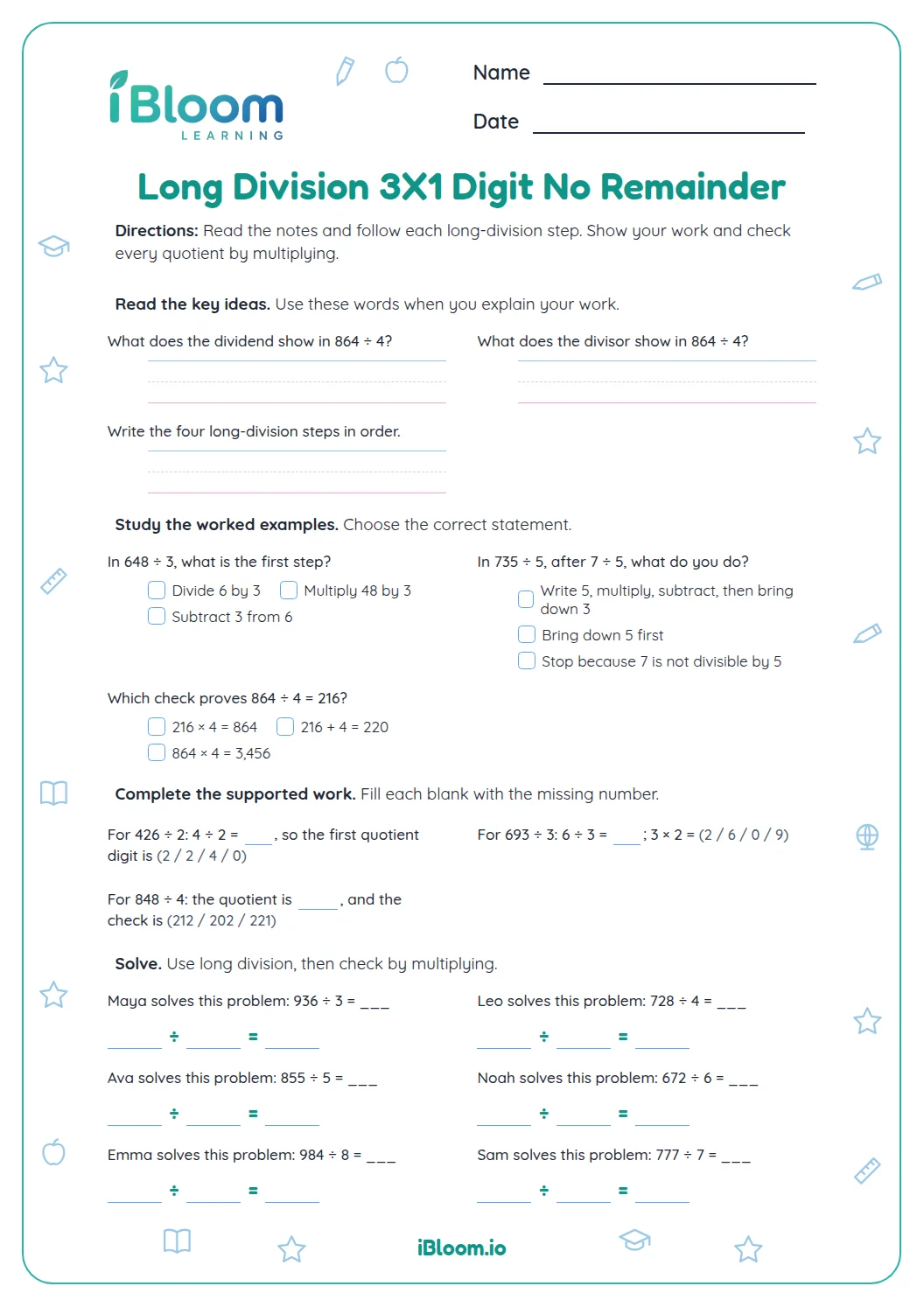
On this sheet: Every quotient is a whole number with no remainder; multiplication provides a check for the division.
Show the official wordingHide the official wording
Find whole-number quotients and remainders with up to four-digit dividends and one-digit divisors, using strategies based on place value, the properties of operations, and/or the relationship between multiplication and division. Illustrate and explain the calculation by using equations, rectangular arrays, and/or area models.
What to practice next
Make more practice
Further reading
Questions parents and teachers ask
How can multiplication check a division quotient?
Multiply the quotient by the divisor. The product should match the dividend. For example, 84 ÷ 4 = 21 can be checked with 21 × 4 = 84. The divisor and quotient together must rebuild the original dividend. This checks both numbers in the division sentence.
Does this worksheet include remainders?
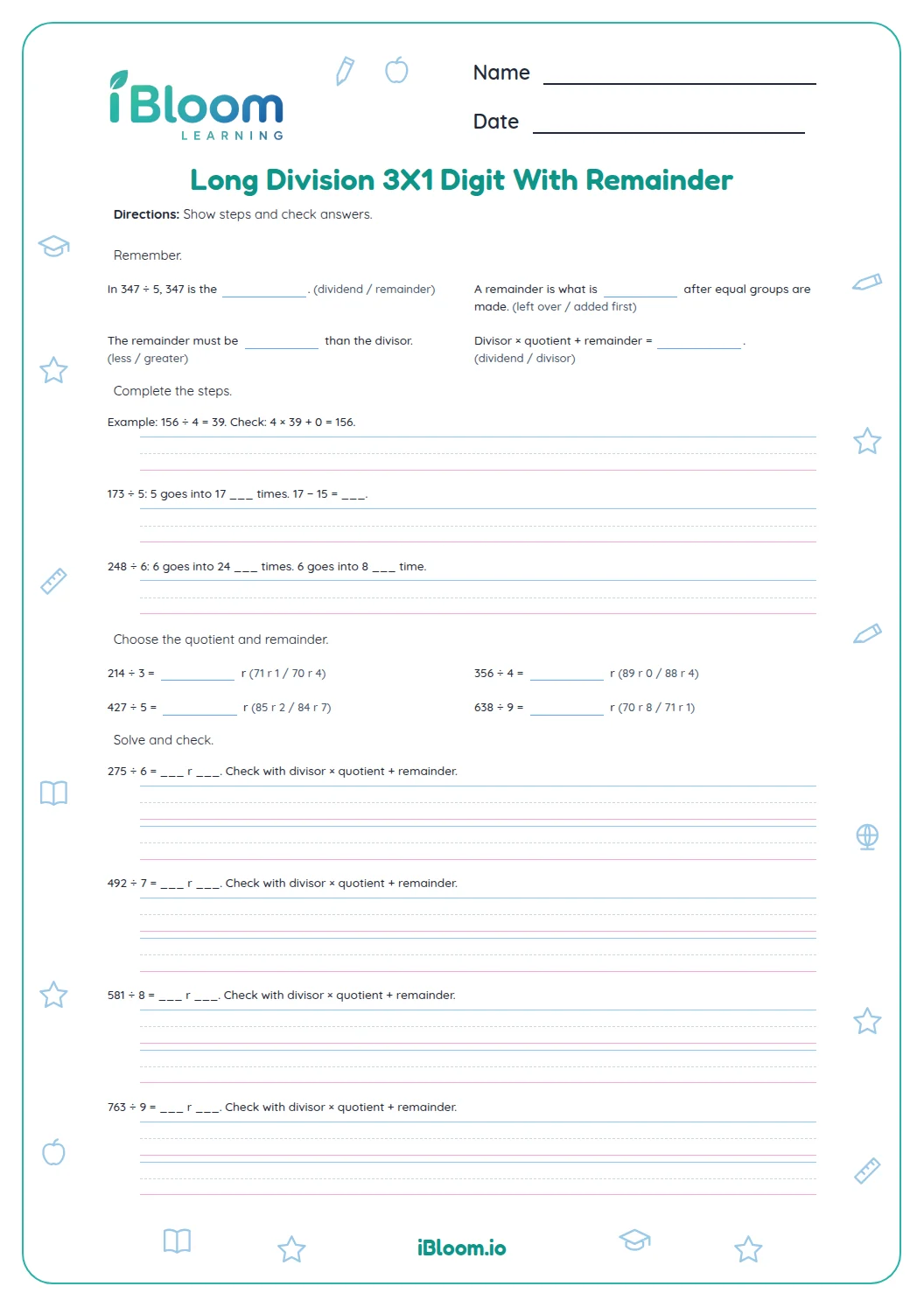
No. Each division problem divides evenly, so every quotient is a whole number and there is no amount left over after making the equal groups. No remainder means the items divide evenly among all groups. Every group gets the same whole number.
What does the divisor tell us in a sharing problem?
The divisor tells how many equal groups to make or how many people share the total. The quotient tells how many items go in each group. For example, 24 shared by six people gives four to each person. The divisor names the number of groups.
Can students use place value to divide?
Yes. They can split a dividend into place-value parts, divide each part, and combine the partial quotients. Long division is another way to organize those steps. Partial quotients show how place-value chunks combine into one quotient. Students can check by multiplication afterward.
How does the worksheet build from examples to contexts?
The first part gives direct division questions so students can focus on the quotient. The second part describes equal groups in short situations. Students use the same division relationship and can check each result with multiplication. This also shows how the two operations undo each other.