




About this worksheet
This Grade 4 worksheet gives students 14 real-world division problems with single-digit divisors and no remainders. Each context describes equal groups, such as packing snacks into bins or sharing crayons among classrooms. Learners write a quotient, include the unit, and can verify by multiplying the quotient by the number of groups. The answer key lists all quotients with units.
Aligned to 4.NBT.B.6
How do you work through single-digit division in equal-sharing stories?
The divisor tells how many groups there are. The quotient tells how many items are in each group.
Write one step at a time and check that the result answers the question asked. The answer key gives a way to check each item.
- 1864 crayons shared among 4 classrooms
- 2864 ÷ 4 = 216
- 3216 × 4 = 864, so each class gets 216 crayons.
What will the practice ask you to do?
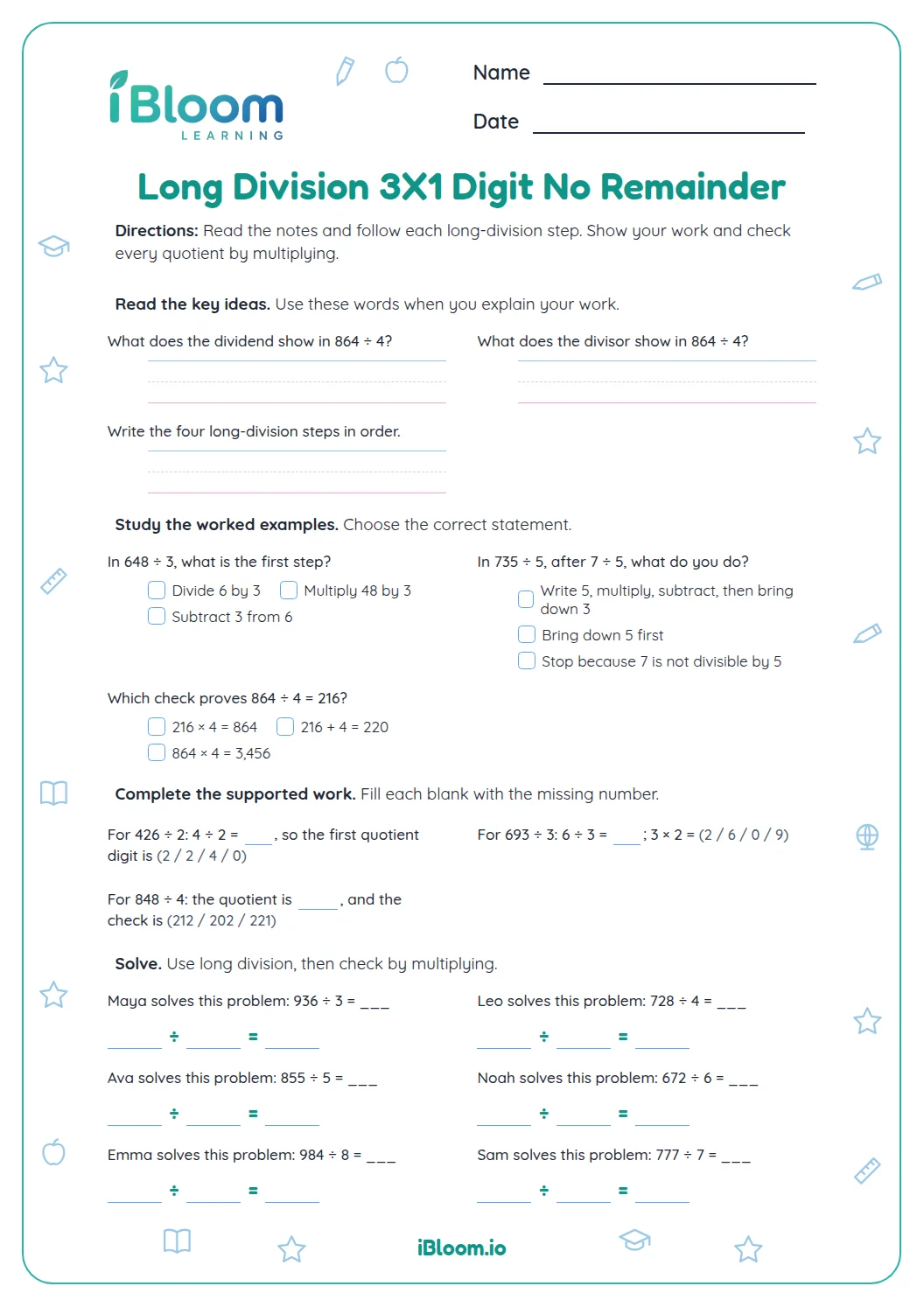
Part A has seven equal-sharing situations, followed by seven more in Part B. Each problem has a three-digit total and a one-digit number of groups; every division is exact.
Write the division sentence, show long-division steps, then attach the unit that names the items in one group.
How can you check an answer?
Multiply the quotient by the number of groups. For 864 crayons shared among 4 classrooms, 216 × 4 returns 864, so the quotient matches the original total.
How to use this worksheet
- 1Underline the total amount.
- 2Identify how many equal groups there are.
- 3Write dividend ÷ divisor.
- 4Use long division to find the quotient.
- 5Attach the correct unit.
- 6Multiply to check the total.
Common mistakes and quick fixes
The mistake
Using the number of groups as the answer.
The fix
The quotient is the amount in each group.
The mistake
Leaving out the unit in the story answer.
The fix
Name what is being shared, such as 216 crayons.
The mistake
Not checking a quotient.
The fix
Multiply quotient by divisor; the product should equal the total.
Common Core alignment
Each story is an equal-sharing division situation with a whole-number quotient.
Use long division and multiplication checks for equal sharing problems.
On this sheet: Use long division and multiplication checks for equal sharing problems.
Show the official wordingHide the official wording
Find whole-number quotients and remainders with up to four-digit dividends and one-digit divisors, using strategies based on place value, the properties of operations, and/or the relationship between multiplication and division. Illustrate and explain the calculation by using equations, rectangular arrays, and/or area models.
What to practice next
Make more practice
Further reading
Questions parents and teachers ask
How can you check a division answer?
Multiply the quotient by the divisor and compare the product with the original total. For 864 crayons shared among 4 classrooms, 216 × 4 = 864. That check confirms both the quotient and the equal sharing. The answer key lists the quotient and item name for each of the 14 stories.
What does the divisor represent in these stories?
The divisor is the number of equal groups. In the first problem, 4 classrooms share 864 crayons, so divide 864 by 4. The quotient, 216, tells how many crayons go to each classroom. Use the same interpretation for bins, stacks, rows, and the other groups on the page.
Why should an answer include a unit?
The unit tells what the quotient counts. “216” alone does not say what each classroom receives; “216 crayons” answers the story. The worksheet asks students to label each answer, and the key includes the same item name so a parent or teacher can check the context.
Do any problems have remainders?
No. Each of the 14 totals divides evenly by the one-digit group count, so the quotient is a whole number. Students can focus on the long-division steps and interpreting how many items belong in each group. A multiplication check returns the original total in every problem.
How many division stories are included?
The two-page worksheet has 14 equal-sharing stories in two parts. It uses three-digit totals and one-digit divisors, with settings such as classrooms, bins, rows, shelves, and trays. A separate answer key lists every whole-number quotient with its unit. Students can multiply each quotient to check it.